Should you measure Brand Equity or Customer Equity?


Malaysian and Asian firms can save themselves a lot of effort and resources by focussing on customer equity as they attempt to build brands.

It’s almost 20 years since the launch of the landmark book “Managing Brand Equity: Capitalizing on the Value of a Brand Name” by David Aaker. David Aaker name may not be as familiar as others in his industry, but he is credited with developing the concept of “brand equity”.

The release of “Managing Brand Equity: Capitalizing on the Value of a Brand Name” came at a time when companies were desperately seeking new ways to increase the value of their brands by assigning a value to them or, measuring the intangible assets of the company such as reputation or channel relationships, that were previously ignored by traditional accounting systems. This became known as Brand equity.

On the face of it, “Brand equity” appeared to quantify intuitive recognition about the value of brands that in turn helped to rationalize marketing expenditures. It was also shorthand for a brand’s two key strengths – its relationship with purchasers and mental image among both prospects and customers. And it provided a means to rank winners and losers in branding wars – MAS vs Singapore Airlines, Maxis vs Celcom, Coca-Cola vs. Sarsi and so on.

Brand equity is now considered one of a number of factors that increase the financial value of a brand and the term is used freely to say the least. Nevertheless, despite its popularity, the concept of “brand equity” has numerous shortcomings, especially in an age when customers not organizations, are determining the success or failure of brands. Indeed, the pursuit of brand equity can even warp executive decision making and lead to lost profits and opportunities.

One shortcoming is that although the term is widely used, no common definition of brand equity exists.

In fact, in his book Building, Measuring and Managing Brand Equity, published about seven years after David Aaker’s work, K.L. Keller lists NINE definitions of Brand equity, some of which actually contradict one another. This lack of a definition means that no universally agreed upon measure exists.

Delve deeper into any methodology concerning a “brand equity” calculation, and it quickly becomes apparent that the effort has all the intellectual rigour of a fence post – a dash of corporate history, a gaggle of retail outlet numbers, a touch of stature here and some strength there, a little bit of ‘brand esteem’ topped off with an extra helping of distribution sales, a sampling of questionnaires and so on.

This lack of a common methodology means that two experts examining the same brand come up with widely divergent calculations. Furthermore, it is impossible to compare brands across different countries, industries or perspectives.

This imprecision – at a time of global economic uncertainty when shareholders are demanding more accountability and C level executives insist on both sophisticated measurement and accountability – means “brand equity” lacks validity as a benchmark for executive decision-making. After all, how can executives make effective decisions when it’s impossible to understand – and agree upon – consistent numbers?

As if C level executives didn’t have enough to think about, this imprecision causes other problems as well. If “brand equity” increases by 10%, what caused it? Was it the latest advertising campaign? Or was it a new product launch? Perhaps it was more aggressive sales? Or maybe it was the discounts at critical times to reduce inventory? Better service? “Brand equity” does not provide any insights about cause-and-effect.

Second, “brand equity” does not indicate market or financial success. Look at some companies with great “brand equity” – Pelangi Air, Perwaja steel, Port Klang Free Zone (PKFZ), Kodak, K-Mart, MV Augusta, MAS, – that have either disappeared, faced or are facing financial difficulties. Indeed, “brand equity” as a guiding star leads companies to focus on product maximization at a time when leading companies recognize that a focus on customers is critical to success.

Finally, and most important of all, “brand equity” is irrelevant to customers. Customers buy on value, service, price, convenience or other reasons, but never make a purchase decision based on the relative “brand equity” of two offerings.

Ask yourself, did you ever walk into Cold Storage, Armani or Isetan and buy something based on its brand equity? No, of course you didn’t. Hold that thought, why should you pay attention to an issue that customers ignore? Because everyone else is? Because you were told to in marketing classes that were probably developed in an era before Facebook, twitter, ecommerce and more?

So what should you focus on? The answer is “Customer equity”.

Customer equity has one universally recognized definition – the lifetime value of customers. This value results from the current and future customer profitability as well as such intangible benefits as testimonials and word-of-mouth sales.

Customer equity incorporates customer loyalty to buy again and again, the faith to recommend a brand and the willingness to forgive the inevitable mistakes that every firm makes.

While “brand equity” is impossible to calculate consistently, customer equity can be easily calculated on the back of an envelope. All that’s required are numbers that every company already is – or should be – calculating. These include revenue, customer acquisition (or marketing) costs, costs of goods/services and retention rates.

Ideally, depending on the industry, companies should also track leads and referrals, and be able to determine the profitability of specific products or services. By adding up revenue (or profits), subtracting relevant costs and incorporating retention rates, companies can determine the current – and future – profitability of every customer.

And because customer equity is easy to calculate, it will be understood by everyone from the boardroom to the warehouse, making it much easier to unify personnel behind the brand.

“Brand equity” is all about a product or an organization. But in the customer economy, brands that attempt to push products onto customers that don’t want them will fail. Even if you spend millions creating awareness of your products. Today, building a successful brand requires customers that are profitable.

Customer equity supports and measures the activities that encourage customers to buy more, more often. Increasing “brand equity” does little for a firm and decades of good will can be wiped out overnight (think BP), but increased customer equity reflects increased retention and word-of-mouth sales, key elements of a profitable brand.

Customer equity has other advantages as well. Because retention and customer profitability are tracked, it’s easy to make a direct link between marketing, service and other programs to increases (or declines) in customer equity.

Customer equity also enables the segmentation of very profitable, not so profitable and unprofitable customers. Knowing the relative profitability of customers not only helps promote retention of the best customers but also substantially improves the investment required and effectiveness of marketing as well as reducing marketing costs.

In today’s customer economy, “Brand equity” provides few if any tools for those responsible for attracting and keeping satisfied customers. In The Loyalty Effect, the author Frederick Reichheld wrote, “Customer equity effectively explains success and failure in business…. The companies with the highest retention rates also earn the best profits. Relative retention explains profits better than market share, scale, cost position or any other variables associated with competitive advantage.”

Do brands have value? Absolutely, and David Aaker has left an impressive legacy. But attempting to measure this value provides little benefit and distracts a company away from the critical task of retaining profitable customers.

Because ultimately, it’s these customers – not a fallible calculation of a dated concept – who are responsible for brand value and long-term corporate success.


How to build a brand in Asia today


Building brands has evolved from the one dimensional, top down era where the company controlled the relationship and essentially managed that relationship using broadcasts across mass media such as TV, Out of Home, print and radio with messages and content created to tell you what the company wanted you to know into the bottom up, customer economy.

In the bottom up customer economy, brands and their success or failure are defined and determined by customers. Those customers will create content and messages and disseminate that content and those messages across multiple platforms and to communities who are interested in their opinions. Now, how you interact with consumers is on their terms.

This is not revolution, simply evolution in the branding space. Brands are to blame for this loss of control because they have consistently misled consumers or over promised and under delivered. Brands can no longer be built using one-size-fits-all messages broadcast across traditional media channels to anyone who will listen. Basically because no one is listening.

Sure, there is still a place for messages, campaigns, and so on but because there are so many sources of information, so much clutter, these messages don’t have the impact or influence they had 20 or 30 years ago. In the digital age you can spend as much as you want on traditional media and reach everyone in the country but if they are not listening they won’t buy your product or service.

If a brand wants to be successful it must learn to communicate with multiple segments, and messages must be targeted and must be dynamic, using content and channels that resonate with those segments. But brands must move away from the traditional demographic approach to researching those segments. After all, how many 15 – 24 communities are there on Facebook? And content must constantly be revised and updated with new content.

And organizations must ensure that they deliver on promises and that promise must deliver economic, experiential and emotional value to each of those multiple segments. In the consumer business, this is most often done, initially anyway, in the store. Because in the customer economy, no matter how much you spend, if your staff don’t know how to build rapport with your prospects then they may buy once but rarely will they become a loyal customer. And without loyal customers, you won’t have a brand.

So if you are looking to build a brand, forget about reach, awareness, positioning and brand equity and trying to be all things to all people and start thinking about delivering value to specific segments and building customer equity.

A solid brand is built from the inside out


The chances are that you have discussed branding, what it is and whether it is important. You’ve probably agreed to ‘look into it’ and assigned someone from marketing to research brand consultants.

Marketing will probably google something like ‘brand consultants’ or ‘how to build a brand’ or ask friends or associates if they can recommend anyone. If your marketing department is staffed with ex advertising agency personnel, they may get on the phone to ex colleagues.

Unfortunately, advertising agencies is where many companies start the development of their brand. Senior management and the marketing department together with an advertising agency and often without any input from other departments such as sales, will spend a considerable amount of time developing the “marketing mix.”

A tagline will be created, colours discussed and so on. This is important but not at this stage. A good brand is built from the inside out. Before the creativity starts, carry out a brief internal brand audit. Ask yourself questions such as, “Do our employees know what we do?” “Do our employees believe in the product/service that we offer?” “Do they understand the role they have to play in the brand mission?” “Do they understand the importance of our customers?” “Do our staff ‘live the brand’?”

Here are 10 other initiatives that will help you lay the foundations for a brand.

Step 1: Review your organizational structure
Customers control relationships with businesses like never before. Manufacturing costs have fallen to record lows. Transactions are cheaper and faster than ever. The Internet has revolutionized the way we communicate and do business. Yet despite these cataclysmic changes, companies continue to integrate in the same old traditional ways.

Employees report to superiors and information is channeled up and down hierarchical chains not across departments, hampering coordination and improvement. To succeed in the future, brands must understand that the customer is king, focus on processes not functions and develop a retention based not acquisition based culture.

Step 2: Recruit talent not bodies
Too many companies leave recruitment to the last minute or try to save money by increasing the work load of already overburdened staff. Look to recruit people that will enhance your organization based on your long term vision.

Step 3: Build a credible corporate vision
In collaboration with staff, create a vision that benefits employees, shareholders and customers. And make it realistic! Brand values must be based on providing value to customers. The reasons for and the role of the organization and individual staff in providing this value and the benefits to the organization and staff must be crystal clear to all.

Step 4: Train new and existing staff immediately, consistently and regularly
The only thing that all brands have in common is that customer loyalty is a result of employee loyalty. The foundations for any internal branding initiative must therefore start with personnel understanding the importance of the role they have to play in the evolution of the brand. In addition to improving skills, training also gives staff the confidence and attitude the organizations requires.

Step 5: View staff as an investment not an expense
Too many companies see staff as an expense and as a result do not invest in them because they are frightened the staff will leave. If you create an environment that is rewarding and encourages personal growth and has clearly defined career paths, your staff will not leave.

Step 6: Give personnel room to grow
Everyone makes mistakes but few people make them deliberately. Once you’ve invested in the right people and trained them, show them you believe in them by supporting them and trusting them to get things done, even if they make mistakes along the way. And if they make mistakes, give them the responsibility to correct the mistake.

Step 7: Encourage freedom of expression at meetings
If you only want to hear people support what you say or agree with what you have done what is the point of them attending meetings? To build a great brand, individuals will contribute and good managers will need to be open and aware of those individuals and give them the freedom to benefit the brand by challenging senior management.

Step 8: Understand that in general the sales department is the frontline of your company
No matter how much you spend on advertising, the first touch point most prospects will have with your brand will be via the sales force. It may be in a shop, a showroom, at an exhibition and so on. If that first meeting with your sales force is unsatisfactory, the prospect will not return. Train your sales force to represent your brand and reward them for doing so.

Step 9: Think long term
Whilst it is possible to build a brand more quickly than perhaps twenty years ago, building a profitable brand takes time and commitment. Take a long term approach to your business rather than a short term deal making mentality.

Step 10: Measure all activities
Wherever possible, measure. But before you do, ensure measurement definitions are standardized to ensure consistency and communicate them corporate wide. And when you measure, share the results across the organization and seek feedback and recommendations for improvement from staff. And then help them implement those recommendations and measure them.

Building brands requires CEOs to understand branding


95% of products fail to become brands, despite over US$1.5 trillion spent on marketing of which about US$500 billion is spent on advertising. And most of that is spent on awareness, reach and other mass market mass economy mass media tactics.

Advertising is important and always will be important to brand building but ‘getting your name out there’ or ‘creating awareness’ are too mass economy and we’re now in the customer economy.

In the customer economy, it is about engaging members of communities that have interests related to your product and entering into a communication initially and a collaboration eventually with certain members of those communities. Throw out the old mass economy mass market attitude that includes carpet bombing consumers with messages via full page ads, TVCs, billboards and one-size-fits-all communications.

But who is to blame? Is it the advertising agencies? Or is it the CEOs? I believe that until CEOs get over their own egos and realise that just because they can see their company name on a 40 foot by 10 foot billboard, or on page 3 of the national newspaper etc etc, doesn’t mean that the rest of us can see through the clutter and even if we do, most of us don’t take any notice because we don’t care.

Until CEOs instead seek accountability and ROI from their advertising, they will, in all likelihood be at the front of the long queue to be one of those products that fail to become brands.

And if advertising agencies continue to make hay, who can blame them?

How to brand a city like Ipoh


Senior Executive Councillor Datuk Hamidah Osman of The Perak state government in Malaysia announced on a trade and investment mission to China recently that the state government, in an effort to boost its tourism industry, intends to brand Ipoh, the capital of Perak as the “City of White Coffee”.

Datuk Hamidah was quoted by Bernama “ Perak should have its own identity and branding just like Shenzhen that is known as the “Shoe City” and Paris which has long been known as the “City of Fashion”.

In conjunction with the plan, Datuk Hamidah said, “We plan to have a food fair to be held in Ipoh this December. The idea is to promote the local foods and tourism industry. We have the best bean sprout chicken rice and chee cheong fun (rice rolls),” she added.

Faced with increased domestic and international competition for both tourists and FDI, there is no doubt that Ipoh and Perak, need to develop a destination brand. But that brand must be based on a platform of multiple tourist attractions and business potential.

Set amongst picturesque limestone scenery, a diverse selection of tourist attractions include Kellie’s Castle, Perak Museum, Ipoh railway station, Tambun hot springs, Taiping lake gardens and Zoo, and more, Ipoh and the rest of the state have a lot to offer.

Other destinations include Pangkor and Pangkor Laut, Bukit Larut and others. Perak also has a rich heritage that can be promoted, including silver and tin mining. It is historically known as an innovator, having pioneered such advances as the first rubber trees in Malaysia and was also the first state in Malaysia to go wireless.

The tagline ‘City of white coffee’ certainly differentiates Ipoh from other destinations but what else does it tell potential visitors, businesses or investors? How can stories be developed around the tagline, who are the target market? How will it be communicated? If it is a one-size-fits all approach, it’ll need significant resources to communicate the new tagline. Have budgets been agreed and so on?

Today, Destination branding is not based on a tagline. Destination branding must be based on experiences that are successfully delivered to specific segments and not based on attempts to market all places to all people.

Research and data are critical to understand tourist and other stakeholder requirements before developing strategies and not the other way around.

Stakeholder buy-in is critical for brand consistency and fulfillment of the brand promise. As an example, how can a hotel contribute to the proposed approach? How can the same hotel leverage the approach to grow it’s business?

Branding is a long term coordinated and integrated strategic exercise and not a tagline. One-size-fits-all strategies using mass media are no longer effective.

Planning is essential to coordinate initiatives, ensure accountability and avoid wasting resources. Without a plan, activities will be reactive and tactical.

What Ipoh and other cities need is a consistent and organized methodology to brand themselves as domestic and international destinations.

Here is one approach that would definitely help Ipoh:

Stage one: Carry out extensive research
Research develops data on key success factors, generates insights and what current and prospective visitors seek, and provides benchmarks to measure branding ROI. The research should consist of the following activities

1) Destination analysis: Key members of the hotel industry, government bodies, local business associations and representatives of major attractions should be confidentially interviewed. The interview will be based on an agenda designed to explore a number of issues related to the city

2) Visitor audit: Carry out interviews with current and past visitors. Other groups can also be selected, such as conference organisers. The interviews will focus on the experiences and motivations associated with Ipoh, information resources, and suggestions for increasing tourist value.

Special attention will be paid to how they researched Ipoh, what they have heard or told others about Ipoh and the channels or vehicles used to tell them. Additionally, representative travel agents in Ipoh will be interviewed about tourist experiences and requirements. Online surveys will be useful to research baseline perceptions of brand Ipoh.

3) Place audit: A place audit will identify Ipoh’s economic/ demographic characteristics, review major attractions (including strengths and weaknesses of the attractions) and outline all brand assets. The place audit will also look to identify product potential.

4) Communications audit: A comprehensive analysis of the channels, vehicles and materials, both digital and print, current and proposed that are or will be used to communicate with both consumers and businesses.

Stage 2: Ensure community buy-in and set internal branding requirements
Community and other stakeholder buy-in is important both for delivery of the brand promise, development and ongoing funding. Stakeholders must be communicated with and input from stakeholders must be incorporated so that they understand that they play an important role in initial and ongoing brand development.

Such buy-in can be accomplished through a variety of activities, including “townhall” or other community meetings, private presentations and media briefings. Initial research findings and recommendations can be discussed as a basis for soliciting input.

Additionally, community buy-in requires a group of citizens, business people, and local and regional government officials. This planning group will:

• Define and diagnose the community’s condition, major issues and potential solutions

• Develop a long-term brand vision based on a realistic assessment of the community’s values, resources and opportunities

• Work to develop a long-term plan of action involving intermediate stages of investment and transformation

Stage 3: Brand plan development
The results of the research and community buy-in will be incorporated into a comprehensive plan for Brand Ipoh. This customized brand plan serves as a strategic framework for all marketing activities, messages, metrics, timetables and proposed budgets. Special attention should be paid to digital branding and product development to get previous visitors to return again.

Stage 4: Comprehensive and segment-specific execution & measurement
Unfortunately this is where most destination begin their brand strategy. Once the brand plan is in place, execution begins. The execution operates on two overlapping fronts – general and segment-specific:

General: General branding represents the ongoing efforts to ensure visibility and provide value to prospects, agents and visitors, as well as gather data, ensure continuous performance and maintain reporting.

Segment-specific: Segment-specific branding concentrates on two areas where it is important to establish and maintain strong relationships. These include existing customers/visitors, and target-rich segments such as families, agents, previous visitors, etc. The actual segments to be targeted will have been defined in the brand plan.

I appreciate that many cities will view this as a daunting and potentially expensive task. But it will not be as expensive as numerous one size fits all communications based on a tagline that tries to speak to all but really speaks to none.

There is no place for the 4 Ps in a brand strategy


The four Ps is a mass economy concept based on the ‘sell what we make’ company driven approach. It has no place in the customer economy of today where customers, not companies define brands. The 4 Ps emerged in the 1930s, a time when your doctor would enjoy a cigarette after examining you. A time when there really was lead in the pencil you stuck in your mouth all day at school. A time one, maybe 2 national TV stations. A time before leisure time, mass travel, cable or satellite TV, multiscreen cinemas, the Internet, Facebook and twitter. The 4 Ps were often used in conjunction with another popular formula, AIDA. AIDA was developed even earlier than the 4 Ps, in the 19th century, by door to door salesmen in the USA.

In the customer economy of today, firms have to sense, define, realise and sustain value for consumers based on those consumer requirements for value. They can only do that by identifying the right consumers, talking with and listening to those consumers and matching product attributes to those consumers requirements for value. And once the long and expensive process of gaining a customer is over, firms have to then continue the relationship to ensure they retain those customers. They have to accept that not everyone is a prospect and shareholders must pressurise them to deliver measureable results in marketing.

The good news is, those consumers no longer inhabit the mass economy world of TV, print media, billboards and so on. Today, those consumers inhabit communities of like minded individuals who can and do influence each others decision making process. And because of the effectiveness of new technology and the nature of those communities and where they are, it is possible to identify the right consumers, engage them, build relationships with them and measure marketing effectiveness.

A key element of successful brand building today is a massive move away from the aquisition focussed approach of the 4 Ps and positioning products (you can read my obituary to positioning here) and an increase in retention strategies that look to sell more and more often to existing customers, acquired at such great expense.

You have a 15% chance of selling to a new customer and a 50% chance of selling more to an existing customer. Bain and Co reckons a 5% increase in retention equates to a 25% increase in profitability. But are you still using the 4 Ps to acquire new customers? Are you still sighing with relief every time a new customer walks in and then letting them go without even finding out who they are? And even if you get their card, how much data do you collect and record and how much of your marketing budget is used to market to these existing customers? I doubt very much.

If you want to build a brand, forget about the 4 Ps and start looking at your existing customers.

Social Media is not a branding silver bullet


A brand is built not on acquisition but on retention.

And retention requires a relationship. And a relationship is based primarily on ‘Trust and an ongoing, sustained engagement, on customer terms that provides economic, experiential and emotional value to the customer’.

That’s what branding is all about. It’s not a communications exercise. It won’t happen as a result of an advertising campaign. And it won’t be carried out on the pages of Facebook. That’s right, social media is not a silver bullet.

Social networks give us the tools to engage with consumers and build relationships with them. But like any tool we need to use it properly to get the most out of it. We still need marketing with links to articles, while papers, blogs and so on that appeal to target markets.

Unfortunately the majority of brands are continuing to use new tools such as social media, that allow them to lay the foundations for a relationship with consumers, in the same way as they use mass market tools that trumpet a one-size-fits-all approach to marketing.

I recently tweeted about a cool bit of kit from sonos, makers of wireless digital audio systems. I asked if there was a Sonos dealer in Malaysia. Sonos tweeted me and told me to contact someone in Singapore and obviously allerted them as I got a tweet from the Singapore guy with an email of the distributor in Malaysia. I emailed the distributor and didn’t get a reply. Sonos hasn’t contacted me to see if I purchased and nor has the Singapore distributor followed up.

There is no silver bullet with social media. It won’t solve all our branding problems but, used correctly, it will help us build relationships with customers. From there you might, just might build a brand

Creative campaign not the solution to smoking issues in Singapore


As with many issues, Singapore has a zero tolerance approach to smoking and in particular, teen smoking. Get caught selling cigarettes to minors and you face a fine of over US$6,000.

Anyone under the age of 18 caught carrying cigarettes, carrying not smoking, and it is an automatic fine of US$30. Get caught again and the fine is US$60. If you don’t pay the fine, your parents spend a night in jail.

Smoking is banned in all public places such as hotels, supermarkets, restaurants, bars, shopping malls, museums, theatres, airports and other public transport places, libraries, indoor and outdoor sports arenas and government and private offices.

If a person serving in the military is caught smoking whilst in uniform he or she is disciplined and fined. Like other countries, cigarette packets carry gruesome images of what smoking can do to throats, mouths, unborn babies and so on.

Little wonder then that according to a recent Synovate survey, Singapore has the lowest numbers of smokers (13%) across a random selection of countries including Bulgaria, Cyprus, France, Italy, Korea, the Netherlands, Russia, Serbia, Slovakia, Taiwan, Thailand, South Africa, the United Arab Emirates and the United Kingdom.

Unfortunately many of these smokers started smoking in their teens. According to a Pfizer poll in May 2010, 84% of smokers started the habit in their teens and some started smoking as young as 12.

And although at 9%, Singapore has one of the lowest rates of teen smoking in the world, the Health Promotion Board is keen to address the issue of smoking amongst young adults and teens.

So the Health Promotion Board appointed Ogilvy & Mather Singapore to develop a creative campaign to encourage young people to reject cigarettes and live a tobacco free life that will improve their appearance, fitness, spending power and contribute positively to the environment.

The results are ‘Live it up without lighting up’ and they can be seen ogilvy_smoke-1 and ogilvy_smoke2-1. The campaign featured above the line (ATL), out of home (OOH), digital, radio and events such as the Great Audio Experience, held on 29th May 2010 as part of World No Tobacco Day celebrations.

The creatives feature gorgeous, young, happy, confident people with unblemished skin in semi cartoon like environments. Copy tells readers that “Non smokers tend to look younger than smokers of the same age” and “Non smokers tend to be physically fitter than smokers.” Goals are to communicate a better more beautiful and green world populated by gorgeous young things who are fitter, healthier and generally in a better place as a result of not smoking.

According to Jon Loke, Head of Art, Ogilvy & Mather Singapore, the agency was careful to ensure that the campaign would not talk down to them. “We needed to turn the traditional way anti-smoking campaigns are carried out on their heads to create a message that would appeal to youths. Hence, the campaign encourages, empowers and ultimately celebrates a smoke-free life.”

Now I really like the creatives, I think they are really well executed and I really hope the campaign works. But I sincerely doubt this is the way forward. That’s because a creative driven campaign, no matter how much it turns things upside down, is unlikely to have an impact on the number of smokers in Singapore.

Malaysia spent RM100 million (US$30 million) over 5 years on such a campaign that was inneffective in bringing down the number of smokers in Malaysia.

In the UK, after extensive research of more than 8,500 smokers over a ten-year period, the Institute for Social and Economic research found that the warnings on cigarette packets that smoking kills or maims are ineffective in reducing the number of smokers.

Likewise, chilling commercials or emotionally disturbing programs are also ineffective. The study also discovered that even when a close family member becomes ill from the effects of smoking, the smoker takes no notice.

In fact, according to the study, smokers only reduce the number of cigarettes or sometimes quit when their own personal health is at stake. And even failing health may not persuade a smoker to reduce or even stop smoking because smoking is linked to a lack of psychological wellbeing and often failing health results in psychological decline.

Even before this campaign, Singapore has successfully reduced smoking amongst youths. Statistics released in 2009 by the Students’ Health Survey (SHS) 2009 suggest a downward trend in youth smoking, with the proportion of youngsters who had tried smoking, even one or two puffs, declining from 26% in 2000 to 16% in 2009. That’s an impressive statistic and I would focus more on what drove those achievements rather than new creative campaigns.

I have a hunch that this campaign will not have a dramatic effect on the number of smokers in Singapore. Data shows that traditional marketing tools are even less effective today than they were 10 years ago. Consumers simply don’t listen to mass marketing the way they used to, especially when copy uses vague terms such as ‘tend’.

What is required is a data driven approach to the issue. Specific and comprehensive qualitative research with relevant targeted questions related to each segment (and each segment will be specific and targetted) that are designed to deliver actionable data. I’m sure this information is already available.

It is imperative that the audience is identified and then engaged individually, on a one to one basis. It will be an expensive and long term effort. That doesn’t mean repeating the same one size fits all commercials or messages, this means developing a relationship with these partners through engagement.

Also critical to the development of the strategy will be the buy in from stakeholders such as doctors, educators, retailers and others. Discussions must be held with these key elements to determine strategies. One such strategy might be to find alternative sources of income for retailers. Policing of key stakeholders such as retailers must be ramped up.

Once research is completed and analysed, a comprehensive strategy must be developed featuring a fully integrated program to communicate with all stakeholders with specific emphasis on education at residential level and dynamic, preventative and educational programmes for schools. Existing smokers will be targetted individually through interviews with doctors, rather than one-size-fits all creative campaigns.

Only once the strategic blueprint is ready can the implementation begin. There is no easy way to reduce the number of smokers in Singapore. It’s going to take a long term investment in time, effort and money.

Singapore has done many things right in the past to reduce the numbers of smokers. Investing valuable resources on creative driven campaigns that have not worked in the past is not the way forward.

Mass emails have a negative effect on your brand


In the early days of the Internet, as brands tried to capitalize on the consumer accessibility email addresses offered, spam was a real problem. But more efficient filters and the ineffectiveness of the one-size-fits-all mass marketing approach soon saw a reduction in spam.

Unfortunately, after a brief lull, the amount of mind numbingly irrelevant and sometimes irreverent emails that I receive from a variety of sources seems to be on the rise. But what’s surprising about the latest avalanche is that many of the emails are coming from advertising industry trade publications that should know better.

Recently I received 3 emails telling me how great a new radio station is. I received another three telling me about the launch of the Mandarin version of the same trade publication.

Now I understand that when I agreed to submit irregular articles to the publication, I probably also agreed to receive ‘carefully chosen 3rd party promotional messages’ but these emails were in Cantonese (I think)! Marcus Osborne does not sound like someone who might be interested in listening to Cantonese radio stations!

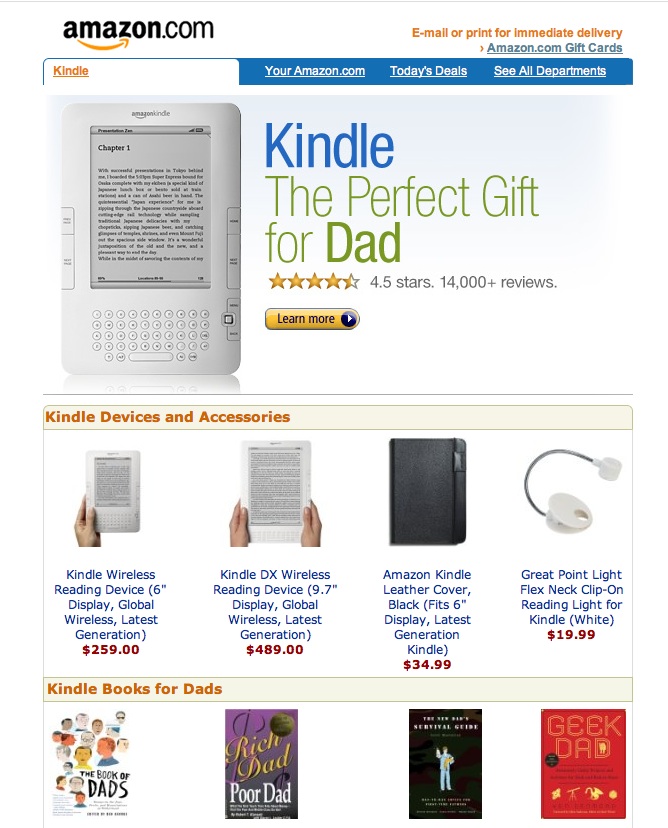
I’m also getting tired of receiving badly targetted emails from supposedly tech and branding savvy organisations like Amazon. Now this may be a coincidence but earlier this week I went to amazon.com to see if I could buy a Kindle. Unfortunately because I live in Malaysia I cannot buy one and even if I could it would be useless because none of the titles available on Kindle can be downloaded in Malaysia. I was obviously disapointed but after a while you get used to these things in South East Asia. However this morning I received an email from Amazon suggesting I buy my father a Kindle for Father’s Day. That really is rubbing salt into the wound.

Case studies of successful email campaigns are hard to come by, but American Greetings Interactive, an online supplier of greeting cards increased customer engagement by 13% between October 2009 and April 2010 thanks to a number of targeted email marketing campaigns.

Rather than shooting out the same email to the whole 5 million member database, American Greetings Interactive and their partner, Metrics Marketing, segmented the card company’s customer database into more than 15 sub segments and created relevant content based not only on the members status, but also previous history, account type and more.

This focus on relevant content and information that resonated with each of the sub segments increased engagement and resulted in more click throughs, more information, more referrals, opportunities for increased share of wallet and more subscriptions.

If you have something to offer, identify those in your data base who may be interested and target them alone. It may take a little time but it is time well spent. Otherwise using mass emails to try and sell the same product to everyone may actually have a negative effect on your brand and you may end up actually turning those customers away.

Top tips for successful city branding


I know I’ve said this before and I am probably beginning to sound like a broken record but advertising agencies do advertising.

And advertising is a tactical initiative driven, on the whole by creativity. Using advertising across one or more channels is a series of tactical initiatives known as a campaign. It is not a brand strategy.

If you want to build a brand, you are not, unless you have extremely deep pockets and are very very lucky, going to do it with advertising alone. This is especially true in the destination branding sector. What is required is a comprehensive, integrated brand strategy that acts as the blueprint that drives multiple interanl and external initiatives, including the very important creative elements developed by advertising agencies and not the other way around.

Bill Baker, author of Destination Branding for Small Cities available here, has written a timely, concise and easy to read set of guidelines for any city or destination that is ready to develop a brand strategy.

The article is here dont_hire_painter-1

I strongly recommend any destination, and for that matter, any company read this article to understand what they need to do before wasting valuable resources on tactical initiatives that will only add to the noise.