Suggestions to improve a travel website


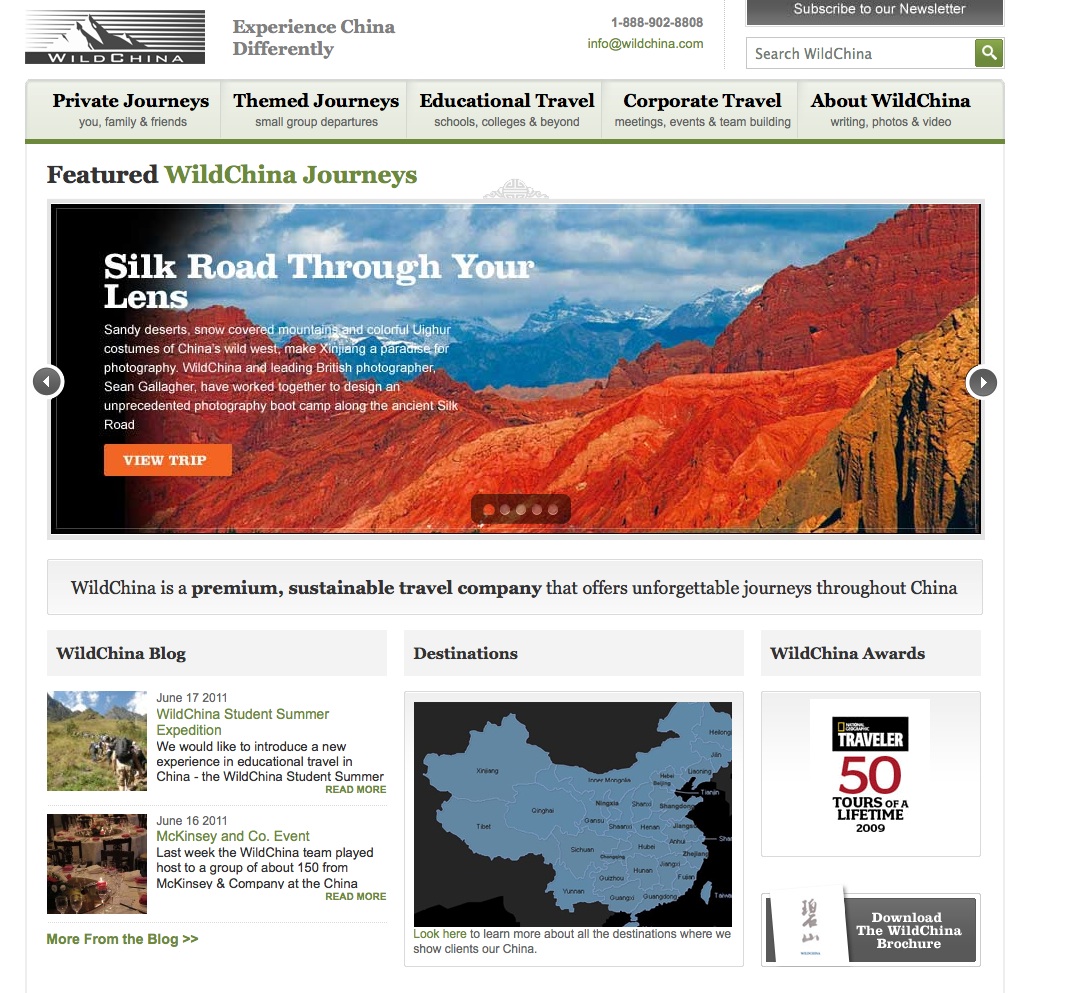
One of my favourite business sites, Bnet has an interesting case study of a site that offers bespoke or customised trips in China. The site is not doing as well as the owners expected.

The article asks the question “Why doesn’t this website draw more visitors” and there is an outline of the situation with the issues and readers are invited to comment. I tried to add my comments but as has happened before, I couldn’t add them so I am including them below.

The look and feel of the site is drab and reminds me of websites from 10 years ago. The content is too ‘traditional’ and rather predicatable.

If they are not happy with the number of visitors, then SEO is obviously an issue. So many companies spend a fortune designing a site and then sit back and wait for the orders to flow in. If only it were so easy…

So what would I do to make things happen?

They need to improve the writing. Although this won’t improve traffic to the site, it’ll keep visitors on the site once they are there.

I’d talk to existing customers and ask them what improvements they would like to see. I’d also talk to prospects that have visited the site and made enquiries but have not booked and identify why they didn’t book.

Before that, they need to invest more in driving traffic to the website, especially if as stated, 10% of the marketing budget generates 70% of enquiries. I’d also investigate and measure the number of leads generated from those 1,650 page views, source of visits, conversion rates from all channels, lost prospects and retention rates.

Other thoughts
1) The target market doesn’t have time to wait for flash to load. Furthermore, many of them are probably accessing from smartphones between appointments or via laptops whilst at airport lounges with poor internet speeds. Keep the information simple and bin the flash. Also you need a mobile version of the site.

2) So many companies think a website will make sales for them. It won’t, it is nothing more than a brochure to generate interest. Once an enquiry comes in, start building a one on one relationship with those prospects.

3) The form is too long. The target market is the wealthy but the wealthy are careful about sharing information, especially at the prospecting stage. If I buy you can have that data but not yet. Let’s stick to email communications for now. And maybe twitter.

4) Social Media initiatives aren’t engaging enough and there is too much broadcasting. Moreover there appear to be comments by readers/fans to which there hasn’t been a response.

5) Although I didn’t read the Blog articles, the headlines on the home page would suggest they are press releases not blog posts.

The key in any customer facing exercise is to put yourself in the shoes of the people you are looking to communicate with. And the best way of doing this is to talk to the people that visit your site, those that do business with you as well as those that don’t.

Direct Mail, Email and your brand


Direct Mail and Email marketing are critical components of any branding strategy for either a business to business or business to consumer brand. And it is a growing business. But the quality of Direct Mail and Email marketing in Malaysia and the mining and management of the databases used is horrendous.

If you own a company and you want to destroy any equity there may be in your brand, prepare a badly written product sheet on your desktop and when you are finished, don’t bother to spell check the document.

Print 50,000 copies and shove them in all the letterboxes of as many office or apartment complexes in the Klang Valley as you can. While you are sitting at home waiting for the phone to ring (assuming you included it on the flyer – and believe me, some don’t), your ‘DM campaign’ is being thrown in the rubbish bin by the lift, used as a place mat for lunch or simply thrown on the floor by the mail boxes. Hardly an inspiring ‘moment of truth’ first time experience for your brand and potential customer.

Another way to damage your brand is to send the wrong material to the wrong people. I have three kids, two under the age of 13. Yet this year they have both received two offers from credit card companies. These offers state that applicants must be at least 18 years of age.

A lot of firms are moving away from DM to save money on the printing of their flyers or brochures and looking at Email marketing. Although figures are unavailable for Malaysia, the Direct Marketing Association in the UK informs us that 90% of companies are now using email marketing.

There is no doubt that a well thought out and planned email campaign can be effective and profitable. But too many firms don’t do this and instead are simply adding to the seven trillion spam messages expected to be delivered to inboxes around the world in 2011.

I signed up with a local event organiser for information on forthcoming branding and marketing seminars that they organise in the region. Within a week my inbox was inundated with emails related to human resources, accounting, insurance, motivation and other topics I have nothing to do with and no interest in. These emails are trashed with the same irritation as the ones for Viagra, lottery wins and Nigerian banks.

Despite my repeated requests to be unsubscribed from their list, I continue to receive multiple emails. I cannot simply mark the email as ‘junk’ because they are using a Gmail account and this will send all mail from Gmail addresses to my trash. The name of the company is ingrained in my subconscious, but for all the wrong reasons and it is now a matter of principle that we will not sign up for any event organized by this firm.

I have received about 10 emails in the past month from an insurance company that recently spent RM13 million (US$4 million) on a rebranding exercise. The emails are not personalized, the attachment is of a flyer that is dull and states in two places that the offer is exclusively for Mastercard holders yet I don’t have a Mastercard.

I really lose faith in financial institutions and other companies when they make such mistakes. Think of the money wasted on the cost of the name, flyers, administration and so on.

The rewards for good campaigns are significant. The Direct Marketing Association reports that more than RM550 billion was spent on direct marketing advertising (including email marketing) in 2008 and sales generated from that were an astonishing RM6,450 billion! There is no question then that DM can be effective because it allows consumers to read about the products and services before deciding to explore further, or even buy.

But it has to be done properly. It is not enough simply to create a campaign and send it out. It is also important that the content resonates with the target market. And you still need to ‘sell’ the product. Just because you have got into the prospect’s inbox, doesn’t mean the prospect will buy.

The key for all direct marketing or email marketing is get the customer information right in the first place and keep it updated accurately thereafter. If you are collecting a lot of leads but don’t have the resources to input and clean the data, then outsource. There are many firms offering such services and it will be money well spent.

There is an edict within Direct Marketing industry that says, “Right offer, right person, right time.”

So it’s time for Malaysian firms, from SME up to main board, to end all this untargetted, uninspiring, untrackable, unproofed direct mail and start building brands with quality marketing collateral.

Effective email campaigns must be part of your brand strategy


You’ve probably never heard of unsolicited bulk Email (UBE) or for that matter, unsolicited commercial email (UCE) but you have of course heard of junk mail or spam, the more common moniker.

The earliest known spam was a message sent in 1978 and the earliest known commercial spam message was sent in March 1994. This latter event coincided with the opening up of the Internet and the amount of spam has grown exponentially since then and the forecast is that seven trillion spam messages will be sent in 2011, making up about 85% of all emails sent worldwide.

This constant carpet bombing of consumer inboxes with irrelevant messages has had a detrimental effect on email marketing and now, with the advent of social media, our belief and trust in email is wavering. Nevertheless, email is still an effective tool in the communications of any brand strategy. It can be used as a marketing, sales, retention and CRM tool and response rates to personalized emails have been reported to be as high as 62% although 2-4% is the average. Still impressive.

But it is critical for marketers to ensure that their emails are relevant to the target market, well written and succinct enough to gain the attention of the reader in the roughly three seconds they have before the reader hits the delete/spam button.

It is also critically important to ensure before the campaign begins, that you know what the purpose of the campaign is and, most important of all, that your database is clean and up to date.

I am constantly stunned at the amount of shockingly written, poorly thought out and irrelevant emails that land in my inbox. I’m equally stunned at the amount of times I receive the same email from the same organization.

For instance this email, from an organization that recently spent RM15 million (US$5 million) on a ‘rebranding’ exercise, is exclusively for Mastercard owners yet I don’t have a mastercard!

Furthermore, the email is addressed to ‘undisclosed recipients’ and contains no cover message or other form of personalization. Finally, to the detriment of the brand, it has been sent to me an incredible six times in less than a month!

Takaful Malaysia which refurbished its 13 platinum branches and outdoor signs and billboards during the rebranding exercise should have also looked at its communications processes and systems, including qualification, lead and list management and other elements. As its stated aim is to ‘make the company more appealing to the younger age group, it should also review its creatives! But I digress!

What should Takaful Malaysia and other companies, who are thinking of carrying out email campaigns do to ensure those email campaigns create leads and prospects rather than brand antagonists?

Here are 10 recommendations that will help them and others get the most out of email:

1. Target your message
It’s critical that the subject line grabs the attention of the reader and encourages them to open the email. The best way to do this is to personalize the subject line. The Takaful Malaysia subject was the name of the product. Few people buy products. A better option would have been “Can I help you protect your family?”

2. Segment your target markets
Keep list sizes to a manageable amount. Don’t send gazillions of messages and then be unable to respond to them in an acceptable time frame (24 hours). Segmenting your targets will stop this happening.

3. Target messages
Keeping list sizes to a manageable level will allow you to develop multiple messages for multiple segments, critical to successful tracking. There is no one-size-fits-all solution.

4. Use a Salutation
The whole point of the exercise is to get a response, not to make a sale. If you met someone at a convention, you wouldn’t start pitching to them the moment you are introduced and it is the same with an email campaign. Be contemporary, slightly informal and inviting. Start prospecting emails with a greeting and, depending on the product or service, the contact’s first or last name, such as “Dear Mr Smith” or “Hi Fatima.”

If you don’t have the first and last name, don’t send the email until you have the correct information. The majority of emails without a name will go straight to the trash folder.

5. Keep Your Email Short
Lay the content out so that it is easy to read and keep the first email short to ensure it is skimmed. You want the prospect to read the entire email but they won’t stick around for long so make it a fast, easy read.

Keep the email to three paragraphs of no more than three or four sentences. You can also close with a one-line sentence.

6. Track each segment within each campaign
One of the great advantages of email campaigns over traditional advertising campaigns is the ability to calculate an exact CROI (campaign return on investment).

But don’t limit your calculations to response and conversion rates. Depending on the goals of the campaign, track demographics, territories, consumer data, page visits, click-throughs, time spent on pages, and other elements. Use this information to influence future email campaigns with more efficient and effective content.

7. Have a hook
Business owners and C level executives are busier than ever. They don’t have time to waste so have an instant hook. We are in difficult economic times and businesses are looking to save money, especially small businesses so an obvious hook would be related to saving money for a business. Ensure content resonates with target markets.

8. Content is still king
Mention specific issues relevant to target segments. There is so much information available that it is easy to identify issues affecting segments. It may take a little more preparation but it will be worth it in the long term.

9. Don’t go overboard on design
I’ve received emails with video clips, multiple graphics, embedded links, audio and so on. These are all distracting and time consuming when opened on a mobile device at an airport. Keep it simple.

10. Email marketing should form part of a brand strategy
Many firms conduct email campaigns on a whim, without any real thought or planning. This is a bit like driving a Ferrari in first gear, the car does everything you want it to but is it getting the best out of the car?

Incorporate your email campaigns into your brand strategy. Identify your quiet periods and implement an email campaign to boost sales in that period.

Email is still the most effective way to reach a lot of new prospects quickly and inexpensively. Email campaigns also have impressive response rates.

But email campaigns, carried out in an amateur way, can have a negative effect on your brand. However, if you follow these email best practices, prospects will take notice and respond, increasing your sales and building your brand.

Advertising campaigns need to be integrated across the organisation


Recently I wrote a post about my experiences when I called the number on a billboard selling a luxury automotive brand. You can read the full article here

Basically I talked about how I rang this brand after seeing a billboard outside my office. I got through to the receptionist who asked for my number and said she would get someone from sales to call me back. Nobody called me back, even though the car costs about RM500,000 (US$166,000)! I thought this was an excellent example of why so many brands fail. But I didn’t think much more about it.

Then today I was sitting at a traffic light outside Bangsar Shopping Complex and I saw the same company had another billboard, this time it was advertising their jaw dropping top of the range V10 sports car that costs over RM1,250,000 (US$420,000) in Malaysia. Now this really is an exclusive motor and in the middle of last year there were orders for about 240 of them in the UK and a waiting list of 12 months. If they are only selling 250 odd in the UK I would expect them to sell no more than 50 in Malaysia. So you have to question why they market such an exclusive product on a billboard.

But this is not a rant about using old mass market mass economy models to sell luxury brands, this is about the fact that it is imperative that marketing campaigns are integrated and organisational excellence is at the heart of any tactical campaign.

And I know it isn’t at the heart of this campaign because whilst waiting for the lights to change I decided to call the number on the billboard and see what sort of a response I would get.

I called the number. No answer. Now it was 5.17pm and perhaps the receptionist has gone home. But I doubt the sales team had gone home. I bet they were sitting around wondering how to drive traffic to the showroom so they can make target this month and get a nice juicy bonus for Chinese New Year. Perhaps at least one of them might have been wondering why the expensive outdoor campaign they’ve been running for some time hasn’t generated any results!

I’ve tried to go and see these guys but the marketing manager tells me they are doing well. Here are some basic principles to abide by when you run an advertising campaign so that when you are doing well, you can do better.

1) You advertise on billboards to stimulate, inform, persuade etc. If you want to inform perhaps a 100 people in the country about a luxury product, spending large amounts of money on billboards or for that matter print ads in daily newspapers, is a complete waste of marketing dollars.
2) Consumers who can afford to spend over 1 million Ringgit on a car are unlikely to keep to your office hours. Make it easy for them to spend money with you.
3) Your advertising copy should appeal to a specific audience – in this case, those who can afford over RM1,250,000 on a car – everyone else is just getting in the way. So create copy that will resonates with that target market. This ad just mentioned the engine capacity and that was it! Ever wondered why mini does so well?
4) Develop metrics for measuring channel effectiveness. A simple metric for outdoor ads is a specially assigned number for that campaign.
5) Outdoor advertising is 24 hours. That’s probably one reason why you bought it in the first place! If you can’t have someone on standby 24 hours a day, install an answering machine or after office hours have calls diverted to a sales manager or sales director.

These are elementary and should be included in any strategy document created by a brand consultant.

Is a traditional marketing campaign going to sell motor oil?


Petronas is Malaysia’s state-owned energy provider and it is the only Malaysian company to be listed in the FORTUNE Global top 500 companies.

Its lubricants division, Petronas Lubricants International (PLI) in association with M&C Saatchi has recently launched a global brand campaign for its flagship product Syntium. M&C Saatchi is responsible for the creation and development of the overall campaign.

The campaign features a 30-second TV commercial that is currently being aired across Astro and Malaysian terrestrial TV channels, radio, print ads and digital initiatives although a quick search of ‘Petronas Syntium’ on Facebook and twitter uncovered zero activity.

And of course, as with any traditional creative driven campaign, there will be lots of below-the-line collaterals.

Costing only about US$350,000 (RM1,000,00) which includes production costs and execution, the campaign has launched in Malaysia and will be pushed out across PLI’s key markets including China, Thailand, Italy, South Africa, India and more. It’s not known if that amount includes the campaign execution across all countries.

M&C Saatchi states that ‘the new Syntium brand campaign was produced using state-of-the-art CGI animation with the core message of the ads reflecting PLI’s fresh approach towards knowledge and technology – Fluid Technology Solutions’.

Do consumers still pay attention to traditional campaigns like this one that haven’t really changed since the 1960s? I know it includes social media but there doesn’t appear to be much going on online. So it’s a yet more noise and clutter to add to the deafening noise consumers are ignoring.

Although I haven’t seen any of the TVC’s, print ads or heard the radio ads I’m sure they will be very well executed and the cutting edge CGI animation will blow me away but the question has to be, will it sell more oil?

I value your comments and thoughts on this issue.

How to brand a city like Ipoh


Senior Executive Councillor Datuk Hamidah Osman of The Perak state government in Malaysia announced on a trade and investment mission to China recently that the state government, in an effort to boost its tourism industry, intends to brand Ipoh, the capital of Perak as the “City of White Coffee”.

Datuk Hamidah was quoted by Bernama “ Perak should have its own identity and branding just like Shenzhen that is known as the “Shoe City” and Paris which has long been known as the “City of Fashion”.

In conjunction with the plan, Datuk Hamidah said, “We plan to have a food fair to be held in Ipoh this December. The idea is to promote the local foods and tourism industry. We have the best bean sprout chicken rice and chee cheong fun (rice rolls),” she added.

Faced with increased domestic and international competition for both tourists and FDI, there is no doubt that Ipoh and Perak, need to develop a destination brand. But that brand must be based on a platform of multiple tourist attractions and business potential.

Set amongst picturesque limestone scenery, a diverse selection of tourist attractions include Kellie’s Castle, Perak Museum, Ipoh railway station, Tambun hot springs, Taiping lake gardens and Zoo, and more, Ipoh and the rest of the state have a lot to offer.

Other destinations include Pangkor and Pangkor Laut, Bukit Larut and others. Perak also has a rich heritage that can be promoted, including silver and tin mining. It is historically known as an innovator, having pioneered such advances as the first rubber trees in Malaysia and was also the first state in Malaysia to go wireless.

The tagline ‘City of white coffee’ certainly differentiates Ipoh from other destinations but what else does it tell potential visitors, businesses or investors? How can stories be developed around the tagline, who are the target market? How will it be communicated? If it is a one-size-fits all approach, it’ll need significant resources to communicate the new tagline. Have budgets been agreed and so on?

Today, Destination branding is not based on a tagline. Destination branding must be based on experiences that are successfully delivered to specific segments and not based on attempts to market all places to all people.

Research and data are critical to understand tourist and other stakeholder requirements before developing strategies and not the other way around.

Stakeholder buy-in is critical for brand consistency and fulfillment of the brand promise. As an example, how can a hotel contribute to the proposed approach? How can the same hotel leverage the approach to grow it’s business?

Branding is a long term coordinated and integrated strategic exercise and not a tagline. One-size-fits-all strategies using mass media are no longer effective.

Planning is essential to coordinate initiatives, ensure accountability and avoid wasting resources. Without a plan, activities will be reactive and tactical.

What Ipoh and other cities need is a consistent and organized methodology to brand themselves as domestic and international destinations.

Here is one approach that would definitely help Ipoh:

Stage one: Carry out extensive research
Research develops data on key success factors, generates insights and what current and prospective visitors seek, and provides benchmarks to measure branding ROI. The research should consist of the following activities

1) Destination analysis: Key members of the hotel industry, government bodies, local business associations and representatives of major attractions should be confidentially interviewed. The interview will be based on an agenda designed to explore a number of issues related to the city

2) Visitor audit: Carry out interviews with current and past visitors. Other groups can also be selected, such as conference organisers. The interviews will focus on the experiences and motivations associated with Ipoh, information resources, and suggestions for increasing tourist value.

Special attention will be paid to how they researched Ipoh, what they have heard or told others about Ipoh and the channels or vehicles used to tell them. Additionally, representative travel agents in Ipoh will be interviewed about tourist experiences and requirements. Online surveys will be useful to research baseline perceptions of brand Ipoh.

3) Place audit: A place audit will identify Ipoh’s economic/ demographic characteristics, review major attractions (including strengths and weaknesses of the attractions) and outline all brand assets. The place audit will also look to identify product potential.

4) Communications audit: A comprehensive analysis of the channels, vehicles and materials, both digital and print, current and proposed that are or will be used to communicate with both consumers and businesses.

Stage 2: Ensure community buy-in and set internal branding requirements
Community and other stakeholder buy-in is important both for delivery of the brand promise, development and ongoing funding. Stakeholders must be communicated with and input from stakeholders must be incorporated so that they understand that they play an important role in initial and ongoing brand development.

Such buy-in can be accomplished through a variety of activities, including “townhall” or other community meetings, private presentations and media briefings. Initial research findings and recommendations can be discussed as a basis for soliciting input.

Additionally, community buy-in requires a group of citizens, business people, and local and regional government officials. This planning group will:

• Define and diagnose the community’s condition, major issues and potential solutions

• Develop a long-term brand vision based on a realistic assessment of the community’s values, resources and opportunities

• Work to develop a long-term plan of action involving intermediate stages of investment and transformation

Stage 3: Brand plan development
The results of the research and community buy-in will be incorporated into a comprehensive plan for Brand Ipoh. This customized brand plan serves as a strategic framework for all marketing activities, messages, metrics, timetables and proposed budgets. Special attention should be paid to digital branding and product development to get previous visitors to return again.

Stage 4: Comprehensive and segment-specific execution & measurement
Unfortunately this is where most destination begin their brand strategy. Once the brand plan is in place, execution begins. The execution operates on two overlapping fronts – general and segment-specific:

General: General branding represents the ongoing efforts to ensure visibility and provide value to prospects, agents and visitors, as well as gather data, ensure continuous performance and maintain reporting.

Segment-specific: Segment-specific branding concentrates on two areas where it is important to establish and maintain strong relationships. These include existing customers/visitors, and target-rich segments such as families, agents, previous visitors, etc. The actual segments to be targeted will have been defined in the brand plan.

I appreciate that many cities will view this as a daunting and potentially expensive task. But it will not be as expensive as numerous one size fits all communications based on a tagline that tries to speak to all but really speaks to none.

Integrating and engaging all activities


Back in the day, if a TV commercial was good a consumer might, just might ask a friend for his opinion on the product advertised. If the opinion was a favourable one, then the consumer may have sought the product out the next time he was at the mall. Assuming of course that he remembered it on the way to the mall or his memory was jogged by some effective point of sale promotions.

But today, the consumer has millions of friends with him as he watches the TV commercial. And all of those friends are just waiting to pass on their opinion to our consumer. To ask them, all our consumer has to do is key in a word or two into the search cell on his browser on the laptop that is probably on his lap as he watches the TV.

With this in mind, wouldn’t it make sense for advertisers to create TVCs with easy to remember links or search terms that can be keyed in at the same time as the commercial plays? Of course product sites will have to feature the same image of the same product with relevant content and information on local store opening hours and product availability. Messaging and images as well as content in traditional and digital media must be consistent too but this shouldn’t be a problem.

Surely we should move away from the mass market mass economy one message for all approach to this more instant, integrated and engaged approach. What do you think?

Building a 400 year old brand is a strategic initiative


Shepherd Neame, the oldest brewer of beer in the UK was established in 1608 or 402 years ago! An amazing heritage and the brewer likes to play on this heritage with its advertising campaigns for brands such as Spitfire, Canterbury Jack and Bishops Finger.

The brewer allocated its entire 2006 advertising budget, which was about £300,000 (US$450,000) to one of those, Spitfire a real ale, and all of the budget was spent on the London Evening Standard, an afternoon/evening newspaper in London. This was considered a radical change of strategy. As well as print ads, content and sponsored supplements, the brand also sponsored the Evening Standard’s football World Cup special feature in May of that year. The strategic agency was John Ayling & Associates and the creative agency was RPM3. Promotional support such as free pint promotions were also included.

The really well executed and edgy “Bottle of Britain” campaign ran over six months and is one of my favourite campaigns. Here are some samples of the award winning creative work that was considered controversial and was investigated by the advertising watchdog Advertising Standards Authority (ASA) in the UK after complaints about the use of SS insignia. The complaints were later rejected by the ASA. You’ll need to have some knowledge of history, colloquial English as well as WWII jargon to really appreciate the ads.

Spitfire

You can find more examples of their campaigns on the Facebook page here

But Shepherd Neame understands that advertising campaigns are not enough to build and grow a strong brand. As a result, the company continues to invest in state of the art SAP technology and bottling technology, new acquisitions of high turnover pubs and refurbishments of existing properties to create airy, spacious and clean environments.

The company also invests extensively in merchandise including a bottle of Britain book, social media and charity work (Spitfire originated as a charity brew) and will link the brand to the extensive 70th anniversary celebrations of the Battle of Britain due to be held in the UK later this year. Also look out for its campaigns related to the 2010 football world cup.

All these elements ensure the brands offer experiential, emotional and economic value to both new and existing customers.

It comes as no surprise therefore that despite the recession and clouds of uncertainty, red tape and increased taxes and shocking weather in the UK, turnover was up 8.2% to £60 million in the last six months of 2009 proving that investing in brands is not just about edgy and controversial advertising campaigns, but a long term strategic imperative to continue to build on a 400 year heritage!

Malaysian and Asian SMEs should look at communications when building brands


I have a lot of respect for small businesses and their owners, especially here in Malaysia and all over South East Asia. The odds are stacked against them as they try to build a business in an environment that should favour them but because of conservative attitudes and the legacies left behind by unscrupulous operators in the past, they are up against it and many of them don’t make it. Even those that do make it do little more than survive.

Furthermore, competition is growing, not just from local competitors but from international ones as well. Rents are rising and real estate is expensive; banks are reluctant to take any risk, no matter how low, talent is hard to find and quite often entrepreneurs are unable to communicate in English due to ever changing education policies or a vernacular education. Plus, here in Malaysia, government subsidies on fuel and other commodities are probably going to be lifted or even abolished. Finally, AFTA means the market may be swamped by cheap products from other regional, less expensive countries.

But despite these and many other issues, depending who you listen to, small and medium sized industries, enterprises and businesses represent up to 99.2% of the Malaysian economic establishment and these organisations are therefore the engine room of the economy. And although the SME contribution to gross domestic product has been almost flat for the last 8 years, rising from 29% in 2000 to 31.4% in 2008, the sector still has a major role to play in the economy.

This is particularly true of the service sector which is the most progressive in terms of SME development. So it is good to hear that the National SME Development Council has approved the establishment of a special unit responsible for SMEs at a number of agencies and ministries. Under the Integrated Action Plan 2009/2010, 354 programmes will be implemented this year with financial commitments totalling RM6.02 billion (S$2.48billion).

Roughly RM3.3 billion has been allocated for the development of SMEs in the services sector in line with the government’s aim of developing Malaysia into a high-income economy.

So should these SMEs be bothered about brand building? Well, in many ways the concept of branding is even more important to small companies than it is to big companies. But obviously they don’t have the resources of a Multi National Corporation (MNC) so they need to be selective on what they address. One area that SMEs can improve significantly with very little investment is their communications. There is a lot of truth in the saying, you never get a second chance to make a first impression. So your communications must leave a positive first impression.

Another mistake SMEs make is that they believe volume is best. They believe that they must have a database with as many names as possible. And once they have that DB they must blast out the same message to everyone on it on an almost daily basis! Negative. The first step in your prospecting process is to qualify all leads to determine any interest level. There is no easy way to do this. It takes old fashioned hard work. Fortunately in Asia privacy laws are limited or even non existent so cold calling is acceptable but of course you need to have a strategy to get past gatekeepers.

Spend some time writing an introductory email. It doesn’t need to be long but if it is targetted and well written, even if the service or product offered is not required, the email may be stored in a resources folder for later reference.

Once you’ve identified your prospects and segmented your DB, use email not to try and sell a product but to make an appointment. Few people are going to buy from a mass email but you may get a reply to the email or some recognition when you follow up the email with a call.

The worst mistake any company can make, SME or MNC is to start their brand development with an advertising campaign. Branding is a journey, advertising is a pit stop on that journey, nothing more. Now I know you want to see your name on a billboard on the highway or a full page advertisement in the national newspaper so that you can announce to all your friends, business associates and clients that you have arrived but think about it, how effective is this going to be? Do you really want to waste that money? (There are exceptions to this rule, but very few).

If you do intend to advertise, make the copy relevant to the consumers you intend to communicate with and only use channels that users of your product are familiar with and engaged by.

If you follow these simple suggestions, you may have a chance of being one of the few SMEs that survive and possibly even thrive.

Take control of your ad placement


I’ve decided to make these real time observations of branding blunders/negative brand association individual posts instead of putting them all together. This latest one is a real gem.

Essentially it is an argument between the British meat industry and the World Cancer Research Fund about the the dangers (or not) of red meat. The article is littered with negative words such as confusing, cancer, nightmare, death, bitter, row and more. To the right (and above) the article is an ad selling Dell computers. You can read the full article here but of course the advertisers may change

The execution of the ad is good. Readers can quickly and easily identify the brand and there is a seamless call to action.

But I’d like to know why Dell is advertising next to such a negative article. How does Dell buy these ads? Have they considered where the ads may be placed? Do they book a specific number of spots and choose the location or does the website decide where the ad goes?

If you are a brand and considering advertising online, make sure you determine what sort of articles the ads can be placed alongside otherwise you may be associated with death, cancer, arguements and so on. Probably not what you intended.

Any thoughts?