10 Principles to build the Malaysia Nation Brand


Minister in the Prime Minister’s department, Datuk Seri Idris Jala announced yesterday that the Prime Minister, Datuk Sri Najib Razak has a team in place and they are working full time to create a national brand for Malaysia.

Datuk Seri Idris said that the brand would involve Malaysian perspectives on national policy as well as the pattern of behaviour of Malaysians. He was quoted as saying, “If we can align these, then we can have a national brand”.

It is good to note that Datuk Seri Idris isn’t suggesting PR and advertising will drive the process. However, I don’t quite know what he means by “the brand would involve Malaysian perspectives on national policy…”, but I am sure he knows what he is doing.

One concern I have is that his statement might give some people the impression that building a Nation Brand is a relatively simple process and that it can be managed and controlled by internal forces.

Whilst the behaviour of Malaysians will have a distinct bearing on the success of a Malaysian Nation Brand, the process will also require significant investment in many other areas, many of which cannot be controlled by internal forces.

And as mentioned above and repeated later, Nation Branding is not a communications process. We cannot convince potential investors or tourists that Malaysia is the place to invest in, move to or visit.

We can influence the reputation of the country by building relationships and delivering on promises – multiple promises to multiple sectors – but we will never convince anyone of anything.

To help the PM and his team develop the Nation Brand, I’ve come up with ten key principles for a strategic Nation branding initiative. Although there isn’t a standard formula for building a Nation Brand because of course they all start from a different place, these principles will help form the foundations of any Nation brand strategy.

The same model should also be applied to government ministries, departments and agencies. And of course, these stakeholders should also form part of the internal element of any Nation Brand initiative.

• Nation Branding is a collaborative process
The best news to come out of Malaysia is that the Prime Minister is driving this initiative because without the CEOs buy in, any branding initiative is doomed. His involvement makes a statement to all those who will be involved that this is very important.

But the PM will need assistance from government representatives in each of the states and from other stakeholders. Most successful destination branding initiatives come from situations where key constituents move beyond turf protection/building, put aside their political affiliations and step out of their comfort zone and show some originality and courage.

Nation branding is difficult, requiring planning, support and coordination from a wide array of public and private entities. But even the best plan in the world will not succeed without buy-in from Nation brand stakeholders.

The most important step to ensuring buy-in is involvement in the research and planning process. As much as possible, brand stakeholders that are involved in implementation must have the opportunity to add their input to the plan.

Such buy-in has two advantages. First, it allows valuable perspectives and experiences to be incorporated into the plan, making the brand plan stronger and more effective.

Next, it facilitates better, more effective execution. If all the parties involved have a complete understanding of the entire plan and their role in it and what its success means to them, then redundant efforts can be avoided and resources maximized.

(I didn’t say this was going to be easy!)

• Research and data are fundamental
Sadly too many Nations (and companies) see Branding as a creative driven process of repetitively pushing government defined tourism and other messages out across traditional media, ad infinitum. The hope is that the message will resonate with someone or enough ‘someones’ to make it worthwhile.

Historically, this process has been the responsibility of the tourism board with support from other departments/agencies such as the agency responsible for inward investment and the Foreign Affairs Ministry.

Often the tourist board drives the Nation Brand

The tourism board delivers its message with a combination of slick, well-produced communications across mainly traditional media, PR and familiarization trips, trade shows and other trade related initiatives.

But just because the concept of carpet-bombing consumers with slickly produced commercials and PR messages worked (although this is contentious) for athletic shoes, automobiles, breakfast cereals and toothpaste in the mass economy (which incidentally no longer exists) of the post war years, doesn’t mean it is the way forward for the Malaysia Nation Brand.

Now, more than ever, step two in the Nation Branding process must include extensive qualitative and quantitative research with multiple stakeholders, both internal and external and from previously identified sectors.

Without research and data, branding decisions are no more than guesswork and the Malaysia Nation Brand is too important to base strategic decisions (or, any decisions) on guesswork.

The right research is vital for uncovering perceptions, attitudes and requirements for emotional, experiential and economic value, the three key elements of a successful Nation brand. Research also provides benchmarks for measurement and accountability.

Most perceptions about countries have been formed long ago but they can be changed, despite what Simon Anholt says! But the way they are changed in America will require a very different approach to the way they are changed in France, UK or Germany.

And of course the requirements for value of an automotive manufacturer from Detroit looking for an Asian country to set up a manufacturing base, will be very different to the value requirements of a financial institution from the city of London.

You’ll also need to know what target industries/segments think of you and also what they want from you, who/where they get their information from and what are their hot buttons.

It will be tempting to develop a common approach for these and other targetted yet diverse industries, but the reality is that each one will require information that is different and therefore more emphasis will have to be placed on relationship building than any communications.

The research will also allow you to identify what firms or institutions you should be going after and which ones you should not. And this is where the balance between the Nation Brand and the immediate success factors critical to political survival become entwined.

Because some industries are more attractive than others but if a firm from a controversial industry waves a couple of billion dollars in your face, the short term political benefits maybe significant but the long term branding benefits may be few, if any.

Of course it will require a very brave CEO to eschew those short-term political benefits for the long term benefit of the Nation. But such decisions will have to be made and to make them more palatable, they must be leveraged effectively for the benefit of the official and the government of the day.

• It is impossible for a Nation Brand to reach its greatest potential using creativity alone
Too much is at stake – both in terms of a country’s brand and resources invested – to depend on a creative-driven branding campaign (and that’s all it is because it is impossible to sustain) to form the foundations of your brand.

Furthermore, a creative campaign is best suited for mass markets and mass media – we’re back to running shoes, shampoo and so on.

Consumers are being inundated with so many messages they've stopped listening

Think of a TV commercial for a country or enterprise zone (you probably won’t be able to remember any, even if you are looking for one). They all say pretty much the same thing – how good the accessibility is, how great the country is, how special/unique their incentives are, how well educated their talent pool is, how extensive is their public transport system and so on.

But the reality is that if you are looking for somewhere to relocate to, the first thing you will do is get on the Internet and use a search engine to explore options.

Increasingly, the information you review will come from consumer generated media across social media platforms. It doesn’t matter how much a country spends on a cool logo or pushing a creative driven message out across traditional media, prospects will still go to the Internet and look for real world experiences.

Another issue I have with the creative driven approach is that it is essentially an acquisition driven model and doesn’t take into account existing prospects and investors.

But most damning of all, this approach leaves the strategy for the Nation in the hands of the advertising agency not in the hands of the CEO and executive management.

• Plan your work and work your plan
Once you have carried out your research and aligned your stakeholders, you can start to map out a Nation Brand plan that will not only form the foundations of attempts to drive the brand forward but also be the glue that keeps stakeholders together.

The world is loose, more fluid and more collaborative than ever before. And you have less control over the Nation Brand than ever before but that doesn’t mean you should forgo a well-researched brand plan and let consumers define your brand. In fact the plan is more important than ever as it serves as a blueprint for all stakeholders to adhere to.

Specifically, the Malaysia Nation Brand plan must communicate a positive and dynamic personality with economic, experiential and emotional values that reflect target audience requirements.

The brand plan must be holistic and comprehensive to enhance export promotion, economic development, tourism, foreign direct investment and other key national initiatives.

It must also communicate the intended message to the target constituents and stakeholders in multiple countries and at the same time, it must lay guidelines to strengthen the strategic, communications and visual impact of the Nation Brand.

The blueprint must also systemically connect the Nation Brand to the country’s core industries, corporate brands and Small and Medium Enterprise (SME) sector brands (more on SMEs later).

This must be established via a systematic, holistic process that accommodates the requirements of both national and international stakeholders. This process must not only be effective to optimize the Malaysia Nation Brand, but also maximize limited national resources.

But be flexible and open to the implementation of the plan. Let events influence the plan and be ready to adapt to events and opportunities.

• The essence of the Malaysia Nation Brand is more important than the brand guidelines so beloved of advertising agencies
It is common practice for companies to spend a great deal of money and time producing, communicating and training personnel about brand guidelines and how to police those brand guidelines.

What they really should be doing is spending those resources on building and nurturing a national appreciation and understanding of the brand and what it stands for, and developing a culture that will deliver a consistent brand across all touch points.

A great example is the South West of England that spent more offering free customer engagement and relationship training to key visitor facing companies than it did on advertising.

• Segmentation enables differentiation
Despite, or because of the power and sweep of globalization, which has Malaysians wearing the same fashions as Italians and Aston Martins in hot demand from Brazil to India and China, each country has its own requirements and world-views.

Once research has revealed the differing characteristics of various audiences, branding must be devoted to tailoring messages, media, channels and activities to the specific values and requirements of target markets.

Such segmentation not only ensures more receptive targets but also easily ensures differentiation from competitive countries trying to be all things to all people.

Social media and the voice of the consumer will drive online discussion and it is imperative that a social media strategy is initiated and integrated with the brand plan.

But communications are not enough. Relationships will be the key to successful development of a Malaysia Nation Brand. The successful implementation of these relationships will require unique and diverse talents that will be able to go out and sell the country. And it is important to match the right level of personnel with the prospects.

• Nation branding is a marathon, not a sprint
There is no quick win or quick fixes in any branding and this applies especially to Nation branding. Even in these technology driven times, establishing a Nation brand may take as long as a generation to develop.

For example, the current view of Japan as a nation famed for its precision and electronics is not based on its weak economic performance over the last decade. Rather, the seeds of Japan’s current nation brand were planted more than thirty years ago, when it began exporting transistor radios and two-cycle engines overseas.

But because it invested heavily in the development of the Japan Nation Brand, it has withstood the effects of the ‘lost decade’ and in fact, many argue that the Japan brand has improved, despite the economic impact of that lost decade and the terrible Tsunami of 2011.

Just as Malaysia launched its Vision 2020 program in 1991 to become a developed nation by 2020, the country must adopt a similar long-term view for Nation branding. Malaysia must look at establishing a Nation brand not for us – but for our children.

The good news is that signs of improvement and the benefits of investing in the Nation Brand development process can be enjoyed more quickly as witnessed by countries such as Croatia, Slovenia and to a lesser extent, Bosnia. These countries have invested heavily in research, product development, training and communications and as a result are building promising Nation Brands.

• The private sector, and in particular SMEs must carry its weight
The Government of Malaysia has tried to develop policies and funding and other resource allocation for SMEs to build brands. The Brand Promotion Grant was one such initiative.

However what would work better for the SMEs would be Brand development grants because Malaysian SMEs, supposedly responsible for as much as 97% of the economy, need to build brands before they can promote them.

The Malaysian government has tried to do a lot for the Nation brand – but it cannot do it alone. The private sector and SMEs need to start pulling their weight.

One way of doing this that would also generate a lot of positive publicity for the government would be to commission a reality TV programme that looks to find 25, 50 or 100 companies with the potential to make it globally.

Every season viewers vote for the SME they think has the most potential and the winner is given the opportunity and significant resources to become a global brand.

This would give SMEs a clear roadmap to success and fast track ‘country of origin’ development for Malaysian products.

Global sporting events will also help to build the Malaysia Nation Brand. It is probably not the right time to suggest Malaysia host the Olympics (although personally, I think Malaysia should be exploring the possibility of co-hosting the event with Indonesia. This would also do wonders for relationships with its neighbour).

Other private sector initiatives can range from promoting country of origin on foods and industrial goods, as Australia has done, to helping to fund trade missions to even good business ethics.

Tourism shouldn’t be neglected but if there is a strategy, it needs to be reviewed because current communications are very tactical and fall into the ‘me too’ category with little differentiation from competitors.

1Malaysia is a good concept but it needs more structure and strategy, not least to protect it otherwise it’s strength and potential will be diluted. It also needs to be better sold to Malaysians.

• Measurement and evaluation
Why should money or resources ever be spent without knowing the return? Wherever possible, perceptions, activities and processes must be measured, ideally with quantitative benchmarks.

Such measurement and evaluation must be used to establish accountability and to ensure continuous improvement.

But don’t rely on polls such as the Nation Brand Index. Such a tool, whilst perhaps relevant to Western countries offers little value to developing countries. People are too worried about their own situations to worry about Malaysia.

The western world is looking to Asia to drag it out of the economic quagmire. We may never get such an opportunity again. The timing of this initiative by the Prime Minister is perfect but we need to move fast.

Successful brand building is determined more by customer experiences than by slick advertising campaigns


Far too many companies, whether Multi National Corporation (MNC) or Small, Medium sized Enterprise (SME) think or are led to believe that the fast track way to branding acceptance is to spend large amounts of money on high quality TV commercials, billboards or print advertising campaigns that showcase their products or services and communicate corporate driven messages to consumers.

But just because telecommunications companies, banks, oil companies, soft drinks firms and others spend considerable amounts of money on advertising doesn’t mean that the advertising is the reason for their success or that it is right for you.

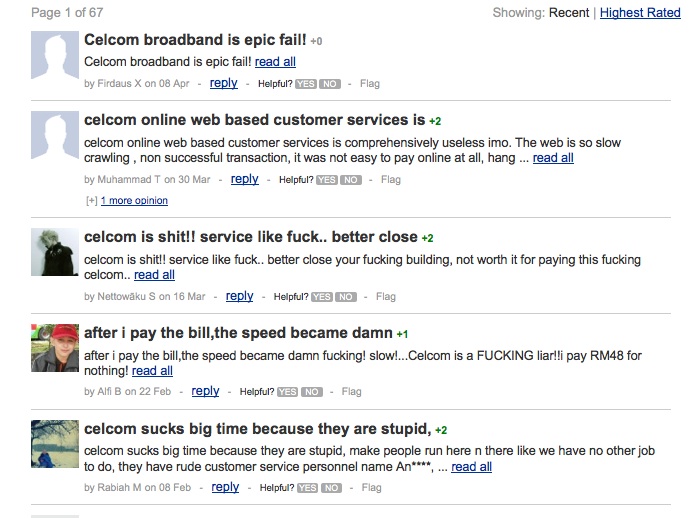
In fact quite often, there seems to be no rhyme or reason to the advertising campaigns initiated by these companies. A case in point is the current Celcom campaign “Ini Wilayah Celcom” prominent on billboards across Kuala Lumpur. With current mobile penetration in Malaysia around 125% of the population, it doesn’t make sense for Celcom to be creating awareness with expensive outdoor campaigns.

Unsurprisingly, at end of many such campaigns, there is often very little change in the fortunes of the brand. Which is why many of these advertising campaigns, do little to build brands and should not be emulated by other companies.

Because a key element of whether or not your brand building is successful will depend not on what you tell consumers through paid media but on the experiences consumers have with your personnel, your business and your products.

Put simply, if you manufacture furniture and spend a lot of money advertising a new furniture range but the furniture breaks all the time, you may make some sales but your brand will suffer as consumers avoid making a return visit and worse, discuss their issues with other consumers on and off line.

Likewise if your staff are slow, rude, inattentive, badly groomed, lack product knowledge, unhelpful and poorly trained, you may make a sale but the customer is unlikely to return and you can be sure they will share their negative experiences with others.

Furthermore, these negative experiences will be spread across the Internet using social media tools and in coffee shops, bars and so on will have a negative impact on your brand. Even sales of previously successful products may be affected negatively.

However, treat customers well and they will remain loyal. In a recent survey by Spherion, 97% of those questioned said a great experience makes them more likely to buy more of a product or repeat a service. However, once they have a bad experience or their trust is lost, it’s very hard to win back. To have a chance of winning back their business, 22% want a simple apology, 10% want a complete refund, and 8% would want incentives or coupons and even then there is no guarantee.

But 46% said that it would take an apology, a complete refund AND coupons or further incentives to have a chance of winning back their business. The implications therefore on your brand, of delivering a bad experience is costly and time consuming.

For the record, 15% said absolutely nothing would atone for their bad experience.

So you can try to shape the perceptions of your products or services with advertising, PR, advertorials, nice brochures and with content across social media and elsewhere but the reality is that the success or failure of your brand will be determined by experiences and how customers discuss your brand after the experiences.

Apple for example charges a premium for its products. It sells the sort of stuff – computers, smart phones, MP3 players – that lots of other people sell yet sells them at a premium. Margins for Apple iPhones are in the region of 50% compared to a meagre 6.2% for Nokia smartphones.

Furthermore, Apple ‘only’ spends US$250 million (2009) on advertising compared with Microsoft US$1.4 billion and Dell US811 million. In terms of a percentage of sales, this equates to 2.4% for Microsoft, 1.3% for Dell and 0.5% for Apple. RIM, manufacturer of the Blackberry spends 3.6% of revenue on advertising.

New technology companies that have sophisticated digital strategies and use email to market themselves spend even less on traditional advertising. Google spends only US$11 million on advertising or 0.05% of revenue. Amazon is a little higher at US$43 million or 0.17% of revenue.

As a general rule of thumb, spending less than 2% of revenue on advertising is considered low. For the automotive industry average advertising spend is nearer 3.5% of revenue. For alcohol it is more like 7% and for packaged goods and most other industries, as high as 10%.

Firms such as Apple, Google, Amazon and others are not successful because they spend huge amounts on short term advertising campaigns to create awareness but on innovative design, quality products and excellent service that is uniformly outstanding across all customer touch points such as in stores, whether bricks and mortar or online.

Consumers will pay more for Apple products because they are guaranteed a quality product (as well as inclusion into a not so unique club of Apple users) that will not fail them. And if it does, customers know they can go back to the store and seek a replacement or have repairs carried out under warranty.

Unfortunately most MNCs and SMEs don’t appreciate just how important the customer experience is. And the increasing popularity of social media means that consumers are voicing their dissent, not just to a few friends over teh tarik at a local Kopi Tiam but now to thousands and thousands of friends and followers and to their friends and followers across communities on Twitter, Facebook and more.

So as you try to build a successful brand, a core component of your strategy must be to build relationships with prospects and customers. You must learn how to manage relationships with customers, not just offline and during office hours but also online and at weekends.

Because unless you have a unique product or service (and few companies have unique products or offer unique services today), customers may buy from you if they have a bad experience but they are unlikely to come back again. And because of increased competition, it is impossible to build a brand on a business model that relies on new customers all the time.

Make sure that at every touch point where consumers interact with your brand, the experience for those customers is a positive one. This becomes a greater challenge as a company grows and if you get it wrong, what was once a nice little niche business with a manageable group of customers who all spoke positively about the company can become, almost overnight a loss making enterprise with fewer customers and a bad reputation for over promising and under delivering.

Ensure that every sales contact, service delivery and customer service interaction that the customer comes into contact with is positive as this will have a positive impact on your brand. Even suppliers need to be treated with respect.

But even if you invest heavily in customer relationships, and even if you keep 99% of your customers happy, there will always be some who are not happy and are dissatisfied with your service. What do you do with them?

The first thing is not to ignore these important customers. Try to get them to explain to you what is the problem. Be prepared to listen and hear stuff that may sound unreasonable. Some customers will be rude, personal and even physical. But you have to make sure your people are trained to listen and empathise. Think KFC!

And where possible solve their problem in a way that is satisfactory for them, not you. I know this might be a problem for you and will certainly cost you money on that particular transaction but in the long run it will offer far greater returns.

If you try to take care of every single customer, both those that are not a problem and those that are you’ll create a positive reputation. Even if customers are frustrated with their experiences with your brand, if you show empathy and provide a solution that makes them happy, there is a good chance they will tell others that they were impressed with you and how hard you worked to solve the problem for them. And with a little incentive, you can probably convince them to come back.

Despite what you may have been told, mass advertising across mass media is not the holy grail to building a brand. Which is fortunate because it means SMEs won’t waste hard earned money on campaigns to compete with large conglomerates. But if you look after the customer and try to make every experience a positive one, you will speed up the process of building a brand.

Thanks to zendesk for the graphic above.

A definition of branding that will help you to build a global brand


This article first appeared in the 30/09/2011 edition of The Malaysian Reserve

Over the years, companies have invested phenomenal amounts of money in marketing and advertising activities such as sales calls, direct mail, TV, outdoor, indoor, print and other advertising, brochures, leaflets and more. Indeed, according to Nick Wreden in his book Profit brand, How to increase the profitability, accountability and sustainability of brands, over US$1.5 trillion is spent annually on marketing (including advertising) worldwide and yet according to McKinsey, a management consultancy, up to 90% of products fail to become brands.

With little or nothing to show for these significant investments, companies looked to other disciplines and soon Branding was considered the way forward and the last 10 years has seen a major change in the resources committed to Branding.

As a result of this interest, hundreds of traditional books and ebooks have been written on the topic of Branding. Thousands of newspaper and magazine column inches have been dedicated to the discipline. Workshops and seminars have been held all over the world, all promising to teach business people how to Brand. These presentations are often uploaded to slideshare and Youtube videos have appeared, all with content related to Branding.

Many companies, including I suspect, yours have explored the concept and many have actually embarked on what they thought was a branding or rebranding exercise. Indeed, only recently, Malayan Banking Bhd (Maybank) announced it had gone through a rebranding exercise and even the Prime Minister attended the press launch of the new ‘brand’.

At the press conference, Malayan Banking Bhd President and CEO Datuk Seri Abdul Wahid Omar unveiled a new logo and explained that the bank would be spending RM13 million on the implementation exercise across the Asian region and that it would take about a year.

On the face of it and with the only evidence a new logo, this does not look like a rebranding exercise. This is more like a brand identity makeover or corporate identity reengineering, nothing more.

Another financial institution recently made a similar announcement and stated that it would spend RM15 million on a rebranding exercise. Soon after I received nine emails for a product that I didn’t understand and with a tagline that offered an exclusive deal for MasterCard holders even though I am not a MasterCard user.

Other well-known companies from the transportation, media and distribution industries have recently announced rebranding exercises that have actually been little more than a new advertising campaign.

The reality is that the new Maybank logo and identity will probably not make a difference to the brand and how consumers and organizations view the brand or the profitability of the brand. Think about it, when was the last time you signed up with or changed your bank because of a competitor’s logo?

This confusion is not Datuk Seri Abdul Wahid Omar’s fault. If we have to point fingers, we should probably point them at the marketers and advertising agencies responsible for muddying the branding waters.

It is because they have confused business owners and consumers with their contradictory interpretations that there is still a lot of confusion about Branding, the concept of Branding, what constitutes a Brand, what is Branding and how to build a Brand.

But this article is not about pointing fingers it is about identifying a definition of branding that will help Malaysian SMEs and other companies use scarce funds effectively and efficiently.

So what is a good definition that Malaysian companies can use as a foundation for their branding efforts?

We created this definition in 2004 and it still rings true today:

A brand is a long term profitable bond between an offering and a customer.

This relationship is based on offering economic, experiential and emotional value to those customers.

And it is backed up by operational excellence and consistently evaluated and improved.


We have used this as a foundation to build Malaysian brands and all of them have benefited from using this to take their brand forward. But what does it mean and how can Malaysian companies like yours use it as a foundation for their branding efforts? To do this, we need to break the definition down into three parts, as per the paragraphs above.

The first paragraph relates to two key elements, profitability and retention. One of the reasons that advertising, marketing and other traditional communications campaigns are so ineffective is that too many companies spend an absolute fortune getting a customer into their shop or showroom and then after the customer buys something, they just let them walk out the door! Isn’t it incredible that firms let customers walk out the door without attempting to at least try to build some sort of bond with them?

If you don’t why should the customer come back again? Don’t kid yourself that your product (there are some exceptions) is so unique that they will ignore other products and fight off all the attempts to lure them into competitor stores even though you have absolutely no relationship with them.

Profitability is an important branding metric, much more important than reach or awareness. It is estimated that up to 15% of a firms customers are unprofitable. You need to know who are your unprofitable customers and get rid of them.

If you have a car that won’t start and you send it to the garage and the mechanic says the engine is broken so you take the car to the paint shop and paint the body, will it help to fix the engine problem? Of course it won’t. It is the same with a brand. If you are receiving numerous complaints about the quality of your products or the time it takes to be served at a branch and you ask an advertising agency to create a new logo and you put that new logo on all your company materials, it won’t solve your quality or service issues or make your brand any better.

But if you carry out research with your customers and identify what are their requirements for economic, experiential and emotional value and then match your product attributes to those requirements for value you will make sales. And if you’ve laid the foundations for retaining those customers, as mentioned earlier, then you will be on your way to building a brand.

And by developing this emotional connection with your customers in which you deliver economic, experiential and emotional value, which incidentally will be done across multiple touch points such as when they use the counter service, through your correspondence and marketing collateral, the way you handle enquiries, your packaging, in one on one meetings with your representatives and so on, there will be no interest or need for them to take their business elsewhere.

In fact you will be surprised at the effort they will put into returning to you. And provided you keep your product or service relevant and continue to interact with those customers across platforms and channels that they engage with then you will be building a brand.

Operational excellence is a key ingredient in your quest to build a brand. It doesn’t matter how much you spend on marketing, sales, advertising etc if your organization isn’t efficient and effective it will struggle to deliver value and ergo, build a brand.

Finally, it is important to continually improve to stay relevant so you must track, evaluate and improve your brand on a continuous basis.

Instead of looking at branding as a creative exercise or short term tactical communications exercise, look at it as a holistic strategic initiative that requires internal and external research, investment in retention and not just acquisition, investment in the organization and a desire to constantly improve.

Follow these rules and you are more likely to build a global Malaysian brand.

Brand communications is no longer about broadcasting a company position across multiple mass communication platforms.


In today’s always on world, an important part of any brand strategy is the communications strategy but if Asian brands are going to be taken seriously, Asian CEOs must understand that times have changed and that we are living in a new world order. And in that new world order, the success of a brand is in the hands of the consumer not the corporation.

Today CEOs must understand that how consumers source information about brands and where they source that information from, has changed dramatically over the last 5 – 10 years. Where previously they learnt about brands from television commercials, newspaper advertisements and the recommendations of friends, today they learn about brands from Facebook communities, Twitter lists and YouTube channels.

Gartner estimates that mass marketing campaigns now have only a 2% response rate and this is declining annually. Despite this, Asian CEOs, so long in control of their brands and reluctant to lose that control, continue to try and shape brand perceptions by broadcasting positions repeatedly across traditional media via multiple and repetitive campaigns.

But Asian CEOs need to accept that in today’s noisy, crowded, dynamic, mobile market place, a brand cannot be shaped by repetitive communications campaigns that try to appeal to as many people as possible in the hope that someone will buy and communicated across traditional media. And those CEOs must understand that the success of their brands is too important to be left in the hands of marketers and advertising agencies.

According to Gartner, by 2015, at least 80% of consumers’ discretionary spending will be influenced by marketing across social and mobile platforms. And it is imperative that CEOs do not allow marketing departments to continue the mass market model of invasive campaigns that try to push a one size fits all corporate position onto consumers.

So if building a successful brand requires more than a traditional approach to marketing where reaching anyone and everyone and making them all aware of the brand with a generic message broadcast multiple times across multiple channels is not the way forward, what should Asian CEOs do if they want to challenge the global western brands?

The first thing is that this new world order is good news for Asian CEOs because it means they can stop wasting funds on expensive creative driven initiatives that require deep wallets to fund advertising campaigns repeatedly across traditional media in the hope that they will resonate with consumers and lead to a possible sale because the reality is, very few of them are noticed, let alone remembered.

Try this experiment. If you advertise in a daily newspaper or on TV, ask yourself which ads you remember from yesterday’s newspaper or on TV last night. Be honest. I doubt it is many. Personally I remember the ads from the Sunday paper because I was stunned at how many pages featured supermarkets and hypermarkets having a ‘cheap off’ on chicken wings, grapes and cases of beer.

And these are the very same newspapers that featured advertisements for Patek Philipe and Rolex watches, Lexus and Audi cars and other luxury products and services the week before!

And even if you remember newspaper ads or TV commercials, how many of the products or services advertised, have you interacted with? And of those how many have led to a purchase? And even if they have led to a purchase, what did the company do to ensure you come back again? I suspect they didn’t do anything and instead, after they spent all that money getting you into their store or to buy their product, they let you leave without getting some personal information in order for them to start to lay the foundations for a relationship!

In this era of smart phones and the half a million applications that can be used on them; In this era of social media with five hundred million Facebook users (6 million in Malaysia) of whom 50% are active every day and one hundred and forty million daily tweets on Twitter, many of them generated by Malaysia’s 1.1 million members; the proliferation of leisure time activities and abundant choice at malls and more, Asian CEOs must understand that the answer to brand building is delivering economic, experiential and emotional value to consumers and on their terms and across all touch points.

The global economic situation is a golden opportunity for Asian brands to take market share from established Western firms struggling to overcome cash flow issues and poor brand penetration. But it is up to CEOs to understand that they have to review traditional practices and take an interest, indeed responsibility for the brand and ensure brand departments understand that it is no longer enough just to advertise in traditional media and hope a brand will succeed.

CEOs must ensure too that at the heart of any new strategy must be the organization, making sure every brand touch point focuses on delivering value and communications departments must take social media seriously and understand how to deliver more engaged communications. And this will have to be done in a much more integrated, dynamic and fluid manner.

And whereas in the past, a series of the same full page ads repeated in daily newspapers or a number of prime time TVCs was generally sufficient to build brand awareness which would lead to a sale. Indeed, many consumers would actually watch a commercial and take a note of the brand and where they could purchase it. Those consumers would then go to the store, look for the brand and buy it. If the brand was unavailable they would take time out to come back again and again until they could make a purchase.

Today those same consumers don’t bother taking note of the brand names because they’re carpet bombed with messages throughout the day, every day. Many of those messages are making outrageous claims or are totally irrelevant to them. They are also too busy multi-tasking during the expensive commercial breaks. Furthermore, they’ve been let down so many times after believing those claims that they now often ignore them completely. And because consumers have so much choice and so many information channels, they don’t need to pay attention to messages broadcast via mass media any more.

Now consumers use social media and other tools where they inhabit communities that they relate to and trust, to seek information about brands. So it is in these communities where brands must learn to communicate and engage with consumers and deliver value that resonates with those consumers enough to make them want to own the brand.

Don’t get me wrong, I’m not saying don’t advertise but I am saying that if your organization is not on brand and all marketing initiatives are not integrated to allow you to deliver on the brand promise. And if your organization is unable to deliver value across all touch points and if you don’t use every opportunity to engage with consumers and collect data to help you get to know your customer and start to build a relationship with your customer, your advertising efforts will be wasted and your brand will not survive these extraordinary times.

In this crazy, always on, competitive market place it is these relationships that are going to help build a successful brand and not newspaper ads or TV commercials, no matter how cool they are and no matter how cutting edge is the technology used in the commercial.

Australia Unlimited. Genius or Garbage?


Someone sent me this link about the plans for the Australian government to use a new tagline to sell Australia Inc to the world.

I’m sure you guys have lots to say and I welcome your thoughts on the article. To get the ball rolling here are a couple of thought starters.

1) Australia Unlimited isn’t a brand, it is a tagline created by an advertising agency to be used in creative driven communications using one message to communicate with all stakeholders, irrespective of their requirements for value. The concept of selling ‘Australia to the world” is laughable as most of the world doesn’t care.

2) Here’s a clip from the article, “Shortlisted agencies were given a brief to ”come up with a brand that would promote Australia’s capabilities across a range of sectors from investments and exports to education, culture, sports and events”

How does “Australia Unlimited” do that? And how could any communications campaign appeal to such a diverse prospect base?

3) Here’s another quote from the article, “John Moore, director of brand development of the Global Brands Group, the agency that has been co-ordinating the new Sydney brand, likes the line. ”It takes it beyond tourism and poses the question of what is unlimited about Australia, to which there can be many answers. I think it will work really well as a connecting device with all those different areas [of trade and business].”

Excuse me? How does it do that? I want to set up a mining company in Australia, what can you do for me? That’s the only question I want to pose.

This is another iniative, involving 2 stakeholders, Tourism Australia and Austrade, who should be working together but in fact appear almost to be competing with each other!

You cannot build a brand with advertising alone


86% of Malaysians don’t trust advertising. The Star) . 78% of Malaysians trust the recommendations of other consumers. There are more than 1,500,000 Malaysians on Faceboook. 80% of affluent Malaysians (those with a household income (HHI) above RM5,000) use social networking sites. Nine of the Top 20 websites in Malaysia are social networking sites. These consumers are the new world order. They are online for many hours a day and pay little attention to traditional mass media. Despite this, Malaysian companies continue to poor billions (RM6.45 billion in 2008. Adoi) into mass market advertising in the mistaken belief that what they are doing is building a profitable brand.

Advertising was much more relevant in the past when the mass media was limited to only one or two TV stations, few radio stations, a couple of national newspapers and the occasional billboard. Limited leisure time pursuits meant consumers spent a lot of time interfacing with the mass media. Finally, there was little competition so high product or service standards were unimportant. With frequency and timing, mass media advertising generated enough ‘awareness’ to justify the budget.

With limited competition and consumers who were willing to accept low standards or didn’t know any better, such awareness could result in sales and for some, it was enough to build a brand.

Using advertising to build a brand is ineffective
Unfortunately, using advertising to build a brand will not work anymore. Mass media has disintegrated into niches or communities. Consumers have been carpet bombed by so many messages – up to 3,000 a day and for so long, that they have learned to block most of those messages. The favoured reaction of advertising agencies to declining responses and lack of effectiveness is to increase frequency but this doesn’t help because it just adds to the cacophony.

In a media saturated world, awareness is just background noise that means very little. For most companies, and there are very few exceptions, in an age when information on every product and service is widely available, and consumers have more choice, are better informed, and more powerful, creating awareness is not going to build a brand. For instance we’re all aware of Mazda, Alfa Romeo, Eon Bank, Pan Am, Airbus, Ritz Carlton and many other multi national global brands, yet most of us will go through life without ever buying something from these companies.

Indeed, many companies have realized, sadly after spending millions on advertising, that advertising can raise awareness (and even that outcome is not a given), but still fail to transform an offering into a brand. Settling for awareness, when so much more is possible and required is a total waste of valuable funds.

But this doesn’t mean that advertising is no longer important. Advertising is, and will probably always be, important to branding. But its role has changed. Advertising can no longer be a tactical initiative to ‘reach’ as many consumers as possible to ‘get the name out there’.

Advertising
Advertising must do more than try to create awareness. Advertising must work to ensure consumers adopt offerings into their lives. Adoption enables an offering to be seen as the best option. But this adoption also needs organisational excellence and the ability to match offerings to client requirements for value. Advertising cannot be expected to do this on its own. And it is wrong of advertising agencies to give the impression it can but it is also wrong of business owners to expect advertising agencies to be solely responsible because advertising is not a silver bullet.

It may seem like I am stating the obvious, but advertising must also communicate trust. This is the key element in any relationship. Prospects won’t make that critical initial connection without trust. And for trust to grow into loyalty, the key to brand building, companies must deliver on the promises made in the advertising. If you don’t deliver on the promises made, your target market is reduced by 86% and you are trying to sell to the 14% of Malaysians who trust advertising.

Some of the claims being made by property developers, automotive distributors, airlines and others in their advertising are often bordering on the ridiculous. Consumers, already pressed for time and cynical, are doubtful as soon as they see the advertising. If you foster doubt from the moment of the initial contact, you’ve wasted every dollar spent on that campaign. If you are making claims you must follow through with them across every touchpoint. And don’t expect it to happen overnight. It takes time to build loyalty.

Understand that building a brand requires not just advertising but also a significant investment in building loyalty and organisational excellence and the money you spend on advertising may be money well spent. Failure to do so and you may as well pour it down the drain.

The branding rules of engagement are evolving quickly


What many brands don’t appreciate is that we invest a great deal of our valuable time, effort and money waiting for the opportunity to spend our hard earned cash on them. Paul McCruddon, a digital strategist and blogger in the UK knows this better than most and got tired of brands mucking him about and appearing not to appreciate the fact that they are, as he puts it, “stealing my attention.”

Earlier this year after calculating his time is worth about £102 per hour, he recorded how much time he spent waiting for service in diverse places such as a post office, shops and restaurants as well as spending 45 minutes waiting for a train at Preston station and so on.

The data is impressive. For instance, and I quote: “ (I) spent 20 hours and 50 minutes with Transport for London mainly taking the tube day in day out. And as a result of that, I’ve spent 2 hours and 35 minutes reading Metro and 80 minutes reading The London Paper, not to mention all the planted PR stories and adverts they contain. For the food shop, I spent more time at Marks & Spencer (5 hours, 16 minutes), but significantly more money at Sainsbury’s (£455). And as for eating out, then Pizza Express will find that their 2 for 1 voucher went down a treat (6 hours, 53 minutes), meaning that I didn’t spend nearly as much time and money in their competitor restaurants, with the exception of the reliable Carluccio’s (5 hours, 40 minutes).”

Paul feels therefore that these companies all owe him money. So, and this is where it gets really interesting, he sent invoices to 50 of these brands for £6,250 for his time that the brands had wasted! To make it more appealing, he offered them all a blanket 75% discount.

So how did he get on? Well the results are quite surprising. You can read about them on his blog, but here are some examples:

Pret A Manger founder Julian Metcalfe sent a cheque for £62 for spending time in their cafes. Pret really got into the spirit by also paying his food bill (£22) and also an extra £1 for to compensate for the hassle of walking to the post box to mail the cheque to his bank!

Little Chef offered vouchers to the tune of £30. Squat + Gobble, an independent restaurant offered a £5 discount card. EAT a small family run company with stores all over London, sent him £15 worth of vouchers.

Boots the chemist failed to get into the spirit, writing a letter stating that they do not recognize the time customers spend in their shops in ‘monetary terms’.

What does this tell us about branding? Well for sure, this is not going to evolve into something that we all do. Although bearing in mind how long most transactions take in Malaysia, if anyone here feels compelled to copy Paul, you should, on paper anyway, earn a lot of money! However it does reiterate that mass economy company driven tactics such as positioning, have no place in the customer economy.

Positioning proposes that the organization concentrates on a word or idea that defines the company in the minds of consumers and then communicates that idea or word relentlessly for as long as budgets will allow. Basically this is how it is and we tell you how our products are positioned. Take it or leave it.

This ‘episode’ reiterates that branding today is a very different place than it was even 5 years ago. Branding today is about entering into two-way collaboration with consumers because consumers have more power than ever before. It is imperative that brands understand and respect their customers.

If brands fail to work with their customers, those customers will take their business elsewhere and tell others of their bad experiences. Paul updates the story regularly on twitter where he has over 1,000 followers on twitter. Those followers (One has 17,000 followers) will retweet (forward) his updates onto hundreds of thousands more and so on. He has been interviewed on TV, radio and print. Many consumers will take note and go out of their way to avoid the brands that don’t appreciate his investments.

Paul used the data collection website Daytum to record all his interactions.

Luxury branding in Malaysia & Asia


Despite the global economic meltdown, the development of the retail sector in Malaysia continues at a phenomenal pace with over 1,000,000 square foot of additional mall space becoming ready this year. Passing almost unnoticed however is the proliferation of international luxury brands in many of those malls. Familiar international names such as Asprey, Giorgio Armani, Prada, TOD’s, Van Cleef and Arpels and so on, have all entered the local market in recent years, encouraged by the success of exclusive names such as Bulgari, Cartier, Hermes, Louis Vuitton, Rolex and other famous names already familiar to KL shoppers.

Unusually in Malaysia, The Pavilion has clustered its luxury boutiques into a high profile area facing Bukit Bintang. Globally, this clustering of stores is nothing new. For centuries stores have organized themselves into districts based on what they sell – think Saville Row in London (tailors), Faubourg Saint-Honore in Paris (designer boutiques), Deira in Dubai (jewelry), and so on. The cluster approach allows the rich and famous to be dropped off in front of the store, rush in and make a purchase that would make a small African country drool and then rush out into the safety of the limousine without having to rub shoulders with the rakyat.

With its double story street facing façade the luxury section or ‘couture precinct’ of the Pavilion is an exciting development in the evolution of the retail sector in Malaysia. But there is one thing missing from this development. That is a luxury Malaysian brand.

And as Malaysia moves from an Original equipment manufacturer (OEM) economy to an Original brand manufacturer (OBM) economy, and the government rams home the need to move up the value chain, the retail sector, where so many Malaysian OEM cut their teeth, should be at the forefront of this step up the value chain. Especially as according to the MasterCard Worldwide Insight report, the value of the market for luxury products and services in the Asia-Pacific region will jump from US$83.3 billion in 2007 to US$258.7 billion in 2016. Not a bad segment.

What’s more, there’s already a ready made market because the largest number of tourist arrivals to Malaysia is from ASEAN countries, followed by Japan and China with India and the Middle East not far behind. And the burgeoning middle classes from these countries are notoriously brand conscious.

This interest almost obsession with brands is likely to continue according to Radha Chadha, author of “The cult of the luxury brand”. She believes that the Asian interest in luxury products is because of the massive changes – social, cultural, economic and political that have been affected by the traditional attitudes to who you are and where you are in the societal food chain.

She believes that over the past 50 or so years, many of the traditional cultural indicators of social standing in Asia – profession, family, clan, caste have been eroded by the onset of globalization, migration and education. Free of rigid social hierarchies, mass migration and the development of urban areas, more people are making money and making it faster. The way to differentiate oneself is by purchasing a luxury product that shouted, “I’ve got money, respect me.”

Displaying one’s status through outward appearances of rank and wealth is nothing new but Asians seem to have taken to it like the proverbial duck to water. And those LV bags, Chanel suits, Jimmy Choo shoes aren’t simple female indulgences, they are part of a new world order that identifies the wearers position in society. Indeed, these luxury brands are a modern set of symbols that Asian consumers are using to redefine their identity and social position.

The Japanese have been devouring brands for years. 94% of Japanese women in their twenties own a Louis Vuitton bag. In fact, the Japanese as a whole are the most brand conscious and a staggering 92 per cent of Japanese women own a Gucci bag, 57 per cent own a Prada one, and 51 per cent own a Chanel bag.

In fact, Japanese passion for luxury brands is so huge that they account for over 40 per cent of worldwide sales for most major luxury brands. Meanwhile, Asia accounts for a third of Louis Vuitton sales worldwide whilst Cartier depends on the region for half of its worldwide sales.

And what of China? According to the China Brand Strategy Association, 175 million Chinese people can now afford to buy luxury products. By 2010 their number is projected to reach 250 million. Already, Chinese consumers are responsible for about US$10 billion of global luxury sales. Following the announcement of the US$586 billion stimulus that is expected to encourage increased spending, 70% of consumers confirmed that they will spend more in the next 6 months than they did in the previous 6 months.

Rolls Royce, the iconic British luxury brand owned by BMW, expects to double annual sales volume from 1,000 to 2,000 when the new, smaller ‘Ghost’ is launched in 2010, many of the early enquiries for the yet to be launched model are from Asia. Not bad considering each car will cost over US$200,000.

So, with all this new found wealth in Asia, the time is ripe for the development of Malaysian luxury brands. And the good news is, Malaysian firms know how to manufacture quality products. They’ve been doing it for years for iconic brands such as Apple, GAP, Guess, Ralph Lauren and other well known global brands.

But developing a luxury brand is also like raising a family – it requires a long-term commitment and investment, attributes that don’t sit well with corporate Malaysia. It also requires limited production, value over volume, even with a successful line. It also requires quality, not only in production but also in marketing and service, especially service. Training of staff is key. Walk into the Cartier store in Kuala Lumpur and the staff will assess you based on a number of pre-determined factors. Pass the test and they’ll offer you a bottle of champagne to anesthetize the pain of the purchase!

Ongoing research is also critical to the long-term success of the luxury brand. Back in 1837, when Hermes was building its brand, the founders lent new products to customers to get feedback on how the products could be improved. Zara applies the same tactics today. If a new line doesn’t sell, it is pulled off the shelves immediately and replaced with a new range based on customer feedback on styles.

One mistake many brands make is that they ignore existing customers, preferring to always acquire new customers. The successful luxury brands have an ongoing relationship with their best customers who become brand ambassadors and grow the family.

And for those cynics who don’t think Malaysians can build luxury brands or that there is any money in luxury brands, think of Jimmy Choo, the closest Malaysia has come to a luxury brand. Six years after Jimmy Choo sold his 51% stake in his own company for US$25 million, TowerBrook Capital Partners recently paid more than US370 million for ownership of the iconic brand named after the charming cobbler born in Penang in 1961. And with annual sales that have grown since 2001 at a compounded rate of over 45% to more than US130 million today, the purchase looks like good value.

Another British based private equity group, Permira, paid US$3.5 billion a couple of years ago for the Valentino Fashion Group. This was one of the most talked about acquisitions of the year because although Valentino is a well respected brand in Europe, it does not have the penetration in Asia of say Giorgio Armani. This is reflected in the global sales of US$340 million for Valentino compared with US$3.1 billion for Giorgio Armani.

There is also a strong argument to suggest that luxury brands are recession proof. At the end of last year, when the American economy was in free fall, Saks Fifth Avenue had a massive sale, offering huge 70% discounts on iconic brands such as Manolo Blahnik and even Prada. However, at the Louis Vuitton shop inside the luxury department store, nothing was reduced. Recently, Moët Hennessy Louis Vuitton announced that sales in its fashion and leather goods division, which includes Louis Vuitton, increased by 11% to $2.1 billion in the first quarter of 2009.

So, as the average tourist spends only 22% of his budget on shopping in Malaysia compared with 50% in Hong Kong and Singapore, the time is ripe for Malaysian firms to start building brands that can take pride of place alongside Canali, Ermenegildo Zegna, Jean-Paul Gaultier and Versace in places like the Pavilion, Star Hill and other prominent malls in KL.