I hate to blow my own trumpet but there are times when I really don’t have a choice. I came across this promotional video for the Malaysia Chinese Association (MCA) which represents the interests of the Chinese in Malaysia’s Barisan Nasional political alliance.
I don’t know if this video is the reason but in the recently held general election in Malaysia, MCA won only seven parliamentary seats out of 37 and 11 state seats out of 90 the party contested. The song was voted the worst ever election song by an Australian TV station.
One thing is for sure, this video won’t have helped the party and I would like to offer my services to the MCA. I promise you, whatever I do for your brand will be an improvement.
Some TV commercials are remembered for the commercial and some for the product and others for the brand. Although they will never admit it, a lot of agencies want you to remember the commercial whilst the brand wants you to remember the brand so you will go out and look for it and then buy it.
Of course from a branding perspective, it is then that you need to build the relationship with the customer to try and cross sell and/or upsell them, either then or at a later date or to get them to become brand influencers. This is marketing 101 yet it never ceases to amaze me how much money firms spend on marketing (which includes advertising) to acquire a customers yet very little on retaining a customer. In fact it amazes me how much they spend on marketing what is obviously a great product but very little on training retail staff to match the product attributes to a customer’s requirements for value.
Anyway, I came across this fantastic TV commercial for LG TVs. It really grabbed my attention and made me think of buying a TV. Unfortunately I’m not in the market for a TV so I won’t be going to check out the LG TVs. But if any of you are looking to buy a TV and this generates some interest, let me know how you get on at the point of sale. Assuming of course that this model is available here.
Word reaches me from reliable sources that “Endless possibilities” the Nation Brand tagline chosen for Malaysia and scheduled for an official launch on 17th September will not now be used.
The tagline was panned from the outset, primarily because it was used by Mongolia and Israel. Trying to communicate a Nation brand promise in a few words or sentence, which is essentially what a tagline does, is becoming more and more complicated, not least because most of the best superlatives have already been used up but also because we live our lives very differently today and we’re not easily convinced by contrived messages anymore.
What most destinations fail to understand is that a tagline is not the first step in developing a Nation brand. Because what this creative driven approach aims to do is create a slogan, build an advertising campaign around that slogan, cross your fingers and hope that target markets will see it, buy into it and act and it will then become a brand. But this approach ignores what are the foundations for any destination brand strategy – stakeholder buy-in.
Unfortunately, because such a slogan is often created by an advertising agency there will be beautifully produced print and TV ads that woo key officials who immediately believe what they see in the slogan and of course buy into it themselves.
As we can see with “Endless Possibilities” this model does not work. So what should be Malaysia’s next move? The first thing is to establish a Branding Malaysia panel or task force. This panel should not be lead by someone with a creative background because this is not a creative exercise.
This panel will be tasked with carrying out extensive internal and external research to identify what Malaysia has to offer to what I hope are already identified target markets and sectors. Subjectivity and a grip on reality are required to make this stage work. I know it’s not sexy and requires a lot of boots on the ground but this phase is critical to the long term success of the project. Once research data is compiled and analysed, a blueprint to present the nation to the relevant audiences and not to the whole world will be created.
This blueprint will lay out the implementation process and feature clear timelines and responsibilities, communications strategies and channels, influencer relationship development, budgets, targets and possibly and only if necessary, a tagline.
This is a brief overview of how to build the Malaysia Nation Brand. A mistake has been made, never mind, let’s get it right the second time.
The response to the “Endless possibilities” tagline has been, as one would expect when discussing a Nation Branding project, emotionally charged.
Much of the focus has been on whether or not the tagline has been used by Israel or for that matter Mongolia. In fact, it would seem the tagline has been used not only by both Israel and Mongolia but also Sagada in the Philippines.
And while we’re at it, “Endless possibilities” has also been used by a lot of companies such as BHS in India who used it for an advertising campaign and by Florian pearls. It’s also the name of a thrift shop in the USA, a change management company in the UK and it also appears on a tee shirt underneath an infinity loop.
But most commentators and those members of the public who have cast scathing comments in blogs, forums and on social media sites are missing the point. There may be questions around the chosen tagline, how it was researched and why it was chosen but the reality is, the tagline doesn’t really matter. Yes it is a bit embarrassing that it has been used by other countries but it’s important to understand that this is not the Malaysia Nation brand.
It is a tagline. And like the majority of taglines, it will soon be forgotten. In fact, taking a macro view it will have very little influence on the success of the Malaysia Nation Brand project.
Sadly, it is not unusual for organisations to launch a brand strategy with the creative side of the project. This is wrong but unfortunately it is common. What will make or break the success of the Malaysia Nation Branding project is what the strategy consists of and what comes next.
This will be mapped out in a well researched, comprehensive brand plan that will not only form the foundations of attempts to drive the brand forward but also be the glue that keeps stakeholders together.
The world is loose, more fluid and more collaborative than ever before. As a result, nations have less control over the Nation Brand than they are used to but that doesn’t mean they should forgo a well-researched brand plan and let consumers define the brand, something that may already be happening in Malaysia. The Nation Brand plan is more important than ever as it serves as a blueprint for all stakeholders to adhere to.
Specifically, the Malaysia Nation Brand plan must communicate a positive and dynamic personality with economic, experiential and emotional values that reflect target audience requirements.
The brand plan must be holistic and comprehensive to enhance export promotion, economic development, tourism, foreign direct investment and other key national initiatives.
It must also communicate the intended message to the target constituents and stakeholders in multiple countries and at the same time, it must lay guidelines to strengthen the strategic, communications and visual impact of the Nation Brand.
The blueprint must also systemically connect the Nation Brand to the country’s core industries, corporate brands and Small and Medium Enterprise (SME) sector brands.
This must be established via a systematic, holistic process that accommodates the requirements of both national and international stakeholders. This process must not only be effective to optimize the Malaysia Nation Brand, but also maximize limited national resources.
But at the same time, the team tasked with this project must be flexible and open in the implementation of the plan. Let events influence the plan and be ready to adapt to events and opportunities.
The new Malaysia logo (thanks to thestar.com.my)
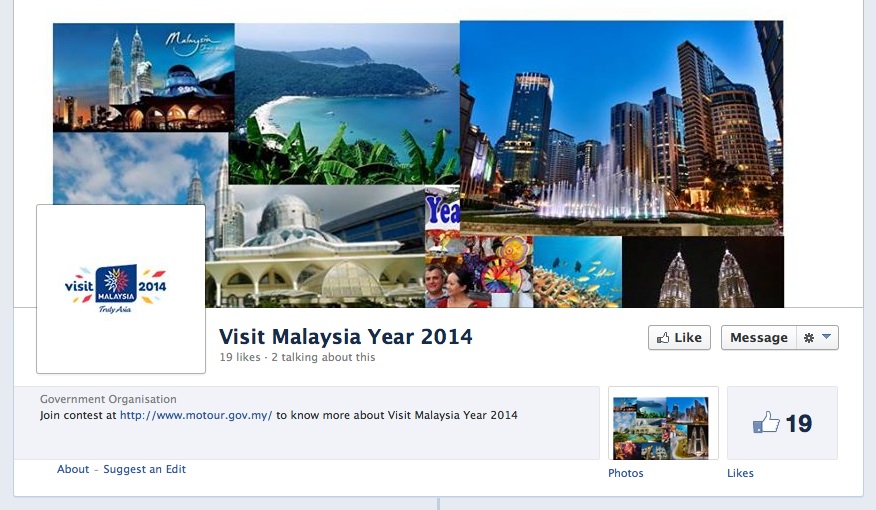
But right now, all we have to go on is the tagline, a logo, a website and a commercial featuring the Prime Minister that was aired on CNN a few months ago. There is a Facebook page for Visit Malaysia Year 2014 that features the new logo but the site hasn’t been updated since March 2013.
VMY 2014 FB page
The Facebook page features a link to a competition but this actually goes to the Ministry of Tourism website. Such competitions will help drive interest in the country and there is no reason why a competition can’t be created for businesses that may want to invest in or relocate to Malaysia.
The message of the TV commercial was to attract Foreign Direct Investment (FDI) while the message of the website is “Whether your passion is food, culture, sports or art; whether you’re a traveler or entrepreneur; Malaysia has something amazing to offer. The journey starts here”.
The malaysia.my home page
One might be forgiven for thinking that sounds like a tourism message however the site features a number of feel good stories about successful Malaysian entrepreneurs, achievements, news, activities and more.
As the website evolves, it may need to focus or at least segment activities more clearly and provide refreshing and new content that is of interest to stakeholders and not repeat content that is already in the public domain. This new content will create interest in the country, be picked up by search engines and robots and drive traffic to the site.
The team tasked with the responsibility of making the Malaysia Nation Brand project a success will also need to engage stakeholders on an ongoing basis and not just use digital platforms to broadcast corporate driven messages.
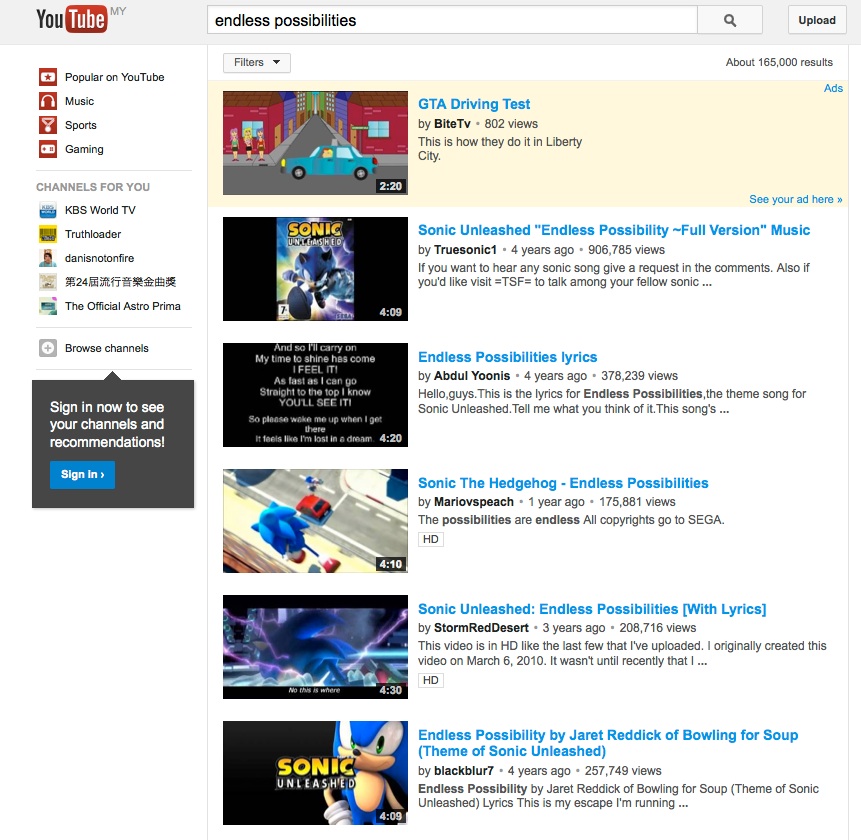
Right now, a search of “Endless Possibilities” on Youtube doesn’t send visitors to any Malaysia site. The Brand plan will also map out tactics for driving users and search engine robots to original content.
you tube search of ‘endless possibilities’
The launch of the new Brand strategy is set for 17th September and we should know more about the project then. But I believe, done properly and based on a comprehensive Nation Brand plan, “Endless Possibilities” really does have endless potential.
Let’s get something straight. A catchy tagline, symbolic logo, pretty colours that symbolize the ‘personality’ of the brand and a custom designed font are not Nation Branding.
Glossy advertisements that push the creative envelope and consist of content that is impossible for stakeholders to buy into or live up to, is not Nation Branding.
Expensive brochures and other marketing collateral that use light gray colours on white backgrounds and font sizes impossible to read is not Nation Branding.
Hugely expensive billboards that create awareness but do little else and are soon lost in the fog of the tens of thousands of messages consumers are exposed to every day is not Nation Branding.
It might have been possible to use such creative-driven branding to build a Nation Brand in the 1960s – 1990s, when countries and their advertising agencies focused more on getting attention than getting results.
But this is a different era. There are now so many channels to consumers, so many competitors all with a similar offering and so many distractions that it is no longer possible to build a Nation Brand in this way.
Furthermore, too many taglines have made promises the Nation couldn’t possibly keep or their marketing or PR collateral has left potential customers underwhelmed. This may not have been the fault of the Nation or it may be the result of poor internal implementation but it has resulted in a delivery failure that has negatively impacted all efforts till then. A case in point is the Incredible India campaign and the multiple attacks on women over the last year.
Moreover, engaging (not reaching) target markets through traditional channels with traditional tools is virtually impossible today. Especially in the digital age when consumers are more knowledgeable, have more choice and are more demanding.
So how do we make the Malaysia Nation Brand successful?
Reach, awareness etc are all irrelevant. Nation Brands today are defined based on the economic, experiential and emotional value they deliver to all stakeholders.
What will make or break the success of the Malaysia Nation Branding project is the work that has gone into determining what are the key elements of the Malaysia Nation Brand.
Identifying and understanding what we have, what is unique, who are the stakeholders, what are we are going to do to get their buy in, how we identify target segments, the knowledge we learn about them and their requirements for value and deliver value to target segments (all of whom are very different and have very different requirements for value and must therefore be engaged with content that resonates with them), how we build our relationships with them, how we work with them and provide solutions to their problems.
The ability to build lasting relationships with stakeholders, a highly trained team capable of matching country attributes to those stakeholder requirements and the ability to consistently deliver value are required.
External communications battles are not fought on the right hand pages of national newspapers, during commercial breaks on terrestrial TV or on the outside back cover of business publications. They are not even fought on the pages of digital media or on corporate websites.
The battles for the hearts and minds of prospects are fought in the comments sections of blogs, on third party sites through user experience comments, through account manager emails, forums, search engines and ongoing personalized relationships.
If the people responsible for this project can match your Nation Brand to the value customers are looking for, they may have a chance of building a successful Malaysia Nation Brand.
I am reliably informed the Malaysia Nation Brand project has a budget of RM30 million. But it’s not known what that covers. If it is simply for a communications campaign then it will not be money well spent and the project will fail.
However, if it is for a comprehensive brand audit and Nation Brand plan (which will have been developed once the brand audit was completed and will focus on internal and external stakeholders) that outlines how to deliver value as defined above and based on the “Endless Possibilities” tagline, then that will be terrific use of taxpayers money and the country will benefit for many, many years.
One of the hardest jobs for any brand is to stay relevant and interesting. This is especially true of airlines who seem to spend their marketing dollars on glossy videos featuring pretty stewardesses, cute kids and modern aircraft.
And when it comes to such activities as safety videos, most airlines opt for the tried and tested formula of the pretty stewardess going through the motions of seat belt, exits, life jacket and so on. A quick look around any flight just before take off will show that few travellers are paying attention.
It was refreshing therefore for me to see that Air New Zealand has really thought out of the box with its latest safety video by teaming up with Eton educated ex SAS officer Bear Grylls to create a unique and captivating safety video. The pretty stewardess and cute kids are still there but I’m sure you’ll agree the rest of the cast is unusual!
The talented team at Brandwatch in the UK have produced a very useful report on Twitter usage by global brands. This report should be read by marketing departments and CEOs. You can read the full report here but some of the findings are listed below:
1) 253 companies, primarily from the US and UK were analysed for the report.
2) Only 2.4% of the companies surveyed did not use Twitter at all
3) 97% of major brands used Twitter in 2013, up from 62% in 2011.
4) It was noted that Apple does not use Twitter or any other social media. Interestingly, Apple’s share price has tumbled to as low as US$400 earlier this year, down from US$700 in September 2012. Of course I’m not blaming that on the fact they don’t use Twitter however it does mean there will be some distance between the brand and customers.
5) Brands use Twitter for both broadcast and engagement purposes but most of them acknowledge that Twitter is best utilized as a two-way channel.
6) 145 brands surveyed (over half) tweet a minimum of 30 times per week.
7) 25% of Brands use Twitter solely as a broadcast channel.
8) 63% of Brands have multiple accounts. Using one for company news and another for customer service was a common example of multiple accounts.
9) Dell has 44 Twitter accounts.
10) Weekends are the best time to reach customers on Twitter. (I don’t think that applies to Asia). However a little research into what your audience prefers goes a long way to successful engagement.
11) Tweets with media (a photo/video) get 3 to 4 times more engagement than those without.
12) The average size of a UK and US Twitter team is 4 people.
13) The maximum number of tweets in a week for the US was 2,500 tweets, compared with 113 tweets in the UK.
14) The Twitter web interface is the most popular platform for tweeting.
15) 20% of the top 100 global brands use HootSuite.
What can Asian firms learn from this data?
For a start, if your firm is not on Twitter, it needs to be. Twitter won’t go away! British and American firms have an average of 4 people on their Twitter team. Most Asian firms don’t even have a community manager, let alone a social team. This needs to change.
Asian firms can use Twitter to engage customers more effectively, deal with issues and retain customers. It is far more effective and less expensive than attempting to use acquisition marketing across traditional channels to retain existing, unhappy or vulnerable customers.
Twitter can be an effective and inexpensive way to drive sales. Low cost airlines in the US generally tweet special offers to their followers before making them available. The cost for the tweet is minimal and its effectiveness can be easily measured.
Asian firms can be notoriously opaque and secretive. Twitter forces firms to become more open and transparent, encouraging trust.
In Asia we tend to follow the US and Europe in many things, especially in marketing. This report gives Asian firms the data needed to support their marketing strategy going forward.
For whatever reason, a guy in the UK called Richard Neill posted a comment on the Facebook page of Bodyform, the manufacturer of female hygiene product Maxipad.
Richard complained that Bodyform had lied to him through their advertising. Apparently Richard watched Bodyform commercials on a regular basis as a child and young man and couldn’t wait to get his first girlfriend to experience all the wonderful experiences shown in the commercials.
Alas it wasn’t as portrayed and he took it out on the company on their Facebook page. You can read his short rant here. The comment has so far got over 100,000 likes and nearly 5,000 people took time to post a comment.
Bodyform could have left the story to fizzle out but they decided to respond with a clever video that featured an actress in the role of CEO Caroline Williams who apologized to Richard and went on to say that they needed to protect men.
The video has received nearly 5 million views and over 8,000 likes.
There is a lot of chat online about how good was the response from Bodyform. What do you think? Did the company do the right thing? Was the content right? Were they right to use an actress or should the real CEO have engaged Richard? Was it just a bit of fun between a company and a consumer?
Personally I think it was a clever use of social media by the company and reflects how to engage consumers on a more personal level. The company has engaged with the writer, and the millions of people who have dropped by to see what all the fuss is about in a like minded way. No airs and graces, confident and light hearted. My only minor criticsm is that the real CEO should have presented the video.
Of course the major question now is “How can the company leverage its new position in the minds of consumers?”
HubSpot, the inbound marketing gurus have come up with an impressive infographic that outlines the history of marketing from the first one dimensional ads of 1450 to the digital, more interactive model of today.
The history of marketing
It’s a massive infographic that features all the key moments in the evolution of marketing such as the print era that lasted 300 or so years to the introduction of new channels including TV and radio advertising and then onto the digital era of video, search marketing, inbound marketing, email and more before coming to the present era of social media and mobile.
Proton Edar CEO Hisham Othman stated recently that the company “Would pay greater attention to product quality and customer service”.
That’s a suitably vague statement that can be open to multiple interpretations and I’ll be commenting on it in greater detail soon. In the meantime, here is a useful graphic from Teletech that should help Proton accelerate the project.
Proton must accelerate its customer service programme





 brandconsultantasia.com