Social Media in action – a case study


For whatever reason, a guy in the UK called Richard Neill posted a comment on the Facebook page of Bodyform, the manufacturer of female hygiene product Maxipad.

Richard complained that Bodyform had lied to him through their advertising. Apparently Richard watched Bodyform commercials on a regular basis as a child and young man and couldn’t wait to get his first girlfriend to experience all the wonderful experiences shown in the commercials.

Alas it wasn’t as portrayed and he took it out on the company on their Facebook page. You can read his short rant here. The comment has so far got over 100,000 likes and nearly 5,000 people took time to post a comment.

Bodyform could have left the story to fizzle out but they decided to respond with a clever video that featured an actress in the role of CEO Caroline Williams who apologized to Richard and went on to say that they needed to protect men.

The video has received nearly 5 million views and over 8,000 likes.

There is a lot of chat online about how good was the response from Bodyform. What do you think? Did the company do the right thing? Was the content right? Were they right to use an actress or should the real CEO have engaged Richard? Was it just a bit of fun between a company and a consumer?

Personally I think it was a clever use of social media by the company and reflects how to engage consumers on a more personal level. The company has engaged with the writer, and the millions of people who have dropped by to see what all the fuss is about in a like minded way. No airs and graces, confident and light hearted. My only minor criticsm is that the real CEO should have presented the video.

Of course the major question now is “How can the company leverage its new position in the minds of consumers?”

Infographic: The history of marketing


HubSpot, the inbound marketing gurus have come up with an impressive infographic that outlines the history of marketing from the first one dimensional ads of 1450 to the digital, more interactive model of today.

The history of marketing

It’s a massive infographic that features all the key moments in the evolution of marketing such as the print era that lasted 300 or so years to the introduction of new channels including TV and radio advertising and then onto the digital era of video, search marketing, inbound marketing, email and more before coming to the present era of social media and mobile.

Proton must fast track core branding activities


Proton Edar CEO Hisham Othman stated recently that the company “Would pay greater attention to product quality and customer service”.

That’s a suitably vague statement that can be open to multiple interpretations and I’ll be commenting on it in greater detail soon. In the meantime, here is a useful graphic from Teletech that should help Proton accelerate the project.

Proton must accelerate its customer service programme

Brilliant ads don’t improve Toyota sales in Australia


It’s not easy creating an original ad these days. Especially when you are trying to sell a car or pick up truck. Some of the best ads tell a story. Some of the really, really good ads tell a story and then take that story even further whilst creating little vignettes within the original story.

The very best do all of that whilst creating humour that resonates with everyone and not just the target market. This commercial, released a couple of years back for Toyota in Australia is one of the latter and probably goes some way to explaining why the Toyota Hilux is the most popular vehicle in the country.

Unfortunately, despite such brilliant commercials, Toyota pick up sales are down 21% year-on-year.

Five steps to creating a CEO brand


According to a survey by Forbes, 70% of professionals believe they have defined their personal brand and 50% believe they are living it but in fact after greater analysis the report states that less than 15% of executives have actually defined their personal brand and less than 5% are actually living it at work on a consistent basis.

The gap is because too many professionals believe self-promotion is personal branding when in fact developing a personal brand requires a commitment to advance themselves by delivering value to others.

Every time an individual is interacting with the community, whether internally at a meeting, staff event, ceremony or other or externally at a conference, exhibition, meeting or other event, corporate leaders must be aware of other’s perceptions of them and be able to influence what they want others to experience about them.

And in today’s fast moving social economy, every corporate leader must maintain a dynamic, fluid and unique profile and look to be viewed as an authority in their chosen field in order to stay relevant and provide an emotional connection for stakeholders.

A CEO’s reputation is critical to the success of a company. In a recent survey, PR company Burson Marsteller found that 95% of those surveyed decided whether or not to invest in a company based on the reputation of the CEO.

Furthermore, 93% would recommend a company as a good strategic or merger partner and 88% would recommend a company as a good place to work.

Crafting an impressive, personal brand requires a comprehensive investment in personal appearance, personality development, communications ability including relevant content development and strategy to social media activities initiated across the ecosystem.

This can be a real challenge for busy executives as it requires a thorough understanding of one self, high levels of self-awareness, the ability to accept personal recommendations and action those recommendations.

There are 5 key steps to building that brand and they are:

1) Carry out a personal audit that includes a perception audit of yourself with key target markets – so in the case of the CEO of a financial institution that would mean retail, corporate and private wealth management. A review of current content and style and platforms used for distribution and value offerings as well as potential new areas to develop.
2) Clearly define what is your brand and what you stand for (your values), and what is required to deliver those values, the tools and platforms to be used and the strategic content to be created.
3) After analysis of the findings, map out a strategy to best communicate the brand including what content is to be created and for which constituents, where distributed and across which platforms and to determine the relevant events and speaking engagements and how your brand is to be managed.
4) Implementation of above strategy, sharing of achievements, victories, activities, developments and creation and sharing of content and the utilization of marketing tools to ensure important content reaches the first two pages of search engine results.
5) Continually measure and improve.

In an increasingly competitive world where even the smallest advantage can give you an edge over your competition, it makes sense to invest in you, your brand.

Storytelling must be part of your brand strategy


Telling a story has always been an important element of brand building but sadly too many CEOs have left it to advertising agencies and creative campaigns to try and tell their story.

This model is flawed because it nearly always focuses more on creativity than content. It is also flawed because few brands have the deep pockets required to sustain such a creative campaign. And the limitations of traditional media mean that it is extremely expensive to try and build a brand this way. And, if the truth be told, too many advertising agencies are often more interested in the next design award than they are on delivering good quality content.

Social Media gives brands the platform and reach they have always wanted, without the costs. Moreover, the increasing importance and influence of social media means that the ability to tell a story and share that story and encourage the sharing of that story further across the ecosystem is now so critically important to an organisation that it no longer needs to be left in the hands of advertising agencies.

This infographic from NCM Fathom maps out nicely what you need to include, what channels to use, why you need to develop stories and the benefits of doing so.

Build stories into your branding

Malaysia Airlines won’t return to profitability with bland, boring TV commercials


I don’t like to kick a man (or an airline) when he’s (or it’s) down, and despite a couple of good quarters, Malaysia Airlines (MAS) is certainly down.

The good quarters (following six straight quarters of losses) are a result of increased revenues thanks to better load factors and higher RASK (Revenue per available seat kilometer).

Just to recap, to avoid bankruptcy, MAS embarked on a massive restructuring plan towards the end of 2011 that included cutting unprofitable routes and reducing costs with the goal being to return to full year profitability in 2013.

Although the airline has done quite well, that’s unlikely to happen even though it is focusing on Asia and has stopped flying to costly destinations such as Buenos Aires, Johannesburg, Cape Town and oddly, Dubai. Giving up Dubai and Dammam suggests the carrier is surrendering to the aggressive carriers from the Middle East.

The most recent business strategy announced two key strategic elements – one to focus on the premium sector and the other to focus on the competitive Asian market. The announcement that the airline would go after the premium sector came at the same time as the partnership deal with AirAsia that has now been scrapped.

I’ve seen nothing to suggest the airline is courting premium customers and although it is good to see the airline understands the importance of segmentation, I doubt their ability to execute such a strategy.

Especially as the airline seems to be going the same old predictable route of using an advertising campaign featuring an irritating tagline (more on that later) to magically increase demand. And I’ve seen nothing else to suggest the airline is doing anything other than the usual advertising, print and PR tactics with a nod to social media.

And what an advertising campaign it is! I think this is the TV commercial.

I’m sorry but this has to be the worst commercial or video I’ve ever seen. It features people of various ages walking, cycling, swimming, jogging, directing traffic (I’m serious), reading newspapers, skateboarding, going to a meeting, graduating, bowling, clubbing and all with one thing in common – they are all carrying at least one suitcase! Yes, even the traffic policeman!! This really is rock bottom.

The print advertisement (which I’ve also seen on a billboard) features two men sitting on a wooden dock. They are both holding suitcases and the younger man has his arm around the older man and is looking into his eyes.

Sitting on the dock of the bay, suitcase in my hand

Does this image make anyone else uncomfortable? Here’s a close up to help you decide.

Does this make you uneasy?

MAS also has a corporate video that starts off with a series of stock scenes featuring babies taking their first steps, dad playing with son, climbers etc and then cuts to old shots of MAS in the early days. Meanwhile the voice over tells us that life is made up of countless journeys. Getit?.

Then we get shots of computer generated imagery of the various planes used by the airline from past to present (didn’t BA do something similar?) before going back to the people shots – nice, smiling, friendly air hostess with kid – cut to boys jumping into lake – then back to nice, smiling people, tender, caring hostess and then, out of the blue we’re told the strangers we meet on our journeys give us courage – cut to skydivers – then back to lovers on beach, cultural harmony, pregnant couple and so on. I stopped at this point, unable to continue. Have a look instead.

One of the videos (I can’t remember which one and I have no intention of watching them again) features the Malaysia Airlines app that I really like but isn’t integrated with the website (or if it is I can’t figure out how to find my bookings made online on the app).

So if MAS is serious about increasing market share, what should the company do? Here are 5 things they need to start doing today.

1) Forget about the big idea. Focus instead on consistent, onging, personalised engagement with each of your very diverse audiences.
2) You probably have one of the most comprehensive databases in South East Asia. Start to use it properly.
3) Focus. These ‘one-size-fits-all’ advertising campaigns are an expensive exercise in naïve futility. Put an end to them now.
4) Don’t do social, be social.
5) Integrate all your solutions to make it easier for consumers to use them. Otherwise they defeat the object of developing them in the first place!

I’ve been flying MAS for over 20 years and I think it is a great product but it needs work. A lot of work. This traditional approach to brand building is not going to help steer the airline to full year profitability. They’d be better off throwing the money down a black hole.

Can you afford to turn away business?


Yesterday was a watershed day for me.

I asked my secretary to find a new supplier. So she did what everyone does and turned to the Internet. After narrowing down the right search terms, she carried out a search and came up with three websites.

The first one we emailed replied within a couple of hours and asked us to come to their factory to see how they work. The contact made an appointment and followed up with an email with directions to the factory. Excellent.

The second company we called hasn’t replied yet.

We asked the third company we called to come to the office and show us some samples. The contact replied, “We’re very busy for the next two weeks.”

Now I don’t know about you guys but I thought the whole point of a website is to generate leads which are then turned into prospects who are eventually turned into customers.

This company is obviously doing so well they don’t need any new business. I suggest they also take down their website as well as it must be annoying answering the phone to potential customers who don’t simply give them business.

Stop advertising and start branding part III


According to medical anthropologist Dr. Michael L. Tan, “Smoking will kill more people in the next twenty years than HIV/AIDS, accidents, homicides, and suicides combined.”

One report estimates that national health care costs for tobacco-related diseases for a population with a smoking prevalence rate of 50% could add up to almost 2% of GDP, or nearly 20% of the country’s total healthcare budget of just under RM20billion (US$6.5billion).

Little wonder then that countries such as Singapore are doing everything they can to encourage smokers to quit. Unfortunately, most of these efforts revolve around advertising campaigns.

And with advertising becoming increasingly ineffective, it is little wonder that the number of smokers shows no sign of a significant reduction.

This despite the fact that Singapore has one of the highest tax rates on cigarettes, the strictest rules on smoking in public places and those under 18 can even be fined just for carrying cigarettes.

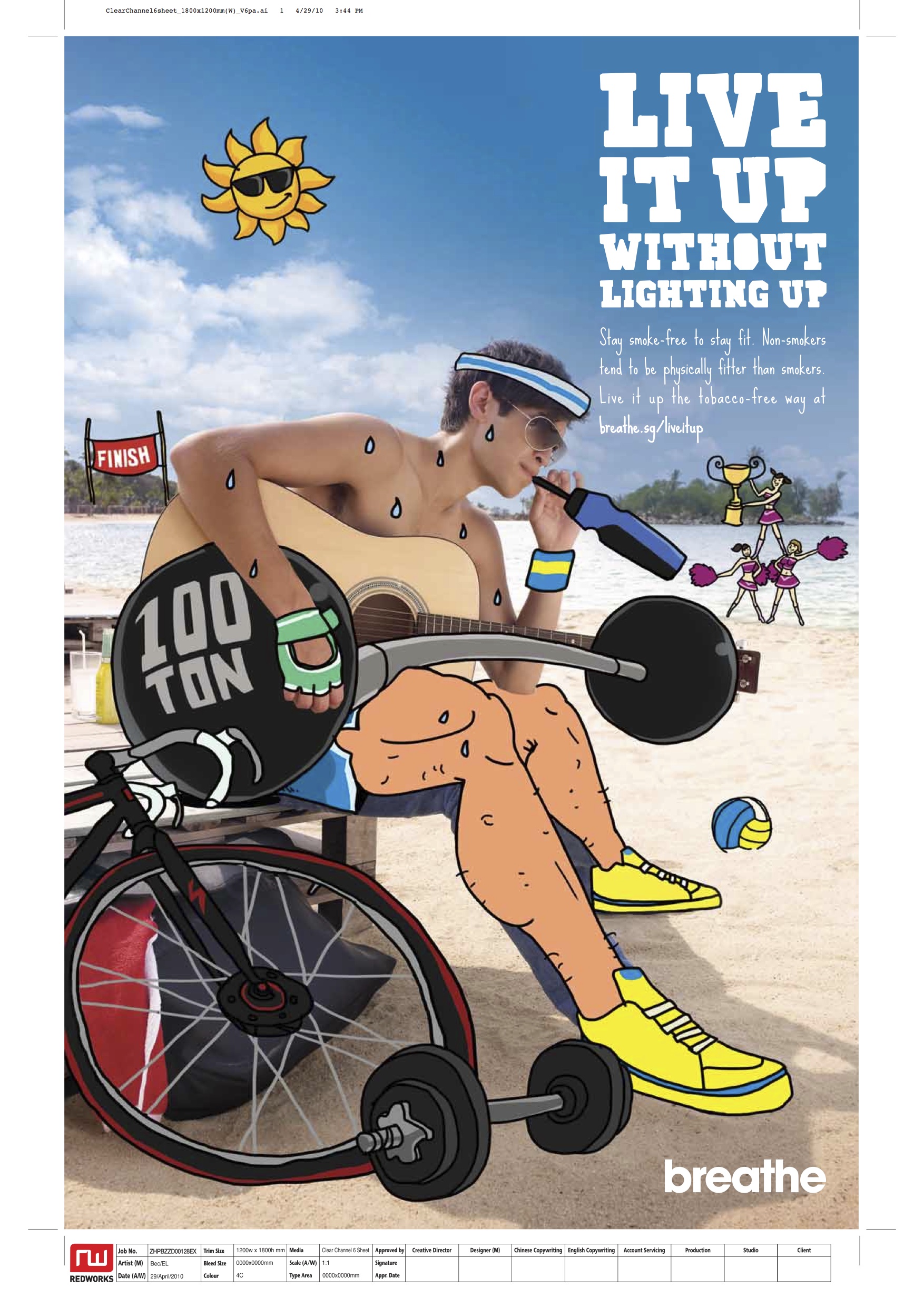
In 2010 the Health Promotion Board appointed Ogilvy & Mather Singapore to develop a creative campaign to encourage young people to ‘reject cigarettes and live a tobacco free life that will improve their appearance, fitness, spending power and contribute positively to the environment’.

The results were ‘Live it up without lighting up’ and examples of the print ads can be seen ogilvy_smoke-1 and ogilvy_smoke2-1. The campaign featured above the line (ATL), out of home (OOH), digital, radio and events such as the Great Audio Experience, held on 29th May 2010 as part of World No Tobacco Day celebrations.
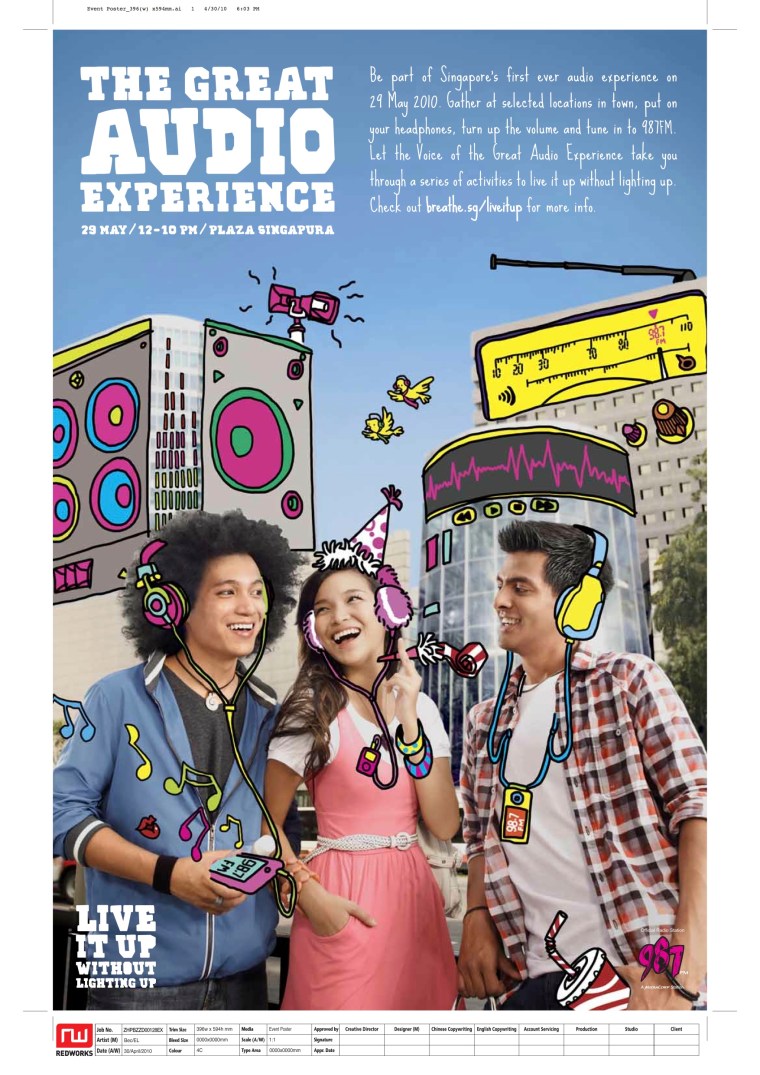
The creatives feature gorgeous, young, happy, confident people with unblemished skin in semi cartoon like environments. Copy tells readers that “Non smokers tend to look younger than smokers of the same age” and “Non smokers tend to be physically fitter than smokers.”

Goals were to communicate a better more beautiful and green world populated by gorgeous young things who are fitter, healthier and generally in a better place as a result of not smoking.

According to Jon Loke, the then Head of Art, Ogilvy & Mather Singapore, the agency was careful to ensure that “the campaign would not talk down to them”.

“We needed to turn the traditional way anti-smoking campaigns are carried out on their heads to create a message that would appeal to youths. Hence, the campaign encourages, empowers and ultimately celebrates a smoke-free life.”

Now I really liked the creatives for this campaign. I think they were really well executed and I wanted the campaign to work. But at the time I sincerely doubted this was the right way forward.

That’s because a creative driven campaign, no matter how much it turns things upside down, is unlikely to have an impact on the number of smokers in Singapore. Data shows that traditional marketing tools are even less effective today than they were as recently as 10 years ago. Consumers simply don’t listen to corporate driven mass marketing the way they used to, especially when copy uses vague terms such as ‘tend’.

Malaysia spent RM100 million (US$30 million) over 5 years on such a campaign that was ineffective in bringing down the number of smokers in Malaysia and the smoking rate of men in Malaysia is still over 50%.

In the UK, after extensive research of more than 8,500 smokers over a ten-year period, the Institute for Social and Economic research found that the warnings on cigarette packets that smoking kills or maims are ineffective in reducing the number of smokers.

Likewise, chilling commercials or emotionally disturbing programs are also ineffective. The study also discovered that even when a close family member becomes ill from the effects of smoking, the smoker takes no notice.

In fact, according to the study, smokers only reduce the number of cigarettes or sometimes quit when their own personal health is at stake. And even failing health may not persuade a smoker to reduce or even stop smoking because smoking is linked to a lack of psychological wellbeing and quite often failing health results in psychological decline.

Now I don’t know if these campaigns are working but if the goal is to reduce smoking then the answer is no they are not. Because according to The Wall Street Journal, more Singaporeans, especially young adults are smoking than ever before.

According to a Singapore National Health Survey in 2010, the proportion of smokers among young Singaporeans aged 18 to 29 was 16.3% in 2010, up 33% from 12.3% in 2004.

Even though previous ad campaigns did not work, the Government of Singapore commissioned Ogilvy & Mather Singapore to develop another campaign. This time the message moved from anti-smoking to pro-quitting. The campaign highlighted citizens who had quit smoking and made them “quitter champions.” ‘im01HealthPromotionBoard-2012-492‘.
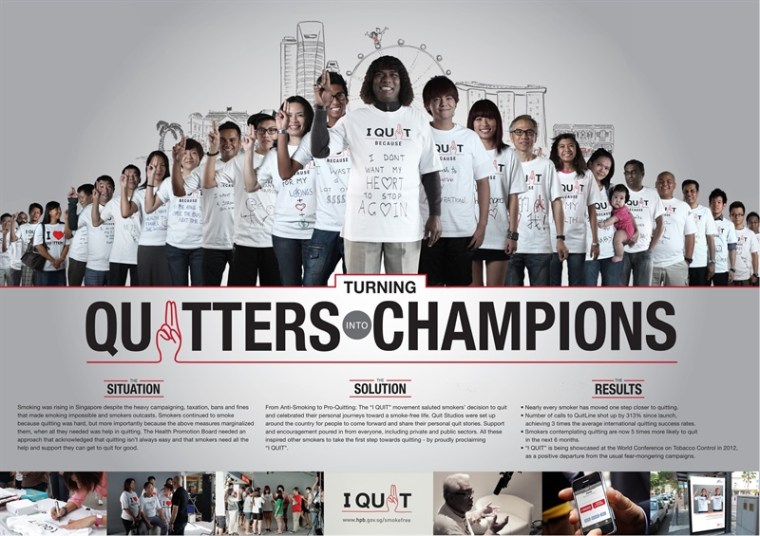
This campaign also featured across traditional and digital media. From 1st June 2013 a quit smoking movement will try to encourage smokers to quit for 28 days in the hope those that commit to the programme will not go back to smoking at the end of the 28 days. We shall see.

So what should Singapore do to reduce smoking in the country?

Countries that really want to reduce the number of smokers (and every country should want to because the burden on the health services will not get better) must understand that advertising is not going to solve their problems. There is no silver bullet to reducing the number of smokers.

What is required is a data driven approach to the issue. Specific and comprehensive qualitative research with relevant targeted questions related to each segment (and each segment will be specific and targetted) that are designed to deliver actionable data. For instance if Singaporeans are becoming smokers when they do their national service, is an advertising campaign going to change that? Of course not. The issue needs to be addressed inside the National Service camps.

It is imperative that audiences are identified and then engaged individually, on a one to one basis. It will be an expensive and long term effort (but not as expensive as wasting money on advertising campaigns and health costs). That doesn’t mean repeating the same one size fits all commercials or messages, this means developing a relationship with these partners through engagement.

Also critical to the development of the strategy will be the buy in from stakeholders such as doctors, educators, retailers and others. Discussions must be held with these key elements to determine strategies. One such strategy will involve retailers where most cigarettes are sold. But before banning sales at retailers, alternative sources of income for retailers must be identified. Once implemented, policing of retailers must be ramped up.

Once research is completed and analysed, a comprehensive strategy must be developed featuring a fully integrated program to communicate with all stakeholders with specific emphasis on education at residential level and dynamic, preventative and educational programmes for schools. Existing smokers will be targetted individually through interviews with doctors, rather than one-size-fits all government driven creative campaigns.

Singapore has done many things right in the past to reduce the numbers of smokers. Investing valuable resources on creative driven campaigns that are proven to have been ineffective in the past is not the way forward.

Turbulence helps Singapore Airlines strengthen its brand


Singapore Airlines only recently reported its group operating profit fell 19.8% to S$229 million (RM564 million). SIA Engineering and SilkAir also reported lower profits while losses for SIA Cargo dived more than 40% from S$119 million to S$167 million.

And then a recent Singapore Airlines flight from Singapore to London made it into the global headlines for all the wrong reasons.

Air turbulence caused the flight to lose altitude just as breakfast was being served. Much of the food and drinks were left all over the cabin and passengers and a potential Public Relations nightmare could have resulted with irate passengers complaining across social media.

Milk and sugar?
Milk and sugar?

However, an event that the airline has little control over turned into a PR success thanks not to the Singapore Airlines corporate PR department but due to the professionalism of the crew and the community approach of the passengers.

As soon as it was safe to do so, the cabin crew checked every passenger and then, with the help of passengers did their best to clean up the mess. When the flight arrived in London, paramedics were waiting to treat the few slightly injured passengers & crew.

As passengers disembarked, the crew handed out an apology, chocolates and of course a big Singapore Airlines smile. A potential disaster averted with good training, responsibility and a customer centric mentality.

Read the full story here