Building brands requires CEOs to understand branding


95% of products fail to become brands, despite over US$1.5 trillion spent on marketing of which about US$500 billion is spent on advertising. And most of that is spent on awareness, reach and other mass market mass economy mass media tactics.

Advertising is important and always will be important to brand building but ‘getting your name out there’ or ‘creating awareness’ are too mass economy and we’re now in the customer economy.

In the customer economy, it is about engaging members of communities that have interests related to your product and entering into a communication initially and a collaboration eventually with certain members of those communities. Throw out the old mass economy mass market attitude that includes carpet bombing consumers with messages via full page ads, TVCs, billboards and one-size-fits-all communications.

But who is to blame? Is it the advertising agencies? Or is it the CEOs? I believe that until CEOs get over their own egos and realise that just because they can see their company name on a 40 foot by 10 foot billboard, or on page 3 of the national newspaper etc etc, doesn’t mean that the rest of us can see through the clutter and even if we do, most of us don’t take any notice because we don’t care.

Until CEOs instead seek accountability and ROI from their advertising, they will, in all likelihood be at the front of the long queue to be one of those products that fail to become brands.

And if advertising agencies continue to make hay, who can blame them?

Top tips for successful city branding


I know I’ve said this before and I am probably beginning to sound like a broken record but advertising agencies do advertising.

And advertising is a tactical initiative driven, on the whole by creativity. Using advertising across one or more channels is a series of tactical initiatives known as a campaign. It is not a brand strategy.

If you want to build a brand, you are not, unless you have extremely deep pockets and are very very lucky, going to do it with advertising alone. This is especially true in the destination branding sector. What is required is a comprehensive, integrated brand strategy that acts as the blueprint that drives multiple interanl and external initiatives, including the very important creative elements developed by advertising agencies and not the other way around.

Bill Baker, author of Destination Branding for Small Cities available here, has written a timely, concise and easy to read set of guidelines for any city or destination that is ready to develop a brand strategy.

The article is here dont_hire_painter-1

I strongly recommend any destination, and for that matter, any company read this article to understand what they need to do before wasting valuable resources on tactical initiatives that will only add to the noise.

Australia Unlimited. Genius or Garbage?


Someone sent me this link about the plans for the Australian government to use a new tagline to sell Australia Inc to the world.

I’m sure you guys have lots to say and I welcome your thoughts on the article. To get the ball rolling here are a couple of thought starters.

1) Australia Unlimited isn’t a brand, it is a tagline created by an advertising agency to be used in creative driven communications using one message to communicate with all stakeholders, irrespective of their requirements for value. The concept of selling ‘Australia to the world” is laughable as most of the world doesn’t care.

2) Here’s a clip from the article, “Shortlisted agencies were given a brief to ”come up with a brand that would promote Australia’s capabilities across a range of sectors from investments and exports to education, culture, sports and events”

How does “Australia Unlimited” do that? And how could any communications campaign appeal to such a diverse prospect base?

3) Here’s another quote from the article, “John Moore, director of brand development of the Global Brands Group, the agency that has been co-ordinating the new Sydney brand, likes the line. ”It takes it beyond tourism and poses the question of what is unlimited about Australia, to which there can be many answers. I think it will work really well as a connecting device with all those different areas [of trade and business].”

Excuse me? How does it do that? I want to set up a mining company in Australia, what can you do for me? That’s the only question I want to pose.

This is another iniative, involving 2 stakeholders, Tourism Australia and Austrade, who should be working together but in fact appear almost to be competing with each other!

Nation Branding and Social Media


A key element of a successful nation branding initiative depends on how well your audience absorbs, understands, adopts and redistributes the message based on their requirements for value. Back in the day this was done at a coffee shop, sundry store, mosque, church, football club or where ever else consumers congregated. Today those same people are increasingly likely to hang out in communities online. Facebook is the most popular home for many communities and it and other forms of Social Media need to be part of any strategic nation branding initiative.

But the Social Media rules are very different to the traditional media rules. And although many nations, organisations and government institutions or destinations believe they understand the new rules, the output of many of them would suggest otherwise. And this is detrimental to the long term success of the nation brand. Social Media channels or tools may not survive as long as many traditional media channels, but Social Media is here to stay.

One country that seems to be doing Social Media right, is the US. The importance of Social Media, and in particular Facebook during Obama’s presidential election campaign is now the stuff of legend. Key to the successes of the campaigns was that campaign personnel asked people what was important to them and then fed that information back to the main office where local service projects were implemented as quickly as possible. Many of of those vote winning projects continue today.

At one stage, in November 2008, Obama had 2,155,244 friends on Facebook, McCain had 578,651 and George W. Bush had none! Little wonder then who won.

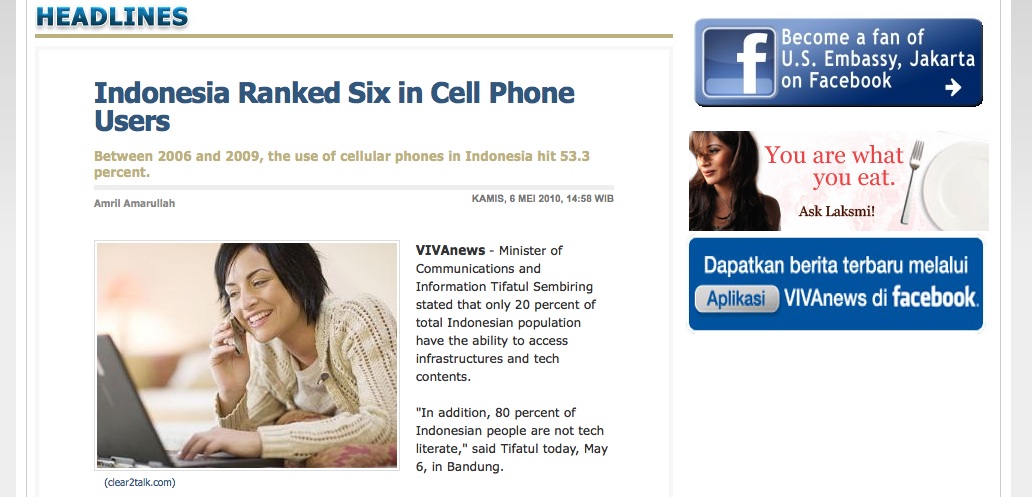
The US has since expanded its use of Social Media to the international arena and the increasing importance of Social Media channels is reflected in the Facebook efforts of the US embassy in Jakarta, Indonesia. The Embassy has invested significant resources into Social Media just as the use of Social Media in the country takes off – the number of active Facebook users in the world’s most populous Muslim country has grown from 2,325,840 in March 2009 to 20,775,320 in March 2010, an increase of 793%!

As the US Embassy in Jakarta has ramped up its presence on Facebook, its fan base has ballooned from 35,000 followers to 131,000 in little more than a month! This in a country not known for its love of the US. But the US embassy understands that this is not a soap box to try and hard sell or influence Indonesians with US policies and attitudes.

As a result, the tone of the Facebook site is light and cheerful. One recent post on the homepage related to Indonesia Batik, has received over 795 comments and more than 2,300 thumbs up. Most of the posts receive 100+ comments and significant numbers of thumbs up. Batik is err a common thread throughout the site and most of the postings are related to American life and culture, and in particular sport, music and popular green initiatives. Other initiatives include Blogger workshops.

Tourism, primarily destinations in the United States are also featured, including a rather ambitious and possibly poorly targetted attempt by Nebraska to attract Indonesians to the Great Plains state. Despite the remoteness of the destination, the video has received over 50 mainly positive comments. Other states using the site to market themselves include Tennessee and Ohio.

The US Embassy markets the site via advertising on local sites such as this one

Social Media and, in this particular case, Facebook is undoubtedly an excellent channel for nations to build their brands by engaging with consumers and offering value to those consumers based on the needs of those consumers, whilst understanding the environment. The USA, certainly in Indonesia seems to know this better than most.

Thanks to unspun for the inspiration for this story

Most Asian firms should not consider Positioning to be the right tool for Branding initiatives


Two of the most famous names in marketing – Jack Trout and Al Ries developed the concept of positioning back in the 1970s. Their business/marketing book, Positioning: The battle for your mind was written in the early 1970s and almost forty years later, is a well thumbed addition to the book shelves of respected marketing professionals around the world.

Jack Trout and Al Ries developed the concept of positioning because they believed that branding was becoming increasingly difficult as audiences were inundated with numerous and confusing communications. Positioning was promoted as a tool to “break through the clutter.”

Today, the following product description for the latest edition of the book on Amazon is: “Positioning” describes a revolutionary approach to creating a “position” in a prospective customer’s mind – one that reflects a company’s own strengths and weaknesses as well as those of its competitors. It goes on to say, “Advertising gurus Ries and Trout explain how to: make and position an industry leader so that its name and message wheedles its way into the collective subconscious of your market – and stays there.”

I disagree with this statement. Positioning may have been revolutionary in the 1970s but it can hardly be described as such today. Furthermore, where I come from, ‘to wheedle’ is not really a flattering term. In fact the free online dictionary has this definition, “To obtain through the use of flattery or guile: a swindler who wheedled my life savings out of me.”

The concept of Positioning also suggests the ‘position’ should be based on being first in a particular category. If another company is already first in the category, then the company should work to redefine itself in a new category to ensure it is first in that category. This was really important to Ries and Trout. In fact so important, that they felt it was more important to be first in the mind than first in the marketplace.

In the mass markets of the 1970s and 1980s, positioning was defined by perceptions. To influence perceptions and maintain a position within the relevant minds, it was imperative that companies dictate the information consumers received.

And, because of the power of mass media, this wasn’t an impossible task. Moreover, because most audiences were relatively passive, and they had little choice of products, well-researched messages were likely to register with targeted audiences.

Furthermore, advertising agencies and in house marketing departments also embraced the concept of positioning because it gave them total control yet there was little opportunity for accountability. After all, it was relatively easy to show progress in awareness or top of mind, but first in the category was tough to measure.

As a result, positioning was adopted by many companies and became a successful tool. In the face of this increased competition, many companies took the wheedling part at face value and started to manipulate information to control a hard fought for position that was threatened on many fronts. Soon fantastic claims were being made in advertising and other channels.

One example is the tobacco industry that tried to convince consumers that tobacco wasn’t addictive. Ford made a similar attempt to persuade prospects that the Pinto did not have design issues. More recently there were some outrageous claims around the Enron scandal and certain financial institutions last year were wheedling furiously!

Unsurprisingly, this has caused consumers to become more disillusioned and cynical and less likely to pay attention to claims made by advertisers. Here in Malaysia, 84% of those polled in a recent study by a daily newspaper said they didn’t believe what they read in advertisements. This despite the fact that many of the companies featured in those ads were attempting to position themselves in the minds of those very consumers.

Because positioning relies on mass media, it has to appeal to as many people as possible. This may be alright in a single or homogeneous market but what happens when a market is segmented?

Furthermore, firms consider a positioning campaign to be the communication of a particular message to a mass audience. But what happens if that audience doesn’t listen or accept the message? The advertising agency will tell the company to do it again, perhaps after tweaking the creatives a bit. This is also known as repositioning.

Jack Trout, this time with Steve Rivkin, released a book last year entitled REPOSITIONING: Marketing in an Era of Competition, Change and Crisis. The back cover calls this “A brilliant new book” and states, “So you’ve mastered the art of marketing. You’ve positioned your company, branded your product, and targeted your consumer. Unfortunately, in today’s economy, that’s not enough. You need REPOSITIONING.”

I haven’t read the book so I can’t comment but I have my doubts as to the effectiveness of repositioning.

Don’t get me wrong, I do think that positioning is a tool that was, in its time and for many products, a very good tool. But I don’t think it has a role to play in today’s customer driven economy. There may be some exceptions such as in the destination branding sector and some soft drinks may benefit but these are the exceptions not the rule.

I know it is hard to let go and there will be a lot of resistance to what I have written. After all, so much effort by so many people has gone into learning about positioning. But the world has changed. More importantly, consumers have changed. And marketers should acknowledge this and change with it.

Communications and the way consumers live have changed a lot over the last 40 years. Isn’t it time Branding and the way brands are built and the tools used to build those brands changed too?

Negative brand association, real world examples


In October of last year, I wrote a piece on my blog about negative brand association. You can read the short post here

David Ansett of Storm in Australia approached the subject from a different angle and you can read his piece here

Essentially, my attitude is that if the concept of positioning a product in a consumers mind is a serious concept then it is only logical to assume that the same process can have a negative impact on the brand. Over the next few months, I will post examples that I encounter and I hope you guys will enter into a conversation with me on the impact, either positive or negative, of this brand association.

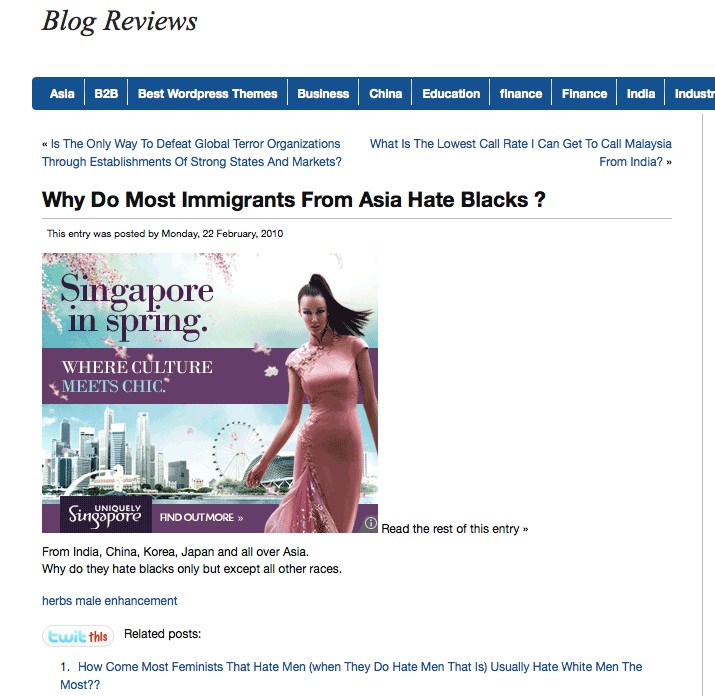
So we’ll kick of this project with a grab of a page I encountered today. I saw the question after answering another question and thought to myself that it would be interesting to see what, if any, the responses to the question might be.

As you can imagine I was shocked to see the ad right under the controversial, not to mention provocative question!

Today’s negative brand association story comes from the BBC site. This time it is a video about a drunk driver in China who is caught on film smashing into road dividers and barricades. You can see the full video here

You’ll note that the story is preceeded by a commercial for Lexus!

Here is a still image from the end of the commercial.

Actually this could also be included in brand disasters. Is it appropriate for a luxury brand such as Lexus to be associated with a drunk driver? Or does it not make a difference?

Any comments?

How Asian firms and politicians can adopt social media into their strategy


When TV first started, commercials consisted of a presenter standing in front of a microphone reading from a script. Why? Because that was how it had always been done on radio. It took companies a few years to leverage the power of TV but eventually they did and now TV ad spend is estimated to be in the region of US$500 billion annually.

And in the same way as first the radio and then the television changed the way companies pass on information to consumers in the 20th century, social media is changing the way consumers source information about businesses in the 21st century. But social media will have an even bigger impact than radio and television because social media is not only changing the way we make decisions related to brands, social medial is changing the way we do business.

Consumers receive up to 5,000 messages a day
Back in the day, companies used radio and then TV to build brands by developing a one-size-fits-all message and broadcasting that message to as many consumers as possible as often as required. All communications were one way and the messages contained only the information the company wanted to share and the consumer was expected to accept this information and not dispute it. In a more trusting world, with limited competition and smaller markets, consumers were accommodating. Unfortunately, more and more companies adopted the same strategy. Soon consumers were inundated with up to 5,000 messages a day, many of them making increasingly outrageous claims.

Companies were unable to follow through on the promises made in advertising and trust, the key element of any relationship, was eroded. Repeatedly let down, consumers began to look elsewhere for independent information and the truth. They found it with other consumers. Consumers now source their information on brands from other consumers. Today, consumers have the power to make a brand succeed or fail. As consumers learn the truth about a brand, the reputation of companies and their brands is being determined, shaped, altered and increasingly discarded by consumers.

Dynamic process
And it is an ongoing, dynamic process. At any given time, consumers are searching for information on a product or service that has caught their eye. But they are not sourcing that information from TV commercials, the radio or the company website, they are looking to other consumers for the information they require.

And they are doing it, on the whole via social media. And social media is yet another tool that organizations must embrace because it is replacing marketers and the marketing department and other barriers between the organization and the consumer.

Social media cost of entry is low
Social media is not a fad. Those companies that don’t buy into social media will be left behind. But a lot of companies in Malaysia are going to be intimidated at the prospect of opening their virtual doors and giving the general public the opportunity to interface directly with them. But they are going to be talked about anyway so they might as well be part of the conversation. That way at least, they will have the chance to contribute a corporate take on all issues. And the good news is that the cost of entry is low and there are very few barriers to participation.

So what should Malaysian firms do to leverage social media?

1. The first thing they have to understand is that social media is not about you. It is not PR and it is not advertising. Social media is not for the hard sell, it is for engaging prospects and customers and for entering into two way conversations with them. Do this, and you will get opinions on issues that are important to an audience who is interested in your product. If you listen and use this information wisely, you will be able to match your product attributes to your customer requirements for value.

2. Identify which social media platforms you intend to use and develop a strategy to use them. Transparency, consistency, honesty and longevity are key so don’t just jump in and fire away for a fortnight of frantic activity and then get bored and stop communicating.

3. Do some research and find out how your customers are using social media, what platforms and so on. 350,000,000 million people read blogs. Identify which ones your prospects and customers are reading and how can you get involved by responding to articles.

4. Offer forums on your website that allow customers to express freely their experiences of using your products. You’ll be astonished at how valuable the feedback will be as you listen to what really matters to consumers and incorporate the feedback into your strategy.

5. Over time, develop a formal process to monitor and review what consumers are saying about you and where they are saying it. This monitoring will allow you to enter into dialogues that are very personal and transparent. It will also allow you to address negative issues as they arise and before they develop into crises. Casual monitoring will give you a real time view of what is being said but it is resource consuming and may not be as effective as a more formal program via a third party such as BuzzMetrics.

6. Set up blogs for key customer facing departments. Blogs are a great sounding board and instantly engage prospects and customers. Be honest, develop a personality but don’t try to sell your products. Don’t worry if your opinions differ to those of the audience. Open and transparent responses are what your audience is looking for.

7. Social media requires a fresh approach to content. Too many Malaysian firms are simply paying ‘lip service’ to social media. One government agency simply copied and pasted its website onto its Facebook page and then left it for nine months!

8. Social media is a platform for communication and collaboration, not a soapbox. Some companies simply tell followers about special offers. A number of politicians use Twitter to tell everyone what they are doing yet ignore specific issues raised by voters.

So as you embark on your social media strategy, remember that the digital environment is immense and fluid. Understand that you must change the corporate approach of one that aims to push messages onto consumers, to one that aims to listen to what they have and then responds to those issues. Take these first steps and you’ll soon learn to leverage the powers of social media and throw away the script.

Case study: Use research to form the foundations of a tourism brand strategy


A powerful country brand developed from a meticulously planned strategy that has at its heart the concept of providing specific value to specific identified segments and meticulously executed and measured can yield massive benefits for investment, domestic industries and culture.

And for most South East Asian countries, tourism will have a prominent role to play in their country brand strategies. And so it should be as most governments recognize the contribution of tourism to stimulating economic growth across all sectors of society.

It also helps that tourism is also considered to be the world’s largest industry with revenue of over US$500 billion. The World Tourism Organisation (UNWTO) estimates International tourist arrivals for 2009 to be at 880 million. Although this was a 4% drop over the previous year, Asia and the pacific saw the first signs of recovery with positive growth in the last 2 quarters.

Going forward, the UNWTO expects international arrivals to reach 1.56 billion by 2020. Of these, almost 400 million are expected to head for Asia and the pacific.

But because of the tendency of politicians to seek a quick fix, most Asian tourism brand strategies look no further than creative advertising campaigns that look the same as many other destinations and are soon lost in the muddle of messages currently carpet bombing consumers.

One country in South East Asia has recognized the futility of this approach and commissioned us to develop a brand strategy based on trade and consumer requirements for value. Client confidentiality doesn’t allow me to reveal the country involved however I am able to share the methodology and some of the results and findings.

The project took just almost 2 years from appointment to implementation of the strategy however some urgent recommendations were implemented earlier.

The tourism office is tasked with marketing the country both domestically and internationally. Our focus was internationally. They were facing a number of challenges including:

Challenges
1) The increased effectiveness of competitor marketing strategies. All regional competitors are investing heavily in tourism products and developing segment focused branding campaigns.

2) Growing ineffectiveness of mass marketing, especially generic print & TV advertising. Increasingly fragmented media and an increase in leisure time activities are making it harder to reach consumers via traditional channels.

3) The increase in the influence of the Internet on the destination decision-making process, especially the increased influence of peer-to-peer networks. Figures released by The Association of British Travel Agents (ABTA) in November 2004 showed that 19% of holidaymakers booked their holiday online – six times more than in 2000. By 2008, this figure had grown to 67% (Online shopping survey). Only about 13% of those surveyed said they would use a travel agent. The Internet is also growing in importance as a communications medium through P2P networks with 34% of respondents to a Mintel survey choosing their destination on the basis of a face-to-face recommendation

4) Poor repeat visitor rates. Repeat visitors not only represent an increased return on the initial marketing investment but also tend to stay longer and spend more. Additionally, they represent a low-cost source of referrals and other word-of mouth advantages. Currently, the country has a below average number of repeat visitors compared to two main competitors which represents a threat to future growth.

5) Lack of awareness and knowledge of the country worldwide. What has been the impact of the country advertising? Has it been effective in improving the perception of the country? How much is it contributing to tourism in the country?

Our research showed that there were about 600,000 competing communities in Asia and more than 1,000 regional and national economic development agencies, all competing for visitors. This made it easy for even the most compelling messages to get lost amid all the destination claims.

We recommended to the client that in this cluttered environment, effective branding depends on data and knowledge about current and prospective visitors and not simply trendy creative campaigns featuring mass marketing tactics across all major channels.

Moreover, choosing the most effective branding strategy depended on sound market & customer research to determine current attitudes and perceptions toward the country among travel agents, previous visitors to the country and those that had never visited the country.

Measurement
By understanding the sources of those perceptions and attitudes, the client would be better able to evaluate current branding efforts, develop strategies to target high-impact segments with the most potential more effectively, drive internal education and other program development, leverage the emerging medium of Web 2.0, develop benchmarks to measure branding progress and ensure that resources were used cost-effectively.

The research could also be used to pinpoint, prioritise and drive online community-based branding. A core requirement as consumers spend more time in those communities.

Other key requirements included communicating knowledge of current branding and target market imperatives among personnel, as well as ensuring knowledge and data transfer.

After extensive discussions with the research division and others and to provide a 360-degree approach to understanding the brand, FusionBrand developed and conducted a multi-phase, six-month international research project that incorporated multiple research methodologies.

These methodologies included:

• 39 focus groups (FG) in thirteen locations in twelve countries comprised of 3 segments:
o Travel Agents
o Travelers who have visited the country in previous 3 years
o Travelers who have not visited the country but have traveled long haul in last 3 years
• Online surveys
o 12 countries
o Worldwide via client website
• Mystery shops in specific countries plus home country
• Internet CGM (consumer-generated media) monitoring & analysis
o 22 million blogs
o 60,000 usenet forums
o 6,000 discussion forums
o Plus podcasts, web sites etc.
• Internal brand audit in HQ and at tourism offices worldwide
o One-on-one, in-depth interviews with domestic & international staff
• External brand audit
o In depth interviews in specific countries
o 3 segments
o Tourist operators & agencies
o Media representatives
o Local tourism associations
• Communications audit (print)
o Brand analysis of print materials
o Comparative analysis of 11 regional competitor materials
o Framework for evaluation, scoring & future design developed
• Communications audit digital
o Own sites
o Brand evaluation based on Internet & customer relationship best practices
o Social Media initiatives

The countries were located in the following regions:

• Asia
• North America
• Europe
• Middle East
• Australia

The research project completely designed by FusionBrand was not only comprehensive, but innovative as well. For example, the Internet monitoring had yet to be accomplished by any destination, while the digital communications audit looked at what is necessary to advance into the emerging era of Internet 2.0.

Output was comprehensive and extensive and included:

• Recording and analysis of relevant input in complete reports
• County-by-country reports concerning perceptions and experiences with the country, including key influencers on travel destination selection
• Brand workshops for client personnel incorporating research results to ensure a corporate-wide understanding of the country brand strategy
• Analysis of Internet and marketing collateral relevance and effectiveness in segment-based branding
• Review of social media initiatives
• Quantitative benchmarks concerning experiences, perceptions, influencers and preferences of target segments
• Detailed insights concerning five key target segments identified in conjunction with the client

Each report not only included the findings from the research, but also prioritised recommendations for addressing the issues raised by the research.

Over 300 actionable recommendations
More than 300 actionable recommendations were made. These recommendations were incorporated into a comprehensive, segment-based brand plan that was developed over six months. The brand plan had a strong emphasis on the internet and social marketing and included strategic planning for marketing, advertising, both online and traditional, public relations, direct marketing, web and other programmes and outlined goals, messages, target markets, measurements, activities, timelines, responsibilities and budgets.

The benefits include consistent messaging and images among target markets, synergy among multiple programs, and elimination of uncoordinated activities that were wasting resources. Crucially, the brand plan also provides tools to evaluate program results.

In addition, in conjunction with representatives in country, country specific brand plans were developed. The Country Brand Plans are primarily focused on specific marketing activities within those countries. These activities include, but are not limited to, PR, local trade shows, agent recruitment and communications, cultural events, advertising, segment specific publications, promotional events, etc.

Although the brand strategy was for 2009, urgent recommendations such as consolidation and improvements to web sites and the appointment of regional PR companies were implemented immediately.

A key element of branding is consistency and yet, during the communications audit, the lack of consistency was evident. A strong recommendation was made for a corporate identity brand manual to be developed immediately. The manual was conceptualized and completed by FusionBrand in 4 months, during the writing of the 2009 brand plan.

Throughout the research and planning process, workshops were designed and presented to client personnel to keep them abreast of the process and educate them.

The project has been deemed a success with many targets met ahead of or on schedule. Furthermore significant savings have been made in a number of areas such as a reduction in collateral printing and a move to print on demand. Finally the destination has appeared on more than one ‘must visit’ destination for 2010 for the first time in its history.
8 reasons why the iPad will fail


Apple owns some of the finest brands on the planet. And I’m an Apple loyalist and brand ambassador. I bought the green iMac when it first arrived in Malaysia. Even though there wasn’t any software to run on it and because it wasn’t compatible with anything else it required multiple peripherals. And even though it spent more time being fixed than it did on my desk and despite the fact that the keyboard was awkward and the mouse hopeless, I loved it and I’ve never had anything else since.

I now have macs in my home and at the office. Every morning when I walk into the office I catch my breath as I look at the sleek lines and brilliant screen of my top of the line iMac.

Every member of my family has an iPod and my two older kids have macbooks. I even convinced my luddite wife to switch from PCs to macs and her company now has 10 of them. Baes on my recommendations, at least one friend bought macs for his event management firm.

I’ve seen the stock I once owned soar over 5,000% from the price I sold it at.

And even though I know that Apple is making margins of over 40% on some of the products I own, I buy them because they are cutting edge in terms of design and functionality, are easy to use and have great features. And because the experience I have with my sales agent is brilliant and he’ll come to my house at nine o’clock at night to help me troubleshoot. At every touchpoint, it’s a great brand.

So you’ll never hear me say a bad word about a mac product. But I think the iPad is a mistake. And here are 8 reasons why:

1) It doesn’t have a camera or a webcam. If the iPod can have a camera, why can’t the iPad? A webcam would also have made sense.
2) The touch screen on the iPod is temperamental so if it’s the same with the iPad, users will need an external keyboard. Reading through the information, users will have to buy a separate keyboard that costs US$75 and can’t use any of their existing Apple keyboards.
3) The iPad doesn’t have any USB ports or card slots so I’m not sure how users are supposed to transfer documents from other devices. There is an iPod connector feature that means users will have to buy another adapter.
4) The iPad doesn’t have Adobe flash which means that any web pages that have applications, videos or advertisements on them will have large blank areas. You read that correctly, users can’t watch video on websites. If true, what are the implications for the travel industry?
5) The iPad doesn’t allow more than one programme to run at a time. So users can’t be working on a document in word and have a video downloading on youtube at the same time.
6) The iPad is not HD ready so watching movies will not be the experience it should be.
7) It can’t be used as a phone.
8) Apple will be able to remotely disable applications.

Before the launch of the iPad The Wall Street Journal wrote: ‘The last time there was this much excitement about a tablet, it had some commandments written on it.’ Apple leapt on that and included it in there marketing collateral at the launch.

Personally, whilst it won’t affect Apple’s position as one of the finest brands on the planet, I don’t think the iPad will fly. Only time will tell if I am right. What do you think?

Stop your product joining the 95% club


According to an Ernst & Young study, the failure rate of new U.S. consumer products is 95%. 95%! Imagine if Boeing or Airbus had a 5% success rate! Yet despite this appalling return, companies spend approximately US$1.5 trillion on marketing, and in particular advertising, annually!

A couple of years ago, (before the explosion of social media, Dominique Hanssens, a director at the Marketing Science Institute in the US and a professor at UCLA’s Anderson Graduate School of Management, reported that the average advertising elasticity for established products is .01. He went on to say that if one of those brands increased its advertising expenditure by 100%, it would see a sales increase of only 1%.

He used as an example Anheuser-Busch. If the firm doubled the US$445 million that it was spending at the time on TV, print, radio, outdoor, and Internet advertising, it would enjoy a 1% increase in net revenues from the then base of US$5.7 billion. Put another way, Anheuser-Busch would spend a total of US$890 million to make US$57 million.

We have to accept that mass economy models that made global brands out of such products as Coke, Budweiser, Marlboro, Sony and others are no longer relevant. And if firms continue to invest in outdated tactics that no longer work, their products will join the 95% club.

If they are to survive, brands today must address current branding imperatives. Current branding imperatives include building and maintaining relationships with customers and partners, internal communication, education, understanding and adaptation of corporate goals throughout the organisations.

Clearly defined organisational processes that are developed with the customer in mind and not shareholders or the organisation. These processes must be developed for both customer facing and non-customer facing departments, not independently but in tandem.

Communications, including advertising are important, but not the traditional one size fits all mass market approach. Communications must understand the requirements of prospects and customers and communicate with them using content that resonates with them via channels that are relevant to them.

Branding imperatives also require effective use of technology and, most important of all, ongoing feedback, measurement and improvement. These establish the foundations for identifying prospects and acquiring and retaining (key to brand success) profitable customers.

If John McEnroe were to play tennis against Roger Federer today, using the racquets he played with back in the day, he might win a few points but he is going to lose the match. It is the same for companies who fail to adapt to the branding imperatives of today.

If consultants recommend you emulate models used by such brands as Coke, Pepsi, Sony and other mass economy brands that were built when tennis racquets were made of wood, show them the door. Likewise, enormous budgets, integrated, synergistic, holistic, innovative, design or creative driven, energetic, positioning campaigns will not establish a brand.

Companies, and governments must understand that there is no quick way to build a brand. It is this obsession and belief that there is a silver bullet and it is called advertising that keeps the 95% club growing.