Telling a story has always been an important element of brand building but sadly too many CEOs have left it to advertising agencies and creative campaigns to try and tell their story.
This model is flawed because it nearly always focuses more on creativity than content. It is also flawed because few brands have the deep pockets required to sustain such a creative campaign. And the limitations of traditional media mean that it is extremely expensive to try and build a brand this way. And, if the truth be told, too many advertising agencies are often more interested in the next design award than they are on delivering good quality content.
Social Media gives brands the platform and reach they have always wanted, without the costs. Moreover, the increasing importance and influence of social media means that the ability to tell a story and share that story and encourage the sharing of that story further across the ecosystem is now so critically important to an organisation that it no longer needs to be left in the hands of advertising agencies.
This infographic from NCM Fathom maps out nicely what you need to include, what channels to use, why you need to develop stories and the benefits of doing so.
I asked my secretary to find a new supplier. So she did what everyone does and turned to the Internet. After narrowing down the right search terms, she carried out a search and came up with three websites.
The first one we emailed replied within a couple of hours and asked us to come to their factory to see how they work. The contact made an appointment and followed up with an email with directions to the factory. Excellent.
The second company we called hasn’t replied yet.
We asked the third company we called to come to the office and show us some samples. The contact replied, “We’re very busy for the next two weeks.”
Now I don’t know about you guys but I thought the whole point of a website is to generate leads which are then turned into prospects who are eventually turned into customers.
This company is obviously doing so well they don’t need any new business. I suggest they also take down their website as well as it must be annoying answering the phone to potential customers who don’t simply give them business.
A fascinating insight into the social media and mobile shopping habits of consumers in the United States, United Kingdom, Australia and Singapore has just been released by SDL in the UK.
The survey size is a little small – 4,000 people in four countries – but the results unearth new data on how social media and mobile are influencing how consumers interact and build relations with brands.
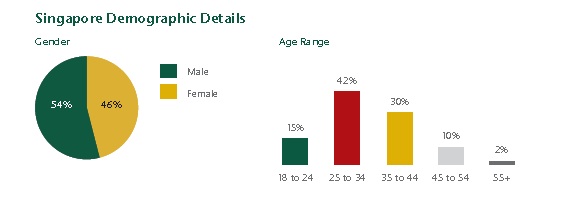
Singapore participant breakdown
Findings include:
33% of respondents from all four countries have acted on promotions seen on social media.
58% of respondents have shared positive experiences online and have sought advice from friends and family when talking about brands on social media.
U.K. respondents are more likely than respondents from the other four countries to complain about service on social.
When respondents express feedback, Facebook is the most popular platform to do this.
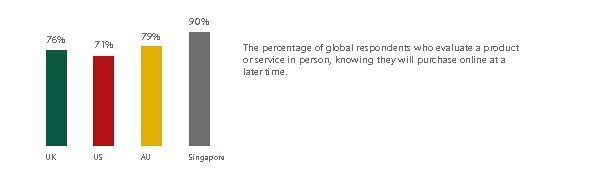
Showrooming (visiting a physical location to evaluate products and services even when you know you will buy online at another time) is increasingly prevalent as 77% of participants showroom.
Experiential branding key to branding success
62% of the participants use a mobile device when in stores to compare product prices.
69% of respondents from all four countries expect a brand’s online store, mobile app, and physical store to offer the same pricing, discounts and sales.
Pricing consistency is expected in all countries
What can brands learn from this thought provoking survey?
They need to understand their relationship with consumers and what resonates with those consumers.
Brands that ensure parity in pricing and products across multiple channels will have to place greater emphasis on the customer experience and experiential branding if they want to win and retain business. Those that compete on price alone will soon be out of business.
Department stores and other retail outlets that represent multiple brands will have to work harder to engage consumers and ensure a positive brand experience otherwise they face the prospect of losing customers, possibly forever.
Mobiles are changing the way consumers research and learn about brands.
Brands that take the time to build relationships with core fans or brand evangelists will see their brands promoted to thousands of fans for minimal financial investment.
Those brands with digital brand strategies that go beyond tactical campaigns online are increasing sales through loyalty and advocacy.
Brands that try to control content and manage corporate driven messages and ignore consumers are unlikely to last very long in the consumer economy of today.
Telling the brand story online should be done across Facebook and other popular platforms with the ongoing development of corporate and consumer content.
Italy is the fifth most visited country in the world and gets over 44 million tourists a year. Tourism is estimated to generate revenue of £120 billion (RM600 billion) per year.
It’s a lucrative industry and one that needs protecting. So the last thing they need is a negative story that could drive visitors away.
Recently, 4 British tourists visited Rome and were forced to pay £54 (RM270) for four ice creams. Now I know Italian ice cream is supposed to be the best in the world but it isn’t THAT good.
Stunned, the group paid but later complained to an Italian newspaper and soon after the story made the front pages of many newspapers in the UK.
Mindful of the impact negative stories have had on other countries such as India where brutal gang rapes of female tourists have resulted in a 25% drop in arrivals, tourism officials were quick to react.
They got in touch with the tourists and invited them back to the city as guests of the mayor. This time they were flown to the city, met at the airport, given free accommodation at the luxury Jumeirah Grand Hotel – rooms from £500 (RM2,500) per night, free meals and free tours of the city.
No trip to Rome is complete without a trip to Harry’s Bar
They were treated like kings and shown around the Piazza Navona, Capitoline Museums and archeological remains of ancient Villas. And of course they stopped off at Harry’s Bar on the Via Veneto for a drink.
The response from quick thinking Italian tourism officials has turned a negative news story into a positive one and ensured the story did not escalate into something that could have had a detrimental effect on the lucrative tourism industry. Simple but effective. In the event of something similar happening to you, do you have a plan in place to do the same?
As the advertising agency driven ‘big idea’ developed to push out a corporate controlled message continues to lose steam, social media and multiple new platforms, devices and applications mean that marketers have less control over the brand. Indeed, as consumers not companies now define brands, those marketers need to learn how to engage consumers on an ongoing basis.
This will be driven by content development and engagement across social media and digital mobile marketing.
This infographic from dotcominfoway suggests the most likely tools and technologies that will most influence the digital marketing landscape in 2013.
The Malaysian automotive industry consists of two low-end manufacturers. To help these manufacturers, the government protects them with massive import duties, sales and other taxes that can jack up the price of an imported car with a large engine by as much as 155%.
In addition to these taxes an Approved Permit (AP) is required to import a car. These can cost around RM30,000 (US$10,000) each.
This makes it a tough country in which to sell foreign cars, especially luxury vehicles. To give you an example, a BMW 3 series that costs approximately £30,000 (RM150,000) in the UK, will cost about RM230,000 (£46,000) in Malaysia.
Top selling luxury cars in Malaysia
The BMW 3 series and the Mercedes C class are the most popular of all luxury vehicles in Malaysia. Sales of the BMW 3 series are around 2,000 units per year and the Mercedes C class slightly higher at 2,200 units. Both these models account for about 40% of each manufacturer’s total annual sales in Malaysia.
Mercedes Benz C class interior
So you would expect any dealer that makes a living selling and servicing luxury cars to be on top of their game. Right?
In November and December 2012, a prospect visited a number of luxury auto dealers and had a few test drives. During one test drive, the sales person spent the whole time texting.
On another occasion, at a different showroom he was approached by an executive who began the discussion by arguing about whether a particular vehicle in the showroom was the latest model.
Despite operating in a very competitive space, neither sales executive followed up on the prospect’s visit. However one of them does send ad hoc emails focusing on discounts.
Eventually the prospect asked a friend to refer him to someone at one of the main dealers. He was introduced to a senior Director who referred him to a manager who referred him to an assistant manager. Despite this the prospect purchased a new Mercedes Benz C250 because this dealer offered a larger discount than any of the other dealers.
Even this luxury car dealer who got a referral from a supplier and made a sale with zero marketing investment has done little to build a relationship with the customer, preferring instead to simply sell a car. More on this later.
Selling a luxury product is not like selling a bag of rice
More than any other sector, luxury brands must have people who know how to build relationships with customers. The market for these brands is 0.02% of the Malaysian population. It is not like selling rice, LCD TVs, Computers or Fax machines where volume is the key to success.
Ensuring a luxury purchase requires an investment in time and effort to build a relationship. A one-to-one relationship with a representative that offers individual specific value, exclusivity and personalisation is what customers want.
Levels of service must be exemplary because customers in this space have so much choice and have worked hard for their disposable income.
They want to be seen as special, important and part of a select club and not simply as another anonymous person in an anonymous crowd buying an anonymous product.
In the first month after purchase, our buyer received two or three calls and both times the callers were essentially going through the motions of ticking service and satisfaction boxes.
Since then he has heard nothing. Then last week he received a text message. It is enclosed here, in full.
Poorly written, too familiar and a lazy way to try and upsell a luxury product!
Pathetic I know. And the cars listed in the text are not cheaper. We’re talking about RM350,000 (£75,000) and upwards!
Now manufacturers, dealers and salesmen are going to say that all that matters is price and discounts but that is only because you cannot be bothered to build relationships with prospects and customers.
So what should this dealer of luxury automobiles do differently? Here are 10 things they need to do and do fast:
1) Recruit the right people and train them not with generic training courses that are used for automotive today and property tomorrow, but with bespoke training relevant to your brand, your industry and your customers.
2) Use technology correctly. Text messages are not a sales tool.
3) Put in place processes and systems that must be adhered to. For instance, if a member of staff has never met a customer before, the relationship must start on a formal footing, at least to begin with. Depending on how the relationship evolves, staff may be allowed to become more familiar.
4) Telling isn’t selling. Appeal to prospect emotions by identifying individual requirements for value and matching your product attributes to those preferences. You don’t sell cars, you realize dreams.
5) Service, service, service. Every interaction with a luxury brand must be of the highest level and expectations must be exceeded every time.
6) Make the experience of dealing with the brand special, unique, glorious but never, ever assume the customer will come back.
7) Too many brands spend a fortune on marketing and then practically ignore the customer. You have a 50% chance of selling to an existing customer and only a 15% chance of selling to a new customer. But sending a poorly written text is not going to retain a customer.
8) Don’t discount.
9) Carry out a sales process audit and sales skills analysis (yes, we can do that for you) and improve the skills of your customer facing staff.
10) Don’t waste time measuring satisfaction. It offers no value.
There is talk of liberalisation of the Malaysian automotive market but the reality is there won’t be any significant changes soon. Luxury brands need to know how to build relationships and realise dreams, not sell cars.
Whilst researching a chapter for my new book (you can get an idea of how the book will go by reading this article here) I came across a fascinating company called Undercurrent.
One of the key players in the firm is a guy called Aaron Dignan. You can follow him on Twitter here.
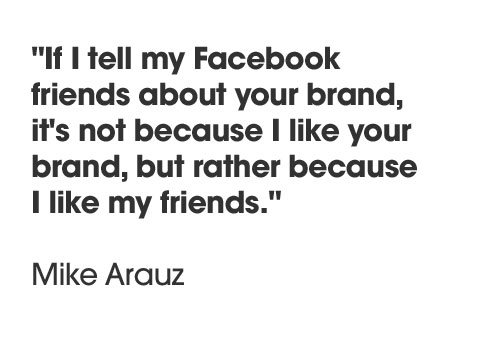
I was impressed by much of what I read on their website but whilst continuing my research, I also found this quote from Aaron:
Do you really understand Facebook?
This simple quote sums up the new world order of branding. It is not about you. Consumers really don’t care about you and your brand. There are so many brands out there that consumers are no longer buying into brands in the same way as they did before.
There are exceptions but on the whole, the world is changing and brands can no longer expect to have the loyalty they used to take for granted. Do you agree?
Are you happy with your branding activities? Or do you find the money you spend does little to build your brand?
Unfortunately, most branding initiatives revolve around a creative campaign developed by an advertising agency. Depending on budget, the creative campaign will be implemented with a one-size-fits-all message communicated to all and sundry and across multiple mass media platforms for as long as budget allows.
The model essentially revolves around hope – hope that lots of people will see the campaign, hope that amongst those people will be the target markets, hope that the message will resonate with those target markets, hope that those target markets will remember and hope that if they remember they will act.
In a noisy world, is a traditional approach to building a brand going to make you stand out?
So basically, the ‘strategy’ is one of hope. Chances are if it doesn’t work, the agency will, if you haven’t already fired them, propose more of the same.
For most brands this approach is an exercise in futility. Wouldn’t it be better to first get an understanding of where your brand is – both internally and externally?
In the social economy, where consumers not companies define brands, don’t you want to know what your stakeholders want from your brand, what you are doing right (and wrong), the channels they are most likely to interface with, their influencers and more?
Internal and external brand and communications audits can both help determine how effective your branding activities have been and, more importantly, what they need to accomplish in the future.
In the social economy, a brand audit is the first step to building a brand
Brand audits have multiple advantages. They provide a benchmark to evaluate the current brand position. Carried out every 2 years they can evaluate progress toward branding goals. They also unify an organization. Too often, everyone has a different definition of branding. A brand audit will identify this and provide recommendations for improvement.
Indeed, a brand audit can provide a consistent, universally accepted brand DNA and from that a definition that ensures that everyone in the organisation is marching to the beat of the same branding drum. Finally, a brand audit can help eliminate the all-too-common disconnect between what companies believe their brand to be and what customers perceive it to be.
An internal brand audit takes the brand temperature from corporate executives and other personnel. One-on-one confidential interviews probe to determine each individual’s perceptions of the brand, branding goals, evaluation of past branding activities, knowledge of key corporate or brand messages and other key points.
An Internal brand audit is a key component of any brand strategy, when did you last carry out an Internal brand audit?
What are the current branding and customer processes, and how can they be improved? One great question to ask is: “Imagine it is five years from now, and the company is celebrating historic financial and market success. How did the company arrive at this point? What are some of the activities that brought us to such success?”
A brand audit can cover a wide cross section of departments but must have the customer and the customer’s needs at its core. What do we know about customers? Are we collecting THE RIGHT data? Is relevant customer data being added to corporate databases? Is customer information shared with other areas of the company? What initiatives are on the horizon that will affect certain customers and how will this be addressed?
A minimum of 25 minutes is required for each interview, but they can take up to an hour. Questions can be prepared beforehand, but the most valuable insights often result from free-ranging discussions on relevant topics.
A key component of a brand audit is a communications audit, which is especially useful for larger firms with multiple divisions or departments that get involved in branding activities.
A communications audit looks at all the visual material that represents a brand – the brand identity, sales documentation, press releases, ads, brochures, Web sites, social media channels, merchandise, vehicles, logos, etc.
Too many so called brand strategies are really just pointless journeys to unknown destinations
Analysis then determines the amount of consistency and integration in appearance/design, messages and their relevance to target markets (in a noisy world where consumers are time poor, content is so, so important) and adherence to corporate standards. Ideally, a brand manual is in place to provide a benchmark.
The role of social media in both internal and external corporate communications is increasingly important and a social media audit must be included in the communications audit. Communications across social media require different skill sets to traditional marketing and this is scaring some companies away but it must be addressed.
A social media audit lays the foundations for the social media strategy that has an crucial role to play in the brand strategy developed later.
Internal brand and communications audits often reveal a stunning amount of discrepancies that result in mixed messages to both prospective personnel and customers, incompatible branding efforts or even disagreement about branding goals.
An external brand audit looks at how various stakeholders (or, more accurately, constituencies) view the brand. Such constituencies include customers, prospects, media, distributors/retailers, regulatory bodies and suppliers.
Sometimes, an external brand audit is combined with a loss analysis to determine why a contract or other business went to a competitor. These constituencies are asked their perceptions and experiences with the brand and crucially, asked “What do we have to do to win back your business?”
For some companies, it should also be combined with a customer acquisition audit to see if relationships are being developed effectively.
Sample questions can include: “Why did you buy the first time?” “Why will you buy again?” “How useful and relevant are corporate communications?” “How responsive is our support?” “How do our competitors compare to us?” One revealing question we’ve used in the past is: “If you were running our company, what would you do to better meet your requirements?”
The number involved in brand audits can vary greatly according to time, cost or other constraints. Even as few as 5 – 10 qualitative interviews may produce actionable insights.
The success of a brand audit will be determined by the people involved. They must understand branding imperatives, be familiar with the relevant products and company and have superb questioning, listening and analytical skills.
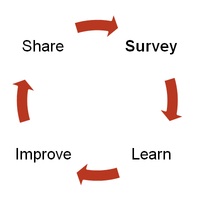
Results of brand audits (the good and the bad) must not only be shared as widely as possible but also incorporated into internal and external branding efforts, including employee communications, advertising and PR.
Share research data, not just the good stuff!
It is especially important to use the results to drive changes in sales, service, support and other customer-facing activities.
Finally, remember to use brand audits as guidelines for improvement, not as sticks for punishment.
We’re involved in the development of the Asean Social Business Summit to be held in Kuala Lumpur in May 2013. You can read more about the event here and visit the official site here
But there is a lot of confusion over what is and what isn’t social business. Social Business refers to enterprise collaboration & innovation that uses social technologies to boost corporate, customer and social value. Social Business does NOT refer to social marketing (PR) or social entrepreneurship (helping rural businesses).
This video argues businesses are still stuck in the Industrial Revolution and need to change and change fast. Importantly, it goes some way to explaining what is social business
John Cullen runs an Internet marketing company out of Ohio in the US. He dropped by my blog and out of courtesy I had a look at his. He also liked the ‘about me’ page on my blog. I’m not sure if I should be happy with that because I hope he liked some of branding related stuff too!
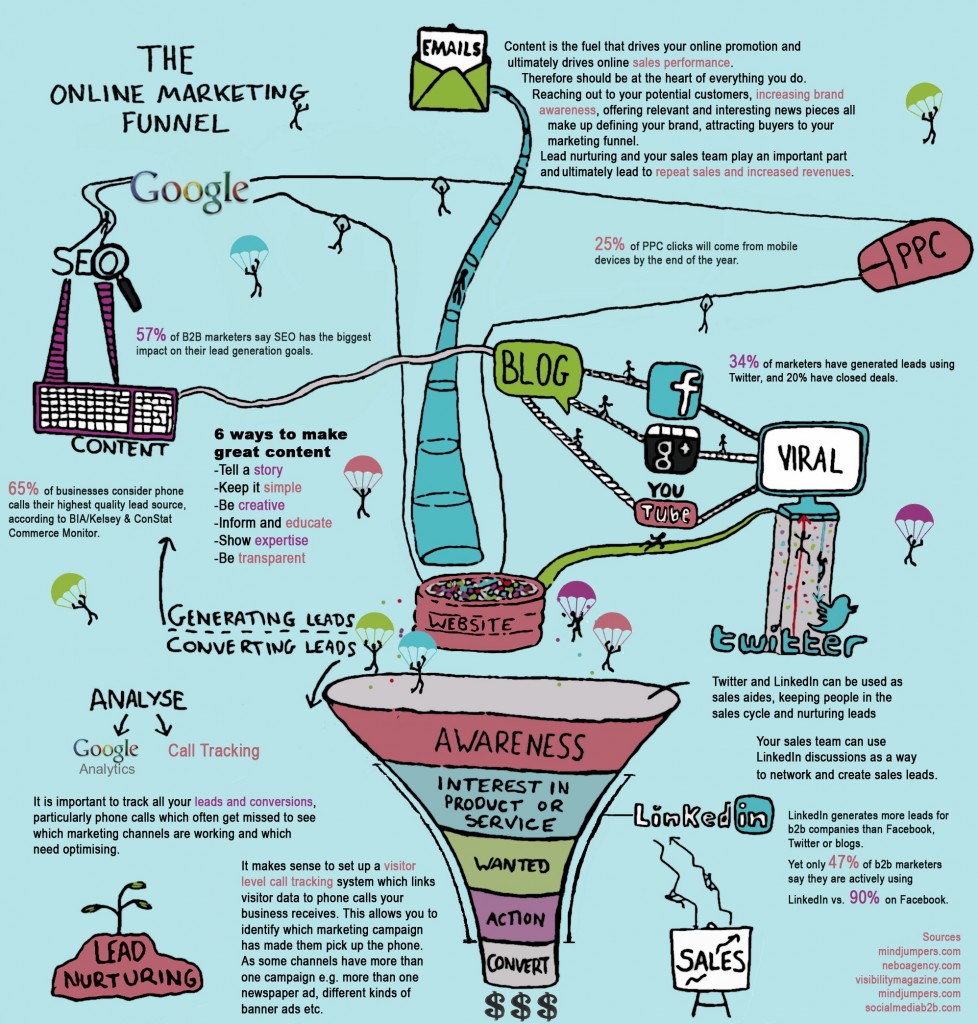
Anyway on his blog I came across this excellent infographic that explains the online marketing funnel.
Online marketing funnel
This fascinating infographic is useful because it shows the importance of digital marketing when building a brand, not through advertising but through the use of content and yet it also shows how important traditional tools such as the telephone are in the brand building process.
It also shows how important it is to use the right tools for the right sector. For instance, Linkedin generates more leads for B2B companies than Facebook, twitter or blogs yet only 47% of B2B marketers say they are active on Linkedin compared with 90% who are active on Facebook.
All you need to know to start building your brand online. Check out response tap for more on this topic.










 brandconsultantasia.com