Build a brand with the basics


Right near my office at Phileo Damansara in Petaling Jaya, a luxury German auto manufacturer has two billboards advertising its top of the range luxury autos. One is a saloon and the other is an SUV. I like this particular SUV so much that if I was still putting posters up on my bedroom wall, the SUV would be front and centre.

This company also has a number of billboards at other locations around the city of Kuala Lumpur and in the suburbs featuring a smaller version of the SUV (for which there is a 1 year waiting list) and other versions of the saloon. It also spends a lot of money on print ads and recently advertised their top end coupe in a Malaysian daily and a Malaysian business weekly.

Cars in Malaysia are expensive as import duties can go as high as 300% for luxury vehicles. The full page full colour ad with standard automotive blurb also stated the price of over RM1,000,000 (US$333,000). At that price, there are probably no more than a handful of people in the country who can afford the car. Even if there are a 100 or even a 1,000 people in the country who can afford the car, full page ads in national newspapers are probably not the most cost effective channels to communicate with those people.

Now I’ve actually approached this particular organisation in the past to ask if we can come in a make a capabilities presentation. We didn’t get past the marketing manager who basically said that as sales were very good there was no point meeting us.

Judging by recent reports, the company is certainly doing well after the launch of new models in 2008. In fact, the company claims to have been Malaysia’s fastest growing luxury car brand in that year with sales up an impressive 102%. Moreover, sales continued to climb in the first 6 months of 2010 with sales up 66% over the same period in 2009. Impressive figures and the company now claims to have about 5% of the luxury market in Malaysia.

Anyway, seeing this billboard on a daily basis with the telephone number prominently displayed, was beginning to get on my nerves. So I decided to call the number. After all, if you advertise your products on a billboard and display your telephone number, one can only assume that you want prospects like me to call you.

And if a prospect calls that number you better have the processes and systems in place to ensure that the person receiving the call passes it on to the right department. And you better have the right processes and systems in place to ensure that the next person in the process does what they are supposed to do. In this particular case, call the prospect back. Especially when we’re talking about a luxury product.

So anyway, I called the number and asked for information about the top of the range SUV. The receptionist was very pleasant and explained that she would get someone from the sales department to call me back. I gave her my mobile number and waited for the call. That was last Thursday, today is Sunday and I still haven’t heard anything. Bear in mind this vehicle costs over RM500,000 (US$166,000).

Generally the point of billboards is to create awareness. A telephone number is there in the hope that the keen, desperate consumer who wants the product so much that he will take the time to record the number and follow through with a call. Of course most of us just ignore billboards and the messages on them. Indeed, it’s rare for a prospect to call. But there are always incoming calls that may just result in an easy sale to one person who may become a customer for life so if you don’t have those basic processes and systems in place to take the information and pass it on, what is the point of advertising?

Here are some more tips that will help this company improve its profitability, the most important metric for branding:

1) The era of the global ad buy is over. Different markets require different communications strategies. Whilst it may make sense to create awareness of a luxury product via national papers in relatively wealthy western markets, it is a waste of money in developing markets where the demand for luxury products is limited to only a few.

2) Brand building is about the long term. When you launch new products they will, if you are extremely lucky, fly off the shelves or out of the showroom. But this is the exception, not the rule. And anyway, this doesn’t mean that you can become complacent, sit back, put your feet up and relax. Your competition will soon catch up and your moment in the limelight will soon be over.

3) The whole point of mass market advertising such as billboards and newspaper ads is to create awareness with mass markets. That is why weekend copies of daily newspapers are full of ads for hypermarkets, supermarkets, discount stores, sales and so on. But luxury products require more than a mass market tactic to make a sale. If you must use these old fashioned tools, use them to develop a database of prospects so that you can qualify those prospects and invite them to your showroom if you think they have potential.

4) Many companies will have a system in place to act on incoming enquiries. But who is responsible for ensuring those enquiries are acted on? The system must also ensure incoming enquiries are reported to sales management so that they can follow up with the sales department.

5) Brands are built on offerings of economic, experiential and emotional value. That journey begins with the first contact. It doesn’t matter how much you spend on advertising, if you can’t deliver that value, prospects will go elsewhere.

Now I’m going to call BMW to get more information on the X5.
Asia is the darling of luxury brands


As the effects of government stimuli wear off and with the global economy heading towards a double dip recession that will impact the traditionally wealthy economies of Europe, the US and Japan more than most, luxury brands have been looking to Asia for salvation. And they’ve probably found it.

Despite the recession, the consultants, Bain & Co predicts luxury industry sales of €158bn in 2010, up 4% after a drop of 8% in 2009. And these sales will, on the whole be driven by Asian operations.

25% of worldwide sales
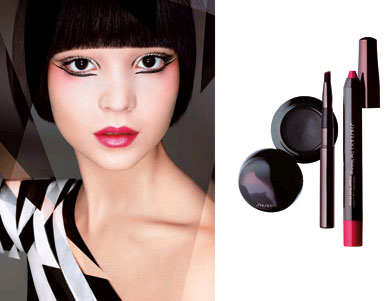
Shiseido, Japan’s largest cosmetics company anticipates sales of high-end cosmetics to grow 20% a year in China over the next 3 years. In fact, China is driving the luxury business and is now the second largest market for luxury goods, accounting for 25% of worldwide luxury sales. More than the US, Europe and Japan who each account for about 20%.

According to Capgemini there are more than 345,000 Chinese millionaires and many of them are keen to snap up luxury products that offer a little bit of exclusivity and heritage.

India crucial for long term success
But the Chinese market is not the only market helping luxury brand ride out the recession(s). In India, Porsche Design recently opened its first store in New Delhi, joining Prada, Louis Vuitton, Ferragamo and Mont Blanc who are all setting up operations in the capital of the republic. Louis Vuitton now has 5 stores in India.

Luxury jewelry retailer Tiffany & Co reported recently that sales at Asian stores open more than 12 months, with the exception of those in Japan, rose 21% during its most recent quarter. The Asia-Pacific region is driving expansion, with stores scheduled to open in Singapore, South Korea and Hong Kong.

China has the highest sales per square foot
Mainland China is at the heart of Tiffany’s Asian expansion, with the number of stores there due to rise from the current 12 to as many as 30 by 2015. Chinese stores have the highest sales per square foot of US$3,800 compared to US$3,000 in other stores.

French luxury giant Hermes reported strong growth in sales in the first quarter of 2010, boosted mainly by sales in Asia but not including Japan.

LVMH, the company behind luxury brands such as Dior, Louis Vuitton and Moët Chandon recently reported a 11% increase in 1Q 2010 sales. Watches and jewellery sales rose by 33%, wines and spirits by 18% and fashion and leather goods by 8%. Sales of Dom Perignon and other LVMH owned champagnes shot up by 33% in the same period.

Watches and timepieces, there is a difference you know, have also had a bumper start to 2010 and the mood at Baselworld, the world’s largest watch and jewellery fair, was bullish after positive announcements from Bréguet, Blancpain, Omega and Longines whose sales were up 46%, 48%, 50% and 49% respectively in January and February 2010.

Mobile phones
Due partly at least to the fact that it doesn’t have many high end high margin devices, Sony Ericsson has been plagued by declining sales for years and hasn’t made a net profit since 2Q 2008.

However the firm moved quickly to develop high end phones and launched the Xperia X10 and Vivaz last year. The result, the company reported a net profit for 1Q 2010 of €21 million, compared with a €293 million net loss a year earlier. Analysts were expecting a €128 million loss.

US leather goods maker Coach has relied for years on the domestic market and Japan. However, after a slow start, it is ramping up operations in Asia and expects sales in China to rise to US$250 million by 2012, up from almost US$100 million this year.

Luxury brands will have to make significant changes to the way they operate in Asia. And they must learn to understand Asian consumers, learn how to build relationships with them, what are their influencers and how best to engage them. If they, they will find salvation not in the short term, for some time to come.

Louis Vuitton in a spot of bother over print ads


The Advertising Standards Authority (ASA) in the UK has received complaints that print ads for Louis Vuitton created by Ogilvy and Mather suggest that the products were made by hand.

Certainly looking at this ad that shows a woman creating the lines for the folds of a wallet

and also this ad that appears to be a woman stitching a handbag

It is easy to see why there have been complaints. Especially as the copy states, “infinite patience protects each overstitch… One could say that a Louis Vuitton bag is a collection of fine details.”

However, according to marketingweek Louis Vuitton defended the campaign by saying that “their employees were not assembling pre-packed pieces but were taking individual handcrafted and hand-sewn parts through a range of hand-made stages to reach a final item.”

Louis Vuitton added that the use of hand sewing machines and associated tasks were “part and parcel of what would amount to ’handmade’ in the 21st century”.

So handmade doesn’t actually mean handmade in the traditional sense?

If that is the case does that mean then that the iconic hand made Hermes Birkin bag that can cost anything from US$10,000 to well over US$100,000 isn’t actually hand made?

Does this mean that the animal skins used in a Birkin bag are not actually spread out on the floor of the processing room and screened by a number of artisans before being measured and cut by hand as required?

Does this mean that the bottom of the handbag is not sown by hand to the front and back with waxed linen threads?

Does this mean that the handle of the Birkin bag is not manually stitched until the shape comes to the fore?

Does this mean then that the artisans don’t use sand paper to smooth rough edges? And does it mean therefore that hot wax is not applied to the handles to protect them from moisture?

And all the effort that goes into the front flap, the metal and lock is not actually done by hand?

Does it mean that the craftsmen in France that all work out of the little lane in Paris don’t actually exist?

And advertising agencies wonder why 76% of consumers don’t believe that companies tell the truth in advertisements. In Malaysia that figure is 86%!

The number one element in any relationship is trust. If a brand wants to build a relationship with a consumer, that consumer must be able to trust the brand.

An element of doubt in communications is not a good way to build trust.

Another argument for building brands


A year ago, the Wall Street Journal was telling us that wealthy consumers were suffering from ‘luxury shame’. Others were talking about the end of the luxury business. Certainly, the luxury business took a massive hit when the sub prime crisis blew up and the repercussions were still being felt at the end of 2009 when many luxury manufacturers and retailers reported poor sales over the traditionally lucrative Christmas and New Year period.

But even a global financial meltdown doesn’t seem to be able to keep the wealthy out of the stores for long as the luxury industry outperformed the MSCI World Index over 1Q 2010. And unsurprisingly, the wealthy don’t head for the department store to save pennies on same store brands.

So what brands are people, sorry the fabulously wealthy buying? Here’s a quick round up of the most popular brands at the mall or wherever it is the wealthy shop!

Last weekend, the Ferrari 599 GTO was officially unveiled at Modena’s Ducal Palace in Italy. This is the legendary brands fastest road car and does 0 – 100km/h in 3.35 seconds! Although a number of key clients were at the launch, all 599 units of the US$450,000 (RM1,500,000) monster have been sold.

Still with cars, top end ‘more affordable’ brands are also performing well, despite current figures reflecting the anniversary of the peak of the scrapping scheme in Europe. In Germany, car sales plummeted 26.6% last month, year-on-year, but Mercedes declined only 6.1 per cent, while BMW sales rose 9 per cent. During the same period in China Mercedes and BMW both increased their sales in 1Q 2010. Audi meanwhile was up a respectable 77%.

Here in Malaysia where cars are subject to astronomical taxes, BMW Malaysia sold 250 of the 7 Series from January 2009 to March 2010. With the cheapest 7 series costing around RM650,000 (US$200,000) and the top of the range 760Li costing RM1,400,000 (US$435,000), that’s impressive and shows the resilience of luxury automotive brands.

Down south in Singapore, Mercedes-Benz delivered 1,139 passenger cars in 1Q 2010, a 22.7% increase over the same period in 2009. Not to be outdone, BMW sold 960 units during the same period, a robust 29% increase over the same period.

Porsche meanwhile announced last week that orders for the latest version of the Cayenne SUV, due to arrive in European showrooms in May 2010 and priced at €56,000 (US$75,000) price tag, were ‘stronger than expected’.

Over in India, Porsche Design recently opened its first store in New Delhi, joining Prada, Louis Vuitton, Ferragamo and Mont Blanc to name a few luxury brand also taking up residence in the capital of the republic. Louis Vuitton now has 5 stores in the country.

LVMH, the company behind luxury brands such as Dior, Louis Vuitton and Moët Chandon recently reported a 11% increase in 1Q 2010 sales. Watches and jewellery sales rose by 33%, wines and spirits by 18% and fashion and leather goods by 8%. Sales of Dom Perignon and other LVMH owned champagnes shot up by 33% in the same period.

Watches and timepieces, there is a difference you know, are also having a bumper start to 2010 and the mood at Baselworld, the world’s largest watch and jewellery fair, was bullish after positive announcements from Bréguet, Blancpain, Omega and Longines whose sales were up 46%, 48%, 50% and 49% respectively in January and February 2010.

Meanwhile, due partly at least to the fact that it doesn’t have many high end high margin devices, Sony Ericsson has been plagued by declining sales for years and hasn’t made a net profit since 2Q 2008.

However the firm moved quickly to develop high end phones and launched the Xperia X10 and Vivaz last year. The result, the company reported a net profit for 1Q 2010 of €21 million, compared with a €293 million net loss a year earlier. Analysts were expecting a €128 million loss.

With the consultants, Bain & Co predicting luxury industry sales of €158bn in 2010, up 4% after a drop of 8% last year, it seems ‘luxury shame’ was nothing more than an itch!

Luxury branding in developing markets requires a different approach


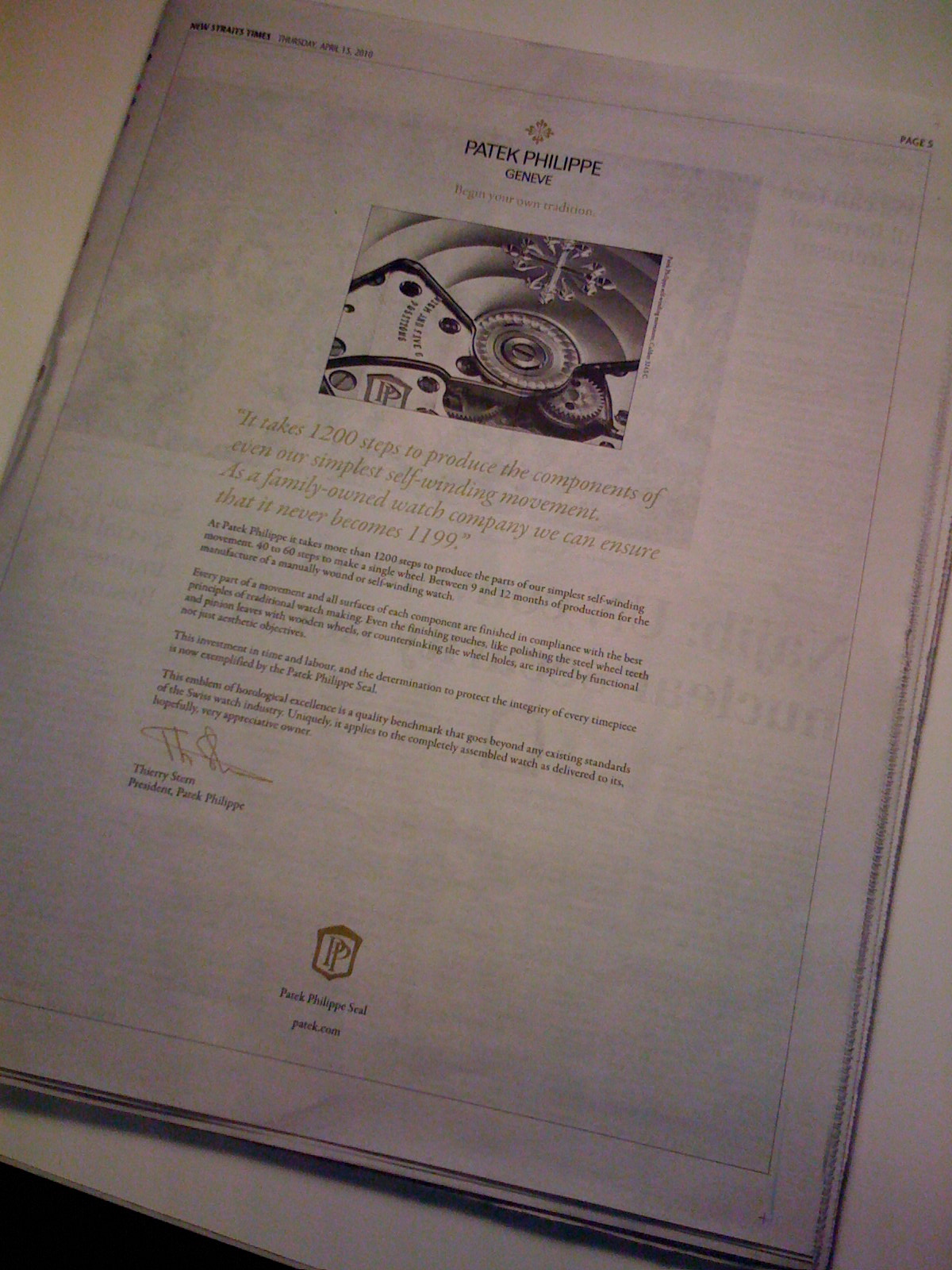
Patek Philippe, the eponymous luxury Swiss watch, or should I say, timepiece brand is known for running the same advertising campaign for years. Although the images may have changed, the tagline “You never actually own a Patek Philippe. You merely look after it for the next generation.” has remained consistent, usually along with a jaw droppingly handsome and immaculately dressed and coiffured ‘father and son’ portrait.

For the target market, the aristocracy and the wealthy of the world, and those that aspire to the class, the ads say many things, including ‘buy one and you’ll be like us and ‘You have class and you know class’.

The ads are a wonderful example of luxury branding – a great product manufactured with precision engineering, immaculate heritage, an aristocratic client base and creative genius in the advertising that communicates on a level that the target market will connect with and explains, in the limited time available to garner interest, the timeless character of the brand. And I am sure the quality of service at the point of sale will be equally as impressive.

PP has recently launched a new global print advertising campaign that focusses on the values of the company established by two Polish immigrants, Frantisek Czapek and Antoni Patek in Geneva in 1839. I’m not sure if this campaign is to replace the old one. I for one hope not.

The latest campaign revolves around the personal letter concept and has the current president, Thierry Stern waxing lyrical about the steps involved, the time taken and care and attention to detail invested in the production of a PP timepiece. He talks about ‘polishing steel wheel teeth and pinion leaves with wooden leaves and countersinking wheel holes’ and the fact that these efforts are ‘inspired by functional not just aesthetic objectives’.

He goes on to mention the Patek Philippe Seal, an ’emblem of horological excellence’ that appears to be an internal ‘quality benchmark’ that claims to be ‘beyond existing standards of the Swiss watch industry’.

The ads are set to appear in ‘quality daily newspapers and influential trade publications’ around the world and will also appear at the point of sale.

The first ad (I think) appeared in Malaysia in the New Straits Times on 15th April 2010. I can understand (although I don’t agree with the tactic) the mass market approach of running an ad in the New York Times or the London Times, South China Morning Post etc or any other developed country where there is significant market potential.

But I can’t understand the purpose of running the ad in a developing country such as Malaysia. A quick search of the net finds a rather old PWC report, that states ‘the mean monthly gross income per Malaysian household increased from MYR2,472 in 1999 to MYR3,011 in 2002, denoting average growth of 6.8% per annum’. So if we use that growth rate to bring us up to 2010, the mean monthly gross income per Malaysian household is now roughly RM5,096 or US$1,358. Don’t forget that is gross and does not take into account the impact of the economic crisis.

Another search of the Internet would suggest that the cheapest PP watch is around US$4,000 and the most expensive sold some time ago for about US$11,000,000 (that’s RM36 million in real money). The majority of PP watches appear to be in the US$10,000 to US$35,000. At those rates, the potential market in a country the size of Malaysia is tiny and an ad for such a luxury product in a daily newspaper is essentially a waste of money.

Just to put things into context, the ad after the PP ad is for Honda and the ad after that is for Panasonic household appliances such as an Alkoline ionizer, hair styler and hair dryer and men’s shaver (inner Blade and outer foil).

So what should PP do in developing markets like Malaysia?

Here are 5 suggestions

1) Rethink the one-size-fits-all mass market approach to building a brand, especially in developing markets. The consumers who can afford your products can be engaged much more effectively in other ways.
2) Build a database of prospects and customers. But all markets require different strategies and data collection techniques will be different.
3) Build relationships with your existing customers. Existing customers are often ignored by companies scared of asking too many probing questions. And certainly timing is important. But well trained luxury retail staff can build relationships with wealthy customers who are likely to be successful businessmen and politicians and their opinions will carry a lot of weight with prospective customers.
4) Advertising is important, but choose your channels carefully. Mass circulation newspapers and magazines are for shavers and hypermarkets.
5) Content is important too. I’m not sure anyone really cares what is hidden away inside the shell of a product with almost 200 years of heritage. After all, if the quality was a given in the previous campaign, why must it be addressed now?
6) Integrate your digital commuications with mobile channels to engage with prospects and customers interactively when they are on the move.

Building a brand is hard enough. PP has done it successfully for 200 years. But treating every market the same and using mass marketing tactics that belong to an era that no longer exists, will make it hard to do it successfully for the next 200 years.

More effective brand communications required to build the Volvo brand in Malaysia


Building a brand in any country requires more than a series of tactical initiatives to create awareness and ‘get the name out there’. It takes a meticulously planned and integrated strategy that incorporates the participation of numerous stakeholders and initiatives, both internal and external. Internally to ensure the whole organisation is on brand and externally to ensure communications and content resonates with target markets and are communicated via relevant channels. There’s more but for the purpose of this article that’s enough for now.

And what if the brand is to penetrate other markets? There was a time when all it took to do this was a continuation of the positioning tactics carried out in the home country, perhaps with a few language changes in print media and perhaps some dubbing of TV commercials (TVCs). An over simplification perhaps, but essentially correct.

But as we all know, the world is very different today.

Building western brands in Asia
To build a Western brand in Asia today, as many international brands are finding out the hard way, takes an even more robust and integrated brand strategy that has at its core organisational excellence. Only once has that strategy been developed can the brand strategy be executed. And part of the brand strategy, a small but critical part, is the communications campaign.

This is particularly true of the automotive industry that has seen a number of well known European and other Western brands find it hard to repeat the successes at home in new Asian markets. There are other issues such as high duties etc but many European brands perform below expectations, despite large marketing budgets.

One of those is Volvo. Despite an extensive presence across most media, in 2009, out of a total industry volume (TIV) of just under 537,000 units, Volvo only sold 600 cars in Malaysia, South East Asia’s largest passenger market. This gives Volvo about 0.15% of the market. Although this is a slight increase over 2008 when Volvo sold 524 cars, it is way below the 2007 total of 752 units. Interestingly, in 1999 Volvo sold 839 cars, giving it 0.3% of the market. So Volvo’s market share of the Malaysian passenger car market has halved in 10 years. I think I know why.

Last Thursday, 28th January 2010, a half page full colour ad in the New Straits Times, (NST) Malaysia’s ‘premium’ newspaper caught my eye. The ad features the Volvo V50 and a headline “There’s more to life with Volvo.” The ad goes on to sell space and luxury using images of a kayak, a windsurfer and a mountain bike. The ad lists, in really small print, a number of dealers in key cities. There is no website address.

Last Friday 29th January 2010, Volvo ran another half page ad in the same publication, this time a spot colour ad. This ad features a Volvo XC60 parked on a snow covered road with the occupants, a man and a woman in warm fur collared winter parkas sitting in a pile of snow staring out at a snow covered landscape. This time the headline is “Volvo owners get more out of life!”

If I’m not mistaken, the traditional rule of thumb has it that you have approximately 3 seconds to grab a readers attention with a print ad headline, perhaps less in today’s noisy, cluttered world. I don’t know how effective the Volvo ads have been but I did notice that the offer in the second ad has been extended, rarely a good sign. I also noticed that there is no tracking mechanism in the copy. And, in case you can’t read it, the tagline in the print ad reads “Volvo owners get more out of life!” So the ad is targetting both existing and potential customers.

Coincidentally, there is a Volvo billboard outside my office, at the busy intersection of a very busy highway. The billboard ad features the Volvo XC90 Diesel. This time the headline is “Winner of fuel efficiency award.”

Sitting in my office in the Malaysian capital of Kuala Lumpur where the recent hot spell has seen the temperature top 40 degrees centigrade on more than one occassion and the humidity is often around 90%, I tried to figure out a couple of things.

1) What was the relevance of these communications to potential and existing Volvo owners in Malaysia?
2) Why are they using images featuring snow to sell a service in the tropics?
3) Why is an ad targetted at existing Volvo owners also trying to get the attention of non Volvo owners?
4) Where is the consistency?
5) Is this part of a planned out, integrated strategy or a series of one off tactics?
6) Why would anyone get out of a nice warm car and sit on wet cold snow to admire the view?

OK, ignore the last one.

Hemorrhoids and Frost bite
Well as far as I can tell, more out of life for the couple featured in the second ad is likely to be hemorrhoids and frost bite. I don’t mean to be fecetious, but what is the relevance to the Malaysian market? There are some marketers who insist that to build a brand you need to be first in a category and perhaps Volvo wants to be first in the frost bite category but I think not.

More confusing is the content. The main copy of the ad is encouraging existing Volvo owners to bring their cars in for servicing, repairs or to buy accessories and be entered into a competition to win vouchers that can be redeemed for more accessories and parts. Shooting off on a brief tangent, the takeaways I get from that copy, as a non Volvo owner are, in roughly equal amounts:

1) you are going to be spending a lot on parts and accessories so here’s a little help or
2) these cars are built so well that you will never actually win anything because nothing needs to be repaired but the model sold is so basic you’ll be spending a lot on accessories. Interestingly Volvo also offers a 3 year warranty/100,000km for cars sold in Malaysia so if you’ve got a new car you may have to wait 3 years to receive your prize!

Seriously though, The Volvo communications are confusing. Furthermore, according to the Star newspaper, 86% of Malaysians don’t trust advertising. So that means the print ads mentioned earlier are targetted at only 14% of Malaysians. Moreover, with an entry level Volvo S40 at around RM170,000 (US$48,000) it is off the radar of the average Malaysian so a mass media approach is a waste of valuable funds.

There are a number of other things Volvo can do to halt the slide in its market share and build a profitable brand in Malaysia.

1) Separate the acquisition strategy from that of the retention strategy.
2) An indifference to retention branding is short-sighted. Michigan State University estimated that US$1 spent on acquisition generates US$5 in revenue, while every dollar spent on retention creates US$60 in revenue. Bain and Co has estimated that increasing retention by 5% can increase profits by 25%. Companies have a 5 – 15% of selling something to a new customer, but a 50% chance when selling to an existing customer. But retention branding requires a completely different strategy to acquisition branding.
3) In the mass economy the brand communications goal was to increase awareness. This evolved into persuasion but the ultimate goal today is adoption. Adoption ensures the brand is seen as the best or, better still, the only choice. But adoption of a brand is not an event it is a process built on the back of organisational excellence and reinforced by the ability to deliver relevant solutions on customer terms.
4) Volvo cannot expect adoption if messaging is inconsistent and fragmented. If print campaigns and billboards are to be part of the brand communications, keep them consistent. Announcing fuel efficiency awards is not going to drive traffic to showrooms.
5) Review communication tools and explore social media options. I believe there is no benefit at all for a luxury product like Volvo to advertise in a daily newspaper in Asia.
6) Understand social media is for communities and those communities must be relevant. The only opportunity for interaction on the Volvo website leads the viewer to an international site. Volvo owners in Malaysia will want to be part of a community here, and learn about issues and opportunities in Malaysia, not in Istanbul.

The purpose of this article is not to embarrass Volvo. So if anyone from Volvo reads this article, please view my comments as feedback, not criticism. There are a number of automotive manufacturers making similar mistakes but Volvo caught my eye!

Singapore Airlines Suites, branding blunder or recession victim?


There have been numerous branding blunders and you can read about some of them here but rarely does Singapore Airlines feature. Singapore Airlines (SIA) consistently leads the industry in profitability and manages to ride out turbulent times better than most in its class. It has always been aggressive, acquiring aircraft and expanding its fleet quickly, in 1979 it set a record at the time, when it traded relatively new aircraft for an updated version of the B-747 for a then record of S$2.2 billion. SIA also differentiated itself early on with its adoption of the Singapore Girl as the face of the airline and service as the unique selling point.

But the world of today and the world of the 1970s are very different. The 1970s were the halcyon days of the mass economy. In the mass economy, with its mass markets and mass media, perhaps a little bit of help from the government and a large dose of nationalism. And by broadcasting the same message to large audiences who had limited sources of information, it was a lot easier for an airline to establish a brand.

More of this and more of that and better this and better that or bigger this and bigger that coupled with large advertising budgets worked well. As competition increased, consumers became more segmented and media choices fragmented, like many other industries, airlines turned to positioning as a strategy.

Positioning
Positioning consisted of creating a position in prospects minds that reflected the strengths and weaknesses of the offering as well as those of competitors. Ideally, this position was based on being first in a particular category. If someone was already first in a category, then companies attempted to redefine themselves in a new category to be first. In the airline business, this tended to be related to passenger comfort or service. The effectiveness of positioning depended on the ability of advertising to drive branding perceptions in the mind of consumers. To do this, airlines often made promises they were unable to keep (admittedly, often due to third party issues out of their control), failed to meet traveller expectations, often because dynamic competitors moved quickly and so raised the bar, which in turn led to brand disillusionment.

Positioning was ideal for the mass economy. It was also ideal for advertising agencies and marketing departments because it gave them enormous power without the responsibility of accountability. Al Ries and Jack Trout invented the concept of positioning. The preface to one book states, “Positioning has nothing to do with the product,…. (it) is what you do in the mind of the prospect.” So, essentially this means that the consumer can be made to believe, through extensive advertising and PR in the right conduits to consumers, and other vehicles, what an offering means to them.

Airbus A380
When Airbus announced it’s super plane, the Airbus A380, ever aggressive, SIA was one of the first to sign up and the first A380 delivered was delivered to Singapore Airlines on 15 October 2007. It entered service on 25 October 2007 with an inaugural flight from Singapore to Sydney. Passengers bought seats in a charity online auction paying between US$560 and US$100,000 for seats. Understandably, the new aircraft, a clever publicity stunt and an inquisitive general public, generated a lot of media coverage and by the end of February 2009, a million passengers had flown with Singapore Airlines on the A380.

Suites
But the majority of those passengers are flying economy. The problem has been getting passengers to use the suites, positioned as, “a class beyond first.” When the new A380 service was launched, in the way that has always done, SIA used global TV, print and online advertising and PR campaigns to launch the new A380.

Beautifully executed TVCs were developed for the Suites by a top advertising agency using taglines such as “your own private bedroom in the sky”. Other taglines included “an unprecedented level of privacy” in a “cabin unlike any other”, and sleeping on a “standalone bed that was not converted from a seat”. Givenchy Beddings (and pyjamas) Ferragamo toiletries and Krug or Dom Perignon were also part of the deal.

But despite a unique product, some slick marketing based on a huge investment in a one-size-fits-all message to mass markets using mass media, consumers and corporations haven’t bought into it. Why not?

Lack of research
One of the reasons could be that SIA didn’t talk to customers and prospects about what they might want from such a service, and, more importantly, how much they would be preparred to pay for it. In fact, it appears that SIA didn’t even engage with members of its Frequest Flyer Programme. SIA simply went ahead and developed the product and then, in a traditional 4 Ps (product, price, place and promotion) and positioning strategy, tried to sell it.

To make it even harder for themselves, and despite charging a premium of more than 50% over the first class fare, SIA would only reward loyal members of its Frequent Flyer Programme (FFP) Krisflyer with 10% more miles than a regular first class ticket! Moreover, any redemption of miles could only be for economy, business or first class and not for the Suites!

According to Shashank Nigam, “Several HR departments of companies, including civil service departments in Singapore, issued circulars or directives stating that “Since the Singapore Airlines Suites are a class beyond first, officers who are usually eligible for First Class travel will be ineligible for Suites”. So by now, SIA had upset its two most important customers, its own government and elite members of the frequent flyer programme!

In 2008, as the economic crisis began to take hold and suite sales nosedived, SIA maintained its pricing strategy, making it even harder for financial institutions, already under scrutiny for lack of risk management, to justify such extravagance.

Another reason for the poor response is probably related to the ground experience. Although positioned as a class beyond first, elite passengers were expected to use the same check-in facilities as passengers travelling in first class, the same lounge and essentially, the same food as first class passengers.

Premium revenues drop by 40%
By the middle of 2009, SIA was feeling the heat on a number of fronts. The economic situation gripping the world caused international premium passenger numbers to fall by 18% year on year in the first 10 months of 2009. At the same time, premium revenues dropped by up to 40% over the same period (IATA). Another challenge was from competitors such as Emirates and Qantas who don’t offer Suites but do have exceptional first class experiences including cabins on their A380s that feature a Bar and bathrooms with showers, limousine transfers at departure and arrival (not available to SIA passengers, even those using Suites).

SIA reviews incentives
SIA scrambled to recover some marketshare. The first incentive was a free night’s accommodation at the Raffles Hotel in Singapore for all passengers flying Suite class. Neat, but hardly enough to justify a 50% premium over first class. Then SIA remembered the people who have made it such a success story in the past, first class passengers and lucrative members of Krisflyer. SIA relented on the bonus miles and began offering 300% bonus miles instead of 10%. Definately a step in the right direction but perhaps too little too late as it is rumoured that a significant number of key SIA customers have defected to Emirates and Qantas. If this is true you can be sure these airlines will make it harder for these premium passengers to leave than did SIA.

So what could SIA have done better? Here are 5 things I would have done although, if they had done number one the rest would have been redundant. What else would you have done?

1) Research. Your existing customers are your best source of information. Talk to them, find out what they are looking for and match attributes to their requirements for value. If SIA had talked to its premium passengers and its own government departments, it would have realised that the market could not support the suites product.
2) Mass market branding with a focus on the 4 Ps is no longer effective. Brands today are built on relationships, access, personalisation and relevance.
3) SIA should have focussed on developing more profitable relationships, not a more profitable product. Brands evolve when companies start buying for customers instead of selling to them.
4) Branding is an organisational not a departmental responsibility. And the organisation is the responsibility of the CEO. To expect a passenger to pay a 50% premium over the price of a first class ticket and not offer a limousine service on the ground when all competitors offer it to first class passengers shows a real lack of judgement.
5) Retention is key to brand building. Companies no longer sell a product, customers buy a product. And once they’ve bought the product, companies should do everything possible to hang onto those customers.

SIA is a great brand. As I write this, I am sure SIA is working out what to do with its Suites. If SIA aims to meet customer requirements for emotional, economic and experiential value, then the airline will bounce back stronger and better for the experience and the Suites can be written off as a victim of the recession. If they don’t the suites may become yet another branding blunder.

What is the impact of the mosques referendum on the Swiss brand?


Last month a much reported public referendum in Switzerland voted to implement a complete ban on the construction of minarets in the country.

The referendum, sponsored by the right-wing Swiss People’s Party sparked numerous national debates and 57.5% of the electorate voted in favour of the ban. This despite the protestations of the ruling pary of Switzerland, religious and business leaders who all campaigned for a no and public polls that suggested a significant majority opposed the referendum.

This is not a political blog so I won’t go into the details, but I am curious to know what people think about the consequences of this decision in respect of the impact it will have on the Swiss brand. Switzerland has an image of a country that has respect for human rights, no doubt influenced, ironically, for a tradition of religious tolerance. Although the decision is likely to be overturned in the European Court of Human Rights, the Swiss image of neutrality and tolerance may have been damaged. If it has, what are the consequences of this, from a branding perspective?

After all, the country is home to many international brands, especially from the financial services industry and luxury brands. These luxury brands and financial institutions are popular with Muslim consumers from all over the Muslim world.

Will we see these Muslim consumers withdraw their funds from Swiss banks and transfer them elsewhere? Will they shun shops selling Swiss watches and other jewellery? Does anyone have any thoughts or firm data on the impact of this decision on the Swiss brand?

How not to sell a London property to Malaysians


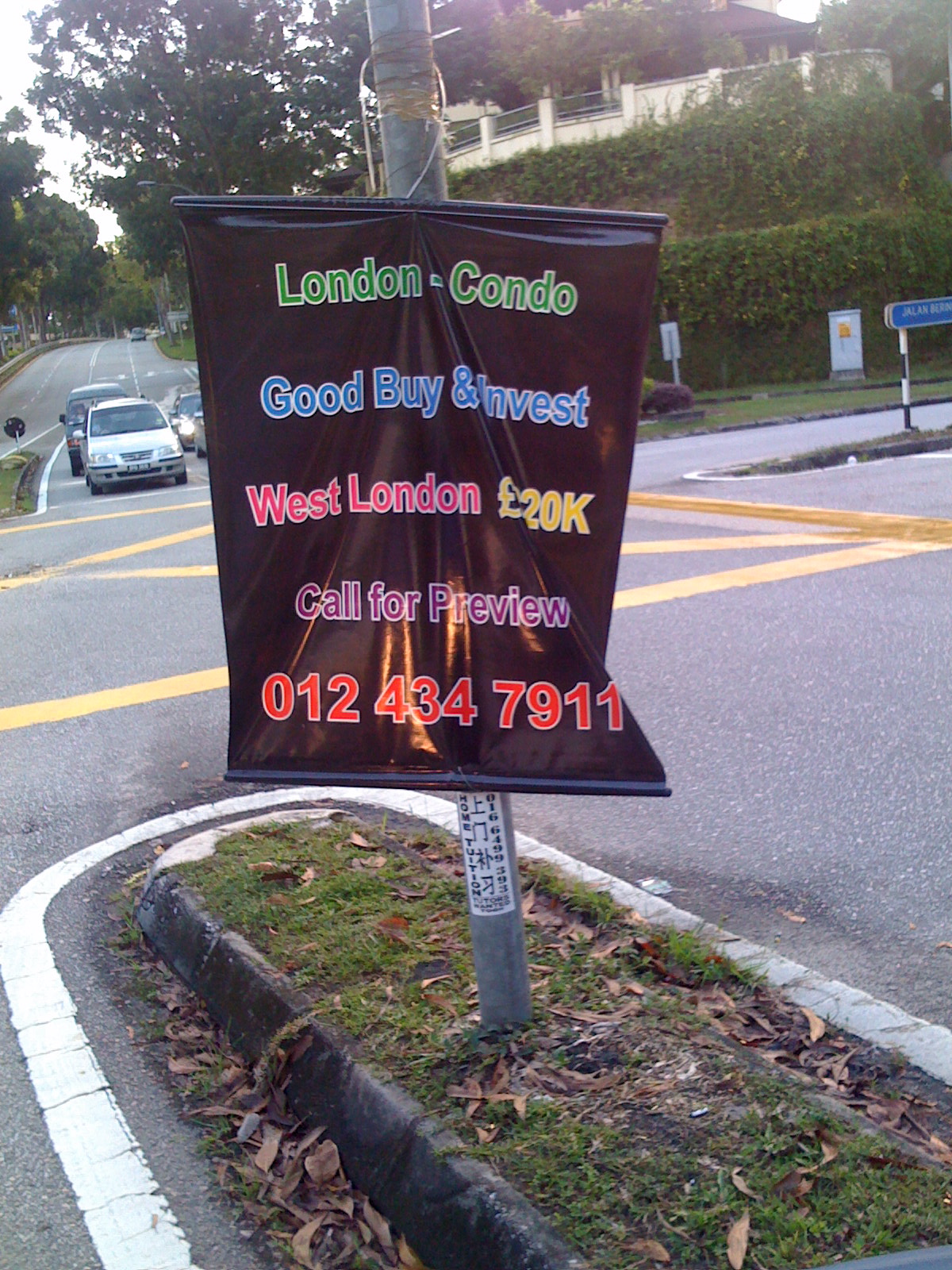
I spotted the sign below on a lamp post in Damansara this morning. In case you can’t read it, the content is as follows:

London – Condo
Good Buy & Invest (sic)
West London £220k
Call for Preview
012XXXXXXX

I cannot believe that a genuine UK property developer or estate agent would encourage a company to sell million Ringgit properties with signs on lamp posts. After all the UK property market, and in particular the London market is benefitting from substantial investment and has hardly been affected by the global financial crisis.

Commercial property
Jones Lang LasSalle expects the total direct investment in commercial real estate in the UK to be around £23 billion (RM125billion) for 2009. Prime yields in the West End are 5% and in the city, around 6.25%. That’s impressive compared with a bank rate of, well about 0%.

Residential Property
Meanwhile, the residential market is also performing strongly. International buyers increased by 25% in 2009 compared to 2008. Most of the investment is coming from Europe, Russia and the Middle East. Knight Frank estimates demand from new buyers is “almost 25% higher than a year ago” and “prices have now risen 13.8% in the nine months since March.”

In fact, most of the investment is coming from the overseas market. Foreign buyers account for 80% of the investment, the highest ever. Indeed, the average over the last 10 years has been closer to 46%. The latest sources of this overseas investment include Oman, Libya, Lebanon, USA, Korea and Ireland.

UK property roadshow
Little wonder then that Malaysian firms want to get in on the act and sell UK property. I can’t find any figures on the total Malaysian investment in the UK or London property market however, the recent launch of a luxury development at Imperial Wharf, London, Malaysian buyers purchased £9.25 million (RM56 million) worth of luxury apartments and penthouses over the 2-day road show in Kuala Lumpur.

Olympic games
With more than 10,000 Malaysians studying in the UK and a number of companies keen to make the UK their European HQ, there are going to be plenty of willing buyers. Especially with the Olympics to held in London in 2012.

Wrong way to sell
But this is not the way to sell those properties. It dilutes the value of the property, negatively impacts the credibility of the local representation and makes it harder for future efforts to sell UK properties here in Malaysia. But worst of all, it portrays Malaysia as an amateur in a professional world.

Updated: 11th January 2010. I have since called the number on the bunting. I spoke to a nice guy with a pleasant attitude. I asked him where the property is. He stated the property was in South Ealing. As I know this area well I asked for the exact location and I consider it to be more Brentford than Ealing. He asked for my email address and promised to email me more information.

That was last Thursday, I have not received anything as of today.