Direct marketing and your brand


More and more companies are moving toward a direct to consumer sales model. There are a number of reasons for this and it can be a tricky process to implement without upsetting the existing distribution ecosystem but let’s not go there for now.

But this move will see an increase in Direct Marketing. Direct Marketing should be included in any Malaysian business’s brand strategy, whether business to business or business to consumer. And it is a tactic that has plenty of room for growth as it is currently under appreciated and under utilized.

Because the quality of Direct Marketing in Malaysia and the mining and management of data must improve before consumers will pay attention.

What is direct marketing?
In a nutshell, direct marketing is the way in which a supplier of goods or services contacts an end user, normally a consumer or business. Direct marketing includes any mail sent via traditional post or email, brochures, magazine inserts, leaflets and catalogs.

With the direct to consumer sales model, it is also common to include telemarketing and face to face sales as elements of direct marketing

The existing model
If you want to at best create a bad first impression of your brand and at worst ensure an instant negative impact on the reputation of your brand, prepare a badly written product or services document on your desktop, use fonts that are hard to read or have a thick bold type face and whatever you do, don’t spell check the document.

Next, print 10,000 copies and shove them in letterboxes at office and/or apartment complexes in the Klang Valley. Don’t bother to record how many are delivered to each destination and ignore whether or not your product or service has any relevance to the occupants.

Then go back to your office and wait for the phone to ring (assuming you included your number on the document – and believe me, some don’t).

With this approach, the best you can hope for is that the leaflet will be used as a place mat for lunch or simply allowed to fall on the floor by the letterboxes. Hardly an inspiring ‘moment of truth’ first time experience for your brand and potential customers.

If there isn’t a response to the exercise, does this mean the ‘Direct Marketing campaign’ is unsuccessful? Absolutely not, what it means is that a very good tool has been used wrongly.

Another way to damage your brand is to send the wrong material to the wrong people. Credit card companies are renowned for sending credit card application forms to children.

Why am I receiving this sort of mail? – Note to self, do not use this company for training.

Little wonder consumers lose faith in financial institutions when they make such glaring mistakes. Think of the money wasted on buying the list of names, designing and writing content for brochures, envelopes, postage, administration and so on.

Email is still one of the most effective forms of communication with open rates of 22%, click through rates of 8% and conversion rates of 1.5%. But it must be done properly. The common approach is to buy a list of names (normally the cheapest) and carpet bomb that list with every offering you have.

Conference and training providers do this. They don’t bother who the recipient is and what he does, they simply fire off an email offering agile this, scrum that to their mailing list each time they have a new event or training seminar. Research suggests most executives have a spam filter that directs this mail straight to the trash.

The UK has some of the toughest privacy laws in the world yet Direct Marketing is still one of the most effective forms of brand development.

In 2011, UK firms spent RM14.5 billion on direct marketing which was responsible for 23% of all sales and generated RM196 billion of business. Direct marketing is effective in the UK because it is used properly.

How to do it properly
The key for all direct marketing is get the customer information right in the first place and keep it updated accurately thereafter. Well targeted communications can improve response rates by 300%.

If you don’t have the resources to compile data, outsource. There are many firms offering data collection, cleansing and data suppression services and it is money well spent.

Next, take some time to think about what you are doing and why. Are you looking to make a sale or build a customer base? Free tip, it should be the latter. Once you know what you are doing and why, think about the channel.

Determine which is the right channel. Should you use email, magazine or newspaper inserts or other. If you have a lot to say or want to show off images, an email is probably not the right channel to use unless you have a very niche product and a very well researched database. Many firms simply programme their servers to reject any email with an attachment.

Measurement
Measurement is critical in any campaign but especially so in Direct Marketing. Understand what the exercise is going to cost so that you know what your break even point is. Also measure response rates from specific segments and determine why prospects don’t buy.

Personalise each communication
If you want to stand out from the competition and have a chance of connecting, every communication should be personalised to ensure a chance of engagement. Personalisation is dificult and time consuming because it requires attention to detail but worth the investment because it instantly makes the recipient feel recognised and important.

Content is king
Content is critical, especially if you are selling a luxury product. Yes I am aware that Malaysia is a price driven and discount defined market but I disagree that that is all it is. It has got to that stage because consumers have been let down by advertisers so often and for so long that they now focus on price and price alone.

But as many luxury retailers, developers and service providers will tell you, provide a high quality service and product and consumers suddenly seem less focused on price and more focused on the experience and the prestige.

So make your content interesting. The example below is from a property developer trying to get wealthy buyers to part with millions of dollars. I doubt they will be successful with this copy.

Make content interesting, it’s not rocket science!

There is an edict within Direct Marketing industry that says, “Right offer, right person, right time.” It isn’t complicated, it just means that to be successful, start up, SMEs and GLCs need to up their game.

Put an end to poorly thought out, badly designed, written and untargeted material and use quality direct marketing to build quality brands.
Customer retention is not the same as customer loyalty


I read an interesting post on The Free Malaysia Today website about customer loyalty and you can read the full article here

It’s a useful article that any Malaysian business owner should pay attention to. But as often happens, it blurs the lines between customer loyalty and customer retention. They are not the same thing.

A retention program is not the same as a loyalty program because a retention program is normally price driven and those customers acquired as a result of a retention program can often be lost to competitors.

A loyalty program on the other hand will help increase share of wallet by encouraging more purchases, often of more premium products and, more pertinently in the social economy encourage customers to become brand advocates and communicate positively about the brand and experiences with the brand.

A case in point for me personally is MAS. I am a member of the MAS frequent flyer program but it does not buy my loyalty. MAS retains me as a customer but I am always looking for a better deal with other carriers.

If another carrier were to invest in building a relationship with me I would switch in a heart beat. I also tend to talk negatively about MAS and even when it delivers a positive experience I tend to take it for granted.

Whilst I’m on the topic of MAS I should mention that one way MAS could improve its business is by investing in its loyalty program and in particular software that can mine the database more effectively. As it is, all the loyalty program does is try to blanket sell all offerings to all members.

Loyalty is no longer about personal relationships and how often you take someone to karaoke or for teh tarik. Customers also expect you to know their industry, the challenges they face, who are their competitors and crucially, who are their customers, potential customers and who are the influencers of those customers.

If you understand and integrate a loyalty program into your brand strategy you will be on the way to building a strong brand. But if you mistake a loyalty program for a retention program, you may do more harm than good.

Top 10 airline brands for 2012


Skytrax, the UK based research company that specialises in research for commercial airlines, has just announced the winners of the world airline award for 2012.

Skytrax parent company, Inflight Research Services work has been used by the UK government to determine the UK government policies on air transport.

The Skytrax Awards are one of the benchmarking tools for the air industry. They measure passengers’ satisfaction levels by surveying passengers in all cabin classes.

The award is announced after a 10 month telephone survey with 18 million airline customers from 100 countries. That’s right, 18 million airline customers from 100 countries. This must be one of the largest surveys ever attempted.

That’s 1.8 million participants a month or based on a 20 day working month, its 90,000 calls per day which equates to, assuming an 8 hour day, 11,250 calls an hour! Many of which are international, in different languages and probably, if they use my carrier, many of the calls cut off half way through the conversation.

I’ve managed some large brand audits that required a lot of calls but not 18 million in 10 months! So Skytrax should be commended for managing such a logistical nightmare. But I digress.

As I mentioned, the survey takes 10 months and covers 200 airlines, both domestic and large international airlines. The survey measures standards across 38 key performance indicators of airline front line product and services.

The study focuses on customer satisfaction related to experiences right across all touch points including check-in, boarding, onboard seat comfort, cabin cleanliness, food, beverages, in-flight entertainment and staff service.

According to the World Airline Awards website, product and Service factors ranked by customers
in the survey included the following elements:

GROUND/AIRPORT
Standard of Airline web site
Online Booking service
Online check-in services
Airport Ticket Counters
Waiting times at Check-in
Quality of Check-in service
Self Check-in options
Boarding Procedures
Pre-boarding for families
Friendliness of Ground staff
Efficiency of Ground Staff
Transfer services
Arrival services
Baggage Delivery
Handling Delays

ONBOARD: PRODUCT
Cabin Seat comfort
Cabin Cleanliness
Toilet Cleanliness
Cabin Lighting / Ambience
Cabin Temperatures
Cabin Comfort amenities
Reading Materials
Airline magazine
Inflight Entertainment standards
Audio/Movie programming
Audio Video on demand (AVOD) options
Quality of Meals
Quantity of Food served
Meal Choices
Selection of Drinks/Pay bar formats

ONBOARD: STAFF SERVICE
Assistance during Boarding
Friendliness of Staff
Service Attentiveness/Efficiency
Consistency of Service across different flights
Staff Language skills
Meal service efficiency
Availability thru Flight/Cabin presence
PA announcements
Assisting families with children
Problem solving Skills
General Staff Attitudes
Staff Grooming

This is an enourmously complex project and it doesn’t end there. Follow up research includes back up interviews and the data is weighted to ‘provide nomination equity when evaluating airlines of different size.’

Anyway after all that, here is the list of the top 10 airlines for 2012

The World’s Best Airlines 2012

1. Qatar Airways
2. Asiana Airlines
3. Singapore Airlines
4. Cathay Pacific Airways
5. ANA All Nippon Airways
6. Etihad Airways
7. Turkish Airlines
8. Emirates
9. Thai Airways
10. Malaysia Airlines

It is interesting to note that 6 of the top ten are Asian brands and the other 4 are Middle Eastern Brands.

Looking back over the last 10 years, the list has always been dominated by Asian and Middle Eastern brands. With the exception of 2006 When British Airways came first, no European Airline has ever appeared in the top 3.

BRAND AUDITS: Key for consistency and integration


How effective are your branding activities? Are they aligned for the future?

Unfortunately, most branding initiatives revolve around a creative campaign developed by an advertising agency. Depending on budget, the creative campaign will be implemented with a one-size-fits-all message communicated to all and sundry and across multiple mass media platforms for as long as budget allows.

The model essentially revolves around hope – hope that lots of people will see the campaign, hope that amongst those people will be the target markets, hope that the message will resonate with those target markets, hope that those target markets will remember and hope that if they remember they will act. So basically, the ‘strategy’ is one of hope. Chances are if it isn’t, the agency will, if you haven’t already fired them, propose more of the same.

For most brands this approach is an exercise in futility. Wouldn’t it be better to first get an understanding of where your brand is, what your stakeholders want from your brand, what you are doing right (and wrong), the channels they are most likely to interface with, their influencers and more?

Internal and external brand and communications audits can both help determine how effective your branding activities have been and, more importantly, what they need to accomplish in the future.

Brand audits have multiple advantages. They provide a benchmark to evaluate the current brand position. Carried out every 2 years they can evaluate progress toward branding goals. They also unify an organization. Too often, everyone has a different definition of branding.

A brand audit can provide a consistent, universally accepted definition that ensures that everyone is marching to the beat of the same branding drum. Finally, a brand audit can help eliminate the all-too-common disconnect between what companies believe their brand to be and what customers perceive it to be.

An internal brand audit takes the brand temperature from corporate executives and other personnel. One-on-one confidential interviews probe to determine each individual’s perceptions of the brand, branding goals, evaluation of past branding activities, knowledge of key corporate or brand messages and other key points.

What are the current branding and customer processes, and how can they be improved? One great question to ask is: “Imagine it is five years from now, and the company is celebrating historic financial and market success. How did the company arrive at this point? What are some of the activities that brought us to such success?”

A brand audit can cover a wide cross section of departments but must have the customer and the customer’s needs at its core. Is relevant customer data being added to corporate databases? Is customer information shared with other areas of the company? What initiatives are on the horizon that will affect certain customers and how will this be addressed?

A minimum of 25 minutes is required for each interview, but they can take up to an hour. Questions can be prepared beforehand, but the most valuable insights often result from free-ranging discussions on relevant topics.

A key component of a brand audit is a communications audit, which is especially useful for larger firms with multiple divisions or departments that get involved in branding activities.

A communications audit looks at all the visual material that represents a brand – the brand identity, press releases, ads, brochures, Web site, logos, etc. Analysis then determines the amount of consistency and integration in appearance/design, messages and their relevance to target markets and adherence to corporate standards. Ideally, a brand manual is in place to provide a benchmark.

The role of social media in corporate communications is increasingly important and a social media audit must be included in the communications audit. Communications across social media require different skill sets to traditional marketing and this is scaring some companies away but it must be addressed.

Internal brand and communications audits often reveal a stunning amount of discrepancies that result in mixed messages, incompatible branding efforts or even disagreement about branding goals.

An external brand audit looks at how various stakeholders (or, more accurately, constituencies) view the brand. Such constituencies include customers, prospects, media, distributors/retailers, regulatory bodies and suppliers.

Sometimes, an external brand audit is combined with a loss analysis to determine why a contract or other business went to a competitor. These constituencies are asked their perceptions and experiences with the brand.

Sample questions can include: “Why did you buy the first time?” “Why will you buy again?” “How useful and relevant are corporate communications?” “How responsive is our support?” “How do our competitors compare to us?” One revealing question we’ve used in the past is: “If you were running our company, what would you do to better meet your requirements?”

The number involved in brand audits can vary greatly according to time, cost or other constraints. Even as few as 5 – 10 interviews may produce actionable insights.

The success of a brand audit will be determined by the people involved. They must understand branding imperatives, be familiar with the relevant products and company and have superb questioning, listening and analytical skills.

Results of brand audits must not only be shared as widely as possible but also incorporated into internal and external branding efforts, including employee communications, advertising and PR.

It is especially important to use the results to drive changes in sales, service, support and other customer-facing activities.

Finally, remember to use brand audits as guidelines for improvement, not as sticks for punishment.

How Tourism Malaysia should have approached its social media strategy


Twitter, facebook and other social media communities have been buzzing with comments related to the RM1,800,000 (US$600,000) Tourism Malaysia (TM) is spending on Social Media (SM). Here’s a little background on the story.

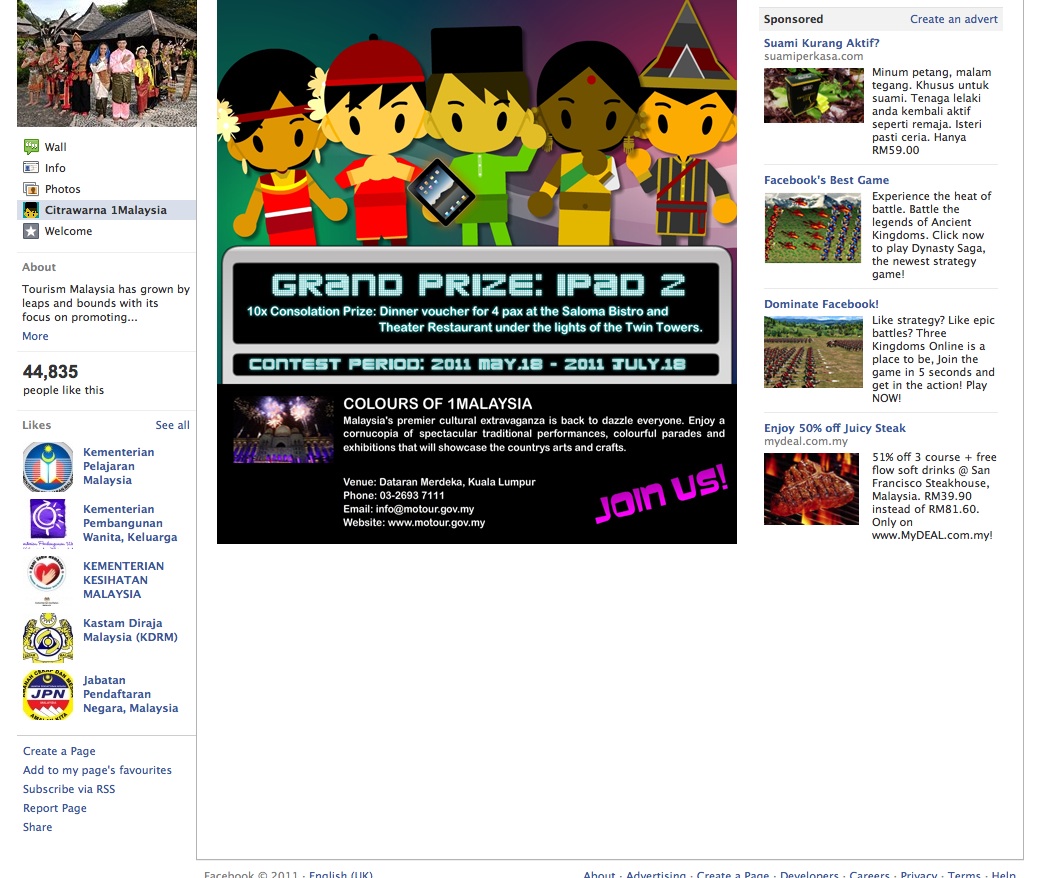
Initially, the deputy minister of tourism was quoted as saying that the RM1,800,000 “covers the cost of hosting various activities on the facebook page, including six interactive Flash applications, development and maintenance work and advertising.” He went on to say that, “the ministry spent nearly RM300,000 to develop each of the six applications on their facebook page.” I could only find one (see screenshot below).

This statement was rejected by citizens and government ministers alike with one minister suggesting it was a waste of funds as the facebook site is free and using the ‘Visit Penang’ facebook page as an example (see screenshot below), explained that it was set up for free and had attracted over 100,000 fans.

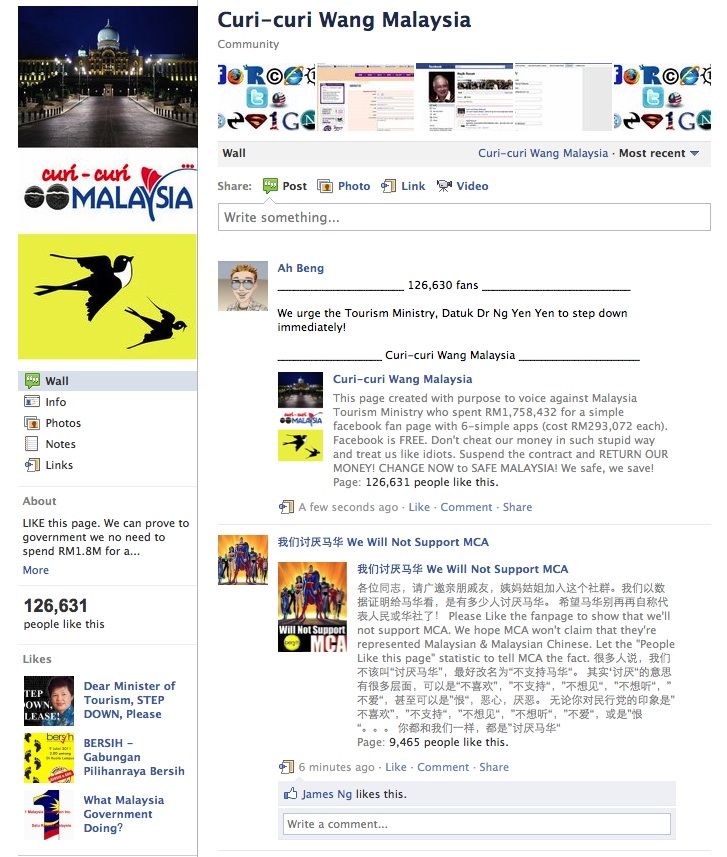
Citizens were even more incensed, with one enterprising and concerned tax payer setting up a facebook page that parodied one of the official government pages (see screen grab below). Within hours, this page had attracted 5 times as many ‘likes’ as the official page.

A couple of days later, the tourism minister announced that, “the RM1.8 million (is) for a full social media branding campaign, and not just to set up a facebook page.” She went on to say, “”(The money) is for responding, informing, interaction and monitoring (work on the facebook page), evaluation, data collecting, content development and advertising on Google, Facebook, etc…”

With her comments came an official release that stated the costs were for the following:

1. Technical

* Dedicated hardware deployment
* Software licencing
* Front end applications
* Application server engine

2. Development of six campaigns that require the following:

* Flash games engine
* Flash programming and coding
* Creative development and design
* Campaigns ideas and concept
* Front-end Flash design
* Testing and debugging

3. Campaign promotions

* Digital advertising campaigns on Google and facebook
* Contest, page wall and tourism fanpage content management
* Collection and management of database

The tourism minister then went on the offensive, asking reporters, “Do you think it’s cheap to set this up?” And as if to justify the expense, explained, “Tourism Australia is spending RM150 million (US$50 million) for the next three years on social media.”

Most recently, the minister stated that the allocation was to ‘run, manage and monitor a tourism campaign in the social media, including RM360,000 for advertising and over RM500,000 for prizes for the contests organized.’

‘Disappointed and hurt’ she is reported to have invited the Malaysian Anti-Corruption Commission (MACC) to investigate the campaign finances.

It is too early to determine the results of Tourism Malaysia’s first foray into social media but whatever the results, the Malaysian government, the tourism minister and the tourism ministry could have handled the matter more effectively and efficiently.

One would be forgiven for thinking that Tourism Malaysia has some internal communications issues. Because when the deputy minister first explained what the funds were spent on, his statement didn’t make sense. The deputy minister’s statement suggests he was provided with notes written by someone more familiar with the workings of an IT department than the requirements of a social media campaign. This has caused the deputy minister to be embarrassed in parliament and I hope someone has been reprimanded.

In terms of the social media exercise, Dave Duarte MD of South Africa based Huddlemind and a social media expert who was in Malaysia as the story broke stated in his blog that the exercise has already justified its expense.

His rationale is based on his guesstimate that the average conversion rate of a facebook fan to a customer is approximately 3% and because the average domestic tourist spends RM2,500 with 40,000 fans, the facebook page has already recouped its expenses.

This statement may be a little optimistic but it is certainly worth tracking the number of ‘likes’.

In terms of the game itself, it seems OK, leaning heavily on guitar hero. Personally I found the racial profiling of the characters unnecessary. Playing the game requires one to be more dexterous than I and as a result, the score required to qualify for the iPad 2 draw will always be beyond my means! I suspect I’m not the only decision maker in the family who will feel the same and this resulted in me leaving the page rather disappointed. But I digress.

So Tourism Malaysia’s (TM) long overdue foray into social media has not had an auspicious start. In the future, what can this key organization that contributes over RM50 billion (US$16.6 billion) to the national purse do to ensure tax payers get value money for all social media branding initiatives?

Here are 10 key recommendations for future initiatives

1) A social media strategy or any of the tactics within that strategy, is not the responsibility of the IT department. In future, the head of the department responsible for social media initiatives should represent the ministry when talking to the press and his press release should be prepared by him and his department and not by anyone else. Although the minister or his/her deputy must respond to questions in parliament, it is wrong to expect them to be knowledgeable about branding tools such as social media. Ministers do not need to talk to the media about such relatively small activities.

2) Social media requires an ongoing strategy and interactive initiatives such as the facebook pages are merely tactics within the strategy. Successful social media initiatives must be integrated with other branding initiatives.

3) I strongly suspect TM didn’t think through what they were doing when they launched the facebook pages. First of all it is important to develop a plan. Within that plan and before embarking on a social media strategy, it is important to identify what are the goals and how can facebook add value to branding efforts. Facebook is obviously an additional channel to interact with prospects and customers but why do it? To get more fans? Why? To get more participants? Why? How does TM convert those participants in the competition into leads? How does TM put a monetary value on social media activities? What metrics should be used? All of these should be outlined in the social media plan before implementation.

At the moment, registration is only required if participants want to be included in the draw for the iPad or meals. So how will TM optimize interactions with those participants and get them to become customers?

4) It’s also important to get fans to interact with other participants and to interact with participants. Critical to the success of any social media campaign are the conversations. Channels such as facebook are not platforms to broadcast messages about the company or in this case, Malaysia. The cuti cuti 1Malaysia facebook page has generated over 40,000 likes in a very short time and this is impressive. Furthermore, many of the postings on the wall have generated plenty of comments but TM is failing to enter into discussions with those who comment, preferring instead to pass that responsibility to others (See screen shot below). Interacting and engaging with people who comment is what social media is all about and will give TM more visibility, improve reputation and increase trust.

5) This first foray into social media is pretty basic and there is nothing wrong with that. But in future, Tourism Malaysia must look to be more innovative with what it does on social media. Fans will soon get bored of commenting and uploading images, especially if issues raised are ignored. Tourism Malaysia must encourage fans to be more creative. Perhaps by designing trips, submitting and voting for slideshows or setting up sub groups of specific niche related fans.

6) What makes being a fan special? At the moment nothing really which is a good and bad thing. Good because it means more people will become fans but bad because TM doesn’t know how many fans are really interested in the product or just want to win an iPad. In future, TM must look for ways to offer special content to fans or competition participants. Don’t be afraid to ask people to register.

7) This maybe a bit difficult for TM because technically, it isn’t allowed to sell Malaysia, only promote it but that doesn’t mean it can’t turn facebook into a potential profit centre. TM should make it easy for fans to book trips to destinations featured on the TM facebook the way it does on its website.

8) TM is still using mass media tactics on social media channels. This is ineffective and pointless. TM needs to stop thinking demographics and start thinking communities.

9) This applies to everyone and not just TM. Pause before creating a facebook group. Managing a group is difficult, time consuming and requires talent and patience to be able to respond to issues raised and continue a conversation till it’s natural end. TM launched four or five facebook pages at the same time! That requires a lot of talented manpower and judging by the lack of responses to issues raised, TM was ill prepared. Also important is what to do with the facebook group once the contest or event is over. It you want to delete a group, you have to manually delete every member of the group. With 40,000 members and growing, and with at least two clicks required to delete a member, the cuti cuti site will take a lot of manpower to shut down! If TM decides not to close down pages, in five years time, there will be a lot of dead pages that will confuse people.

10) The big question with facebook is what to measure and how to calculate ROI. In 2010 a study stated that fans of the top twenty brands on facebook were worth an average of US$136 each. With 40,000 fans, that would make the cuti cuti page worth over RM16 million! However the study was panned as it was actually a measure of the value of customer loyalty and not a measure of how much facebook had contributed to that loyalty. Moreover, the average of 20 brands like Nokia and Apple bears no relevance to tourism anyway!

As TM doesn’t technically have a product to sell, it is hard to know what to measure. For instance, TM can’t measure the ROI of acquiring a prospect and turning that prospect into a customer via facebook and comparing it with other customer acquisition programmes.

In reality, Measuring the ROI of facebook fans is probably impossible, especially for a national tourism agency such as TM and especially when the facebook page features a competition that allows multiple attempts from the same user and the end product is a future staycation.

As the dust settles on this rather unfortunate event, TM and its agency has a lot of work to do to sort out its social media strategy. It’s not a great start, and a lot of mistakes have been made. The key is not to make the same ones again.

Email and your brand, part three


Sticking with the use of email as a tactic within your brand strategy, I came across this interesting graphic showing when are the best times to send emails. Thanks Chuan Choong for the heads up.

But even if you get the timing right and the recipient does actually scan or even read the email, there are certain rules that must be adhered to.

You must be honest (in the US, deceptive subject lines are illegal) and transparent by revealing routing information such as the originator email address.

Make sure you offer recipients an opt out method and if they opt out, accept it and don’t add them back again three months later.

If you want to be taken seriously, I suggest you also include your physical address and website in any emails.

It is important too to make sure you track the effectiveness of your email campaigns and analyse the results. Create a source code for each campaign, track response rates, cost in terms of personnel, financial and time.

But most important of all is the content of the email and whether it is personalised and relevant to the target.

Here is another email that I received recently. From memory lane it is an absolute shocker. It isn’t personalised, it doesn’t resonate with me, the content is dull and uninspiring and the design, if I may call it that is dreadful.

When I receive a good example I will post it!

Direct Mail, Email and your brand


Direct Mail and Email marketing are critical components of any branding strategy for either a business to business or business to consumer brand. And it is a growing business. But the quality of Direct Mail and Email marketing in Malaysia and the mining and management of the databases used is horrendous.

If you own a company and you want to destroy any equity there may be in your brand, prepare a badly written product sheet on your desktop and when you are finished, don’t bother to spell check the document.

Print 50,000 copies and shove them in all the letterboxes of as many office or apartment complexes in the Klang Valley as you can. While you are sitting at home waiting for the phone to ring (assuming you included it on the flyer – and believe me, some don’t), your ‘DM campaign’ is being thrown in the rubbish bin by the lift, used as a place mat for lunch or simply thrown on the floor by the mail boxes. Hardly an inspiring ‘moment of truth’ first time experience for your brand and potential customer.

Another way to damage your brand is to send the wrong material to the wrong people. I have three kids, two under the age of 13. Yet this year they have both received two offers from credit card companies. These offers state that applicants must be at least 18 years of age.

A lot of firms are moving away from DM to save money on the printing of their flyers or brochures and looking at Email marketing. Although figures are unavailable for Malaysia, the Direct Marketing Association in the UK informs us that 90% of companies are now using email marketing.

There is no doubt that a well thought out and planned email campaign can be effective and profitable. But too many firms don’t do this and instead are simply adding to the seven trillion spam messages expected to be delivered to inboxes around the world in 2011.

I signed up with a local event organiser for information on forthcoming branding and marketing seminars that they organise in the region. Within a week my inbox was inundated with emails related to human resources, accounting, insurance, motivation and other topics I have nothing to do with and no interest in. These emails are trashed with the same irritation as the ones for Viagra, lottery wins and Nigerian banks.

Despite my repeated requests to be unsubscribed from their list, I continue to receive multiple emails. I cannot simply mark the email as ‘junk’ because they are using a Gmail account and this will send all mail from Gmail addresses to my trash. The name of the company is ingrained in my subconscious, but for all the wrong reasons and it is now a matter of principle that we will not sign up for any event organized by this firm.

I have received about 10 emails in the past month from an insurance company that recently spent RM13 million (US$4 million) on a rebranding exercise. The emails are not personalized, the attachment is of a flyer that is dull and states in two places that the offer is exclusively for Mastercard holders yet I don’t have a Mastercard.

I really lose faith in financial institutions and other companies when they make such mistakes. Think of the money wasted on the cost of the name, flyers, administration and so on.

The rewards for good campaigns are significant. The Direct Marketing Association reports that more than RM550 billion was spent on direct marketing advertising (including email marketing) in 2008 and sales generated from that were an astonishing RM6,450 billion! There is no question then that DM can be effective because it allows consumers to read about the products and services before deciding to explore further, or even buy.

But it has to be done properly. It is not enough simply to create a campaign and send it out. It is also important that the content resonates with the target market. And you still need to ‘sell’ the product. Just because you have got into the prospect’s inbox, doesn’t mean the prospect will buy.

The key for all direct marketing or email marketing is get the customer information right in the first place and keep it updated accurately thereafter. If you are collecting a lot of leads but don’t have the resources to input and clean the data, then outsource. There are many firms offering such services and it will be money well spent.

There is an edict within Direct Marketing industry that says, “Right offer, right person, right time.”

So it’s time for Malaysian firms, from SME up to main board, to end all this untargetted, uninspiring, untrackable, unproofed direct mail and start building brands with quality marketing collateral.

Effective email campaigns must be part of your brand strategy


You’ve probably never heard of unsolicited bulk Email (UBE) or for that matter, unsolicited commercial email (UCE) but you have of course heard of junk mail or spam, the more common moniker.

The earliest known spam was a message sent in 1978 and the earliest known commercial spam message was sent in March 1994. This latter event coincided with the opening up of the Internet and the amount of spam has grown exponentially since then and the forecast is that seven trillion spam messages will be sent in 2011, making up about 85% of all emails sent worldwide.

This constant carpet bombing of consumer inboxes with irrelevant messages has had a detrimental effect on email marketing and now, with the advent of social media, our belief and trust in email is wavering. Nevertheless, email is still an effective tool in the communications of any brand strategy. It can be used as a marketing, sales, retention and CRM tool and response rates to personalized emails have been reported to be as high as 62% although 2-4% is the average. Still impressive.

But it is critical for marketers to ensure that their emails are relevant to the target market, well written and succinct enough to gain the attention of the reader in the roughly three seconds they have before the reader hits the delete/spam button.

It is also critically important to ensure before the campaign begins, that you know what the purpose of the campaign is and, most important of all, that your database is clean and up to date.

I am constantly stunned at the amount of shockingly written, poorly thought out and irrelevant emails that land in my inbox. I’m equally stunned at the amount of times I receive the same email from the same organization.

For instance this email, from an organization that recently spent RM15 million (US$5 million) on a ‘rebranding’ exercise, is exclusively for Mastercard owners yet I don’t have a mastercard!

Furthermore, the email is addressed to ‘undisclosed recipients’ and contains no cover message or other form of personalization. Finally, to the detriment of the brand, it has been sent to me an incredible six times in less than a month!

Takaful Malaysia which refurbished its 13 platinum branches and outdoor signs and billboards during the rebranding exercise should have also looked at its communications processes and systems, including qualification, lead and list management and other elements. As its stated aim is to ‘make the company more appealing to the younger age group, it should also review its creatives! But I digress!

What should Takaful Malaysia and other companies, who are thinking of carrying out email campaigns do to ensure those email campaigns create leads and prospects rather than brand antagonists?

Here are 10 recommendations that will help them and others get the most out of email:

1. Target your message
It’s critical that the subject line grabs the attention of the reader and encourages them to open the email. The best way to do this is to personalize the subject line. The Takaful Malaysia subject was the name of the product. Few people buy products. A better option would have been “Can I help you protect your family?”

2. Segment your target markets
Keep list sizes to a manageable amount. Don’t send gazillions of messages and then be unable to respond to them in an acceptable time frame (24 hours). Segmenting your targets will stop this happening.

3. Target messages
Keeping list sizes to a manageable level will allow you to develop multiple messages for multiple segments, critical to successful tracking. There is no one-size-fits-all solution.

4. Use a Salutation
The whole point of the exercise is to get a response, not to make a sale. If you met someone at a convention, you wouldn’t start pitching to them the moment you are introduced and it is the same with an email campaign. Be contemporary, slightly informal and inviting. Start prospecting emails with a greeting and, depending on the product or service, the contact’s first or last name, such as “Dear Mr Smith” or “Hi Fatima.”

If you don’t have the first and last name, don’t send the email until you have the correct information. The majority of emails without a name will go straight to the trash folder.

5. Keep Your Email Short
Lay the content out so that it is easy to read and keep the first email short to ensure it is skimmed. You want the prospect to read the entire email but they won’t stick around for long so make it a fast, easy read.

Keep the email to three paragraphs of no more than three or four sentences. You can also close with a one-line sentence.

6. Track each segment within each campaign
One of the great advantages of email campaigns over traditional advertising campaigns is the ability to calculate an exact CROI (campaign return on investment).

But don’t limit your calculations to response and conversion rates. Depending on the goals of the campaign, track demographics, territories, consumer data, page visits, click-throughs, time spent on pages, and other elements. Use this information to influence future email campaigns with more efficient and effective content.

7. Have a hook
Business owners and C level executives are busier than ever. They don’t have time to waste so have an instant hook. We are in difficult economic times and businesses are looking to save money, especially small businesses so an obvious hook would be related to saving money for a business. Ensure content resonates with target markets.

8. Content is still king
Mention specific issues relevant to target segments. There is so much information available that it is easy to identify issues affecting segments. It may take a little more preparation but it will be worth it in the long term.

9. Don’t go overboard on design
I’ve received emails with video clips, multiple graphics, embedded links, audio and so on. These are all distracting and time consuming when opened on a mobile device at an airport. Keep it simple.

10. Email marketing should form part of a brand strategy
Many firms conduct email campaigns on a whim, without any real thought or planning. This is a bit like driving a Ferrari in first gear, the car does everything you want it to but is it getting the best out of the car?

Incorporate your email campaigns into your brand strategy. Identify your quiet periods and implement an email campaign to boost sales in that period.

Email is still the most effective way to reach a lot of new prospects quickly and inexpensively. Email campaigns also have impressive response rates.

But email campaigns, carried out in an amateur way, can have a negative effect on your brand. However, if you follow these email best practices, prospects will take notice and respond, increasing your sales and building your brand.

Brand communications is no longer about broadcasting a company position across multiple mass communication platforms.


In today’s always on world, an important part of any brand strategy is the communications strategy but if Asian brands are going to be taken seriously, Asian CEOs must understand that times have changed and that we are living in a new world order. And in that new world order, the success of a brand is in the hands of the consumer not the corporation.

Today CEOs must understand that how consumers source information about brands and where they source that information from, has changed dramatically over the last 5 – 10 years. Where previously they learnt about brands from television commercials, newspaper advertisements and the recommendations of friends, today they learn about brands from Facebook communities, Twitter lists and YouTube channels.

Gartner estimates that mass marketing campaigns now have only a 2% response rate and this is declining annually. Despite this, Asian CEOs, so long in control of their brands and reluctant to lose that control, continue to try and shape brand perceptions by broadcasting positions repeatedly across traditional media via multiple and repetitive campaigns.

But Asian CEOs need to accept that in today’s noisy, crowded, dynamic, mobile market place, a brand cannot be shaped by repetitive communications campaigns that try to appeal to as many people as possible in the hope that someone will buy and communicated across traditional media. And those CEOs must understand that the success of their brands is too important to be left in the hands of marketers and advertising agencies.

According to Gartner, by 2015, at least 80% of consumers’ discretionary spending will be influenced by marketing across social and mobile platforms. And it is imperative that CEOs do not allow marketing departments to continue the mass market model of invasive campaigns that try to push a one size fits all corporate position onto consumers.

So if building a successful brand requires more than a traditional approach to marketing where reaching anyone and everyone and making them all aware of the brand with a generic message broadcast multiple times across multiple channels is not the way forward, what should Asian CEOs do if they want to challenge the global western brands?

The first thing is that this new world order is good news for Asian CEOs because it means they can stop wasting funds on expensive creative driven initiatives that require deep wallets to fund advertising campaigns repeatedly across traditional media in the hope that they will resonate with consumers and lead to a possible sale because the reality is, very few of them are noticed, let alone remembered.

Try this experiment. If you advertise in a daily newspaper or on TV, ask yourself which ads you remember from yesterday’s newspaper or on TV last night. Be honest. I doubt it is many. Personally I remember the ads from the Sunday paper because I was stunned at how many pages featured supermarkets and hypermarkets having a ‘cheap off’ on chicken wings, grapes and cases of beer.

And these are the very same newspapers that featured advertisements for Patek Philipe and Rolex watches, Lexus and Audi cars and other luxury products and services the week before!

And even if you remember newspaper ads or TV commercials, how many of the products or services advertised, have you interacted with? And of those how many have led to a purchase? And even if they have led to a purchase, what did the company do to ensure you come back again? I suspect they didn’t do anything and instead, after they spent all that money getting you into their store or to buy their product, they let you leave without getting some personal information in order for them to start to lay the foundations for a relationship!

In this era of smart phones and the half a million applications that can be used on them; In this era of social media with five hundred million Facebook users (6 million in Malaysia) of whom 50% are active every day and one hundred and forty million daily tweets on Twitter, many of them generated by Malaysia’s 1.1 million members; the proliferation of leisure time activities and abundant choice at malls and more, Asian CEOs must understand that the answer to brand building is delivering economic, experiential and emotional value to consumers and on their terms and across all touch points.

The global economic situation is a golden opportunity for Asian brands to take market share from established Western firms struggling to overcome cash flow issues and poor brand penetration. But it is up to CEOs to understand that they have to review traditional practices and take an interest, indeed responsibility for the brand and ensure brand departments understand that it is no longer enough just to advertise in traditional media and hope a brand will succeed.

CEOs must ensure too that at the heart of any new strategy must be the organization, making sure every brand touch point focuses on delivering value and communications departments must take social media seriously and understand how to deliver more engaged communications. And this will have to be done in a much more integrated, dynamic and fluid manner.

And whereas in the past, a series of the same full page ads repeated in daily newspapers or a number of prime time TVCs was generally sufficient to build brand awareness which would lead to a sale. Indeed, many consumers would actually watch a commercial and take a note of the brand and where they could purchase it. Those consumers would then go to the store, look for the brand and buy it. If the brand was unavailable they would take time out to come back again and again until they could make a purchase.

Today those same consumers don’t bother taking note of the brand names because they’re carpet bombed with messages throughout the day, every day. Many of those messages are making outrageous claims or are totally irrelevant to them. They are also too busy multi-tasking during the expensive commercial breaks. Furthermore, they’ve been let down so many times after believing those claims that they now often ignore them completely. And because consumers have so much choice and so many information channels, they don’t need to pay attention to messages broadcast via mass media any more.

Now consumers use social media and other tools where they inhabit communities that they relate to and trust, to seek information about brands. So it is in these communities where brands must learn to communicate and engage with consumers and deliver value that resonates with those consumers enough to make them want to own the brand.

Don’t get me wrong, I’m not saying don’t advertise but I am saying that if your organization is not on brand and all marketing initiatives are not integrated to allow you to deliver on the brand promise. And if your organization is unable to deliver value across all touch points and if you don’t use every opportunity to engage with consumers and collect data to help you get to know your customer and start to build a relationship with your customer, your advertising efforts will be wasted and your brand will not survive these extraordinary times.

In this crazy, always on, competitive market place it is these relationships that are going to help build a successful brand and not newspaper ads or TV commercials, no matter how cool they are and no matter how cutting edge is the technology used in the commercial.

Should you measure Brand Equity or Customer Equity?


Malaysian and Asian firms can save themselves a lot of effort and resources by focussing on customer equity as they attempt to build brands.

It’s almost 20 years since the launch of the landmark book “Managing Brand Equity: Capitalizing on the Value of a Brand Name” by David Aaker. David Aaker name may not be as familiar as others in his industry, but he is credited with developing the concept of “brand equity”.

The release of “Managing Brand Equity: Capitalizing on the Value of a Brand Name” came at a time when companies were desperately seeking new ways to increase the value of their brands by assigning a value to them or, measuring the intangible assets of the company such as reputation or channel relationships, that were previously ignored by traditional accounting systems. This became known as Brand equity.

On the face of it, “Brand equity” appeared to quantify intuitive recognition about the value of brands that in turn helped to rationalize marketing expenditures. It was also shorthand for a brand’s two key strengths – its relationship with purchasers and mental image among both prospects and customers. And it provided a means to rank winners and losers in branding wars – MAS vs Singapore Airlines, Maxis vs Celcom, Coca-Cola vs. Sarsi and so on.

Brand equity is now considered one of a number of factors that increase the financial value of a brand and the term is used freely to say the least. Nevertheless, despite its popularity, the concept of “brand equity” has numerous shortcomings, especially in an age when customers not organizations, are determining the success or failure of brands. Indeed, the pursuit of brand equity can even warp executive decision making and lead to lost profits and opportunities.

One shortcoming is that although the term is widely used, no common definition of brand equity exists.

In fact, in his book Building, Measuring and Managing Brand Equity, published about seven years after David Aaker’s work, K.L. Keller lists NINE definitions of Brand equity, some of which actually contradict one another. This lack of a definition means that no universally agreed upon measure exists.

Delve deeper into any methodology concerning a “brand equity” calculation, and it quickly becomes apparent that the effort has all the intellectual rigour of a fence post – a dash of corporate history, a gaggle of retail outlet numbers, a touch of stature here and some strength there, a little bit of ‘brand esteem’ topped off with an extra helping of distribution sales, a sampling of questionnaires and so on.

This lack of a common methodology means that two experts examining the same brand come up with widely divergent calculations. Furthermore, it is impossible to compare brands across different countries, industries or perspectives.

This imprecision – at a time of global economic uncertainty when shareholders are demanding more accountability and C level executives insist on both sophisticated measurement and accountability – means “brand equity” lacks validity as a benchmark for executive decision-making. After all, how can executives make effective decisions when it’s impossible to understand – and agree upon – consistent numbers?

As if C level executives didn’t have enough to think about, this imprecision causes other problems as well. If “brand equity” increases by 10%, what caused it? Was it the latest advertising campaign? Or was it a new product launch? Perhaps it was more aggressive sales? Or maybe it was the discounts at critical times to reduce inventory? Better service? “Brand equity” does not provide any insights about cause-and-effect.

Second, “brand equity” does not indicate market or financial success. Look at some companies with great “brand equity” – Pelangi Air, Perwaja steel, Port Klang Free Zone (PKFZ), Kodak, K-Mart, MV Augusta, MAS, – that have either disappeared, faced or are facing financial difficulties. Indeed, “brand equity” as a guiding star leads companies to focus on product maximization at a time when leading companies recognize that a focus on customers is critical to success.

Finally, and most important of all, “brand equity” is irrelevant to customers. Customers buy on value, service, price, convenience or other reasons, but never make a purchase decision based on the relative “brand equity” of two offerings.

Ask yourself, did you ever walk into Cold Storage, Armani or Isetan and buy something based on its brand equity? No, of course you didn’t. Hold that thought, why should you pay attention to an issue that customers ignore? Because everyone else is? Because you were told to in marketing classes that were probably developed in an era before Facebook, twitter, ecommerce and more?

So what should you focus on? The answer is “Customer equity”.

Customer equity has one universally recognized definition – the lifetime value of customers. This value results from the current and future customer profitability as well as such intangible benefits as testimonials and word-of-mouth sales.

Customer equity incorporates customer loyalty to buy again and again, the faith to recommend a brand and the willingness to forgive the inevitable mistakes that every firm makes.

While “brand equity” is impossible to calculate consistently, customer equity can be easily calculated on the back of an envelope. All that’s required are numbers that every company already is – or should be – calculating. These include revenue, customer acquisition (or marketing) costs, costs of goods/services and retention rates.

Ideally, depending on the industry, companies should also track leads and referrals, and be able to determine the profitability of specific products or services. By adding up revenue (or profits), subtracting relevant costs and incorporating retention rates, companies can determine the current – and future – profitability of every customer.

And because customer equity is easy to calculate, it will be understood by everyone from the boardroom to the warehouse, making it much easier to unify personnel behind the brand.

“Brand equity” is all about a product or an organization. But in the customer economy, brands that attempt to push products onto customers that don’t want them will fail. Even if you spend millions creating awareness of your products. Today, building a successful brand requires customers that are profitable.

Customer equity supports and measures the activities that encourage customers to buy more, more often. Increasing “brand equity” does little for a firm and decades of good will can be wiped out overnight (think BP), but increased customer equity reflects increased retention and word-of-mouth sales, key elements of a profitable brand.

Customer equity has other advantages as well. Because retention and customer profitability are tracked, it’s easy to make a direct link between marketing, service and other programs to increases (or declines) in customer equity.

Customer equity also enables the segmentation of very profitable, not so profitable and unprofitable customers. Knowing the relative profitability of customers not only helps promote retention of the best customers but also substantially improves the investment required and effectiveness of marketing as well as reducing marketing costs.

In today’s customer economy, “Brand equity” provides few if any tools for those responsible for attracting and keeping satisfied customers. In The Loyalty Effect, the author Frederick Reichheld wrote, “Customer equity effectively explains success and failure in business…. The companies with the highest retention rates also earn the best profits. Relative retention explains profits better than market share, scale, cost position or any other variables associated with competitive advantage.”

Do brands have value? Absolutely, and David Aaker has left an impressive legacy. But attempting to measure this value provides little benefit and distracts a company away from the critical task of retaining profitable customers.

Because ultimately, it’s these customers – not a fallible calculation of a dated concept – who are responsible for brand value and long-term corporate success.