Isn’t it time you valued – not measured — customer satisfaction?


Recently I’ve met a couple of companies who couldn’t explain why they implemented a customer satisfaction survey and how they used the results! I hope this is the exception, not the rule.

If you’ve carried out a customer satisfaction survey, you probably did it because you want to deliver great customer service and believe the satisfaction survey will give you something to benchmark future results against. If this is the case, you are not alone.

Many companies regularly measure customer satisfaction. They send out surveys or call asking questions about satisfaction with service, product usage and more. Most people will have encountered the satisfaction survey at the bank counter that encourages immediate responses, the results of which can impact the manager’s bonus.

Others may have received a call from a car workshop after a service or an email from an online service provider.

But, unfortunately, the results of such measurement are unactionable. That means customer satisfaction surveys do a poor job of linking cause and effect.

As an example, a traditional survey might ask, “How satisfied were you with the product/service?” And then give 5 options from “Very satisfied” to “Very dissatisfied” but where’s the cause and effect?

If customers are dissatisfied with the product, what caused it? Was it a poor sales or other service experience? Or was it because the teller gave the wrong information? An unfair ‘returns policy’? Complexity? A lack of add-ons?

Part of a typical satisfaction survey, how measureable are the results?

Many customer satisfaction surveys measure the wrong activity at the wrong time, often with the wrong customers. If a walk in customer to a branch of a bank is a frequent visitor who takes up a lot of time making withdrawals or engaging expensive, trained personnel with minor transactions, should the bank care if they are satisfied or not?

Another failing of customer satisfaction surveys is that they are divorced from the costs of satisfaction. Yes, customers can be satisfied, but do you really want to satisfy every customer no matter what it costs?

Many organizations apparently do and some think good satisfaction scores are considered more important than profits. At least one Malaysian firm boasts of “exceeding expectations.” Not unexpectedly, setting the satisfaction bar so high inevitably leads to excessive expenses, hurting profitability.

And it is also misleading. According to Frederick Reichheld, writing in the influential Harvard Business School publication, 90% of industry customers report that they are satisfied or very satisfied. Impressive figures but why is it then that repeat purchases remain in the 30% – 40% range? Surely if so many customers are satisfied, shouldn’t they be making repeat purchases?

But most telling of all, in numerous surveys, 60% – 80% of customers have reported they are happy with service, before moving to a competitor!

Harvard Business Review - even completely satisfied customers can leave

Another issue with satisfaction is that as consumers become more empowered, the less likely they are to be satisfied. According to a survey by Accenture and the Marketing Society, the percentage of people whose ‘expectations of service quality are frequently or always met’ declined from 53% in 2007 to 40% in 2009. If this trend continues, it is unlikely that expectations will ever be met and therefore, what is the relevance of a satisfaction survey?

Companies can also influence or manipulate satisfaction scores with the timing of the questions. For instance, if an airline upgrades a traveler from economy to business class on a long haul flight and then calls the next day to ask if the passenger was satisfied will produce a predictable answer.

What you really want to do is to value satisfaction, not measure it. Valuing satisfaction means putting an actual cost figure on the satisfaction that is required to keep a customer as a customer.

After all, you spend large amounts of money on advertising, sales and other branding tactics to acquire a customer and then when you do acquire him, you ask if he is satisfied with the service. Wouldn’t it make sense to know why he became a customer and what it will take to keep him as a customer?

The importance of keeping a customer as a customer is ignored in almost all satisfaction surveys. Yet why would you want to satisfy a customer if 60% – 80% are likely to defect to a competitor with the next purchase?

Companies committed to growing profitability instead of expenses are already making the move to valuing satisfaction.

One of the first companies was Starbucks. Starbucks prides itself in providing a unique customer experience. In many ways, its brand is based on this customer experience. But Starbucks success meant longer queues that created unhappy customers. So, to ensure continued growth, Starbucks sought to measure satisfaction with the customer experience.

Starbucks strives to deliver value

Starbucks decided to talk to customers. Its customer research discovered that the average “unsatisfied” customer stuck with the company for a little more than one year, made 47 visits to its stores during that period and spent a total of approximately US$200. Not bad, really, for an “unsatisfied” customer.

But look at the value of a “satisfied” customer. The average “highly satisfied” Starbucks customer patronized the chain for more than eight years, made almost double the amount of visits (86) per year and spent over US$3,000 over that average eight-year time frame.

What was the primary difference between “unsatisfied” and “highly satisfied” customers? The amount of time the customer had to wait in line. Now that Starbucks knew the value of satisfaction, it could make the appropriate financial decisions.

Indeed, once the connection was made between marketing metric and financial outcome, calculating the investment and its potential payoff became easier. Based on Starbucks’ estimate, marketing would have to invest US$40 million annually worldwide to sufficiently reduce wait times and help convert those unsatisfied customers into highly satisfied ones. That’s no small amount, even for Starbucks.

If you were the CEO of Starbucks, what would you have done?

Actually, the data made the decision quite easy. Since the research had shown that each highly satisfied customer was worth US$3,000 over eight years and each unsatisfied customer was worth US$200 for one year, all Starbucks had to do was calculate the discounted cash flow and determine how many customers must be converted from unsatisfied to satisfied customers to generate the US$40 million in incremental revenue needed to cover the investment. The calculation revealed that Starbucks would rapidly recover its investment in satisfaction.

So take a close look at your own customer satisfaction surveys. Are they just telling you how “happy” customers are at a particular time and place and based on a specific transaction? Or do they provide actionable data about customer value?

Do they let you know their standards for product and service performance? Do they let you know how customers hold you accountable? Do they provide data that lets you make financial investments in customers that will bring the greatest financial return?

What’s needed today – and unfortunately is missing among companies that depend on creativity to build their brand – is a correlation between marketing metrics and financial outcomes.

Don’t limit your bottom line with feel-good customer satisfaction surveys that just look at customer good will. Instead, measure the value of their satisfaction. The result will not only tell you the causes of their satisfaction or dissatisfaction, but, much more importantly, provide the hard financial data to determine what to do about it.

A definition of branding that will help you to build a global brand


This article first appeared in the 30/09/2011 edition of The Malaysian Reserve

Over the years, companies have invested phenomenal amounts of money in marketing and advertising activities such as sales calls, direct mail, TV, outdoor, indoor, print and other advertising, brochures, leaflets and more. Indeed, according to Nick Wreden in his book Profit brand, How to increase the profitability, accountability and sustainability of brands, over US$1.5 trillion is spent annually on marketing (including advertising) worldwide and yet according to McKinsey, a management consultancy, up to 90% of products fail to become brands.

With little or nothing to show for these significant investments, companies looked to other disciplines and soon Branding was considered the way forward and the last 10 years has seen a major change in the resources committed to Branding.

As a result of this interest, hundreds of traditional books and ebooks have been written on the topic of Branding. Thousands of newspaper and magazine column inches have been dedicated to the discipline. Workshops and seminars have been held all over the world, all promising to teach business people how to Brand. These presentations are often uploaded to slideshare and Youtube videos have appeared, all with content related to Branding.

Many companies, including I suspect, yours have explored the concept and many have actually embarked on what they thought was a branding or rebranding exercise. Indeed, only recently, Malayan Banking Bhd (Maybank) announced it had gone through a rebranding exercise and even the Prime Minister attended the press launch of the new ‘brand’.

At the press conference, Malayan Banking Bhd President and CEO Datuk Seri Abdul Wahid Omar unveiled a new logo and explained that the bank would be spending RM13 million on the implementation exercise across the Asian region and that it would take about a year.

On the face of it and with the only evidence a new logo, this does not look like a rebranding exercise. This is more like a brand identity makeover or corporate identity reengineering, nothing more.

Another financial institution recently made a similar announcement and stated that it would spend RM15 million on a rebranding exercise. Soon after I received nine emails for a product that I didn’t understand and with a tagline that offered an exclusive deal for MasterCard holders even though I am not a MasterCard user.

Other well-known companies from the transportation, media and distribution industries have recently announced rebranding exercises that have actually been little more than a new advertising campaign.

The reality is that the new Maybank logo and identity will probably not make a difference to the brand and how consumers and organizations view the brand or the profitability of the brand. Think about it, when was the last time you signed up with or changed your bank because of a competitor’s logo?

This confusion is not Datuk Seri Abdul Wahid Omar’s fault. If we have to point fingers, we should probably point them at the marketers and advertising agencies responsible for muddying the branding waters.

It is because they have confused business owners and consumers with their contradictory interpretations that there is still a lot of confusion about Branding, the concept of Branding, what constitutes a Brand, what is Branding and how to build a Brand.

But this article is not about pointing fingers it is about identifying a definition of branding that will help Malaysian SMEs and other companies use scarce funds effectively and efficiently.

So what is a good definition that Malaysian companies can use as a foundation for their branding efforts?

We created this definition in 2004 and it still rings true today:

A brand is a long term profitable bond between an offering and a customer.

This relationship is based on offering economic, experiential and emotional value to those customers.

And it is backed up by operational excellence and consistently evaluated and improved.


We have used this as a foundation to build Malaysian brands and all of them have benefited from using this to take their brand forward. But what does it mean and how can Malaysian companies like yours use it as a foundation for their branding efforts? To do this, we need to break the definition down into three parts, as per the paragraphs above.

The first paragraph relates to two key elements, profitability and retention. One of the reasons that advertising, marketing and other traditional communications campaigns are so ineffective is that too many companies spend an absolute fortune getting a customer into their shop or showroom and then after the customer buys something, they just let them walk out the door! Isn’t it incredible that firms let customers walk out the door without attempting to at least try to build some sort of bond with them?

If you don’t why should the customer come back again? Don’t kid yourself that your product (there are some exceptions) is so unique that they will ignore other products and fight off all the attempts to lure them into competitor stores even though you have absolutely no relationship with them.

Profitability is an important branding metric, much more important than reach or awareness. It is estimated that up to 15% of a firms customers are unprofitable. You need to know who are your unprofitable customers and get rid of them.

If you have a car that won’t start and you send it to the garage and the mechanic says the engine is broken so you take the car to the paint shop and paint the body, will it help to fix the engine problem? Of course it won’t. It is the same with a brand. If you are receiving numerous complaints about the quality of your products or the time it takes to be served at a branch and you ask an advertising agency to create a new logo and you put that new logo on all your company materials, it won’t solve your quality or service issues or make your brand any better.

But if you carry out research with your customers and identify what are their requirements for economic, experiential and emotional value and then match your product attributes to those requirements for value you will make sales. And if you’ve laid the foundations for retaining those customers, as mentioned earlier, then you will be on your way to building a brand.

And by developing this emotional connection with your customers in which you deliver economic, experiential and emotional value, which incidentally will be done across multiple touch points such as when they use the counter service, through your correspondence and marketing collateral, the way you handle enquiries, your packaging, in one on one meetings with your representatives and so on, there will be no interest or need for them to take their business elsewhere.

In fact you will be surprised at the effort they will put into returning to you. And provided you keep your product or service relevant and continue to interact with those customers across platforms and channels that they engage with then you will be building a brand.

Operational excellence is a key ingredient in your quest to build a brand. It doesn’t matter how much you spend on marketing, sales, advertising etc if your organization isn’t efficient and effective it will struggle to deliver value and ergo, build a brand.

Finally, it is important to continually improve to stay relevant so you must track, evaluate and improve your brand on a continuous basis.

Instead of looking at branding as a creative exercise or short term tactical communications exercise, look at it as a holistic strategic initiative that requires internal and external research, investment in retention and not just acquisition, investment in the organization and a desire to constantly improve.

Follow these rules and you are more likely to build a global Malaysian brand.

Be part of a new brand being built from scratch


We’ve been building brands for other people for some time now but have decided to build our own online clothing brand that will begin with a range of souvenir Tee shirts with a specific theme and target market to build traction.

But as we’re not a traditional group of people, we won’t be doing this in a traditional way!

We’re looking for designers who are interested to be part of our team and yet work with us on a commission basis that provides ongoing rewards for your efforts.

What this means is that you will receive a royalty for each Tee shirt sold instead of a one off fee at the beginning.

So if your design becomes a global best seller, you will be in a position to receive royalties for two years, thereby realising the fruits of your creative capabilities!

If you are interested to learn more, please get in touch with me directly to start a dialogue.

For brands, now more than ever, content is king but who generates that content?


I think it was Bill Gates who coined the phrase “Content is King” back in the mid 1990s. He was right then and he is right today, possibly even more so today.

In today’s economic climate, traditional media owners, desperate for content but unable to afford to produce it themselves, are increasingly looking to independent production companies to generate that content.

But ever more cynical consumers are skeptical of content distributed via traditional media channels, especially in Malaysia where the mainstream media is acknowledged as being controlled by the government. Even content on respected platforms such as the BBC, CNN and CNBC has come under scrutiny recently after questions were asked about content produced by UK company FBC media

At the same time, or perhaps as a result of this, consumers are now changing the way they interact with brands, both during the evaluation stage, purchase stage and, critically after the purchase.

In the past, despite the major investment required to attract a new customer, the brand owner would be happy to sell them something and let them go. If they didn’t come back, it didn’t really matter as there were an increasing number of consumers to replace the initial customer and competition was limited. Moreover consumers expected little from the brands they bought.

Now after a purchase, consumers want to be involved with brands and mindful of the lack of genuine information available, want to influence others. Thanks to social media, they can do this and will share information, thoughts and opinions about their acquisition, long after the actual purchase.

Those consumers also believe they have a right to a role in the development of the brand going forward. This means that increasingly we are seeing consumers create content that defines brands and not the brand owner.

So content is still king, but it is now created by consumers. The key is to influence that content in the same way as traditional media once did.

Do you agree?

How Tourism Malaysia should have approached its social media strategy


Twitter, facebook and other social media communities have been buzzing with comments related to the RM1,800,000 (US$600,000) Tourism Malaysia (TM) is spending on Social Media (SM). Here’s a little background on the story.

Initially, the deputy minister of tourism was quoted as saying that the RM1,800,000 “covers the cost of hosting various activities on the facebook page, including six interactive Flash applications, development and maintenance work and advertising.” He went on to say that, “the ministry spent nearly RM300,000 to develop each of the six applications on their facebook page.” I could only find one (see screenshot below).

This statement was rejected by citizens and government ministers alike with one minister suggesting it was a waste of funds as the facebook site is free and using the ‘Visit Penang’ facebook page as an example (see screenshot below), explained that it was set up for free and had attracted over 100,000 fans.

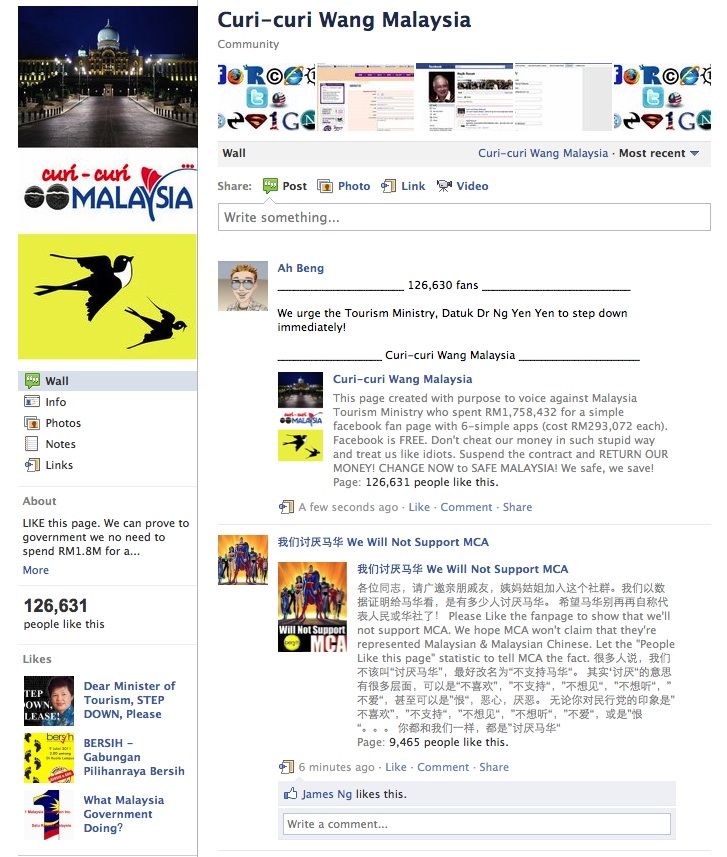
Citizens were even more incensed, with one enterprising and concerned tax payer setting up a facebook page that parodied one of the official government pages (see screen grab below). Within hours, this page had attracted 5 times as many ‘likes’ as the official page.

A couple of days later, the tourism minister announced that, “the RM1.8 million (is) for a full social media branding campaign, and not just to set up a facebook page.” She went on to say, “”(The money) is for responding, informing, interaction and monitoring (work on the facebook page), evaluation, data collecting, content development and advertising on Google, Facebook, etc…”

With her comments came an official release that stated the costs were for the following:

1. Technical

* Dedicated hardware deployment
* Software licencing
* Front end applications
* Application server engine

2. Development of six campaigns that require the following:

* Flash games engine
* Flash programming and coding
* Creative development and design
* Campaigns ideas and concept
* Front-end Flash design
* Testing and debugging

3. Campaign promotions

* Digital advertising campaigns on Google and facebook
* Contest, page wall and tourism fanpage content management
* Collection and management of database

The tourism minister then went on the offensive, asking reporters, “Do you think it’s cheap to set this up?” And as if to justify the expense, explained, “Tourism Australia is spending RM150 million (US$50 million) for the next three years on social media.”

Most recently, the minister stated that the allocation was to ‘run, manage and monitor a tourism campaign in the social media, including RM360,000 for advertising and over RM500,000 for prizes for the contests organized.’

‘Disappointed and hurt’ she is reported to have invited the Malaysian Anti-Corruption Commission (MACC) to investigate the campaign finances.

It is too early to determine the results of Tourism Malaysia’s first foray into social media but whatever the results, the Malaysian government, the tourism minister and the tourism ministry could have handled the matter more effectively and efficiently.

One would be forgiven for thinking that Tourism Malaysia has some internal communications issues. Because when the deputy minister first explained what the funds were spent on, his statement didn’t make sense. The deputy minister’s statement suggests he was provided with notes written by someone more familiar with the workings of an IT department than the requirements of a social media campaign. This has caused the deputy minister to be embarrassed in parliament and I hope someone has been reprimanded.

In terms of the social media exercise, Dave Duarte MD of South Africa based Huddlemind and a social media expert who was in Malaysia as the story broke stated in his blog that the exercise has already justified its expense.

His rationale is based on his guesstimate that the average conversion rate of a facebook fan to a customer is approximately 3% and because the average domestic tourist spends RM2,500 with 40,000 fans, the facebook page has already recouped its expenses.

This statement may be a little optimistic but it is certainly worth tracking the number of ‘likes’.

In terms of the game itself, it seems OK, leaning heavily on guitar hero. Personally I found the racial profiling of the characters unnecessary. Playing the game requires one to be more dexterous than I and as a result, the score required to qualify for the iPad 2 draw will always be beyond my means! I suspect I’m not the only decision maker in the family who will feel the same and this resulted in me leaving the page rather disappointed. But I digress.

So Tourism Malaysia’s (TM) long overdue foray into social media has not had an auspicious start. In the future, what can this key organization that contributes over RM50 billion (US$16.6 billion) to the national purse do to ensure tax payers get value money for all social media branding initiatives?

Here are 10 key recommendations for future initiatives

1) A social media strategy or any of the tactics within that strategy, is not the responsibility of the IT department. In future, the head of the department responsible for social media initiatives should represent the ministry when talking to the press and his press release should be prepared by him and his department and not by anyone else. Although the minister or his/her deputy must respond to questions in parliament, it is wrong to expect them to be knowledgeable about branding tools such as social media. Ministers do not need to talk to the media about such relatively small activities.

2) Social media requires an ongoing strategy and interactive initiatives such as the facebook pages are merely tactics within the strategy. Successful social media initiatives must be integrated with other branding initiatives.

3) I strongly suspect TM didn’t think through what they were doing when they launched the facebook pages. First of all it is important to develop a plan. Within that plan and before embarking on a social media strategy, it is important to identify what are the goals and how can facebook add value to branding efforts. Facebook is obviously an additional channel to interact with prospects and customers but why do it? To get more fans? Why? To get more participants? Why? How does TM convert those participants in the competition into leads? How does TM put a monetary value on social media activities? What metrics should be used? All of these should be outlined in the social media plan before implementation.

At the moment, registration is only required if participants want to be included in the draw for the iPad or meals. So how will TM optimize interactions with those participants and get them to become customers?

4) It’s also important to get fans to interact with other participants and to interact with participants. Critical to the success of any social media campaign are the conversations. Channels such as facebook are not platforms to broadcast messages about the company or in this case, Malaysia. The cuti cuti 1Malaysia facebook page has generated over 40,000 likes in a very short time and this is impressive. Furthermore, many of the postings on the wall have generated plenty of comments but TM is failing to enter into discussions with those who comment, preferring instead to pass that responsibility to others (See screen shot below). Interacting and engaging with people who comment is what social media is all about and will give TM more visibility, improve reputation and increase trust.

5) This first foray into social media is pretty basic and there is nothing wrong with that. But in future, Tourism Malaysia must look to be more innovative with what it does on social media. Fans will soon get bored of commenting and uploading images, especially if issues raised are ignored. Tourism Malaysia must encourage fans to be more creative. Perhaps by designing trips, submitting and voting for slideshows or setting up sub groups of specific niche related fans.

6) What makes being a fan special? At the moment nothing really which is a good and bad thing. Good because it means more people will become fans but bad because TM doesn’t know how many fans are really interested in the product or just want to win an iPad. In future, TM must look for ways to offer special content to fans or competition participants. Don’t be afraid to ask people to register.

7) This maybe a bit difficult for TM because technically, it isn’t allowed to sell Malaysia, only promote it but that doesn’t mean it can’t turn facebook into a potential profit centre. TM should make it easy for fans to book trips to destinations featured on the TM facebook the way it does on its website.

8) TM is still using mass media tactics on social media channels. This is ineffective and pointless. TM needs to stop thinking demographics and start thinking communities.

9) This applies to everyone and not just TM. Pause before creating a facebook group. Managing a group is difficult, time consuming and requires talent and patience to be able to respond to issues raised and continue a conversation till it’s natural end. TM launched four or five facebook pages at the same time! That requires a lot of talented manpower and judging by the lack of responses to issues raised, TM was ill prepared. Also important is what to do with the facebook group once the contest or event is over. It you want to delete a group, you have to manually delete every member of the group. With 40,000 members and growing, and with at least two clicks required to delete a member, the cuti cuti site will take a lot of manpower to shut down! If TM decides not to close down pages, in five years time, there will be a lot of dead pages that will confuse people.

10) The big question with facebook is what to measure and how to calculate ROI. In 2010 a study stated that fans of the top twenty brands on facebook were worth an average of US$136 each. With 40,000 fans, that would make the cuti cuti page worth over RM16 million! However the study was panned as it was actually a measure of the value of customer loyalty and not a measure of how much facebook had contributed to that loyalty. Moreover, the average of 20 brands like Nokia and Apple bears no relevance to tourism anyway!

As TM doesn’t technically have a product to sell, it is hard to know what to measure. For instance, TM can’t measure the ROI of acquiring a prospect and turning that prospect into a customer via facebook and comparing it with other customer acquisition programmes.

In reality, Measuring the ROI of facebook fans is probably impossible, especially for a national tourism agency such as TM and especially when the facebook page features a competition that allows multiple attempts from the same user and the end product is a future staycation.

As the dust settles on this rather unfortunate event, TM and its agency has a lot of work to do to sort out its social media strategy. It’s not a great start, and a lot of mistakes have been made. The key is not to make the same ones again.

Email and your brand, part three


Sticking with the use of email as a tactic within your brand strategy, I came across this interesting graphic showing when are the best times to send emails. Thanks Chuan Choong for the heads up.

But even if you get the timing right and the recipient does actually scan or even read the email, there are certain rules that must be adhered to.

You must be honest (in the US, deceptive subject lines are illegal) and transparent by revealing routing information such as the originator email address.

Make sure you offer recipients an opt out method and if they opt out, accept it and don’t add them back again three months later.

If you want to be taken seriously, I suggest you also include your physical address and website in any emails.

It is important too to make sure you track the effectiveness of your email campaigns and analyse the results. Create a source code for each campaign, track response rates, cost in terms of personnel, financial and time.

But most important of all is the content of the email and whether it is personalised and relevant to the target.

Here is another email that I received recently. From memory lane it is an absolute shocker. It isn’t personalised, it doesn’t resonate with me, the content is dull and uninspiring and the design, if I may call it that is dreadful.

When I receive a good example I will post it!

Why you should start building your Brand today


This article first appeared in the Friday 29th April 2011 edition of The Malaysian Reserve/International Herald Tribune

Does this statement sound familiar? “I know I need to start thinking about building my brand but I don’t know where to start so it can wait.”

I’ve heard this statement a lot recently and if it is a general feeling throughout the business community, then we’ve got a problem.

We’ve got a problem because as Malaysia becomes an increasingly wealthy country it will increasingly become a target for global brands that have seen their penetration in more traditional markets reach saturation point.

Moreover, free trade agreements and stagnant manufacturing or services based economies are also encouraging global brands to take notice of countries like Malaysia.

In the last twelve months, major global brands from the agriculture, automotive, aviation, biotechnology, education, fashion, food, hospitality, logistics, property, transportation and other sectors that in the past have barely considered Malaysia, are now establishing offices here.

Even Unilever owned brand Marmite, a quintessentially British savoury spread most often used on toast, now has sales in excess of RM20 million in Malaysia, mainly because it makes a bowl of congee a little more interesting!

And as these global brands take note of Malaysia they will invest substantial funds to establish their brands here and once those brands are established, it will be difficult for Malaysian products and services to compete with them. Unable to compete, over time, these Malaysian brands will fail.

So Malaysian firms really must begin the process of building brands now, rather than later. The good news is that beginning the process of building a brand or revamping an existing company has many benefits. Some of the most significant include the ability to charge more for products and services as well as a reduction in costs. Furthermore, changes in technology and communications mean that Malaysian firms might not have to invest significant funds into mass communications.

A word of warning though. Any branding initiative should begin with a careful analysis of the organization, its processes and systems, especially those that are customer facing and whether or not it has a customer centric culture, what it stands for and whether these elements are relevant today. Be ready for bad news but see it as feedback and an opportunity to improve not as criticism.

And once the brand is ready, communications should focus not on broadcasting how wonderful the brand is across traditional mass media channels, but on engaging prospects with content that resonates with them and delivering economic, emotional and experiential value to consumers and across all touch points.

Here are six more reasons why you shouldn’t wait to start to build a brand.

Reason No 1: Branding unifies your organization & motivates staff
Your people will want to be part of a respected and recognized brand because personnel who can identify with and support a brand’s culture, values and behaviour are better motivated, more loyal and engaged, both internally and externally.

As a result, your people will have pride and an interest in the company they work for and what they do for that company. Morale will improve, productivity will rise and resignations will be reduced. Moreover, a culture that strives to deliver value to customers and on customer terms will prevail. This in turn will lead to increased sales.

Reason No 2: Branding integrates & enhances brand touch points
This is really important. Organisations with weak or non-existent brands more often than not, make promises they cannot keep, focus on acquiring customers but pay little attention to existing customers and underestimate the importance of the customer experience. By developing a brand and building processes and systems into the brand delivery system, every single touch point between your organization and the consumer will be geared towards delivering a positive experience. Positive brand experiences will go a long way towards building customer loyalty, key to profitability.

Reason No 3: Branding reduces costs
What better incentive can there be for building a brand? Branding requires a brand strategy and a strategy will anticipate multiple scenarios and prepare the organization for outcomes, reducing the likelihood of expensive cost over runs or unexpected expenses.

Furthermore, a well recognized and well respected brand attracts talent, reducing the need for time consuming recruitment campaigns and expensive head hunters. A brand also reduces marketing costs. Less established products or services can spend up to 10% of revenue on marketing, brands often spend as little as 0.8% up to 2% on marketing.

Reason No 4: Branding justifies a price premium
Yet another major incentive for anyone still not convinced they should be building a brand. Branding allows you to charge more for your product or service because people will pay more for a name they can trust and have confidence in.

Reason No 5: Branding shortens the sales cycle
A strong, well respected and recognized brand creates trust and an emotional attachment to the product which also helps to make purchasing decisions easier. Over time, this influences the speed at which a prospect or customer makes that purchasing decision. This in turn allows a company to build customer loyalty and create brand ambassadors to sell the brand on their behalf, shortening the process further.

Reason No 6: Branding blocks competition
By focusing on building a brand rather than carrying out a series of transactions, you will ‘ring fence’ your brand and stop the competition from poaching your customers. As interactions with your brand increase, customers will automatically think of you when thinking of your category, thereby ignoring competitors.

In an increasingly competitive and noisy environment where better established global brands with deeper pockets are starting to flex their muscle, it is imperative that Malaysian firms, large and small start to build their brands now, before global brands get a foot hold in the country and it is too late.

Effective email campaigns must be part of your brand strategy


You’ve probably never heard of unsolicited bulk Email (UBE) or for that matter, unsolicited commercial email (UCE) but you have of course heard of junk mail or spam, the more common moniker.

The earliest known spam was a message sent in 1978 and the earliest known commercial spam message was sent in March 1994. This latter event coincided with the opening up of the Internet and the amount of spam has grown exponentially since then and the forecast is that seven trillion spam messages will be sent in 2011, making up about 85% of all emails sent worldwide.

This constant carpet bombing of consumer inboxes with irrelevant messages has had a detrimental effect on email marketing and now, with the advent of social media, our belief and trust in email is wavering. Nevertheless, email is still an effective tool in the communications of any brand strategy. It can be used as a marketing, sales, retention and CRM tool and response rates to personalized emails have been reported to be as high as 62% although 2-4% is the average. Still impressive.

But it is critical for marketers to ensure that their emails are relevant to the target market, well written and succinct enough to gain the attention of the reader in the roughly three seconds they have before the reader hits the delete/spam button.

It is also critically important to ensure before the campaign begins, that you know what the purpose of the campaign is and, most important of all, that your database is clean and up to date.

I am constantly stunned at the amount of shockingly written, poorly thought out and irrelevant emails that land in my inbox. I’m equally stunned at the amount of times I receive the same email from the same organization.

For instance this email, from an organization that recently spent RM15 million (US$5 million) on a ‘rebranding’ exercise, is exclusively for Mastercard owners yet I don’t have a mastercard!

Furthermore, the email is addressed to ‘undisclosed recipients’ and contains no cover message or other form of personalization. Finally, to the detriment of the brand, it has been sent to me an incredible six times in less than a month!

Takaful Malaysia which refurbished its 13 platinum branches and outdoor signs and billboards during the rebranding exercise should have also looked at its communications processes and systems, including qualification, lead and list management and other elements. As its stated aim is to ‘make the company more appealing to the younger age group, it should also review its creatives! But I digress!

What should Takaful Malaysia and other companies, who are thinking of carrying out email campaigns do to ensure those email campaigns create leads and prospects rather than brand antagonists?

Here are 10 recommendations that will help them and others get the most out of email:

1. Target your message
It’s critical that the subject line grabs the attention of the reader and encourages them to open the email. The best way to do this is to personalize the subject line. The Takaful Malaysia subject was the name of the product. Few people buy products. A better option would have been “Can I help you protect your family?”

2. Segment your target markets
Keep list sizes to a manageable amount. Don’t send gazillions of messages and then be unable to respond to them in an acceptable time frame (24 hours). Segmenting your targets will stop this happening.

3. Target messages
Keeping list sizes to a manageable level will allow you to develop multiple messages for multiple segments, critical to successful tracking. There is no one-size-fits-all solution.

4. Use a Salutation
The whole point of the exercise is to get a response, not to make a sale. If you met someone at a convention, you wouldn’t start pitching to them the moment you are introduced and it is the same with an email campaign. Be contemporary, slightly informal and inviting. Start prospecting emails with a greeting and, depending on the product or service, the contact’s first or last name, such as “Dear Mr Smith” or “Hi Fatima.”

If you don’t have the first and last name, don’t send the email until you have the correct information. The majority of emails without a name will go straight to the trash folder.

5. Keep Your Email Short
Lay the content out so that it is easy to read and keep the first email short to ensure it is skimmed. You want the prospect to read the entire email but they won’t stick around for long so make it a fast, easy read.

Keep the email to three paragraphs of no more than three or four sentences. You can also close with a one-line sentence.

6. Track each segment within each campaign
One of the great advantages of email campaigns over traditional advertising campaigns is the ability to calculate an exact CROI (campaign return on investment).

But don’t limit your calculations to response and conversion rates. Depending on the goals of the campaign, track demographics, territories, consumer data, page visits, click-throughs, time spent on pages, and other elements. Use this information to influence future email campaigns with more efficient and effective content.

7. Have a hook
Business owners and C level executives are busier than ever. They don’t have time to waste so have an instant hook. We are in difficult economic times and businesses are looking to save money, especially small businesses so an obvious hook would be related to saving money for a business. Ensure content resonates with target markets.

8. Content is still king
Mention specific issues relevant to target segments. There is so much information available that it is easy to identify issues affecting segments. It may take a little more preparation but it will be worth it in the long term.

9. Don’t go overboard on design
I’ve received emails with video clips, multiple graphics, embedded links, audio and so on. These are all distracting and time consuming when opened on a mobile device at an airport. Keep it simple.

10. Email marketing should form part of a brand strategy
Many firms conduct email campaigns on a whim, without any real thought or planning. This is a bit like driving a Ferrari in first gear, the car does everything you want it to but is it getting the best out of the car?

Incorporate your email campaigns into your brand strategy. Identify your quiet periods and implement an email campaign to boost sales in that period.

Email is still the most effective way to reach a lot of new prospects quickly and inexpensively. Email campaigns also have impressive response rates.

But email campaigns, carried out in an amateur way, can have a negative effect on your brand. However, if you follow these email best practices, prospects will take notice and respond, increasing your sales and building your brand.

Brand communications is no longer about broadcasting a company position across multiple mass communication platforms.


In today’s always on world, an important part of any brand strategy is the communications strategy but if Asian brands are going to be taken seriously, Asian CEOs must understand that times have changed and that we are living in a new world order. And in that new world order, the success of a brand is in the hands of the consumer not the corporation.

Today CEOs must understand that how consumers source information about brands and where they source that information from, has changed dramatically over the last 5 – 10 years. Where previously they learnt about brands from television commercials, newspaper advertisements and the recommendations of friends, today they learn about brands from Facebook communities, Twitter lists and YouTube channels.

Gartner estimates that mass marketing campaigns now have only a 2% response rate and this is declining annually. Despite this, Asian CEOs, so long in control of their brands and reluctant to lose that control, continue to try and shape brand perceptions by broadcasting positions repeatedly across traditional media via multiple and repetitive campaigns.

But Asian CEOs need to accept that in today’s noisy, crowded, dynamic, mobile market place, a brand cannot be shaped by repetitive communications campaigns that try to appeal to as many people as possible in the hope that someone will buy and communicated across traditional media. And those CEOs must understand that the success of their brands is too important to be left in the hands of marketers and advertising agencies.

According to Gartner, by 2015, at least 80% of consumers’ discretionary spending will be influenced by marketing across social and mobile platforms. And it is imperative that CEOs do not allow marketing departments to continue the mass market model of invasive campaigns that try to push a one size fits all corporate position onto consumers.

So if building a successful brand requires more than a traditional approach to marketing where reaching anyone and everyone and making them all aware of the brand with a generic message broadcast multiple times across multiple channels is not the way forward, what should Asian CEOs do if they want to challenge the global western brands?

The first thing is that this new world order is good news for Asian CEOs because it means they can stop wasting funds on expensive creative driven initiatives that require deep wallets to fund advertising campaigns repeatedly across traditional media in the hope that they will resonate with consumers and lead to a possible sale because the reality is, very few of them are noticed, let alone remembered.

Try this experiment. If you advertise in a daily newspaper or on TV, ask yourself which ads you remember from yesterday’s newspaper or on TV last night. Be honest. I doubt it is many. Personally I remember the ads from the Sunday paper because I was stunned at how many pages featured supermarkets and hypermarkets having a ‘cheap off’ on chicken wings, grapes and cases of beer.

And these are the very same newspapers that featured advertisements for Patek Philipe and Rolex watches, Lexus and Audi cars and other luxury products and services the week before!

And even if you remember newspaper ads or TV commercials, how many of the products or services advertised, have you interacted with? And of those how many have led to a purchase? And even if they have led to a purchase, what did the company do to ensure you come back again? I suspect they didn’t do anything and instead, after they spent all that money getting you into their store or to buy their product, they let you leave without getting some personal information in order for them to start to lay the foundations for a relationship!

In this era of smart phones and the half a million applications that can be used on them; In this era of social media with five hundred million Facebook users (6 million in Malaysia) of whom 50% are active every day and one hundred and forty million daily tweets on Twitter, many of them generated by Malaysia’s 1.1 million members; the proliferation of leisure time activities and abundant choice at malls and more, Asian CEOs must understand that the answer to brand building is delivering economic, experiential and emotional value to consumers and on their terms and across all touch points.

The global economic situation is a golden opportunity for Asian brands to take market share from established Western firms struggling to overcome cash flow issues and poor brand penetration. But it is up to CEOs to understand that they have to review traditional practices and take an interest, indeed responsibility for the brand and ensure brand departments understand that it is no longer enough just to advertise in traditional media and hope a brand will succeed.

CEOs must ensure too that at the heart of any new strategy must be the organization, making sure every brand touch point focuses on delivering value and communications departments must take social media seriously and understand how to deliver more engaged communications. And this will have to be done in a much more integrated, dynamic and fluid manner.

And whereas in the past, a series of the same full page ads repeated in daily newspapers or a number of prime time TVCs was generally sufficient to build brand awareness which would lead to a sale. Indeed, many consumers would actually watch a commercial and take a note of the brand and where they could purchase it. Those consumers would then go to the store, look for the brand and buy it. If the brand was unavailable they would take time out to come back again and again until they could make a purchase.

Today those same consumers don’t bother taking note of the brand names because they’re carpet bombed with messages throughout the day, every day. Many of those messages are making outrageous claims or are totally irrelevant to them. They are also too busy multi-tasking during the expensive commercial breaks. Furthermore, they’ve been let down so many times after believing those claims that they now often ignore them completely. And because consumers have so much choice and so many information channels, they don’t need to pay attention to messages broadcast via mass media any more.

Now consumers use social media and other tools where they inhabit communities that they relate to and trust, to seek information about brands. So it is in these communities where brands must learn to communicate and engage with consumers and deliver value that resonates with those consumers enough to make them want to own the brand.

Don’t get me wrong, I’m not saying don’t advertise but I am saying that if your organization is not on brand and all marketing initiatives are not integrated to allow you to deliver on the brand promise. And if your organization is unable to deliver value across all touch points and if you don’t use every opportunity to engage with consumers and collect data to help you get to know your customer and start to build a relationship with your customer, your advertising efforts will be wasted and your brand will not survive these extraordinary times.

In this crazy, always on, competitive market place it is these relationships that are going to help build a successful brand and not newspaper ads or TV commercials, no matter how cool they are and no matter how cutting edge is the technology used in the commercial.

Is Positioning still relevant today? Part two


Recently I wrote a blog post questioning the relevance of positioning today. You can read the full post here. A fellow blogger called Pepita responded with some well thought out and pertinent comments. Below are her comments, taken from the comments section and re posted here together with my responses embedded within the questions.

Pepita: You state chat a model that was developed for the US mass market in the seventies is not applicable to other countries or through time. Why does a market have to be similar in order for a model to work? All markets have the same elements (competitors, customers, manufacturers etc.) don’t they. If you extend your statement to other theories it is the same as saying that economic theories cannot be applied in Malaysia because they were thought up by Americans or English in another era. This reasoning in my opinion is flawed.

Marcus: I think that one of the reasons so many products fail to become brands (According to Ernst & Young this figure is 90%) is because companies assume that a model that works in one market will work in another. The mass economy was powered by mass market products that were standard and mass media was used to sell those products in multiple markets. As a simple example, for years British car manufacturers had a monopoly on the Malaysian market even though their cars were build in the UK and shipped here with UK specifications. So, a customer in the tropics was expected to buy a car with a heater. Limited choice meant customers had to accept this and British cars had over 90% market share. Then someone imported an American car with aircon. To this day, British auto manufacturers (of which there aren’t many) have been unable to make up that lost market share.

Pepita: Bad claims or outrageous claims developed by agencies for the clients doesn’t mean that the concept of positioning is no good. It means that agencies did poor work.

Marcus: Ries and Trout developed the concept of positioning because audiences were receiving multiple and confusing messages from more and more companies. Positioning’s goal is to create a ‘position’ in the consumers (any consumers) mind that is a reflection of the strengths and weaknesses of the offering. If you are first in that category even better. If you are not first, the goal was to create another new category. Positioning, according to Ries and Trout is about being ‘first in the mind than first in the marketplace’. Companies had to shape information communicated to consumers. Mass media was the obvious vehicle with its massive reach. For this they used and still do use agencies. The outrageous claims were a result of the pressure to create those new categories or influence perceptions. If companies didn’t like the work created by agencies they are able to reject it.

Pepita: I am not sure what you mean by your statement that positioning is only suitable for mass markets. As long as there is competition and there are customers you can use the concept. Even if there is no competition you can still position your company or your brand.

Marcus: You are right, as long as there are customers and there is competition, you can attempt to position your brand. Even if there is no competition you can still try to position your brand.

Pepita: Mission and vision, values, BHAG’s; there are tons of stuff in business that are immeasurable. Or they are measurable but aren’t measured. Does that mean that the concept doesn’t hold? I don’t think so.

Marcus: Generally speaking, in today’s customer driven marketplace where customers not companies define brands and with the tools available to marketers to collect data and use that data, positioning, with one or two exceptions is no longer relevant. Brands are built through retention (you have a 15% chance of selling to a new customer and a 50% chance of selling to an existing customer) not acquisition yet positioning tends to focus on acquiring new customers not retaining them.

Pepita: Wikipedia is no official standard. It could be my opinion or yours; whoever comes last. So dimissing positioning because you do not like the definition in Wikipedia is a sophism. Skipping that and going back to Ries & Trout, the wrote a book on bottom-up marketing and always had the consumer/customer/prospects in mind.

Marcus: I’m not trying to deceive anyone. I googled the ‘definition of positioning’ and got 12 million responses. The beauty of the Internet and tools such as Wikipedia is that we seek references and definitions from others through these platforms. Opinions shared across social media and other peer to peer networks play an increasingly important role in building profitable brands. Positioning simply cannot address these voices, opinions, concerns and so on.

Pepita: You state positioning is one way communication. The company is telling the customer how the products are positioned. I think that you are confusing claims with positioning again. I hope companies would be smarter than to communicate their positioning to their target audience. Who cares?

Marcus: I agree, nobody cares or pays any attention yet positioning, according to Ries and Trout is about, “what you do to the mind of the prospect.” Once it is created, the position has to be communicated via communications and claims are made in those communications that reflect the required position.

Pepita: To me positioning is both competition and consumer/customer driven. That is the way I work and I know that others do too. And Ries & Trout say the following: “To find a tactic that will work, you have to leave your ivory tower and go down to the front where the marketing battle is being fought. Where is the front? In the minds of your customers and prospects”.

Marcus: A couple of responses to this, firstly, using the actions of competitors to determine your brand strategy is a complete waste of time and resources as you will forever be playing catchup. Secondly, my mind is so full of clutter that you will have trouble finding any space to position your product! Much of that clutter is made up of negative connotations related to claims made by brands when trying to position their products in my mind. This is probably a universal state which is why we have the sad statistic from Ernst and Young above.

Pepita: Of course the world has changed significantly over the last 40 years but that doesn’t mean that theories and models aren’t true or usable anymore?

Marcus: Actually, although this is a sweeping generalisation, I don’t think you should be using models developed in one market 40 years ago to build a brand in another market. It would be nice if it could be done but the reality is the agencies want firms to because it makes it easier for them and also marketing professionals. But more importantly, consumers have changed, the way they source and gather information, their influencers and so on. Furthermore their requirements for economic, experiential and emotional value are very different and vary considerably from country to country.

Pepita: You state that positioning uses mass market channels. To me positioning is a strategic concept and not equal to marketing communication. So what you really seem to be saying here is that mass market channels aren’t of this day and age. I agree with you there, but it has nothing to do with the concept of positioning.

Marcus: As I mentioned above, positions have to be communicated. Most agencies recommend mass media to do this because of its reach. But this is an agency issue.

Pepita: Advertising can cost a lot of money. You are equaling positioning and advertising. Positioning is a strategic concept and Advertising is a possible form of execution of the strategic positioning for a company or a product.

Marcus: Again, positions have to be communicated. Don’t forget, this is a blog post not a book! I’ve only got so many words to play with. The most common method to communicate positions is via mass media advertising.

Pepita: Of course tennis rackets have changed throughout the years because of the possibilities technology offer, but since 1873 tennis has been played with a racket. The concept of the tool is still the same. People still play tennis with a racket. If I apply this analogy it would mean that the theory of positioning can be innovated and developed throughout the years, and still be a tool to be used.

Marcus: I don’t see how positioning has been innovated and developed throughout the years.

Pepita: You state some undeniable facts. Markets and consumers have changed. Communication channels are of another era. But your arguments for positioning being outdated and unusable are – in my opinion – flawed and have not convinced me. I also miss an alternative. It would be great positioning for your agency: The brand agency with the alternative to positioning!

Marcus: Nice idea for a tagline, thank you! So much has been written and so much time spent learning about the power of Positioning and the 4 Ps by a whole generation of marketers. But the world is a very different place, the way consumers live their lives and their knowledge and the tools available mean that we have to think past using increased budgets to build brands.

There is no silver bullet to building strong, profitable brands. Every brand is different as are its customers. Some brands are B2B, some B2C. But there is a process to building a strong profitable brand. It requires a focus on research, organisational excellence, planning, personalisation, retention and doing business on customer terms. It’s not particularly sexy and won’t see many brands staring down from billboards, much to the delight of brand owners and ad agencies, but it will go a long way to building strong, profitable brands.

Because without profitability, a brand is irrelevant.