Top tips for successful city branding


I know I’ve said this before and I am probably beginning to sound like a broken record but advertising agencies do advertising.

And advertising is a tactical initiative driven, on the whole by creativity. Using advertising across one or more channels is a series of tactical initiatives known as a campaign. It is not a brand strategy.

If you want to build a brand, you are not, unless you have extremely deep pockets and are very very lucky, going to do it with advertising alone. This is especially true in the destination branding sector. What is required is a comprehensive, integrated brand strategy that acts as the blueprint that drives multiple interanl and external initiatives, including the very important creative elements developed by advertising agencies and not the other way around.

Bill Baker, author of Destination Branding for Small Cities available here, has written a timely, concise and easy to read set of guidelines for any city or destination that is ready to develop a brand strategy.

The article is here dont_hire_painter-1

I strongly recommend any destination, and for that matter, any company read this article to understand what they need to do before wasting valuable resources on tactical initiatives that will only add to the noise.

Nation Branding and Social Media


A key element of a successful nation branding initiative depends on how well your audience absorbs, understands, adopts and redistributes the message based on their requirements for value. Back in the day this was done at a coffee shop, sundry store, mosque, church, football club or where ever else consumers congregated. Today those same people are increasingly likely to hang out in communities online. Facebook is the most popular home for many communities and it and other forms of Social Media need to be part of any strategic nation branding initiative.

But the Social Media rules are very different to the traditional media rules. And although many nations, organisations and government institutions or destinations believe they understand the new rules, the output of many of them would suggest otherwise. And this is detrimental to the long term success of the nation brand. Social Media channels or tools may not survive as long as many traditional media channels, but Social Media is here to stay.

One country that seems to be doing Social Media right, is the US. The importance of Social Media, and in particular Facebook during Obama’s presidential election campaign is now the stuff of legend. Key to the successes of the campaigns was that campaign personnel asked people what was important to them and then fed that information back to the main office where local service projects were implemented as quickly as possible. Many of of those vote winning projects continue today.

At one stage, in November 2008, Obama had 2,155,244 friends on Facebook, McCain had 578,651 and George W. Bush had none! Little wonder then who won.

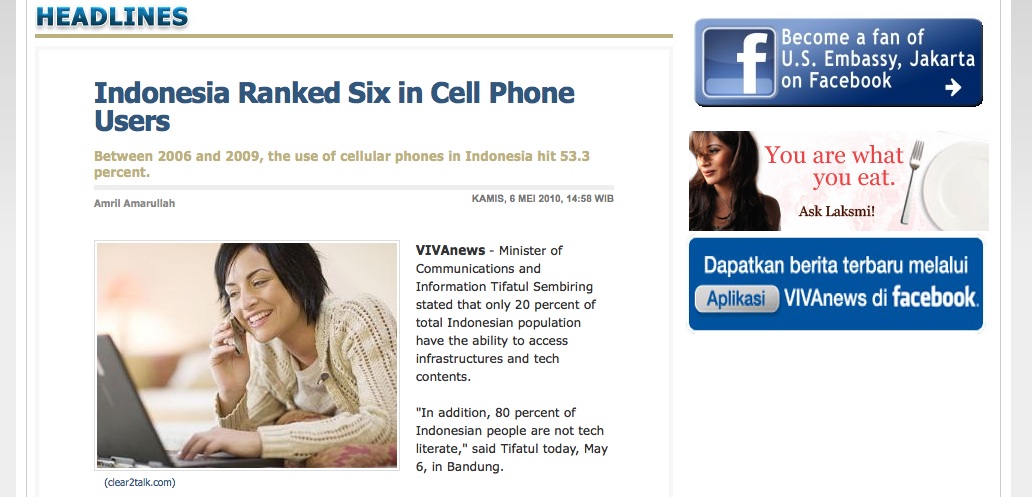
The US has since expanded its use of Social Media to the international arena and the increasing importance of Social Media channels is reflected in the Facebook efforts of the US embassy in Jakarta, Indonesia. The Embassy has invested significant resources into Social Media just as the use of Social Media in the country takes off – the number of active Facebook users in the world’s most populous Muslim country has grown from 2,325,840 in March 2009 to 20,775,320 in March 2010, an increase of 793%!

As the US Embassy in Jakarta has ramped up its presence on Facebook, its fan base has ballooned from 35,000 followers to 131,000 in little more than a month! This in a country not known for its love of the US. But the US embassy understands that this is not a soap box to try and hard sell or influence Indonesians with US policies and attitudes.

As a result, the tone of the Facebook site is light and cheerful. One recent post on the homepage related to Indonesia Batik, has received over 795 comments and more than 2,300 thumbs up. Most of the posts receive 100+ comments and significant numbers of thumbs up. Batik is err a common thread throughout the site and most of the postings are related to American life and culture, and in particular sport, music and popular green initiatives. Other initiatives include Blogger workshops.

Tourism, primarily destinations in the United States are also featured, including a rather ambitious and possibly poorly targetted attempt by Nebraska to attract Indonesians to the Great Plains state. Despite the remoteness of the destination, the video has received over 50 mainly positive comments. Other states using the site to market themselves include Tennessee and Ohio.

The US Embassy markets the site via advertising on local sites such as this one

Social Media and, in this particular case, Facebook is undoubtedly an excellent channel for nations to build their brands by engaging with consumers and offering value to those consumers based on the needs of those consumers, whilst understanding the environment. The USA, certainly in Indonesia seems to know this better than most.

Thanks to unspun for the inspiration for this story

Most Asian firms should not consider Positioning to be the right tool for Branding initiatives


Two of the most famous names in marketing – Jack Trout and Al Ries developed the concept of positioning back in the 1970s. Their business/marketing book, Positioning: The battle for your mind was written in the early 1970s and almost forty years later, is a well thumbed addition to the book shelves of respected marketing professionals around the world.

Jack Trout and Al Ries developed the concept of positioning because they believed that branding was becoming increasingly difficult as audiences were inundated with numerous and confusing communications. Positioning was promoted as a tool to “break through the clutter.”

Today, the following product description for the latest edition of the book on Amazon is: “Positioning” describes a revolutionary approach to creating a “position” in a prospective customer’s mind – one that reflects a company’s own strengths and weaknesses as well as those of its competitors. It goes on to say, “Advertising gurus Ries and Trout explain how to: make and position an industry leader so that its name and message wheedles its way into the collective subconscious of your market – and stays there.”

I disagree with this statement. Positioning may have been revolutionary in the 1970s but it can hardly be described as such today. Furthermore, where I come from, ‘to wheedle’ is not really a flattering term. In fact the free online dictionary has this definition, “To obtain through the use of flattery or guile: a swindler who wheedled my life savings out of me.”

The concept of Positioning also suggests the ‘position’ should be based on being first in a particular category. If another company is already first in the category, then the company should work to redefine itself in a new category to ensure it is first in that category. This was really important to Ries and Trout. In fact so important, that they felt it was more important to be first in the mind than first in the marketplace.

In the mass markets of the 1970s and 1980s, positioning was defined by perceptions. To influence perceptions and maintain a position within the relevant minds, it was imperative that companies dictate the information consumers received.

And, because of the power of mass media, this wasn’t an impossible task. Moreover, because most audiences were relatively passive, and they had little choice of products, well-researched messages were likely to register with targeted audiences.

Furthermore, advertising agencies and in house marketing departments also embraced the concept of positioning because it gave them total control yet there was little opportunity for accountability. After all, it was relatively easy to show progress in awareness or top of mind, but first in the category was tough to measure.

As a result, positioning was adopted by many companies and became a successful tool. In the face of this increased competition, many companies took the wheedling part at face value and started to manipulate information to control a hard fought for position that was threatened on many fronts. Soon fantastic claims were being made in advertising and other channels.

One example is the tobacco industry that tried to convince consumers that tobacco wasn’t addictive. Ford made a similar attempt to persuade prospects that the Pinto did not have design issues. More recently there were some outrageous claims around the Enron scandal and certain financial institutions last year were wheedling furiously!

Unsurprisingly, this has caused consumers to become more disillusioned and cynical and less likely to pay attention to claims made by advertisers. Here in Malaysia, 84% of those polled in a recent study by a daily newspaper said they didn’t believe what they read in advertisements. This despite the fact that many of the companies featured in those ads were attempting to position themselves in the minds of those very consumers.

Because positioning relies on mass media, it has to appeal to as many people as possible. This may be alright in a single or homogeneous market but what happens when a market is segmented?

Furthermore, firms consider a positioning campaign to be the communication of a particular message to a mass audience. But what happens if that audience doesn’t listen or accept the message? The advertising agency will tell the company to do it again, perhaps after tweaking the creatives a bit. This is also known as repositioning.

Jack Trout, this time with Steve Rivkin, released a book last year entitled REPOSITIONING: Marketing in an Era of Competition, Change and Crisis. The back cover calls this “A brilliant new book” and states, “So you’ve mastered the art of marketing. You’ve positioned your company, branded your product, and targeted your consumer. Unfortunately, in today’s economy, that’s not enough. You need REPOSITIONING.”

I haven’t read the book so I can’t comment but I have my doubts as to the effectiveness of repositioning.

Don’t get me wrong, I do think that positioning is a tool that was, in its time and for many products, a very good tool. But I don’t think it has a role to play in today’s customer driven economy. There may be some exceptions such as in the destination branding sector and some soft drinks may benefit but these are the exceptions not the rule.

I know it is hard to let go and there will be a lot of resistance to what I have written. After all, so much effort by so many people has gone into learning about positioning. But the world has changed. More importantly, consumers have changed. And marketers should acknowledge this and change with it.

Communications and the way consumers live have changed a lot over the last 40 years. Isn’t it time Branding and the way brands are built and the tools used to build those brands changed too?

Should destinations brace themselves for a brutal summer?


Grant Thornton has published a report that forecasts 373,000 visitors to the Football World Cup in South Africa in June. That’s a drop of 110,000 from original forecasts.

The big question is, are fans waiting to the last minute to book tickets or is this a sign of the recession? Certainly political tensions in the country may be causing fans to wait and see before making a decision on a significant financial commitment. After all it’s not just the match tickets. Fans also have to take into account the cost of flights, accommodation and internal travel which can be significant distances. Grant Thornton predicts fans will have to fork out US$4,000 each. For a family of four, that’s US$16,000 for a summer holiday in a recession! Hard to justify.

But I believe that the poor ticket sales are a result of the global economic situation. And if I am right, destinations in South East Asia could be heading for a brutal summer.

I think that free spending Europeans will forego an international holiday and instead invest in a large LCD or Plasma TV and stay at home to watch the World Cup. If they do go away, it will be either for a short domestic holiday or somewhere in Europe. I expect Eastern Europe to benefit.

If I am right, what should destinations do to soften the blow?

Well the first thing is to curtail one-size-fits-all mass market TV advertising communicating the usual white sandy beaches, tropical blue skies and azure seas. There is simply no differentiation from other destinations. Consider this comment from Qualitative research carried out by FusionBrand in the United States earlier this month,

“Watching the basketball today and an ad came on for a destination with some really nice water/resort images. It was Malaysia. But is (sic) struck me that the line Truely Asia gave me the feeling that they were trying very hard to say, “us too”. It gave me the feeling of them saying “we’re just like the other (good things) in Asia”. But the images in the ad could have been in the Carribean.”

How confusing is that?

There is no time to build a communications strategy for 2010. If it hasn’t already been done, and at least 2 countries in South East Asia don’t have a plan for 2010, it is too late. But there is still time to develop an integrated tactical approach to activity based not geographic based marketing.

Thirdly, embrace social media, NOW. Start to engage prospects and those who have visited via social media. Redistribute resources, train staff and create teams to build relationships with consumers via Facebook, Twitter, Travelocity, Tripadvisor and others. Forget about the old global buys on CNN and the BBC. Creating awareness via mass marketing wastes valuable resources and anyway, consumers aren’t listening. Reinvest that money in engaging consumers.

Fourth, don’t ignore the traditional web. Make sure your website is as contempory as possible. If you are sitting back thinking, why do we need to change or improve our website again, we updated it two years ago, the Internet is fluid. Destinations need to be seen as dynamic. Singapore is on its third design (and best so far) in two years.

Develop a plan for your digital tactics and don’t forget basic web marketing tools like SEO and SEM.

Call emergency meetings with all stakeholders – representatives of the mayor’s office from all key cities, transportation companies, travel agents, tour operators, shopping malls, hotels and so on. Identify what each has to offer and work with them to develop an integrated holistic plan to leverage their attributes and match those attributes to the requirements of target markets.

2010 is going to be a bumpy ride for cities, states and other destinations. This is an emergency and it calls for emergency measures.

Otherwise the 30% drop in arrivals in South Africa will be duplicated around South East Asia. And without the attraction of a World Cup, they could be magnified, causing many destinations to have a brutal summer.

Your communications are critical.

Luxury branding in developing markets requires a different approach


Patek Philippe, the eponymous luxury Swiss watch, or should I say, timepiece brand is known for running the same advertising campaign for years. Although the images may have changed, the tagline “You never actually own a Patek Philippe. You merely look after it for the next generation.” has remained consistent, usually along with a jaw droppingly handsome and immaculately dressed and coiffured ‘father and son’ portrait.

For the target market, the aristocracy and the wealthy of the world, and those that aspire to the class, the ads say many things, including ‘buy one and you’ll be like us and ‘You have class and you know class’.

The ads are a wonderful example of luxury branding – a great product manufactured with precision engineering, immaculate heritage, an aristocratic client base and creative genius in the advertising that communicates on a level that the target market will connect with and explains, in the limited time available to garner interest, the timeless character of the brand. And I am sure the quality of service at the point of sale will be equally as impressive.

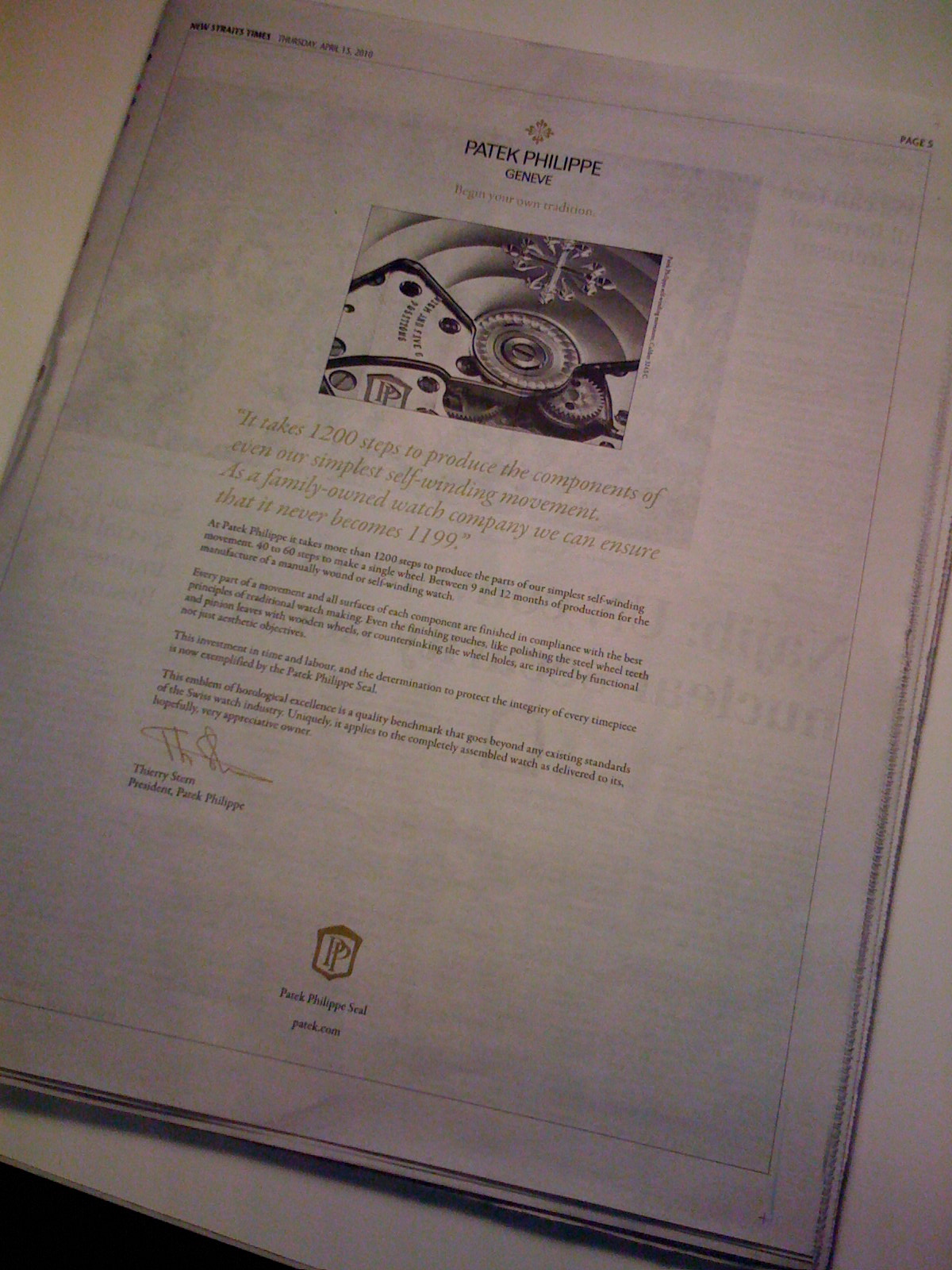
PP has recently launched a new global print advertising campaign that focusses on the values of the company established by two Polish immigrants, Frantisek Czapek and Antoni Patek in Geneva in 1839. I’m not sure if this campaign is to replace the old one. I for one hope not.

The latest campaign revolves around the personal letter concept and has the current president, Thierry Stern waxing lyrical about the steps involved, the time taken and care and attention to detail invested in the production of a PP timepiece. He talks about ‘polishing steel wheel teeth and pinion leaves with wooden leaves and countersinking wheel holes’ and the fact that these efforts are ‘inspired by functional not just aesthetic objectives’.

He goes on to mention the Patek Philippe Seal, an ’emblem of horological excellence’ that appears to be an internal ‘quality benchmark’ that claims to be ‘beyond existing standards of the Swiss watch industry’.

The ads are set to appear in ‘quality daily newspapers and influential trade publications’ around the world and will also appear at the point of sale.

The first ad (I think) appeared in Malaysia in the New Straits Times on 15th April 2010. I can understand (although I don’t agree with the tactic) the mass market approach of running an ad in the New York Times or the London Times, South China Morning Post etc or any other developed country where there is significant market potential.

But I can’t understand the purpose of running the ad in a developing country such as Malaysia. A quick search of the net finds a rather old PWC report, that states ‘the mean monthly gross income per Malaysian household increased from MYR2,472 in 1999 to MYR3,011 in 2002, denoting average growth of 6.8% per annum’. So if we use that growth rate to bring us up to 2010, the mean monthly gross income per Malaysian household is now roughly RM5,096 or US$1,358. Don’t forget that is gross and does not take into account the impact of the economic crisis.

Another search of the Internet would suggest that the cheapest PP watch is around US$4,000 and the most expensive sold some time ago for about US$11,000,000 (that’s RM36 million in real money). The majority of PP watches appear to be in the US$10,000 to US$35,000. At those rates, the potential market in a country the size of Malaysia is tiny and an ad for such a luxury product in a daily newspaper is essentially a waste of money.

Just to put things into context, the ad after the PP ad is for Honda and the ad after that is for Panasonic household appliances such as an Alkoline ionizer, hair styler and hair dryer and men’s shaver (inner Blade and outer foil).

So what should PP do in developing markets like Malaysia?

Here are 5 suggestions

1) Rethink the one-size-fits-all mass market approach to building a brand, especially in developing markets. The consumers who can afford your products can be engaged much more effectively in other ways.
2) Build a database of prospects and customers. But all markets require different strategies and data collection techniques will be different.
3) Build relationships with your existing customers. Existing customers are often ignored by companies scared of asking too many probing questions. And certainly timing is important. But well trained luxury retail staff can build relationships with wealthy customers who are likely to be successful businessmen and politicians and their opinions will carry a lot of weight with prospective customers.
4) Advertising is important, but choose your channels carefully. Mass circulation newspapers and magazines are for shavers and hypermarkets.
5) Content is important too. I’m not sure anyone really cares what is hidden away inside the shell of a product with almost 200 years of heritage. After all, if the quality was a given in the previous campaign, why must it be addressed now?
6) Integrate your digital commuications with mobile channels to engage with prospects and customers interactively when they are on the move.

Building a brand is hard enough. PP has done it successfully for 200 years. But treating every market the same and using mass marketing tactics that belong to an era that no longer exists, will make it hard to do it successfully for the next 200 years.

Malaysia getting ready to be major player in world’s largest service sector industry


One of the most interesting elements of the New Economic model (NEM) announced by the Malaysian Prime Minister, Datuk Seri Najib Razak was related to tourism.

I quote directly from his speech, “…the tourism sector has not been exploited to its potential. More can be done to attract new markets from Europe and the Americas to complement the markets from the United Kingdom and Asia.

We have some of the oldest forests in the world, rich with flora and fauna and diving experiences acclaimed to be unforgettable. Malaysia can lead in providing environmentally sustainable eco-tourism adventures that are much sought after by the advanced markets.

We should aim to provide services which will attract high-end tourists who seek exclusiveness and high value services. We must also be creative as we consider new areas of tourism. From medical tourism — a high-potential growth sector — to eco-tourism, luxury market tourism and visitors related to our growth as a regional education hub. Malaysia’s tourism future is bright if we have the vision and creativity to support its diverse growth potential.”

World’s largest service sector industry
As the PM said, Malaysia has long neglected the business of tourism, despite the fact that it is, according to the World Bank, the fastest developing industry in the world. Moreover, according to the World Tourism Organisation, 2006 (the last year before the sub prime crisis) was a record for world tourism with 842 million tourists visiting other countries, up 4.5% over the previous year. Tourism is now the World’s largest service sector industry.

Furthermore, according to the World Tourism And Travel Council (WTTC), 12% of exports, 9.3% of international investments, 8.3% of the world’s places of work and 3.6% of world internal gross product account for a share of tourism and its relevant sub industries.

Using the satellite accounting approach, which attempts to calculate the extent to which other economic sectors contribute to and benefit from tourism and passenger traffic, the WTTC also estimates that the travel and tourism industry in 2008 was valued at approximately US$5.9 trillion or 9.9% of global GDP.

Tourism is also a popular industry with governments because it impacts every level of society from the sundry shop owner who sells a tourist a bottle of water and a map to the car hire company, locally owned hotel and airline.

With hundreds of miles of pristine coastline, breathtaking islands and the oldest rain forest in the world, Malaysia should have a better developed tourism industry and it will be interesting to see what incentives the government offers investors and developers to encourage them to invest in the infrastructure and products needed to move Malaysia up the value chain in this beneficial industry.

49 million visitors by 2020
I managed to get my eyes on a copy of a report preparred by a respected international consultancy and commissioned by the government to provide data for the NEM. Unfortunately one of the key recommendations was to increase the number of arrivals to Malaysia to 49 million by 2020.

It has been a common thread in announcements made in Malaysia that volume is key and we need to be attracting hordes of foreigners to Malaysia to consider our tourism business a success. But this advice is poorly thought out. One example, imagine the impact of 49 million tourists, many of them blue collar Europeans who consider it their God given right to walk around without a shirt on (men) or only in a bikini (women) and quite often with a beer in their hands, on a place like Kuala Terengganu or Kota Bahru.

What we need to do is move away from this volume is best approach and look more at a value is best strategy that aims to attract smaller numbers of higher value visitors. This will also help with the infrastructure and talent issue as we do not have the people available to staff the 500 or 600 room hotels required to support 49 million visitors.

Breathtakingly beautiful island
One of the best natural destinations in Malaysia is Redang Island in the South China Sea. This breathtakingly beautiful island has slowly had it’s natural attractions such as the coral destroyed by boats dragging anchors, careless swimmers and greedy fishermen.

But the concept of volume over value ruled and so little was done until recently when the Terengganu state government announced that it will no longer approve any applications for cheap Chalet style resorts as it wants to make Redang a destination for high net worth visitors. This is a a sensible move that will also help save the marine environment and attempt to prevent further environmental damage.

It is a sensible move that the state government, and hopefully the federal government will offer financial support, wants to upgrade this amazing destination. But the state government should also understand that it is not just about changing the names of the resorts, upgrading facilities, spending large sums on awareness advertising and increasing the rack rate by 300%. There will need to be a significant investment in the upgrading of the resorts and also supporting infrastructure.

Here are 5 other recommendations:

1) Carry out research with stakeholders, prospects, customers and others to determine the way forward.
2) Work with carriers and others to improve domestic and international connectivity.
3) Find the right partners. Malaysia doesn’t have a domestic 5 or 6 star hospitality company that is recognised globally. Work with a globally respected and recognised resort management company.
4) Redang is a small part of the potential of Terengganu. The state must develop and implement state destination brand masterplans. The brand masterplans must incorporate measureable and relevant promotional strategies that are not based on traditional marketing techniques but leverage the power of social media.
5) In line with federal initiatives, reduce costs of doing business and offer exciting incentives for investors, above and above usual free utilities for 5 years etc.

We’ve heard about incentives for the tourism industry before but the government has never really pushed them. I have a hunch that this new administration is different and that this is a small first step in a revolution that is long overdue.

Don’t expect prospects to build your brand


Yesterday I saw a video on the new sonos zone player. You can find the video on the site here but to brief you it is a cool looking internet radio and itunes player controlled by your iPhone that allows you to play music in all your rooms. Pretty cool so watch the video if you can.

The video was really well executed and I was sold by the end of it. I went to the ‘Find a store’ feature on the site and was impressed to find a dealer not far from my office in Kuala Lumpur. There was even a contact name and email address.

I sent the contact an email but also decided to post a request for information on Twitter. Probably because I have sent emails to electronics dealers in Malaysia before and never heard from them (it’s a fairly unsophisticated business here, dominated by old school Chinese traders). But I sent the email because it is slowly changing, as I found out when I had a technical issue with my Zepellin.

Anyway, I haven’t got a reply to the email but I did get 2 responses to my tweet, one directly from the manufacturer @Sonos and one from the distributor in Singapore @SeowHow.

Incredibly, the manufacturer told me to contact their distributor and the distributor told me to contact his sales office!

Here’s some free advice to ensure your brand doesn’t end up in the bulging cemetary of great brands.

1) Don’t expect an interested prospect to become a customer
2) Treat all your leads/prospects as if they are the most important person in your world
3) Don’t expect a prospect, even an excited prospect with buyer written all over his face, to do all the heavy lifting
4) Your brand may be the be all and end all of your life but it isn’t of anyone elses
5) There is a lot of competition out there

Asian companies need to stop following the herd


I’ve said it before, but I feel the need to say it again, according to Ernst & Young, up to 90% of products fail to become brands, despite US$1.5 trillion spent on marketing every year. Despite massive marketing budgets, global brands with extensive reach and high brand recall, numerous brands have died a painful and often avoidable death. Despite those massive marketing budgets, brand loyalty is decreasing and customer dissatisfaction is increasing.

So why do companies insist on investing massive amounts of money in marketing even though it is proven to be inneffective? There are a number of reasons – ego, inertia, fear of the unknown and fear of change, herd mentality and more.

But for the smart companies, think Dell, Amazon, Google, McDonalds, Walmart, Public Bank, Toyota, yes Toyota and many more, the halcyon days of inneffectiveness are over for marketing people and smart CEOs and CFOs expect, no demand greater accountability and more sustainable results from their marketing investments.

When branding was little more than a creative driven concept where a logo was used to make a name stand out and the world was much larger and competition was limited, the four Ps and old world communication goals such as reach, positioning and awareness were often enough to build a brand, then branding was little more than a subset of marketing.

But that US centric mass economy era no longer exists. The world is a much smaller, competitive and very different place today and branding has taken on a much more important role within the organisation. Moreover, consumers are more enlightened and cynical and no longer pay much attention to traditional marketing efforts.

The definition of a brand today is here

Key areas are retention (95% of marketing efforts are aquisition focussed yet very little is spent on retention so as 1 customer is expensively aquired, an earlier one also expensively acquired, walks out the door to the competition. Many companies lose money on the first sale. In the case of technology, it could be the first million sales. Brands are built on the 2nd, 3rd 4th and so on sale).

Organisational excellence (if you don’t do everything effectively and efficiently and on personalised customer terms, you won’t survive). Economic, experiential and economic value for customers (on their terms) and measurement.

It’s not only marketing that is now part of branding, it is also the supply chain, customer service, accounting, sales, purchasing and so on.

The world has changed and if you own a company, you need to change with it. You owe it to your shareholders, your customers, your staff and yourself. It is time to stop wasting money on proven inneffective marketing and start investing in your brand.

Personalisation


Companies have to stop trying to sell stuff to prospects and customers and start coordinating all the resources it has to supplying or satisfying specific customers specific requirements for value.

Consumers don’t want products (or services) they want the products/services they like immediately and personalised. But personalisation in its present form is primitive because of cost, technology, time and lack of appreciation by CEOs. Right now personalisation is nothing more than a colour, sun roof or memory size. Consumers will want to actively shape the offerings and information they receive. It’s already happening in the aircraft/shipping/hospitality etc industries. Hey, even Barbie has 6,000 customisation options!

I’m sure I’m not the only one who has bought something that wasn’t quite what I wanted but was bought more in frustration at not finding what I wanted exactly. After a week it was gathering dust in a store room. In the future, with advanced build to order capabilities, even complex products will be produced specifically for one customer and buying products that don’t quite fit the bill be a thing of the past.

This will also have an impact on communications. Existing customers will no longer visit websites, they will have direct access to their own landing page.