Louis Vuitton in a spot of bother over print ads


The Advertising Standards Authority (ASA) in the UK has received complaints that print ads for Louis Vuitton created by Ogilvy and Mather suggest that the products were made by hand.

Certainly looking at this ad that shows a woman creating the lines for the folds of a wallet

and also this ad that appears to be a woman stitching a handbag

It is easy to see why there have been complaints. Especially as the copy states, “infinite patience protects each overstitch… One could say that a Louis Vuitton bag is a collection of fine details.”

However, according to marketingweek Louis Vuitton defended the campaign by saying that “their employees were not assembling pre-packed pieces but were taking individual handcrafted and hand-sewn parts through a range of hand-made stages to reach a final item.”

Louis Vuitton added that the use of hand sewing machines and associated tasks were “part and parcel of what would amount to ’handmade’ in the 21st century”.

So handmade doesn’t actually mean handmade in the traditional sense?

If that is the case does that mean then that the iconic hand made Hermes Birkin bag that can cost anything from US$10,000 to well over US$100,000 isn’t actually hand made?

Does this mean that the animal skins used in a Birkin bag are not actually spread out on the floor of the processing room and screened by a number of artisans before being measured and cut by hand as required?

Does this mean that the bottom of the handbag is not sown by hand to the front and back with waxed linen threads?

Does this mean that the handle of the Birkin bag is not manually stitched until the shape comes to the fore?

Does this mean then that the artisans don’t use sand paper to smooth rough edges? And does it mean therefore that hot wax is not applied to the handles to protect them from moisture?

And all the effort that goes into the front flap, the metal and lock is not actually done by hand?

Does it mean that the craftsmen in France that all work out of the little lane in Paris don’t actually exist?

And advertising agencies wonder why 76% of consumers don’t believe that companies tell the truth in advertisements. In Malaysia that figure is 86%!

The number one element in any relationship is trust. If a brand wants to build a relationship with a consumer, that consumer must be able to trust the brand.

An element of doubt in communications is not a good way to build trust.

Australia Unlimited. Genius or Garbage?


Someone sent me this link about the plans for the Australian government to use a new tagline to sell Australia Inc to the world.

I’m sure you guys have lots to say and I welcome your thoughts on the article. To get the ball rolling here are a couple of thought starters.

1) Australia Unlimited isn’t a brand, it is a tagline created by an advertising agency to be used in creative driven communications using one message to communicate with all stakeholders, irrespective of their requirements for value. The concept of selling ‘Australia to the world” is laughable as most of the world doesn’t care.

2) Here’s a clip from the article, “Shortlisted agencies were given a brief to ”come up with a brand that would promote Australia’s capabilities across a range of sectors from investments and exports to education, culture, sports and events”

How does “Australia Unlimited” do that? And how could any communications campaign appeal to such a diverse prospect base?

3) Here’s another quote from the article, “John Moore, director of brand development of the Global Brands Group, the agency that has been co-ordinating the new Sydney brand, likes the line. ”It takes it beyond tourism and poses the question of what is unlimited about Australia, to which there can be many answers. I think it will work really well as a connecting device with all those different areas [of trade and business].”

Excuse me? How does it do that? I want to set up a mining company in Australia, what can you do for me? That’s the only question I want to pose.

This is another iniative, involving 2 stakeholders, Tourism Australia and Austrade, who should be working together but in fact appear almost to be competing with each other!

Most Asian firms should not consider Positioning to be the right tool for Branding initiatives


Two of the most famous names in marketing – Jack Trout and Al Ries developed the concept of positioning back in the 1970s. Their business/marketing book, Positioning: The battle for your mind was written in the early 1970s and almost forty years later, is a well thumbed addition to the book shelves of respected marketing professionals around the world.

Jack Trout and Al Ries developed the concept of positioning because they believed that branding was becoming increasingly difficult as audiences were inundated with numerous and confusing communications. Positioning was promoted as a tool to “break through the clutter.”

Today, the following product description for the latest edition of the book on Amazon is: “Positioning” describes a revolutionary approach to creating a “position” in a prospective customer’s mind – one that reflects a company’s own strengths and weaknesses as well as those of its competitors. It goes on to say, “Advertising gurus Ries and Trout explain how to: make and position an industry leader so that its name and message wheedles its way into the collective subconscious of your market – and stays there.”

I disagree with this statement. Positioning may have been revolutionary in the 1970s but it can hardly be described as such today. Furthermore, where I come from, ‘to wheedle’ is not really a flattering term. In fact the free online dictionary has this definition, “To obtain through the use of flattery or guile: a swindler who wheedled my life savings out of me.”

The concept of Positioning also suggests the ‘position’ should be based on being first in a particular category. If another company is already first in the category, then the company should work to redefine itself in a new category to ensure it is first in that category. This was really important to Ries and Trout. In fact so important, that they felt it was more important to be first in the mind than first in the marketplace.

In the mass markets of the 1970s and 1980s, positioning was defined by perceptions. To influence perceptions and maintain a position within the relevant minds, it was imperative that companies dictate the information consumers received.

And, because of the power of mass media, this wasn’t an impossible task. Moreover, because most audiences were relatively passive, and they had little choice of products, well-researched messages were likely to register with targeted audiences.

Furthermore, advertising agencies and in house marketing departments also embraced the concept of positioning because it gave them total control yet there was little opportunity for accountability. After all, it was relatively easy to show progress in awareness or top of mind, but first in the category was tough to measure.

As a result, positioning was adopted by many companies and became a successful tool. In the face of this increased competition, many companies took the wheedling part at face value and started to manipulate information to control a hard fought for position that was threatened on many fronts. Soon fantastic claims were being made in advertising and other channels.

One example is the tobacco industry that tried to convince consumers that tobacco wasn’t addictive. Ford made a similar attempt to persuade prospects that the Pinto did not have design issues. More recently there were some outrageous claims around the Enron scandal and certain financial institutions last year were wheedling furiously!

Unsurprisingly, this has caused consumers to become more disillusioned and cynical and less likely to pay attention to claims made by advertisers. Here in Malaysia, 84% of those polled in a recent study by a daily newspaper said they didn’t believe what they read in advertisements. This despite the fact that many of the companies featured in those ads were attempting to position themselves in the minds of those very consumers.

Because positioning relies on mass media, it has to appeal to as many people as possible. This may be alright in a single or homogeneous market but what happens when a market is segmented?

Furthermore, firms consider a positioning campaign to be the communication of a particular message to a mass audience. But what happens if that audience doesn’t listen or accept the message? The advertising agency will tell the company to do it again, perhaps after tweaking the creatives a bit. This is also known as repositioning.

Jack Trout, this time with Steve Rivkin, released a book last year entitled REPOSITIONING: Marketing in an Era of Competition, Change and Crisis. The back cover calls this “A brilliant new book” and states, “So you’ve mastered the art of marketing. You’ve positioned your company, branded your product, and targeted your consumer. Unfortunately, in today’s economy, that’s not enough. You need REPOSITIONING.”

I haven’t read the book so I can’t comment but I have my doubts as to the effectiveness of repositioning.

Don’t get me wrong, I do think that positioning is a tool that was, in its time and for many products, a very good tool. But I don’t think it has a role to play in today’s customer driven economy. There may be some exceptions such as in the destination branding sector and some soft drinks may benefit but these are the exceptions not the rule.

I know it is hard to let go and there will be a lot of resistance to what I have written. After all, so much effort by so many people has gone into learning about positioning. But the world has changed. More importantly, consumers have changed. And marketers should acknowledge this and change with it.

Communications and the way consumers live have changed a lot over the last 40 years. Isn’t it time Branding and the way brands are built and the tools used to build those brands changed too?

Branding is more than a communications exercise


The most common definition of a brand that I hear is: “A brand is a name, sign, symbol, slogan or anything that is used to identify and distinguish a specific good (product), service, or business” This comes from the respected American Marketing Association. The problem is that this definition belongs to an era of limited competition, limited choice and limited knowledge of consumers.

In the mass economy that no longer exists, it was relatively easy to build a brand and your brand could easily become the name, in your category, on everyone’s lips. And it got to this position by mass advertising via mass media. 50 years ago, a good ad on prime time TV was enough to get someone to write a brand name down and ask for it at the department store the next day.

Quite often, even if the product was unable to deliver value, consumers would still buy it, quite often because they didn’t have a choice or because they were less demanding, and willing to put up with poor quality. In some cases consumers believed they were wrong and the product was good so they continued to buy it.

Today consumers are far more knowledgeable and much more demanding. They have more choice and there is more competition, especially for consumers attention via mass marketing channels. Moreover, a lot of those products with their flashy names, creative symbols and signs have lied to consumers in their slogans and consumers have been let down. It is no longer enough to tell a consumer your product is the best. If they are let down they won’t buy it again.

Instead, they go elsewhere. Today, to build a brand requires a comprehensive investment in organisational excellence. Building a brand is no longer a creative exercise or a communications exercise to differentiate a product. And the key metric must be profitability.

At this stage, most articles give an example of Nike, Coke, Apple or a similar brand. But these companies are exceptions and I’ll explain that in another article. But this time I am going to use Apple as an example because they have adopted their brand better than most.

Apple is a brand but 15 years ago the name, logo, etc that differentiated the good/product was not helping the company gain market share in the computer business. In fact, I wouldn’t be surprised if they were thinking of changing the name.

But instead, what happened was a massive investment in operational excellence, R&D, purchasing, supply chain, distribution and strategic alliances in manufacturing, etc plus a complete overhaul of sales processes, customer service, a huge stroke of luck and later, an investment in clever creatives.

The result, the ability to match product attributes to give consumers economic, experiential and emotional value that has built a global brand. I would say that the ads didn’t build Apple, it was the investment in R&D, organisational excellence and a lot of luck.

Another example is PAN AM. PAN AM had a great name, nice logo and spent a lot of money on mass marketing. I’m sure we all remember the tagline “PanAm. We’re flying better than ever”. Where is PAN AM today? PAN AM doesn’t exist.

So the next time someone says a brand is “A brand is a name, sign, symbol, slogan or anything that is used to identify and distinguish a specific good (product), service, or business” Ask them how many products they buy because of the name.

Another argument for building brands


A year ago, the Wall Street Journal was telling us that wealthy consumers were suffering from ‘luxury shame’. Others were talking about the end of the luxury business. Certainly, the luxury business took a massive hit when the sub prime crisis blew up and the repercussions were still being felt at the end of 2009 when many luxury manufacturers and retailers reported poor sales over the traditionally lucrative Christmas and New Year period.

But even a global financial meltdown doesn’t seem to be able to keep the wealthy out of the stores for long as the luxury industry outperformed the MSCI World Index over 1Q 2010. And unsurprisingly, the wealthy don’t head for the department store to save pennies on same store brands.

So what brands are people, sorry the fabulously wealthy buying? Here’s a quick round up of the most popular brands at the mall or wherever it is the wealthy shop!

Last weekend, the Ferrari 599 GTO was officially unveiled at Modena’s Ducal Palace in Italy. This is the legendary brands fastest road car and does 0 – 100km/h in 3.35 seconds! Although a number of key clients were at the launch, all 599 units of the US$450,000 (RM1,500,000) monster have been sold.

Still with cars, top end ‘more affordable’ brands are also performing well, despite current figures reflecting the anniversary of the peak of the scrapping scheme in Europe. In Germany, car sales plummeted 26.6% last month, year-on-year, but Mercedes declined only 6.1 per cent, while BMW sales rose 9 per cent. During the same period in China Mercedes and BMW both increased their sales in 1Q 2010. Audi meanwhile was up a respectable 77%.

Here in Malaysia where cars are subject to astronomical taxes, BMW Malaysia sold 250 of the 7 Series from January 2009 to March 2010. With the cheapest 7 series costing around RM650,000 (US$200,000) and the top of the range 760Li costing RM1,400,000 (US$435,000), that’s impressive and shows the resilience of luxury automotive brands.

Down south in Singapore, Mercedes-Benz delivered 1,139 passenger cars in 1Q 2010, a 22.7% increase over the same period in 2009. Not to be outdone, BMW sold 960 units during the same period, a robust 29% increase over the same period.

Porsche meanwhile announced last week that orders for the latest version of the Cayenne SUV, due to arrive in European showrooms in May 2010 and priced at €56,000 (US$75,000) price tag, were ‘stronger than expected’.

Over in India, Porsche Design recently opened its first store in New Delhi, joining Prada, Louis Vuitton, Ferragamo and Mont Blanc to name a few luxury brand also taking up residence in the capital of the republic. Louis Vuitton now has 5 stores in the country.

LVMH, the company behind luxury brands such as Dior, Louis Vuitton and Moët Chandon recently reported a 11% increase in 1Q 2010 sales. Watches and jewellery sales rose by 33%, wines and spirits by 18% and fashion and leather goods by 8%. Sales of Dom Perignon and other LVMH owned champagnes shot up by 33% in the same period.

Watches and timepieces, there is a difference you know, are also having a bumper start to 2010 and the mood at Baselworld, the world’s largest watch and jewellery fair, was bullish after positive announcements from Bréguet, Blancpain, Omega and Longines whose sales were up 46%, 48%, 50% and 49% respectively in January and February 2010.

Meanwhile, due partly at least to the fact that it doesn’t have many high end high margin devices, Sony Ericsson has been plagued by declining sales for years and hasn’t made a net profit since 2Q 2008.

However the firm moved quickly to develop high end phones and launched the Xperia X10 and Vivaz last year. The result, the company reported a net profit for 1Q 2010 of €21 million, compared with a €293 million net loss a year earlier. Analysts were expecting a €128 million loss.

With the consultants, Bain & Co predicting luxury industry sales of €158bn in 2010, up 4% after a drop of 8% last year, it seems ‘luxury shame’ was nothing more than an itch!

Luxury branding in developing markets requires a different approach


Patek Philippe, the eponymous luxury Swiss watch, or should I say, timepiece brand is known for running the same advertising campaign for years. Although the images may have changed, the tagline “You never actually own a Patek Philippe. You merely look after it for the next generation.” has remained consistent, usually along with a jaw droppingly handsome and immaculately dressed and coiffured ‘father and son’ portrait.

For the target market, the aristocracy and the wealthy of the world, and those that aspire to the class, the ads say many things, including ‘buy one and you’ll be like us and ‘You have class and you know class’.

The ads are a wonderful example of luxury branding – a great product manufactured with precision engineering, immaculate heritage, an aristocratic client base and creative genius in the advertising that communicates on a level that the target market will connect with and explains, in the limited time available to garner interest, the timeless character of the brand. And I am sure the quality of service at the point of sale will be equally as impressive.

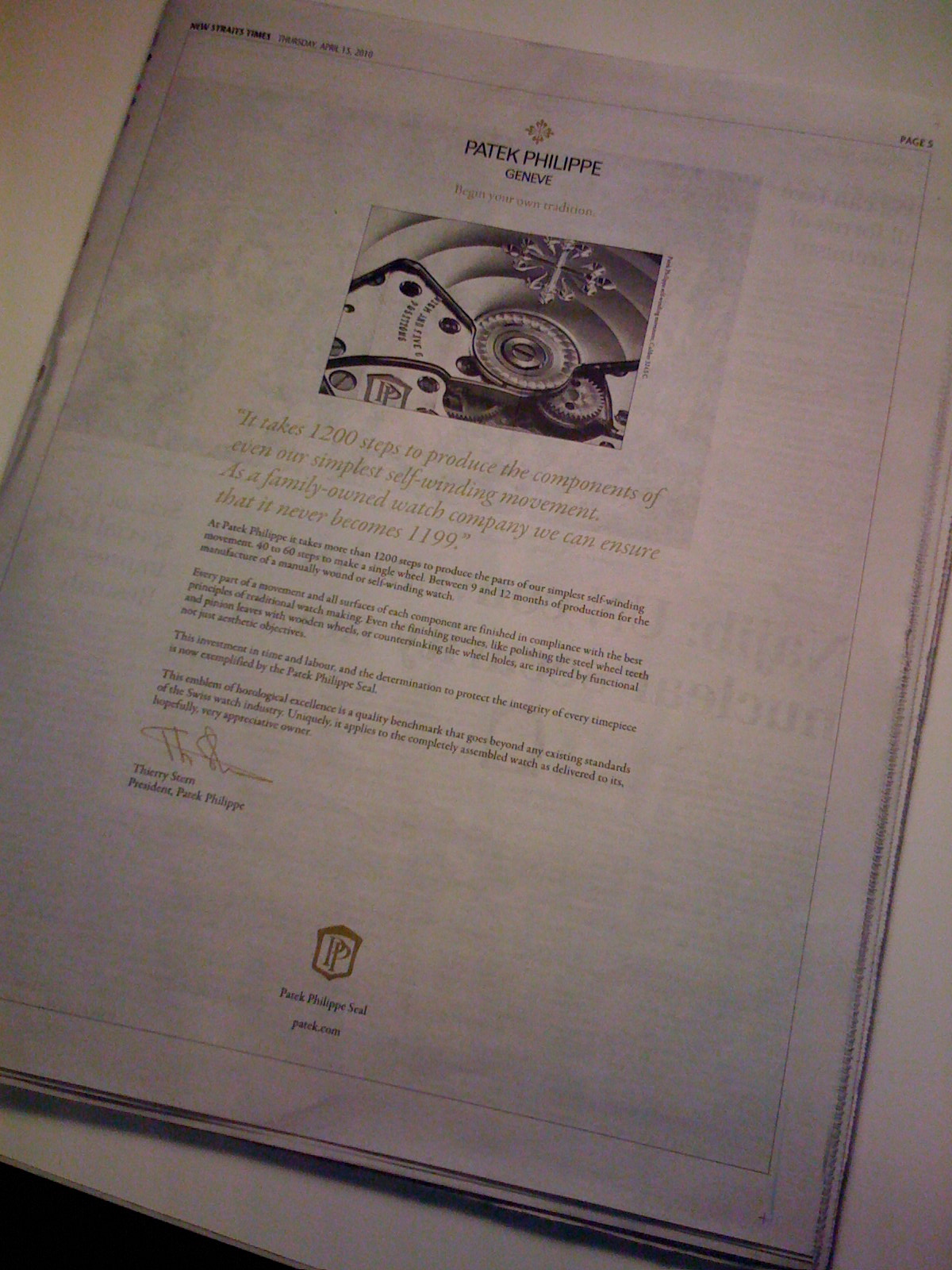
PP has recently launched a new global print advertising campaign that focusses on the values of the company established by two Polish immigrants, Frantisek Czapek and Antoni Patek in Geneva in 1839. I’m not sure if this campaign is to replace the old one. I for one hope not.

The latest campaign revolves around the personal letter concept and has the current president, Thierry Stern waxing lyrical about the steps involved, the time taken and care and attention to detail invested in the production of a PP timepiece. He talks about ‘polishing steel wheel teeth and pinion leaves with wooden leaves and countersinking wheel holes’ and the fact that these efforts are ‘inspired by functional not just aesthetic objectives’.

He goes on to mention the Patek Philippe Seal, an ’emblem of horological excellence’ that appears to be an internal ‘quality benchmark’ that claims to be ‘beyond existing standards of the Swiss watch industry’.

The ads are set to appear in ‘quality daily newspapers and influential trade publications’ around the world and will also appear at the point of sale.

The first ad (I think) appeared in Malaysia in the New Straits Times on 15th April 2010. I can understand (although I don’t agree with the tactic) the mass market approach of running an ad in the New York Times or the London Times, South China Morning Post etc or any other developed country where there is significant market potential.

But I can’t understand the purpose of running the ad in a developing country such as Malaysia. A quick search of the net finds a rather old PWC report, that states ‘the mean monthly gross income per Malaysian household increased from MYR2,472 in 1999 to MYR3,011 in 2002, denoting average growth of 6.8% per annum’. So if we use that growth rate to bring us up to 2010, the mean monthly gross income per Malaysian household is now roughly RM5,096 or US$1,358. Don’t forget that is gross and does not take into account the impact of the economic crisis.

Another search of the Internet would suggest that the cheapest PP watch is around US$4,000 and the most expensive sold some time ago for about US$11,000,000 (that’s RM36 million in real money). The majority of PP watches appear to be in the US$10,000 to US$35,000. At those rates, the potential market in a country the size of Malaysia is tiny and an ad for such a luxury product in a daily newspaper is essentially a waste of money.

Just to put things into context, the ad after the PP ad is for Honda and the ad after that is for Panasonic household appliances such as an Alkoline ionizer, hair styler and hair dryer and men’s shaver (inner Blade and outer foil).

So what should PP do in developing markets like Malaysia?

Here are 5 suggestions

1) Rethink the one-size-fits-all mass market approach to building a brand, especially in developing markets. The consumers who can afford your products can be engaged much more effectively in other ways.
2) Build a database of prospects and customers. But all markets require different strategies and data collection techniques will be different.
3) Build relationships with your existing customers. Existing customers are often ignored by companies scared of asking too many probing questions. And certainly timing is important. But well trained luxury retail staff can build relationships with wealthy customers who are likely to be successful businessmen and politicians and their opinions will carry a lot of weight with prospective customers.
4) Advertising is important, but choose your channels carefully. Mass circulation newspapers and magazines are for shavers and hypermarkets.
5) Content is important too. I’m not sure anyone really cares what is hidden away inside the shell of a product with almost 200 years of heritage. After all, if the quality was a given in the previous campaign, why must it be addressed now?
6) Integrate your digital commuications with mobile channels to engage with prospects and customers interactively when they are on the move.

Building a brand is hard enough. PP has done it successfully for 200 years. But treating every market the same and using mass marketing tactics that belong to an era that no longer exists, will make it hard to do it successfully for the next 200 years.

Are we seeing the commoditisation of the iPhone in Asia?


Here in Malaysia it took time for the mobile service providers to agree terms with Apple to offer the iPhone to subscribers. But finally, Maxis signed up and has invested heavily over past year or so in traditional aquisition focussed marketing.

Recently, another provider, the aggressive and innovative provider, Digi signed an agreement with Apple and has started to promote the iPhone.

Last night, I was watching TV and was astonished to see first a Maxis ad for the iPhone, featuring the numerous applications (there’s one for just about everything) and then, I think separated by another commercial but possibly even back to back, the same commercial for the iPhone, featuring all the applications, this time with a Digi logo!

I have a number of reactions to this. Firstly, don’t advertising agencies know how to do a deal with a TV station anymore? If you can’t get an exclusive deal at least ensure no competitor products advertise on the same program.

Secondly, what are these telcos doing slugging it out in public on TV? Do’t they have any understanding of the iPhone and what it stands for and means?

Thirdly, these telcos are commoditising a valuable brand that deserves better. A more sophisticated approach for a sophisticated product that offers value for many people in many ways targetted at existing subscribers and personalised would be far more effective than a mass economy spray and pray approach!

Creating awareness via TVCs is a complete waste of money for a product such as the iPhone. If anyone out there is unaware of the iPhone, the applications and how they can add value to a person’s life, then that person is not the type of customer Apple, or the telcos want!

Asian companies need to stop following the herd


I’ve said it before, but I feel the need to say it again, according to Ernst & Young, up to 90% of products fail to become brands, despite US$1.5 trillion spent on marketing every year. Despite massive marketing budgets, global brands with extensive reach and high brand recall, numerous brands have died a painful and often avoidable death. Despite those massive marketing budgets, brand loyalty is decreasing and customer dissatisfaction is increasing.

So why do companies insist on investing massive amounts of money in marketing even though it is proven to be inneffective? There are a number of reasons – ego, inertia, fear of the unknown and fear of change, herd mentality and more.

But for the smart companies, think Dell, Amazon, Google, McDonalds, Walmart, Public Bank, Toyota, yes Toyota and many more, the halcyon days of inneffectiveness are over for marketing people and smart CEOs and CFOs expect, no demand greater accountability and more sustainable results from their marketing investments.

When branding was little more than a creative driven concept where a logo was used to make a name stand out and the world was much larger and competition was limited, the four Ps and old world communication goals such as reach, positioning and awareness were often enough to build a brand, then branding was little more than a subset of marketing.

But that US centric mass economy era no longer exists. The world is a much smaller, competitive and very different place today and branding has taken on a much more important role within the organisation. Moreover, consumers are more enlightened and cynical and no longer pay much attention to traditional marketing efforts.

The definition of a brand today is here

Key areas are retention (95% of marketing efforts are aquisition focussed yet very little is spent on retention so as 1 customer is expensively aquired, an earlier one also expensively acquired, walks out the door to the competition. Many companies lose money on the first sale. In the case of technology, it could be the first million sales. Brands are built on the 2nd, 3rd 4th and so on sale).

Organisational excellence (if you don’t do everything effectively and efficiently and on personalised customer terms, you won’t survive). Economic, experiential and economic value for customers (on their terms) and measurement.

It’s not only marketing that is now part of branding, it is also the supply chain, customer service, accounting, sales, purchasing and so on.

The world has changed and if you own a company, you need to change with it. You owe it to your shareholders, your customers, your staff and yourself. It is time to stop wasting money on proven inneffective marketing and start investing in your brand.

Personalisation


Companies have to stop trying to sell stuff to prospects and customers and start coordinating all the resources it has to supplying or satisfying specific customers specific requirements for value.

Consumers don’t want products (or services) they want the products/services they like immediately and personalised. But personalisation in its present form is primitive because of cost, technology, time and lack of appreciation by CEOs. Right now personalisation is nothing more than a colour, sun roof or memory size. Consumers will want to actively shape the offerings and information they receive. It’s already happening in the aircraft/shipping/hospitality etc industries. Hey, even Barbie has 6,000 customisation options!

I’m sure I’m not the only one who has bought something that wasn’t quite what I wanted but was bought more in frustration at not finding what I wanted exactly. After a week it was gathering dust in a store room. In the future, with advanced build to order capabilities, even complex products will be produced specifically for one customer and buying products that don’t quite fit the bill be a thing of the past.

This will also have an impact on communications. Existing customers will no longer visit websites, they will have direct access to their own landing page.