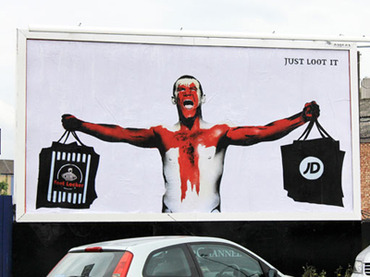
Street art goes to war against outdoor advertising


Here’s something interesting from the UK.

A group of artists from the UK, Italy and France have embarked on a project around the UK that is called “Brandalism” which aims to “challenge the destructive impacts of the advertising industry.”

Brandalism is essentially a campaign to hijack a number of billboards around London and ‘refresh’ them with new work by 26 street artists.

These guys are not happy with the advertising industry, claiming the industry takes no responsibility for the messages they force-feed consumers and don’t give those consumers a chance to opt out from these intrusions into public and personal spaces.

Nike is just one of the brands targetted by the group

The project has so far targetted outdoor campaigns by Nike, Footlocker, JD Sports and McDonald’s and Locog have been “refreshed” by the artists among others. The group has also posted anti advertising campaigns in Leeds, Manchester, Birmingham and Bristol.

This is being portrayed as street art against branding when in fact it should be street art against outdoor advertising.

Outdoor advertising is an element of advertising which is an element of communications which is an element of branding.

I don’t quite understand how taking a billboard with one message and painting over with another message is going to stop the intrusive attempts by advertisers (and their clients) to get our attention.

There’s also a danger that they will become guilty of the ‘crime’ they are so against, don’t you think?

You can read more about the project here

5 branding tips for Malaysia Airlines to save its troubled brand


Earlier this month, troubled Malaysian carrier, Malaysia Airlines (MAS) reported a staggering RM2.52 Billion (US$850 million) loss for 2011. Despite the tough economic climate, a number of competitor airlines – British Airways, Singapore Airlines and Cathay Pacific all reported a profitable year.

Soon after, Group CEO of MAS Ahmad Jauhari announced that he will implement ‘strong and immediate measures to stem the flow of losses with staff redeployment, improved productivity and efficiency, further cost controls and more route reviews’ whilst at the same time, he also promised ‘an aggressive sales and marketing strategy’.

Marketing budget doubled
Then MAS announced that it has doubled its marketing budget for 2012. The marketing budget is reported to be as much as 2% of revenue which on 2011 revenue of RM13.90 billion (US$4.63 billion) equates to about RM278 million or nearly US$100 million.

So if the marketing budget is doubled, it means that MAS has more than RM550 million or US$190 million to rebuild it’s battered brand. That’s a tidy sum.

Details of what marketing initiatives the company has in mind are sketchy. Although the company has announced it will provide ‘better and more branded customer experience and embark on a major advertising and promotions campaign in 2H/2012’.

This morning I read that the airline has appointed Ogilvy and Mather Advertising as its master creative agency. I also read this comment on the appointment from Al Ishal Ishak the senior vice president for marketing and promotions, “2012 will be a breakthrough year for Malaysia Airlines on our path to recovery. We recognised, however, that we could not achieve financial success without clearly defining our brand positioning.”

He went on to say, “Ogilvy understood this and throughout the pitch process were best able to translate our message into a powerful campaign idea. An idea that is big enough to help us transform our business and truly engage our customers like never before.”

Before I go on, I have a confession to make, I am a loyal Malaysia Airlines passenger and fan of more than 20 years. During that time I have been on the receiving end of more positive than negative experiences with the airline. So I want the airline to succeed.

But if this is the last chance for this iconic brand, Al Ishak and his team have to get it right. Any advertising campaigns will need to reflect the culture of travel and consumers today and not try to use the traditional high gloss beautifully presented images and TVCs so favoured by the airline industry to ‘clearly define our brand positioning’.

How will MAS spend the marketing budget?
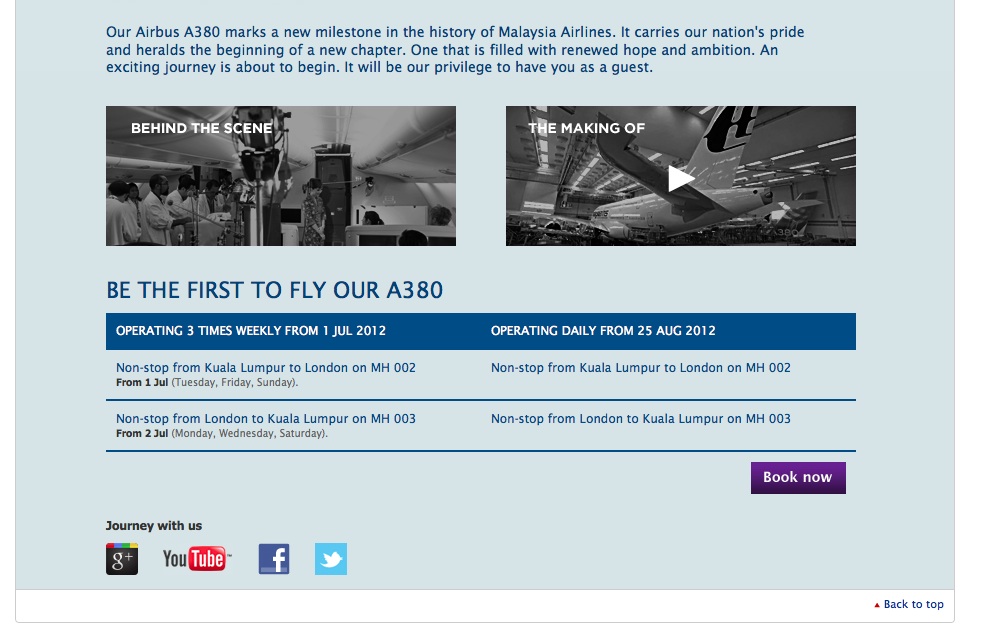
I appreciate it is early days but I have noticed a digital campaign selling the new A380. The style would suggest MAS is going the traditional route using glossy images and slick advertising with high production values to attempt to position the company in the minds of its consumers.

The ad features an image of the A380 in the very attractive new MAS livery and a tagline about the journey which I assume is related to the A380 and one about the aircraft being the pride of the nation. Let’s hope Ogilvy improves on that. Anyway, clicking on the ad, you go to the existing MAS site where you are greeted with the same, larger image of the A380 and the same taglines.

Below the fold there are two black and white images with click through options. The one on the left entitled, Behind the scene (sic) links to still images of the making of the new commercials which look very traditional and my first reaction was what a pity they haven’t changed the cabin crew uniforms. The image on the right links to a video entitled ‘The pride of our nation”, a predictable and uninspiring video of an MAS A380 being painted!

Throughout, the copy is uninspiring.

Below the images are social media options. I had a quick look at the twitter feed and it looks very collaborative with plenty of discussions although efforts to build the brand in the social context can be improved.

But I have a sneaking suspicion that the bulk of that US$190 million is going to be spent on advertising. And as Singapore Airlines learnt with it’s A380s, you can no longer rely on developing a position and using advertising to communicate that position in the hope that it will work and consumers will buy.

Positioning
The problem is that positioning is a throwback to the mass economy that no longer exists. What advertising agencies tried to do was create a position that reflected the strengths and weaknesses of the offering. Ideally, this position was based on being first in a particular category.

If someone was already first in a category, then companies attempted to redefine themselves in a new category to be first. In the airline business, this tended to be related to passenger comfort or service. The effectiveness of positioning depended on the ability of advertising to drive branding perceptions in the mind of consumers.

To do this, airlines often made promises they were unable to keep (admittedly, often due to third party issues out of their control), failed to meet traveller expectations, often because dynamic competitors moved quickly and so raised the bar, which in turn led to brand disillusionment.

Positioning was ideal for the mass economy. It was also ideal for advertising agencies and marketing departments because it gave them enormous power without the responsibility of accountability. Al Ries and Jack Trout invented the concept of positioning. The preface to one of their books states, “Positioning has nothing to do with the product,…. (it) is what you do in the mind of the prospect.” So, essentially this means that the consumer can be made to believe, through extensive advertising and PR and via the right conduits to consumers, and other vehicles, what an offering means to them.

Well I’m sorry, this might have been true in our parents day, when consumers were more predictable, more trusting and had less choice but in today’s mean spirited world, a world in which only 4% of Americans and 14% of Malaysians believe what they read in adverts it is going to be very, very difficult. And of course the problem with using positioning to build a brand is, if it doesn’t work, the money is wasted, time is lost and you have to repeat the process again, with a new position!

So how can MAS save its troubled brand?
1) Research. Your existing customers are your best source of information. But they are not all the same. I would be interested to know which, if any customers MAS talked to when they were configuring the aircraft. MAS is talking about flat beds and big TV screens in first and business. Well that is so last year and who doesn’t offer them so why should I change? What about Internet access? I hope the A380 offers it throughout the aircraft.

2) Mass market branding and the old model of developing a position and communicating that position across for mass media repetatively for as long as possible is no longer effective. Brands today are built on relationships, access, personalisation and relevance. Before MAS marketed to segments of 18 – 34 year olds, businessmen and so on. Today, MAS must deliver economic, experiential and emotional value to to everybody and on their terms.

3) MAS must focus on developing more profitable relationships, not a more profitable product. Brands evolve when companies start buying for customers instead of selling to them.

4) Branding is an organisational not a departmental responsibility. And the organisation is the responsibility of the CEO. MAS is charging about a 100% premium for an economy class ticket on its A380 in July over the price of an economy class ticket on a 747 for the same route. Throw in all the other airport fees etc and it’s going to have to be a pretty good product to charge such a premium.

5) Retention is key to brand building. Companies no longer sell a product, customers buy a product. And those customers have plenty of choice, especially in the airline business. Sadly too many companies spend lots of money on acquiring a customer but very little on retaining them. MAS is one such company. Once a consumer buys the product, companies should do everything possible to hang onto those customers, build relationships with them, learn about them and leverage them.

Bonus tip. This is the social era. As I said MAS is working hard on social media but there is room for improvement and integration. It would be interesting to know how they leverage their social media efforts to get more business.
Repositioning won’t solve Nokia’s problems


In 2002, Nokia was Britain’s number two super brand; by 2010 it was 89th. But Nokia doesn’t have a branding problem.

Although I no longer use a Nokia, I still have some brand loyalty and track the performance of the Finnish mobile phone behemoth and although it’s global share of mobile sales dropped below 30% for the first time since 1999, it still sold 450 million handsets in 2010, outselling Apple 10 to one.

10 years ago, in 2000, Nokia sold 128 million handsets out of a total of 405 million, giving it just under 32% of the market and with margins of 20%, Nokia was well placed in the sector as Motorola and Ericsson struggled.

By the end of 2003, Nokia had increased its share of the global handset market to 34.6%. By the end of the first quarter, 2004, that share had slipped to 28.4%. This 20% drop in market share was despite a year-over-year increase of mobile shipments of 29.3%. Nokia found itself in this potentially dangerous position because it was slow to introduce clamshell style phones and colour displays.

Fast forward to 2007 and Nokia was once again humiliating competitors in the handset stakes, and in particular Motorola. In the first quarter of 2007, Nokia shipped 92 million units, a 20.6% growth compared with Motorola’s 47.5 million units shipped during the same period. 2007 also saw handset sales break through the one billion units level with a total of 1.17 units sold, a 16% increase over the 990 million phones sold in 2006.

Nokia’s global market share climbed to 38% whilst Motorola’s slumped to a dismal 13%. Analysts thought at the time that Nokia’s share of the global market could climb to an all-time high of 40% by the end of 2007.

On 2nd August of that year, Nokia announced an astonishing 57% increase in second quarter operating profits to US$3.2 billion. And when the definitive metric for measuring brands is profitability, Nokia sizzled again with operating margins for the combined mobile device business of 20.9%. The company also had US$9.5 billion in cash and no debt.

But 2007 saw the launch of the iPhone and suddenly the mobile phone became a smartphone. By the third quarter of 2007 the iPhone had 20% of the smartphone market, way behind RIM with the Blackberry at 39% but more than the smartphone sales of Motorola, Nokia and Palm combined.

By 2010 Nokia’s market share had slid from a 36.4 percent share in 2009 to 28.9%. Nokia still sells more mobile phones than any other company but consumers no longer want mobile phones, they want smartphones.

And at the heart of the smartphone is the operating system. By January 2011, Google’s Android, and its Chinese versions Tapas and OMS had become the top smartphone platform in the world with an 888% year-over-year growth.

Nokia’s Symbian system is a very close second with Research in Motion a distant third and Apple’s iOS way back in fourth. Microsoft’s mobile operating system barely warrants a mention with 4% of the market.

Under pressure in a market it once dominated and essentially still does, Nokia has panicked. Realising the key to smartphone sales is the OS, it has mucked about with Symbian, a perfectly good OS with no more flaws than the iOS.

But because of the now huge size of the organisation, issues bought up during the testing of touch screens and browsers were often ignored.

Desperate, Nokia launched the N-Gage with too few poor quality games and terrible network connectivity for multiplayers, the phone was blown away by the PSP and DS.

Next came another disaster, the Ovi. Nokia’s answer to the iTunes Store was an unmitigated disaster. In 2007, Nokia restarted its touchscreen development after deciding in 2006 that touchscreens were essentially a gimmick.

This delay meant that the N95 and N97, both good smartphones in their own right and with email, music players, the Internet and GPS as well as a slide out Querty keyboard were supposed to compete with the cool iPhone.

Next up, the beautiful N8, launched in 3Q2010. Engineering porn in my opinion with a 12 megapixel camera used by professionals. But the N8 was outsold 6 to one in Europe and did even worse in the gadget hungry, fast growing Asian markets.

Then it tried a completely new Linux based OS called MeeGo but it’s corporate heart wasn’t in it and MeeGo only got a year.

Now, in what could be seen as a last throw of the dice, Nokia has teamed up with Microsoft and is launching the partnership with a US$112m global brand repositioning campaign, which will see the launch of its first phone running on the Windows 7 operating system in October 2011.

This is a big mistake. Microsoft’s Phone 7 was launched for Q4/2010 on about twelve handsets from a number of manufacturers. During the quarter it achieved a meagre 1.5 million sales, earning it about a 2% market share and worse than Windows Mobile which had 4%.

During the same period, the latest version of Symbian (the all new user-friendly touch screen version that powers the N8) was launched on 3 Nokia smartphones and sold 5 million units. All Symbian products sold a respectable 32 million units.

Although I don’t know the objectives of the six month reposition campaign, one assumes it is an attempt by Nokia to try and regain lost market share from rivals Android, Apple and Blackberry.

But this won’t happen because some ad agency or agencies have created a position that they intend to push out, no doubt primarily across traditional mass media because that’s where most of the eyes are supposed to be and it pays the highest commissions.

And I’m sure the same message will be communicated in all countries, irrespective of local cultures, smartphone habits and so on.

And of course there will also be a nod to digital and social media. And with US$100 million to play with there will no doubt be an attempt at a clever Old Spice type viral campaign.

But the problem is, Nokia’s issues cannot be solved with a communications campaign that will no doubt generate lots of interest but will not change the fact that the Windows OS is an unpopular OS.

Nokia doesn’t have a brand problem, it has an organisational problem that cannot be solved by a repositioning campaign.

Nokia products don’t come close to delivering the experience Android, RIM and Apple smartphone products offer. And that won’t change with seven. Especially as Nokia has had very little influence over the first Windows 7 devices.

And if you can’t offer a compelling experience, you won’t solve the problems Nokia has.

Nokia would be better off taking that US$100 million and giving it to the Symbian crew to improve what is almost a very good OS capable of competing with Android and iOS.

What Malaysia must do to build a Nation Brand


Traditionally, Tourism Malaysia has had the responsibility of raising the awareness and promotion of Malaysia. And Tourism Malaysia has worked hard to build awareness of the country as a tourist destination and on the whole, it has been reasonably successful.

But in an increasingly competitive world, Malaysia is not just in a global competition to attract tourists. It is also in a global competition to encourage talented Malaysians to return to the country, international talent to live in the country and international investment. Malaysia also needs to move away from its image as a supplier of commodities to the provider of more valued added products and services and increase its influence in Asia and on the world stage. As if there weren’t enough, it is also in a domestic battle to forge a national identity bought into by multiple races!

A strategic tool to achieve the goals of attracting talent, increased revenue through expanded tourism and more valuable exports is Nation Branding or country branding. Australia, India, Norway, Oman and Qatar are all making a concerted effort to attract the world’s attention, interest and revenue by embarking on Nation Branding initiatives.

In this competitive environment, complicated by bickering politicians and individual agendas, tactical rather than strategic initiatives, fragmented and outdated communications, a lack of integration and communication between organisations and dwindling global funds available for investment, Malaysia has a lot to offer.

It is a progressive, innovative and stimulating country in which to live, work and visit. Malaysians are enthusiastic for development and have a natural ability for entrepreneurship. Individual races have capabilities in specific areas important for the growth of the country. For such a young country, it is remarkably open and many times it has been called a model Islamic country. It has numerous natural resources that should ensure quality of life can be high. Residents and visitors can enjoy the benefits of increasingly advanced infrastructure combined with a vibrant, diverse culture and a reasonably well trained and educated work force.

But, unfortunately, Malaysia does not have a clearly defined image or the visibility internationally that it deserves. Part of the reason is that it lacks a national Brand that resonates with Malaysians and enjoys wide acceptance internally and is effectively and consistently communicated externally.

As a result, international perceptions vary widely. Some believe it is an undeveloped country rich in such natural resources as rubber and timber; others look at the Petronas twin towers and fail to see many differences between Taipei, Shanghai, Bangkok, Hong Kong and other Asian metropolises. This lack of a consistent Nation Brand persists despite the efforts of successive Prime Ministers, international events such as the Formula 1 Grand Prix and the 1998 Commonwealth Games and increased visitors to the country.

The need for successful Nation Branding is recognized at the highest levels.

Most recently, the Prime Minister, via his website and with the assistance of Tony Fernandes, CEO of Air Asia has outlined the need to shape the country moving forward and asked for help from citizens. Although technically not a citizen, I have three children growing up as Malaysians so I have a vested interest in the success of the country.

So what should Malaysia do to start building the Malaysia Nation Brand?

Five key factors are required to achieve the prime minister’s goal as an international “corporate nation.” These include:

• Widespread agreement and acceptance on what Malaysia stands for, and what makes her unique in the community of nations. The agreement and acceptance is based on communication and understanding among all levels of government and all facets of society.

• The identification of industries most likely to complement Nation Branding initiatives and a clear process for investing in and sustaining that investment and developing those industries.

• Clear, consistent and coordinated communications to domestic and international audiences by public and private sectors. A long-term plan with goals and measurements is critical. Ideally, these communications must be tailored to specific segments.

• Successful execution of brand messages. This is not just a communications exercise. The public and private sector must facilitate international and other economic involvement, while tourist-related industries and areas must perform according to expectations.

• Leadership. Current branding efforts are hampered by a variety of uncoordinated tactical efforts, each promulgating a different message. Leadership is required to ensure that Malaysia both speaks “with a single voice” and has the necessary long-term commitment.

The following are the key steps required in the development of the Malaysia Nation Brand and they are as follows:

1) Carry out a brand audit. Who do we think we are? Who do our stakeholders think we are? What do we have? What do we want to become? What do we have? Do we have the skill sets required to sell it? Are our communications communicating this effectively? Does the content of our communications resonate with target markets or are we using a one-size-fits-all strategy to communicate with everyone? Are we using the right platforms? Who are key stakeholder influencers? How do we communicate with them? What do stakeholders want from us? Can we deliver? If so how?

2) Analyse and review the data collected in step one and identification of key industries to help drive the Malaysia Nation Brand.

3) Develop the nation brand framework. This stage includes the development and articulation of the vision, mission and values of the brand as well as the development of a positive & competitive identity that offers economic, experiential and emotional value to each target audience

4) Develop a holistic and comprehensive visual and verbal brand. Sadly this is where most nation brands start. Using a creative driven approach, they look to spray advertising across as many platforms as budgets will allow and pray that it sticks in at least some of the places. This ‘spray and pray’ approach to branding is destined to fail nearly every time.

5) Develop the brand strategy. Only AFTER the above steps can the brand strategy be developed. Normally a plan to drive the brand forward, it outlines how to position Malaysia as a unique, different and attractive country for key stakeholders such as tourists, investors, strategic partners and talent and includes, branding, marketing, sales and other imperatives as well as measurement, budgets, responsibilities and more. Individual country brand strategies should also be included for key markets. The brand strategy also outlines requirements to clearly communicate relevant messages to the target constituents and stakeholders in multiple countries.

6) Make sure all initiatives systemically connect the Nation Brand to Malaysia’s core industries, corporate brands and Small and Medium Enterprise (SME) sector brands

7) Measure, improve, refresh and keep relevant.

Building a nation brand is not easy. It requires commitment and perseverance and the will to stick with something even when it may not be going according to plan. Follow the elements above and we will have a much better chance of building a Malaysia Nation Brand.

Brand communications is no longer about broadcasting a company position across multiple mass communication platforms.


In today’s always on world, an important part of any brand strategy is the communications strategy but if Asian brands are going to be taken seriously, Asian CEOs must understand that times have changed and that we are living in a new world order. And in that new world order, the success of a brand is in the hands of the consumer not the corporation.

Today CEOs must understand that how consumers source information about brands and where they source that information from, has changed dramatically over the last 5 – 10 years. Where previously they learnt about brands from television commercials, newspaper advertisements and the recommendations of friends, today they learn about brands from Facebook communities, Twitter lists and YouTube channels.

Gartner estimates that mass marketing campaigns now have only a 2% response rate and this is declining annually. Despite this, Asian CEOs, so long in control of their brands and reluctant to lose that control, continue to try and shape brand perceptions by broadcasting positions repeatedly across traditional media via multiple and repetitive campaigns.

But Asian CEOs need to accept that in today’s noisy, crowded, dynamic, mobile market place, a brand cannot be shaped by repetitive communications campaigns that try to appeal to as many people as possible in the hope that someone will buy and communicated across traditional media. And those CEOs must understand that the success of their brands is too important to be left in the hands of marketers and advertising agencies.

According to Gartner, by 2015, at least 80% of consumers’ discretionary spending will be influenced by marketing across social and mobile platforms. And it is imperative that CEOs do not allow marketing departments to continue the mass market model of invasive campaigns that try to push a one size fits all corporate position onto consumers.

So if building a successful brand requires more than a traditional approach to marketing where reaching anyone and everyone and making them all aware of the brand with a generic message broadcast multiple times across multiple channels is not the way forward, what should Asian CEOs do if they want to challenge the global western brands?

The first thing is that this new world order is good news for Asian CEOs because it means they can stop wasting funds on expensive creative driven initiatives that require deep wallets to fund advertising campaigns repeatedly across traditional media in the hope that they will resonate with consumers and lead to a possible sale because the reality is, very few of them are noticed, let alone remembered.

Try this experiment. If you advertise in a daily newspaper or on TV, ask yourself which ads you remember from yesterday’s newspaper or on TV last night. Be honest. I doubt it is many. Personally I remember the ads from the Sunday paper because I was stunned at how many pages featured supermarkets and hypermarkets having a ‘cheap off’ on chicken wings, grapes and cases of beer.

And these are the very same newspapers that featured advertisements for Patek Philipe and Rolex watches, Lexus and Audi cars and other luxury products and services the week before!

And even if you remember newspaper ads or TV commercials, how many of the products or services advertised, have you interacted with? And of those how many have led to a purchase? And even if they have led to a purchase, what did the company do to ensure you come back again? I suspect they didn’t do anything and instead, after they spent all that money getting you into their store or to buy their product, they let you leave without getting some personal information in order for them to start to lay the foundations for a relationship!

In this era of smart phones and the half a million applications that can be used on them; In this era of social media with five hundred million Facebook users (6 million in Malaysia) of whom 50% are active every day and one hundred and forty million daily tweets on Twitter, many of them generated by Malaysia’s 1.1 million members; the proliferation of leisure time activities and abundant choice at malls and more, Asian CEOs must understand that the answer to brand building is delivering economic, experiential and emotional value to consumers and on their terms and across all touch points.

The global economic situation is a golden opportunity for Asian brands to take market share from established Western firms struggling to overcome cash flow issues and poor brand penetration. But it is up to CEOs to understand that they have to review traditional practices and take an interest, indeed responsibility for the brand and ensure brand departments understand that it is no longer enough just to advertise in traditional media and hope a brand will succeed.

CEOs must ensure too that at the heart of any new strategy must be the organization, making sure every brand touch point focuses on delivering value and communications departments must take social media seriously and understand how to deliver more engaged communications. And this will have to be done in a much more integrated, dynamic and fluid manner.

And whereas in the past, a series of the same full page ads repeated in daily newspapers or a number of prime time TVCs was generally sufficient to build brand awareness which would lead to a sale. Indeed, many consumers would actually watch a commercial and take a note of the brand and where they could purchase it. Those consumers would then go to the store, look for the brand and buy it. If the brand was unavailable they would take time out to come back again and again until they could make a purchase.

Today those same consumers don’t bother taking note of the brand names because they’re carpet bombed with messages throughout the day, every day. Many of those messages are making outrageous claims or are totally irrelevant to them. They are also too busy multi-tasking during the expensive commercial breaks. Furthermore, they’ve been let down so many times after believing those claims that they now often ignore them completely. And because consumers have so much choice and so many information channels, they don’t need to pay attention to messages broadcast via mass media any more.

Now consumers use social media and other tools where they inhabit communities that they relate to and trust, to seek information about brands. So it is in these communities where brands must learn to communicate and engage with consumers and deliver value that resonates with those consumers enough to make them want to own the brand.

Don’t get me wrong, I’m not saying don’t advertise but I am saying that if your organization is not on brand and all marketing initiatives are not integrated to allow you to deliver on the brand promise. And if your organization is unable to deliver value across all touch points and if you don’t use every opportunity to engage with consumers and collect data to help you get to know your customer and start to build a relationship with your customer, your advertising efforts will be wasted and your brand will not survive these extraordinary times.

In this crazy, always on, competitive market place it is these relationships that are going to help build a successful brand and not newspaper ads or TV commercials, no matter how cool they are and no matter how cutting edge is the technology used in the commercial.

What will be the impact of social TV on your brand?


A fascinating survey by Digital Clarity in the UK of 1,300 under 25 mobile Internet users reports that a large number of them are talking to friends about the show they are watching.

80% of the survey participants said that they used Facebook, Twitter or other mobile applications to actually comment on the programme and talk about the programme to friends as they watch it.

Twitter (72%) is the most popular platform, followed by Facebook (56%) and other mobile applications (34%). Of those surveyed, 62% use a combination of all three.

Social TV as it is being called is popular because it means young people can communicate with friends, in real time whilst watching their favourite programmes.

But this is really going to put the cat amongst the advertising pidgeons. Here are half a dozen questions that I’d really like to get you input on:

What are the implications for advertisers, already struggling to keep viewers focused on the TV during commercial breaks?

Will advertisers accept that reaching lots of consumers is no longer a relevant metric and demand more from media owners?

Will advertisers push the creative envelope more to try and position products?

Will product placement increase, perhaps with cross platform repetition?

How will they integrate technology with traditional marketing initiatives?

How will this integration of consumer habit impact overall branding strategies?

I look forward to hearing from you.

Is positioning still relevant today? Part three


Here are some thought starters related to my belief that positioning is generally a pointless exercise:

According to Industry Week magazine, 70% of today’s manufactured goods will be obsolete in six years. There are estimated to be more than 30,000 new product introductions in the US alone every year, just in the packaged goods market. According to AC Nielsen, up to 90% of products fail. This means that as many as 27,000 of those new products will fail.

Despite approximately US$1.5 trillion spent on marketing annually and over US$500 million spent on advertising alone in the US, the annual US based “Most Memorable New Product Launch Survey 2007”, found that unaided, 77% of respondents could not name one of the top 50 new products of 2007, even if it was a strong well recognised brand.

The development of a positioning strategy takes time and the communication of that ‘position’ will be the responsibility of an advertising agency and that agency will, generally speaking use mass media to communicate the position.

With such short life times and high failure rates, isn’t it time companies reviewed the tools/tactics/strategies/channels etc that they are using to build brands? Don’t they owe it to their shareholders, investors, customers, the environment to do something about this?

What do you think?

Is Positioning still relevant today? Part two


Recently I wrote a blog post questioning the relevance of positioning today. You can read the full post here. A fellow blogger called Pepita responded with some well thought out and pertinent comments. Below are her comments, taken from the comments section and re posted here together with my responses embedded within the questions.

Pepita: You state chat a model that was developed for the US mass market in the seventies is not applicable to other countries or through time. Why does a market have to be similar in order for a model to work? All markets have the same elements (competitors, customers, manufacturers etc.) don’t they. If you extend your statement to other theories it is the same as saying that economic theories cannot be applied in Malaysia because they were thought up by Americans or English in another era. This reasoning in my opinion is flawed.

Marcus: I think that one of the reasons so many products fail to become brands (According to Ernst & Young this figure is 90%) is because companies assume that a model that works in one market will work in another. The mass economy was powered by mass market products that were standard and mass media was used to sell those products in multiple markets. As a simple example, for years British car manufacturers had a monopoly on the Malaysian market even though their cars were build in the UK and shipped here with UK specifications. So, a customer in the tropics was expected to buy a car with a heater. Limited choice meant customers had to accept this and British cars had over 90% market share. Then someone imported an American car with aircon. To this day, British auto manufacturers (of which there aren’t many) have been unable to make up that lost market share.

Pepita: Bad claims or outrageous claims developed by agencies for the clients doesn’t mean that the concept of positioning is no good. It means that agencies did poor work.

Marcus: Ries and Trout developed the concept of positioning because audiences were receiving multiple and confusing messages from more and more companies. Positioning’s goal is to create a ‘position’ in the consumers (any consumers) mind that is a reflection of the strengths and weaknesses of the offering. If you are first in that category even better. If you are not first, the goal was to create another new category. Positioning, according to Ries and Trout is about being ‘first in the mind than first in the marketplace’. Companies had to shape information communicated to consumers. Mass media was the obvious vehicle with its massive reach. For this they used and still do use agencies. The outrageous claims were a result of the pressure to create those new categories or influence perceptions. If companies didn’t like the work created by agencies they are able to reject it.

Pepita: I am not sure what you mean by your statement that positioning is only suitable for mass markets. As long as there is competition and there are customers you can use the concept. Even if there is no competition you can still position your company or your brand.

Marcus: You are right, as long as there are customers and there is competition, you can attempt to position your brand. Even if there is no competition you can still try to position your brand.

Pepita: Mission and vision, values, BHAG’s; there are tons of stuff in business that are immeasurable. Or they are measurable but aren’t measured. Does that mean that the concept doesn’t hold? I don’t think so.

Marcus: Generally speaking, in today’s customer driven marketplace where customers not companies define brands and with the tools available to marketers to collect data and use that data, positioning, with one or two exceptions is no longer relevant. Brands are built through retention (you have a 15% chance of selling to a new customer and a 50% chance of selling to an existing customer) not acquisition yet positioning tends to focus on acquiring new customers not retaining them.

Pepita: Wikipedia is no official standard. It could be my opinion or yours; whoever comes last. So dimissing positioning because you do not like the definition in Wikipedia is a sophism. Skipping that and going back to Ries & Trout, the wrote a book on bottom-up marketing and always had the consumer/customer/prospects in mind.

Marcus: I’m not trying to deceive anyone. I googled the ‘definition of positioning’ and got 12 million responses. The beauty of the Internet and tools such as Wikipedia is that we seek references and definitions from others through these platforms. Opinions shared across social media and other peer to peer networks play an increasingly important role in building profitable brands. Positioning simply cannot address these voices, opinions, concerns and so on.

Pepita: You state positioning is one way communication. The company is telling the customer how the products are positioned. I think that you are confusing claims with positioning again. I hope companies would be smarter than to communicate their positioning to their target audience. Who cares?

Marcus: I agree, nobody cares or pays any attention yet positioning, according to Ries and Trout is about, “what you do to the mind of the prospect.” Once it is created, the position has to be communicated via communications and claims are made in those communications that reflect the required position.

Pepita: To me positioning is both competition and consumer/customer driven. That is the way I work and I know that others do too. And Ries & Trout say the following: “To find a tactic that will work, you have to leave your ivory tower and go down to the front where the marketing battle is being fought. Where is the front? In the minds of your customers and prospects”.

Marcus: A couple of responses to this, firstly, using the actions of competitors to determine your brand strategy is a complete waste of time and resources as you will forever be playing catchup. Secondly, my mind is so full of clutter that you will have trouble finding any space to position your product! Much of that clutter is made up of negative connotations related to claims made by brands when trying to position their products in my mind. This is probably a universal state which is why we have the sad statistic from Ernst and Young above.

Pepita: Of course the world has changed significantly over the last 40 years but that doesn’t mean that theories and models aren’t true or usable anymore?

Marcus: Actually, although this is a sweeping generalisation, I don’t think you should be using models developed in one market 40 years ago to build a brand in another market. It would be nice if it could be done but the reality is the agencies want firms to because it makes it easier for them and also marketing professionals. But more importantly, consumers have changed, the way they source and gather information, their influencers and so on. Furthermore their requirements for economic, experiential and emotional value are very different and vary considerably from country to country.

Pepita: You state that positioning uses mass market channels. To me positioning is a strategic concept and not equal to marketing communication. So what you really seem to be saying here is that mass market channels aren’t of this day and age. I agree with you there, but it has nothing to do with the concept of positioning.

Marcus: As I mentioned above, positions have to be communicated. Most agencies recommend mass media to do this because of its reach. But this is an agency issue.

Pepita: Advertising can cost a lot of money. You are equaling positioning and advertising. Positioning is a strategic concept and Advertising is a possible form of execution of the strategic positioning for a company or a product.

Marcus: Again, positions have to be communicated. Don’t forget, this is a blog post not a book! I’ve only got so many words to play with. The most common method to communicate positions is via mass media advertising.

Pepita: Of course tennis rackets have changed throughout the years because of the possibilities technology offer, but since 1873 tennis has been played with a racket. The concept of the tool is still the same. People still play tennis with a racket. If I apply this analogy it would mean that the theory of positioning can be innovated and developed throughout the years, and still be a tool to be used.

Marcus: I don’t see how positioning has been innovated and developed throughout the years.

Pepita: You state some undeniable facts. Markets and consumers have changed. Communication channels are of another era. But your arguments for positioning being outdated and unusable are – in my opinion – flawed and have not convinced me. I also miss an alternative. It would be great positioning for your agency: The brand agency with the alternative to positioning!

Marcus: Nice idea for a tagline, thank you! So much has been written and so much time spent learning about the power of Positioning and the 4 Ps by a whole generation of marketers. But the world is a very different place, the way consumers live their lives and their knowledge and the tools available mean that we have to think past using increased budgets to build brands.

There is no silver bullet to building strong, profitable brands. Every brand is different as are its customers. Some brands are B2B, some B2C. But there is a process to building a strong profitable brand. It requires a focus on research, organisational excellence, planning, personalisation, retention and doing business on customer terms. It’s not particularly sexy and won’t see many brands staring down from billboards, much to the delight of brand owners and ad agencies, but it will go a long way to building strong, profitable brands.

Because without profitability, a brand is irrelevant.

Advertising campaigns need to be integrated across the organisation


Recently I wrote a post about my experiences when I called the number on a billboard selling a luxury automotive brand. You can read the full article here

Basically I talked about how I rang this brand after seeing a billboard outside my office. I got through to the receptionist who asked for my number and said she would get someone from sales to call me back. Nobody called me back, even though the car costs about RM500,000 (US$166,000)! I thought this was an excellent example of why so many brands fail. But I didn’t think much more about it.

Then today I was sitting at a traffic light outside Bangsar Shopping Complex and I saw the same company had another billboard, this time it was advertising their jaw dropping top of the range V10 sports car that costs over RM1,250,000 (US$420,000) in Malaysia. Now this really is an exclusive motor and in the middle of last year there were orders for about 240 of them in the UK and a waiting list of 12 months. If they are only selling 250 odd in the UK I would expect them to sell no more than 50 in Malaysia. So you have to question why they market such an exclusive product on a billboard.

But this is not a rant about using old mass market mass economy models to sell luxury brands, this is about the fact that it is imperative that marketing campaigns are integrated and organisational excellence is at the heart of any tactical campaign.

And I know it isn’t at the heart of this campaign because whilst waiting for the lights to change I decided to call the number on the billboard and see what sort of a response I would get.

I called the number. No answer. Now it was 5.17pm and perhaps the receptionist has gone home. But I doubt the sales team had gone home. I bet they were sitting around wondering how to drive traffic to the showroom so they can make target this month and get a nice juicy bonus for Chinese New Year. Perhaps at least one of them might have been wondering why the expensive outdoor campaign they’ve been running for some time hasn’t generated any results!

I’ve tried to go and see these guys but the marketing manager tells me they are doing well. Here are some basic principles to abide by when you run an advertising campaign so that when you are doing well, you can do better.

1) You advertise on billboards to stimulate, inform, persuade etc. If you want to inform perhaps a 100 people in the country about a luxury product, spending large amounts of money on billboards or for that matter print ads in daily newspapers, is a complete waste of marketing dollars.
2) Consumers who can afford to spend over 1 million Ringgit on a car are unlikely to keep to your office hours. Make it easy for them to spend money with you.
3) Your advertising copy should appeal to a specific audience – in this case, those who can afford over RM1,250,000 on a car – everyone else is just getting in the way. So create copy that will resonates with that target market. This ad just mentioned the engine capacity and that was it! Ever wondered why mini does so well?
4) Develop metrics for measuring channel effectiveness. A simple metric for outdoor ads is a specially assigned number for that campaign.
5) Outdoor advertising is 24 hours. That’s probably one reason why you bought it in the first place! If you can’t have someone on standby 24 hours a day, install an answering machine or after office hours have calls diverted to a sales manager or sales director.

These are elementary and should be included in any strategy document created by a brand consultant.

Why are you still using positioning to build a brand?


Back in the late 1960s, Al Ries and Jack Trout published their first article on positioning. But the term didn’t really become advertising jargon until the articles entitled “The Positioning Era”, were published in Advertising Age in the early 1970’s.

You can read the original articles here

There are numerous definitions of what positioning is today (Google ‘what is positioning’ and you get 24,900,000 responses). Even wikipedia isn’t sure but anyway you can read their definition here

But in today’s marketplace, positioning has multiple problems. Here are 11 reasons why you shouldn’t use positioning to build your brand:

1) Positioning was developed for the US mass market of the 1970’s. Is the Malaysian market similar to the US market? I don’t think so. The Malaysian market isn’t even similar to the Singapore market and they used to be the same country! And Thailand has little in common with Indonesia and so on. So why use the same model here?

2) In a smaller, flatter more competitive world, advertising agencies have used increasingly desperate and outrageous claims in their advertising to position products in the consumer mind. In Malaysia, Proton uses ‘You’ll be amazed’ to describe it’s MPV. I’m sure it is a good car but if it will amaze me, how will a Lamborghini make me feel? Consumers have been carpet-bombed with such claims for so long that now, they rarely take any notice of traditional advertising.

3) Positioning is only suitable for mass markets. Yet branding today is about segmentation and communicating and engaging with those segments via relevant channels and with messages that resonate specifically with those segments or niche markets. It’s also about retention and relationships. Does this mean that a company should develop different positioning for different niches? Or does it use the same approach for every niche? And does it use the same approach for existing customers as well as prospects?

4) Positioning is immeasurable: You can’t say “our positioning has improved our sales by 5 % or as a result of our positioning strategy, our brand is 12% better than competitors. Furthermore, it is impossible to measure the ROI or benchmark positioning.

5) The wikipedia definition is a top-down, company knows best, hierarchical marketing approach. Yet we live in a C2C environment in which consumers define brands.

6) Positioning is one-way. The company knows best and you must listen to us. We tell you how our products are positioned and you will accept what we tell you. But today, if you are not entering into 2 way conversations with consumers you are about to join the brand graveyard. Today, consumers get any information they want on anything from anywhere at anytime and then make their own decisions.

7) Positioning is competition, not customer driven. The basic premise of positioning is that you want to be number 1 or number 2 in a category in a prospect’s mind. If you can’t be number 1 or number 2 in an existing category because of competition, you make your own category. In today’s congested marketplace, the investments required to develop a new category are enormous. Furthermore, besides the difficulty and expense of creating your own category, you are also letting your marketing be driven by the competition rather than consumer demands for value. This means you are always playing ‘catch-up’.

8) Positioning is dated. With limited competition (by today’s standards) in most categories, positioning was a compelling theory. The problem is that the world has changed a little since 1969. Yet agencies continue to recommend positioning as the foundation for any brand strategy.

9) Positioning uses mass market channels such as TV and billboards to reach as many consumers as possible using repetition to create interest. Yet ask yourself, what do you do when the commercials come on TV? Surf the Internet? Put the kettle on? Go to the bathroom? Text a friend? Basically, you do anything but watch the commercial. How many TV commercials can you remember seeing over the weekend? It’s the same with billboards. How many billboards can you remember from your morning commute? And even if you remember those commercials or billboards, how many of the brands have you explored and purchased?

10) Positioning requires massive, and I mean massive budgets that few companies have. If you do have a massive budget and you do execute your campaign across multiple channels for say six months, what happens if it doesn’t work?

11) To use a sporting analogy, in the early 1970s, professional tennis players were still playing with wooden racquets. Soon after the first non-wood racquets appeared. These were initially made of steel, then aluminium and after that, carbon fiber composites. Today’s racquets include titanium alloys and ceramics. As technology has broken new ground, the tools have improved. It is the same in every Industry yet when it comes to building brands, we’re expected to use the same technology and tools as we have been for the last forty years.

If your agency recommends developing a positioning strategy to build your brand politely show them the door and call us!