How not to sell a London property to Malaysians


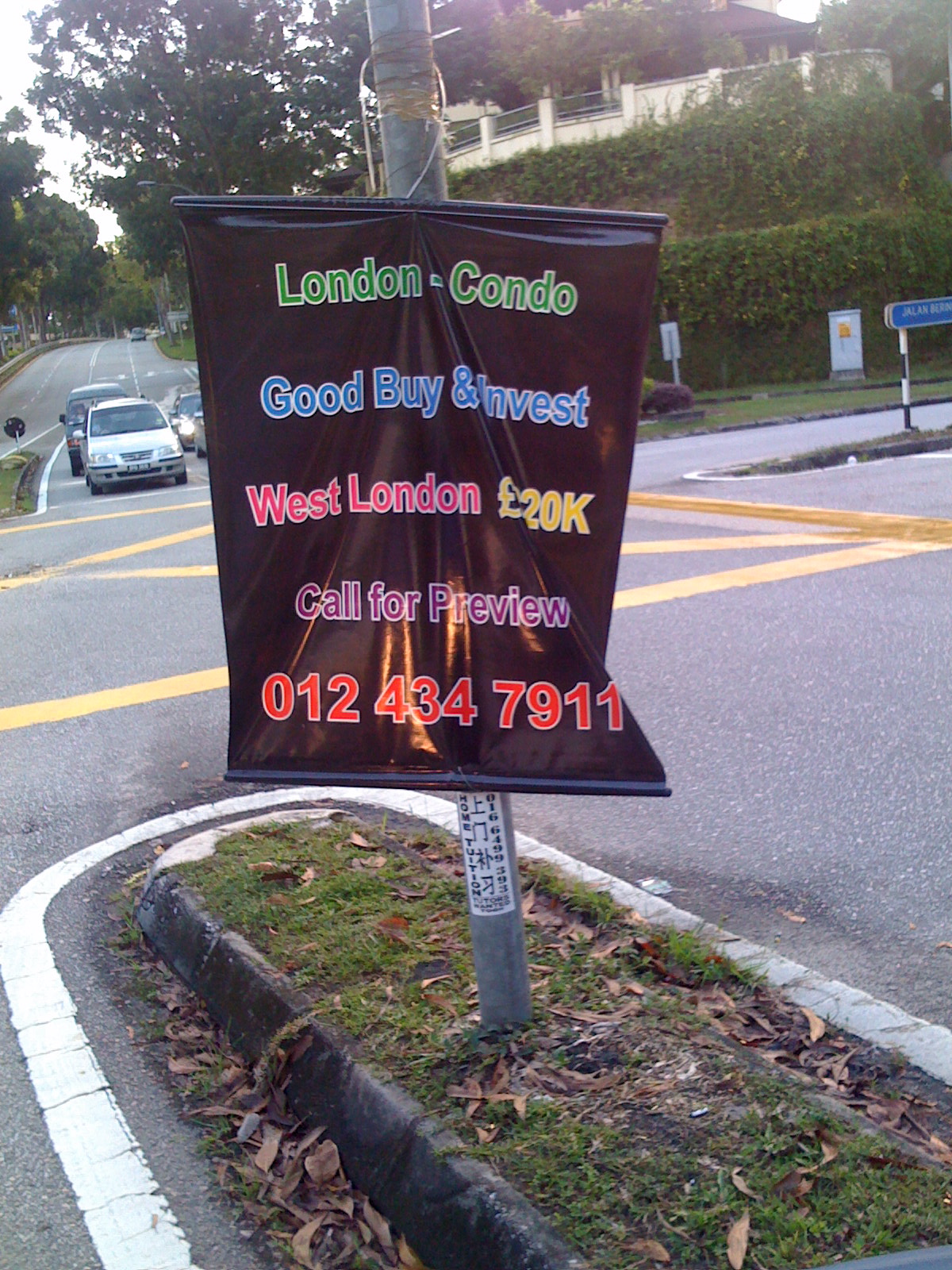
I spotted the sign below on a lamp post in Damansara this morning. In case you can’t read it, the content is as follows:

London – Condo
Good Buy & Invest (sic)
West London £220k
Call for Preview
012XXXXXXX

I cannot believe that a genuine UK property developer or estate agent would encourage a company to sell million Ringgit properties with signs on lamp posts. After all the UK property market, and in particular the London market is benefitting from substantial investment and has hardly been affected by the global financial crisis.

Commercial property
Jones Lang LasSalle expects the total direct investment in commercial real estate in the UK to be around £23 billion (RM125billion) for 2009. Prime yields in the West End are 5% and in the city, around 6.25%. That’s impressive compared with a bank rate of, well about 0%.

Residential Property
Meanwhile, the residential market is also performing strongly. International buyers increased by 25% in 2009 compared to 2008. Most of the investment is coming from Europe, Russia and the Middle East. Knight Frank estimates demand from new buyers is “almost 25% higher than a year ago” and “prices have now risen 13.8% in the nine months since March.”

In fact, most of the investment is coming from the overseas market. Foreign buyers account for 80% of the investment, the highest ever. Indeed, the average over the last 10 years has been closer to 46%. The latest sources of this overseas investment include Oman, Libya, Lebanon, USA, Korea and Ireland.

UK property roadshow
Little wonder then that Malaysian firms want to get in on the act and sell UK property. I can’t find any figures on the total Malaysian investment in the UK or London property market however, the recent launch of a luxury development at Imperial Wharf, London, Malaysian buyers purchased £9.25 million (RM56 million) worth of luxury apartments and penthouses over the 2-day road show in Kuala Lumpur.

Olympic games
With more than 10,000 Malaysians studying in the UK and a number of companies keen to make the UK their European HQ, there are going to be plenty of willing buyers. Especially with the Olympics to held in London in 2012.

Wrong way to sell
But this is not the way to sell those properties. It dilutes the value of the property, negatively impacts the credibility of the local representation and makes it harder for future efforts to sell UK properties here in Malaysia. But worst of all, it portrays Malaysia as an amateur in a professional world.

Updated: 11th January 2010. I have since called the number on the bunting. I spoke to a nice guy with a pleasant attitude. I asked him where the property is. He stated the property was in South Ealing. As I know this area well I asked for the exact location and I consider it to be more Brentford than Ealing. He asked for my email address and promised to email me more information.

That was last Thursday, I have not received anything as of today.

Case study – How a Malaysian Company built its brand from the inside


Senior executives at a Malaysian technology related firm were frustrated. Sales growth was not meeting expectations, despite the firm’s 20-plus year track record, strategic partnerships with top international firms, excellent service and high profile advertising campaigns.

To boost sales, the firm had explored common alternatives – price cuts and an expensive marketing campaign. But although such actions had a short term impact in the past, there were no long term benefits and they hurt profitability. So the senior executives decided to look at another option – increase sales effectiveness by reviewing sales processes and tools, increasing the sales close rate and shortening the sales cycles.

Headquartered in Kuala Lumpur, the firm specializes in boosting supply chain and other efficiencies through both product sales and software and other integration. With offices in Singapore, Thailand and other Asian countries, the firm has a blue-chip list of customers that includes some of Malaysia’s largest companies. Sales had grown steadily over the previous decades, but the firm was now facing price-based competition from China at the same time as it was weighing opportunities to go public.

Issues
After looking at the issue, senior management determined that the sales problem was not due to a lack of leads. The firm received a steady supply of leads from word-of-mouth and customer referrals, as well as from its strategic partners. The sales staff also cold-called regularly for leads.

The main issue was converting those leads into sales. Qualified leads languished in the sales pipeline for months or even years. Too often, active senior management involvement was required to close sales, which took time away from expansion, financial and operational issues. The sales force constantly pressured management for price cuts to make sales. Even when sales were made, opportunities for sales to other divisions or branches were rarely leveraged. Too many sales were for low-margin commodities and replaceables, when the firm wanted more profitable service, maintenance and IT integration contracts.

Management had earlier tried to address these issues with automation (providing laptops to the sales force and installing a low-end CRM system), new sales compensation schemes, re-organization (creating a department just for telephone sales) and other steps. But sales still were not meeting expectations.

Traditional sales training
So the managing director decided that the best solution was to upgrade the skills of the 15-member sales force and other customer facing departments, and requested bids from multiple training companies. The most common proposal focused on sales training that emphasized lead development and closing skills. However, such training was generic to almost any industry.

Another, more expensive option, was a comprehensive approach that included revamping its sales processes and skills around the company’s offerings and requirements of its customers. After careful consideration, the company decided that an improved sales process and customized training provided the most value, and contracted with the sales development division of Malaysia’s leading customer driven brand consultancy, FusionBrand.

Sales audit
The first step was an in-depth sales audit that sought to uncover issues hampering sales as well as opportunities for improvement. FusionBrand conducted hour-long, confidential interviews with senior management, sales managers and many sales personnel. All sales material, including brochures, proposals, quotations, sales scripts, pipeline reports and other information, was reviewed and analyzed. Current as well as “lost” customers were interviewed for their critical perspective on the sales process and their reasons for buying/not buying.

The sales audit resulted in a comprehensive sales process analysis that identified strengths and weaknesses in the sales process as well as in the sales material. For example, the sales pipeline report, a key tool for sales forecasting and supplier orders, was both out of date and contained inaccurate information, making it difficult to prioritize resources and estimate future sales. The sales process analysis included numerous specific recommendations for improving sales processes, reports, collateral and proposals.

Many graduates of training courses complain that the material studied was not relevant to their industry or customer requirements. This issue did not arise because FusionBrand carried out a sales audit first. Information learned during the sales audit was then used to develop two customized sales training courses that incorporated actual customer, product and sales situations. Furthermore, the number of attendees was limited to 12 to ensure that each sales person gained maximum benefit from numerous role-plays and hands-on exercises.

The first customized, two-day course focused on sales basics, ranging from lead development, time management and closing. Special attention was paid to dealing with price-based objections. About four weeks later, the second customized course was held in 5 half-day sessions over a three-week period to minimize the impact on sales time and provide more opportunities for review and retention. This course focused on “strategic sales.”

Many training courses assume that sales can be made in a single sales call. However, only commodity, low-margin products can be sold in one call. More advanced offerings inevitably require strategic sales, characterized by longer sales cycles, multiple corporate decision-makers (ranging from finance to IT to actual users) and complex requirements. Such strategic sales require understanding differing requirements for value among various departments as well as internal political issues at the prospect. Using an existing prospect that was difficult to close, each attendee developed a focused sales strategy and delivered a PowerPoint presentation designed to win over all departmental decision-makers involved in contract approval.

Sales manual development
The final phase of the multi-month effort was a sales manual. A sales manual includes standardized information on sales processes, compensation (eg, commission schedules), reporting, requirements, resources (ranging from key telephone numbers to report and presentation templates), sales tips and more. The sales manual gives the company more consistent management by acting as teaching tool for sales managers with new staff and ensures more consistent operations and reduces training time.

Results
Results have been achieved in both sales and other departments. Ordering is based on more accurate pipeline data, which has reduced inventory, freeing up capital for expansion. Morale has improved, sales personnel are more confident and less inclined to reach for a calculator at the first objection and offer discounts. The company has made its sales and presentations more customer-centric. Most importantly, sales have accelerated and sales cycles are starting to decrease.

Other internal branding initiatives were embarked on to ensure the successes were communicated and integrated throughout the organization.

Summary
Companies invest a lot in marketing to generate leads. But even all the leads in the world mean nothing until they are converted into a sale and, ideally, a long-term customer. That is why investing in your sales organization, processes, and personnel is crucial for ensuring that customer requirements for value – whether at the MD or user level — are consistently understood and addressed by the brand. Such understanding is hard to achieve from a ‘one-size-fits-all’ sales training class.

A sales process audit, customized sales instruction and sales manual can give companies the framework and structure to close more sales more often – without having to compete just on price. This in turn will build a comprehensive, well respected and, most important of all, profitable brand.

The organization is the brand


Japan Airlines was established as the national flag carrier of Japan in 1953. The government was the largest shareholder and for over 30 years, JAL was the only Japanese domestic airline with the rights to fly international routes. In other words, as a government entity it had a monopoly on those prized international sectors.

Rather than employing professionals in the industry, the government tried to run the airline, creating bureaucratic inefficiencies that had little inclination to deliver the value customers are looking for.

Hope came in the late 1980s when the government sold it’s stock in the company and the airline was privatized. In 2002 Japan Airlines System was incorporated to manage JAL and by 2006 the airline’s daily operations had reached 192 international routes and 387 daily flights.

A new brand identity and aircraft livery themed around ‘the arc of the sun’ was created and it was hoped that ‘the identity would help JAL build a stronger global brand and position a JAL flight as a means to acclimatizing to Japanese culture, attempting to attract more international business people flying to Japan to choose JAL over other international carriers’.

In 2010, JAL is fighting off claims of imminent bankruptcy by multiple media organizations. According to etravelblackboardasia.com, JAL has experienced financial difficulties for quite some time and currently owes more than US$5.8 billion.

JAL shares plunged to a record low in Tokyo trading last week, however the airline is still positive that it will experience a turnaround with the support of the Japanese government. The site also quotes a JAL spokesperson as saying that reports that JAL was planning to cut all of its international routes to cut costs are 100% false.

Well, only time will tell but it is crystal clear that the airline is in big trouble and is surviving on bail outs from the ETIC (Enterprise Turnaround Initiative Corporation of Japan).

What lessons can other legacy carriers learn from this?

Using creativity to build a brand.
When Japan Airlines and Japan Air Systems merged, the idea was to provide the foundations for a more efficient organisation to compete both domestically and internationally. Nothing wrong so far.

Next came the development of the brand image. This was to clearly communicate the fact that the merger had created a new and improved organization. According to Landor, the JAL agency, “the JAL brandmark needed to express a new business philosophy and strategy and at the same time be flexible enough to apply at every touchpoint where travelers, airline employees, and travel advisors have exposure to the brand.”

Landor also says on it’s website, “The JAL mark reaches dynamically to the sky. It is derived from the motif of a rising sun, one of the best-known icons of Japan. The mark is drawn in a modern way and is reflected in the red sun on the tail of the aircraft. In 2002, the integrated holding company was established and the JAL mark was introduced. It is now visible in advertising, ticketing, airport environments, and the combined fleet of aircraft. Implementation of the design will be gradually executed through prioritized applications.”

Sounds good, but the problem is that consumers aren’t buying that stuff anymore. Positioning products belongs in a mass economy that no longers exists. There are too many airlines essentially positioning themselves in the same way. This is because positioning and the 4 ‘Ps’ are imprinted on the DNA of an entire generation of marketers. But the market conditions have changed and it is time to bury the concept otherwise we’ll see more companies in the same position as JAL.

JAL should have focussed it’s brand building efforts, not on reaching for the sky with a motive derived directly from the sun but on providing value to customers based on bespoke relationships with existing customers, access, relevant content to relevant segments, userbility, technology and more. Sure a slick identity is important but it will not build the brand on its own.

Strategic relationships
JAL was late joining an airline alliance which meant it couldn’t offer the interconnectivity of competitors. This has had a profound impact on the airline. ANA, JAL’s competitor joined Star Alliance in 1999, eight years before JAL joined ONEWORLD.

Operations
Although once the airline was privatised, it did reduce costs by cutting staff levels and employing cheaper foreign staff, it still operated at high unit costs which had a negative impact on operating effectiveness.

The right technology
It is critical to invest in technology that is user friendly. JAL’s flight planning software is awkward and confusing.

Flexibility
Like many airlines, JAL focussed on attracting customers to the high yield spots at the front of the plane. There is a general theory (I don’t know how true it is) that if you fill business class on a 747, the flight is paid for and the rest is gravy. This is a common strategy but in the recent economic meltdown it’s not a very effective one.

Despite no longer being a government company, JAL was slow to adapt to the economic situation and suffered as a result. It is imperative therefore that airlines become more nimble and whilst a strategic plan is important, it has to be versatile enough to adapt quickly to challenging market situations. At the same time, it has to be adaptable to take advantage of opportunities.

I doubt very much that the Japanese government will let JAL fail. But what about other Asian legacy carrier established by governments to fly the flag globally? Many of them are already sucking funds out of already empty coffers. Will they be alowed to fail?

Tips for building a retail brand


In terms of service, Christmas shopping this year has been a roller coaster ride from the highs of the interactions in the luxury stores of Pavillion to the lows of the interactions in the wannabe Malaysian fashion store in Mid Valley.

And even though approximately 85% of the interactions have left me frustrated, I want to be positive during the festive season and so am offering free advice to those retailers in Malaysia who want to build a profitable brand.

1) Teach your staff to smile when a customer walks into your shop. It costs nothing and instantly makes the customer feel welcome.

2) If you are a clothes store, get your staff to wear your clothes. If you are not a clothes store, develop a company policy on dress and stick to it. It may also help if you are responsible for laundry, that way the clothes will get washed.

3) Make it a company policy that all customer facing staff must have a shower and brush their teeth EVERY day, before coming to work. This is especially important in restaurants.

4) Teach your staff to approach the customer and say ‘good morning/afternoon’ etc with a smile on their face.

5) Teach your staff to understand how to respond if another customer interrupts a transaction. Essentially, teach them how to say no.

6) If you are a luxury or high end store, make it a company policy not to allow staff to drink from plastic bags when customers are in the store. Actually, make it a company policy not to allow staff to drink from plastic anything, ever.

7) The same goes with food. I walked into one store as a member of the staff was eating at the counter. He was on his own so came to serve me. I walked out 9 seconds later with half his samosa on my lapel.

8) The opening line, “Can I help you?” Begs a negative response. Teach your staff to try something open ended, such as “Are you looking for shirts or trousers?”

9) Sales staff are not order takers. If a customer, despite all the attempts by your staff to prevent him from making a purchase, insists on buying something, teach your staff to show something that goes well with the purchase. You never know, you might actually sell something else.

10) Listen carefully, the statement, “NO STOCK LAH!” is being used by many staff to get the prospect out of the store so the staff member can go back to sending sms messages to his friends. Teach your staff to apologise profusely for the fact that they just sold the last piece 15 minutes ago. Teach them to then explain that they will be happy to call other branches to see if they have the relevant product/size/colour. If you don’t have other branches, then teach them to ask nicely for the prospect’s number and explain that your customer service representative will call the prospect as soon as the correct product/size/colour comes in.

11) If someone buys something they have gone from being a prospect to a customer. Remember all that money you spent on launch party/PR/mailshots/leaflets/brochures/billboards/print ads etc? Well, you did all that for this moment. It wasn’t to create awareness, it was to drive this person to your store. And now he’s bought something, what are you going to do? Well, most of you let him walk out the door! Are you nuts? You have a 5% – 15% chance of selling to a prospect and a 50% chance of selling to an existing customer. So what is the point of letting a new customer walk out the door? It’s criminal! I’m serious! Be nice to this person, flatter him, spoil him, kiss him, do whatever it takes to get his contact information because he is now a customer. He is familiar with your product, your store, your staff, despite their best efforts. Your job now is to get him back into the store, preferably tomorrow!

12) Not every white person is a tourist. And not every tourist is a white person, but that’s another story. Just because a customer looks like a tourist, doesn’t mean he is one. Moreover, if he is wearing a suit, he probably has a white collar job which means, in Asia that he is probably paid well. Even if he is visiting, he may be back or he may be lonely so ensure your staff engage him.

13) The needs of a Saudi are different to those of an Englishman. And the needs of an Englishman are different to those of a Korean. You get the point. Invest in some training that teaches your staff to be able to develop rapport with different nationalities.

14) Pay your staff a commission on sales. If you don’t where is the incentive to sell your products? Without a commission, all the staff are doing is increasing your energy bill and destroying your brand.

15) While we are on the subject of remuneration, I suggest you pay your staff more. Every sales person I spoke to complained about their salary. One was earning RM550 per month, with no commission. That is slavery. Sales staff are an investment, not a cost. They represent your brand and, with the correct training, can multiply your profits enormously. And good ones are worth paying for. And before you tell me about the lack of loyalty, please don’t bother. If you create a nice environment with good pay, your staff will stick with you.

If you implement the above into your corporate strategy (if you have one, and many of the stores I visited over the last week can’t even spell it) then I guarantee you will increase your sales and move toward a more profitable brand.

I’ve got about 100 more of these but I’ve got a plane to catch. Happy Christmas!

Organisational excellence required to build global Asian brands


Not too long ago, the Michigan (U.S.) State Business School reported that every US$1 (RM3.36) invested in marketing earned US$5 (RM16.80). By contrast, for every US$1 (RM3.36) invested in operational excellence, returned revenue was US$60 (RM201.75).

Despite such data, the majority of Asian firms have been slow to grasp the importance of everyday operational excellence that requires a continuing commitment to quality service, as well as processes that are effective from the customer’s point of view and advanced supply chain skills.

Many Asian firms prefer to spend fortunes on tactics to acquire customers yet very little on the operational and other strategic requirements needed to keep them. Sales and marketing growth based on increased awareness are fine and important but they are activities to be embarked on only after the operational foundations are in place. This is because an acquisition only approach is generally unsustainable.

Therefore, once a customer is acquired, it is critical to develop relationships to retain them. Firms cannot simply ‘hope’ they will come back time and time again because, with so much competition, so many alternatives, if you are not communicating with them – and selling to them, someone else will.

Customers build brands
And because customers have the power to make or break our brands, Asian companies must learn to do business on their terms. At the same time, they must become focused on creating PROFITABLE customers (on average, 15% of customers are unprofitable), ensuring those customers become our brand ambassadors, and consistently increasing their share of wallet.

Coca-Cola, Marlboro, Pan-Am, Ford and so on, represent mass-economy brands. These Western brands were successful because they shrewdly used the tools of the mass economy. They positioned themselves by repeatedly advertising in the mass media of one, two or three TV stations, one or two newspapers and knew where consumers were most of the time as there were few leisure time activities to take them away from the home.

Global markets
They also used mass production to achieve economies of scale, and they used distribution to penetrate mass markets. Global markets were opening up, disposable income was increasing, competition was limited. Customer retention didn’t really matter. Markets were growing so fast, and the mass-economy tools were so powerful, that it is was fairly easy to acquire a new customer for everyone that was lost. They also had a large, essentially one segment, ready made affluent domestic market.

But today, the mass economy is dead. The mass economy was killed by the fragmentation of the media, new leisure time activities, the Internet, greater competition, globalization, immigration, increasing number of and power of retailers, marketing segmentation and other forces.

In its place, we now have the “Customer Economy.” Companies no longer have the exclusivity to make the rules and control information by “positioning” products or promoting “brand equity” through advertising and PR like they did in the mass economy. Moreover, where in the past, prospects were segmented by demographics and geography, now they are part of communities. In these circumstances, can advertising and PR be effective to build brands? As part of a comprehensive brand strategy, yes. On their own, no.

For example, in the 10 year period to 2006, the computer manufacturer Acer spent US$10 billion (RM33.6 billion) trying to build a global brand via advertising. The effort failed. Acer withdrew from the retail market and has only recently reentered it with a new strategy focusing on individual segments.

Sony mass market failure
In 2000 and 2001, Sony spent an incredible US$2.5 billion (RM8.4 billion) on advertising worldwide. The result? The first three months of 2003 saw stunning losses, a 25% slide in the company’s share price in just two days and layoffs of more than 20,000 workers worldwide.

Unperturbed, Sony again tried mass economy tactics in 2008, spending an astonishing US$4.9 billion (RM16.5 billion) to position its diverse range of products including televisions, Blu-Ray players, music players, Laptops, PlayStation games, movies from Sony Pictures and new music from Sony Music. The approach failed and Sony is now exploring a more specific product focused niche approach.

Asian companies
Asian companies obsess with using traditional marketing tools such as advertising and PR to acquire new customers. But what good does it do to acquire customers if you have no idea how long they are going to stay and how profitable they will be? Also required are investments in operational excellence and accountability.

There is also a belief by many firms that they just have to ‘participate’ in an activity to get business. One local firm we’re familiar with collected 200 qualified leads from a trade show, yet months later those leads were still collecting dust! They were waiting for the prospects to contact them!

Another Asian company invested over US$50,000 (RM175,000) on a trade show, instructed 3 ‘top’ sales people to represent the company at the trade show and then failed to train the staff on how to behave and sell at the trade show. Moreover, there was zero investment in a lead management programme for leads generated. This meant the company was unable to measure the effectiveness of the trade show.

Finally, within 3 weeks of the trade show ending, two of the sales people manning the booth left the company, taking all the leads generated with them.

As we work to move up the value chain, the goal of every Asian company that wants to build a brand must be profitability, backed by measurement and accountability. Reaching solely for sales or market growth is no longer enough.

Repeat business
Not so long ago, in the US, to reach its sales goals, Ford offered $3,000 in rebates and other special deals off the cost of the Taurus car. Ford maintained its market share – but at the cost of losing money on each vehicle sold. Interestingly, Ford learned from its mistakes. Its next TV ad campaign in the US was based on the following line: “The highest proportion of repeat buyers of any car in its class.” What better testimonial is there? Little wonder then that in a report released by LeaseTrader.com in August 2009, Ford had the highest brand loyalty of any American automotive brand.

Despite the obvious need to invest heavily in retention strategies, ask a typical advertising agency about the branding issues faced by Acer, Sony, Ford and other companies, and what do you think the most common response will be?

Exactly. Recommendations for more ads, in more media across more platforms! They’ll promise a better creative team to provide greater creativity, but what’s really required is accountability for results! The usual agency attitude of “spraying and praying!” may have been the best strategy during the mass economy when there were a limited number of media conduits. But in the customer economy, the proliferation of media outlets and competitive advertisers now makes it practically impossible to build a brand solely based on ‘spraying and praying’.

Strategic approach required
What Asian companies need more than anything else is a strategic approach to branding that is aligned with the new imperatives of the customer driven global economy. Branding in the customer economy requires a fresh look at how the organisation engages with customers, as well as market and profitability requirements.

Rather than a simplistic reliance on logos and creative driven, one-size-fits-all, repetitive advertising, branding today demands research, data, measurement, supply chain effectiveness, customer intelligence, service AND accountability to both customer requirements and resources spent. Only once the company has identified who it should talk to and how, can it start to talk to those prospects.

Because acquisition is so expensive, and existing customers make the best brand ambassadors, branding also requires an emphasis on the identification and retention of PROFITABLE customers. This is especially true as the balance of power shifts from sellers to buyers.

The payoffs from such customer-economy branding can be substantial. British Airways calculates that customer retention efforts return $2 for every dollar invested. The clothing label Zara has thrived against powerhouses like Gap by moving from four collections a year to releasing new styles every two weeks.

So, as Asian firms attempt to move up the value chain, it is imperative companies monitor their retention rates (which fewer than 20% of companies do), because it is the best indicator of future profitability and brand strength.

Track RFM (Recency, Frequency, Monetary Value) because it shows which customers may be prone to defection and which are candidates for up – or cross – selling. Since it is likely 20% of customers are generating 80% of profits, segment customers according to profitability, and develop unique value propositions for the top 1%, 4% and 15%.

Calculate the lifetime value of clients. For instance, Ford calculates that a customer who buys his first car at the age of eighteen, upgrades it every three years and services it at a Ford dealership is worth a six figure sum to Ford over a lifetime. Cadillac estimates the lifetime value to be $300,000.

Revisit dormant customers. And optimize spending by developing marketing ROI based on actual customer profitability.

Other areas of organisational excellence that are key to building global Asian brands include recruitment and training. The retail sector is only realizing a fraction of its potential. This is partly due to the lack of training of staff and subsequent indifference of frontline staff when interacting with customers. If there is no attempt to build rapport with a prospect, why should the prospect return?

This is also true of manufacturing. One company in Malaysia we contacted recently listed 2 markets it wanted to develop as the UK and France. Yet when we called the office, no one spoke English.

Building Asian brands will take much more than basic advertising and PR. Core requirements include research, accountability, operational excellence, data management and customer equity (lifetime value of customers).

In Malaysia, according to research carried out by PriceWaterhouse Coopers, 86% of Malaysian CEOs and their Board of Directors say that they believe in the economic potential of effective brand building. However, almost the same number of CEO respondents admitted that they do not have a brand unit to integrate brand practices within their organisation. Sentiments are similar in Thailand, Indonesia and Vietnam

Until those C level executives take the plunge and invest in their brands by building operational excellence into their brand strategy, the concept of building global Malaysian or other Asian brands will remain just that, a concept.

KRC8UE5H2XBQ
Automation is a tool, not a solution


In the mass economy that started before the second world war and ran until the start of the customer economy circa mid nineties, branding was a less complicated process. Consumers had little choice or knowledge and as a result would make brand decisions based on corporate promises or claims. Consumers needs were relatively simple and once they used a brand and if they were happy with that brand, they would remain loyal to the brand.

We’ve come a long way since then and branding has become a lot more complicated. As competition increased, companies tried to compete, often by slashing prices that ruined quality or making false claims about product capabilities. Advertising led campaigns focussed on aquisition and fed up consumers fled to the competition and the process continued.

A core element of brand building today requires brands to engage with customers to ensure a thorough understanding of the customer’s requirements for value and then matching the attributes of the product to those requirements for value. Once a customer is acquired, the process of continuous engagement continues through two way communication. The ultimate goal is to retain customers in order for the company to up or cross sell to them in the future. The icing on the cake is to turn them into brand ambassadors.

Up until recently, mobile service providers in Malaysia didn’t have to worry about subscribers leaving because they were able to create a number of road blocks to ensure the process of switching providers was too complicated. Even the recent implementation of number portability still punishes consumers which is why the response has been lukewarm.

I’ve been with my mobile provider, Celcom for at least 10 years and have put up with poor service, repeated dropped calls, confusing billing, lack of interest or understanding of my needs, inflexibility and non existent customer engagement for the majority of that decade. During a recent trip to Singapore I was checking email on a regular basis and have just been hit with an astronomical bill due to my usage of the data roaming service. I am not complaining about the massive hike in my bill because the reality is I should have checked the fees before using the service. (Having said that, I have done this in the past and not received such a large bill. Furthermore, a brief warning before usage would have been helpful).

But I am complaining about the fact that, after 10 years as a customer, Celcom sends me one text message warning me that I have passed my credit limit and then cuts my line without any consideration for my payment history or my time as a customer. This is even more irksome as my October bill is not actually due till 16/11. Despite this, and no doubt wary of the reputation of Celcom, my efficient pa had, yesterday instructed our despatch to pay the bill today, 11/11, five days before it is due. The balance is from my November bill and is not due till around the same time in December.

I’m also compaining about the company’s use of automation. If I try to make a call to my provider, using my handphone I am transferred to a machine that gives me some instructions that result in me receiving a text message stating the details of my overdue amount including dates due. That’s useful information. But it doesn’t give me an opportunity to pay the overdue amount or discuss the situation to someone. So Celcom is saying to me, “Your payment is overdue, you are barred from using your phone. We know you run a business but we don’t care. We know that some of you use your phone to go online and now you can’t, tough. In fact, we don’t want to help you or have anything to do with you until you settle your outstanding bill.”

So here are some suggestions for Celcom that brands in other sectors can also benefit from:

1) All customers are not created equal. Don’t treat those with a good payment record the same way as you treat those with a bad payment record.

2) Similarly, most customers are good people. If someone is late with their payment, don’t automatically assume they are a criminal. Find out what the problem is and see how you can make it better.

4) You collect a lot of data on your customers and their usage patterns. Use that data to form a relationship with those customers in the form of better service delivery.

5) Branding today is about engagement. Take the time to engage with your customers. Communicate with your customers in person.

6) Automation is a tool, it’s not a solution.

7) Just because you have acquired a customer, doesn’t mean you own them and don’t have to do anything to keep them.

8) You are not the only company doing what you do in the country.

9) At least give your customers the impression you are grateful for their business.

10) Everything you offer can be duplicated by other service providers, except the relationship you have with your customers.

Feel free to submit any recommendations to improve the Celcom brand experience.

Retention is key. Low cost carriers must learn from the mistakes of legacy carriers


The legendary Peter Drucker said it best: “The purpose of business is not to make a sale but to make and keep a customer”. This is what branding is about. It’s not about aquisition, it’s about retention. And the airline industry, and in particular, Low Cost Carriers (LCCs) need to realise this soon otherwise they will find it tough to build brands that can compete, long term with the mighty legacy carriers with their frequent flyer programmes, multiple classes, business lounges, inflight entertainment and gourmet food (well some of them).

Most of the LCCs have a price based offering. Being small, they are nimble and more efficient than their lumbering competitors. These young, brash and determined airlines, often helmed by charismatic individuals with little industry experience have ripped up the industry manuals and replaced them with revolutionary business models that charge consumers for peanuts, coffee, noodles, seats, luggage and most recently in the case of Air Asia, a ‘convenience fee’.

According to an official response from the airline to an indignant passenger, this ‘convenience fee’ is “meant to recover costs in implementing, upgrading and maintaining our online payment systems. It is also to enhance security features for credit card payments to give guests a comfortable and safe booking environment.”

You’d be forgiven for thinking that this response, available here in full on malaysiakini.com came from one of those stuffy legacy carriers mentioned earlier. You’d be forgiven too for scoffing at the line, “give guests a comfortable booking environment”. How does charging me more make me more comfortable? You’d also be forgiven for thinking that perhaps the online payment system wasn’t good in the first place and wondering what the implications of that might be.

In the past most airlines, including Air Asia, would have absorbed these costs. I quote again, “However, now that AirAsia is experiencing a rapidly growing number of online transactions, these costs have significantly increased.”

The official response to the complaint goes on to say, “This convenience fee is charged on a per way per guest basis because the costs of these systems are driven by the value of the transaction rather than by the number of transactions. As costs vary per country, the convenience fee also varies.”

The whole process has been dealt with in a manner more suited to one of the aging behemoths than such a young, aggressive and savvy carrier. To me it says that because you, the customer have helped us grow so fast, we’d like to reward you by charging you to use our online booking service. Even though it is automated and therefore doesn’t require the ongoing investment in real estate and talent that a booking office requires, we’re going to make you, the customer pay for it.

The danger here is that Air Asia is making a common legacy carrier, or perhaps I can call it legacy branding, mistake. It is treating passengers as if they are insignificant seat fillers and it is assuming that all passengers are the same, don’t have options and will put up with being treated badly. Irrespective of whether it is the first or fifty first time the passenger is using the airline.

Surely, if a passenger is a long time user of the airline, there will be significant personal data available (and Air Asia offers customers the opportunity to submit a lot of personal, travel and other information) and multiple transactions with that customer mean that the liklihood of fraud is low, should that passenger be treated, and charged, the same as a new customer? And anyway, the burden of fraud is with the Credit Card company and not the carrier, which is why it is the Credit Card company that sometimes calls after you use the card to make a booking.

Unfortunately, because the prevaling attitude in most agencies (and companies) is that acquisition is key, the typical response is yes. And it would seem, based on this episode, that Air Asia agrees with this attitude.

However, FusionBrand has long argued that retention is key to brand building. Although LCC’s have thrown some traditional branding theories out the window with their price driven strategies, you cannot build a long term profitable brand, on acquisition alone. Indeed, a low price strategy that aims to ‘buy’ loyalty can often encourage only disloyalty. That’s because a price driven customer is always looking for a cheaper alternative. And, in the LCC space, will often find it.

This is substantiated in a survey carried out by Sabre Airline Solutions, which found that 86% of airlines believe that customer loyalty and retention will have the most positive impact on their business in 2010.

So my advice to Air Asia and other LCCs is that if you want to become a brand, you must start treating customers with more respect, understand that a low price alone will not build relationships, think carefully about how you communicate with your passengers and remember that the purpose of business is not to make a sale but to make and keep a customer.

In a social media world, are Billboards a necessity or expensive exercise in vanity?


We all accept that the way consumers source and absorb data has changed dramatically in the last 10 years. Instead of listening to brands and what they have to say about themselves, consumers now listen to other consumers and buy brands based on data sourced from those other consumers.

The way consumers partition their worlds is also changing and nowadays, consumers segment themselves into communities. For companies, this should be seen as an exciting development because it gives them the opportunity to communicate directly with consumers in pre identified commuities using content that resonates with those communities in a more personalised and dynamic manner and using tools that are widely available and relatively inexpensive.

But when we meet with prospects, they only seem to be interested in traditional tools such as print ads, TV commercials and billboards. And they soon lapse back into semi indifference as we suggest the future is not about these expensive, outdated tools that are increasingly closed out by consumers.

All prospects seem to want is reach, awareness and creativity to build a brand. The high profile, mass economy tools and creative stuff that looks good, reaches the most consumers, irrespective of whether or not the product or service is relevant to those consumers and wins agencies awards.

Even if it means spending millions of Ringgit on immeasurable campaigns that are lost in the fog of messages consumers are bombarded with every day. Even if it means they cannot measure the effectiveness of the campaign with real, actionable data that they can use to save money and improve the effectiveness of future campaigns. Even if the messages within the campaign make claims the company simply cannot live up to, they still prefer this route to less expensive, targeted messages with relevant content to specific communities based on the requirements for value of that community.

It’s as if they are reassured that they are getting value for money because they can see the print ads, the billboards, the TV Commercials and therefore, so can lots of other people. Sure, billboards can be an inexpensive medium to pass on a message to a large audience. Indeed one company BPS states in their marketing collateral, …”Perhaps it’s because they (billboards) reach more people for cheaper prices than any other type of media.” But is reaching more people for cheaper prices a sound strategy for a social media world? From this we deduce that if lots of people see the product or service on TV or on a billboard, then many of them will seek out the product or remember it and buy it when they encounter it in the ‘flesh’. This may have been acceptable in a more sedate world, with limited competition etc. But we all know that in today’s marketplace, this approach is no longer effective.

Is this an Asian thing? Or is it universal? Here in Malaysia, one mass economy tool that is really popular is the billboard. Billboards, and in particular getting a company on one, is fast becoming a national obsession. One prospect recently interupted our strategic proposal and asked us to find a number of billboards at strategic locations across the capital to raise awareness of the company (The company is almost 100 years old).

The belief is that if enough consumers see the product on a billboard, preferably a really big billboard alongside a really busy highway, then the success of the brand is all but guaranteed. This obsession is growing fast. Currently, out of home accounts for only 2% of ad spend in Malaysia, but it is growing at over 35% per annum and is now worth in excess of RM100,000,000 (US$30million).

But I fail to understand the logic in this. Because think about your behaviour when you are driving. Unless you spend your days splitting molecules or working on a vaccine for AIDS, driving is probably the most complicated daily activity you will do. Not only is it a complicated activity that requires great skill, but according to research, it is a skill that consists of more than 1500 ”sub skills”.

When we’re driving, there is no opportunity to relax (This is where a wry grin appears on the faces of Malaysians). Throughout the journey, we are navigating badly signposted and unforgiving roads and terrain that changes on an almost daily basis. We’re constantly scanning the environment (well some of us are) for cars that don’t signal, pedestrians who take their time crossing the road, despite the obvious implications of being hit by a ton of steel at 50km, motor bikes driving the wrong way and debris from a recent lorry puncture. Plus, we’re constantly seeking information that can help us.

At the same time, we’re trying to maintain our position on the road. We’re also constantly checking our speed and mirrors (well some of us are), making decisions (apparently, about twenty per mile), evaluating risk and reward, looking at instruments and, despite the obvious futility, trying to anticipate the actions of the white wira with a black door and five girls in the back.

Whilst doing all this, many of us, and you know who you are, are sending an sms, talking on the phone, sipping from a water bottle or thinking about ___________________(insert name of premier league team). Others are trying to stop yet another fight between irritable kids or starting one with a spouse.

Research from the USA carried out a survey on one stretch of road in Maryland and, “found that a piece of information was presented every two feet, which at 30 miles per hour, the study reasoned, meant the driver was exposed to 1,320 “items of information”, or roughly 440 words, per minute. This is akin to reading three paragraphs like this one while also looking at lots of pretty pictures, not to mention doing all the other things mentioned above – and then repeating the cycle, every minute you drive.” (source Traffic: Why We Drive the Way We Do (and What it Says About Us) by Tom Vanderbilt). With all that going on, do billboards engage consumers effectively?

And billboards are not cheap. In Kuala Lumpur, the most expensive billboard in the country is on the federal highway, costs RM900,000 a year and reaches 252,000 cars daily. Less high profile billboards cost are around RM250,000 – RM500,000 per annum, depending on traffic. But branding requires so much more than reach today. Whilst reaching hundreds of thousands of consumers and creating awareness, especially for a new product may be an important step in the branding process of some products and services, it isn’t a goal, for any product of service.

Now I’m not suggesting for one minute that billboards are a waste of money. However, I am suggesting that you should get independent advice on whether or not it is the right tool for your brand. I’ve seen a number of billboards for B2B companies, one recently was selling shock absorbers. The major investment in that billboard and the production costs, would have been better spent on sales and marketing material to engage the automotive manufacturers and repair shops that purchase shock absorbers.

You also need to be careful how you chose the location. Just because 500,000 cars pass the billboard, doesn’t mean it is a good location. Equally important is the content of the billboard. Writing an essay will defeat the object of the billboard.

Some other questions you need to ask yourself include:

What role do billboards have to play in our brand strategy?
How can we measure the effectiveness of the campaign?
If we can’t measure it, should we do it?
What happens once we take the billboard down? How do we maintain momentum?
How can we leverage the impact of the billboard?
How can we make the billboard stand out?

It may be that a billboard will become a neccessary part of your brand strategy. But it is worth asking yourselves these questions first. Otherwise, your billboard will waste a lot of money that few companies can afford.

If having asked yourself these questions, you still believe billboards are part of your communications campaign, try to make them original. 3 dimensional billboards will definately get attention and so will digital boards. It amazes me when I see a photo of a watch on a billboard. We recently had a huge watch billboard outside our office. It was there for at least a month. No one in the office had ever heard of the brand so we decided to investigate it further to see what other communications were part of the campaign.

We couldn’t find anything so we can only assume that billboard was the extent of the communications campaign. As I write this, two months later, I have asked if anyone remembers the name. Nobody does. That’s probably RM200,000 wasted.

However, if that billboard had been digital and the watch actually worked, then we would probably remember the brand. Of course this doesn’t necessarily mean we would buy the product, but at least awareness levels would have increased.

This article has some great ideas for 3D billboards. A simple search of the Internet will uncover plenty more.

Does Air Asia need to be a brand?


Whenever I find a brand that matches its offerings to my requirements for value, I become not only a brand loyalist but also a brand ambassador. For years I was a Marco Polo member and sang the praises of Cathay Pacific to anyone who would listen. Then about 15 years ago I moved to Malaysia. Initially I flew Cathay, even though it meant going in the completely opposite direction to Hong Kong to pick up a connecting flight to Europe. But after a while, probably around the same time as I had run out of miles and therefore could no longer get an upgrade, I looked around for someone else to build a relationship with. The obvious choice was Singapore Airlines and I dabbled for a while but the hassle of changing flights in Changi and the extra 3 – 8 hours that added to my return trip meant this wasn’t really an option.

Next I tried BA for a while but they were in the process of pulling out of Malaysia so the only other option was Malaysian Airlines. I was reluctant, really reluctant for a number of reasons. MAS was horribly managed or rather mismanaged at the time. Safety was an issue, coffee shop talk was negative, morale was at an all time low, rumours of imminent sabotage were rife and the numbers suggested a severe crisis was due. But by then I had no choice as MAS was the only airline flying directly to London.

It was a gradual process but in the first year I flew a lot of domestic and international miles. I learnt the system and was able to get the best out of the airline which allowed me to experience all classes. It wasn’t so bad and by the end of the year, I was a Malaysia Airlines loyalist.

When AirAsia arrived I dismissed it as a little upstart, out of it’s league and destined to go the way of Pelangi Air and many others. The LCC model wasn’t something I believed in. Since when was travel no more than stuffing as many bodies as possible into the smallest plane that could fly the distance required? But a couple of years later I had to fly to Macau and the only flight that matched my schedule was an AirAsia flight. I swallowed my pride, apologised under my breath to the MAS 747 taxiing past the terminal and boarded the brand new Airbus, so crisp, clean and shiny compared to the 25 year old MAS Boeings and their tired interiors.

As I boarded, I was greeted by a smiling face and enthusiastic personalities that was contagious and impossible not to like, especially compared to the glum and tired looking MAS crews. Since that December day in 2007, I’ve become a regular AirAsia customer but every time I chose AirAsia, my choices are made based on price – RM680 for my wife and I to fly to Singapore and back compared to RM1710 on MAS and so on. I justify delays by reminding myself of the price and the savings. I reluctantly accept the fact that I have to pay (more and more) to check in a suitcase. I bite my tongue at the instructions that say I cannot take my own drinks on board. And this is key, I don’t have a relationship with AirAsia. And with the exception of 2 trips where I flew the night before a meeting, none of the trips have been time sensitive. To me it’s simply buying a commodity. Perhaps this is the way the business of flying is headed. Perhaps LCCs are the new legacy carriers and this is how all flying will be.

If this is the case, then fine. But how does a LCC like AirAsia build brand loyalty and the far more profitable repeat business critical to brand building? I’m fortunate in that I’ve not been subjected to one of the delays just about everyone I know has been subjected to when flying AirAsia. But when I do, I’ll immediately look at the other LCCs plying the same routes and I will switch in a heartbeat. As far as I am concerned, there is no brand loyalty with AirAsia. So essentially, the company model is based on the hope that there will be enough demand enough of the time on enough of the routes. If this is the case, then AirAsia doesn’t need to be a brand.

Perhaps this is enough for the aviation business to survive, and perhaps thrive. But judging by the LCCs in the US, I doubt it. What do you think?

Developing a sales culture is key to brand building – part 2


Too many companies manage sales as a series of “events”, not as an integrated sales effort that forms part of a corporate brand strategy. And yet, if you are a sales driven organization, the sales force is often the first touch point a prospect has with the company. Mess this key moment up and the significant investment made in preparing the organization for the moment and getting the prospect to this stage is wasted.

Despite this, some executives even turn their noses up at the mention of sales systems or dismiss the concept of a sales force being an integral part of the organisation. When good sales people leave, they often don’t replace them till there is a specific need. If the quality talent is not in the market when that need arises, they end up with poor quality sales people. Unable to sell products, this leads to the inevitable fallback – discount – and prices get cut day after day. This discount culture may spike sales in the short term and may work in a developing market. But in the long term, it hurts profitability, and is a fast track to a brand graveyard.

Over the last twenty years or so, sales development was not an organizational priority. This was generally due to demand in most sectors that outstripped supply. But over the next 10 years, as Malaysia prepares herself for the giant leap into the ranks of developed nations, with an economy based on service and not price, the ability to sell products and/or services, both domestically and globally, in competition with foreign companies and their slick and well trained sales force’ with be critical to the success of this transition.

If we get it wrong, not only will we fail to develop global brands, we’ll be unable to compete locally and internationally.