It is accepted now that consumers are paying less attention to traditional media.
Although the TV or the radio may be on, it doesn’t mean they are viewed or heard. And with the proliferation of ads and trailers, more consumers are reaching for other screens during a break in programming.
But marketers still insist on using traditional media to reach as many consumers as possible in the hope that their message will stick. Even those companies that are spending on digital are using the same methods as they used in the old mass economy.
This despite the fact that last year Harvard Business Review said, “Traditional marketing is dead… in today’s increasingly social media-infused environment, traditional marketing and sales not only doesn’t work so well, it doesn’t make sense.”
However, all is not doom and gloom for traditional media channels. Or at least the TV.
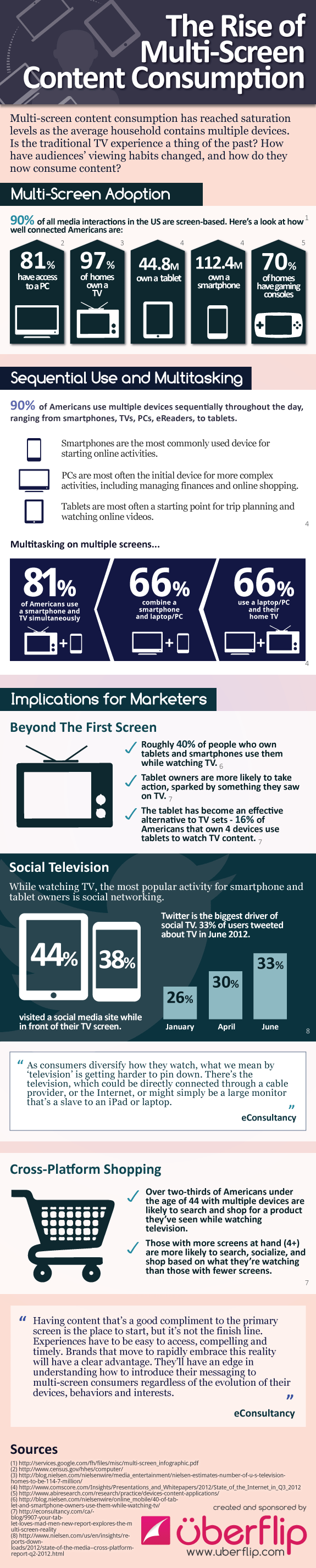
This infographic from Uberflip shows that although consumers are reaching for other devices whilst watching TV, many of them (66%) are using those devices to source information on a product and often purchase after seeing that product on TV.
Cross platform marketing requires a new mindset
So there may be a future for the TV as a communications tool after all.
However, what marketers must do is rely less on corporate driven messages and instead, identify how to introduce their products on one screen and then integrate that product and messaging across other screens taking into account changed behaviours, attitudes and cultures.
It’s well documented how numerous companies waste huge amounts of money on ineffective advertising. Generally the advertising is ineffective because it is poorly written, isn’t tested or has been developed to appeal to as many vastly different segments as possible.
This is especially true of country brands. If I had £1 for every ‘me too’ destination advertisement that I’ve seen on TV, heard on radio or seen on a website, I’d be a rich man. Time and time again I see beautifully executed ads for destinations such as Thailand, Egypt, Malta, Malaysia, Bali and others that are all selling the same things – beautiful white sandy beaches, crystal clear waters and cloudless blue skies.
These ads are pushed out across traditional media in the hope that enough people will see them, buy into them and eventually visit the country. If the campaign doesn’t work (and no one knows whether they work or not), the agency is generally sacked, a new one appointed and the whole process starts again.
Basically this model uses Hope as a strategy – hope the timing is right, hope it will be seen, hope it will be liked, hope it will be remembered, hope it will influence viewers enough to reject previous choices, hope the destination will be researched, hope the inevitable competitors that are seen at the same time will not influence viewers, hope this and hope that.
But it doesn’t need to be like that anymore. In the social media era, when consumers not countries define brands and the Internet provides copius amounts of information from other like minded consumers to help influence the decision making process, destinations need to be reaching out across this channel and leveraging consumer produced media to market themselves.
This approach requires a massive mindset change and will revolutionise the traditional organisational hierarchy but it has to start soon or destinations will lose the increasingly brutal competition for heads in beds.
To illustrate this point, I came across one video that is an outstanding advertisement for Kuala Lumpur, the capital of Malaysia. It didn’t cost the Malaysian Tourism Board a penny and is a far better advertisement than any advertising agency produced Television Commercial.
Tourism Malaysia needs to have a community team scouring the web for such content and must then distribute such content across multiple channels to generate buzz and interest. This content will allow destinations to engage directly with influencers and other consumers in a way that traditional media does not allow them to.
This really is an impressive video. I suspect that after you watch it, Malaysia will go to the top of your list of must visit destinations.
As the XLVIII Superbowl kicks off in New Orleans, attention turns to the numerous (some would say infuriatingly repetitive) commercials that can cost up to US$4 million (RM12 million) for a thirty second slot – that’s just for the airtime, not the production and other costs.
I’ve had a look at this year’s ads and (no surprises here) amongst other things, there will be beer, cars, singing fish, beer, coke (a bit of controversy around that one, well not really if you are a sensible, well rounded human being but a little bit of controversy, contrived or not does generate more column inches as well as a bit of consumer participation getting into that site during the game will be a challenge) pepsi, sports illustrated models, cowboys, cars and a liberal dash of humour to hold your attention (But no Visa this year).
Of course most people outside the US don’t get to see the ads as they get local content which if, like me you live in Malaysia that means the same Astro trailer repeated a gazillion times.
But anyway, if you would like to see what the best creative talent in the world is doing to get the attention of consumers in the US, watch all the superbowl ads by visiting here
However, if you don’t have more than US$4 million to spend on a TV slot during the superbowl or think you could spend the money more effectively elsewhere or you just like more accountability when it comes to your marketing budget, then have a look at this article at Digiday that gives you an idea of what US$4 million gets you if you take your campaign online.
One of the less mainstream online newspapers carried a scathing attack on Sabah Tourism Board today. You can read the article here
The paper carried extensive comments from a local activist who slammed the State government for recording what he called a ‘paltry’ 1.1% growth in arrivals for 2012 and blames this growth on a lack of planning.
I’ve worked to develop the tourism brand in Malaysia at both the federal level and with some of the State tourism boards and I have to say that although I have not worked with Sabah, from a distance, I think Sabah tourism is one of the most accomplished State tourism boards in Malaysia.
I do know that the State has invested in Tourism infrasture and although it has made some mistakes (name me a country, State or region that hasn’t), the Sabah Tourism Board appears to have worked hard to develop the industry and attract visitors to the State.
However, I do agree that a well thought out short, medium and long term plan that is flexible enough to react to the dynamic world today that focusses on delivering economic, experiential and emotional value (and not ‘me too’ advertising campaigns that do nothing more than waste valuable funds) is key to delivering a destination that not only survives but thrives. And as far as I know, not one State in Malaysia has a clearly defined brand strategy going forward.
One other issue that Sabah and Malaysia in general face is the lack of new products in the state and indeed in the country. Many of the visitors to competitor destinations return year after year because there are new products, opportunities and more.
In the face of growing regional and international competition and the changing tourism demographics that will see tourists from India and China looking for more than a beach resort with a well stocked bar, States such as Sabah and countries like Malaysia will have to invest in new products otherwise any growth, however low will soon turn into a decline.
Bloom Consulting has just published the 2012 Bloom Consulting Country Brand Ranking which classifies countries based on the effectiveness of their country brand strategies and the impact this has on GDP.
the 2012 Country Brand ranking
In an email to me the Ranking was explained as having a different methodology to other indexes such as the Futurebrand or Simon Anholt rankings as it “conveys dozens of variables in order to position the countries by facts and mathematical algorithms instead of pure opinions, like other country branding rankings do”.
The ranking “takes into account both hard and soft data and includes ground breaking processes to show the relationship between the country’s economic performance and the projections of the country’s brand strategy.”
It doesn’t explain what those processes are, how it gets access to those projections or how it measures them but I do like the fact that someone is trying to develop branding metrics for destination branding initiatives.
“The methodology measures the coherency between the external messages of a country and its actual economic performance under a certain period of time.
The higher a country is on the list, the better they are compared to their competitors, in positioning themselves to attract either Foreign Direct Investment (FDI) or tourists”.
Bloom doesn’t believe that it is possible to develop a single promise for a country and this I agree with (and have been saying for years – please read this article on nation branding). We’re working with destinations in Asia trying to attract tourists from the region, talent from the country and heavy industries from North Asia and North America. Trying to create an umbrella promise for such diverse target markets will be an exercise in futility!
The email went on to say, “this year Bloom incorporated Online Search Demand (OSD) into the ranking. This looks at the gap between what countries are promoting (supply) and what investors and tourists are searching for (demand).
You can read the report and get more information on the methodology, from this page. Or you can look at an interactive version here.
What’s interesting from an Asian perspective is that Asian countries are big winners in 2012, especially in tourism. Although the USA was top for the second year running, eight Asian countries were in the top 25.
China was the top Asian country at 4th, Thailand 6th, Macao came in 8th, Hong Kong 13th, Malaysia 14th and Singapore 22nd.
Japan was down in 28th place, no doubt the Tsunami played a part although the Arab Spring didn’t seem to have too much of a negative impact on Eqypt which, all things considered did well to come in at 31st.
More and more firms are using effective email campaigns in association with their social media initiatives to build brands. This is because an email campaign allows you to know who is opening your emails, which links they’re clicking on and how many of your them are forwarding your emails to their friends. The right product also means you will only pay when a recipient clicks through to the offer.
Malaysian firms are slowly waking up to the benefits of a good email campaign. Let me put that differently, Malaysian firms are waking up to the fact that email is an effective marketing tool. Which is good timing because according to a recent report from MarketingProfs, email returns the highest return on investment (ROI).
The problem is that too many Malaysian firms are trying to do their email campaigns ‘on the cheap’. often they do it inhouse or if they do outsource, they outsource to the cheapest company.
This means they often send out poor quality emails that can damage the brand. it is important to get the email and the content of your email right. Because this is the first interaction a potential customer will have with your brand. It is a great opportunity to make a good impression and start building the foundations you need to earn their trust and eventually make a sale.
Unfortunately, it is also a great opportunity to make a bad impression. And once you’ve made a bad impression, it is very dificult to build trust with a consumer who is already forming a negative opinion of you and your brand.
Not only should your email campaign resonate with your target markets, it also needs to be well written and to the point. If it is full of poor English or grammatical errors, you will create a bad impression with the recipient.
Below are two examples of emails I received recently. Although I haven’t included the subject line, take it from me they were almost as bad as the copy.
How to create a good email campaign
When you prepare an email campaign, the subject line is the most important element of the exercise because this is the first thing the recipient will see.
If there are spelling mistakes in the subject line, the reader will not have any faith in what you say from there on in. If you make outrageous claims in the subject line, the email will go straight to the trash.
Finally, if the subject line doesn’t state its point concisely, it will be ignored. Accept that it is impossible to include content in a subject line that will appeal to everyone on your mailing list. It may take more time but it is better to break up your database and rewrite different subject lines and body copy for different segments.
Once you get to the body of the email, a good rule of thumb is that less is more. Don’t waffle on and on about how great is your product or use textbook marketing jargon that confuses the reader and drives them away from the product.
Keep the email simple. Remember, you are not trying to make a sale, only get the recipient to interact with your brand. Explain what you have to offer, where the recipient can get it or gather more information, who you are and why they should buy your product or service.
Finally and most importantly, focus more on the benefits of your product not the features.
Get the message right, and email is an effective and inexpensive way to make sales, grow your customer base and build a valuable, profitable brand. Used wrongly and it is a complete waste of your time and the recipient’s time and instead of making sales and building your brand you will actually damage your brand.
More and more companies are moving toward a direct to consumer sales model. There are a number of reasons for this and it can be a tricky process to implement without upsetting the existing distribution ecosystem but let’s not go there for now.
But this move will see an increase in Direct Marketing. Direct Marketing should be included in any Malaysian business’s brand strategy, whether business to business or business to consumer. And it is a tactic that has plenty of room for growth as it is currently under appreciated and under utilized.
Because the quality of Direct Marketing in Malaysia and the mining and management of data must improve before consumers will pay attention.
What is direct marketing?
In a nutshell, direct marketing is the way in which a supplier of goods or services contacts an end user, normally a consumer or business. Direct marketing includes any mail sent via traditional post or email, brochures, magazine inserts, leaflets and catalogs.
With the direct to consumer sales model, it is also common to include telemarketing and face to face sales as elements of direct marketing
The existing model
If you want to at best create a bad first impression of your brand and at worst ensure an instant negative impact on the reputation of your brand, prepare a badly written product or services document on your desktop, use fonts that are hard to read or have a thick bold type face and whatever you do, don’t spell check the document.
Next, print 10,000 copies and shove them in letterboxes at office and/or apartment complexes in the Klang Valley. Don’t bother to record how many are delivered to each destination and ignore whether or not your product or service has any relevance to the occupants.
Then go back to your office and wait for the phone to ring (assuming you included your number on the document – and believe me, some don’t).
With this approach, the best you can hope for is that the leaflet will be used as a place mat for lunch or simply allowed to fall on the floor by the letterboxes. Hardly an inspiring ‘moment of truth’ first time experience for your brand and potential customers.
If there isn’t a response to the exercise, does this mean the ‘Direct Marketing campaign’ is unsuccessful? Absolutely not, what it means is that a very good tool has been used wrongly.
Another way to damage your brand is to send the wrong material to the wrong people. Credit card companies are renowned for sending credit card application forms to children.
Why am I receiving this sort of mail? – Note to self, do not use this company for training.
Little wonder consumers lose faith in financial institutions when they make such glaring mistakes. Think of the money wasted on buying the list of names, designing and writing content for brochures, envelopes, postage, administration and so on.
Email is still one of the most effective forms of communication with open rates of 22%, click through rates of 8% and conversion rates of 1.5%. But it must be done properly. The common approach is to buy a list of names (normally the cheapest) and carpet bomb that list with every offering you have.
Conference and training providers do this. They don’t bother who the recipient is and what he does, they simply fire off an email offering agile this, scrum that to their mailing list each time they have a new event or training seminar. Research suggests most executives have a spam filter that directs this mail straight to the trash.
The UK has some of the toughest privacy laws in the world yet Direct Marketing is still one of the most effective forms of brand development.
In 2011, UK firms spent RM14.5 billion on direct marketing which was responsible for 23% of all sales and generated RM196 billion of business. Direct marketing is effective in the UK because it is used properly.
How to do it properly
The key for all direct marketing is get the customer information right in the first place and keep it updated accurately thereafter. Well targeted communications can improve response rates by 300%.
If you don’t have the resources to compile data, outsource. There are many firms offering data collection, cleansing and data suppression services and it is money well spent.
Next, take some time to think about what you are doing and why. Are you looking to make a sale or build a customer base? Free tip, it should be the latter. Once you know what you are doing and why, think about the channel.
Determine which is the right channel. Should you use email, magazine or newspaper inserts or other. If you have a lot to say or want to show off images, an email is probably not the right channel to use unless you have a very niche product and a very well researched database. Many firms simply programme their servers to reject any email with an attachment.
Measurement
Measurement is critical in any campaign but especially so in Direct Marketing. Understand what the exercise is going to cost so that you know what your break even point is. Also measure response rates from specific segments and determine why prospects don’t buy.
Personalise each communication
If you want to stand out from the competition and have a chance of connecting, every communication should be personalised to ensure a chance of engagement. Personalisation is dificult and time consuming because it requires attention to detail but worth the investment because it instantly makes the recipient feel recognised and important.
Content is king
Content is critical, especially if you are selling a luxury product. Yes I am aware that Malaysia is a price driven and discount defined market but I disagree that that is all it is. It has got to that stage because consumers have been let down by advertisers so often and for so long that they now focus on price and price alone.
But as many luxury retailers, developers and service providers will tell you, provide a high quality service and product and consumers suddenly seem less focused on price and more focused on the experience and the prestige.
So make your content interesting. The example below is from a property developer trying to get wealthy buyers to part with millions of dollars. I doubt they will be successful with this copy.
Make content interesting, it’s not rocket science!
There is an edict within Direct Marketing industry that says, “Right offer, right person, right time.” It isn’t complicated, it just means that to be successful, start up, SMEs and GLCs need to up their game.
Put an end to poorly thought out, badly designed, written and untargeted material and use quality direct marketing to build quality brands.
And as it happens, I’ve never managed to secure any consulting projects with automotive brands. So as buying a car is probably the second largest investment most of us will make, I decided to use this opportunity to carry out a mini brand audit of those brands I visited.
So today (Sunday) I visited the Audi, Mercedes, Peugeot, Land Rover & VW showrooms in Kuala Lumpur. Excluding the luxury marques – Aston Martin, Rolls Royce and Bentley, these are considered top end cars in Malaysia.
The automotive sector here in Malaysia is really tough, especially as the middle class market, although growing is still rather small. In fact, between them these brands probably sell no more than 10,000 units per annum of which 60% are Mercedes.
Furthermore, with import duties higher than anywhere else in the world and an increasingly bleak global economy that looks like it will catch up with south east Asia in 2013, you would expect these guys to have some of the best sales people in the industry.
Well here’s my ‘mini’ report card on my experiences and the ability of these top marques to sell their products.
Firstly though, some background information.
1) Not one of the sales people that attended to me asked for my business card.
2) Only one sales person asked my name.
3) Only one of them asked me what car I currently drive.
4) One of the sales people who was very pleasant, could not pronounce the name of her brand. I’d like to add that this brand name is bloody hard to pronounce for English people so must be impossible for a native Chinese speaker. But…
5) At one of the showrooms I was told if I bought the car today I could get free Sat Nav (GPS). When I asked whether it covered Malaysia, Singapore and Thailand I was told no, it covered France – I swear to god that is the truth!
So, in reverse order, here is my report card on my experiences with these brands and a brief explanation. WARNING: It makes for distressing reading.
5=) VW.
VW comes in last, way last. Not really a result of the salesman’s ability or inability to sell because he was a very nice guy and anyway we didn’t get a chance to test his sales ability because the VW in Malaysia doesn’t come with Sat Nav (GPS) and in my opinion, at that level if you don’t have Sat Nav, you are not in the game.
5=) Land Rover
Joint last is Land Rover. Again, not a result of the ability or inability to sell because we didn’t get a chance to find out. There weren’t any sales people to attend to me because they were all out doing test drives. That’s no excuse. When your cheapest car – the Freelander 2 – is RM271,000 (US$90,000) and your most popular car – the Evogue – has a long waiting list, you need to be on top of your game. I wasn’t the only person to walk out frustrated.
3=) Peugeot
I really liked the top of the range 508 GT but the sales person seemed to want to sell me something cheaper. Maybe she was on a higher commission to sell that car or maybe she was just using price to make a quick sale.
3=) Audi
The Audi lady was nice and gave a good description of Quattro to my wife who really looked as if she was interested. But she didn’t ask me anything about what car I drive, how old is it etc, etc. Where’s the relationship building?
1) Mercedes Benz
Apparently, the sales lady here was working in the Mercedes showroom in Glasgow, Scotland for 10 years but is now back in Malaysia. In 20 years of living in Malaysia, this was the first time I have heard a Malaysian speaking with a Glaswegian accent! But crucially she was miles ahead of the rest with her product knowledge, attempts to build rapport, personality and sales ability. Not too pushy, not too technical and she asked for my name at the right time in the discussion and when I gave her my first name she asked for my surname so she could address me as Mr Osborne – top talent.
I’m not here to criticize, only to offer feedback to help people and brands. Viewed for what it is – feedback, every brand on this page can learn from my experiences. Sales is no longer about taking orders or convincing someone of something. It is now about building rapport and delivering value, on an individual basis. If you don’t have the training or the skills to do that you will lose business, lots of it.
All of these brands spend a lot on advertising to draw people into their showrooms. And they may be happy with their sales but my question is, would any of them be happier with less advertising spend and increased sales as a result of better customer engagement skills? Of course they would.
I read an interesting article on the Malaysia Nation Brand which can be found here.
But I was particularly taken by one of the reader’s comments.
As someone who has worked on a number of elements of the Malaysia brand and who has written numerous articles on it, I believe I can add value to this discussion.
Firstly, it is incredibly hard to write about the Malaysia Nation Brand or any other Nation Brand in an article of a thousand words or so! It’s a thankless task which is why many experts have trouble writing a relevant or coherent book on the subject!
And, because the world is so dynamic, what is a ‘cutting edge’ tool today maybe obsolete tomorrow and a tactical solution recommended yesterday may not be relevant tomorrow.
Anyway, back to the contributor. He appeared to state that maintenance in Malaysia is not a problem and insinuated that it was irrelevant anyway because it had no bearing on the Malaysia Nation Brand.
The author of the article responded saying that maintenance is very important and forms part of the confusing image of Malaysia. The author goes on to say that poor maintenance of buildings contributes to the experience and therefore the success of the brand.
Let me state here that maintenance is a major cause for concern in Malaysia, especially at Government venues but also at privately owned venues.
Last Saturday and Sunday, I was at the Bukit Jalil indoor stadium for a world class sporting event (ATP Tennis) and the place is a sad, shabby, tired mess. Walls are filthy, the place smells, doors are broken, clocks don’t work, ventilation is poor and navigation complicated. I won’t event mention the toilets. Furthermore, the TV sets are old and either not working or showing a picture that looks as if there is a snow storm going – the list of poor experiences is endless.
As I left I looked up at the beautiful main stadium and could see numerous holes in the roof, abandoned scaffolding and other signs of neglect. And we all know this scene is replicated around the country.
If we want to build a nation brand, it will require more than a tagline, a brand essence or a glossy advertising campaign. To build a Malaysia Nation Brand will require a massive change in mindset. Part of this will require an understanding that positive experiences create positive memories which lead to positive word of mouth and an improved Nation Brand.
Because it is the experiences people have when they interact with numerous touchpoints that they will remember and communicate to others.
World class sporting events are a major way of improving a brands image and the organisers should be commended for bringing in this prestigious event. But the authorities should also do their part and make sure the experience is unforgettable, for the right reasons.
If you are interested I wrote an article on the Malaysia Nation Brand and you can find it here.