Personalisation


Companies have to stop trying to sell stuff to prospects and customers and start coordinating all the resources it has to supplying or satisfying specific customers specific requirements for value.

Consumers don’t want products (or services) they want the products/services they like immediately and personalised. But personalisation in its present form is primitive because of cost, technology, time and lack of appreciation by CEOs. Right now personalisation is nothing more than a colour, sun roof or memory size. Consumers will want to actively shape the offerings and information they receive. It’s already happening in the aircraft/shipping/hospitality etc industries. Hey, even Barbie has 6,000 customisation options!

I’m sure I’m not the only one who has bought something that wasn’t quite what I wanted but was bought more in frustration at not finding what I wanted exactly. After a week it was gathering dust in a store room. In the future, with advanced build to order capabilities, even complex products will be produced specifically for one customer and buying products that don’t quite fit the bill be a thing of the past.

This will also have an impact on communications. Existing customers will no longer visit websites, they will have direct access to their own landing page.

How Asian firms and politicians can adopt social media into their strategy


When TV first started, commercials consisted of a presenter standing in front of a microphone reading from a script. Why? Because that was how it had always been done on radio. It took companies a few years to leverage the power of TV but eventually they did and now TV ad spend is estimated to be in the region of US$500 billion annually.

And in the same way as first the radio and then the television changed the way companies pass on information to consumers in the 20th century, social media is changing the way consumers source information about businesses in the 21st century. But social media will have an even bigger impact than radio and television because social media is not only changing the way we make decisions related to brands, social medial is changing the way we do business.

Consumers receive up to 5,000 messages a day
Back in the day, companies used radio and then TV to build brands by developing a one-size-fits-all message and broadcasting that message to as many consumers as possible as often as required. All communications were one way and the messages contained only the information the company wanted to share and the consumer was expected to accept this information and not dispute it. In a more trusting world, with limited competition and smaller markets, consumers were accommodating. Unfortunately, more and more companies adopted the same strategy. Soon consumers were inundated with up to 5,000 messages a day, many of them making increasingly outrageous claims.

Companies were unable to follow through on the promises made in advertising and trust, the key element of any relationship, was eroded. Repeatedly let down, consumers began to look elsewhere for independent information and the truth. They found it with other consumers. Consumers now source their information on brands from other consumers. Today, consumers have the power to make a brand succeed or fail. As consumers learn the truth about a brand, the reputation of companies and their brands is being determined, shaped, altered and increasingly discarded by consumers.

Dynamic process
And it is an ongoing, dynamic process. At any given time, consumers are searching for information on a product or service that has caught their eye. But they are not sourcing that information from TV commercials, the radio or the company website, they are looking to other consumers for the information they require.

And they are doing it, on the whole via social media. And social media is yet another tool that organizations must embrace because it is replacing marketers and the marketing department and other barriers between the organization and the consumer.

Social media cost of entry is low
Social media is not a fad. Those companies that don’t buy into social media will be left behind. But a lot of companies in Malaysia are going to be intimidated at the prospect of opening their virtual doors and giving the general public the opportunity to interface directly with them. But they are going to be talked about anyway so they might as well be part of the conversation. That way at least, they will have the chance to contribute a corporate take on all issues. And the good news is that the cost of entry is low and there are very few barriers to participation.

So what should Malaysian firms do to leverage social media?

1. The first thing they have to understand is that social media is not about you. It is not PR and it is not advertising. Social media is not for the hard sell, it is for engaging prospects and customers and for entering into two way conversations with them. Do this, and you will get opinions on issues that are important to an audience who is interested in your product. If you listen and use this information wisely, you will be able to match your product attributes to your customer requirements for value.

2. Identify which social media platforms you intend to use and develop a strategy to use them. Transparency, consistency, honesty and longevity are key so don’t just jump in and fire away for a fortnight of frantic activity and then get bored and stop communicating.

3. Do some research and find out how your customers are using social media, what platforms and so on. 350,000,000 million people read blogs. Identify which ones your prospects and customers are reading and how can you get involved by responding to articles.

4. Offer forums on your website that allow customers to express freely their experiences of using your products. You’ll be astonished at how valuable the feedback will be as you listen to what really matters to consumers and incorporate the feedback into your strategy.

5. Over time, develop a formal process to monitor and review what consumers are saying about you and where they are saying it. This monitoring will allow you to enter into dialogues that are very personal and transparent. It will also allow you to address negative issues as they arise and before they develop into crises. Casual monitoring will give you a real time view of what is being said but it is resource consuming and may not be as effective as a more formal program via a third party such as BuzzMetrics.

6. Set up blogs for key customer facing departments. Blogs are a great sounding board and instantly engage prospects and customers. Be honest, develop a personality but don’t try to sell your products. Don’t worry if your opinions differ to those of the audience. Open and transparent responses are what your audience is looking for.

7. Social media requires a fresh approach to content. Too many Malaysian firms are simply paying ‘lip service’ to social media. One government agency simply copied and pasted its website onto its Facebook page and then left it for nine months!

8. Social media is a platform for communication and collaboration, not a soapbox. Some companies simply tell followers about special offers. A number of politicians use Twitter to tell everyone what they are doing yet ignore specific issues raised by voters.

So as you embark on your social media strategy, remember that the digital environment is immense and fluid. Understand that you must change the corporate approach of one that aims to push messages onto consumers, to one that aims to listen to what they have and then responds to those issues. Take these first steps and you’ll soon learn to leverage the powers of social media and throw away the script.

More effective brand communications required to build the Volvo brand in Malaysia


Building a brand in any country requires more than a series of tactical initiatives to create awareness and ‘get the name out there’. It takes a meticulously planned and integrated strategy that incorporates the participation of numerous stakeholders and initiatives, both internal and external. Internally to ensure the whole organisation is on brand and externally to ensure communications and content resonates with target markets and are communicated via relevant channels. There’s more but for the purpose of this article that’s enough for now.

And what if the brand is to penetrate other markets? There was a time when all it took to do this was a continuation of the positioning tactics carried out in the home country, perhaps with a few language changes in print media and perhaps some dubbing of TV commercials (TVCs). An over simplification perhaps, but essentially correct.

But as we all know, the world is very different today.

Building western brands in Asia
To build a Western brand in Asia today, as many international brands are finding out the hard way, takes an even more robust and integrated brand strategy that has at its core organisational excellence. Only once has that strategy been developed can the brand strategy be executed. And part of the brand strategy, a small but critical part, is the communications campaign.

This is particularly true of the automotive industry that has seen a number of well known European and other Western brands find it hard to repeat the successes at home in new Asian markets. There are other issues such as high duties etc but many European brands perform below expectations, despite large marketing budgets.

One of those is Volvo. Despite an extensive presence across most media, in 2009, out of a total industry volume (TIV) of just under 537,000 units, Volvo only sold 600 cars in Malaysia, South East Asia’s largest passenger market. This gives Volvo about 0.15% of the market. Although this is a slight increase over 2008 when Volvo sold 524 cars, it is way below the 2007 total of 752 units. Interestingly, in 1999 Volvo sold 839 cars, giving it 0.3% of the market. So Volvo’s market share of the Malaysian passenger car market has halved in 10 years. I think I know why.

Last Thursday, 28th January 2010, a half page full colour ad in the New Straits Times, (NST) Malaysia’s ‘premium’ newspaper caught my eye. The ad features the Volvo V50 and a headline “There’s more to life with Volvo.” The ad goes on to sell space and luxury using images of a kayak, a windsurfer and a mountain bike. The ad lists, in really small print, a number of dealers in key cities. There is no website address.

Last Friday 29th January 2010, Volvo ran another half page ad in the same publication, this time a spot colour ad. This ad features a Volvo XC60 parked on a snow covered road with the occupants, a man and a woman in warm fur collared winter parkas sitting in a pile of snow staring out at a snow covered landscape. This time the headline is “Volvo owners get more out of life!”

If I’m not mistaken, the traditional rule of thumb has it that you have approximately 3 seconds to grab a readers attention with a print ad headline, perhaps less in today’s noisy, cluttered world. I don’t know how effective the Volvo ads have been but I did notice that the offer in the second ad has been extended, rarely a good sign. I also noticed that there is no tracking mechanism in the copy. And, in case you can’t read it, the tagline in the print ad reads “Volvo owners get more out of life!” So the ad is targetting both existing and potential customers.

Coincidentally, there is a Volvo billboard outside my office, at the busy intersection of a very busy highway. The billboard ad features the Volvo XC90 Diesel. This time the headline is “Winner of fuel efficiency award.”

Sitting in my office in the Malaysian capital of Kuala Lumpur where the recent hot spell has seen the temperature top 40 degrees centigrade on more than one occassion and the humidity is often around 90%, I tried to figure out a couple of things.

1) What was the relevance of these communications to potential and existing Volvo owners in Malaysia?
2) Why are they using images featuring snow to sell a service in the tropics?
3) Why is an ad targetted at existing Volvo owners also trying to get the attention of non Volvo owners?
4) Where is the consistency?
5) Is this part of a planned out, integrated strategy or a series of one off tactics?
6) Why would anyone get out of a nice warm car and sit on wet cold snow to admire the view?

OK, ignore the last one.

Hemorrhoids and Frost bite
Well as far as I can tell, more out of life for the couple featured in the second ad is likely to be hemorrhoids and frost bite. I don’t mean to be fecetious, but what is the relevance to the Malaysian market? There are some marketers who insist that to build a brand you need to be first in a category and perhaps Volvo wants to be first in the frost bite category but I think not.

More confusing is the content. The main copy of the ad is encouraging existing Volvo owners to bring their cars in for servicing, repairs or to buy accessories and be entered into a competition to win vouchers that can be redeemed for more accessories and parts. Shooting off on a brief tangent, the takeaways I get from that copy, as a non Volvo owner are, in roughly equal amounts:

1) you are going to be spending a lot on parts and accessories so here’s a little help or
2) these cars are built so well that you will never actually win anything because nothing needs to be repaired but the model sold is so basic you’ll be spending a lot on accessories. Interestingly Volvo also offers a 3 year warranty/100,000km for cars sold in Malaysia so if you’ve got a new car you may have to wait 3 years to receive your prize!

Seriously though, The Volvo communications are confusing. Furthermore, according to the Star newspaper, 86% of Malaysians don’t trust advertising. So that means the print ads mentioned earlier are targetted at only 14% of Malaysians. Moreover, with an entry level Volvo S40 at around RM170,000 (US$48,000) it is off the radar of the average Malaysian so a mass media approach is a waste of valuable funds.

There are a number of other things Volvo can do to halt the slide in its market share and build a profitable brand in Malaysia.

1) Separate the acquisition strategy from that of the retention strategy.
2) An indifference to retention branding is short-sighted. Michigan State University estimated that US$1 spent on acquisition generates US$5 in revenue, while every dollar spent on retention creates US$60 in revenue. Bain and Co has estimated that increasing retention by 5% can increase profits by 25%. Companies have a 5 – 15% of selling something to a new customer, but a 50% chance when selling to an existing customer. But retention branding requires a completely different strategy to acquisition branding.
3) In the mass economy the brand communications goal was to increase awareness. This evolved into persuasion but the ultimate goal today is adoption. Adoption ensures the brand is seen as the best or, better still, the only choice. But adoption of a brand is not an event it is a process built on the back of organisational excellence and reinforced by the ability to deliver relevant solutions on customer terms.
4) Volvo cannot expect adoption if messaging is inconsistent and fragmented. If print campaigns and billboards are to be part of the brand communications, keep them consistent. Announcing fuel efficiency awards is not going to drive traffic to showrooms.
5) Review communication tools and explore social media options. I believe there is no benefit at all for a luxury product like Volvo to advertise in a daily newspaper in Asia.
6) Understand social media is for communities and those communities must be relevant. The only opportunity for interaction on the Volvo website leads the viewer to an international site. Volvo owners in Malaysia will want to be part of a community here, and learn about issues and opportunities in Malaysia, not in Istanbul.

The purpose of this article is not to embarrass Volvo. So if anyone from Volvo reads this article, please view my comments as feedback, not criticism. There are a number of automotive manufacturers making similar mistakes but Volvo caught my eye!

Retention branding in the hospitality industry


Advertising, direct mail, marketing collateral, public relations and other acquisition efforts tend to get the bulk of a company’s branding budget. The belief being that it is easier to acquire a customer who is presumably using a competitor product than it is to hang on to a customer you’ve already acquired.

Retention branding, the efforts implemented to hold onto those customers who have been acquired at enormous cost, gets very little attention at all. Some firms don’t even know if a customer has bought before and many don’t even know when was the last time a customer bought something.

And yet a brand is not built on acquiring customers, it is built on retaining them. This is especially true in the hospitality industry. Which is why I was surprised to learn that Hilton is imposing a 25% increase on the number of reward points required to qualify for free rooms under its loyalty programme.

The global recession has hit the hospitality industry harder than many other industries. Occupancy and rack rates have tumbled. To combat this, many of Hilton’s competitors have bent over backwards to work with existing customers and are investing heavily in retention branding. Starwood Hotels recently launched a special offer for members of its loyalty programme, Starwood Preferred Guest (SPG) that offers between double and quadruple points for each stay.

Starwood, which includes the Westin and Sheraton brands offers guests who stay two nights double points, those who stay three nights triple points and quadruple points for those who stay four nights.

Last year, at the height of the economic crisis, Marriott offered members of its loyalty programme a fifth night free when four nights were booked using reward points. One of the most frustrating issues for loyalty programme members are ‘blackout dates’. These are normally busy periods when the hotel can sell rooms at rack rates. Aware of the negative impact this had on loyal customers, Marriott scrapped the unpopular policy.

Last December, in the US, InterContinental Hotels Group (IHG) ran a tactical campaign via twitter offering loyalty card holders points for staying in its hotels. IHG also has no plans to increase reward rates.

Other hotels that have not announced specific initiatives have however ended many of the restrictions related to when points can be redeemed.

So most of the Hilton’s competitors appear to be investing in retention campaigns to hold onto their existing customers. As customers leave Hilton, as they inevitably will, the competition will be happy to acquire them and but if they continue to invest in retention campaigns, will make it very hard for Hilton to win them back.

You cannot build a brand with advertising alone


86% of Malaysians don’t trust advertising. The Star) . 78% of Malaysians trust the recommendations of other consumers. There are more than 1,500,000 Malaysians on Faceboook. 80% of affluent Malaysians (those with a household income (HHI) above RM5,000) use social networking sites. Nine of the Top 20 websites in Malaysia are social networking sites. These consumers are the new world order. They are online for many hours a day and pay little attention to traditional mass media. Despite this, Malaysian companies continue to poor billions (RM6.45 billion in 2008. Adoi) into mass market advertising in the mistaken belief that what they are doing is building a profitable brand.

Advertising was much more relevant in the past when the mass media was limited to only one or two TV stations, few radio stations, a couple of national newspapers and the occasional billboard. Limited leisure time pursuits meant consumers spent a lot of time interfacing with the mass media. Finally, there was little competition so high product or service standards were unimportant. With frequency and timing, mass media advertising generated enough ‘awareness’ to justify the budget.

With limited competition and consumers who were willing to accept low standards or didn’t know any better, such awareness could result in sales and for some, it was enough to build a brand.

Using advertising to build a brand is ineffective
Unfortunately, using advertising to build a brand will not work anymore. Mass media has disintegrated into niches or communities. Consumers have been carpet bombed by so many messages – up to 3,000 a day and for so long, that they have learned to block most of those messages. The favoured reaction of advertising agencies to declining responses and lack of effectiveness is to increase frequency but this doesn’t help because it just adds to the cacophony.

In a media saturated world, awareness is just background noise that means very little. For most companies, and there are very few exceptions, in an age when information on every product and service is widely available, and consumers have more choice, are better informed, and more powerful, creating awareness is not going to build a brand. For instance we’re all aware of Mazda, Alfa Romeo, Eon Bank, Pan Am, Airbus, Ritz Carlton and many other multi national global brands, yet most of us will go through life without ever buying something from these companies.

Indeed, many companies have realized, sadly after spending millions on advertising, that advertising can raise awareness (and even that outcome is not a given), but still fail to transform an offering into a brand. Settling for awareness, when so much more is possible and required is a total waste of valuable funds.

But this doesn’t mean that advertising is no longer important. Advertising is, and will probably always be, important to branding. But its role has changed. Advertising can no longer be a tactical initiative to ‘reach’ as many consumers as possible to ‘get the name out there’.

Advertising
Advertising must do more than try to create awareness. Advertising must work to ensure consumers adopt offerings into their lives. Adoption enables an offering to be seen as the best option. But this adoption also needs organisational excellence and the ability to match offerings to client requirements for value. Advertising cannot be expected to do this on its own. And it is wrong of advertising agencies to give the impression it can but it is also wrong of business owners to expect advertising agencies to be solely responsible because advertising is not a silver bullet.

It may seem like I am stating the obvious, but advertising must also communicate trust. This is the key element in any relationship. Prospects won’t make that critical initial connection without trust. And for trust to grow into loyalty, the key to brand building, companies must deliver on the promises made in the advertising. If you don’t deliver on the promises made, your target market is reduced by 86% and you are trying to sell to the 14% of Malaysians who trust advertising.

Some of the claims being made by property developers, automotive distributors, airlines and others in their advertising are often bordering on the ridiculous. Consumers, already pressed for time and cynical, are doubtful as soon as they see the advertising. If you foster doubt from the moment of the initial contact, you’ve wasted every dollar spent on that campaign. If you are making claims you must follow through with them across every touchpoint. And don’t expect it to happen overnight. It takes time to build loyalty.

Understand that building a brand requires not just advertising but also a significant investment in building loyalty and organisational excellence and the money you spend on advertising may be money well spent. Failure to do so and you may as well pour it down the drain.

Malaysians haven’t changed since 2003


Omnicom Media Group (OMG) announced yesterday that newspaper advertising in Malaysia is as effective as it was six years ago. The report also states that readers ‘take note’ of 57% of newspaper ads and that this figure has not changed, I repeat, has not changed since 2003.

The sample size was 1,023 readers aged between 15 – 34 in four locations. They were tested on their recall of 15 ads in different sizes and in different places in newspapers they had read. The number of ads tested was 2,452 that appeared in 15 ‘main’ newspapers.

The agency developed what they describe as ‘three indicators of effectiveness’

1) Ad Noting or ad recall
2) Ad read or readers attention
3) Brand recall

The reports states that bigger ads perform better with a full page ad yielding 21% higher ad noting than a quarter page. Furthermore 60% of colour ads are noticed compared to 53% of B/W ads.

I got my information from this article and not from the original report which I would love to see.

So I can only go on the above data, plus some other results that don’t deserve to be published.

So what is my beef with this report? Well, in no particular order, the first issue I have is with the methodology. The report doesn’t tell us if the responses were aided or unaided. Critical. My second beef is with the ‘indicators of effectiveness’. There was a time, many years ago when newspaper advertising, with its one-size-fits-all mass marketing approach was effective. But not today. Awareness, or noting, or recall is simply not enough to turn a prospect into a tryer. And even if readers are bucking the global trend and not blanking out these and other messages but are indeed noting these ads, so what!?

Another beef is with the number of ads and the channels. 2,452 ads that appeared in 15 newspapers. That’s a lot of ads in a lot of newspapers. Most of us would find it hard to think of 15 mainstream newspapers in Malaysia. I’d also like to know which ads they were shown. For instance, were 15 year olds shown Louis Vuitton ads? They might recall it but what are the chances of them buying the product?

When we have a first meeting with a prospect, one of the first questions we ask is, “Have you read the paper today and if so, which ads do you recall?” Very, very rarely does someone actually recall an ad. And many of them were reading the paper as we walked into the meeting!

The time spent by Malaysians online went up 24% from 3 hours a day in 2006 to 3 hours and 46 minutes a day in 2008. With broadband penetration forecast to be 50% in 2010, that figure is going to rise significantly. Already, 80% of affluent Malaysians (those with a household income above RM5,000) use social networking sites. The time Malaysians spend interfacing with traditional media will suffer. But perhaps the most telling statistic of all is one that appeared recently in the Star, “78% of people trust the recommendations of other consumers, while only 14% trust advertising.”

So even if consumers are noting or recalling or whatever the latest term is, it doesn’t really matter because 86% of them don’t believe what they read in the advertisements so they’ll never buy the product!

Dodge seeks survival with mass economy approach


Chrysler has, like most US auto manufacturers, with the exception perhaps of Ford, seen its market share drop further in 2009. But this time it is down below the psychological 10% barrier at 8.9%, down from 11% in 2008. Sales are down a worrying 40% over the same period. This is not good, especially as the company stated in early 2001 that it intended to have 20% of the US market by 2005.

A restructuring plan in November 2009 introduced a number of initiatives including using models from Europe to mask the fact that Chrysler has made little investment in new products.

In what has become a depressingly familiar process, executives at the restructuring also introduced a number of new positioning strategies for the Jeep, Ram and Dodge brands. According to the executives, new models are to be redesigned or improved in times quicker than ever known to the industry. Ambitious sales figures include global sales targets of 2.8 million vehicles by the year 2014, of which about 60% are projected to be in the US. The firm forecast break even in 2010 and anticipated posting a profit in 2011. Revenues are forecast to be in the region of US$70 billion.

Specific brand initiatives include the biggest marketing budget for the Jeep brand in four years. Showrooms are to be redesigned to reflect off road heritage and Jeep managers will engage more with consumers at events. Meanwhile at Dodge, another new logo has been created to reflect a ‘sporty, youthful, inexpensive’ car. New entry level cars are to be available in different ‘flavors’ or equipped ‘differently’ not ‘expensively’. Are there such words as ‘differently’ or ‘expensively’?

Ralph V. Gilles was appointed President and Chief Executive Officer of the Dodge Car Brand in October 2009, with full profit and loss responsibility for the Dodge car product portfolio. Before this he was VP of design. He is responsible for halting the Dodge slide but to do so he is going to need more than a new positioning strategy, new logos and a one-size-fits-all approach to marketing. Unfortunately the signs are not good as he has appointed Wieden & Kennedy, an advertising agency to build the Dodge brand.

Gilles is on record as saying that Dodge cars are, “Cars that make you feel good, that are niche-like in their demeanor, but have mass appeal.” Well I’m sorry, but that sounds to me like a one-size-fits-all typical mass marketing ad agency driven concept that will, in the end, appeal to nobody.

What do you think?

Singapore Airlines Suites, branding blunder or recession victim?


There have been numerous branding blunders and you can read about some of them here but rarely does Singapore Airlines feature. Singapore Airlines (SIA) consistently leads the industry in profitability and manages to ride out turbulent times better than most in its class. It has always been aggressive, acquiring aircraft and expanding its fleet quickly, in 1979 it set a record at the time, when it traded relatively new aircraft for an updated version of the B-747 for a then record of S$2.2 billion. SIA also differentiated itself early on with its adoption of the Singapore Girl as the face of the airline and service as the unique selling point.

But the world of today and the world of the 1970s are very different. The 1970s were the halcyon days of the mass economy. In the mass economy, with its mass markets and mass media, perhaps a little bit of help from the government and a large dose of nationalism. And by broadcasting the same message to large audiences who had limited sources of information, it was a lot easier for an airline to establish a brand.

More of this and more of that and better this and better that or bigger this and bigger that coupled with large advertising budgets worked well. As competition increased, consumers became more segmented and media choices fragmented, like many other industries, airlines turned to positioning as a strategy.

Positioning
Positioning consisted of creating a position in prospects minds that reflected the strengths and weaknesses of the offering as well as those of competitors. Ideally, this position was based on being first in a particular category. If someone was already first in a category, then companies attempted to redefine themselves in a new category to be first. In the airline business, this tended to be related to passenger comfort or service. The effectiveness of positioning depended on the ability of advertising to drive branding perceptions in the mind of consumers. To do this, airlines often made promises they were unable to keep (admittedly, often due to third party issues out of their control), failed to meet traveller expectations, often because dynamic competitors moved quickly and so raised the bar, which in turn led to brand disillusionment.

Positioning was ideal for the mass economy. It was also ideal for advertising agencies and marketing departments because it gave them enormous power without the responsibility of accountability. Al Ries and Jack Trout invented the concept of positioning. The preface to one book states, “Positioning has nothing to do with the product,…. (it) is what you do in the mind of the prospect.” So, essentially this means that the consumer can be made to believe, through extensive advertising and PR in the right conduits to consumers, and other vehicles, what an offering means to them.

Airbus A380
When Airbus announced it’s super plane, the Airbus A380, ever aggressive, SIA was one of the first to sign up and the first A380 delivered was delivered to Singapore Airlines on 15 October 2007. It entered service on 25 October 2007 with an inaugural flight from Singapore to Sydney. Passengers bought seats in a charity online auction paying between US$560 and US$100,000 for seats. Understandably, the new aircraft, a clever publicity stunt and an inquisitive general public, generated a lot of media coverage and by the end of February 2009, a million passengers had flown with Singapore Airlines on the A380.

Suites
But the majority of those passengers are flying economy. The problem has been getting passengers to use the suites, positioned as, “a class beyond first.” When the new A380 service was launched, in the way that has always done, SIA used global TV, print and online advertising and PR campaigns to launch the new A380.

Beautifully executed TVCs were developed for the Suites by a top advertising agency using taglines such as “your own private bedroom in the sky”. Other taglines included “an unprecedented level of privacy” in a “cabin unlike any other”, and sleeping on a “standalone bed that was not converted from a seat”. Givenchy Beddings (and pyjamas) Ferragamo toiletries and Krug or Dom Perignon were also part of the deal.

But despite a unique product, some slick marketing based on a huge investment in a one-size-fits-all message to mass markets using mass media, consumers and corporations haven’t bought into it. Why not?

Lack of research
One of the reasons could be that SIA didn’t talk to customers and prospects about what they might want from such a service, and, more importantly, how much they would be preparred to pay for it. In fact, it appears that SIA didn’t even engage with members of its Frequest Flyer Programme. SIA simply went ahead and developed the product and then, in a traditional 4 Ps (product, price, place and promotion) and positioning strategy, tried to sell it.

To make it even harder for themselves, and despite charging a premium of more than 50% over the first class fare, SIA would only reward loyal members of its Frequent Flyer Programme (FFP) Krisflyer with 10% more miles than a regular first class ticket! Moreover, any redemption of miles could only be for economy, business or first class and not for the Suites!

According to Shashank Nigam, “Several HR departments of companies, including civil service departments in Singapore, issued circulars or directives stating that “Since the Singapore Airlines Suites are a class beyond first, officers who are usually eligible for First Class travel will be ineligible for Suites”. So by now, SIA had upset its two most important customers, its own government and elite members of the frequent flyer programme!

In 2008, as the economic crisis began to take hold and suite sales nosedived, SIA maintained its pricing strategy, making it even harder for financial institutions, already under scrutiny for lack of risk management, to justify such extravagance.

Another reason for the poor response is probably related to the ground experience. Although positioned as a class beyond first, elite passengers were expected to use the same check-in facilities as passengers travelling in first class, the same lounge and essentially, the same food as first class passengers.

Premium revenues drop by 40%
By the middle of 2009, SIA was feeling the heat on a number of fronts. The economic situation gripping the world caused international premium passenger numbers to fall by 18% year on year in the first 10 months of 2009. At the same time, premium revenues dropped by up to 40% over the same period (IATA). Another challenge was from competitors such as Emirates and Qantas who don’t offer Suites but do have exceptional first class experiences including cabins on their A380s that feature a Bar and bathrooms with showers, limousine transfers at departure and arrival (not available to SIA passengers, even those using Suites).

SIA reviews incentives
SIA scrambled to recover some marketshare. The first incentive was a free night’s accommodation at the Raffles Hotel in Singapore for all passengers flying Suite class. Neat, but hardly enough to justify a 50% premium over first class. Then SIA remembered the people who have made it such a success story in the past, first class passengers and lucrative members of Krisflyer. SIA relented on the bonus miles and began offering 300% bonus miles instead of 10%. Definately a step in the right direction but perhaps too little too late as it is rumoured that a significant number of key SIA customers have defected to Emirates and Qantas. If this is true you can be sure these airlines will make it harder for these premium passengers to leave than did SIA.

So what could SIA have done better? Here are 5 things I would have done although, if they had done number one the rest would have been redundant. What else would you have done?

1) Research. Your existing customers are your best source of information. Talk to them, find out what they are looking for and match attributes to their requirements for value. If SIA had talked to its premium passengers and its own government departments, it would have realised that the market could not support the suites product.
2) Mass market branding with a focus on the 4 Ps is no longer effective. Brands today are built on relationships, access, personalisation and relevance.
3) SIA should have focussed on developing more profitable relationships, not a more profitable product. Brands evolve when companies start buying for customers instead of selling to them.
4) Branding is an organisational not a departmental responsibility. And the organisation is the responsibility of the CEO. To expect a passenger to pay a 50% premium over the price of a first class ticket and not offer a limousine service on the ground when all competitors offer it to first class passengers shows a real lack of judgement.
5) Retention is key to brand building. Companies no longer sell a product, customers buy a product. And once they’ve bought the product, companies should do everything possible to hang onto those customers.

SIA is a great brand. As I write this, I am sure SIA is working out what to do with its Suites. If SIA aims to meet customer requirements for emotional, economic and experiential value, then the airline will bounce back stronger and better for the experience and the Suites can be written off as a victim of the recession. If they don’t the suites may become yet another branding blunder.

What is the impact of the mosques referendum on the Swiss brand?


Last month a much reported public referendum in Switzerland voted to implement a complete ban on the construction of minarets in the country.

The referendum, sponsored by the right-wing Swiss People’s Party sparked numerous national debates and 57.5% of the electorate voted in favour of the ban. This despite the protestations of the ruling pary of Switzerland, religious and business leaders who all campaigned for a no and public polls that suggested a significant majority opposed the referendum.

This is not a political blog so I won’t go into the details, but I am curious to know what people think about the consequences of this decision in respect of the impact it will have on the Swiss brand. Switzerland has an image of a country that has respect for human rights, no doubt influenced, ironically, for a tradition of religious tolerance. Although the decision is likely to be overturned in the European Court of Human Rights, the Swiss image of neutrality and tolerance may have been damaged. If it has, what are the consequences of this, from a branding perspective?

After all, the country is home to many international brands, especially from the financial services industry and luxury brands. These luxury brands and financial institutions are popular with Muslim consumers from all over the Muslim world.

Will we see these Muslim consumers withdraw their funds from Swiss banks and transfer them elsewhere? Will they shun shops selling Swiss watches and other jewellery? Does anyone have any thoughts or firm data on the impact of this decision on the Swiss brand?

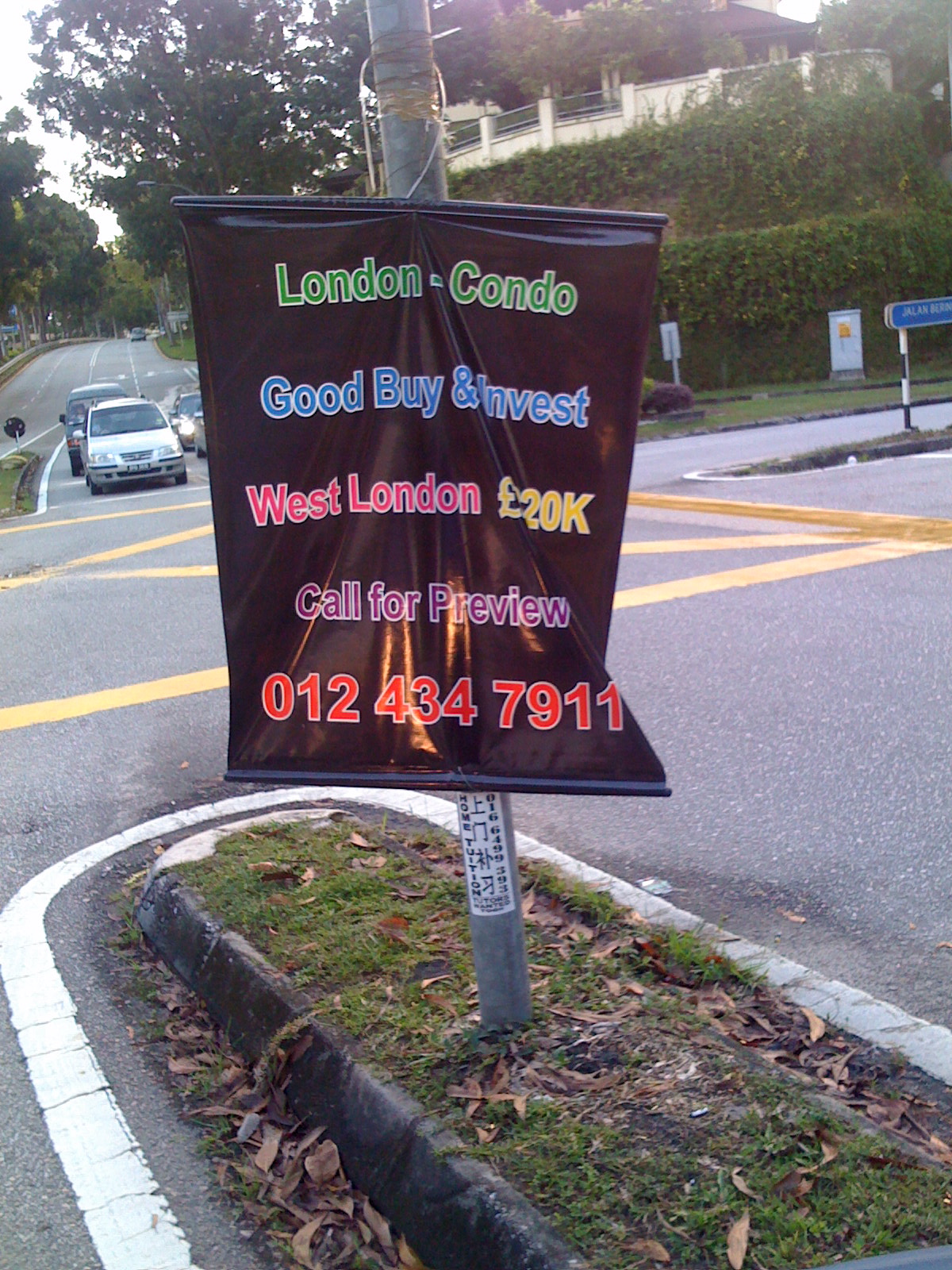
How not to sell a London property to Malaysians


I spotted the sign below on a lamp post in Damansara this morning. In case you can’t read it, the content is as follows:

London – Condo
Good Buy & Invest (sic)
West London £220k
Call for Preview
012XXXXXXX

I cannot believe that a genuine UK property developer or estate agent would encourage a company to sell million Ringgit properties with signs on lamp posts. After all the UK property market, and in particular the London market is benefitting from substantial investment and has hardly been affected by the global financial crisis.

Commercial property
Jones Lang LasSalle expects the total direct investment in commercial real estate in the UK to be around £23 billion (RM125billion) for 2009. Prime yields in the West End are 5% and in the city, around 6.25%. That’s impressive compared with a bank rate of, well about 0%.

Residential Property
Meanwhile, the residential market is also performing strongly. International buyers increased by 25% in 2009 compared to 2008. Most of the investment is coming from Europe, Russia and the Middle East. Knight Frank estimates demand from new buyers is “almost 25% higher than a year ago” and “prices have now risen 13.8% in the nine months since March.”

In fact, most of the investment is coming from the overseas market. Foreign buyers account for 80% of the investment, the highest ever. Indeed, the average over the last 10 years has been closer to 46%. The latest sources of this overseas investment include Oman, Libya, Lebanon, USA, Korea and Ireland.

UK property roadshow
Little wonder then that Malaysian firms want to get in on the act and sell UK property. I can’t find any figures on the total Malaysian investment in the UK or London property market however, the recent launch of a luxury development at Imperial Wharf, London, Malaysian buyers purchased £9.25 million (RM56 million) worth of luxury apartments and penthouses over the 2-day road show in Kuala Lumpur.

Olympic games
With more than 10,000 Malaysians studying in the UK and a number of companies keen to make the UK their European HQ, there are going to be plenty of willing buyers. Especially with the Olympics to held in London in 2012.

Wrong way to sell
But this is not the way to sell those properties. It dilutes the value of the property, negatively impacts the credibility of the local representation and makes it harder for future efforts to sell UK properties here in Malaysia. But worst of all, it portrays Malaysia as an amateur in a professional world.

Updated: 11th January 2010. I have since called the number on the bunting. I spoke to a nice guy with a pleasant attitude. I asked him where the property is. He stated the property was in South Ealing. As I know this area well I asked for the exact location and I consider it to be more Brentford than Ealing. He asked for my email address and promised to email me more information.

That was last Thursday, I have not received anything as of today.