Another argument for building brands


A year ago, the Wall Street Journal was telling us that wealthy consumers were suffering from ‘luxury shame’. Others were talking about the end of the luxury business. Certainly, the luxury business took a massive hit when the sub prime crisis blew up and the repercussions were still being felt at the end of 2009 when many luxury manufacturers and retailers reported poor sales over the traditionally lucrative Christmas and New Year period.

But even a global financial meltdown doesn’t seem to be able to keep the wealthy out of the stores for long as the luxury industry outperformed the MSCI World Index over 1Q 2010. And unsurprisingly, the wealthy don’t head for the department store to save pennies on same store brands.

So what brands are people, sorry the fabulously wealthy buying? Here’s a quick round up of the most popular brands at the mall or wherever it is the wealthy shop!

Last weekend, the Ferrari 599 GTO was officially unveiled at Modena’s Ducal Palace in Italy. This is the legendary brands fastest road car and does 0 – 100km/h in 3.35 seconds! Although a number of key clients were at the launch, all 599 units of the US$450,000 (RM1,500,000) monster have been sold.

Still with cars, top end ‘more affordable’ brands are also performing well, despite current figures reflecting the anniversary of the peak of the scrapping scheme in Europe. In Germany, car sales plummeted 26.6% last month, year-on-year, but Mercedes declined only 6.1 per cent, while BMW sales rose 9 per cent. During the same period in China Mercedes and BMW both increased their sales in 1Q 2010. Audi meanwhile was up a respectable 77%.

Here in Malaysia where cars are subject to astronomical taxes, BMW Malaysia sold 250 of the 7 Series from January 2009 to March 2010. With the cheapest 7 series costing around RM650,000 (US$200,000) and the top of the range 760Li costing RM1,400,000 (US$435,000), that’s impressive and shows the resilience of luxury automotive brands.

Down south in Singapore, Mercedes-Benz delivered 1,139 passenger cars in 1Q 2010, a 22.7% increase over the same period in 2009. Not to be outdone, BMW sold 960 units during the same period, a robust 29% increase over the same period.

Porsche meanwhile announced last week that orders for the latest version of the Cayenne SUV, due to arrive in European showrooms in May 2010 and priced at €56,000 (US$75,000) price tag, were ‘stronger than expected’.

Over in India, Porsche Design recently opened its first store in New Delhi, joining Prada, Louis Vuitton, Ferragamo and Mont Blanc to name a few luxury brand also taking up residence in the capital of the republic. Louis Vuitton now has 5 stores in the country.

LVMH, the company behind luxury brands such as Dior, Louis Vuitton and Moët Chandon recently reported a 11% increase in 1Q 2010 sales. Watches and jewellery sales rose by 33%, wines and spirits by 18% and fashion and leather goods by 8%. Sales of Dom Perignon and other LVMH owned champagnes shot up by 33% in the same period.

Watches and timepieces, there is a difference you know, are also having a bumper start to 2010 and the mood at Baselworld, the world’s largest watch and jewellery fair, was bullish after positive announcements from Bréguet, Blancpain, Omega and Longines whose sales were up 46%, 48%, 50% and 49% respectively in January and February 2010.

Meanwhile, due partly at least to the fact that it doesn’t have many high end high margin devices, Sony Ericsson has been plagued by declining sales for years and hasn’t made a net profit since 2Q 2008.

However the firm moved quickly to develop high end phones and launched the Xperia X10 and Vivaz last year. The result, the company reported a net profit for 1Q 2010 of €21 million, compared with a €293 million net loss a year earlier. Analysts were expecting a €128 million loss.

With the consultants, Bain & Co predicting luxury industry sales of €158bn in 2010, up 4% after a drop of 8% last year, it seems ‘luxury shame’ was nothing more than an itch!

Luxury branding in developing markets requires a different approach


Patek Philippe, the eponymous luxury Swiss watch, or should I say, timepiece brand is known for running the same advertising campaign for years. Although the images may have changed, the tagline “You never actually own a Patek Philippe. You merely look after it for the next generation.” has remained consistent, usually along with a jaw droppingly handsome and immaculately dressed and coiffured ‘father and son’ portrait.

For the target market, the aristocracy and the wealthy of the world, and those that aspire to the class, the ads say many things, including ‘buy one and you’ll be like us and ‘You have class and you know class’.

The ads are a wonderful example of luxury branding – a great product manufactured with precision engineering, immaculate heritage, an aristocratic client base and creative genius in the advertising that communicates on a level that the target market will connect with and explains, in the limited time available to garner interest, the timeless character of the brand. And I am sure the quality of service at the point of sale will be equally as impressive.

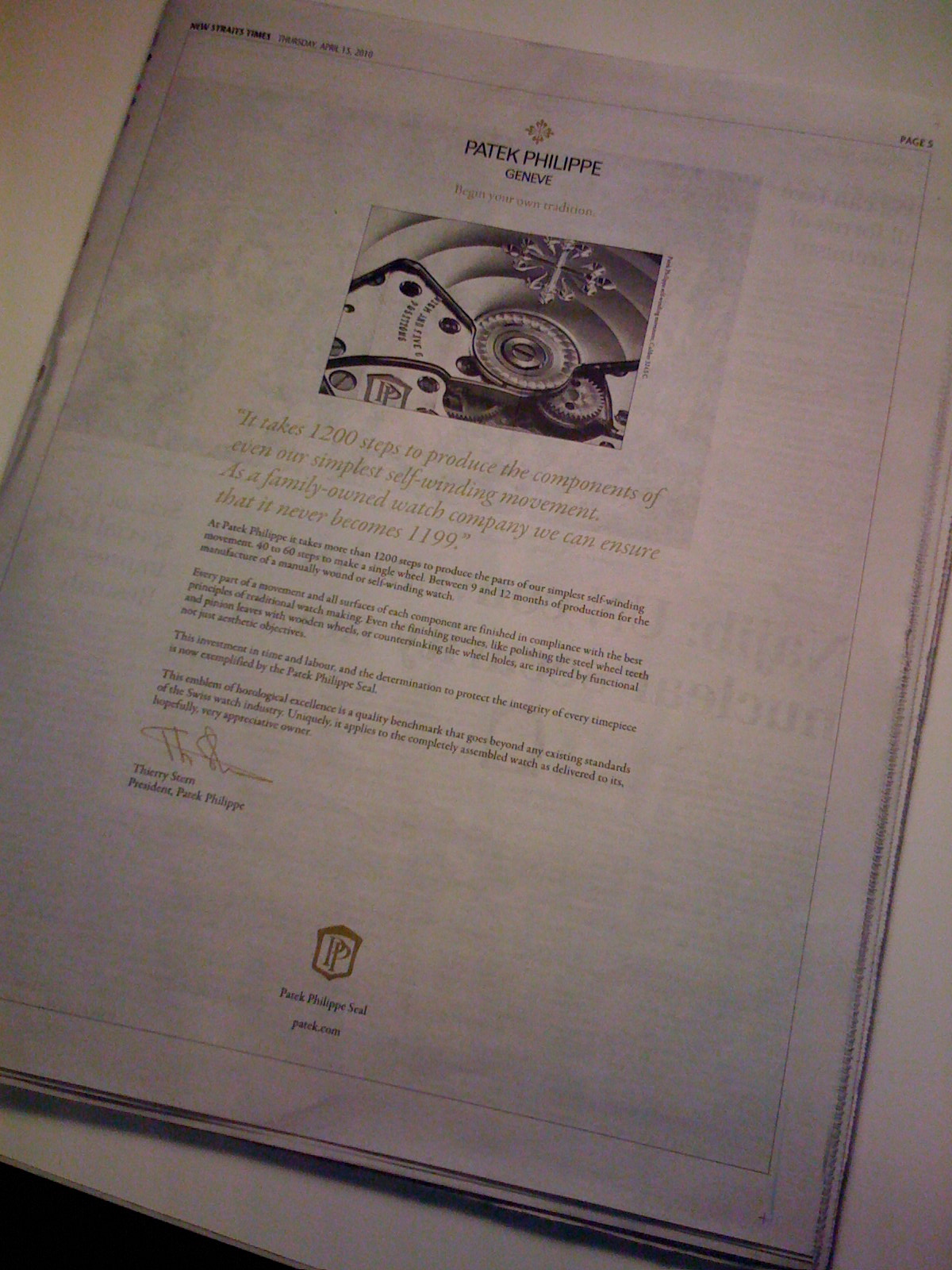
PP has recently launched a new global print advertising campaign that focusses on the values of the company established by two Polish immigrants, Frantisek Czapek and Antoni Patek in Geneva in 1839. I’m not sure if this campaign is to replace the old one. I for one hope not.

The latest campaign revolves around the personal letter concept and has the current president, Thierry Stern waxing lyrical about the steps involved, the time taken and care and attention to detail invested in the production of a PP timepiece. He talks about ‘polishing steel wheel teeth and pinion leaves with wooden leaves and countersinking wheel holes’ and the fact that these efforts are ‘inspired by functional not just aesthetic objectives’.

He goes on to mention the Patek Philippe Seal, an ’emblem of horological excellence’ that appears to be an internal ‘quality benchmark’ that claims to be ‘beyond existing standards of the Swiss watch industry’.

The ads are set to appear in ‘quality daily newspapers and influential trade publications’ around the world and will also appear at the point of sale.

The first ad (I think) appeared in Malaysia in the New Straits Times on 15th April 2010. I can understand (although I don’t agree with the tactic) the mass market approach of running an ad in the New York Times or the London Times, South China Morning Post etc or any other developed country where there is significant market potential.

But I can’t understand the purpose of running the ad in a developing country such as Malaysia. A quick search of the net finds a rather old PWC report, that states ‘the mean monthly gross income per Malaysian household increased from MYR2,472 in 1999 to MYR3,011 in 2002, denoting average growth of 6.8% per annum’. So if we use that growth rate to bring us up to 2010, the mean monthly gross income per Malaysian household is now roughly RM5,096 or US$1,358. Don’t forget that is gross and does not take into account the impact of the economic crisis.

Another search of the Internet would suggest that the cheapest PP watch is around US$4,000 and the most expensive sold some time ago for about US$11,000,000 (that’s RM36 million in real money). The majority of PP watches appear to be in the US$10,000 to US$35,000. At those rates, the potential market in a country the size of Malaysia is tiny and an ad for such a luxury product in a daily newspaper is essentially a waste of money.

Just to put things into context, the ad after the PP ad is for Honda and the ad after that is for Panasonic household appliances such as an Alkoline ionizer, hair styler and hair dryer and men’s shaver (inner Blade and outer foil).

So what should PP do in developing markets like Malaysia?

Here are 5 suggestions

1) Rethink the one-size-fits-all mass market approach to building a brand, especially in developing markets. The consumers who can afford your products can be engaged much more effectively in other ways.
2) Build a database of prospects and customers. But all markets require different strategies and data collection techniques will be different.
3) Build relationships with your existing customers. Existing customers are often ignored by companies scared of asking too many probing questions. And certainly timing is important. But well trained luxury retail staff can build relationships with wealthy customers who are likely to be successful businessmen and politicians and their opinions will carry a lot of weight with prospective customers.
4) Advertising is important, but choose your channels carefully. Mass circulation newspapers and magazines are for shavers and hypermarkets.
5) Content is important too. I’m not sure anyone really cares what is hidden away inside the shell of a product with almost 200 years of heritage. After all, if the quality was a given in the previous campaign, why must it be addressed now?
6) Integrate your digital commuications with mobile channels to engage with prospects and customers interactively when they are on the move.

Building a brand is hard enough. PP has done it successfully for 200 years. But treating every market the same and using mass marketing tactics that belong to an era that no longer exists, will make it hard to do it successfully for the next 200 years.

Malaysia getting ready to be major player in world’s largest service sector industry


One of the most interesting elements of the New Economic model (NEM) announced by the Malaysian Prime Minister, Datuk Seri Najib Razak was related to tourism.

I quote directly from his speech, “…the tourism sector has not been exploited to its potential. More can be done to attract new markets from Europe and the Americas to complement the markets from the United Kingdom and Asia.

We have some of the oldest forests in the world, rich with flora and fauna and diving experiences acclaimed to be unforgettable. Malaysia can lead in providing environmentally sustainable eco-tourism adventures that are much sought after by the advanced markets.

We should aim to provide services which will attract high-end tourists who seek exclusiveness and high value services. We must also be creative as we consider new areas of tourism. From medical tourism — a high-potential growth sector — to eco-tourism, luxury market tourism and visitors related to our growth as a regional education hub. Malaysia’s tourism future is bright if we have the vision and creativity to support its diverse growth potential.”

World’s largest service sector industry
As the PM said, Malaysia has long neglected the business of tourism, despite the fact that it is, according to the World Bank, the fastest developing industry in the world. Moreover, according to the World Tourism Organisation, 2006 (the last year before the sub prime crisis) was a record for world tourism with 842 million tourists visiting other countries, up 4.5% over the previous year. Tourism is now the World’s largest service sector industry.

Furthermore, according to the World Tourism And Travel Council (WTTC), 12% of exports, 9.3% of international investments, 8.3% of the world’s places of work and 3.6% of world internal gross product account for a share of tourism and its relevant sub industries.

Using the satellite accounting approach, which attempts to calculate the extent to which other economic sectors contribute to and benefit from tourism and passenger traffic, the WTTC also estimates that the travel and tourism industry in 2008 was valued at approximately US$5.9 trillion or 9.9% of global GDP.

Tourism is also a popular industry with governments because it impacts every level of society from the sundry shop owner who sells a tourist a bottle of water and a map to the car hire company, locally owned hotel and airline.

With hundreds of miles of pristine coastline, breathtaking islands and the oldest rain forest in the world, Malaysia should have a better developed tourism industry and it will be interesting to see what incentives the government offers investors and developers to encourage them to invest in the infrastructure and products needed to move Malaysia up the value chain in this beneficial industry.

49 million visitors by 2020
I managed to get my eyes on a copy of a report preparred by a respected international consultancy and commissioned by the government to provide data for the NEM. Unfortunately one of the key recommendations was to increase the number of arrivals to Malaysia to 49 million by 2020.

It has been a common thread in announcements made in Malaysia that volume is key and we need to be attracting hordes of foreigners to Malaysia to consider our tourism business a success. But this advice is poorly thought out. One example, imagine the impact of 49 million tourists, many of them blue collar Europeans who consider it their God given right to walk around without a shirt on (men) or only in a bikini (women) and quite often with a beer in their hands, on a place like Kuala Terengganu or Kota Bahru.

What we need to do is move away from this volume is best approach and look more at a value is best strategy that aims to attract smaller numbers of higher value visitors. This will also help with the infrastructure and talent issue as we do not have the people available to staff the 500 or 600 room hotels required to support 49 million visitors.

Breathtakingly beautiful island
One of the best natural destinations in Malaysia is Redang Island in the South China Sea. This breathtakingly beautiful island has slowly had it’s natural attractions such as the coral destroyed by boats dragging anchors, careless swimmers and greedy fishermen.

But the concept of volume over value ruled and so little was done until recently when the Terengganu state government announced that it will no longer approve any applications for cheap Chalet style resorts as it wants to make Redang a destination for high net worth visitors. This is a a sensible move that will also help save the marine environment and attempt to prevent further environmental damage.

It is a sensible move that the state government, and hopefully the federal government will offer financial support, wants to upgrade this amazing destination. But the state government should also understand that it is not just about changing the names of the resorts, upgrading facilities, spending large sums on awareness advertising and increasing the rack rate by 300%. There will need to be a significant investment in the upgrading of the resorts and also supporting infrastructure.

Here are 5 other recommendations:

1) Carry out research with stakeholders, prospects, customers and others to determine the way forward.
2) Work with carriers and others to improve domestic and international connectivity.
3) Find the right partners. Malaysia doesn’t have a domestic 5 or 6 star hospitality company that is recognised globally. Work with a globally respected and recognised resort management company.
4) Redang is a small part of the potential of Terengganu. The state must develop and implement state destination brand masterplans. The brand masterplans must incorporate measureable and relevant promotional strategies that are not based on traditional marketing techniques but leverage the power of social media.
5) In line with federal initiatives, reduce costs of doing business and offer exciting incentives for investors, above and above usual free utilities for 5 years etc.

We’ve heard about incentives for the tourism industry before but the government has never really pushed them. I have a hunch that this new administration is different and that this is a small first step in a revolution that is long overdue.

Are we seeing the commoditisation of the iPhone in Asia?


Here in Malaysia it took time for the mobile service providers to agree terms with Apple to offer the iPhone to subscribers. But finally, Maxis signed up and has invested heavily over past year or so in traditional aquisition focussed marketing.

Recently, another provider, the aggressive and innovative provider, Digi signed an agreement with Apple and has started to promote the iPhone.

Last night, I was watching TV and was astonished to see first a Maxis ad for the iPhone, featuring the numerous applications (there’s one for just about everything) and then, I think separated by another commercial but possibly even back to back, the same commercial for the iPhone, featuring all the applications, this time with a Digi logo!

I have a number of reactions to this. Firstly, don’t advertising agencies know how to do a deal with a TV station anymore? If you can’t get an exclusive deal at least ensure no competitor products advertise on the same program.

Secondly, what are these telcos doing slugging it out in public on TV? Do’t they have any understanding of the iPhone and what it stands for and means?

Thirdly, these telcos are commoditising a valuable brand that deserves better. A more sophisticated approach for a sophisticated product that offers value for many people in many ways targetted at existing subscribers and personalised would be far more effective than a mass economy spray and pray approach!

Creating awareness via TVCs is a complete waste of money for a product such as the iPhone. If anyone out there is unaware of the iPhone, the applications and how they can add value to a person’s life, then that person is not the type of customer Apple, or the telcos want!

Don’t expect prospects to build your brand


Yesterday I saw a video on the new sonos zone player. You can find the video on the site here but to brief you it is a cool looking internet radio and itunes player controlled by your iPhone that allows you to play music in all your rooms. Pretty cool so watch the video if you can.

The video was really well executed and I was sold by the end of it. I went to the ‘Find a store’ feature on the site and was impressed to find a dealer not far from my office in Kuala Lumpur. There was even a contact name and email address.

I sent the contact an email but also decided to post a request for information on Twitter. Probably because I have sent emails to electronics dealers in Malaysia before and never heard from them (it’s a fairly unsophisticated business here, dominated by old school Chinese traders). But I sent the email because it is slowly changing, as I found out when I had a technical issue with my Zepellin.

Anyway, I haven’t got a reply to the email but I did get 2 responses to my tweet, one directly from the manufacturer @Sonos and one from the distributor in Singapore @SeowHow.

Incredibly, the manufacturer told me to contact their distributor and the distributor told me to contact his sales office!

Here’s some free advice to ensure your brand doesn’t end up in the bulging cemetary of great brands.

1) Don’t expect an interested prospect to become a customer
2) Treat all your leads/prospects as if they are the most important person in your world
3) Don’t expect a prospect, even an excited prospect with buyer written all over his face, to do all the heavy lifting
4) Your brand may be the be all and end all of your life but it isn’t of anyone elses
5) There is a lot of competition out there

Personalisation


Companies have to stop trying to sell stuff to prospects and customers and start coordinating all the resources it has to supplying or satisfying specific customers specific requirements for value.

Consumers don’t want products (or services) they want the products/services they like immediately and personalised. But personalisation in its present form is primitive because of cost, technology, time and lack of appreciation by CEOs. Right now personalisation is nothing more than a colour, sun roof or memory size. Consumers will want to actively shape the offerings and information they receive. It’s already happening in the aircraft/shipping/hospitality etc industries. Hey, even Barbie has 6,000 customisation options!

I’m sure I’m not the only one who has bought something that wasn’t quite what I wanted but was bought more in frustration at not finding what I wanted exactly. After a week it was gathering dust in a store room. In the future, with advanced build to order capabilities, even complex products will be produced specifically for one customer and buying products that don’t quite fit the bill be a thing of the past.

This will also have an impact on communications. Existing customers will no longer visit websites, they will have direct access to their own landing page.

Malaysian and Asian SMEs should look at communications when building brands


I have a lot of respect for small businesses and their owners, especially here in Malaysia and all over South East Asia. The odds are stacked against them as they try to build a business in an environment that should favour them but because of conservative attitudes and the legacies left behind by unscrupulous operators in the past, they are up against it and many of them don’t make it. Even those that do make it do little more than survive.

Furthermore, competition is growing, not just from local competitors but from international ones as well. Rents are rising and real estate is expensive; banks are reluctant to take any risk, no matter how low, talent is hard to find and quite often entrepreneurs are unable to communicate in English due to ever changing education policies or a vernacular education. Plus, here in Malaysia, government subsidies on fuel and other commodities are probably going to be lifted or even abolished. Finally, AFTA means the market may be swamped by cheap products from other regional, less expensive countries.

But despite these and many other issues, depending who you listen to, small and medium sized industries, enterprises and businesses represent up to 99.2% of the Malaysian economic establishment and these organisations are therefore the engine room of the economy. And although the SME contribution to gross domestic product has been almost flat for the last 8 years, rising from 29% in 2000 to 31.4% in 2008, the sector still has a major role to play in the economy.

This is particularly true of the service sector which is the most progressive in terms of SME development. So it is good to hear that the National SME Development Council has approved the establishment of a special unit responsible for SMEs at a number of agencies and ministries. Under the Integrated Action Plan 2009/2010, 354 programmes will be implemented this year with financial commitments totalling RM6.02 billion (S$2.48billion).

Roughly RM3.3 billion has been allocated for the development of SMEs in the services sector in line with the government’s aim of developing Malaysia into a high-income economy.

So should these SMEs be bothered about brand building? Well, in many ways the concept of branding is even more important to small companies than it is to big companies. But obviously they don’t have the resources of a Multi National Corporation (MNC) so they need to be selective on what they address. One area that SMEs can improve significantly with very little investment is their communications. There is a lot of truth in the saying, you never get a second chance to make a first impression. So your communications must leave a positive first impression.

Another mistake SMEs make is that they believe volume is best. They believe that they must have a database with as many names as possible. And once they have that DB they must blast out the same message to everyone on it on an almost daily basis! Negative. The first step in your prospecting process is to qualify all leads to determine any interest level. There is no easy way to do this. It takes old fashioned hard work. Fortunately in Asia privacy laws are limited or even non existent so cold calling is acceptable but of course you need to have a strategy to get past gatekeepers.

Spend some time writing an introductory email. It doesn’t need to be long but if it is targetted and well written, even if the service or product offered is not required, the email may be stored in a resources folder for later reference.

Once you’ve identified your prospects and segmented your DB, use email not to try and sell a product but to make an appointment. Few people are going to buy from a mass email but you may get a reply to the email or some recognition when you follow up the email with a call.

The worst mistake any company can make, SME or MNC is to start their brand development with an advertising campaign. Branding is a journey, advertising is a pit stop on that journey, nothing more. Now I know you want to see your name on a billboard on the highway or a full page advertisement in the national newspaper so that you can announce to all your friends, business associates and clients that you have arrived but think about it, how effective is this going to be? Do you really want to waste that money? (There are exceptions to this rule, but very few).

If you do intend to advertise, make the copy relevant to the consumers you intend to communicate with and only use channels that users of your product are familiar with and engaged by.

If you follow these simple suggestions, you may have a chance of being one of the few SMEs that survive and possibly even thrive.

Managing your media placement is critical


Here’s another example of poor control of ad placement online. If you are responsible for your own ad placement, make sure this will not happen. If the channel won’t let you dictate where your ads cannot appear, find another channel. If your agency is responsible for your ad placement tell them if this happens again, they’ll be one client short in a heart beat.

A is for Advertising


This is a good place to start a compendium of branding terms because unfortunately, it is where many companies start their brand building. And that’s a shame, no tragedy because it is an expensive exercise in futility to try and build a brand using advertising alone.

Advertising can be traced back to around the late eighteenth century when the first print ads appeared in the USA. However, they were rarely much more than extensions of the editorial copy and newspapers were reluctant to allow ads that were bigger than a single column. Even magazines preferred to print all the advertisements at the back of the publication.

Mass advertising only really began in the second half of the nineteenth century when firms began to produce greater quantities of more and more products thanks to improved production techniques. Soon after manufacturing, other businesses such as department stores and mail order firms jumped on the bandwagon and by 1880 advertising in the US was estimated to be in the region of US$200 million. This grew to almost US$3 billion by 1920.

In the mass economy of the 1930s to the 1990s that coincided with the growth of mass circulation magazines, advertising companies proliferated. At the same time, companies wanting to stand out from the competition determined, quite rightly that the quickest way to grow was to raise the profile and awareness of the company’s product or service by informing or reaching as many people as possible in the shortest time.

The most common way to do this was via advertising, especially via TV advertising. The business of advertising is based on a model of repetition across mass media. OK, creativity is important, initially anyway, but once you get over the wow factor, the idea is to repeat the same message through as many channels as possible for as long as possible.

Budget played (and still does) a significant part in what sort of advertising an agency may recommend. It is important for you to know that from the advertising company point of view, the size of the available budget will determine two main points, 1) who works on the project (in terms of seniority and talent) and 2) what channels will be utilised. A larger budget generally results in TV advertising becoming part of the recommendations.

Other platforms include print advertisements, billboards, lamp post buntings, banners, taxi, bus and tube trains, coffee shop tables, flyers, leaflets and more. The introduction of the Internet has seen a proliferation of banner ads, tower ads, unicast ads, contextual ads, takeover ads, interstitial ads, floating ads, and other options to an already noisy, crowded and complicated marketplace. It is important to note that none of these initiatives are branding, they are all advertising and advertising is a tactical initiative not a strategic initiative, like branding.

In the mass economy and unfortunately still to this day, once a campaign has launched, probably to much fanfare, the client waits with anticipation to see the promised sales spike. Meanwhile the agency submitted any well executed commercials to one of the numerous creative shows that offer awards for creativity.

As mentioned earlier, repetition is important and with enough frequency, and perhaps a little vague targeting, this repetition was expected to encourage enough consumers to walk into a store or other outlet and choose or request the advertised product.

The model worked, to some degree fifty years ago but in today’s crowded marketplace, using advertising alone to build a brand is leaving too much to chance. It is simply too difficult to stand out from the crowd. Can you remember the last ‘great’ TV commercial or print ad that you saw? And even if you can, have you bought the product?

Quite often, the promised sales spike didn’t happen, unperturbed and with a straight face, the agency would ask the client for more money, arguing that it is the client’s fault as it should have made more money available in the first place for increased frequency. If you have gone this route, I suggest you bin the advertising agency and call a brand consultant.

Should you still use advertising? Absolutely because advertising will help your company project a vision of the relationship you can deliver to the customer. The ads also help you to educate customers about the value that you can offer them. Advertising must also communicate trust. Unfortunately this is forgotten by most advertisers, especially in South East Asia where outrageous claims made in advertising are rarely backed up in reality. In Malaysia for example, after years of being let down by claims made in advertising, only 14% of Malaysians now believe what companies tell them in their advertising.

But instead of seeking to increase awareness of your product or service with as many consumers as possible, ensure your advertising seeks to communicate with those consumers that are most likely to adopt your product or service.

Make your advertising relevant to those consumers you have targeted. Core messages must be related to those consumers interests, needs and/or desires. So rather than a one-size-fits-all approach in your communications, it is essential for messages to be about offering value to those specific customers and making their life better as a result. How to identify those consumers and what is relevant to them will be explored in brand audits and targetting.

The goal is to ensure a consumer incorporates an offering into their personal or business lives.

Adoption will ensure your brand is seen as the best, hey perhaps even the only choice. This won’t happen on its own. It is a process built on operational excellence, superb sales incorporating ‘top of game’ customer service and the ability to match offerings to the consumers individual requirements for value, on an ongoing basis. To build a brand retention is key and retention requires relationships and without relationships, adoption is not achievable.

And this is good news for Asian companies because the fact is Asian companies, and especially those from South East Asia, simply don’t have deep enough pockets to compete with international brands using outdated one-size-fits-all, mass economy tactics.