Branding is relational, not transactional. It's about retention, not acquisition. I work with companies and governments to identify and develop the strategies required to build the relationships that ensure ongoing branding success.
I call it data driven branding & it should not be confused with creative driven branding.
I'm also a rugby nut & devoted family man, probably in that order, but don't tell my wife!
My inbox is overflowing with ‘invitations’ to attend numerous conventions, exhibitions, masterclasses, seminars and so on. I don’t know where these guys get my email address but I must be on every mailing list from Malaysia to Mexico.
I’ve trained my junk mail filter to send most of them to the trash without me having to do it manually but somehow, quite a few still get through. One company is particularly good at getting around my filter and I find myself actually reading the subject line or even some of the copy, especially when I can’t find anything with which to self harm which is what I would prefer to do.
Normally I just swear at the sender, make a note of the company name and promise myself that I will never, ever attend one of their events and then just trash the email. But I thought I’d share this one with you so that if you are in the event or seminar business, you might learn something.
Here is a section of their most recent email
Not quite relevant to brand consultants
Of course her earlier email was included so I’m going to share part of it with you
Who is responsible for boilers? Are you serious?
You can draw your own conclusions from this farcical attempt to get the head of boiler operations at a brand consultancy to attend a seminar, the benefits of which are according to the email, “boiler efficiency, improved water strategy and analysis, better understanding of modern boiler burner operations as well as easier identification of its failures, by reducing cost and increasing safety and finally better understanding of legal requirements of Dosh”
Tosh more like. If you must use email campaigns to try and drum up business, here are 5 top tips for an email campaign:
1) Give recipients an opt out from your list. This email doesn’t even allow me to unsubscribe, which may well be illegal.
2) Segment your list or risk destroying your brand. You’ve collected information, use it properly. Failure to do so may see you embarrassed on a blog.
3) Make your subject line creative, short and sweet.
4) Less is more. Trust me, the more emails I get, the more determined I am not to attend any of the seminars listed.
5) Track your customer activities. If they don’t respond to any emails, get in contact and find out why.
There you are, despite annoying me I’ve given you some sound and free advice. I shall be sending this post to Anna. Feel free to send it to anyone who keeps sending you irrelevant emails.
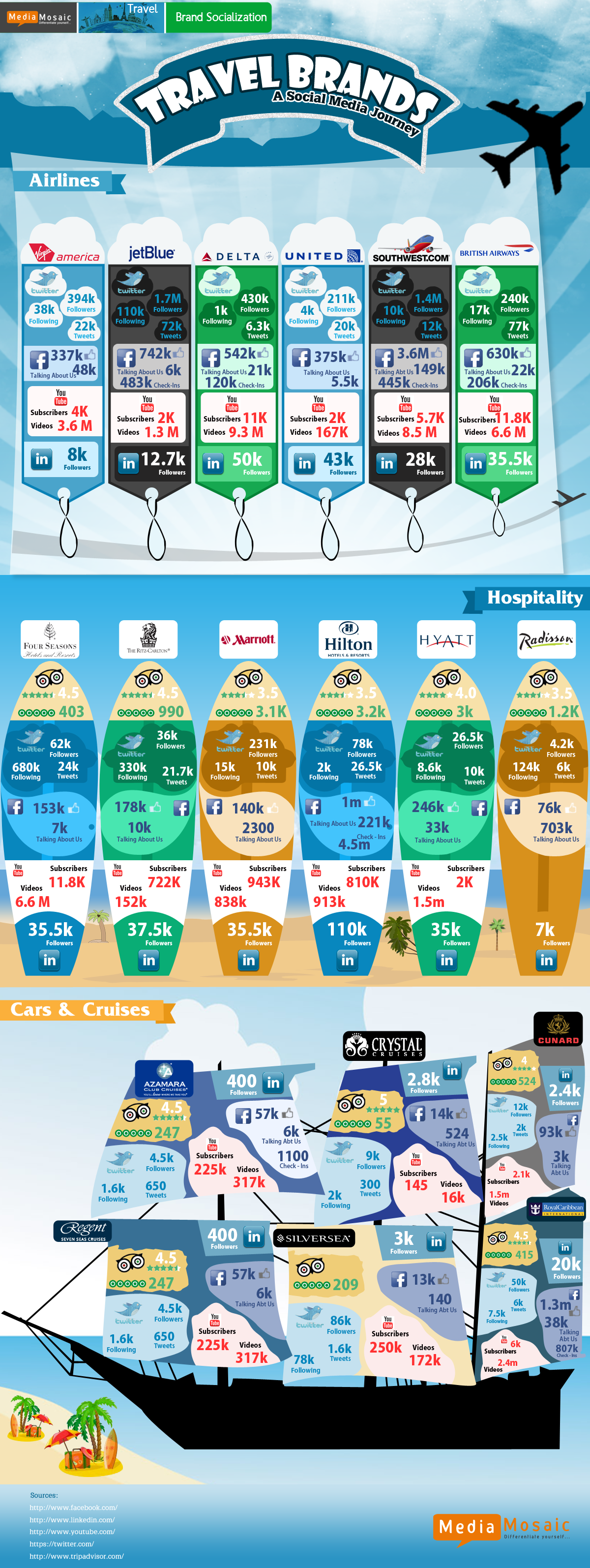
Any brand in the destination branding space should look at this infographic to see how much effort the big travel related US brands are pouring into social media.
It is reported that there are 199 airlines active on Twitter which is an impressive total. This infographic looks at the top six which is dominated by US carriers.
Travel brands are investing in social because that’s where their prospects and customers are spending their time
US hotels have jumped on the social bandwagon as well. Followers on Twitter for the top 6 hotels range from 4,000 (Radisson) to 231,000 for the Marriott. According to hotel marketing Internet users in the US generate 66.3% of global searches for luxury hotel brands which means that anyone in the luxury destination business needs to be online and doing social.
But it’s not just luxury brands that need to be doing social. 65% of leisure travelers begin researching online before they have decided where or how to travel. And a typical traveller visits 22 sites before making a destination decision. Arabs are big users of the online space for travel. Online bookings will nearly double in Arabia between 2011 and 2014, and the online leisure and business travel market is expected to cross the US$16 billion mark.
So if you are looking to attract visitors, especially from Western countries, you need to be doing social.
Spikes Asia is an annual get together for the creative communications industry to share ideas, network and possibly drink too much. It is considered by many to be a melting pot of creative talent from the east and the west and anyone who is anyone in the industry should be there.
There are lots of seminars, workshops and exhibitions. Work exhibited at the event is judged by leading creative minds and awards are handed out to the winners. A Spikes award is much coveted by anyone in the creative industry. The 2013 event was held in Singapore in September.
You are probably wondering why I am commenting on such an event, especially as I have written before that I think there are too many of these events and as a result creative people focus less on delivering value to clients and more on winning awards. Few people agreed with me. I remember some years back we interviewed a creative guy who had won nearly 200 awards and he was only 22!
I’m commenting again because I came across an interesting article on the mumbrella site about comments made at during Spikes Asia. Sonal Dabral, Chairman and CEO of DDB Mudra Group India said, “There is a restlessness among creatives to achieve fame fast without really understanding the consumer or the client’s product.”
Advertising in Asia is crap
He went on to say, ““Greed and shortcuts” are partly to blame for why there is “so much crap” advertising in Asia.”
Calvin Soh, the former creative head of Publicis Asia Pacific and now founder of Ninety Nine Percent said, “If you have a truly great product, you don’t need to advertise.”
You can read the full article here. Leading minds in the creative industries saying that a lot of what they do is crap, that many in the industry don’t understand their clients and that many companies don’t need to advertise does make me wonder why companies continue to let advertising agencies take responsibility for the success or failure of their brands.
It’s official, the new tagline that was supposed to launch the Malaysia Nation Brand will not now be used. The official launch for “Endless Possibilities” was supposed to be yesterday however it was cancelled. You can read more about the cancellation here.
My sources tell me that McKinsey, Futurebrand, Leo Burnett, McCann Erickson and O&M were all involved although I haven’t confirmed this. Ignoring the fact that not one of them bothered to Google the phrase “Endless Possibilities” before giving it the Prime Minister and causing him much embarrassment, my main concern is that the whole sorry process will be repeated once again and we’ll see them trying to retrofit the Malaysia Nation Brand around a tagline.
This is not the way to build a Nation Brand. You can get insights into how to build a nation brand here and here
Okay, here we have yet another beautifully executed short film, this time from Audi featuring not one but two Claire Danes or is it Dans? Desperate to get to New York, she has to make a choice between making the almost 700 mile journey in a chauffeur driven non descript American tank or drive herself in a Audi A6 Diesel.
The film imagines, in an amusing, if predictable way what the journey would be like in each vehicle. So the chauffeur turns out to be a massive bore who used to be in a band (unnecessary surgery) and happens to have a tape with him. And the clunky dashboard still accepts tape. Of course the car needs to stop for petrol and gets a puncture and they meet some strange people and finally Claire Danes gets arrested (not sure why) and ends up in jail.
The alternative journey in the Audi features the star driving herself to New York. Of course this journey is the complete opposite, all autumn colours, perfect sunset, calming music, open spaces and time for a picnic with puppies, yes puppies. She makes it to New York in plenty of time and everything is fine and as she’s about to go on stage she manages to squeeze in a line about the Audi fuel efficiency.
Meanwhile, in the alternative journey she ends up in a dive where she may meet an old flame.
On the 5th September 2013, I reported that the newly developed tagline for Malaysia “Endless Possibilities” would not be used. You can read the full story here. The official launch was supposed to be on 17th September 2013 but this has now officially been ‘postponed’. This is a hugely embarrassing situation.
Malaysia tagline: Dead in the water
Background
According to an article in the Malaysian Insider on 12th September 2013, “…the campaign and tagline was refined by two foreign consultancies and a market research firm after discussions with officials from the Prime Minister’s Department.”
The article goes on to say, “”The consultants refined it from the phrase ‘Endless Opportunities’ which was used in a speech to ‘Endless Possibilities’.”
“An advertising agency was then called in to create the logo, which the Tourism Ministry used together with the tagline last year before it was used in Davos.”
This process began in December 2011 and the new tagline was given its first outing by the Tourism Ministry in Dubai in 2012. It was due to be launched officially on 17th September 2013, almost two years after the project was initiated. You only need to read this blog or those of any other destination branding experts to know this is not the way to build a destination brand. So what can we learn from this nightmare?
Here are 5 general lessons we can learn to ensure that next time the Malaysia Nation Brand project is executed properly:
1) If I’ve said it once, I’ve said it a thousand times, YOU CANNOT DEVELOP A TAGLINE AND THEN RETROFIT A BRAND AROUND THAT TAGLINE USING ADVERTISING AND PROMOTIONS. It is a fundamental of branding. If you are responsible for developing a Nation Brand you must understand this. I don’t care if someone gives you a tagline and tells you to build a brand around it. It simply is not possible and you have to stand your ground. 2) A tagline is not a brand. Let me say it again, A TAGLINE IS NOT A BRAND. Too many taglines have made promises the Nation couldn’t possibly keep, have left potential customers underwhelmed, have been lost in the clutter of advertising noise or have been ruined by an event beyond the control of the Nation. Moreover, we live in a social economy. What is the first thing a prospect will do when he hears a tagline? He will look to the Internet to find out what is being said about the country. If he sees more negativity than positivity, he’ll believe what others are saying, not what the Nation says. It won’t matter how much you spend on corporate driven messages pushed out across mass media that try to convince him otherwise. 3) Ask yourself how many great ads you remember from yesterday or the day before. Not many, right? Even those in the industry find this a tough question. There is so much advertising noise that it is very hard for a campaign to be seen, let alone remembered and acted upon. There is a place for advertising countries, but not for using advertising to gain traction for the brand. 4) Just because you hire a research company to do your research, doesn’t mean you’ll get the right research. And if you are starting with a tagline and trying to retrofit your brand around that tagline, your research is going to be flawed before it even starts. After all, how can you develop the right research methodology if you are starting from the wrong place? 5) If you insist on starting with a tagline, Google it first before you do anything. A Google search of “Endless Possibilities” throws up 13 million results including destinations that have already used it – Mongolia, Israel, Sagada, corporations – BHS India and conferences, t-shirts, singers etc. Every stage of every element of any brand development should be checked and double checked again.
13 million results requires some investigation before acceptance
There are other, more specific lessons that can be learned from this issue but there is nothing to be gained by outlining them here. Let’s just hope that to avoid any more lost time and money, the project will now be carried out the way it should have been in the first place.
This article looks at two high profile situations in Malaysia and how these very different institutions used technology and social media to communicate with and engage stakeholders during a crisis.
Case study one: Syabas
Syabas (pronounced Sha-bas) provides water to the state of Selangor, the largest and most developed state in Malaysia. Following a diesel spillage on the Selangor river (a major source of water) at the end of August 2013, Syabas shut down four treatment plants, essentially cutting off water supply to nearly 1 million homes. I was personally affected by this issue and was without water for over 24 hours.
When my taps ran dry, the first thing I did was go to the Syabas website where I was greeted by a pop up press release telling me there was no water. I also found a 1800 number. I called the number and a recorded message told me to go back to the website. I revisited the website which told me that I was living in an area that was affected by the shut down. This wasn’t really very helpful as I new this because my taps were dry.
Not really helpful
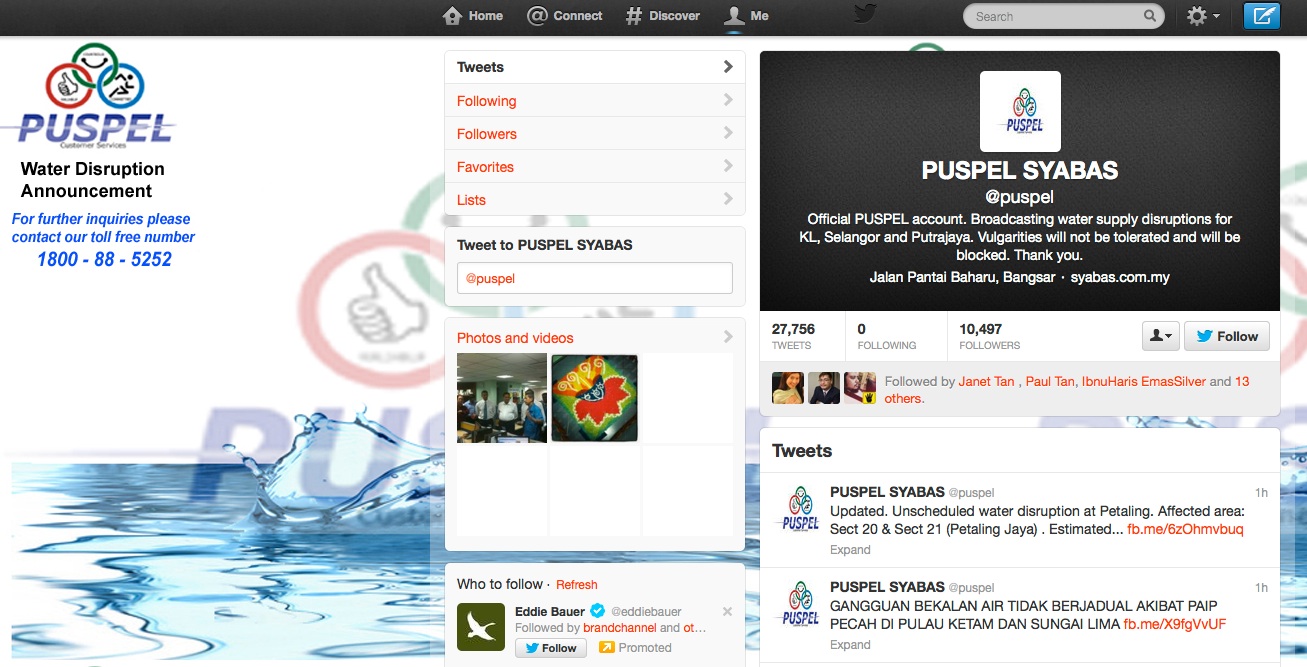
So my next stop was Twitter. I found the Syabas Twitter feed and fired off some tweets asking for more specific information that would allow me to plan for my family of seven who could not shower, flush toilets, wash clothes and make contingency plans for our open house scheduled for Sunday 1st September.
None of my tweets generated a response. I was stunned to find Syabas has over 10,000 followers on Twitter but doesn’t follow one person. I appreciate that not many companies have the resources to listen to what their customers are doing all the time however, one of the key reasons for being on Twitter is to be able to quickly identify conversations and trends about their business, their brand and their services.
No followers makes it hard to use Twitter effectively
This then allows brands to address issues in a transparent, prompt and empathetic manner and also leverage positive comments and discussions, join in with the conversation and encourage engagement.
So after trying the 1800 number, the website and the Twitter page, my last resort to try and get some actionable data to help me plan ahead was to go to the Syabas Facebook page.
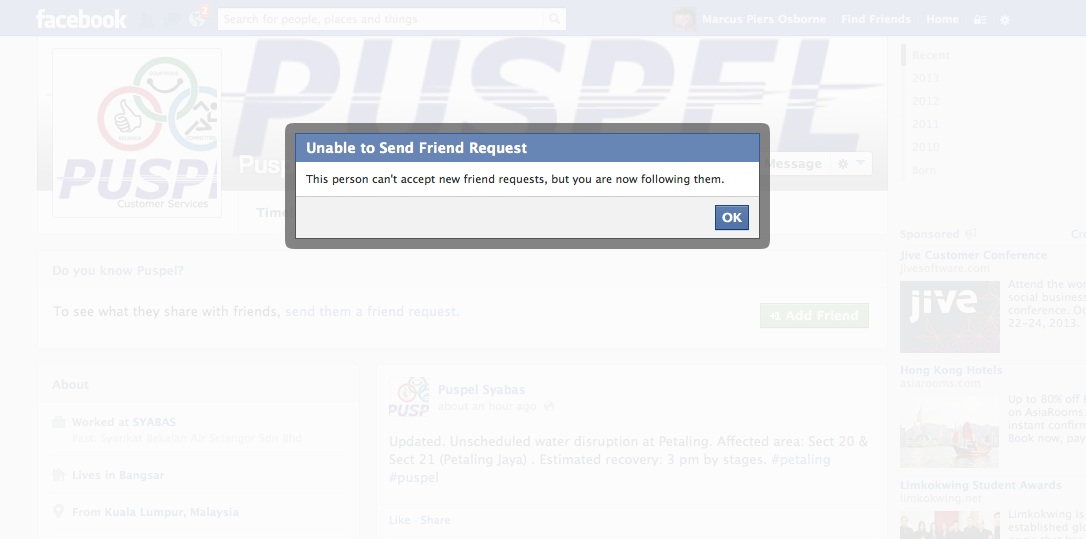
No luck on Facebook because Syabas had disabled the comments function which meant that I could follow them but couldn’t make any comments! As they were only reposting the press releases posted on the website, this was pointless. So I was unable to source any information that was relevant to me or get specific answers to specific problems.
Please listen to us but don’t ask us anything
Incredibly, Syabas was on every social media platform yet was using those platforms not to engage with consumers but to broadcast only the messages it wanted consumers to hear. All Syabas seemed to want to do was push generic and pointless press releases to consumers. Yet the whole point of these platforms is to allow consumers to interact with the brand and get closure on personal issues.
And this is particularly relevant when it comes to negative issues or complaints. During a recent stay at the Marina Bay Sands, I complained on Twitter. Within 30 minutes the MBS was following me and asked me to follow them back so that they could send me a Direct message. Not only did this make me feel someone was listening, it also allowed them to take my complaint out of the public domain. The Marina Bay Sands has 8,500 followers and follows almost 1,700 people.
The irony of this situation is that Syabas actually dealt with the physical problem very efficiently and the water was back online to over 650,000 consumers within 36 hours. But by then it was too late and what could have been a PR success turned into a social media nightmare as frustrated consumers turned to forums, online newspapers and social media to vent their anger.
Case study two: Sekolah Sri Cempaka
Sekolah Sri Cempaka is a private school in Malaysia. It quickly embraced the arrival of technology in the classroom and places a great emphasis on communicating with students via its digital platform, Schoology. On Saturday 7th September 2013 a fire broke out at the school in the exclusive neighbourhood of Damansara Heights in the suburbs of Kuala Lumpur.
Within an hour Twitter was awash with chatter and soon after images of the fire were all over Twitter and Facebook. This fire could not have come at a worse time for the school with students busily preparing for critical exams.
The school quickly announced the fire simultaneously on Twitter and Facebook. The school then expanded its reach on both Social Media and the school Intranet to communicate with concerned students and parents.
Openness and transparency, success factors for social media
Throughout the next 36 hours numerous rumours developed and began to spread however, the school was quick to inform stakeholders of the real situation. By acting quickly and in a transparent, engaging manner, students and parents were reassured and potentially damaging rumours were negated, before they got out of control.
As the crisis unfolded, the school maintained contact with students and parents. Sharing with them the important developments – news of the damage, the fire department inspection, plans by the school, discussions with the education ministry and so on. This gave concerned and busy parents a regular stream of credible information which allowed them to plan ahead.
The new technological landscape is here to stay. Here are five things you must do now to prepare your company for a crisis:
1. Every company, government department and institution should have a clear, transparent, policy on social media and a clearly defined social media crisis management strategy to address comments/posts on the website or social media pages during the crisis. And this should be part of a grater social media plan.
2. Make sure you have enough properly trained staff to administer your social media pages and respond to issues raised by angry consumers.
3. Unless there is a potential threat to your organisation or your staff, transparency is key.
4. Always, always, always engage. Ignoring consumers or shutting down conversations is the worst thing you can do.
5. Have a back up solution ready for such situations.
These two institutions responded very differently to a crisis. One got it right, one didn’t. Which one best represents your brand?
I hate to blow my own trumpet but there are times when I really don’t have a choice. I came across this promotional video for the Malaysia Chinese Association (MCA) which represents the interests of the Chinese in Malaysia’s Barisan Nasional political alliance.
I don’t know if this video is the reason but in the recently held general election in Malaysia, MCA won only seven parliamentary seats out of 37 and 11 state seats out of 90 the party contested. The song was voted the worst ever election song by an Australian TV station.
One thing is for sure, this video won’t have helped the party and I would like to offer my services to the MCA. I promise you, whatever I do for your brand will be an improvement.
As the corporate driven creative message is assigned to the advertising graveyard, and content becomes the key tool to engage consumers the ability to use content to build a story around your brand is more important than ever before.
If you know and understand your customers and are able to create content that resonates with each segment (and I’m not talking traditional age related segments) you are well on your way to building a profitable brand.
That’s because so much research is carried out online. Need to find something out, what do you do? You ask Google. It is estimated that Google answers more than a billion questions from people around the world every day.
So where do you start? Well this superb infographic from BrandPoint in the US provides a robust overview of what you must do to build awareness, generate interest and create customers. These are of course key steps to building a profitable brand.
Some TV commercials are remembered for the commercial and some for the product and others for the brand. Although they will never admit it, a lot of agencies want you to remember the commercial whilst the brand wants you to remember the brand so you will go out and look for it and then buy it.
Of course from a branding perspective, it is then that you need to build the relationship with the customer to try and cross sell and/or upsell them, either then or at a later date or to get them to become brand influencers. This is marketing 101 yet it never ceases to amaze me how much money firms spend on marketing (which includes advertising) to acquire a customers yet very little on retaining a customer. In fact it amazes me how much they spend on marketing what is obviously a great product but very little on training retail staff to match the product attributes to a customer’s requirements for value.
Anyway, I came across this fantastic TV commercial for LG TVs. It really grabbed my attention and made me think of buying a TV. Unfortunately I’m not in the market for a TV so I won’t be going to check out the LG TVs. But if any of you are looking to buy a TV and this generates some interest, let me know how you get on at the point of sale. Assuming of course that this model is available here.






 brandconsultantasia.com