Simon Anholt comments on the Public Relations efforts of Malaysia


Simon Anholt, the originator of the term nation brand and for many years an authority on managing national identity was interviewed by BFM radio in Kuala Lumpur recently. You can hear the interview here.

The interview was also covered by the online media and you can read about it here.

My thoughts on this issue are as follows

No disrespect Datuk Seri, but Malaysia and her future is much bigger and more important than Datuk Seri Najib Razak, UMNO and BN. Indeed, I am sure Datuk Seri Najib would be the first to agree with me.

Politically, the facts are that citizens of Malaysia voted for the government and gave that government a mandate to rule and represent the people. If about 35% of the population didn’t vote for a party within the government coalition and voted instead for another party (assuming they did vote – if they didn’t they should keep quiet) they have to accept that their party lost, and get on with working to build a global nation for their children and grand children.

Recently, the Malaysian government, elected by the people to manage the country on behalf of the people, decided to use traditional media, as part of what I hope is an integrated, multi pronged country brand communications strategy to help improve the image of the country.

It is unlikely this is an isolated tactic but part of multiple, integrated initiatives that are planned and coordinated by a plan that measures and leverages results.

If the government decides to work with a company that appears to have impecable credentials (and FCB media have them in spades) but appears to mislead the government then that government must dispense with such companies and its services, which is exactly what the Malaysian government has done with FCB media.

It is an unfortunate event but I sincerely believe that the government is not to blame for the debacle.

What perhaps should be questioned is not that the goverment tried to improve the image of the country – how can that be a bad thing and show me a country that doesn’t want to improve its image – but what were the justifications for using FCB media, what were the channels used and are they as effective today as they were say 25 years ago, what was the scope of work, what did FCB promise, was it necessary to pay such large sums of money to FCB, what did FCB use that money for and what metrics were used to calculate ROI?

On the face of it the amount spent appears to be excessive but without a breakdown of the expenditure we can’t be sure. And although it is not justification for spending so much money, show me a country that doesn’t waste taxpayer’s money? Only today, the UK has announced it wasted £11.5 BILLION on a National Health Service project that has been abandoned despite the huge sums spent.

Personally, I’m surprised that Simon Anholt has chosen to make such damning comments about one tactic that is, I assume part of a larger more integrated and holistic Malaysia country brand strategy.

I’m also surprised at his suggestion that countries can only make themselves more relevant by ‘making themselves more useful’. And the way to do this is by tackling a list of predictable issues – climate change, women’s rights, terrorism and financial insecurity – currently being addressed by many countries already.

I also think it is a little naive to think that Malaysia isn’t playing its part in some or all of those issues already. In fact, one could argue Malaysia has successfully combatted terrorism for longer than many countries except perhaps Northern Ireland.

I’m also surprised that he cites becoming a ‘widely recognised and widely appreciated country’ as goals. These are rather wishy washy goals and probably irrelevant as it wouldn’t be difficult to identify millions of people worldwide who recognise Malaysia and the country is probably ‘widely appreciated’ by hundreds of millions of people already.

You can read my earlier post on how Malaysia should build a nation brand here

First rule of auto advertising – keep it real!


We are carpet bombed with messages from the moment we wake up till the moment we go to sleep. Little wonder then that studies show we are increasingly oblivious to these messages.

As a result advertising agencies are increasingly hard pressed to cut through all the clutter and make us look, listen and absorb. To try and sell cars, those advertising agencies have for years used CGI (Computer Generated Imagery), think Honda and the ‘greatest ever car’ commercial, sex, think the Renault Megane ‘shake it’ campaign and humour, think Proton and ‘the Pontianak’ in their TV commercials.

Print advertising hasn’t escaped either. I don’t know exactly when automotive manufacturers started to make ridiculous claims in print advertising but I certainly remember when Toyota, in the late 1970s used “Oh what a feeling” to describe driving a Toyota!

I also remember Peugeot talking about the ‘lion leaping from strength to strength’ in the 1990s and the launch campaign for the first Proton MPV the Exora that claimed “You’ll be amazed” in 2009. I’m sorry but if I’m going to be amazed by the Exora then how will I feel about the Aston Martin V12 Zagato? Or, perhaps more relevant, how will I feel about the third version of the Exora due out in 2012?

Most recently I came across an online ad for the Volvo S60. The ad claims there are ‘naughty cars everywhere’ and that ‘naughty cars go everywhere’. The box ad features the price of the car and two links to either get naughty with the car or test drive it.

I decided to click on the get naughty link and was diverted to a landing page where I was encouraged to enter a website address. Naturally I entered my address and was confronted with this cringeworthy statement, “When we said naughty cars go everywhere…. we meant everywhere!”

You are then encouraged to ‘start your engines’ and the gimmick is that you can drive an S60 around your website very own website.

Once you get bored, and for most of you that will be after about 3 seconds, you can then request a test drive, invite a fried to have a go or close the tab, which I did. My memory of this exercise is the smoke coming out of the exhaust and the tyre tracks, not very environmentally considerate.

I don’t know about you but I think this campaign is flawed on numerous levels. To start with it really is a stretch to use the word naughty in the same sentence as Volvo. Secondly, what is naughty about the car? thirdly, what is naughty about maneuvering a car around a website? Finally, after all that effort, the campaign doesn’t collect any information on visitors!

You can see some good but hardly naughty volvo videos here

What Malaysia must do to build a Nation Brand


Traditionally, Tourism Malaysia has had the responsibility of raising the awareness and promotion of Malaysia. And Tourism Malaysia has worked hard to build awareness of the country as a tourist destination and on the whole, it has been reasonably successful.

But in an increasingly competitive world, Malaysia is not just in a global competition to attract tourists. It is also in a global competition to encourage talented Malaysians to return to the country, international talent to live in the country and international investment. Malaysia also needs to move away from its image as a supplier of commodities to the provider of more valued added products and services and increase its influence in Asia and on the world stage. As if there weren’t enough, it is also in a domestic battle to forge a national identity bought into by multiple races!

A strategic tool to achieve the goals of attracting talent, increased revenue through expanded tourism and more valuable exports is Nation Branding or country branding. Australia, India, Norway, Oman and Qatar are all making a concerted effort to attract the world’s attention, interest and revenue by embarking on Nation Branding initiatives.

In this competitive environment, complicated by bickering politicians and individual agendas, tactical rather than strategic initiatives, fragmented and outdated communications, a lack of integration and communication between organisations and dwindling global funds available for investment, Malaysia has a lot to offer.

It is a progressive, innovative and stimulating country in which to live, work and visit. Malaysians are enthusiastic for development and have a natural ability for entrepreneurship. Individual races have capabilities in specific areas important for the growth of the country. For such a young country, it is remarkably open and many times it has been called a model Islamic country. It has numerous natural resources that should ensure quality of life can be high. Residents and visitors can enjoy the benefits of increasingly advanced infrastructure combined with a vibrant, diverse culture and a reasonably well trained and educated work force.

But, unfortunately, Malaysia does not have a clearly defined image or the visibility internationally that it deserves. Part of the reason is that it lacks a national Brand that resonates with Malaysians and enjoys wide acceptance internally and is effectively and consistently communicated externally.

As a result, international perceptions vary widely. Some believe it is an undeveloped country rich in such natural resources as rubber and timber; others look at the Petronas twin towers and fail to see many differences between Taipei, Shanghai, Bangkok, Hong Kong and other Asian metropolises. This lack of a consistent Nation Brand persists despite the efforts of successive Prime Ministers, international events such as the Formula 1 Grand Prix and the 1998 Commonwealth Games and increased visitors to the country.

The need for successful Nation Branding is recognized at the highest levels.

Most recently, the Prime Minister, via his website and with the assistance of Tony Fernandes, CEO of Air Asia has outlined the need to shape the country moving forward and asked for help from citizens. Although technically not a citizen, I have three children growing up as Malaysians so I have a vested interest in the success of the country.

So what should Malaysia do to start building the Malaysia Nation Brand?

Five key factors are required to achieve the prime minister’s goal as an international “corporate nation.” These include:

• Widespread agreement and acceptance on what Malaysia stands for, and what makes her unique in the community of nations. The agreement and acceptance is based on communication and understanding among all levels of government and all facets of society.

• The identification of industries most likely to complement Nation Branding initiatives and a clear process for investing in and sustaining that investment and developing those industries.

• Clear, consistent and coordinated communications to domestic and international audiences by public and private sectors. A long-term plan with goals and measurements is critical. Ideally, these communications must be tailored to specific segments.

• Successful execution of brand messages. This is not just a communications exercise. The public and private sector must facilitate international and other economic involvement, while tourist-related industries and areas must perform according to expectations.

• Leadership. Current branding efforts are hampered by a variety of uncoordinated tactical efforts, each promulgating a different message. Leadership is required to ensure that Malaysia both speaks “with a single voice” and has the necessary long-term commitment.

The following are the key steps required in the development of the Malaysia Nation Brand and they are as follows:

1) Carry out a brand audit. Who do we think we are? Who do our stakeholders think we are? What do we have? What do we want to become? What do we have? Do we have the skill sets required to sell it? Are our communications communicating this effectively? Does the content of our communications resonate with target markets or are we using a one-size-fits-all strategy to communicate with everyone? Are we using the right platforms? Who are key stakeholder influencers? How do we communicate with them? What do stakeholders want from us? Can we deliver? If so how?

2) Analyse and review the data collected in step one and identification of key industries to help drive the Malaysia Nation Brand.

3) Develop the nation brand framework. This stage includes the development and articulation of the vision, mission and values of the brand as well as the development of a positive & competitive identity that offers economic, experiential and emotional value to each target audience

4) Develop a holistic and comprehensive visual and verbal brand. Sadly this is where most nation brands start. Using a creative driven approach, they look to spray advertising across as many platforms as budgets will allow and pray that it sticks in at least some of the places. This ‘spray and pray’ approach to branding is destined to fail nearly every time.

5) Develop the brand strategy. Only AFTER the above steps can the brand strategy be developed. Normally a plan to drive the brand forward, it outlines how to position Malaysia as a unique, different and attractive country for key stakeholders such as tourists, investors, strategic partners and talent and includes, branding, marketing, sales and other imperatives as well as measurement, budgets, responsibilities and more. Individual country brand strategies should also be included for key markets. The brand strategy also outlines requirements to clearly communicate relevant messages to the target constituents and stakeholders in multiple countries.

6) Make sure all initiatives systemically connect the Nation Brand to Malaysia’s core industries, corporate brands and Small and Medium Enterprise (SME) sector brands

7) Measure, improve, refresh and keep relevant.

Building a nation brand is not easy. It requires commitment and perseverance and the will to stick with something even when it may not be going according to plan. Follow the elements above and we will have a much better chance of building a Malaysia Nation Brand.

A solid brand is built from the inside out


The chances are that you have discussed branding, what it is and whether it is important. You’ve probably agreed to ‘look into it’ and assigned someone from marketing to research brand consultants.

Marketing will probably google something like ‘brand consultants’ or ‘how to build a brand’ or ask friends or associates if they can recommend anyone. If your marketing department is staffed with ex advertising agency personnel, they may get on the phone to ex colleagues.

Unfortunately, advertising agencies is where many companies start the development of their brand. Senior management and the marketing department together with an advertising agency and often without any input from other departments such as sales, will spend a considerable amount of time developing the “marketing mix.”

A tagline will be created, colours discussed and so on. This is important but not at this stage. A good brand is built from the inside out. Before the creativity starts, carry out a brief internal brand audit. Ask yourself questions such as, “Do our employees know what we do?” “Do our employees believe in the product/service that we offer?” “Do they understand the role they have to play in the brand mission?” “Do they understand the importance of our customers?” “Do our staff ‘live the brand’?”

Here are 10 other initiatives that will help you lay the foundations for a brand.

Step 1: Review your organizational structure
Customers control relationships with businesses like never before. Manufacturing costs have fallen to record lows. Transactions are cheaper and faster than ever. The Internet has revolutionized the way we communicate and do business. Yet despite these cataclysmic changes, companies continue to integrate in the same old traditional ways.

Employees report to superiors and information is channeled up and down hierarchical chains not across departments, hampering coordination and improvement. To succeed in the future, brands must understand that the customer is king, focus on processes not functions and develop a retention based not acquisition based culture.

Step 2: Recruit talent not bodies
Too many companies leave recruitment to the last minute or try to save money by increasing the work load of already overburdened staff. Look to recruit people that will enhance your organization based on your long term vision.

Step 3: Build a credible corporate vision
In collaboration with staff, create a vision that benefits employees, shareholders and customers. And make it realistic! Brand values must be based on providing value to customers. The reasons for and the role of the organization and individual staff in providing this value and the benefits to the organization and staff must be crystal clear to all.

Step 4: Train new and existing staff immediately, consistently and regularly
The only thing that all brands have in common is that customer loyalty is a result of employee loyalty. The foundations for any internal branding initiative must therefore start with personnel understanding the importance of the role they have to play in the evolution of the brand. In addition to improving skills, training also gives staff the confidence and attitude the organizations requires.

Step 5: View staff as an investment not an expense
Too many companies see staff as an expense and as a result do not invest in them because they are frightened the staff will leave. If you create an environment that is rewarding and encourages personal growth and has clearly defined career paths, your staff will not leave.

Step 6: Give personnel room to grow
Everyone makes mistakes but few people make them deliberately. Once you’ve invested in the right people and trained them, show them you believe in them by supporting them and trusting them to get things done, even if they make mistakes along the way. And if they make mistakes, give them the responsibility to correct the mistake.

Step 7: Encourage freedom of expression at meetings
If you only want to hear people support what you say or agree with what you have done what is the point of them attending meetings? To build a great brand, individuals will contribute and good managers will need to be open and aware of those individuals and give them the freedom to benefit the brand by challenging senior management.

Step 8: Understand that in general the sales department is the frontline of your company
No matter how much you spend on advertising, the first touch point most prospects will have with your brand will be via the sales force. It may be in a shop, a showroom, at an exhibition and so on. If that first meeting with your sales force is unsatisfactory, the prospect will not return. Train your sales force to represent your brand and reward them for doing so.

Step 9: Think long term
Whilst it is possible to build a brand more quickly than perhaps twenty years ago, building a profitable brand takes time and commitment. Take a long term approach to your business rather than a short term deal making mentality.

Step 10: Measure all activities
Wherever possible, measure. But before you do, ensure measurement definitions are standardized to ensure consistency and communicate them corporate wide. And when you measure, share the results across the organization and seek feedback and recommendations for improvement from staff. And then help them implement those recommendations and measure them.

Lead generation key to brand building


Many brands in Malaysia believe acquisition is key to brand building and are always trying to speed up the sales process. They focus on trying to close a deal as soon as possible. Qualification doesn’t exist, there is no attempt to build rapport and lay the foundations for a relationship. All that matters is closing a deal.

Even at road shows or other public events essentially meant to be marketing efforts to gather leads to approach later, the focus is on trying to sell something. Often, a photocopied flyer, even for luxury products will be thrust into a passing consumer’s hand with numerous features described in a robotic manner.

From suspect to customer
But a road show or trade exhibition, advertising campaign or similar is often meant not to sell something, but to lay the foundations of a relationship with a consumer who may, just may become a suspect, then prospect and finally customer. In other words, they are lead generation campaigns.

CSO insights release an annual report on Lead Generation Optimisation. Simplified, Lead Generation is marketing efforts designed to encourage targetted consumers to request more information about a product or service.

Unsurprisingly 67% of the 635 firms surveyed, reported weak sales so far this year as a result of reduced marketing budgets last year. But one positive to come out of the economic situation was that firms were spending more resources on measurement.

Measurement
Companies establish measurement systems to track strategic decisions – new enquiries, new customers won, sales and so on. But it is important not to measure the wrong stuff or measure for the sake of measuring. Metrics such as satisfaction (too broad) and awareness (too vague) are the wrong metrics and will tell you little.

In the CSO report over 50% of the firms that took part now have processes in place to track campaign ROI. And the criteria are simple, with the top 3 criteria being:

1. Total number of leads generated per campaign
2. Number of leads that convert to sales opportunities
3. Amount of revenue ultimately closed from those opportunities.

Now this isn’t nuclear science. Any company, of any size should be measuring these three elements every time they carry out a marketing campaign such as a trade exhibition. In the long run they may not speed up the sales process but they will definitely make it more profitable. And profitability not sales should be the goal of any brand.

How to sustain a family retail brand


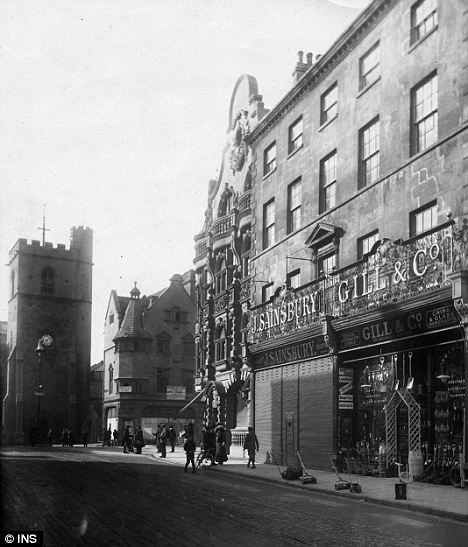
The picture below was taken in 1912 in Oxford, UK a city about 60 miles to the North West of London. It features Gill & Co, an ironmongers and a branch of J. Sainsbury, a food store.

Gill & Co was established in 1530 during Henry VIII’s reign. At the time it was the first ironmonger in the country. It has been in business ever since and has witnessed the English Civil War, two World Wars, a couple of global economic depressions, three recessions, the birth of the railway, the car, powered flight, electricity, the Internet and more.

Originally the firm supplied ironware and related products for Oxford residents however as times changed it tried to reinvent itself and also stocked equipment for chimney sweeps (think Mary Poppins), farming equipment, tools and gardening supplies. Although Gill & Co moved locations, it was always a one store operation in Oxford.

In 2010, after 480 years in business Gill & Co is closing down, beaten into submission by large DIY and home improvement suppliers like B&Q the 3rd largest DIY retailer in the world, largest in Europe and the largest in China and Homebase.

Sainsbury’s, at a mere 141 years old, a relatively new brand was established in 1869 in Drury Lane. Although now at the centre of the theatre district, this was once a very poor area of London.

Sainsbury has also witnessed much, including 2 world wars, 2 depressions, a couple of recessions, the automobile, manned flight, the moon landings and more. Sainsbury soon became an institution, offering high quality products at low prices. By 1882 Sainsbury was selling it’s own label brands.

Although lacking the heritage of Gill & Co, Sainsbury invested heavily in its staff, employing women as managers when it was unheard of in the early 20th century and developing its own training school to train managers.

Sainsbury also invested in new stores and although at times it has had a rough ride, today it employs more than 150,000 people, has 800 stores in the UK and there are on average more than 19 million customer transactions in Sainsbury’s stores every week and the company has a 16% market share.

It has diversified into non-food products and services and non-food is growing 3 times faster than food. It has a bank with operating profits of £19million and its Internet home delivery shopping service is responsible for 100,000 deliveries every week.

Asia has many small family businesses. In fact in Malaysia, Small Medium Sized Enterprises (SME’s) make up 99% of Malaysia’s total registered businesses. Hanoi in Vietnam has over 90,000 SMEs.

These organizations have a critical impact on the business of a country. In Japan, known for its heavy industry, approximately 70% of the Japanese work force is employed by small and medium-size enterprises (SMEs) and half the total value added in Japan is generated by SMEs.

Asian SMEs, many of them well established with years of heritage cannot sit by and hope that they will be safe from bigger, more aggressive retailers. They need to start planning for the future now before it’s too late.

Here are 5 recommendations for Asian SMEs to help them become a Sainsbury

1) Keep an eye on retail trends, especially in your space
2) Talk to your customers, not just about the weather/politics/sport. Ask them what their needs are, what they would like you to stock, when they would like you to open and so on
3) Build a database of customers and their preferences. If you do sell up, this will help you secure a better price for your business
4) Leverage what you have against the big retailers in your space. You can’t compete on price and probably can’t compete on choice but you can compete in other areas – convenience, personalization, customization, free alterations, returns, speed of delivery and more
5) Develop a brand strategy that includes succession planning. If you have sent your kids to university overseas, are they going to come back and work in your hardware store? If you don’t think so, look to create strategic relationships with other players in your space now before it is too late.

Australia Unlimited. Genius or Garbage?


Someone sent me this link about the plans for the Australian government to use a new tagline to sell Australia Inc to the world.

I’m sure you guys have lots to say and I welcome your thoughts on the article. To get the ball rolling here are a couple of thought starters.

1) Australia Unlimited isn’t a brand, it is a tagline created by an advertising agency to be used in creative driven communications using one message to communicate with all stakeholders, irrespective of their requirements for value. The concept of selling ‘Australia to the world” is laughable as most of the world doesn’t care.

2) Here’s a clip from the article, “Shortlisted agencies were given a brief to ”come up with a brand that would promote Australia’s capabilities across a range of sectors from investments and exports to education, culture, sports and events”

How does “Australia Unlimited” do that? And how could any communications campaign appeal to such a diverse prospect base?

3) Here’s another quote from the article, “John Moore, director of brand development of the Global Brands Group, the agency that has been co-ordinating the new Sydney brand, likes the line. ”It takes it beyond tourism and poses the question of what is unlimited about Australia, to which there can be many answers. I think it will work really well as a connecting device with all those different areas [of trade and business].”

Excuse me? How does it do that? I want to set up a mining company in Australia, what can you do for me? That’s the only question I want to pose.

This is another iniative, involving 2 stakeholders, Tourism Australia and Austrade, who should be working together but in fact appear almost to be competing with each other!

Nation Branding and Social Media


A key element of a successful nation branding initiative depends on how well your audience absorbs, understands, adopts and redistributes the message based on their requirements for value. Back in the day this was done at a coffee shop, sundry store, mosque, church, football club or where ever else consumers congregated. Today those same people are increasingly likely to hang out in communities online. Facebook is the most popular home for many communities and it and other forms of Social Media need to be part of any strategic nation branding initiative.

But the Social Media rules are very different to the traditional media rules. And although many nations, organisations and government institutions or destinations believe they understand the new rules, the output of many of them would suggest otherwise. And this is detrimental to the long term success of the nation brand. Social Media channels or tools may not survive as long as many traditional media channels, but Social Media is here to stay.

One country that seems to be doing Social Media right, is the US. The importance of Social Media, and in particular Facebook during Obama’s presidential election campaign is now the stuff of legend. Key to the successes of the campaigns was that campaign personnel asked people what was important to them and then fed that information back to the main office where local service projects were implemented as quickly as possible. Many of of those vote winning projects continue today.

At one stage, in November 2008, Obama had 2,155,244 friends on Facebook, McCain had 578,651 and George W. Bush had none! Little wonder then who won.

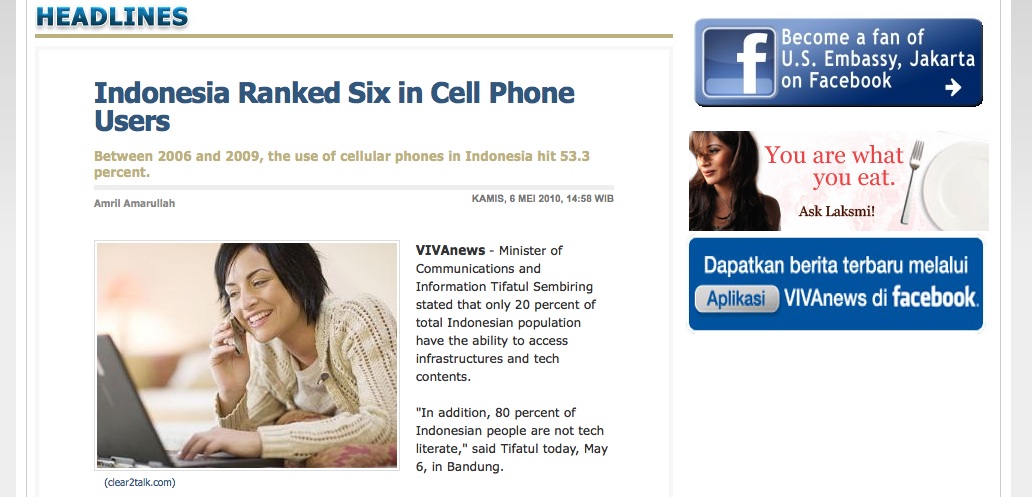
The US has since expanded its use of Social Media to the international arena and the increasing importance of Social Media channels is reflected in the Facebook efforts of the US embassy in Jakarta, Indonesia. The Embassy has invested significant resources into Social Media just as the use of Social Media in the country takes off – the number of active Facebook users in the world’s most populous Muslim country has grown from 2,325,840 in March 2009 to 20,775,320 in March 2010, an increase of 793%!

As the US Embassy in Jakarta has ramped up its presence on Facebook, its fan base has ballooned from 35,000 followers to 131,000 in little more than a month! This in a country not known for its love of the US. But the US embassy understands that this is not a soap box to try and hard sell or influence Indonesians with US policies and attitudes.

As a result, the tone of the Facebook site is light and cheerful. One recent post on the homepage related to Indonesia Batik, has received over 795 comments and more than 2,300 thumbs up. Most of the posts receive 100+ comments and significant numbers of thumbs up. Batik is err a common thread throughout the site and most of the postings are related to American life and culture, and in particular sport, music and popular green initiatives. Other initiatives include Blogger workshops.

Tourism, primarily destinations in the United States are also featured, including a rather ambitious and possibly poorly targetted attempt by Nebraska to attract Indonesians to the Great Plains state. Despite the remoteness of the destination, the video has received over 50 mainly positive comments. Other states using the site to market themselves include Tennessee and Ohio.

The US Embassy markets the site via advertising on local sites such as this one

Social Media and, in this particular case, Facebook is undoubtedly an excellent channel for nations to build their brands by engaging with consumers and offering value to those consumers based on the needs of those consumers, whilst understanding the environment. The USA, certainly in Indonesia seems to know this better than most.

Thanks to unspun for the inspiration for this story

Principles of Nation Branding


Here are my eight key principles for a strategic Nation branding initiative.

Having said that, I also believe these principles should be applied to government ministries, departments, agencies and the private sector as well. What do you think?

1) Research and data are fundamental: Qualitative and quantitative research is essential to data-driven branding (see below) and data-driven branding is essential to building a brand in the customer economy of today and the demand economy of tomorrow. Without research and data, branding decisions are no more than guesswork and the nation brand strategy is too important to base strategic decisions (or, any decisions) on guesswork.

Research is vital for uncovering perceptions, attitudes and requirements for emotional, experiential and economic value, the three key elements of a successful brand. Research also provides benchmarks for measurement and accountability.

Qualitative research gives you valuable data on the requirements of target segments in the future. It allows you to tailor communications to resonate with target segments and also identifies key influencers, thereby saving valuable funds that are wasted on a mass market, one-size-fits-all approach.

2) It is impossible to build a brand on creativity alone. Too much is at stake – both in terms of a country’s brand and resources invested – to depend on a creative-driven branding campaign (and that’s all it is because it is impossible to sustain) to form the foundations of a nation brand. Let’s face it, if you sit back and think for five minutes, how many country related advertising campaigns can you remember? More relevant, how many made you act?

Furthermore, a creative campaign is best suited for mass markets and mass media whereas data-driven branding enables segmentation and targeting of communications that ensures content resonates with target markets. For instance, divers don’t think, “Let’s go to Malaysia and see if we can dive.” They think, “Let’s go diving.” And then determine the destination.

Likewise, are potential investors going to be impressed by white sandy beaches or communications that resonate with them because they offer specific value?

Other benefits of data-driven creative driven branding include a focus on acquisition and relationships that ensure ongoing business, while creative driven branding focuses primarily on acquisition. Crucially, a data-driven approach to branding places strategy in the hands of executive management whereas a creative driven approach puts the strategy in the hands of an advertising agency.

3) Segmentation enables differentiation: “One-size-fits-all” branding doesn’t work. Despite the power and sweep of globalization, which has Malaysians wearing the same fashions as Italians and Aston Martins in hot demand from Brazil to China, each country has its own requirements and world-views.

Once research has revealed the differing characteristics of various audiences, branding must be devoted to tailoring messages, media, channels and activities to the specific values and requirements of target markets. Such segmentation not only ensures more receptive targets but also easily ensures differentiation from competitive countries trying to be all things to all people.

4) No buy-in, no success: Nation branding is difficult, requiring planning, support and coordination from a wide array of public and private entities. But even the best plan in the world will not succeed without buy-in from brand stakeholders. The most important step to ensuring buy-in is involvement in the research and planning process. As much as possible, brand stakeholders that are involved in implementation must have the opportunity to add their input to the plan.

Such buy-in has two advantages. First, it allows valuable perspectives and experiences to be incorporated into the plan, making the plan stronger and more effective. Next, it facilitates better execution. If all the parties involved have a complete understanding of the entire plan and their role in it and what its success means to them, then redundant efforts can be avoided and resources maximized.

5) A brand blueprint must be developed: A strong, visible Nation brand must have a blueprint based on the research findings to enhance the country’s reputation and image while enhancing economic, education and social growth and increasing its ‘share of voice’ in the world community. Specifically, the Nation Brand Blueprint must communicate a positive and dynamic personality with economic, experiential and emotional values that reflect target audience requirements.

The blueprint must be holistic and comprehensive to enhance export promotion, economic development, tourism, foreign direct investment and other key national initiatives. It must also communicate the intended message to the target constituents and stakeholders in multiple countries and at the same time, it must lay guidelines to strengthen the strategic, communications and visual impact of the Nation Brand.

The blueprint must also systemically connect the Nation Brand to the country’s core industries, corporate brands and Small and Medium Enterprise (SME) sector brands. This must be established via a systematic, holistic process that accommodates the requirements of both national and international stakeholders. This process must not only be effective to optimize the Nation Brand, but also maximize limited national resources.

6) Nation branding is a marathon, not a sprint: There are no silver bullets or quick fixes in any branding and this applies especially to Nation branding. Even in these technology driven times, establishing a Nation brand may take as long as a generation to develop. For example, the current view of Japan as a nation famed for its precision and electronics is not based on its efforts during the past decade. Rather, the seeds of Japan’s current nation brand were planted more than thirty years ago, when it began exporting transistor radios and two-stroke engines overseas. Just as Malaysia launched its Vision 2020 program in 1991 to become a developed nation by 2020, the country must adopt a similar long-term view for Nation branding. Malaysia and other countries must look at establishing a Nation brand not for us – but for our children.

7) Private sector must carry its weight: As an example, with responsible policies, funding and resource allocation, the Government of Malaysia can and has tried to do a lot for the Nation brand – but it cannot do it alone. Private-sector involvement and initiative are crucial. Private sector initiatives can range from promoting country of origin on foods and industrial goods, as Australia has done, to helping to fund trade missions to even good business ethics. The bulk of activities outlined in the Nation Brand Blueprint must be carried out by private and non-profit organizations

8) Measurement and evaluation: Why should money or resources ever be spent without knowing the return? Wherever possible, perceptions, activities and processes must be measured, ideally with quantitative benchmarks. Such measurement and evaluation must be used to establish accountability and to ensure continuous improvement.

These key priniciples form the foundations of any nation branding initiative but there are other equally important elements.

One example of these other elements is a crisis plan which should be incorporated into the brand blueprint.

Recent events in Malaysia and Angola show little signs of a planned response with either silence or multiple and often conflicting responses coming from various sources and little or no reactions to debates on social media.

This failure to engage consumers, citizens and potential investors will undo much of the good work carried out to date.