You cannot build a brand with advertising alone


86% of Malaysians don’t trust advertising. The Star) . 78% of Malaysians trust the recommendations of other consumers. There are more than 1,500,000 Malaysians on Faceboook. 80% of affluent Malaysians (those with a household income (HHI) above RM5,000) use social networking sites. Nine of the Top 20 websites in Malaysia are social networking sites. These consumers are the new world order. They are online for many hours a day and pay little attention to traditional mass media. Despite this, Malaysian companies continue to poor billions (RM6.45 billion in 2008. Adoi) into mass market advertising in the mistaken belief that what they are doing is building a profitable brand.

Advertising was much more relevant in the past when the mass media was limited to only one or two TV stations, few radio stations, a couple of national newspapers and the occasional billboard. Limited leisure time pursuits meant consumers spent a lot of time interfacing with the mass media. Finally, there was little competition so high product or service standards were unimportant. With frequency and timing, mass media advertising generated enough ‘awareness’ to justify the budget.

With limited competition and consumers who were willing to accept low standards or didn’t know any better, such awareness could result in sales and for some, it was enough to build a brand.

Using advertising to build a brand is ineffective
Unfortunately, using advertising to build a brand will not work anymore. Mass media has disintegrated into niches or communities. Consumers have been carpet bombed by so many messages – up to 3,000 a day and for so long, that they have learned to block most of those messages. The favoured reaction of advertising agencies to declining responses and lack of effectiveness is to increase frequency but this doesn’t help because it just adds to the cacophony.

In a media saturated world, awareness is just background noise that means very little. For most companies, and there are very few exceptions, in an age when information on every product and service is widely available, and consumers have more choice, are better informed, and more powerful, creating awareness is not going to build a brand. For instance we’re all aware of Mazda, Alfa Romeo, Eon Bank, Pan Am, Airbus, Ritz Carlton and many other multi national global brands, yet most of us will go through life without ever buying something from these companies.

Indeed, many companies have realized, sadly after spending millions on advertising, that advertising can raise awareness (and even that outcome is not a given), but still fail to transform an offering into a brand. Settling for awareness, when so much more is possible and required is a total waste of valuable funds.

But this doesn’t mean that advertising is no longer important. Advertising is, and will probably always be, important to branding. But its role has changed. Advertising can no longer be a tactical initiative to ‘reach’ as many consumers as possible to ‘get the name out there’.

Advertising
Advertising must do more than try to create awareness. Advertising must work to ensure consumers adopt offerings into their lives. Adoption enables an offering to be seen as the best option. But this adoption also needs organisational excellence and the ability to match offerings to client requirements for value. Advertising cannot be expected to do this on its own. And it is wrong of advertising agencies to give the impression it can but it is also wrong of business owners to expect advertising agencies to be solely responsible because advertising is not a silver bullet.

It may seem like I am stating the obvious, but advertising must also communicate trust. This is the key element in any relationship. Prospects won’t make that critical initial connection without trust. And for trust to grow into loyalty, the key to brand building, companies must deliver on the promises made in the advertising. If you don’t deliver on the promises made, your target market is reduced by 86% and you are trying to sell to the 14% of Malaysians who trust advertising.

Some of the claims being made by property developers, automotive distributors, airlines and others in their advertising are often bordering on the ridiculous. Consumers, already pressed for time and cynical, are doubtful as soon as they see the advertising. If you foster doubt from the moment of the initial contact, you’ve wasted every dollar spent on that campaign. If you are making claims you must follow through with them across every touchpoint. And don’t expect it to happen overnight. It takes time to build loyalty.

Understand that building a brand requires not just advertising but also a significant investment in building loyalty and organisational excellence and the money you spend on advertising may be money well spent. Failure to do so and you may as well pour it down the drain.
Singapore Airlines Suites, branding blunder or recession victim?


There have been numerous branding blunders and you can read about some of them here but rarely does Singapore Airlines feature. Singapore Airlines (SIA) consistently leads the industry in profitability and manages to ride out turbulent times better than most in its class. It has always been aggressive, acquiring aircraft and expanding its fleet quickly, in 1979 it set a record at the time, when it traded relatively new aircraft for an updated version of the B-747 for a then record of S$2.2 billion. SIA also differentiated itself early on with its adoption of the Singapore Girl as the face of the airline and service as the unique selling point.

But the world of today and the world of the 1970s are very different. The 1970s were the halcyon days of the mass economy. In the mass economy, with its mass markets and mass media, perhaps a little bit of help from the government and a large dose of nationalism. And by broadcasting the same message to large audiences who had limited sources of information, it was a lot easier for an airline to establish a brand.

More of this and more of that and better this and better that or bigger this and bigger that coupled with large advertising budgets worked well. As competition increased, consumers became more segmented and media choices fragmented, like many other industries, airlines turned to positioning as a strategy.

Positioning
Positioning consisted of creating a position in prospects minds that reflected the strengths and weaknesses of the offering as well as those of competitors. Ideally, this position was based on being first in a particular category. If someone was already first in a category, then companies attempted to redefine themselves in a new category to be first. In the airline business, this tended to be related to passenger comfort or service. The effectiveness of positioning depended on the ability of advertising to drive branding perceptions in the mind of consumers. To do this, airlines often made promises they were unable to keep (admittedly, often due to third party issues out of their control), failed to meet traveller expectations, often because dynamic competitors moved quickly and so raised the bar, which in turn led to brand disillusionment.

Positioning was ideal for the mass economy. It was also ideal for advertising agencies and marketing departments because it gave them enormous power without the responsibility of accountability. Al Ries and Jack Trout invented the concept of positioning. The preface to one book states, “Positioning has nothing to do with the product,…. (it) is what you do in the mind of the prospect.” So, essentially this means that the consumer can be made to believe, through extensive advertising and PR in the right conduits to consumers, and other vehicles, what an offering means to them.

Airbus A380
When Airbus announced it’s super plane, the Airbus A380, ever aggressive, SIA was one of the first to sign up and the first A380 delivered was delivered to Singapore Airlines on 15 October 2007. It entered service on 25 October 2007 with an inaugural flight from Singapore to Sydney. Passengers bought seats in a charity online auction paying between US$560 and US$100,000 for seats. Understandably, the new aircraft, a clever publicity stunt and an inquisitive general public, generated a lot of media coverage and by the end of February 2009, a million passengers had flown with Singapore Airlines on the A380.

Suites
But the majority of those passengers are flying economy. The problem has been getting passengers to use the suites, positioned as, “a class beyond first.” When the new A380 service was launched, in the way that has always done, SIA used global TV, print and online advertising and PR campaigns to launch the new A380.

Beautifully executed TVCs were developed for the Suites by a top advertising agency using taglines such as “your own private bedroom in the sky”. Other taglines included “an unprecedented level of privacy” in a “cabin unlike any other”, and sleeping on a “standalone bed that was not converted from a seat”. Givenchy Beddings (and pyjamas) Ferragamo toiletries and Krug or Dom Perignon were also part of the deal.

But despite a unique product, some slick marketing based on a huge investment in a one-size-fits-all message to mass markets using mass media, consumers and corporations haven’t bought into it. Why not?

Lack of research
One of the reasons could be that SIA didn’t talk to customers and prospects about what they might want from such a service, and, more importantly, how much they would be preparred to pay for it. In fact, it appears that SIA didn’t even engage with members of its Frequest Flyer Programme. SIA simply went ahead and developed the product and then, in a traditional 4 Ps (product, price, place and promotion) and positioning strategy, tried to sell it.

To make it even harder for themselves, and despite charging a premium of more than 50% over the first class fare, SIA would only reward loyal members of its Frequent Flyer Programme (FFP) Krisflyer with 10% more miles than a regular first class ticket! Moreover, any redemption of miles could only be for economy, business or first class and not for the Suites!

According to Shashank Nigam, “Several HR departments of companies, including civil service departments in Singapore, issued circulars or directives stating that “Since the Singapore Airlines Suites are a class beyond first, officers who are usually eligible for First Class travel will be ineligible for Suites”. So by now, SIA had upset its two most important customers, its own government and elite members of the frequent flyer programme!

In 2008, as the economic crisis began to take hold and suite sales nosedived, SIA maintained its pricing strategy, making it even harder for financial institutions, already under scrutiny for lack of risk management, to justify such extravagance.

Another reason for the poor response is probably related to the ground experience. Although positioned as a class beyond first, elite passengers were expected to use the same check-in facilities as passengers travelling in first class, the same lounge and essentially, the same food as first class passengers.

Premium revenues drop by 40%
By the middle of 2009, SIA was feeling the heat on a number of fronts. The economic situation gripping the world caused international premium passenger numbers to fall by 18% year on year in the first 10 months of 2009. At the same time, premium revenues dropped by up to 40% over the same period (IATA). Another challenge was from competitors such as Emirates and Qantas who don’t offer Suites but do have exceptional first class experiences including cabins on their A380s that feature a Bar and bathrooms with showers, limousine transfers at departure and arrival (not available to SIA passengers, even those using Suites).

SIA reviews incentives
SIA scrambled to recover some marketshare. The first incentive was a free night’s accommodation at the Raffles Hotel in Singapore for all passengers flying Suite class. Neat, but hardly enough to justify a 50% premium over first class. Then SIA remembered the people who have made it such a success story in the past, first class passengers and lucrative members of Krisflyer. SIA relented on the bonus miles and began offering 300% bonus miles instead of 10%. Definately a step in the right direction but perhaps too little too late as it is rumoured that a significant number of key SIA customers have defected to Emirates and Qantas. If this is true you can be sure these airlines will make it harder for these premium passengers to leave than did SIA.

So what could SIA have done better? Here are 5 things I would have done although, if they had done number one the rest would have been redundant. What else would you have done?

1) Research. Your existing customers are your best source of information. Talk to them, find out what they are looking for and match attributes to their requirements for value. If SIA had talked to its premium passengers and its own government departments, it would have realised that the market could not support the suites product.
2) Mass market branding with a focus on the 4 Ps is no longer effective. Brands today are built on relationships, access, personalisation and relevance.
3) SIA should have focussed on developing more profitable relationships, not a more profitable product. Brands evolve when companies start buying for customers instead of selling to them.
4) Branding is an organisational not a departmental responsibility. And the organisation is the responsibility of the CEO. To expect a passenger to pay a 50% premium over the price of a first class ticket and not offer a limousine service on the ground when all competitors offer it to first class passengers shows a real lack of judgement.
5) Retention is key to brand building. Companies no longer sell a product, customers buy a product. And once they’ve bought the product, companies should do everything possible to hang onto those customers.

SIA is a great brand. As I write this, I am sure SIA is working out what to do with its Suites. If SIA aims to meet customer requirements for emotional, economic and experiential value, then the airline will bounce back stronger and better for the experience and the Suites can be written off as a victim of the recession. If they don’t the suites may become yet another branding blunder.

Outstanding performance by Tourism Malaysia


Tourism Malaysia should be commended for its performance last year. A total of 23.65 million visitors in 2009, beating the target set by Putrajaya by an impressive 4 million. In fact the 2010 target of 23 million visitors was beaten by over 500,000 visitors. This generated over RM50 billion for the country despite the difficult global situation.

You may be interested to learn that FusionBrand carried out the research that addressed numerous areas and culminated in over 300 actionable recommendations, including that TM move away from a global one size fits all strategy to a geographic focussed, segment specific stategy.

To realise these recommendations, FusionBrand also wrote the 2009 Tourism Malaysia global brand plan and 12 key market brand plans that were the back bone of the Tourism Malaysia brand strategy for 2009.

FusionBrand would like to think it was responsible, at least in a small way, for part of this impressive performance by an organisation that will be, within 10 years the number one industry in Malaysia, in terms of revenue.

Does shock and awe advertising still work?


This is a brutally graphic public service announcement from Australia’s Transport Accident Commission (TAC). Viewer discretion is advised.

This is an immensely powerful piece of work beautifully executed. And it had an emotional impact on me. All the characters resonated with me as I imagined myself as many of them at various stages of my life. At the end I was breathless and close to tears.

But the question being asked by Bill Green is “Does this stuff work? Really work?” According to Bill, TAC says yes. According to TAC, “in 1989 the first TAC commercial went to air. In that year the road toll was 776; by 2008 it had fallen to 303”. That fell again to 295 in 2009. However, despite these powerful commercials, 16 people died over the Christmas period.

Topically, I have just spent 10 days in Australia over the festive period and the only TVCs I can recall were for alcohol (beer and hard liquor) and fast food. I was stunned to see so much alcohol advertised on TV. I didn’t see this TAC commercial or if I did, it didn’t register.

Using creativity to communicate
Advertising, and in particular well executed advertising, used to be a great way to reach a great many people over a relatively short period of time. With less competition, more accepting and attentive consumers, such reach could ensure the message was received and absorbed by the right people. Not anymore. Mass media has fragmented into niches and communities. Using creativity to communicate a message is no longer effective because the message is blocked out or soon forgotten because we simply don’t have the interest or bandwidth to absorb all the messages assaulting us throughout the day, every day. Increasing frequency doesn’t help, it makes it worse as it adds to the noise. Even beautifully executed work like this is lost in the fog of products and services.

I wrote an article about a similar approach used toward smoking in the UK and Malaysia. You can read the full article here,

Chilling commercials don’t work
With smoking, the research, carried out over 10 years by the Institute for Social and Economic research found that the warnings on cigarette packets that smoking kills or maims are ineffective in reducing the number of smokers. Likewise, chilling commercials or emotionally disturbing programs are also ineffective. The study also discovered that when a close family member become ill from the effects of smoking, the smoker takes no notice. In fact, according to the study, smokers only reduce the number of cigarettes or sometimes quit when their own personal health is at stake.

In Malaysia, despite nearly US$50 million spent on shock and awe campaigns to create awareness of the dangers of smoking, the number of smokers has practically doubled every 10 years. Whether or not there are parallels between campaigns for smokers and those who drink and drive, I don’t know.

Personally, I suspect that the reductions in fatal traffic accidents since 1989 are due to better safety features in cars, better roads, better lighting, highly visible enforcement measures, increased penalties for offences such as not wearing seatbelts and using mobiles, reductions of speed limits, more drug testing and better educated consumers.

The key then is not to add to carpet bombing of consumers via advertising, but to identify how those consumers become better educated? Was it the commercials or a reaction to the commercials or other initiatives?

Pubs legally obliged to breathalyse patrons
This can be done using qualitative research with consumers and then use that data to forge future strategies. It may be expensive and time consuming, but it will give us the answers we are looking for and determine future strategies. Of course it may be that it is not the commercials but in fact peer pressure at key times such as when consumers leave a pub, club etc. I think this may be the case and I see a time, not too far in the distant future when all bars and restaurants have to, by law, breathalyse all patrons as they leave the premises.

Personally, although this is a powerful TVC, I wouldn’t watch it again. If this commercial came on, I would change channels because if I am watching TV, I don’t want my leisure time to be challenged by issues I don’t want to address at that particular time.

Thanks to Andy Wright for the heads up on this story.

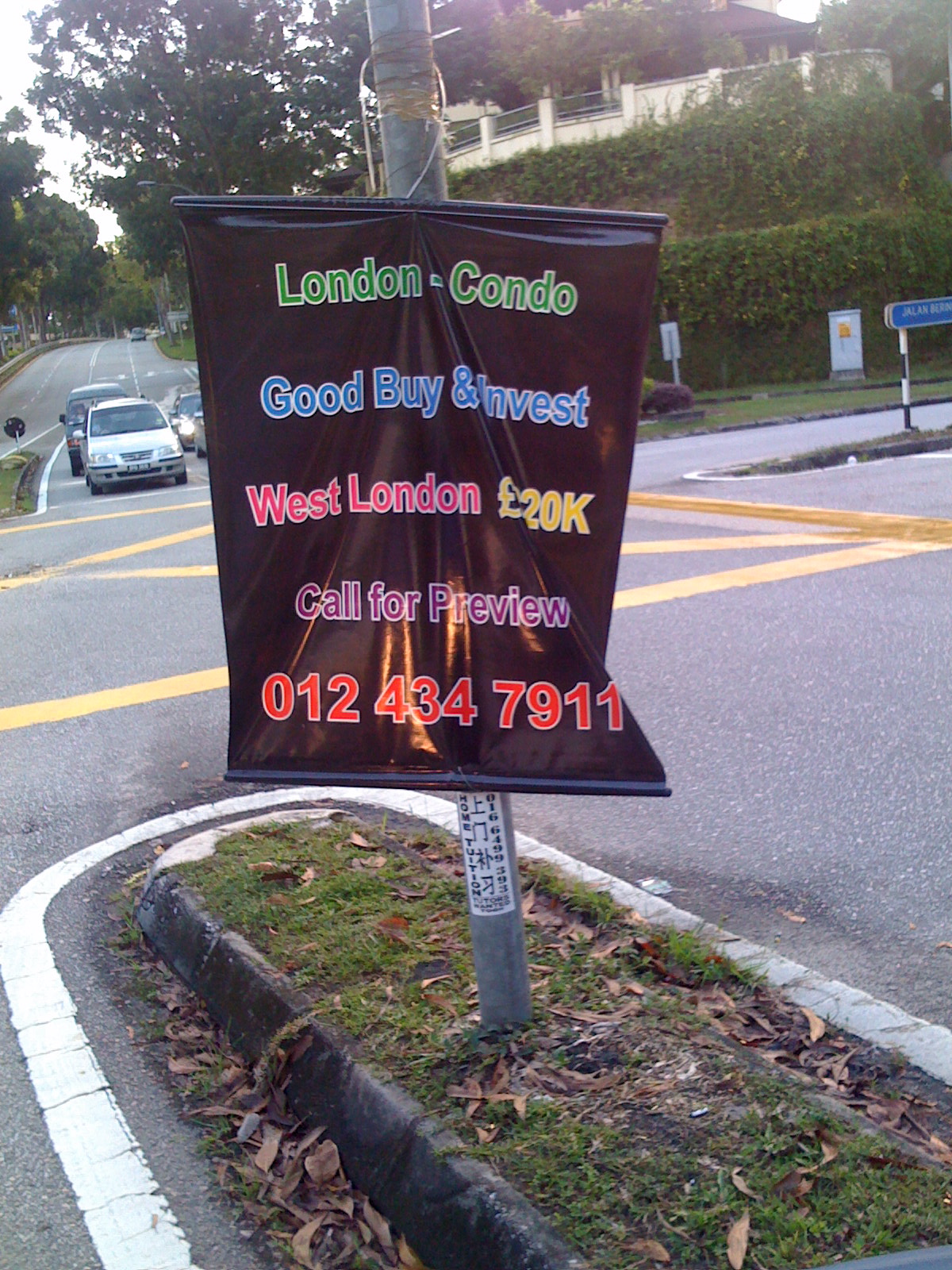
How not to sell a London property to Malaysians


I spotted the sign below on a lamp post in Damansara this morning. In case you can’t read it, the content is as follows:

London – Condo
Good Buy & Invest (sic)
West London £220k
Call for Preview
012XXXXXXX

I cannot believe that a genuine UK property developer or estate agent would encourage a company to sell million Ringgit properties with signs on lamp posts. After all the UK property market, and in particular the London market is benefitting from substantial investment and has hardly been affected by the global financial crisis.

Commercial property
Jones Lang LasSalle expects the total direct investment in commercial real estate in the UK to be around £23 billion (RM125billion) for 2009. Prime yields in the West End are 5% and in the city, around 6.25%. That’s impressive compared with a bank rate of, well about 0%.

Residential Property
Meanwhile, the residential market is also performing strongly. International buyers increased by 25% in 2009 compared to 2008. Most of the investment is coming from Europe, Russia and the Middle East. Knight Frank estimates demand from new buyers is “almost 25% higher than a year ago” and “prices have now risen 13.8% in the nine months since March.”

In fact, most of the investment is coming from the overseas market. Foreign buyers account for 80% of the investment, the highest ever. Indeed, the average over the last 10 years has been closer to 46%. The latest sources of this overseas investment include Oman, Libya, Lebanon, USA, Korea and Ireland.

UK property roadshow
Little wonder then that Malaysian firms want to get in on the act and sell UK property. I can’t find any figures on the total Malaysian investment in the UK or London property market however, the recent launch of a luxury development at Imperial Wharf, London, Malaysian buyers purchased £9.25 million (RM56 million) worth of luxury apartments and penthouses over the 2-day road show in Kuala Lumpur.

Olympic games
With more than 10,000 Malaysians studying in the UK and a number of companies keen to make the UK their European HQ, there are going to be plenty of willing buyers. Especially with the Olympics to held in London in 2012.

Wrong way to sell
But this is not the way to sell those properties. It dilutes the value of the property, negatively impacts the credibility of the local representation and makes it harder for future efforts to sell UK properties here in Malaysia. But worst of all, it portrays Malaysia as an amateur in a professional world.

Updated: 11th January 2010. I have since called the number on the bunting. I spoke to a nice guy with a pleasant attitude. I asked him where the property is. He stated the property was in South Ealing. As I know this area well I asked for the exact location and I consider it to be more Brentford than Ealing. He asked for my email address and promised to email me more information.

That was last Thursday, I have not received anything as of today.

Case study – How a Malaysian Company built its brand from the inside


Senior executives at a Malaysian technology related firm were frustrated. Sales growth was not meeting expectations, despite the firm’s 20-plus year track record, strategic partnerships with top international firms, excellent service and high profile advertising campaigns.

To boost sales, the firm had explored common alternatives – price cuts and an expensive marketing campaign. But although such actions had a short term impact in the past, there were no long term benefits and they hurt profitability. So the senior executives decided to look at another option – increase sales effectiveness by reviewing sales processes and tools, increasing the sales close rate and shortening the sales cycles.

Headquartered in Kuala Lumpur, the firm specializes in boosting supply chain and other efficiencies through both product sales and software and other integration. With offices in Singapore, Thailand and other Asian countries, the firm has a blue-chip list of customers that includes some of Malaysia’s largest companies. Sales had grown steadily over the previous decades, but the firm was now facing price-based competition from China at the same time as it was weighing opportunities to go public.

Issues
After looking at the issue, senior management determined that the sales problem was not due to a lack of leads. The firm received a steady supply of leads from word-of-mouth and customer referrals, as well as from its strategic partners. The sales staff also cold-called regularly for leads.

The main issue was converting those leads into sales. Qualified leads languished in the sales pipeline for months or even years. Too often, active senior management involvement was required to close sales, which took time away from expansion, financial and operational issues. The sales force constantly pressured management for price cuts to make sales. Even when sales were made, opportunities for sales to other divisions or branches were rarely leveraged. Too many sales were for low-margin commodities and replaceables, when the firm wanted more profitable service, maintenance and IT integration contracts.

Management had earlier tried to address these issues with automation (providing laptops to the sales force and installing a low-end CRM system), new sales compensation schemes, re-organization (creating a department just for telephone sales) and other steps. But sales still were not meeting expectations.

Traditional sales training
So the managing director decided that the best solution was to upgrade the skills of the 15-member sales force and other customer facing departments, and requested bids from multiple training companies. The most common proposal focused on sales training that emphasized lead development and closing skills. However, such training was generic to almost any industry.

Another, more expensive option, was a comprehensive approach that included revamping its sales processes and skills around the company’s offerings and requirements of its customers. After careful consideration, the company decided that an improved sales process and customized training provided the most value, and contracted with the sales development division of Malaysia’s leading customer driven brand consultancy, FusionBrand.

Sales audit
The first step was an in-depth sales audit that sought to uncover issues hampering sales as well as opportunities for improvement. FusionBrand conducted hour-long, confidential interviews with senior management, sales managers and many sales personnel. All sales material, including brochures, proposals, quotations, sales scripts, pipeline reports and other information, was reviewed and analyzed. Current as well as “lost” customers were interviewed for their critical perspective on the sales process and their reasons for buying/not buying.

The sales audit resulted in a comprehensive sales process analysis that identified strengths and weaknesses in the sales process as well as in the sales material. For example, the sales pipeline report, a key tool for sales forecasting and supplier orders, was both out of date and contained inaccurate information, making it difficult to prioritize resources and estimate future sales. The sales process analysis included numerous specific recommendations for improving sales processes, reports, collateral and proposals.

Many graduates of training courses complain that the material studied was not relevant to their industry or customer requirements. This issue did not arise because FusionBrand carried out a sales audit first. Information learned during the sales audit was then used to develop two customized sales training courses that incorporated actual customer, product and sales situations. Furthermore, the number of attendees was limited to 12 to ensure that each sales person gained maximum benefit from numerous role-plays and hands-on exercises.

The first customized, two-day course focused on sales basics, ranging from lead development, time management and closing. Special attention was paid to dealing with price-based objections. About four weeks later, the second customized course was held in 5 half-day sessions over a three-week period to minimize the impact on sales time and provide more opportunities for review and retention. This course focused on “strategic sales.”

Many training courses assume that sales can be made in a single sales call. However, only commodity, low-margin products can be sold in one call. More advanced offerings inevitably require strategic sales, characterized by longer sales cycles, multiple corporate decision-makers (ranging from finance to IT to actual users) and complex requirements. Such strategic sales require understanding differing requirements for value among various departments as well as internal political issues at the prospect. Using an existing prospect that was difficult to close, each attendee developed a focused sales strategy and delivered a PowerPoint presentation designed to win over all departmental decision-makers involved in contract approval.

Sales manual development
The final phase of the multi-month effort was a sales manual. A sales manual includes standardized information on sales processes, compensation (eg, commission schedules), reporting, requirements, resources (ranging from key telephone numbers to report and presentation templates), sales tips and more. The sales manual gives the company more consistent management by acting as teaching tool for sales managers with new staff and ensures more consistent operations and reduces training time.

Results
Results have been achieved in both sales and other departments. Ordering is based on more accurate pipeline data, which has reduced inventory, freeing up capital for expansion. Morale has improved, sales personnel are more confident and less inclined to reach for a calculator at the first objection and offer discounts. The company has made its sales and presentations more customer-centric. Most importantly, sales have accelerated and sales cycles are starting to decrease.

Other internal branding initiatives were embarked on to ensure the successes were communicated and integrated throughout the organization.

Summary
Companies invest a lot in marketing to generate leads. But even all the leads in the world mean nothing until they are converted into a sale and, ideally, a long-term customer. That is why investing in your sales organization, processes, and personnel is crucial for ensuring that customer requirements for value – whether at the MD or user level — are consistently understood and addressed by the brand. Such understanding is hard to achieve from a ‘one-size-fits-all’ sales training class.

A sales process audit, customized sales instruction and sales manual can give companies the framework and structure to close more sales more often – without having to compete just on price. This in turn will build a comprehensive, well respected and, most important of all, profitable brand.

Retention is key. Low cost carriers must learn from the mistakes of legacy carriers


The legendary Peter Drucker said it best: “The purpose of business is not to make a sale but to make and keep a customer”. This is what branding is about. It’s not about aquisition, it’s about retention. And the airline industry, and in particular, Low Cost Carriers (LCCs) need to realise this soon otherwise they will find it tough to build brands that can compete, long term with the mighty legacy carriers with their frequent flyer programmes, multiple classes, business lounges, inflight entertainment and gourmet food (well some of them).

Most of the LCCs have a price based offering. Being small, they are nimble and more efficient than their lumbering competitors. These young, brash and determined airlines, often helmed by charismatic individuals with little industry experience have ripped up the industry manuals and replaced them with revolutionary business models that charge consumers for peanuts, coffee, noodles, seats, luggage and most recently in the case of Air Asia, a ‘convenience fee’.

According to an official response from the airline to an indignant passenger, this ‘convenience fee’ is “meant to recover costs in implementing, upgrading and maintaining our online payment systems. It is also to enhance security features for credit card payments to give guests a comfortable and safe booking environment.”

You’d be forgiven for thinking that this response, available here in full on malaysiakini.com came from one of those stuffy legacy carriers mentioned earlier. You’d be forgiven too for scoffing at the line, “give guests a comfortable booking environment”. How does charging me more make me more comfortable? You’d also be forgiven for thinking that perhaps the online payment system wasn’t good in the first place and wondering what the implications of that might be.

In the past most airlines, including Air Asia, would have absorbed these costs. I quote again, “However, now that AirAsia is experiencing a rapidly growing number of online transactions, these costs have significantly increased.”

The official response to the complaint goes on to say, “This convenience fee is charged on a per way per guest basis because the costs of these systems are driven by the value of the transaction rather than by the number of transactions. As costs vary per country, the convenience fee also varies.”

The whole process has been dealt with in a manner more suited to one of the aging behemoths than such a young, aggressive and savvy carrier. To me it says that because you, the customer have helped us grow so fast, we’d like to reward you by charging you to use our online booking service. Even though it is automated and therefore doesn’t require the ongoing investment in real estate and talent that a booking office requires, we’re going to make you, the customer pay for it.

The danger here is that Air Asia is making a common legacy carrier, or perhaps I can call it legacy branding, mistake. It is treating passengers as if they are insignificant seat fillers and it is assuming that all passengers are the same, don’t have options and will put up with being treated badly. Irrespective of whether it is the first or fifty first time the passenger is using the airline.

Surely, if a passenger is a long time user of the airline, there will be significant personal data available (and Air Asia offers customers the opportunity to submit a lot of personal, travel and other information) and multiple transactions with that customer mean that the liklihood of fraud is low, should that passenger be treated, and charged, the same as a new customer? And anyway, the burden of fraud is with the Credit Card company and not the carrier, which is why it is the Credit Card company that sometimes calls after you use the card to make a booking.

Unfortunately, because the prevaling attitude in most agencies (and companies) is that acquisition is key, the typical response is yes. And it would seem, based on this episode, that Air Asia agrees with this attitude.

However, FusionBrand has long argued that retention is key to brand building. Although LCC’s have thrown some traditional branding theories out the window with their price driven strategies, you cannot build a long term profitable brand, on acquisition alone. Indeed, a low price strategy that aims to ‘buy’ loyalty can often encourage only disloyalty. That’s because a price driven customer is always looking for a cheaper alternative. And, in the LCC space, will often find it.

This is substantiated in a survey carried out by Sabre Airline Solutions, which found that 86% of airlines believe that customer loyalty and retention will have the most positive impact on their business in 2010.

So my advice to Air Asia and other LCCs is that if you want to become a brand, you must start treating customers with more respect, understand that a low price alone will not build relationships, think carefully about how you communicate with your passengers and remember that the purpose of business is not to make a sale but to make and keep a customer.

In a social media world, are Billboards a necessity or expensive exercise in vanity?


We all accept that the way consumers source and absorb data has changed dramatically in the last 10 years. Instead of listening to brands and what they have to say about themselves, consumers now listen to other consumers and buy brands based on data sourced from those other consumers.

The way consumers partition their worlds is also changing and nowadays, consumers segment themselves into communities. For companies, this should be seen as an exciting development because it gives them the opportunity to communicate directly with consumers in pre identified commuities using content that resonates with those communities in a more personalised and dynamic manner and using tools that are widely available and relatively inexpensive.

But when we meet with prospects, they only seem to be interested in traditional tools such as print ads, TV commercials and billboards. And they soon lapse back into semi indifference as we suggest the future is not about these expensive, outdated tools that are increasingly closed out by consumers.

All prospects seem to want is reach, awareness and creativity to build a brand. The high profile, mass economy tools and creative stuff that looks good, reaches the most consumers, irrespective of whether or not the product or service is relevant to those consumers and wins agencies awards.

Even if it means spending millions of Ringgit on immeasurable campaigns that are lost in the fog of messages consumers are bombarded with every day. Even if it means they cannot measure the effectiveness of the campaign with real, actionable data that they can use to save money and improve the effectiveness of future campaigns. Even if the messages within the campaign make claims the company simply cannot live up to, they still prefer this route to less expensive, targeted messages with relevant content to specific communities based on the requirements for value of that community.

It’s as if they are reassured that they are getting value for money because they can see the print ads, the billboards, the TV Commercials and therefore, so can lots of other people. Sure, billboards can be an inexpensive medium to pass on a message to a large audience. Indeed one company BPS states in their marketing collateral, …”Perhaps it’s because they (billboards) reach more people for cheaper prices than any other type of media.” But is reaching more people for cheaper prices a sound strategy for a social media world? From this we deduce that if lots of people see the product or service on TV or on a billboard, then many of them will seek out the product or remember it and buy it when they encounter it in the ‘flesh’. This may have been acceptable in a more sedate world, with limited competition etc. But we all know that in today’s marketplace, this approach is no longer effective.

Is this an Asian thing? Or is it universal? Here in Malaysia, one mass economy tool that is really popular is the billboard. Billboards, and in particular getting a company on one, is fast becoming a national obsession. One prospect recently interupted our strategic proposal and asked us to find a number of billboards at strategic locations across the capital to raise awareness of the company (The company is almost 100 years old).

The belief is that if enough consumers see the product on a billboard, preferably a really big billboard alongside a really busy highway, then the success of the brand is all but guaranteed. This obsession is growing fast. Currently, out of home accounts for only 2% of ad spend in Malaysia, but it is growing at over 35% per annum and is now worth in excess of RM100,000,000 (US$30million).

But I fail to understand the logic in this. Because think about your behaviour when you are driving. Unless you spend your days splitting molecules or working on a vaccine for AIDS, driving is probably the most complicated daily activity you will do. Not only is it a complicated activity that requires great skill, but according to research, it is a skill that consists of more than 1500 ”sub skills”.

When we’re driving, there is no opportunity to relax (This is where a wry grin appears on the faces of Malaysians). Throughout the journey, we are navigating badly signposted and unforgiving roads and terrain that changes on an almost daily basis. We’re constantly scanning the environment (well some of us are) for cars that don’t signal, pedestrians who take their time crossing the road, despite the obvious implications of being hit by a ton of steel at 50km, motor bikes driving the wrong way and debris from a recent lorry puncture. Plus, we’re constantly seeking information that can help us.

At the same time, we’re trying to maintain our position on the road. We’re also constantly checking our speed and mirrors (well some of us are), making decisions (apparently, about twenty per mile), evaluating risk and reward, looking at instruments and, despite the obvious futility, trying to anticipate the actions of the white wira with a black door and five girls in the back.

Whilst doing all this, many of us, and you know who you are, are sending an sms, talking on the phone, sipping from a water bottle or thinking about ___________________(insert name of premier league team). Others are trying to stop yet another fight between irritable kids or starting one with a spouse.

Research from the USA carried out a survey on one stretch of road in Maryland and, “found that a piece of information was presented every two feet, which at 30 miles per hour, the study reasoned, meant the driver was exposed to 1,320 “items of information”, or roughly 440 words, per minute. This is akin to reading three paragraphs like this one while also looking at lots of pretty pictures, not to mention doing all the other things mentioned above – and then repeating the cycle, every minute you drive.” (source Traffic: Why We Drive the Way We Do (and What it Says About Us) by Tom Vanderbilt). With all that going on, do billboards engage consumers effectively?

And billboards are not cheap. In Kuala Lumpur, the most expensive billboard in the country is on the federal highway, costs RM900,000 a year and reaches 252,000 cars daily. Less high profile billboards cost are around RM250,000 – RM500,000 per annum, depending on traffic. But branding requires so much more than reach today. Whilst reaching hundreds of thousands of consumers and creating awareness, especially for a new product may be an important step in the branding process of some products and services, it isn’t a goal, for any product of service.

Now I’m not suggesting for one minute that billboards are a waste of money. However, I am suggesting that you should get independent advice on whether or not it is the right tool for your brand. I’ve seen a number of billboards for B2B companies, one recently was selling shock absorbers. The major investment in that billboard and the production costs, would have been better spent on sales and marketing material to engage the automotive manufacturers and repair shops that purchase shock absorbers.

You also need to be careful how you chose the location. Just because 500,000 cars pass the billboard, doesn’t mean it is a good location. Equally important is the content of the billboard. Writing an essay will defeat the object of the billboard.

Some other questions you need to ask yourself include:

What role do billboards have to play in our brand strategy?
How can we measure the effectiveness of the campaign?
If we can’t measure it, should we do it?
What happens once we take the billboard down? How do we maintain momentum?
How can we leverage the impact of the billboard?
How can we make the billboard stand out?

It may be that a billboard will become a neccessary part of your brand strategy. But it is worth asking yourselves these questions first. Otherwise, your billboard will waste a lot of money that few companies can afford.

If having asked yourself these questions, you still believe billboards are part of your communications campaign, try to make them original. 3 dimensional billboards will definately get attention and so will digital boards. It amazes me when I see a photo of a watch on a billboard. We recently had a huge watch billboard outside our office. It was there for at least a month. No one in the office had ever heard of the brand so we decided to investigate it further to see what other communications were part of the campaign.

We couldn’t find anything so we can only assume that billboard was the extent of the communications campaign. As I write this, two months later, I have asked if anyone remembers the name. Nobody does. That’s probably RM200,000 wasted.

However, if that billboard had been digital and the watch actually worked, then we would probably remember the brand. Of course this doesn’t necessarily mean we would buy the product, but at least awareness levels would have increased.

This article has some great ideas for 3D billboards. A simple search of the Internet will uncover plenty more.

Positioning, an exercise in naive manipulative futility


I have a great dialogue going with Derrick Daye at branding strategy insider

I told him that positioning is an outdated strategy that wastes money, is immeasurable and should be confined to the marketing graveyard. He replied that I am wrong because although the world has changed in the last 40 years, the human condition hasn’t.

Here is my response in full.

Derrick you make the fundamental mistake that the majority of other marketers make – that the human condition hasn’t changed. Do you really believe that? Do you really believe that despite all that extra noise and clutter and, let’s face it, false promises on product capabilities and deliverables; despite the radical changes that have occurred in the way we lead our lives and so on, the tools and channels that we use to source information, the human condition is the same in 2009 as it was in 1969?

The world has been through unprecedented changes since Mr Trout published his first article on positioning. Yet advertising agencies and brand consultants continue to recommend positioning to clients, whatever their industry. I do agree that in its day, positioning could work, and I stress the word could, for large consumer-oriented firms but with MAYBE one or two exceptions, it is not the right way forward.

It is exactly because of the multiple sources of information available to the consumer, including from those that the consumer respects and, more importantly, believes and the subsequent over-communication of product controlled messages as mentioned by you, as well as the fact that there is an abundance of choice and channels, the consumer can now control the relationship the brand has with them and therefore define the brand.

Indeed, any attempt to ‘own a singular concept in the mind’, or as someone else put it, ‘find an empty space in the consumers mind and then park your brand there’ is basically an expensive exercise in naive manipulative futility.

Is it time to put positioning to bed?


40 years ago this year, Jack Trout published his first article on positioning. But the term didn’t really become advertising jargon until his articles entitled “The Positioning Era”, were published in Advertising Age in the early 1970’s.

There are numerous definitions of what positioning is today but to ensure we’re all on the same page, I propose this version: http://en.wikipedia.org/wiki/Positioning_%28marketing%29

But in today’s marketplace, positioning has multiple problems:

1) Positioning is immeasurable: You can’t say “our positioning has improved our sales by 5 % or as a result of our positioning strategy, our brand is 12% better than competitions. Furthermore, it is impossible to measure the ROI or benchmark positioning.

2) Positioning is only suitable for mass markets. Yet branding today is about segmentation and communicating and engaging with those segments via relevant channels and with messages that resonate specifically with those segments or niche markets. Does this mean that a company should develop different positioning for different niches?

3) Positioning is suitable for mass markets with limited competition and limited consumer access to media and information. Today, consumers can get any information they want on anything from anywhere.

4) The wikipedia definition is a top-down, company knows best, hierarchical marketing approach. Yet we live in a C2C environment in which consumers define brands.

5) Positioning is one-way. The company knows best and you must listen to us. We tell you how our products are positioned. But today, if you are not entering into 2 way conversations with consumers you are about to join the brand graveyard.

6) Positioning was developed for the US mass market of the 1970’s. But we’re in a globalized world now, with much more competition and more knowledgeable consumers.

7) Positioning is competition, not customer driven. The basic premise of positioning is that you want to be number 1 or number 2 in a category in a prospect’s mind. If you can’t be number 1 or number 2 in an existing category because of competition, you make your own category. In today’s congested marketplace, the investments required to develop a new category are enormous. Furthermore, besides the difficulty and expense of creating your own category, you are also letting your marketing be driven by the competition rather than consumer demands for value.

8) Positioning is dated. With limited competition (by today’s standards) in most categories, positioning was a compelling theory. The problem is that the world has changed a little since 1969. Yet agencies continue to recommend positioning as the foundation for any brand strategy.

9) Positioning uses mass market channels such as TV and billboards to reach as many consumers as possible using repetition to create interest. Yet ask yourself, what do you do when the commercials come on? Surf? Put the kettle on? Go to the bathroom? Text a friend? Surf the web? Basically, do anything but watch the commercial. Same with billboards. How many billboards can you remember from your morning commute?

10) Positioning requires massive, and I mean massive budgets that few companies have. If you do have a massive budget and you do execute your campaign across multiple channels for say six months, what happens if it doesn’t work?

So my question is, what are agencies doing recommending a theory that was developed before the PC was invented? I welcome your comments.