Stop advertising and start branding part II


A fascinating insight into the social media and mobile shopping habits of consumers in the United States, United Kingdom, Australia and Singapore has just been released by SDL in the UK.

The survey size is a little small – 4,000 people in four countries – but the results unearth new data on how social media and mobile are influencing how consumers interact and build relations with brands.
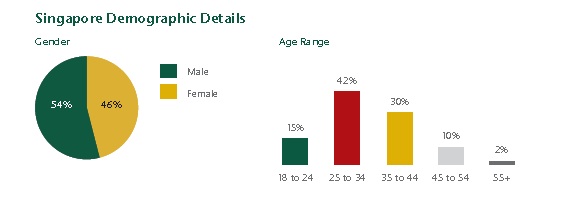
Singapore participant breakdown

Findings include:

33% of respondents from all four countries have acted on promotions seen on social media.

58% of respondents have shared positive experiences online and have sought advice from friends and family when talking about brands on social media.

U.K. respondents are more likely than respondents from the other four countries to complain about service on social.

When respondents express feedback, Facebook is the most popular platform to do this.

Showrooming (visiting a physical location to evaluate products and services even when you know you will buy online at another time) is increasingly prevalent as 77% of participants showroom.
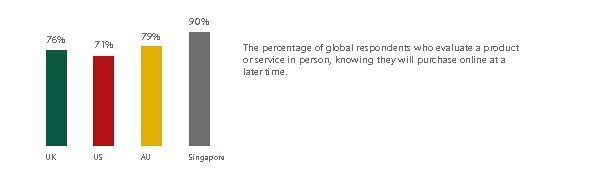
Experiential branding key to branding success

62% of the participants use a mobile device when in stores to compare product prices.

69% of respondents from all four countries expect a brand’s online store, mobile app, and physical store to offer the same pricing, discounts and sales.

Pricing consistency is expected in all countries

What can brands learn from this thought provoking survey?

They need to understand their relationship with consumers and what resonates with those consumers.

Brands that ensure parity in pricing and products across multiple channels will have to place greater emphasis on the customer experience and experiential branding if they want to win and retain business. Those that compete on price alone will soon be out of business.

Department stores and other retail outlets that represent multiple brands will have to work harder to engage consumers and ensure a positive brand experience otherwise they face the prospect of losing customers, possibly forever.

Mobiles are changing the way consumers research and learn about brands.

Brands that take the time to build relationships with core fans or brand evangelists will see their brands promoted to thousands of fans for minimal financial investment.

Those brands with digital brand strategies that go beyond tactical campaigns online are increasing sales through loyalty and advocacy.

Brands that try to control content and manage corporate driven messages and ignore consumers are unlikely to last very long in the consumer economy of today.

Telling the brand story online should be done across Facebook and other popular platforms with the ongoing development of corporate and consumer content.
Brands, it is no longer about you


Whilst researching a chapter for my new book (you can get an idea of how the book will go by reading this article here) I came across a fascinating company called Undercurrent.

One of the key players in the firm is a guy called Aaron Dignan. You can follow him on Twitter here.

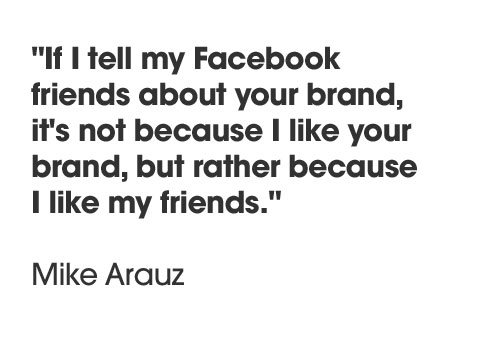
I was impressed by much of what I read on their website but whilst continuing my research, I also found this quote from Aaron:

Do you really understand Facebook?

This simple quote sums up the new world order of branding. It is not about you. Consumers really don’t care about you and your brand. There are so many brands out there that consumers are no longer buying into brands in the same way as they did before.

There are exceptions but on the whole, the world is changing and brands can no longer expect to have the loyalty they used to take for granted. Do you agree?

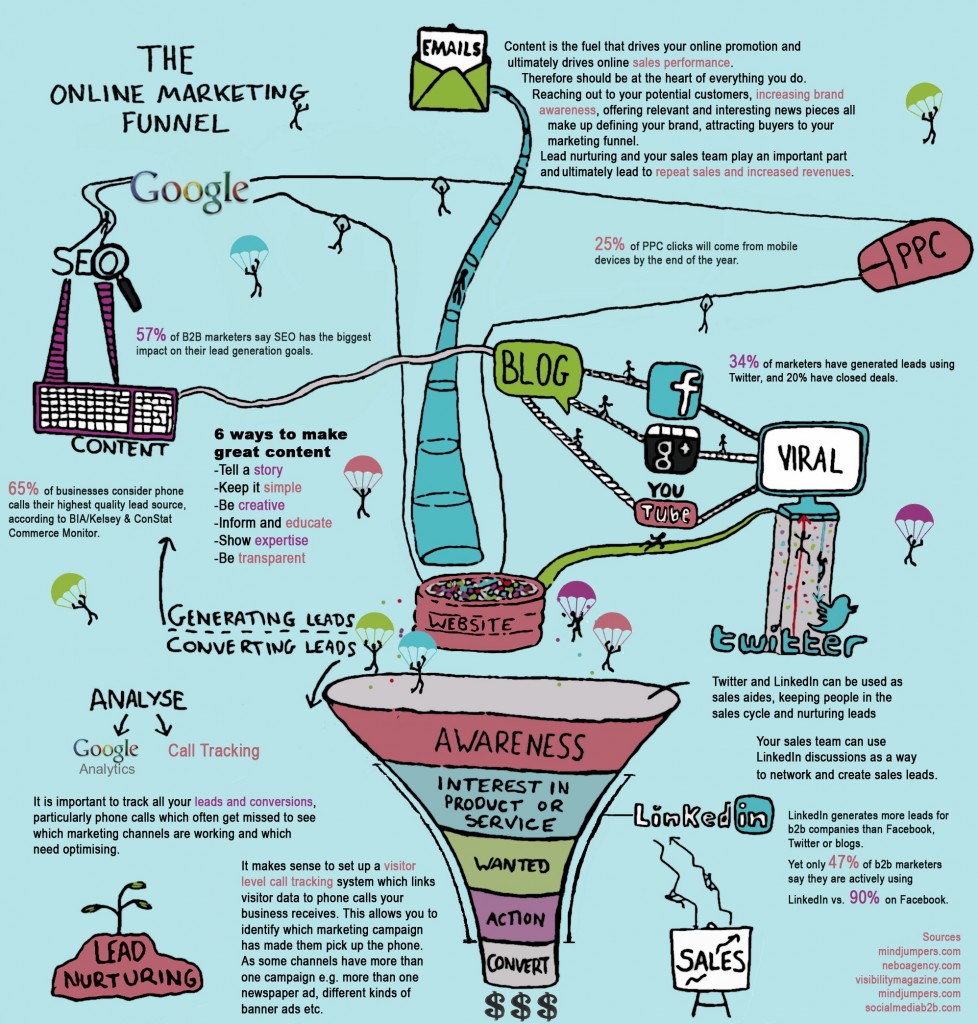
This infographic shows the right way to build a brand online


John Cullen runs an Internet marketing company out of Ohio in the US. He dropped by my blog and out of courtesy I had a look at his. He also liked the ‘about me’ page on my blog. I’m not sure if I should be happy with that because I hope he liked some of branding related stuff too!

Anyway on his blog I came across this excellent infographic that explains the online marketing funnel.

Online marketing funnel

This fascinating infographic is useful because it shows the importance of digital marketing when building a brand, not through advertising but through the use of content and yet it also shows how important traditional tools such as the telephone are in the brand building process.

It also shows how important it is to use the right tools for the right sector. For instance, Linkedin generates more leads for B2B companies than Facebook, twitter or blogs yet only 47% of B2B marketers say they are active on Linkedin compared with 90% who are active on Facebook.

All you need to know to start building your brand online. Check out response tap for more on this topic.

5 facts about developing a brand strategy in the social economy


1) Research is more important than ever.
Research has always been important but it was cumbersome and time consuming. Not any more. Today, the right research can be developed and implemented and results analysed quickly and efficiently.

Brand building - don't run before you can walk
Brand building – don’t run before you can walk

It’s easy to find those people who are likely to like your product. It’s even easier to talk to them. But too many companies don’t bother, preferring to chase the holy grail of more new customers through corporate driven messages.

And don’t forget your existing customers because they are your best source of information. Talk to them, find out what they are looking for, what they value and match attributes to their requirements for value.

2) Mass market branding with a focus on the 4 Ps is no longer effective.
Brands today are built on delivering economic, experiential and emotional value. Not on creating some cool position and communicating it across as many channels as possible for as long as possible.

Deliver that value with stories that resonate with target markets and existing customers. Build relationships with customers by allowing access to the brand, personalizing all elements of all interactions, through relevance, experiences and emotions.

Ignore the social element of the social economy by trying to speak to everyone with one corporate driven message and you will fail.

3) Focus on developing more profitable relationships, not a more profitable product. Brands evolve when companies start buying for customers instead of selling to them. This is especially true in times of economic hardship.

4) Branding is an organisational issue not a departmental responsibility.
And the organisation is the responsibility of the CEO. The CEO needs to be involved in the development of the corporate brand.

Your brand is too important to be left to a marketing department that still believes in the corporate driven message over the engagement of the consumer.

And once you’ve built a brand, don’t rest on your laurels, continue to innovate or you will be left behind.

5) Retention is key to brand building.
Companies no longer sell products, customers buy them. And once customers have bought a product, companies must do everything possible to hang onto those customers. After all, you’ve investment a lot of money to gain a customer, why let them go?

Especially as the more time a customer spends with you, the more money they will spend with you.

Cross platform marketing to build a brand


It is accepted now that consumers are paying less attention to traditional media.

Although the TV or the radio may be on, it doesn’t mean they are viewed or heard. And with the proliferation of ads and trailers, more consumers are reaching for other screens during a break in programming.

But marketers still insist on using traditional media to reach as many consumers as possible in the hope that their message will stick. Even those companies that are spending on digital are using the same methods as they used in the old mass economy.

This despite the fact that last year Harvard Business Review said, “Traditional marketing is dead… in today’s increasingly social media-infused environment, traditional marketing and sales not only doesn’t work so well, it doesn’t make sense.”

However, all is not doom and gloom for traditional media channels. Or at least the TV.

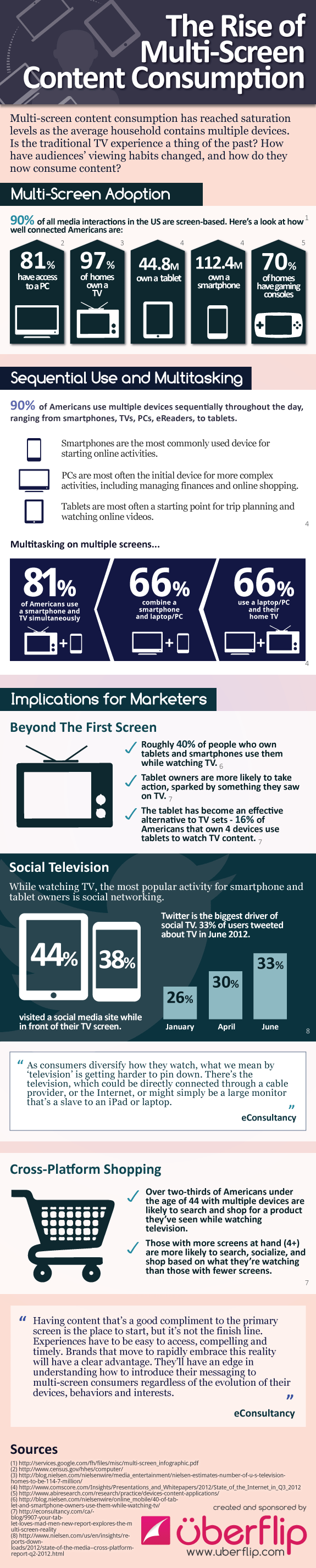
This infographic from Uberflip shows that although consumers are reaching for other devices whilst watching TV, many of them (66%) are using those devices to source information on a product and often purchase after seeing that product on TV.

Cross platform marketing requires a new mindset

So there may be a future for the TV as a communications tool after all.

However, what marketers must do is rely less on corporate driven messages and instead, identify how to introduce their products on one screen and then integrate that product and messaging across other screens taking into account changed behaviours, attitudes and cultures.

More thoughts on why positioning is wrong for your brand


The issue or issues I have with positioning are well documented in this blog.

But I still get a lot of resistance when I try to explain to companies that they are wasting their money relying on advertising agencies to manage their brands by developing a positioning strategy.

This is because another issue that is increasingly relevant is the fact that it takes time to develop a position, strategise it and then communicate it, normally across traditional media channels.

Please, not more messages!

In a (reluctant) nod to the Internet and Social Media, agencies are beginning to use online channels (whilst online advertising is growing, I don’t think it is growing fast enough and one reason is because agencies can’t control it or rather it is too transparent) but they are using these channels in the same way as they use traditional media, ie trying to broadcast a position to as many people as possible.

Developing a position was alright in a ‘mono’ world such as the early to end 20th Century USA or in Europe where many of marketing’s traditional tools and tactics were developed.

Indeed, before commercial flights, mass migration of peoples, national TV and newspapers as well as a more localised population and limited competition, such a model had legs and made sense.

It was also easier to find those USPs – remember when quality was a USP? – imagine trying to build a brand on a product that wasn’t high quality. OK, Microsoft did it but there are always exceptions to every rule!

As Glen Myatt said in his response to one of my blog postings (read his reply in full here) Quote, “With the myriad touchpoints available to brands now, a better way of thinking about what a brand should represent is what its story is rather than what its positioning is.

This is beyond benefits and personality to its values, what it believes in, its purpose in ‘the world’, its ambition.

The result is usually a unique combination of associations rather than a single unique association. (For instance, some may argue Apple is positioned on simple & intuitive technology while others fall back on its creative values of ‘thinking differently’. Both of these are valid as are the myriad other associations that make up the Apple story).

A brand story is typically not single-minded though it often has a central theme. In this respect positioning as a single ownable thought that can be packaged in a 30 second television spot is probably redundant.

As the idea of a unique, ownable story it is alive and well. And companies need to have and steer those stories even as their customers may also be shaping them. As the saying goes, “If you don’t know what you stand for you’ll fall for anything”. End quote.

With 2 exceptions, I agree with What Glen says.

The first exception I have is that I don’t think Apple is positioned. I think it produces great products, tells a great story, creates a great experience and then lets consumers define the brand. In other words, it offers economic, experiential and emotional value to consumers and on their terms (it makes mistakes but generally addresses those mistakes in a transparent, emotional, fair and collaborative manner). It is very human in its approach. Unfamiliar corporate territory but in the social economy, branding dynamite.

Which leads onto my second exception. I don’t believe you can create a unique ownable story and then develop it into a position. And knowing what you stand for doesn’t equate to a position. Those are corporate values. Perhaps there is an overlap…

Going back to my original point, not many companies have the time, or for that matter the resources to go through what is traditionally required to build a brand.

The days of broadcasting a corporate driven message are over

I believe that instead they should focus on delivering economic, experiential and emotional value to customers and on their terms. And do this in a transparent, human, personal, collaborative manner. Everything else will fall into place.

A great example of how to drive traffic to your retail outlet in a slow month


Today is a landmark day for retailing in the UK as Selfridges “The best department store in the world*” launches a “No-noise” experience at its major stores across the the country.

It’s a pretty cool concept, offering a Silence Room where customers can ‘find a moment of peace in a world where we are bombarded by a cacophony of information and stimulation’. Customers will be asked to leave their shoes, mobile phones and anything else that makes a noise at the door.

Interestingly the store also aims to reduce the visual noise and has encouraged some brands to offer ‘de-logoed’ products. Paul Smith and Heinz are already onboard with others expected to join in later.

There will also be meditation sessions, quiet music performances (that’ll be a challenge), art exhibitions and motion sensor window displays. Selfridges will also take its name off the classic yellow shopping bags.

You can see more about the Silence Room and other elements of the event on the Selfridges site.

Personally, I think this is a brilliant concept as it understands what customers are looking for and takes experiential branding to a new level. What do you think?

*Global Department Store Summit, Paris. 2012

To engage consumers, Jakarta needs to improve its communications


As the world attempts to shake loose the shackles of the economic meltdown, competition for tourists from both established and new markets is gathering pace.

But the new environment is an even more competitive one. There are almost 200 countries worldwide and over 100,000 places in Asia alone, actively seeking to attract and retain tourists.

As a result, it is increasingly important that destinations seeking domestic and international visitors have a well researched, structured, long-term strategy for increasing visibility & engaging the right segments to generate arrivals.

One relative newcomer to this tourism marketing battleground is the city of Jakarta, the capital of Indonesia, located on the island of Java and the capital of Indonesia. If you haven’t been to Jakarta I recommend you go as soon as possible because it is a fascinatiing destination.

I spotted this ad in a Malaysian daily recently.

Does this ad make you want to get more information on Jakarta?

It would appear that the people at the Jakarta tourism and culture department are looking to attract visitors to Jakarta with the promise of great shopping. However, as a consumer, without knowing anything about the rest of this campaign I can tell you that this ad needs work.

Firstly, what is the headline trying to tell us? Is it telling us that time is irrelevant? This is an existential argument and possibly true but in this situation not relevant. Perhaps it is saying, “don’t worry about time when you go shopping in Jakarta”? Or to be more specific, when you go shopping for shoes because after looking at this ad, am I wrong to assume Jakarta is a great place to buy shoes?

There is no call to action, the image of the shoe boxes looks photo shopped onto the main image and there isn’t a website address to gather more information.

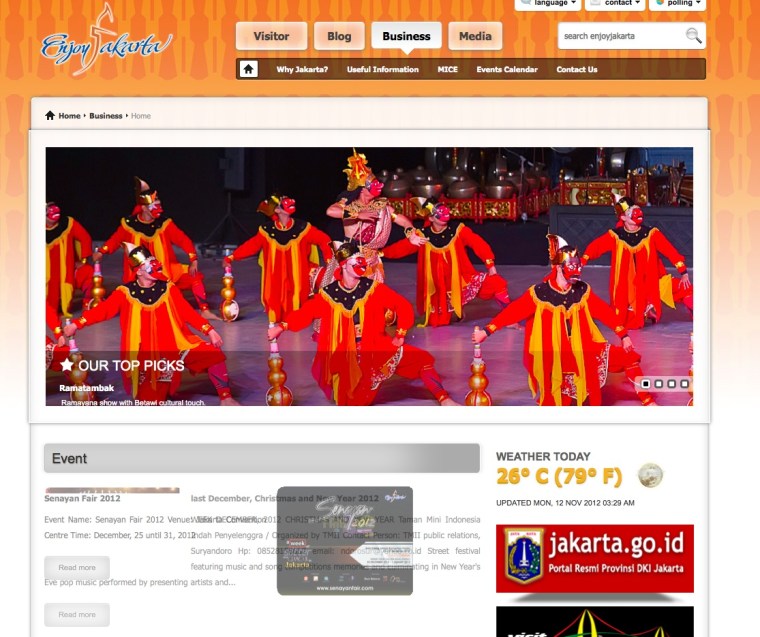
So I took it on myself to google (other search engines are available) “Enjoy Jakarta” and arrived at the official Jakarta travel website where I couldn’t find any information on enjoying Jakarta, shopping or even shoe shopping.

Not the best introduction to what Jakarta has to offer

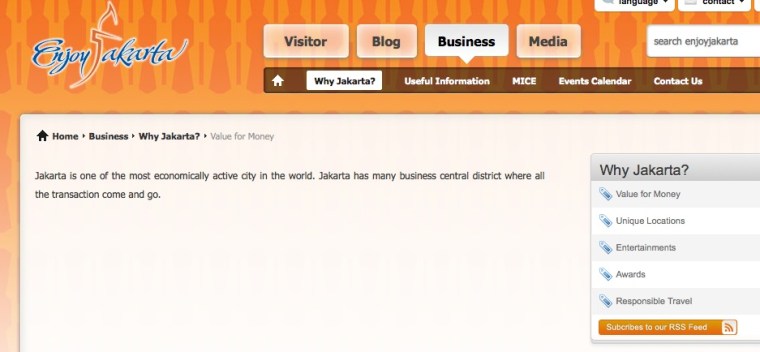
I spent some time on the site and for what it’s worth, I found the site very slow, difficult to navigate with limited information and English that needs proof reading before pubication. When I clicked on the “Why Jakarta” tab on the drop down menu, the information provided was hardly compelling and unlikely to attract investors. And talking of investors, is this a tourism site or a business site?

Not the most compelling of arguments

Moreover, I found the information above the fold didn’t match the information below the fold and when I clicked on Wine and Dine in the footer, all I got was a list of restaurants which to a first time visitor would mean nothing.

This won't mean much to anyone
This won’t mean much to anyone

Today, audiences rely less on traditional media to source information, making them increasingly hard to reach. Furthermore, consumers are less inclined to see or be interested in a corporate driven message delivered across traditional media.

But as the reliance on traditional media diminishes, opportunities arise in new and social media. Where before, companies were dependent on content from the media owners, today they can create their own content that resonates with specific consumers and their interests.

Consumers too are developing their own content and it’s important that destination brands such as Jakarta understand this and provide channels for consumers to create and share content.

It is good to see Jakarta looking to encourage visitors to this exciting city but it will take more than the print campaign and website reviewed in this article to be successful.

Great tips for using email to build your brand


More and more firms are using effective email campaigns in association with their social media initiatives to build brands. This is because an email campaign allows you to know who is opening your emails, which links they’re clicking on and how many of your them are forwarding your emails to their friends. The right product also means you will only pay when a recipient clicks through to the offer.

Malaysian firms are slowly waking up to the benefits of a good email campaign. Let me put that differently, Malaysian firms are waking up to the fact that email is an effective marketing tool. Which is good timing because according to a recent report from MarketingProfs, email returns the highest return on investment (ROI).

The problem is that too many Malaysian firms are trying to do their email campaigns ‘on the cheap’. often they do it inhouse or if they do outsource, they outsource to the cheapest company.

This means they often send out poor quality emails that can damage the brand. it is important to get the email and the content of your email right. Because this is the first interaction a potential customer will have with your brand. It is a great opportunity to make a good impression and start building the foundations you need to earn their trust and eventually make a sale.

Unfortunately, it is also a great opportunity to make a bad impression. And once you’ve made a bad impression, it is very dificult to build trust with a consumer who is already forming a negative opinion of you and your brand.

Not only should your email campaign resonate with your target markets, it also needs to be well written and to the point. If it is full of poor English or grammatical errors, you will create a bad impression with the recipient.

Below are two examples of emails I received recently. Although I haven’t included the subject line, take it from me they were almost as bad as the copy.

poor proof readingterrible email copy

How to create a good email campaign
When you prepare an email campaign, the subject line is the most important element of the exercise because this is the first thing the recipient will see.

If there are spelling mistakes in the subject line, the reader will not have any faith in what you say from there on in. If you make outrageous claims in the subject line, the email will go straight to the trash.

Finally, if the subject line doesn’t state its point concisely, it will be ignored. Accept that it is impossible to include content in a subject line that will appeal to everyone on your mailing list. It may take more time but it is better to break up your database and rewrite different subject lines and body copy for different segments.

Once you get to the body of the email, a good rule of thumb is that less is more. Don’t waffle on and on about how great is your product or use textbook marketing jargon that confuses the reader and drives them away from the product.

Keep the email simple. Remember, you are not trying to make a sale, only get the recipient to interact with your brand. Explain what you have to offer, where the recipient can get it or gather more information, who you are and why they should buy your product or service.

Finally and most importantly, focus more on the benefits of your product not the features.

Get the message right, and email is an effective and inexpensive way to make sales, grow your customer base and build a valuable, profitable brand. Used wrongly and it is a complete waste of your time and the recipient’s time and instead of making sales and building your brand you will actually damage your brand.