How Malaysia Airlines can rebuild its troubled Brand


Malaysia Airlines (MAS) embarked on a massive restructuring plan towards the end of 2011 with the goal being to reduce costs and return to full year profitability in 2013.

At the same time, the airline reported a staggering RM2.52 Billion (US$850 million) loss for 2011.

MAS logo

MAS didn’t realise its stated goal because in late February 2014, the national carrier posted a 2013 net loss of RM1.17 billion (US$356 million). This was almost three times the airline’s 2012 net loss of RM432.6 million.

So despite the restructuring plan, MAS lost RM4 billion in 3 years. Ouch.

In 2012, one assumes as part of the restructuring plan, MAS announced a business strategy with two key strategic elements – one to focus on the premium sector and the other to focus on the competitive Asian market.

I don’t know what the airline’s definition of the premium sector is but bearing in mind premium passenger numbers appear flat, a large chunk of its business comes from the domestic government and the price sensitive kangaroo routes, this may be a major challenge.

Furthermore, I’ve seen nor heard of any premium customer strategy or tactics. The ‘Flying in luxury’ section of the March 2014 issue of Going Places offers little insight into what might be happening. Even the benefits of being a platinum member of the Enrich programme haven’t changed in a long time.

Premium passenger numbers appear flat

Of course they could be referring to the upgrades to the business and first class check in counters at KLIA. Whilst they are an improvement and certainly add an air of exclusivity to the experience, they are hardly ground breaking. And the attitude of some of the staff manning these counters is often indifferent at best.

But I digress. About 18 months ago, MAS announced that it was doubling its marketing budget. The marketing budget is reported to be as much as 2% of revenue which means that in 2012, MAS spent more than RM550 million or US$190 million to focus on the premium sector and the Asian market in an attempt to rebuild it’s battered brand. That’s a tidy sum. Did it work? Based on the latest figures, no.

In 2012, the company announced it will provide a ‘better and more branded customer experience and embark on a major advertising and promotions campaign′.

I don’t know exactly what is ‘a more branded customer experience’ but as a frequent flyer of the airline I haven’t witnessed a change in or better customer experience although the terrifying vibrations at 38,000 feet on a 737 flight from Kuching to KL in January 2014 were new but I don’t think that’s what they meant.

And judging by the negativity across the Internet it would appear few others have experienced an improvement in customer experience.

In 2012 talking about the appointment of Ogilvy and Mather as the airline’s agency, Al Ishal Ishak the senior vice president for marketing and promotions stated, “2012 will be a breakthrough year for Malaysia Airlines on our path to recovery. We recognised, however, that we could not achieve financial success without clearly defining our brand positioning.”

He went on to say, “Ogilvy understood this and throughout the pitch process were best able to translate our message into a powerful campaign idea. An idea that is big enough to help us transform our business and truly engage our customers like never before.”

Judging by the advertising campaign that soon followed, I can only assume that idea revolved around journeys and suitcases. It was, in my humble opinion one of the worst advertising campaigns I have ever seen. I wrote about it here and you can see the TVC below.

What is really depressing about this whole depressingly familiar scenario is that the O&M advertising campaign aims in part to create awareness and drive visitors to the MAS website. And if improvements were to be made to the experience, one would expect logically that the website experience would be the first experiential improvement.

Sadly no, despite a RM550 million marketing budget which I hope wasn’t spent just on the O&M advertising campaign, the first page of the MAS website has a bug in it that frustrates visitors every time and the bug hasn’t been fixed for at least a year!

Another area that one would expect to be addressed during the improvements to the customer experience would be interactions with the customer service department but again, judging by this negative blog posting, the airline has not managed to deliver on its promises.

So now that MAS has posted another net loss, despite doubling it’s marketing budget to clearly define it’s brand positioning and despite not improving the customer experience, what can the airline do now to salvage its reputation and rebuild its brand?

Here are 20 things MAS needs to do now to improve its brand

1) You and the unions need to wake up to reality and appreciate that market conditions are such that unless you get rid of a large number of staff, the airline will be on my list of brands that won’t make it past 2016.
2) The organization is the brand. Many MAS staff are trying really hard but they are let down by those that don’t care. Current middle management systems don’t seem to be working. Fix them.
3) The six principles to turning around an airline and used successfully by Air Canada, ANA and Aeroflot and probably being used by MAS (a logical assumption bearing in mind the influx of management from Air Canada) include a zero compromise on quality of customer service, investments in staff training and better internal and external communications. The company is failing miserably in all these activities and needs to carry out a comprehensive review and overhaul of current practices and service providers in these critical areas.
4) Forget about the big idea. In the social economy, when consumers not companies define brands and those consumers are spoilt for choice and rarely believe what advertisers tell them, the one size fits all ‘clearly defined’ brand positioning campaign is a futile exercise that does nothing more than waste valuable funds. In this case, RM550 million of valuable funds.
5) Focus instead on consistent, ongoing, personalised engagement with each of your very diverse audiences. And start with your Enrich database! Segment that database in a way that allows you to deliver value to relevant segments today and not segments that belong to the 1980s. Travellers are segmenting into smaller niche, groups and individual travellers and they are willing/able to manage the whole process themselves. Talking to them requires more than an advertising campaign. See point 5.
6) FIX THE BLOODY BUG IN YOUR BOOKING ENGINE! It doesn’t matter what it costs just fix it! If your global advertising campaign did make a prospect visit your site and she then had to go through the ridiculous moves required to enter a destination or departure city, they’d soon leave thinking, ‘if they can’t make a simple fix like that, what are they not fixing on their aircraft or elsewhere?’
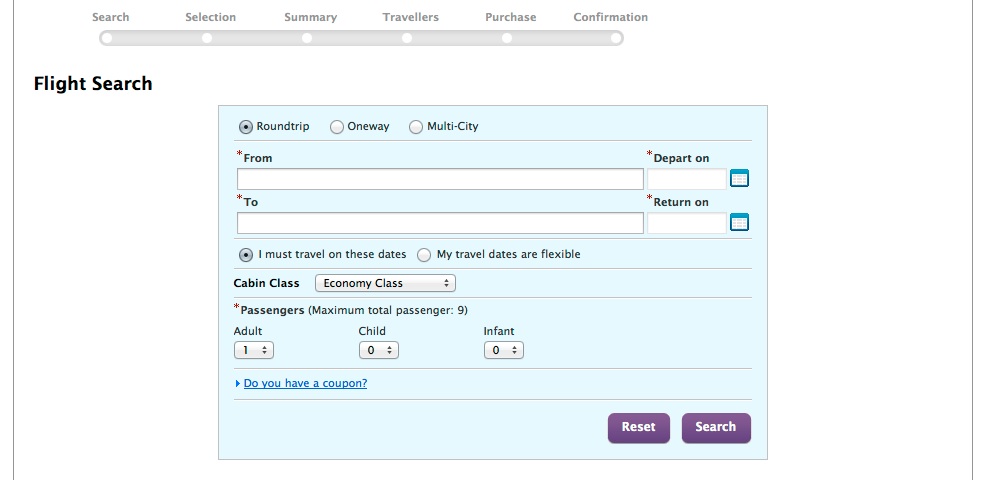
Why is it so hard to fill in the 'to' and 'from' fields?
Why is it so hard to fill in the ‘to’ and ‘from’ fields?

7) Because it’s so important, your database gets a double mention. A chunk of your brand’s profitability will come from your existing customers. Instead of spending RM550 million on an outdated advertising campaign that seems to want to acquire and retain customers, start to use what is probably one of the most comprehensive databases in South East Asia, properly.
8) Focus. These ‘one-size-fits-all’ advertising campaigns are an expensive exercise in naïve futility. Put an end to them now. If I’m repeating myself its because the marketing budget is being wasted on outdated mass market models.
9) Don’t do social, be social. Pushing one size fits all advertising campaigns out across social media is pointless. It’s not a television or a radio so don’t use it like one. Social is dynamic and you need to be dynamic to get the most out of it. Stop using your Facebook as another broadcast platform. And stop ignoring negative comments and blog posts and instead, engage with the authors.
10) Integrate all your solutions to make it easier for consumers to use them. 40% of business travellers and 25% of leisure travellers in Asia now use mobile or tablets for travel but as far as I can work out, the MAS app (when I can get it to work) isn’t integrated with my online profile. Why not?
11) Stop spending, no wasting huge amounts of money on forgettable mass market advertising campaigns and start building a brand.
12) Train your staff, and start with your customer relationship staff. Whoever is doing it now isn’t doing a good job. Find someone who really wants it and make your staff the best in the world.
13) You have a legion of brand angels out there who are desperate for you to succeed. Do you know who they are? If not, you need to identify influencers and quickly leverage on their passion for your brand.
14) Seek new revenue streams. Of course you are already doing this but there are a couple of opportunities that you are not exploiting and you should be.
15) You are not a low cost carrier so stop trying to be one.
16) Get those new aircraft, now.
17) Stop focussing on costs and start focussing on delivering value.
18) Don’t compromise on anything related to customer touch points, whatever the cost.
19) Image is everything. The change in the look of some aircraft was a great development but what about the rest of the fleet? There seem to be three different liveries for the MAS fleet. And what about the uniforms? A partial change was made to some male uniforms but what happened to the rest of them? Is this a strategic project or an ad hoc one? Whatever it is, consistency in a brand image is a must.
20) One last comment on segmentation. Each segment within each country has completely different requirements for value. In Indonesia small businesses employ 80% of employees. In Malaysia, SMEs account for as much as 99% of businesses. In Japan, 20% of leisure travel is by the over 65s. What do you know about these segments and do you have a brand strategy to communicate with them?

Not many legacy carriers have remained profitable following the intense competition in the airline industry. Even without the massive interference of the governments of the past, MAS has found it tough to adapt to increased customer expectations, LCC competition, fluctuating fuel prices and rising costs.

The days of using cost cutting and outdated mass marketing communications campaigns to drive restructuring plans are over. The future will require an even more nimble approach and a focus on delivering value to diverse segments on their terms.

Only then can MAS out maneuver budget airlines and other new entrants into the market and become profitable once again.

Old fashioned marketing won’t help Wonda achieve 20% market share in Malaysia


Wonda Coffee, owned by Asahi Group of Japan used The New Straits Times (NST) a Malaysian daily to launch its hallmark canned coffee with what the NST called “its first 5D advertisement campaign.”

According to the NST the campaign for the ready to drink coffee was “widely touted as the most amazing print-enabled campaign.”

It ran for four days and readers of the newspaper were promised they would be able to “engage their senses of touch, sight, sound, smell and taste with the launch of Wonda.”

There were multiple teaser ads before the launch, at least four full page ads in one edition of the paper, wraparounds of another, a four page ‘pop-up’ ad and sponsorships of whole supplements of the paper that required the use of 3D glasses. The 3D glasses were supposed to come with the paper but ours didn’t.

There were advertorials on the benefits of coffee, teaser ads and even a little music box that played a Wonda coffee Jingle that probably went out across radio. I couldn’t get it to work although it does now play occasionally, normally when nobody is near it.

Typical Wonda print ad

There were also multiple messages, taglines and headings used in the campaign that I found confusing.

I don’t know the cost of this campaign but it won’t have been cheap. It is not uncommon for a brand to launch with a mass advertising campaign like this. It’s the wrong way but if you give your product launch to an advertising agency, what else can you expect?

One of the key points of a launch is to ensure that if any buzz is created and consumers buy into the idea of the product, their ability to engage physically with the brand must be seamless. In other words it needs to be available or better still be everywhere the consumer goes.

Although I’m a coffee drinker, I’m not a fan of instant coffee but I decided to buy the product. On the third day of the campaign, I went down to my local convenience store to buy Wonda. They sell most drinks here except it would seem, Wonda.

The following day the NST carried another full page ad for Wonda coffee with a coupon offering a can for 10 cents if you buy from 7eleven. So I tore out the coupon and went over to the local 7eleven. I had a look in the fridges and there was no sign of Wonda coffee. Competitor brands from Nescafe and others were represented and selling for RM1.90 (local brand) – RM2.20 (Nescafe).

I showed the coupon to the assistant and asked for my 10c drink. He wasn’t aware of the offer. However after some cajoling and a couple of rereads while the queue grew he went to the storeroom and got me a can. I asked what the retail price is and he said RM1.90. On the tin it says premium coffee yet is priced below Nescafe.

Since the big splash in the NST I’ve seen Wonda coffee posters at toll booths and there is at least one TVC (see below) so they are obviously spending a lot of money on traditional media.

But of course the initial buzz around the product launch will die down within a week or two once the advertising has stopped. In this era of social media, there is a great opportunity to maintain any traction by taking the marketing to the community.

I had a quick look on Youtube to see if there is a consumer driven competition there. All I could find was this TV commercial.

The TVC has been up for a month and has only received 400 views. Interestingly not one like or dislike. Seriously underwhelming but at least we know they haven’t paid for likes!

Determined now to find out how Wonda is engaging consumers on Social Media I figured there would be a big splash on Facebook, right? Nope. I couldn’t find anything. Twitter? Nothing.

I wonder why Wonda isn't using FB to launch itself
I wonder why Wonda isn’t using FB to launch itself

So here we are in 2014, launching a new product in Malaysia and there doesn’t seem to be any use of social media!

Even though Facebook is the most visited site in Malaysia – There are 10.5 million Facebook users in Malaysia (out of a population of about 27 million) and 3.5 million of those are 18 – 24, probably the perfect target market for this product. Social media is responsible for 33% of all web traffic in Malaysia.

Globally 93% of marketers rate social tools as important and 90% of them support this by using social media channels for business. In this social media dominated era, why aren’t the team responsible for launching Wonda using Social media?

Now of course I don’t know what else is involved in the launch of Wonda and it could be that some sort of Social media presence is part 2 of the launch.

Although not the right way to launch a product, I hope this is the case because ultimately, it will be consumers on social media who determine the success or failure of Wonda Coffee and not a traditional campaign pushed out across traditional media, no matter how creative it is and how ‘amazing’ it is.

Asahi is targetting 20% of Malaysia’s coffee beverage market with Wonda. If it continues to use old fashioned methods to launch and market Wonda and doesn’t leverage on Social Media, it won’t achieve this goal.

Is this the scariest tyre commercial of all time?


This Japanese commercial for tyre manufacturer Autoway comes with a health warning that recommends those with a heart condition, physical or mental problems or those who visit their doctor on a regular basis should not watch it.

It’s a clever if rather radical attempt to sell tyres. I’ve written about ‘shock and awe’ advertising here. Traditionally, it hasn’t been very effective, in markets like Malaysia, Singapore, the UK and Australia.

As an example, in Malaysia, despite nearly US$50 million spent on shock and awe campaigns to create awareness of the dangers of smoking, the number of smokers has practically doubled every 10 years.

Of course the success of this campaign will depend on what other initiatives are carried out and on which channels.

Whether or not there are parallels between campaigns for smokers and those who buy tyres, I don’t know. Perhaps this will be different, what do you think?

Volvo truck commercial goes viral, but will it help build the brand?


In 2011 Volvo posted its largest year-on-year increase in truck sales for the North American market. The market saw an impressive sales volume increase of 75%.

Since then the company has struggled to compete in a tough economic environment and even though 2012 saw the overall truck market in North America rise 52%, Volvo, owned by Geely, China saw sales drop by 6%. The company recorded double digit drops in China and Sweden and predicted a tough 2013.

At the same time, there is a boardroom fight going on between Chief Executive Stefan Jacoby and Vice Chairman Hans-Olov Olsson that often gets bitterly personal.

In Malaysia the company has faired better with 2012 sales up an impressive 42% from 2011. I haven’t seen any advertising campaigns for Volvo trucks in Malaysia but the latest commercial has gone viral and will no doubt get some coverage here.

The commercial features Jean Claude Van Damme doing the splits between two Volvo trucks driving backwards into the sunset to an Enya tune. It’s an impressive stunt and JC is in excellent shape but will the commercial make a difference to Volvo truck sales?

Will this impressively produced commercial get potential customers to review their purchasing options? Will it get logistics companies to revise their transportation tenders to include the line, “All vehicles must come with the equivalent of Volvo’s Dynamic Steering System”?

Surely such a unique and impressive bit of technology needs to be experienced by a potential driver/buyer first hand?

Of course I don’t know the full extent of the Volvo truck brand strategy going forward but to me, whilst the exploits of JC are impressive I find them a distraction, damaging the attempts by Volvo to draw my attention to a cool bit of kit. Do you agree or am I just an old cynic?

Virgin America safety video raises the bar for airline Brand content


In my previous post I gave 10 reasons why you should use video to build your brand. You can read that post here

But there needs to be a creative element to those videos. Looking at the airline business, far too many carriers believe the bulk of their marketing dollars should be spent on well produced but hugely irritating glossy videos featuring pretty stewardesses, cute kids and seats that look further apart than they are on any plane I’ve ever flown.

A case in point is Thai Airways. In 2010, to celebrate its 50th anniversary, the carrier released a well produced video that gnaws at the heartstrings but does little new to differentiate it from competitors.

The video has generated a respectable 150,000 views since its launch in 2010 but only 400 likes which would suggest it has made very little impact.

There are some though that are doing their best to move away from this predictable and instantly forgetable approach. Most recently, Virgin America and Air New Zealand have approached the safety video from a new direction.

Instead of the oft ignored stewardess standing self consciously in the aisle and demonstrating how to use a seat belt, where are the exits, how to put on a life jacket and what to do when the oxygen mask drops, these airlines have gone to great expense with a refreshing approach to the tried and tested.

Earlier this week, on the 29th October 2013, Virgin America launched an airline safety video that it claims is the first safety video set entirely to music. They are probably right and the result is impressive.

Obviously I’m not the only one to think so as the video has already been viewed by more than 700,000 people in just two days. What I like about the Virgin video is that they are keeping the story live by inviting dancers to audition for future versions.

Potential participants must send an Instagram video to a specially set up safety dance battle website. Some of those Instagram videos, that can only be up to 15 seconds long will then no doubt take on a life of their own, thereby continuing the Virgin America narrative. So far, the video has over 13,500 Likes on YouTube.

Earlier this year Air New Zealand teamed up with Eton educated ex SAS officer Bear Grylls to create a unique and captivating safety video. The pretty stewardess and cute kids are still there but I’m sure you’ll agree the rest of the cast is unusual!

To date, the Air New Zealand video has garnered more than 277,000 views on Youtube. Not bad for an inflight safety video!

I did a quick search of Youtube to see what Asian airlines are doing on Youtube. Cathay Pacific has created a lot of content some of which has generated a lot of views. Last year they did a ‘Day in the Life’ feature with flight attendants, pilots and ground crew.

This video of a day in the life of Grace, a flight attendant has a respectable 200,000 views but not too many likes.

Malaysia Airlines YouTube page suggests the carrier is creating a lot of video content but judging by the numbers of views it isn’t compelling enough for consumers to engage with, Like and share. However, when they do get creative, or rather innovative interest in the brand goes through the roof, as shown by this flashmob video that has generated over 1,100,000 views in just under 2 years.

Unfortunately this project appears to be tactical rather than part of a strategic initiative because it doesn’t seem to go anywhere or be integrated with any other activities.

According to Cisco, 90% of all Internet traffic will be video by 2017. These Asian carriers need to start producing content that is interesting and relevant. And that content needs to be part of a planned, strategic story that resonates with target markets in order for those markets to engage with and share across the ecosystem. Otherwise it becomes just another piece of expensive content that is out there, rarely viewed and therefore ineffective.

10 reasons why you should use video to build your brand


Video is no longer a ‘nice to have’ it is now a ‘must have’. Here’s why:

1) According to Google, YouTube uploads have increased from 40 hours per 60 seconds in 2011 to 100 hours per 60 seconds in 2013.
2) As attention spans decrease, video is twice as effective at getting a viewers attention.
3) Video flot states that 20% of visitors to a site will read content in the form of text but 80% of visitors to the same site will watch the same content in video.
4) Visitors to a site who view a video stay 2 minutes longer on the site and are 64% more likely to make a purchase than other visitors.
5) 78% of people watch a video online at least once a week and 55% watch one everyday. threemotion
6) 80% of Internet users recall watching a video ad on a website they visited in the past month. 46% took some action after viewing the ad. Online Publishers Association
7) 90% of information transmitted to the brain is visual, and visuals are processed 60,000 times faster in the brain than text
8) 500 years of YouTube video are watched every day on Facebook, and over 700 YouTube videos are shared on Twitter each minute. YouTube
9) Video results have appeared in almost 70% of the top 100 search listing on Google in 2012. Marketing week
10) Cisco reports that 90% of all Internet traffic will be video by 2017.

And if you are still not convinced, have a look at this impressive video from visually

by alboardman.
Explore more infographics like this one on the web’s largest information design community – Visually.

Malaysia Airlines achieves 1 million Likes on Facebook


Malaysia Airlines issued a press release yesterday announcing the airline has one million “Likes” on Facebook.

You don’t need me to tell you Facebook is massive. But I will. Facebook is massive. If it were a country it would be the third largest in terms of population, the largest in terms of area covered and probably the richest in terms of income.

So it is understandable that MAS wants to use Social Media and in particular Facebook, to build its business. Indeed, Khairul Syahar Khalid, Malaysia Airlines’ Head of Advertising & Promotions says, “Social Media is a new frontier for marketing, and as many brands have discovered, going on social media certainly pays.”

Encik Khairul adds, “We have positioned social media at the forefront of our marketing mix. We will be pushing the boundaries even further with our next marketing plans, all of which will see the social media platforms at the forefront. We want to continue to engage with our fans globally at a much deeper level whilst growing our footprint further. Growing our engagement with fans globally has contributed significantly to our business turnaround successes.”

Crediting Social Media with providing a significant contribution to the improvements in the airline’s performances recently is interesting and shows how important is Social Media.

Personally I think it is exciting that MAS is pushing the boundaries even further on social media, especially after the dreadful advertising campaign that is still being run. For more on that campaign please refer to this article

To thank fans for helping the airline reach one million ‘Likes’ on Facebook, MAS created a video with their social media ambassador, Malaysian singer Yuna. The video has been viewed 2,000 times since its launch a week ago.

Incidentally, I believe the Malaysian government has missed a trick here because I think Yuna should be the face of the Malaysia Nation Brand. You can read more about that here.

But how important are Facebook ‘Likes’? Are they a relevant metric for a business? What do they tell us and how can we leverage them?

The bad news is that 96% (BrandGlue goes even further, stating that only 0.02% of fans who ‘Like’ a page ever return) of ‘fans’ never return to a page after liking it. Moreover on Facebook, most posts are seen only by about 10% of fans.

Another little known fact about Facebook is that when fans create new posts on your Facebook page, other fans don’t necessarily see them. In other words, just because you go to your fan page doesn’t mean your fans are doing the same.

Consumers are increasingly sceptical about Facebook ‘Likes’ because it it is so easy and cheap to buy them. Twipquick is offering 100,000 Facebook ‘Likes’ for about US$750.

Any social media strategy must have clearly defined target markets and relevant customer data and content must be developed that will resonate with those customers. This content must resonate with those target markets. After all, there aren’t any groups for 18-35 year olds on Facebook.

MAS must avoid taking its advertising campaigns and trying to push them out across social media. Taking a video and dubbing it into the local language is not a social media strategy. This is simply mass economy marketing and there is no place for that model in the social economy where customers not companies define brands.

MAS must engage consumers and encourage them to contribute to the MAS story and then share and encourage the sharing of that content whilst enabling multiple channels for consumers to interact through.

At the same time, MAS must not forget its existing customers. MAS has millions of frequent flyer members but it currently neglects these existing customers, despite spending a lot of money to acquire them.

You need to track the reputation of your brand online: Infographic


Recently I was asked to map out a plan to develop some substance around the CEO of a major organization in Malaysia. The belief was that although he heads a hugely successful company, his personal brand lacks gravitas and this may count against the firm in the long run.

And they were right because the reputation of a CEO is inextricably linked to the reputation of a company. Just look at the fortunes of any CEO who had a good reputation then lost it.

Or the fortunes of a business whose reputation was painstakingly built over years, only to fall in a heartbeat because of C level indiscretions or dodgy practices.

Here in Malaysia errant CEOs generally leave quietly so we don’t often hear about such reputational issues but there are plenty of examples of the above. Because of the increasingly litigious nature of society, I’m not going to name names but think of the automotive, aviation, banking, steel and telecommunications industries amongst others and you should be able to work out who I am talking about.

Even in the consumer trenches, a company with a poorly respected CEO or dodgy reputation is going to struggle to find enough customers to build a brand. After all, would you buy from a company with a poor reputation? If a company with a questionable reputation submits a tender to your company, would you consider them? With so many alternatives in the market, there is no need to do so.

Even if the CEO has a solid reputation, he is often the difference between the company and a competitor. If he lacks charisma he may struggle to compete effectively. Tracking his reputation online will enable firms to identify what issues to address, in which channels and where and when. The effectiveness of solutions can be tracked and improved almost immediately.

In today’s social economy, where consumers not companies define brands it is imperative that every organization tracks its reputation online. This is even more important here in Asia where consumers are more likely to take to social media to complain and raise issues rather than connect directly with a company.

Unfortunately many companies still don’t see the benefit of tracking their reputation. Hopefully that will change with this handy infographic from Digital Firefly which shows why companies need to make reputation management a top priority – NOW!

Tracking your reputation online has never been more important

Poor database management can destroy your brand’s credibility


My inbox is overflowing with ‘invitations’ to attend numerous conventions, exhibitions, masterclasses, seminars and so on. I don’t know where these guys get my email address but I must be on every mailing list from Malaysia to Mexico.

I’ve trained my junk mail filter to send most of them to the trash without me having to do it manually but somehow, quite a few still get through. One company is particularly good at getting around my filter and I find myself actually reading the subject line or even some of the copy, especially when I can’t find anything with which to self harm which is what I would prefer to do.

Normally I just swear at the sender, make a note of the company name and promise myself that I will never, ever attend one of their events and then just trash the email. But I thought I’d share this one with you so that if you are in the event or seminar business, you might learn something.

Here is a section of their most recent email

Not quite relevant to brand consultants

Of course her earlier email was included so I’m going to share part of it with you

Who is responsible for boilers? Are you serious?

You can draw your own conclusions from this farcical attempt to get the head of boiler operations at a brand consultancy to attend a seminar, the benefits of which are according to the email, “boiler efficiency, improved water strategy and analysis, better understanding of modern boiler burner operations as well as easier identification of its failures, by reducing cost and increasing safety and finally better understanding of legal requirements of Dosh

Tosh more like. If you must use email campaigns to try and drum up business, here are 5 top tips for an email campaign:

1) Give recipients an opt out from your list. This email doesn’t even allow me to unsubscribe, which may well be illegal.
2) Segment your list or risk destroying your brand. You’ve collected information, use it properly. Failure to do so may see you embarrassed on a blog.
3) Make your subject line creative, short and sweet.
4) Less is more. Trust me, the more emails I get, the more determined I am not to attend any of the seminars listed.
5) Track your customer activities. If they don’t respond to any emails, get in contact and find out why.

There you are, despite annoying me I’ve given you some sound and free advice. I shall be sending this post to Anna. Feel free to send it to anyone who keeps sending you irrelevant emails.

Endless possibilities have ceased to be endless


It’s official, the new tagline that was supposed to launch the Malaysia Nation Brand will not now be used. The official launch for “Endless Possibilities” was supposed to be yesterday however it was cancelled. You can read more about the cancellation here.

Oops

My sources tell me that McKinsey, Futurebrand, Leo Burnett, McCann Erickson and O&M were all involved although I haven’t confirmed this. Ignoring the fact that not one of them bothered to Google the phrase “Endless Possibilities” before giving it the Prime Minister and causing him much embarrassment, my main concern is that the whole sorry process will be repeated once again and we’ll see them trying to retrofit the Malaysia Nation Brand around a tagline.

This is not the way to build a Nation Brand. You can get insights into how to build a nation brand here and here