5 lessons to be learned from the “Endless Possibilities” Branding blunder


On the 5th September 2013, I reported that the newly developed tagline for Malaysia “Endless Possibilities” would not be used. You can read the full story here. The official launch was supposed to be on 17th September 2013 but this has now officially been ‘postponed’. This is a hugely embarrassing situation.

Malaysia tagline: Dead in the water

Background
According to an article in the Malaysian Insider on 12th September 2013, “…the campaign and tagline was refined by two foreign consultancies and a market research firm after discussions with officials from the Prime Minister’s Department.”

The article goes on to say, “”The consultants refined it from the phrase ‘Endless Opportunities’ which was used in a speech to ‘Endless Possibilities’.”

An advertising agency was then called in to create the logo, which the Tourism Ministry used together with the tagline last year before it was used in Davos.”

This process began in December 2011 and the new tagline was given its first outing by the Tourism Ministry in Dubai in 2012. It was due to be launched officially on 17th September 2013, almost two years after the project was initiated. You only need to read this blog or those of any other destination branding experts to know this is not the way to build a destination brand. So what can we learn from this nightmare?

Here are 5 general lessons we can learn to ensure that next time the Malaysia Nation Brand project is executed properly:

1) If I’ve said it once, I’ve said it a thousand times, YOU CANNOT DEVELOP A TAGLINE AND THEN RETROFIT A BRAND AROUND THAT TAGLINE USING ADVERTISING AND PROMOTIONS. It is a fundamental of branding. If you are responsible for developing a Nation Brand you must understand this. I don’t care if someone gives you a tagline and tells you to build a brand around it. It simply is not possible and you have to stand your ground.
2) A tagline is not a brand. Let me say it again, A TAGLINE IS NOT A BRAND. Too many taglines have made promises the Nation couldn’t possibly keep, have left potential customers underwhelmed, have been lost in the clutter of advertising noise or have been ruined by an event beyond the control of the Nation. Moreover, we live in a social economy. What is the first thing a prospect will do when he hears a tagline? He will look to the Internet to find out what is being said about the country. If he sees more negativity than positivity, he’ll believe what others are saying, not what the Nation says. It won’t matter how much you spend on corporate driven messages pushed out across mass media that try to convince him otherwise.
3) Ask yourself how many great ads you remember from yesterday or the day before. Not many, right? Even those in the industry find this a tough question. There is so much advertising noise that it is very hard for a campaign to be seen, let alone remembered and acted upon. There is a place for advertising countries, but not for using advertising to gain traction for the brand.
4) Just because you hire a research company to do your research, doesn’t mean you’ll get the right research. And if you are starting with a tagline and trying to retrofit your brand around that tagline, your research is going to be flawed before it even starts. After all, how can you develop the right research methodology if you are starting from the wrong place?
5) If you insist on starting with a tagline, Google it first before you do anything. A Google search of “Endless Possibilities” throws up 13 million results including destinations that have already used it – Mongolia, Israel, Sagada, corporations – BHS India and conferences, t-shirts, singers etc. Every stage of every element of any brand development should be checked and double checked again.

13 million results requires some investigation before acceptance

There are other, more specific lessons that can be learned from this issue but there is nothing to be gained by outlining them here. Let’s just hope that to avoid any more lost time and money, the project will now be carried out the way it should have been in the first place.

Case studies of how two Malaysian brands used technology in a crisis


This article looks at two high profile situations in Malaysia and how these very different institutions used technology and social media to communicate with and engage stakeholders during a crisis.

Case study one: Syabas
Syabas (pronounced Sha-bas) provides water to the state of Selangor, the largest and most developed state in Malaysia. Following a diesel spillage on the Selangor river (a major source of water) at the end of August 2013, Syabas shut down four treatment plants, essentially cutting off water supply to nearly 1 million homes. I was personally affected by this issue and was without water for over 24 hours.

When my taps ran dry, the first thing I did was go to the Syabas website where I was greeted by a pop up press release telling me there was no water. I also found a 1800 number. I called the number and a recorded message told me to go back to the website. I revisited the website which told me that I was living in an area that was affected by the shut down. This wasn’t really very helpful as I new this because my taps were dry.

Not really helpful
Not really helpful

So my next stop was Twitter. I found the Syabas Twitter feed and fired off some tweets asking for more specific information that would allow me to plan for my family of seven who could not shower, flush toilets, wash clothes and make contingency plans for our open house scheduled for Sunday 1st September.

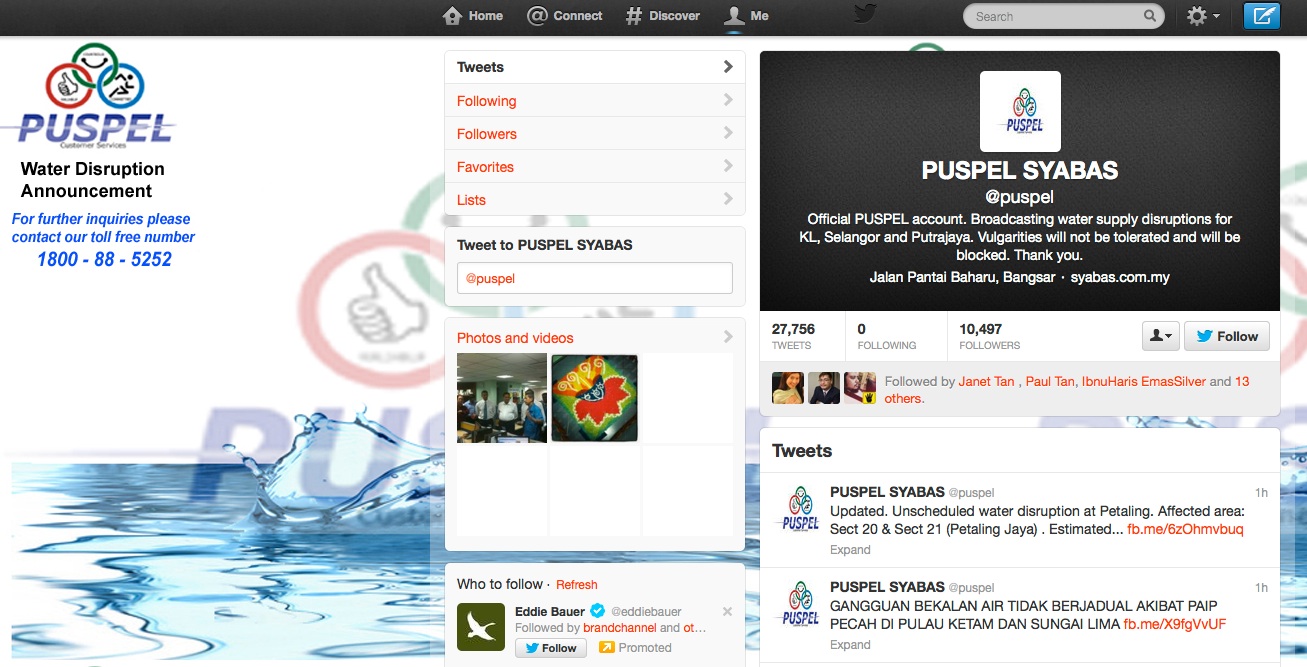
None of my tweets generated a response. I was stunned to find Syabas has over 10,000 followers on Twitter but doesn’t follow one person. I appreciate that not many companies have the resources to listen to what their customers are doing all the time however, one of the key reasons for being on Twitter is to be able to quickly identify conversations and trends about their business, their brand and their services.

No followers makes it hard to use Twitter effectively

This then allows brands to address issues in a transparent, prompt and empathetic manner and also leverage positive comments and discussions, join in with the conversation and encourage engagement.

So after trying the 1800 number, the website and the Twitter page, my last resort to try and get some actionable data to help me plan ahead was to go to the Syabas Facebook page.

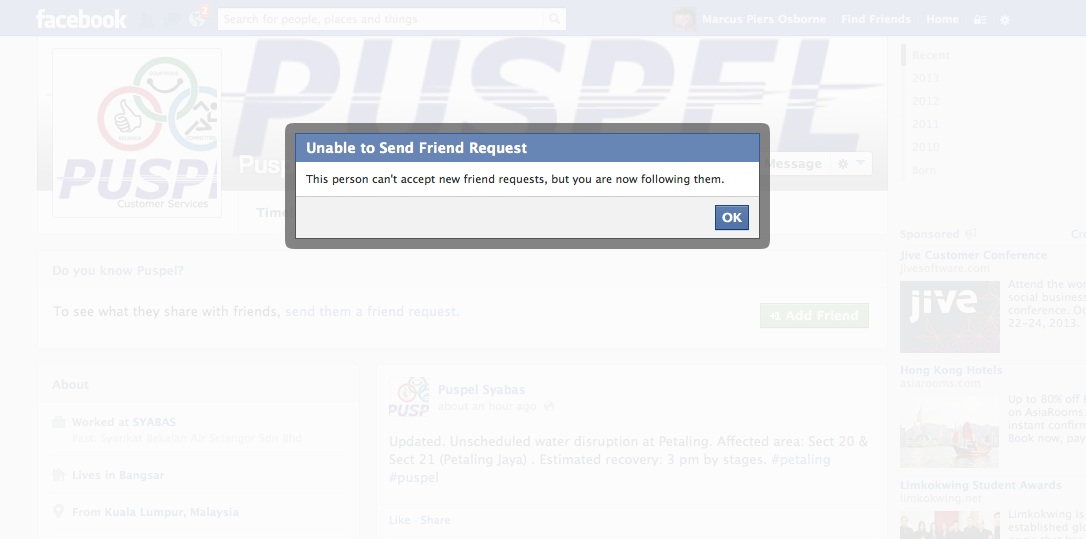
No luck on Facebook because Syabas had disabled the comments function which meant that I could follow them but couldn’t make any comments! As they were only reposting the press releases posted on the website, this was pointless. So I was unable to source any information that was relevant to me or get specific answers to specific problems.

Please listen to us but don't ask us anything
Please listen to us but don’t ask us anything

Incredibly, Syabas was on every social media platform yet was using those platforms not to engage with consumers but to broadcast only the messages it wanted consumers to hear. All Syabas seemed to want to do was push generic and pointless press releases to consumers. Yet the whole point of these platforms is to allow consumers to interact with the brand and get closure on personal issues.

And this is particularly relevant when it comes to negative issues or complaints. During a recent stay at the Marina Bay Sands, I complained on Twitter. Within 30 minutes the MBS was following me and asked me to follow them back so that they could send me a Direct message. Not only did this make me feel someone was listening, it also allowed them to take my complaint out of the public domain. The Marina Bay Sands has 8,500 followers and follows almost 1,700 people.

The irony of this situation is that Syabas actually dealt with the physical problem very efficiently and the water was back online to over 650,000 consumers within 36 hours. But by then it was too late and what could have been a PR success turned into a social media nightmare as frustrated consumers turned to forums, online newspapers and social media to vent their anger.

Case study two: Sekolah Sri Cempaka
Sekolah Sri Cempaka is a private school in Malaysia. It quickly embraced the arrival of technology in the classroom and places a great emphasis on communicating with students via its digital platform, Schoology. On Saturday 7th September 2013 a fire broke out at the school in the exclusive neighbourhood of Damansara Heights in the suburbs of Kuala Lumpur.

Within an hour Twitter was awash with chatter and soon after images of the fire were all over Twitter and Facebook. This fire could not have come at a worse time for the school with students busily preparing for critical exams.

The school quickly announced the fire simultaneously on Twitter and Facebook. The school then expanded its reach on both Social Media and the school Intranet to communicate with concerned students and parents.

Openness and transparency, success factors for social media

Throughout the next 36 hours numerous rumours developed and began to spread however, the school was quick to inform stakeholders of the real situation. By acting quickly and in a transparent, engaging manner, students and parents were reassured and potentially damaging rumours were negated, before they got out of control.

As the crisis unfolded, the school maintained contact with students and parents. Sharing with them the important developments – news of the damage, the fire department inspection, plans by the school, discussions with the education ministry and so on. This gave concerned and busy parents a regular stream of credible information which allowed them to plan ahead.

cem2

The new technological landscape is here to stay. Here are five things you must do now to prepare your company for a crisis:

1. Every company, government department and institution should have a clear, transparent, policy on social media and a clearly defined social media crisis management strategy to address comments/posts on the website or social media pages during the crisis. And this should be part of a grater social media plan.
2. Make sure you have enough properly trained staff to administer your social media pages and respond to issues raised by angry consumers.
3. Unless there is a potential threat to your organisation or your staff, transparency is key.
4. Always, always, always engage. Ignoring consumers or shutting down conversations is the worst thing you can do.
5. Have a back up solution ready for such situations.

These two institutions responded very differently to a crisis. One got it right, one didn’t. Which one best represents your brand?

MCA needs to work on how it communicates its brand


I hate to blow my own trumpet but there are times when I really don’t have a choice. I came across this promotional video for the Malaysia Chinese Association (MCA) which represents the interests of the Chinese in Malaysia’s Barisan Nasional political alliance.

I don’t know if this video is the reason but in the recently held general election in Malaysia, MCA won only seven parliamentary seats out of 37 and 11 state seats out of 90 the party contested. The song was voted the worst ever election song by an Australian TV station.

One thing is for sure, this video won’t have helped the party and I would like to offer my services to the MCA. I promise you, whatever I do for your brand will be an improvement.

Back to the drawing board for Brand Malaysia


Word reaches me from reliable sources that “Endless possibilities” the Nation Brand tagline chosen for Malaysia and scheduled for an official launch on 17th September will not now be used.

The tagline was panned from the outset, primarily because it was used by Mongolia and Israel. Trying to communicate a Nation brand promise in a few words or sentence, which is essentially what a tagline does, is becoming more and more complicated, not least because most of the best superlatives have already been used up but also because we live our lives very differently today and we’re not easily convinced by contrived messages anymore.

What most destinations fail to understand is that a tagline is not the first step in developing a Nation brand. Because what this creative driven approach aims to do is create a slogan, build an advertising campaign around that slogan, cross your fingers and hope that target markets will see it, buy into it and act and it will then become a brand. But this approach ignores what are the foundations for any destination brand strategy – stakeholder buy-in.

Unfortunately, because such a slogan is often created by an advertising agency there will be beautifully produced print and TV ads that woo key officials who immediately believe what they see in the slogan and of course buy into it themselves.

As we can see with “Endless Possibilities” this model does not work. So what should be Malaysia’s next move? The first thing is to establish a Branding Malaysia panel or task force. This panel should not be lead by someone with a creative background because this is not a creative exercise.

This panel will be tasked with carrying out extensive internal and external research to identify what Malaysia has to offer to what I hope are already identified target markets and sectors. Subjectivity and a grip on reality are required to make this stage work. I know it’s not sexy and requires a lot of boots on the ground but this phase is critical to the long term success of the project. Once research data is compiled and analysed, a blueprint to present the nation to the relevant audiences and not to the whole world will be created.

This blueprint will lay out the implementation process and feature clear timelines and responsibilities, communications strategies and channels, influencer relationship development, budgets, targets and possibly and only if necessary, a tagline.

This is a brief overview of how to build the Malaysia Nation Brand. A mistake has been made, never mind, let’s get it right the second time.

Why the tagline “Endless Possibilities” doesn’t matter


Those responsible for developing the Malaysia Nation Brand have come in for a lot of flack since the announcement by the Prime Minister that ‘Endless Possibilities’ was the new Nation Brand tagline.

And then, after several days of negative comments, respected news portal the mole reported last Thursday that the official launch of the tagline may be scrapped or at least delayed.

Frankly I’m stunned to hear there may be a U turn on this project almost before it has begun because the tagline has a minor role to play in the context of nation branding and what it is doesn’t really matter.

Because whatever tagline is chosen will have very little impact on the success or failure of the Nation Brand project and furthermore, it will be forgotten sooner rather than later.

Does anyone remember “Indonesia: Admit It You Love It”? Or for that matter the globally ridiculed and grammatically incorrect “Celebrating 100 years of Nation’s awakening.” Of course you don’t yet Southeast Asia’s largest economy has achieved growth of more than 6% in four of the last five years. That’s four of the last 5 years since 2008 when the world went into economic meltdown. Remarkably, in April – June 2013 the country attracted US$6.5 billion of FDI, up 19% over the same period last year.

Tourist arrivals to Indonesia have also shown significant growth and in the first half of 2013, the number of foreign visitors was up 7.18% to 4.15 million from 3.87 million in the same period in 2012.

Some time ago Germany, normally the poster boy of well thought out strategic initiatives came out with the bland, pointless and rather unlikely “Germany, affordable Hospitality.” Nevertheless, the country is the rose amongst thorns of European economies.

Some of the best and iconic country taglines are those that evoke a sense of the place they describe such as “New Zealand 100% Pure”, “Switzerland Get Natural” or “Montenegro Wild Beauty.”

And who can forget ‘cool Britannia’ introduced by the British Labour party in the late 1990s and created to communicate Britain as a vibrant, trendy and cool country. There was a similar backlash to the one in Malaysia and the UK tourism authority disagreed with it so much they went off on their own and created “UK OK” as a tagline. I doubt anyone reading this remembers either tagline but it hasn’t stopped the UK becoming the leading European destination for foreign direct investment, securing 1,559 investment projects that created 170,000 jobs. In fact, while global FDI inflows declined by 18%, FDI inflows into the UK rose by 22%

As Malaysia has discovered, finding a superlative that hasn’t been used is not an easy task but choosing one that has been used doesn’t mean it can’t be used again.

In fact, one could argue that the very fact that so many countries and companies have used “Endless Possibilities” could be considered proof that in fact the opposite is true and that this is a good tagline.

Malaysia Airlines needs to up its digital branding game


In 2012, online advertising spend breached the US$100 billion level for the first time. And forecasters are predicting double digit increases for the next couple of years.

But the types of ads are extensive, from pop-ups to banner ads, to text ads to display ads and so on. There is no consensus on what works the best and what doesn’t but studies suggest that interstitial ads (those that appear when you move from one page to another) animated ads and pop-up ads have the highest visibility, but have low click-through rates.

Whereas banner ads suffer from what the industry calls “banner blindness.” Which basically means that users have stopped seeing them.

According to one company in Australia, for every 1,000 people who see an online ad, only 1 will click on it and the average conversion rate for most sites is 2% which means that you require 50,000 people to see your online ad before you are likely to make a sale.

Another company, Digiday states that only 8% of Internet users account for 85% of clicks on banner ads and that 50% of clicks on mobile banner ads are a mistake.

But digital advertising will continue to grow especially as advertisers online can target their messages at the right segments, thanks to increasingly sophisticated technology. But with such low penetration, you need to get the content right so that when the 1 in 50,000 comes along, there is a good chance they will buy whatever it is you are selling.

I’ve had a go at Malaysia Airlines a few times and I’m probably not very popular with them which is a shame because I’m a big fan of the brand and in some areas, they are trying very hard to build a global brand. But I don’t believe the airline is demonstrating high levels of branding professionalism. Most recently I had a go at their latest advertising campaign. You can read that story here.

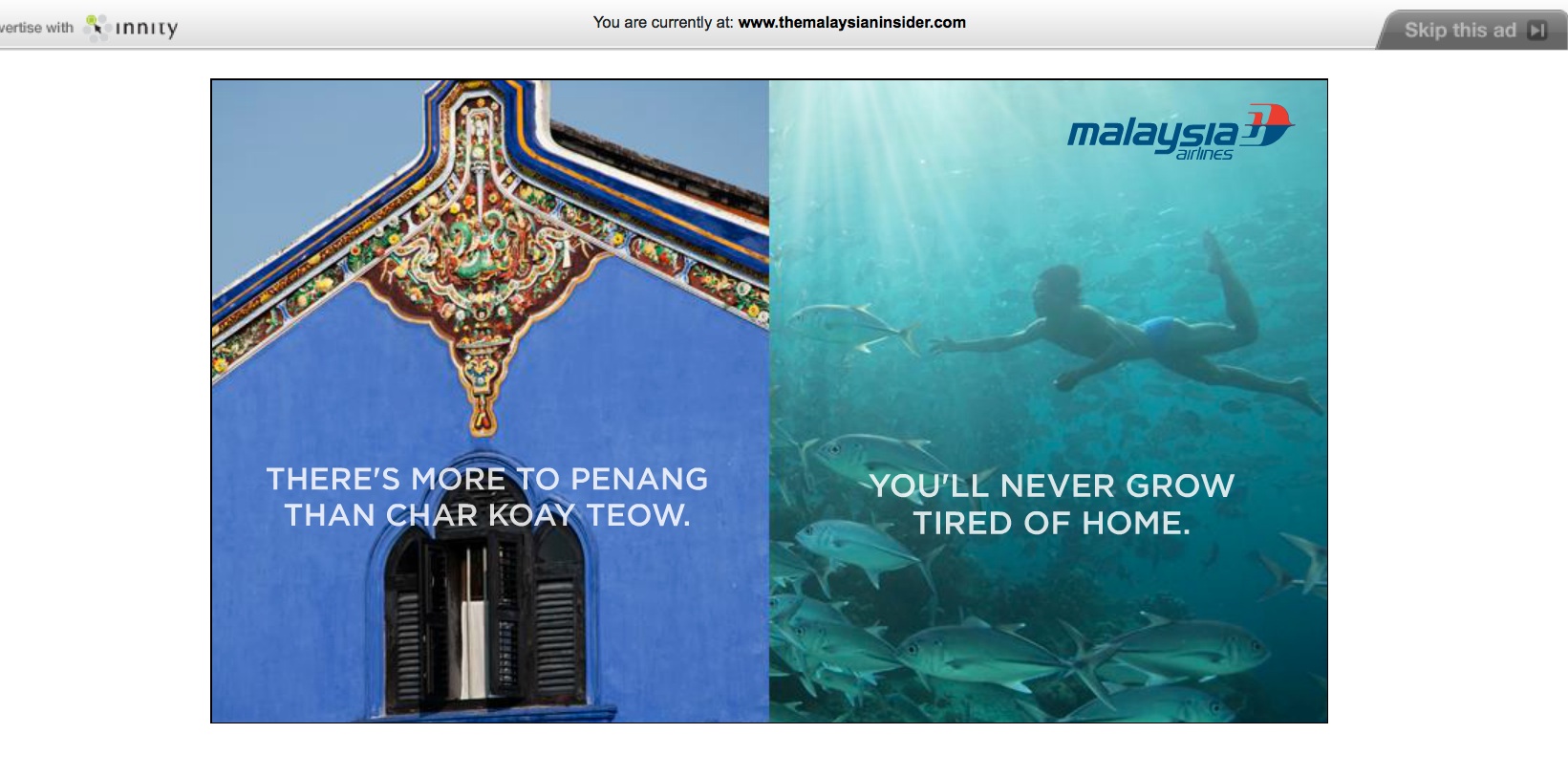
I’m sorry to say that I’m going to have another go at them. Earlier today I clicked on a link at the Malaysian Insider website and was interrupted by an interstitial ad for Malaysia Airlines. The ad (see below) featured an underwater image and an image of Penang. Obviously I was interested to see what they were doing so I clicked on the ad.

mas1

I was directed to the Malaysia Airlines site and was told it is under going system maintenance. Now I understand that sites need to be up dated all the time but not in the middle of a digital advertising campaign.

System update in the middle of a communications campaign? Not good for branding.

This type of schoolboy error can be fixed with a brand blueprint that is shared throughout the organisation and ensures the organisation works collaboratively, not in silos. Until they make such organisational improvements, Malaysia Airlines will continue to struggle. It really needs to up its branding game if it is serious about becoming profitable.

Endless Possibilities has endless potential


The response to the “Endless possibilities” tagline has been, as one would expect when discussing a Nation Branding project, emotionally charged.

Much of the focus has been on whether or not the tagline has been used by Israel or for that matter Mongolia. In fact, it would seem the tagline has been used not only by both Israel and Mongolia but also Sagada in the Philippines.

sagada-2010-marlboro-country-endless-possibilities

And while we’re at it, “Endless possibilities” has also been used by a lot of companies such as BHS in India who used it for an advertising campaign and by Florian pearls. It’s also the name of a thrift shop in the USA, a change management company in the UK and it also appears on a tee shirt underneath an infinity loop.

But most commentators and those members of the public who have cast scathing comments in blogs, forums and on social media sites are missing the point. There may be questions around the chosen tagline, how it was researched and why it was chosen but the reality is, the tagline doesn’t really matter. Yes it is a bit embarrassing that it has been used by other countries but it’s important to understand that this is not the Malaysia Nation brand.

It is a tagline. And like the majority of taglines, it will soon be forgotten. In fact, taking a macro view it will have very little influence on the success of the Malaysia Nation Brand project.

Sadly, it is not unusual for organisations to launch a brand strategy with the creative side of the project. This is wrong but unfortunately it is common. What will make or break the success of the Malaysia Nation Branding project is what the strategy consists of and what comes next.

This will be mapped out in a well researched, comprehensive brand plan that will not only form the foundations of attempts to drive the brand forward but also be the glue that keeps stakeholders together.

The world is loose, more fluid and more collaborative than ever before. As a result, nations have less control over the Nation Brand than they are used to but that doesn’t mean they should forgo a well-researched brand plan and let consumers define the brand, something that may already be happening in Malaysia. The Nation Brand plan is more important than ever as it serves as a blueprint for all stakeholders to adhere to.

Specifically, the Malaysia Nation Brand plan must communicate a positive and dynamic personality with economic, experiential and emotional values that reflect target audience requirements.

The brand plan must be holistic and comprehensive to enhance export promotion, economic development, tourism, foreign direct investment and other key national initiatives.

It must also communicate the intended message to the target constituents and stakeholders in multiple countries and at the same time, it must lay guidelines to strengthen the strategic, communications and visual impact of the Nation Brand.

The blueprint must also systemically connect the Nation Brand to the country’s core industries, corporate brands and Small and Medium Enterprise (SME) sector brands.

This must be established via a systematic, holistic process that accommodates the requirements of both national and international stakeholders. This process must not only be effective to optimize the Malaysia Nation Brand, but also maximize limited national resources.

But at the same time, the team tasked with this project must be flexible and open in the implementation of the plan. Let events influence the plan and be ready to adapt to events and opportunities.

The new Malaysia logo (thanks to thestar.com.my)

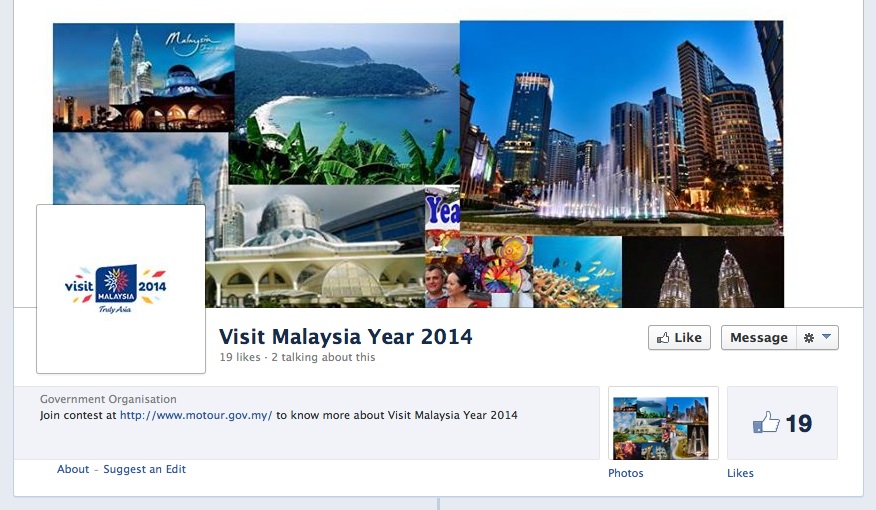
But right now, all we have to go on is the tagline, a logo, a website and a commercial featuring the Prime Minister that was aired on CNN a few months ago. There is a Facebook page for Visit Malaysia Year 2014 that features the new logo but the site hasn’t been updated since March 2013.

VMY 2014 FB page
VMY 2014 FB page

The Facebook page features a link to a competition but this actually goes to the Ministry of Tourism website. Such competitions will help drive interest in the country and there is no reason why a competition can’t be created for businesses that may want to invest in or relocate to Malaysia.

The message of the TV commercial was to attract Foreign Direct Investment (FDI) while the message of the website is “Whether your passion is food, culture, sports or art; whether you’re a traveler or entrepreneur; Malaysia has something amazing to offer. The journey starts here”.

The malaysia.my home page

One might be forgiven for thinking that sounds like a tourism message however the site features a number of feel good stories about successful Malaysian entrepreneurs, achievements, news, activities and more.

As the website evolves, it may need to focus or at least segment activities more clearly and provide refreshing and new content that is of interest to stakeholders and not repeat content that is already in the public domain. This new content will create interest in the country, be picked up by search engines and robots and drive traffic to the site.

The team tasked with the responsibility of making the Malaysia Nation Brand project a success will also need to engage stakeholders on an ongoing basis and not just use digital platforms to broadcast corporate driven messages.

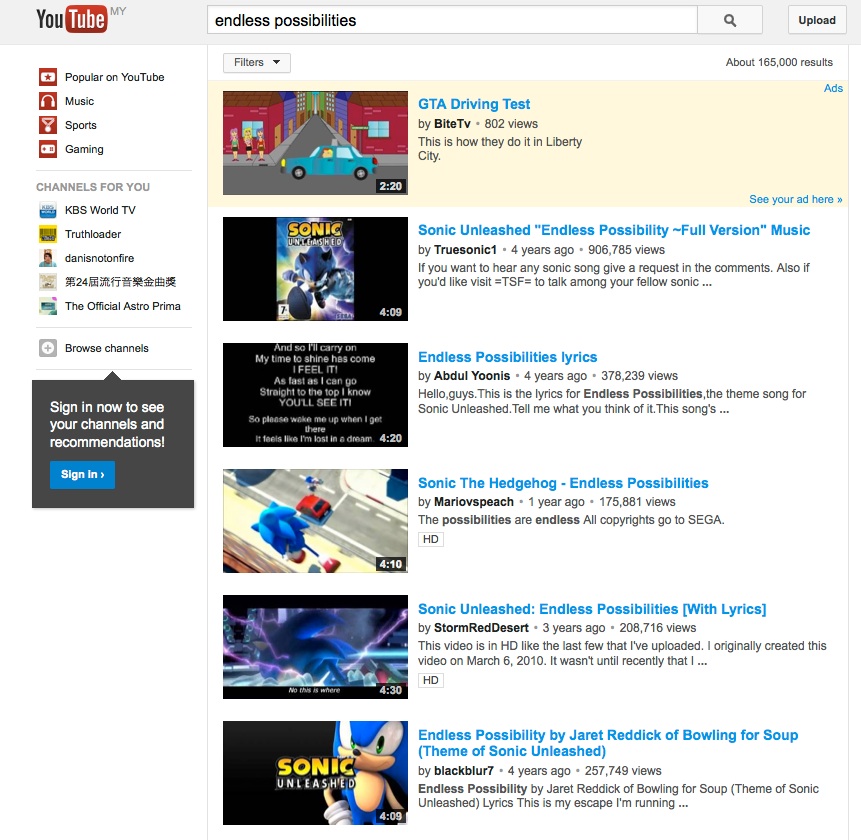
Right now, a search of “Endless Possibilities” on Youtube doesn’t send visitors to any Malaysia site. The Brand plan will also map out tactics for driving users and search engine robots to original content.

you tube search of 'endless possibilities'
you tube search of ‘endless possibilities’

The launch of the new Brand strategy is set for 17th September and we should know more about the project then. But I believe, done properly and based on a comprehensive Nation Brand plan, “Endless Possibilities” really does have endless potential.

How to make the Malaysia Nation Brand strategy successful


Let’s get something straight. A catchy tagline, symbolic logo, pretty colours that symbolize the ‘personality’ of the brand and a custom designed font are not Nation Branding.

Glossy advertisements that push the creative envelope and consist of content that is impossible for stakeholders to buy into or live up to, is not Nation Branding.

Expensive brochures and other marketing collateral that use light gray colours on white backgrounds and font sizes impossible to read is not Nation Branding.

Hugely expensive billboards that create awareness but do little else and are soon lost in the fog of the tens of thousands of messages consumers are exposed to every day is not Nation Branding.

It might have been possible to use such creative-driven branding to build a Nation Brand in the 1960s – 1990s, when countries and their advertising agencies focused more on getting attention than getting results.

But this is a different era. There are now so many channels to consumers, so many competitors all with a similar offering and so many distractions that it is no longer possible to build a Nation Brand in this way.

Furthermore, too many taglines have made promises the Nation couldn’t possibly keep or their marketing or PR collateral has left potential customers underwhelmed. This may not have been the fault of the Nation or it may be the result of poor internal implementation but it has resulted in a delivery failure that has negatively impacted all efforts till then. A case in point is the Incredible India campaign and the multiple attacks on women over the last year.

Moreover, engaging (not reaching) target markets through traditional channels with traditional tools is virtually impossible today. Especially in the digital age when consumers are more knowledgeable, have more choice and are more demanding.

So how do we make the Malaysia Nation Brand successful?
Reach, awareness etc are all irrelevant. Nation Brands today are defined based on the economic, experiential and emotional value they deliver to all stakeholders.

What will make or break the success of the Malaysia Nation Branding project is the work that has gone into determining what are the key elements of the Malaysia Nation Brand.

Identifying and understanding what we have, what is unique, who are the stakeholders, what are we are going to do to get their buy in, how we identify target segments, the knowledge we learn about them and their requirements for value and deliver value to target segments (all of whom are very different and have very different requirements for value and must therefore be engaged with content that resonates with them), how we build our relationships with them, how we work with them and provide solutions to their problems.

The ability to build lasting relationships with stakeholders, a highly trained team capable of matching country attributes to those stakeholder requirements and the ability to consistently deliver value are required.

External communications battles are not fought on the right hand pages of national newspapers, during commercial breaks on terrestrial TV or on the outside back cover of business publications. They are not even fought on the pages of digital media or on corporate websites.

The battles for the hearts and minds of prospects are fought in the comments sections of blogs, on third party sites through user experience comments, through account manager emails, forums, search engines and ongoing personalized relationships.

If the people responsible for this project can match your Nation Brand to the value customers are looking for, they may have a chance of building a successful Malaysia Nation Brand.

I am reliably informed the Malaysia Nation Brand project has a budget of RM30 million. But it’s not known what that covers. If it is simply for a communications campaign then it will not be money well spent and the project will fail.

However, if it is for a comprehensive brand audit and Nation Brand plan (which will have been developed once the brand audit was completed and will focus on internal and external stakeholders) that outlines how to deliver value as defined above and based on the “Endless Possibilities” tagline, then that will be terrific use of taxpayers money and the country will benefit for many, many years.

Building the Malaysia Nation Brand requires a strategic approach


The development of a Malaysia nation brand has been discussed for a number of years. As part of the Industrial Master Plan (IMP3), a National Branding Task Force was established and tasked with building the Malaysia Nation Brand. In 2008, through the Malaysian External Trade Development Corporation (MATRADE) and after extensive research and a nationwide tender, the project was awarded to a brand consultancy.

After a letter of award was issued to the consultancy and the project team was mobilized, the then Prime Minister stepped down and six months later the project was cancelled. Soon after the National Branding Task Force was disbanded.

Since then there hasn’t really been any organization established to develop a Malaysia Nation Brand. Some of you will say that 1 Malaysia was a Nation Brand but it wasn’t.

At the end of 2011, some firms were invited to “submit slogans for a new Nation Branding project”. Of course a slogan isn’t a Nation Branding project but it was considered a start.

The slogan chosen was probably “Endless Possibilities” because this was used during the World Economic Forum in Davos to promote Malaysia as a South East Asia location for investment and tourism.

Without any warning, a sixty second TV commercial aired on CNN in March 2013. If you have a weak stomach, I don’t recommend you read any of the reader/viewer comments below the video.

It’s hard to identify who posted the video but there is reference to a brief with the comment, “The brief from the Prime Minister’s Office of Malaysia was to promote Malaysia as a dynamic country with well developed infrastructure and an aggressive economic growth plan for the future.”

More recently, the Prime Minister was spotted wearing a badge with a design that has been described as “a starburst in red, yellow and white against a blue background.” Malaysia, in a custom font is underneath the logo.

The new Malaysia logo (thanks to thestar.com.my)

In late August 2013, a local news portal reported that Prime Minister Najib Razak will launch a new national branding effort and that the national branding effort comes with the slogan or tagline, “Endless Possibilities”.

This is exciting news, so what should we expect from the Malaysia Nation Branding project?

It is important that Malaysia doesn’t fall into the trap many other countries fall into – jumping head first into a well produced communications campaign in a misguided attempt to build a brand.

India is famous for its ‘Incredible India’ advertising campaign launched in 2002. By 2009, India was spending US$200 million advertising the country. In November 2012 India announced that a new advertising campaign headlined, “Find what you seek” would be launched to build on the Incredible India efforts.

The new Indian minister of tourism announced that the new campaign highlighted to consumers that ‘they will find whatever they are looking for from a holiday in India.’

The goal of the new campaign was to increase international arrivals by 12% annually till 2016. Unfortunately, little more than a month later, a woman in Delhi was brutally gang raped and left for dead on a public bus. The story made headlines around the world.

Four months later, a Swiss woman was gang raped whilst on a cycling tour of Madhya Pradesh and soon after, a British woman was attacked in Delhi and only avoided potential death after jumping from a hotel window to escape.

Within a matter of weeks, instead of announcing increased interest, tour operators were reporting a 35% cancellation rate from women and a 25% drop in all arrivals with multiple cancellations from the lucrative markets of Australia, the UK, Canada and the United States.

Meanwhile, FDI dropped 29% in 2012 despite the ongoing advertising campaign. An advertising campaign, however good, isn’t going to change perceptions caused by crime or reverse FDI declines caused by the global economic situation. So years of the Incredible India campaign, if remembered at all will now be replaced with harrowing tales of the treatment of women in India and depressing economic data.

What nation brands have to understand is that today, not only are constituents in target markets more segmented and more knowledgeable, they also live their lives very differently, source their information more socially and in many countries, no longer believe corporate driven messages anyway.

But most important of all, in today’s dynamic, fluid social, Internet fuelled world the corporate driven message, created after months of brain storming by consultants and the like and communicated to all and sundry at enormous expense repeatedly can be undone in a moment and replaced with harrowing tales of criminality and economic woe.

Building a Nation Brand is a strategic initiative not a tactical one. A communications campaign is a tactical activity and it is not possible to build a Nation Brand with a communications campaign, especially one that is created to convince both internal and external stakeholders of something that is hard to prove.

Today, building a Nation Brand requires multiple elements that are critical to the success of any such project. However there are two in particular that will make or break the Malaysia Nation Branding project.

The first is that the community must be involved in the development of the Nation Brand and agreed values must be clearly defined and understood by all stakeholders and integrated into their lives and applied to every touch point.

Sure there must be a CEO with the knowledge, strength and unbiased objective viewpoint to drive the project but without this early stage buy in from stakeholders, the chance of success are very low.

And the second critical element is that promises made must be kept. It is simply not good enough anymore to say you are something or you are going to do something without delivering on that promise at every touchpoint.

I don’t know the full extent of this project and how the community was involved but in the video aired on CNN, the Prime Minister says, “Malaysia is the unique place where the best of Asia comes alive.” That’s a bold statement that will require buy in from all Malaysians and will be tough to deliver to all stakeholders.

So let’s hope the Prime Minister and his team pulls it off because in the current economic climate, a well defined brand that has the buy in of key constituents, resonates with target markets and delivers on promises made will give Malaysia a significant edge over competitors in an increasingly competitive environment.

Further proof that you need Twitter to build your brand


The talented team at Brandwatch in the UK have produced a very useful report on Twitter usage by global brands. This report should be read by marketing departments and CEOs. You can read the full report here but some of the findings are listed below:

1) 253 companies, primarily from the US and UK were analysed for the report.
2) Only 2.4% of the companies surveyed did not use Twitter at all
3) 97% of major brands used Twitter in 2013, up from 62% in 2011.
4) It was noted that Apple does not use Twitter or any other social media. Interestingly, Apple’s share price has tumbled to as low as US$400 earlier this year, down from US$700 in September 2012. Of course I’m not blaming that on the fact they don’t use Twitter however it does mean there will be some distance between the brand and customers.
5) Brands use Twitter for both broadcast and engagement purposes but most of them acknowledge that Twitter is best utilized as a two-way channel.
6) 145 brands surveyed (over half) tweet a minimum of 30 times per week.
7) 25% of Brands use Twitter solely as a broadcast channel.
8) 63% of Brands have multiple accounts. Using one for company news and another for customer service was a common example of multiple accounts.
9) Dell has 44 Twitter accounts.
10) Weekends are the best time to reach customers on Twitter. (I don’t think that applies to Asia). However a little research into what your audience prefers goes a long way to successful engagement.
11) Tweets with media (a photo/video) get 3 to 4 times more engagement than those without.
12) The average size of a UK and US Twitter team is 4 people.
13) The maximum number of tweets in a week for the US was 2,500 tweets, compared with 113 tweets in the UK.
14) The Twitter web interface is the most popular platform for tweeting.
15) 20% of the top 100 global brands use HootSuite.

What can Asian firms learn from this data?

For a start, if your firm is not on Twitter, it needs to be. Twitter won’t go away! British and American firms have an average of 4 people on their Twitter team. Most Asian firms don’t even have a community manager, let alone a social team. This needs to change.

Asian firms can use Twitter to engage customers more effectively, deal with issues and retain customers. It is far more effective and less expensive than attempting to use acquisition marketing across traditional channels to retain existing, unhappy or vulnerable customers.

Twitter can be an effective and inexpensive way to drive sales. Low cost airlines in the US generally tweet special offers to their followers before making them available. The cost for the tweet is minimal and its effectiveness can be easily measured.

Asian firms can be notoriously opaque and secretive. Twitter forces firms to become more open and transparent, encouraging trust.

In Asia we tend to follow the US and Europe in many things, especially in marketing. This report gives Asian firms the data needed to support their marketing strategy going forward.