Branding requires you to get to know your customers


This is the start of an ad hoc series of personal experiences I have with brands and some recommendations to help improve the experience.

Running a small retail business is tough, particularly in today’s climate. It’s even tougher in the competitive retail wine business in a small muslim country with high taxes on alcohol. Key to building a profitable business will be the relationship between the company and their customers.

Yesterday evening I walked into my local wine shop where I have shopped off and on for 5 years and was greeted with a “Hi, we haven’t seen you for a long time.” I mumbled a reply and the clerk nodded and carried on reading her magazine. This is not the first time I have gone ‘AWOL’ but the reason for my absense is the same. I haven’t been there for a while because about 3 months ago I was made an offer I couldn’t refuse and bought 5 cases of wine from another company.

Although I got a great deal on the wine there is no reason why my regular wine shop couldn’t have given me the same deal. But of course they didn’t know about it because they don’t make an effort to collect data on me. They just hope that I will come by every now and then and buy something. And if I don’t, never mind, there will be other new customers to replace me. To a certain extent this is true but wouldn’t it make more sense to look at ways to encourage those people who are already customers to come back again? And get to know those that come on a regular basis to increase share of wallet and develop brand ambassadors?

Here are 5 useful tips for any small retail business looking to be more profitable

1) You have a 15% chance of selling to a new customer and a 50% chance of selling to an existing customer. Distribute your resources accordingly.
2) Invest in database software that will allow you to store data about your customers
3) Don’t be afraid to ask for contact information from new and existing customers
4) Invest time in keying in customer data that you can use to determine buying patterns, product preferences and so on
5) Train your staff to get to know your customers.

How to sustain a family retail brand


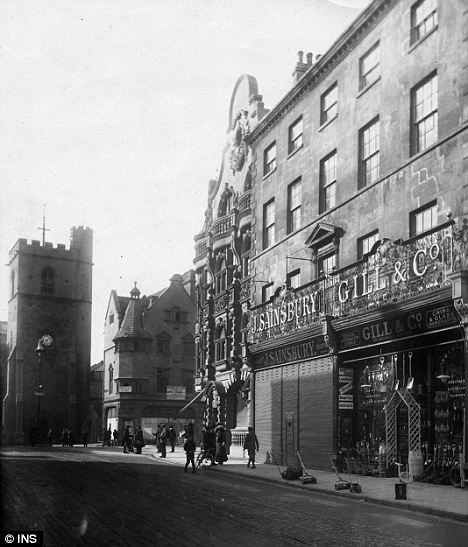
The picture below was taken in 1912 in Oxford, UK a city about 60 miles to the North West of London. It features Gill & Co, an ironmongers and a branch of J. Sainsbury, a food store.

Gill & Co was established in 1530 during Henry VIII’s reign. At the time it was the first ironmonger in the country. It has been in business ever since and has witnessed the English Civil War, two World Wars, a couple of global economic depressions, three recessions, the birth of the railway, the car, powered flight, electricity, the Internet and more.

Originally the firm supplied ironware and related products for Oxford residents however as times changed it tried to reinvent itself and also stocked equipment for chimney sweeps (think Mary Poppins), farming equipment, tools and gardening supplies. Although Gill & Co moved locations, it was always a one store operation in Oxford.

In 2010, after 480 years in business Gill & Co is closing down, beaten into submission by large DIY and home improvement suppliers like B&Q the 3rd largest DIY retailer in the world, largest in Europe and the largest in China and Homebase.

Sainsbury’s, at a mere 141 years old, a relatively new brand was established in 1869 in Drury Lane. Although now at the centre of the theatre district, this was once a very poor area of London.

Sainsbury has also witnessed much, including 2 world wars, 2 depressions, a couple of recessions, the automobile, manned flight, the moon landings and more. Sainsbury soon became an institution, offering high quality products at low prices. By 1882 Sainsbury was selling it’s own label brands.

Although lacking the heritage of Gill & Co, Sainsbury invested heavily in its staff, employing women as managers when it was unheard of in the early 20th century and developing its own training school to train managers.

Sainsbury also invested in new stores and although at times it has had a rough ride, today it employs more than 150,000 people, has 800 stores in the UK and there are on average more than 19 million customer transactions in Sainsbury’s stores every week and the company has a 16% market share.

It has diversified into non-food products and services and non-food is growing 3 times faster than food. It has a bank with operating profits of £19million and its Internet home delivery shopping service is responsible for 100,000 deliveries every week.

Asia has many small family businesses. In fact in Malaysia, Small Medium Sized Enterprises (SME’s) make up 99% of Malaysia’s total registered businesses. Hanoi in Vietnam has over 90,000 SMEs.

These organizations have a critical impact on the business of a country. In Japan, known for its heavy industry, approximately 70% of the Japanese work force is employed by small and medium-size enterprises (SMEs) and half the total value added in Japan is generated by SMEs.

Asian SMEs, many of them well established with years of heritage cannot sit by and hope that they will be safe from bigger, more aggressive retailers. They need to start planning for the future now before it’s too late.

Here are 5 recommendations for Asian SMEs to help them become a Sainsbury

1) Keep an eye on retail trends, especially in your space
2) Talk to your customers, not just about the weather/politics/sport. Ask them what their needs are, what they would like you to stock, when they would like you to open and so on
3) Build a database of customers and their preferences. If you do sell up, this will help you secure a better price for your business
4) Leverage what you have against the big retailers in your space. You can’t compete on price and probably can’t compete on choice but you can compete in other areas – convenience, personalization, customization, free alterations, returns, speed of delivery and more
5) Develop a brand strategy that includes succession planning. If you have sent your kids to university overseas, are they going to come back and work in your hardware store? If you don’t think so, look to create strategic relationships with other players in your space now before it is too late.

Australia Unlimited. Genius or Garbage?


Someone sent me this link about the plans for the Australian government to use a new tagline to sell Australia Inc to the world.

I’m sure you guys have lots to say and I welcome your thoughts on the article. To get the ball rolling here are a couple of thought starters.

1) Australia Unlimited isn’t a brand, it is a tagline created by an advertising agency to be used in creative driven communications using one message to communicate with all stakeholders, irrespective of their requirements for value. The concept of selling ‘Australia to the world” is laughable as most of the world doesn’t care.

2) Here’s a clip from the article, “Shortlisted agencies were given a brief to ”come up with a brand that would promote Australia’s capabilities across a range of sectors from investments and exports to education, culture, sports and events”

How does “Australia Unlimited” do that? And how could any communications campaign appeal to such a diverse prospect base?

3) Here’s another quote from the article, “John Moore, director of brand development of the Global Brands Group, the agency that has been co-ordinating the new Sydney brand, likes the line. ”It takes it beyond tourism and poses the question of what is unlimited about Australia, to which there can be many answers. I think it will work really well as a connecting device with all those different areas [of trade and business].”

Excuse me? How does it do that? I want to set up a mining company in Australia, what can you do for me? That’s the only question I want to pose.

This is another iniative, involving 2 stakeholders, Tourism Australia and Austrade, who should be working together but in fact appear almost to be competing with each other!

Self service can help brand profitability


The other day, one of our computers froze. This is a scary moment for most companies and it was even more scary for us as we use Apple computers and it was the first time this happened in 7 years. More worrying, this particular PC is running some expensive design software and auto-save was off!

We had two options call tech support and wait 24 – 36 hours for them to come in or check out the Apple support site and see of we could solve the problem ourselves. We chose the latter and 20 minutes later the PC was up and running.

Enabling prospects and customers to answer their own questions is nothing new, but few Asian brands use it effectively. Yet it can have a significant impact on profitability. Forrester found that the cost of a customer sales or support call cost as much as US$33. The same report found that even email support can cost as much as US$10 per response. Yet Web-based self help averages US$1.17 per incident. And this doesn’t take into account the impact on reputation due to lost productivity by the customer.

Customers benefit too. In our case, we work to tight deadlines, sometimes spending the whole weekend in the office. If this had happened on a Saturday night, with a Monday delivery deadline, we may have lost the account.

One word of caution though. Self-service is not an excuse for avoiding service.

Luxury branding in developing markets requires a different approach


Patek Philippe, the eponymous luxury Swiss watch, or should I say, timepiece brand is known for running the same advertising campaign for years. Although the images may have changed, the tagline “You never actually own a Patek Philippe. You merely look after it for the next generation.” has remained consistent, usually along with a jaw droppingly handsome and immaculately dressed and coiffured ‘father and son’ portrait.

For the target market, the aristocracy and the wealthy of the world, and those that aspire to the class, the ads say many things, including ‘buy one and you’ll be like us and ‘You have class and you know class’.

The ads are a wonderful example of luxury branding – a great product manufactured with precision engineering, immaculate heritage, an aristocratic client base and creative genius in the advertising that communicates on a level that the target market will connect with and explains, in the limited time available to garner interest, the timeless character of the brand. And I am sure the quality of service at the point of sale will be equally as impressive.

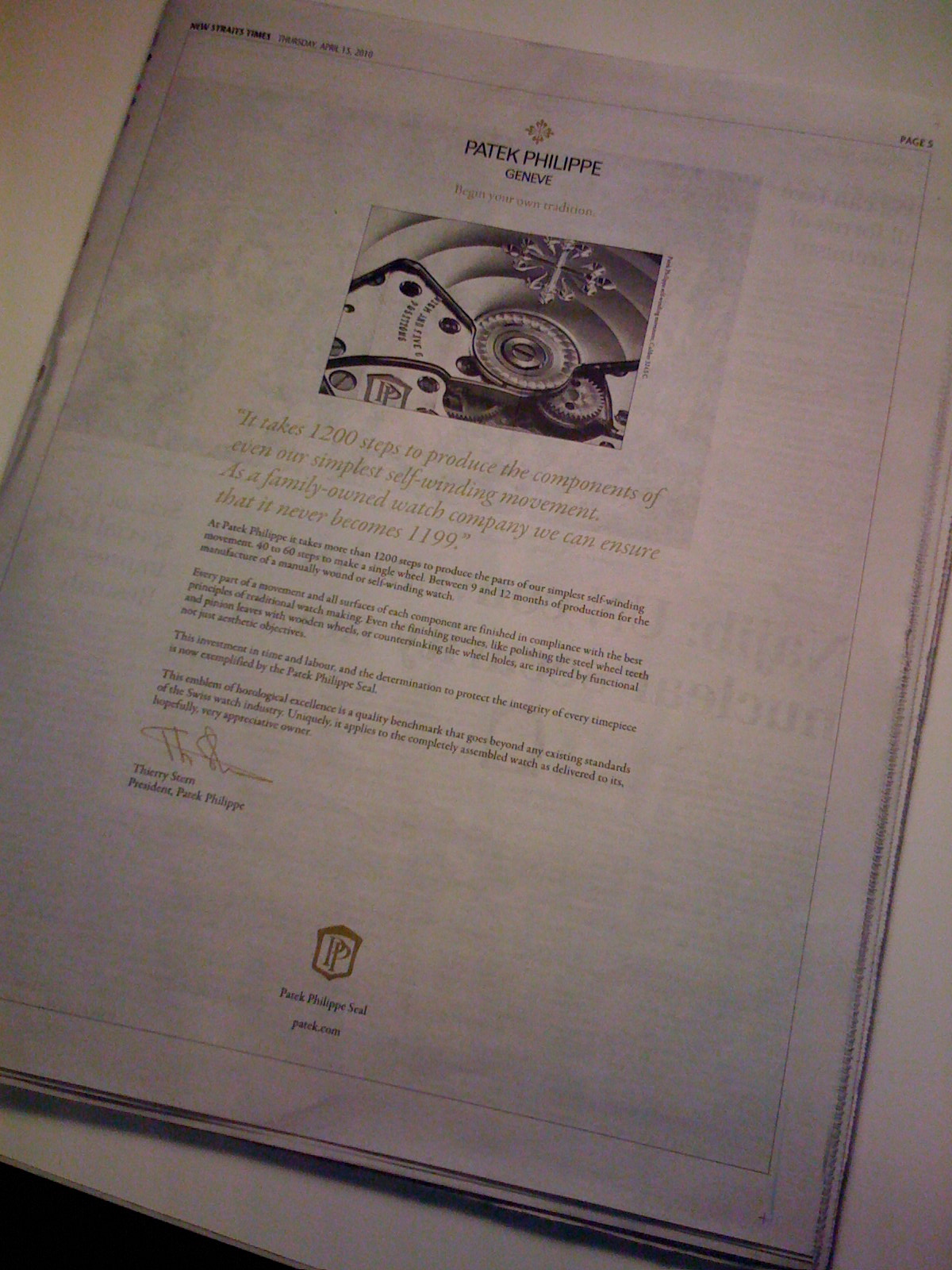
PP has recently launched a new global print advertising campaign that focusses on the values of the company established by two Polish immigrants, Frantisek Czapek and Antoni Patek in Geneva in 1839. I’m not sure if this campaign is to replace the old one. I for one hope not.

The latest campaign revolves around the personal letter concept and has the current president, Thierry Stern waxing lyrical about the steps involved, the time taken and care and attention to detail invested in the production of a PP timepiece. He talks about ‘polishing steel wheel teeth and pinion leaves with wooden leaves and countersinking wheel holes’ and the fact that these efforts are ‘inspired by functional not just aesthetic objectives’.

He goes on to mention the Patek Philippe Seal, an ’emblem of horological excellence’ that appears to be an internal ‘quality benchmark’ that claims to be ‘beyond existing standards of the Swiss watch industry’.

The ads are set to appear in ‘quality daily newspapers and influential trade publications’ around the world and will also appear at the point of sale.

The first ad (I think) appeared in Malaysia in the New Straits Times on 15th April 2010. I can understand (although I don’t agree with the tactic) the mass market approach of running an ad in the New York Times or the London Times, South China Morning Post etc or any other developed country where there is significant market potential.

But I can’t understand the purpose of running the ad in a developing country such as Malaysia. A quick search of the net finds a rather old PWC report, that states ‘the mean monthly gross income per Malaysian household increased from MYR2,472 in 1999 to MYR3,011 in 2002, denoting average growth of 6.8% per annum’. So if we use that growth rate to bring us up to 2010, the mean monthly gross income per Malaysian household is now roughly RM5,096 or US$1,358. Don’t forget that is gross and does not take into account the impact of the economic crisis.

Another search of the Internet would suggest that the cheapest PP watch is around US$4,000 and the most expensive sold some time ago for about US$11,000,000 (that’s RM36 million in real money). The majority of PP watches appear to be in the US$10,000 to US$35,000. At those rates, the potential market in a country the size of Malaysia is tiny and an ad for such a luxury product in a daily newspaper is essentially a waste of money.

Just to put things into context, the ad after the PP ad is for Honda and the ad after that is for Panasonic household appliances such as an Alkoline ionizer, hair styler and hair dryer and men’s shaver (inner Blade and outer foil).

So what should PP do in developing markets like Malaysia?

Here are 5 suggestions

1) Rethink the one-size-fits-all mass market approach to building a brand, especially in developing markets. The consumers who can afford your products can be engaged much more effectively in other ways.
2) Build a database of prospects and customers. But all markets require different strategies and data collection techniques will be different.
3) Build relationships with your existing customers. Existing customers are often ignored by companies scared of asking too many probing questions. And certainly timing is important. But well trained luxury retail staff can build relationships with wealthy customers who are likely to be successful businessmen and politicians and their opinions will carry a lot of weight with prospective customers.
4) Advertising is important, but choose your channels carefully. Mass circulation newspapers and magazines are for shavers and hypermarkets.
5) Content is important too. I’m not sure anyone really cares what is hidden away inside the shell of a product with almost 200 years of heritage. After all, if the quality was a given in the previous campaign, why must it be addressed now?
6) Integrate your digital commuications with mobile channels to engage with prospects and customers interactively when they are on the move.

Building a brand is hard enough. PP has done it successfully for 200 years. But treating every market the same and using mass marketing tactics that belong to an era that no longer exists, will make it hard to do it successfully for the next 200 years.

Malaysian and Asian SMEs should look at communications when building brands


I have a lot of respect for small businesses and their owners, especially here in Malaysia and all over South East Asia. The odds are stacked against them as they try to build a business in an environment that should favour them but because of conservative attitudes and the legacies left behind by unscrupulous operators in the past, they are up against it and many of them don’t make it. Even those that do make it do little more than survive.

Furthermore, competition is growing, not just from local competitors but from international ones as well. Rents are rising and real estate is expensive; banks are reluctant to take any risk, no matter how low, talent is hard to find and quite often entrepreneurs are unable to communicate in English due to ever changing education policies or a vernacular education. Plus, here in Malaysia, government subsidies on fuel and other commodities are probably going to be lifted or even abolished. Finally, AFTA means the market may be swamped by cheap products from other regional, less expensive countries.

But despite these and many other issues, depending who you listen to, small and medium sized industries, enterprises and businesses represent up to 99.2% of the Malaysian economic establishment and these organisations are therefore the engine room of the economy. And although the SME contribution to gross domestic product has been almost flat for the last 8 years, rising from 29% in 2000 to 31.4% in 2008, the sector still has a major role to play in the economy.

This is particularly true of the service sector which is the most progressive in terms of SME development. So it is good to hear that the National SME Development Council has approved the establishment of a special unit responsible for SMEs at a number of agencies and ministries. Under the Integrated Action Plan 2009/2010, 354 programmes will be implemented this year with financial commitments totalling RM6.02 billion (S$2.48billion).

Roughly RM3.3 billion has been allocated for the development of SMEs in the services sector in line with the government’s aim of developing Malaysia into a high-income economy.

So should these SMEs be bothered about brand building? Well, in many ways the concept of branding is even more important to small companies than it is to big companies. But obviously they don’t have the resources of a Multi National Corporation (MNC) so they need to be selective on what they address. One area that SMEs can improve significantly with very little investment is their communications. There is a lot of truth in the saying, you never get a second chance to make a first impression. So your communications must leave a positive first impression.

Another mistake SMEs make is that they believe volume is best. They believe that they must have a database with as many names as possible. And once they have that DB they must blast out the same message to everyone on it on an almost daily basis! Negative. The first step in your prospecting process is to qualify all leads to determine any interest level. There is no easy way to do this. It takes old fashioned hard work. Fortunately in Asia privacy laws are limited or even non existent so cold calling is acceptable but of course you need to have a strategy to get past gatekeepers.

Spend some time writing an introductory email. It doesn’t need to be long but if it is targetted and well written, even if the service or product offered is not required, the email may be stored in a resources folder for later reference.

Once you’ve identified your prospects and segmented your DB, use email not to try and sell a product but to make an appointment. Few people are going to buy from a mass email but you may get a reply to the email or some recognition when you follow up the email with a call.

The worst mistake any company can make, SME or MNC is to start their brand development with an advertising campaign. Branding is a journey, advertising is a pit stop on that journey, nothing more. Now I know you want to see your name on a billboard on the highway or a full page advertisement in the national newspaper so that you can announce to all your friends, business associates and clients that you have arrived but think about it, how effective is this going to be? Do you really want to waste that money? (There are exceptions to this rule, but very few).

If you do intend to advertise, make the copy relevant to the consumers you intend to communicate with and only use channels that users of your product are familiar with and engaged by.

If you follow these simple suggestions, you may have a chance of being one of the few SMEs that survive and possibly even thrive.

A is for Advertising


This is a good place to start a compendium of branding terms because unfortunately, it is where many companies start their brand building. And that’s a shame, no tragedy because it is an expensive exercise in futility to try and build a brand using advertising alone.

Advertising can be traced back to around the late eighteenth century when the first print ads appeared in the USA. However, they were rarely much more than extensions of the editorial copy and newspapers were reluctant to allow ads that were bigger than a single column. Even magazines preferred to print all the advertisements at the back of the publication.

Mass advertising only really began in the second half of the nineteenth century when firms began to produce greater quantities of more and more products thanks to improved production techniques. Soon after manufacturing, other businesses such as department stores and mail order firms jumped on the bandwagon and by 1880 advertising in the US was estimated to be in the region of US$200 million. This grew to almost US$3 billion by 1920.

In the mass economy of the 1930s to the 1990s that coincided with the growth of mass circulation magazines, advertising companies proliferated. At the same time, companies wanting to stand out from the competition determined, quite rightly that the quickest way to grow was to raise the profile and awareness of the company’s product or service by informing or reaching as many people as possible in the shortest time.

The most common way to do this was via advertising, especially via TV advertising. The business of advertising is based on a model of repetition across mass media. OK, creativity is important, initially anyway, but once you get over the wow factor, the idea is to repeat the same message through as many channels as possible for as long as possible.

Budget played (and still does) a significant part in what sort of advertising an agency may recommend. It is important for you to know that from the advertising company point of view, the size of the available budget will determine two main points, 1) who works on the project (in terms of seniority and talent) and 2) what channels will be utilised. A larger budget generally results in TV advertising becoming part of the recommendations.

Other platforms include print advertisements, billboards, lamp post buntings, banners, taxi, bus and tube trains, coffee shop tables, flyers, leaflets and more. The introduction of the Internet has seen a proliferation of banner ads, tower ads, unicast ads, contextual ads, takeover ads, interstitial ads, floating ads, and other options to an already noisy, crowded and complicated marketplace. It is important to note that none of these initiatives are branding, they are all advertising and advertising is a tactical initiative not a strategic initiative, like branding.

In the mass economy and unfortunately still to this day, once a campaign has launched, probably to much fanfare, the client waits with anticipation to see the promised sales spike. Meanwhile the agency submitted any well executed commercials to one of the numerous creative shows that offer awards for creativity.

As mentioned earlier, repetition is important and with enough frequency, and perhaps a little vague targeting, this repetition was expected to encourage enough consumers to walk into a store or other outlet and choose or request the advertised product.

The model worked, to some degree fifty years ago but in today’s crowded marketplace, using advertising alone to build a brand is leaving too much to chance. It is simply too difficult to stand out from the crowd. Can you remember the last ‘great’ TV commercial or print ad that you saw? And even if you can, have you bought the product?

Quite often, the promised sales spike didn’t happen, unperturbed and with a straight face, the agency would ask the client for more money, arguing that it is the client’s fault as it should have made more money available in the first place for increased frequency. If you have gone this route, I suggest you bin the advertising agency and call a brand consultant.

Should you still use advertising? Absolutely because advertising will help your company project a vision of the relationship you can deliver to the customer. The ads also help you to educate customers about the value that you can offer them. Advertising must also communicate trust. Unfortunately this is forgotten by most advertisers, especially in South East Asia where outrageous claims made in advertising are rarely backed up in reality. In Malaysia for example, after years of being let down by claims made in advertising, only 14% of Malaysians now believe what companies tell them in their advertising.

But instead of seeking to increase awareness of your product or service with as many consumers as possible, ensure your advertising seeks to communicate with those consumers that are most likely to adopt your product or service.

Make your advertising relevant to those consumers you have targeted. Core messages must be related to those consumers interests, needs and/or desires. So rather than a one-size-fits-all approach in your communications, it is essential for messages to be about offering value to those specific customers and making their life better as a result. How to identify those consumers and what is relevant to them will be explored in brand audits and targetting.

The goal is to ensure a consumer incorporates an offering into their personal or business lives.

Adoption will ensure your brand is seen as the best, hey perhaps even the only choice. This won’t happen on its own. It is a process built on operational excellence, superb sales incorporating ‘top of game’ customer service and the ability to match offerings to the consumers individual requirements for value, on an ongoing basis. To build a brand retention is key and retention requires relationships and without relationships, adoption is not achievable.

And this is good news for Asian companies because the fact is Asian companies, and especially those from South East Asia, simply don’t have deep enough pockets to compete with international brands using outdated one-size-fits-all, mass economy tactics.

Stop your product joining the 95% club


According to an Ernst & Young study, the failure rate of new U.S. consumer products is 95%. 95%! Imagine if Boeing or Airbus had a 5% success rate! Yet despite this appalling return, companies spend approximately US$1.5 trillion on marketing, and in particular advertising, annually!

A couple of years ago, (before the explosion of social media, Dominique Hanssens, a director at the Marketing Science Institute in the US and a professor at UCLA’s Anderson Graduate School of Management, reported that the average advertising elasticity for established products is .01. He went on to say that if one of those brands increased its advertising expenditure by 100%, it would see a sales increase of only 1%.

He used as an example Anheuser-Busch. If the firm doubled the US$445 million that it was spending at the time on TV, print, radio, outdoor, and Internet advertising, it would enjoy a 1% increase in net revenues from the then base of US$5.7 billion. Put another way, Anheuser-Busch would spend a total of US$890 million to make US$57 million.

We have to accept that mass economy models that made global brands out of such products as Coke, Budweiser, Marlboro, Sony and others are no longer relevant. And if firms continue to invest in outdated tactics that no longer work, their products will join the 95% club.

If they are to survive, brands today must address current branding imperatives. Current branding imperatives include building and maintaining relationships with customers and partners, internal communication, education, understanding and adaptation of corporate goals throughout the organisations.

Clearly defined organisational processes that are developed with the customer in mind and not shareholders or the organisation. These processes must be developed for both customer facing and non-customer facing departments, not independently but in tandem.

Communications, including advertising are important, but not the traditional one size fits all mass market approach. Communications must understand the requirements of prospects and customers and communicate with them using content that resonates with them via channels that are relevant to them.

Branding imperatives also require effective use of technology and, most important of all, ongoing feedback, measurement and improvement. These establish the foundations for identifying prospects and acquiring and retaining (key to brand success) profitable customers.

If John McEnroe were to play tennis against Roger Federer today, using the racquets he played with back in the day, he might win a few points but he is going to lose the match. It is the same for companies who fail to adapt to the branding imperatives of today.

If consultants recommend you emulate models used by such brands as Coke, Pepsi, Sony and other mass economy brands that were built when tennis racquets were made of wood, show them the door. Likewise, enormous budgets, integrated, synergistic, holistic, innovative, design or creative driven, energetic, positioning campaigns will not establish a brand.

Companies, and governments must understand that there is no quick way to build a brand. It is this obsession and belief that there is a silver bullet and it is called advertising that keeps the 95% club growing.

Does shock and awe advertising still work?


This is a brutally graphic public service announcement from Australia’s Transport Accident Commission (TAC). Viewer discretion is advised.

This is an immensely powerful piece of work beautifully executed. And it had an emotional impact on me. All the characters resonated with me as I imagined myself as many of them at various stages of my life. At the end I was breathless and close to tears.

But the question being asked by Bill Green is “Does this stuff work? Really work?” According to Bill, TAC says yes. According to TAC, “in 1989 the first TAC commercial went to air. In that year the road toll was 776; by 2008 it had fallen to 303”. That fell again to 295 in 2009. However, despite these powerful commercials, 16 people died over the Christmas period.

Topically, I have just spent 10 days in Australia over the festive period and the only TVCs I can recall were for alcohol (beer and hard liquor) and fast food. I was stunned to see so much alcohol advertised on TV. I didn’t see this TAC commercial or if I did, it didn’t register.

Using creativity to communicate
Advertising, and in particular well executed advertising, used to be a great way to reach a great many people over a relatively short period of time. With less competition, more accepting and attentive consumers, such reach could ensure the message was received and absorbed by the right people. Not anymore. Mass media has fragmented into niches and communities. Using creativity to communicate a message is no longer effective because the message is blocked out or soon forgotten because we simply don’t have the interest or bandwidth to absorb all the messages assaulting us throughout the day, every day. Increasing frequency doesn’t help, it makes it worse as it adds to the noise. Even beautifully executed work like this is lost in the fog of products and services.

I wrote an article about a similar approach used toward smoking in the UK and Malaysia. You can read the full article here,

Chilling commercials don’t work
With smoking, the research, carried out over 10 years by the Institute for Social and Economic research found that the warnings on cigarette packets that smoking kills or maims are ineffective in reducing the number of smokers. Likewise, chilling commercials or emotionally disturbing programs are also ineffective. The study also discovered that when a close family member become ill from the effects of smoking, the smoker takes no notice. In fact, according to the study, smokers only reduce the number of cigarettes or sometimes quit when their own personal health is at stake.

In Malaysia, despite nearly US$50 million spent on shock and awe campaigns to create awareness of the dangers of smoking, the number of smokers has practically doubled every 10 years. Whether or not there are parallels between campaigns for smokers and those who drink and drive, I don’t know.

Personally, I suspect that the reductions in fatal traffic accidents since 1989 are due to better safety features in cars, better roads, better lighting, highly visible enforcement measures, increased penalties for offences such as not wearing seatbelts and using mobiles, reductions of speed limits, more drug testing and better educated consumers.

The key then is not to add to carpet bombing of consumers via advertising, but to identify how those consumers become better educated? Was it the commercials or a reaction to the commercials or other initiatives?

Pubs legally obliged to breathalyse patrons
This can be done using qualitative research with consumers and then use that data to forge future strategies. It may be expensive and time consuming, but it will give us the answers we are looking for and determine future strategies. Of course it may be that it is not the commercials but in fact peer pressure at key times such as when consumers leave a pub, club etc. I think this may be the case and I see a time, not too far in the distant future when all bars and restaurants have to, by law, breathalyse all patrons as they leave the premises.

Personally, although this is a powerful TVC, I wouldn’t watch it again. If this commercial came on, I would change channels because if I am watching TV, I don’t want my leisure time to be challenged by issues I don’t want to address at that particular time.

Thanks to Andy Wright for the heads up on this story.

Case study – How a Malaysian Company built its brand from the inside


Senior executives at a Malaysian technology related firm were frustrated. Sales growth was not meeting expectations, despite the firm’s 20-plus year track record, strategic partnerships with top international firms, excellent service and high profile advertising campaigns.

To boost sales, the firm had explored common alternatives – price cuts and an expensive marketing campaign. But although such actions had a short term impact in the past, there were no long term benefits and they hurt profitability. So the senior executives decided to look at another option – increase sales effectiveness by reviewing sales processes and tools, increasing the sales close rate and shortening the sales cycles.

Headquartered in Kuala Lumpur, the firm specializes in boosting supply chain and other efficiencies through both product sales and software and other integration. With offices in Singapore, Thailand and other Asian countries, the firm has a blue-chip list of customers that includes some of Malaysia’s largest companies. Sales had grown steadily over the previous decades, but the firm was now facing price-based competition from China at the same time as it was weighing opportunities to go public.

Issues
After looking at the issue, senior management determined that the sales problem was not due to a lack of leads. The firm received a steady supply of leads from word-of-mouth and customer referrals, as well as from its strategic partners. The sales staff also cold-called regularly for leads.

The main issue was converting those leads into sales. Qualified leads languished in the sales pipeline for months or even years. Too often, active senior management involvement was required to close sales, which took time away from expansion, financial and operational issues. The sales force constantly pressured management for price cuts to make sales. Even when sales were made, opportunities for sales to other divisions or branches were rarely leveraged. Too many sales were for low-margin commodities and replaceables, when the firm wanted more profitable service, maintenance and IT integration contracts.

Management had earlier tried to address these issues with automation (providing laptops to the sales force and installing a low-end CRM system), new sales compensation schemes, re-organization (creating a department just for telephone sales) and other steps. But sales still were not meeting expectations.

Traditional sales training
So the managing director decided that the best solution was to upgrade the skills of the 15-member sales force and other customer facing departments, and requested bids from multiple training companies. The most common proposal focused on sales training that emphasized lead development and closing skills. However, such training was generic to almost any industry.

Another, more expensive option, was a comprehensive approach that included revamping its sales processes and skills around the company’s offerings and requirements of its customers. After careful consideration, the company decided that an improved sales process and customized training provided the most value, and contracted with the sales development division of Malaysia’s leading customer driven brand consultancy, FusionBrand.

Sales audit
The first step was an in-depth sales audit that sought to uncover issues hampering sales as well as opportunities for improvement. FusionBrand conducted hour-long, confidential interviews with senior management, sales managers and many sales personnel. All sales material, including brochures, proposals, quotations, sales scripts, pipeline reports and other information, was reviewed and analyzed. Current as well as “lost” customers were interviewed for their critical perspective on the sales process and their reasons for buying/not buying.

The sales audit resulted in a comprehensive sales process analysis that identified strengths and weaknesses in the sales process as well as in the sales material. For example, the sales pipeline report, a key tool for sales forecasting and supplier orders, was both out of date and contained inaccurate information, making it difficult to prioritize resources and estimate future sales. The sales process analysis included numerous specific recommendations for improving sales processes, reports, collateral and proposals.

Many graduates of training courses complain that the material studied was not relevant to their industry or customer requirements. This issue did not arise because FusionBrand carried out a sales audit first. Information learned during the sales audit was then used to develop two customized sales training courses that incorporated actual customer, product and sales situations. Furthermore, the number of attendees was limited to 12 to ensure that each sales person gained maximum benefit from numerous role-plays and hands-on exercises.

The first customized, two-day course focused on sales basics, ranging from lead development, time management and closing. Special attention was paid to dealing with price-based objections. About four weeks later, the second customized course was held in 5 half-day sessions over a three-week period to minimize the impact on sales time and provide more opportunities for review and retention. This course focused on “strategic sales.”

Many training courses assume that sales can be made in a single sales call. However, only commodity, low-margin products can be sold in one call. More advanced offerings inevitably require strategic sales, characterized by longer sales cycles, multiple corporate decision-makers (ranging from finance to IT to actual users) and complex requirements. Such strategic sales require understanding differing requirements for value among various departments as well as internal political issues at the prospect. Using an existing prospect that was difficult to close, each attendee developed a focused sales strategy and delivered a PowerPoint presentation designed to win over all departmental decision-makers involved in contract approval.

Sales manual development
The final phase of the multi-month effort was a sales manual. A sales manual includes standardized information on sales processes, compensation (eg, commission schedules), reporting, requirements, resources (ranging from key telephone numbers to report and presentation templates), sales tips and more. The sales manual gives the company more consistent management by acting as teaching tool for sales managers with new staff and ensures more consistent operations and reduces training time.

Results
Results have been achieved in both sales and other departments. Ordering is based on more accurate pipeline data, which has reduced inventory, freeing up capital for expansion. Morale has improved, sales personnel are more confident and less inclined to reach for a calculator at the first objection and offer discounts. The company has made its sales and presentations more customer-centric. Most importantly, sales have accelerated and sales cycles are starting to decrease.

Other internal branding initiatives were embarked on to ensure the successes were communicated and integrated throughout the organization.

Summary
Companies invest a lot in marketing to generate leads. But even all the leads in the world mean nothing until they are converted into a sale and, ideally, a long-term customer. That is why investing in your sales organization, processes, and personnel is crucial for ensuring that customer requirements for value – whether at the MD or user level — are consistently understood and addressed by the brand. Such understanding is hard to achieve from a ‘one-size-fits-all’ sales training class.

A sales process audit, customized sales instruction and sales manual can give companies the framework and structure to close more sales more often – without having to compete just on price. This in turn will build a comprehensive, well respected and, most important of all, profitable brand.