Turbulence helps Singapore Airlines strengthen its brand


Singapore Airlines only recently reported its group operating profit fell 19.8% to S$229 million (RM564 million). SIA Engineering and SilkAir also reported lower profits while losses for SIA Cargo dived more than 40% from S$119 million to S$167 million.

And then a recent Singapore Airlines flight from Singapore to London made it into the global headlines for all the wrong reasons.

Air turbulence caused the flight to lose altitude just as breakfast was being served. Much of the food and drinks were left all over the cabin and passengers and a potential Public Relations nightmare could have resulted with irate passengers complaining across social media.

Milk and sugar?
Milk and sugar?

However, an event that the airline has little control over turned into a PR success thanks not to the Singapore Airlines corporate PR department but due to the professionalism of the crew and the community approach of the passengers.

As soon as it was safe to do so, the cabin crew checked every passenger and then, with the help of passengers did their best to clean up the mess. When the flight arrived in London, paramedics were waiting to treat the few slightly injured passengers & crew.

As passengers disembarked, the crew handed out an apology, chocolates and of course a big Singapore Airlines smile. A potential disaster averted with good training, responsibility and a customer centric mentality.

Read the full story here

Stop advertising and start branding part II


A fascinating insight into the social media and mobile shopping habits of consumers in the United States, United Kingdom, Australia and Singapore has just been released by SDL in the UK.

The survey size is a little small – 4,000 people in four countries – but the results unearth new data on how social media and mobile are influencing how consumers interact and build relations with brands.

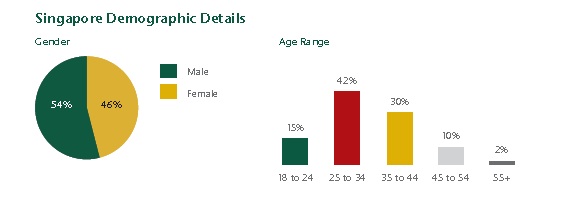
Singapore participant breakdown

Findings include:

33% of respondents from all four countries have acted on promotions seen on social media.

58% of respondents have shared positive experiences online and have sought advice from friends and family when talking about brands on social media.

U.K. respondents are more likely than respondents from the other four countries to complain about service on social.

When respondents express feedback, Facebook is the most popular platform to do this.

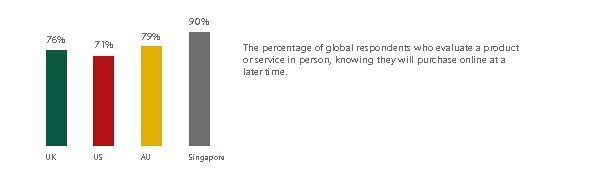
Showrooming (visiting a physical location to evaluate products and services even when you know you will buy online at another time) is increasingly prevalent as 77% of participants showroom.

Experiential branding key to branding success

62% of the participants use a mobile device when in stores to compare product prices.

69% of respondents from all four countries expect a brand’s online store, mobile app, and physical store to offer the same pricing, discounts and sales.

Pricing consistency is expected in all countries

What can brands learn from this thought provoking survey?

They need to understand their relationship with consumers and what resonates with those consumers.

Brands that ensure parity in pricing and products across multiple channels will have to place greater emphasis on the customer experience and experiential branding if they want to win and retain business. Those that compete on price alone will soon be out of business.

Department stores and other retail outlets that represent multiple brands will have to work harder to engage consumers and ensure a positive brand experience otherwise they face the prospect of losing customers, possibly forever.

Mobiles are changing the way consumers research and learn about brands.

Brands that take the time to build relationships with core fans or brand evangelists will see their brands promoted to thousands of fans for minimal financial investment.

Those brands with digital brand strategies that go beyond tactical campaigns online are increasing sales through loyalty and advocacy.

Brands that try to control content and manage corporate driven messages and ignore consumers are unlikely to last very long in the consumer economy of today.

Telling the brand story online should be done across Facebook and other popular platforms with the ongoing development of corporate and consumer content.

Every brand can make a mistake


When Starbucks first came to South East Asia the general perception was that no one in the region would pay US$4 and upwards for a cup of coffee when a decent cup of local coffee (kopi-O as we call it here in Malaysia and we’re the ones who drink it without sugar or condensed milk) would set you back no more than one dollar.

But Starbucks is a classic brand that understands better than most the new realities of branding. And one of those new realities is the experience consumers have with the brand. Get that experience right and consumers will pay well over the odds for the product.

Starbucks has got it right globally and the special experience Starbuck’s personnel create for each customer is what brings customers back time and time again.

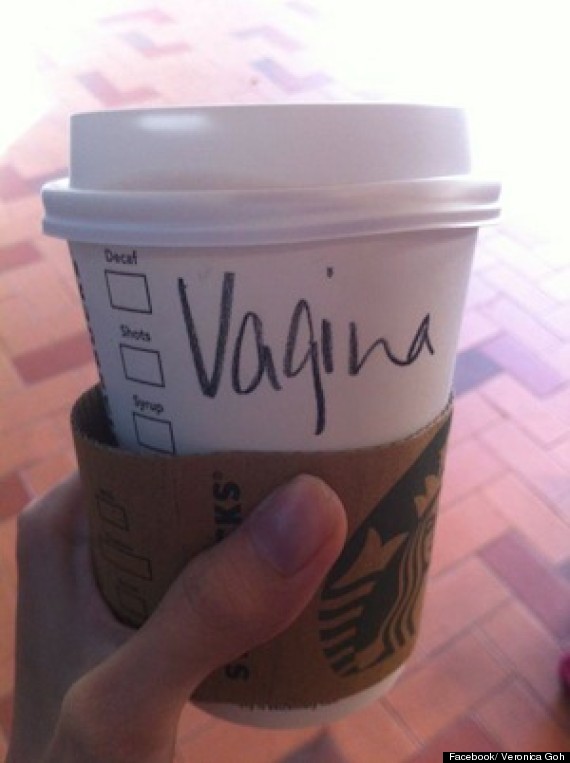
Part of the Starbucks experience is the greeting and their use of your name to identify your drink from all the others at the serving area.

One traveller called Veronica went to a Starbucks in Hong Kong and as you can see from the image below, the Barista didn’t quite get her name right.

Ooops!
Ooops!

She was unimpressed although I don’t really see the big deal. After all, most of us in this part of the world have experienced this at least once. My first name is Marcus and it has been translated into Marks, Marqus and bizarrely, Fungus. I’m serious. Now, I just say Max and it works every time.

Brands, it is no longer about you


Whilst researching a chapter for my new book (you can get an idea of how the book will go by reading this article here) I came across a fascinating company called Undercurrent.

One of the key players in the firm is a guy called Aaron Dignan. You can follow him on Twitter here.

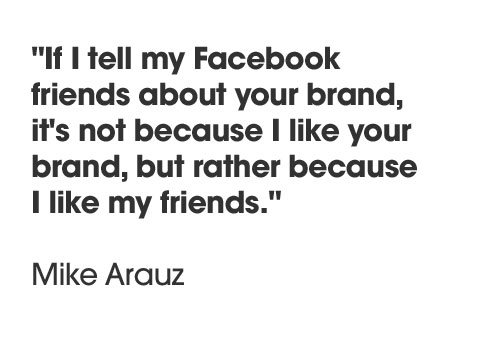
I was impressed by much of what I read on their website but whilst continuing my research, I also found this quote from Aaron:

Do you really understand Facebook?

This simple quote sums up the new world order of branding. It is not about you. Consumers really don’t care about you and your brand. There are so many brands out there that consumers are no longer buying into brands in the same way as they did before.

There are exceptions but on the whole, the world is changing and brands can no longer expect to have the loyalty they used to take for granted. Do you agree?

What is Social Business


We’re involved in the development of the Asean Social Business Summit to be held in Kuala Lumpur in May 2013. You can read more about the event here and visit the official site here

But there is a lot of confusion over what is and what isn’t social business. Social Business refers to enterprise collaboration & innovation that uses social technologies to boost corporate, customer and social value. Social Business does NOT refer to social marketing (PR) or social entrepreneurship (helping rural businesses).

This video argues businesses are still stuck in the Industrial Revolution and need to change and change fast. Importantly, it goes some way to explaining what is social business

<a href="

” target=”_blank”>

5 facts about developing a brand strategy in the social economy


1) Research is more important than ever.
Research has always been important but it was cumbersome and time consuming. Not any more. Today, the right research can be developed and implemented and results analysed quickly and efficiently.

Brand building - don't run before you can walk
Brand building – don’t run before you can walk

It’s easy to find those people who are likely to like your product. It’s even easier to talk to them. But too many companies don’t bother, preferring to chase the holy grail of more new customers through corporate driven messages.

And don’t forget your existing customers because they are your best source of information. Talk to them, find out what they are looking for, what they value and match attributes to their requirements for value.

2) Mass market branding with a focus on the 4 Ps is no longer effective.
Brands today are built on delivering economic, experiential and emotional value. Not on creating some cool position and communicating it across as many channels as possible for as long as possible.

Deliver that value with stories that resonate with target markets and existing customers. Build relationships with customers by allowing access to the brand, personalizing all elements of all interactions, through relevance, experiences and emotions.

Ignore the social element of the social economy by trying to speak to everyone with one corporate driven message and you will fail.

3) Focus on developing more profitable relationships, not a more profitable product. Brands evolve when companies start buying for customers instead of selling to them. This is especially true in times of economic hardship.

4) Branding is an organisational issue not a departmental responsibility.
And the organisation is the responsibility of the CEO. The CEO needs to be involved in the development of the corporate brand.

Your brand is too important to be left to a marketing department that still believes in the corporate driven message over the engagement of the consumer.

And once you’ve built a brand, don’t rest on your laurels, continue to innovate or you will be left behind.

5) Retention is key to brand building.
Companies no longer sell products, customers buy them. And once customers have bought a product, companies must do everything possible to hang onto those customers. After all, you’ve investment a lot of money to gain a customer, why let them go?

Especially as the more time a customer spends with you, the more money they will spend with you.

Cross platform marketing to build a brand


It is accepted now that consumers are paying less attention to traditional media.

Although the TV or the radio may be on, it doesn’t mean they are viewed or heard. And with the proliferation of ads and trailers, more consumers are reaching for other screens during a break in programming.

But marketers still insist on using traditional media to reach as many consumers as possible in the hope that their message will stick. Even those companies that are spending on digital are using the same methods as they used in the old mass economy.

This despite the fact that last year Harvard Business Review said, “Traditional marketing is dead… in today’s increasingly social media-infused environment, traditional marketing and sales not only doesn’t work so well, it doesn’t make sense.”

However, all is not doom and gloom for traditional media channels. Or at least the TV.

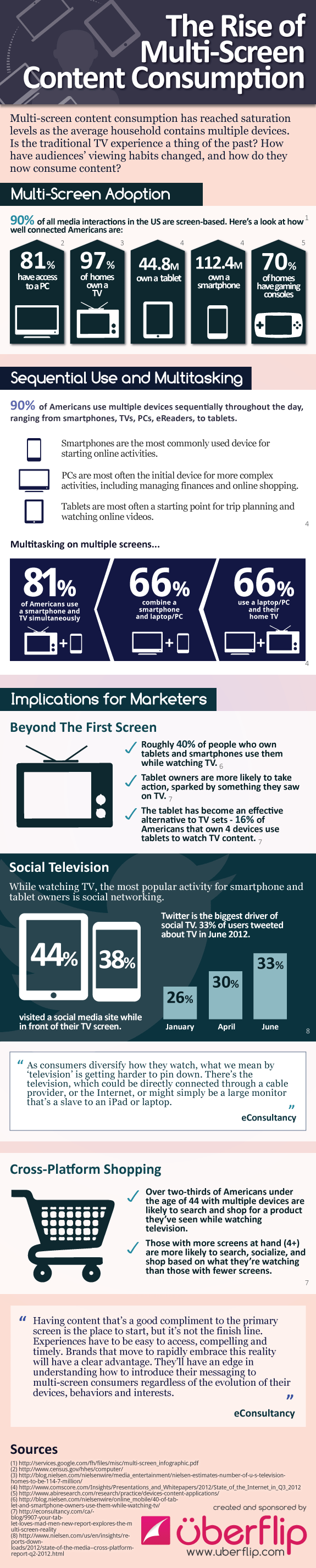
This infographic from Uberflip shows that although consumers are reaching for other devices whilst watching TV, many of them (66%) are using those devices to source information on a product and often purchase after seeing that product on TV.

Cross platform marketing requires a new mindset

So there may be a future for the TV as a communications tool after all.

However, what marketers must do is rely less on corporate driven messages and instead, identify how to introduce their products on one screen and then integrate that product and messaging across other screens taking into account changed behaviours, attitudes and cultures.

Can poor customer engagement across social media destroy a brand?


I came across a remarkable story about how a brand failed to deliver on its promise and the result of that failure. You can read the full story here

In a nutshell, it’s the story of a gamers attempt to buy an add-on for video game console controllers. The tool, known as the Avenger and invented by N-Control was announced in November 2011, word soon spread across social media and demand went through the roof.

After ordering 2 of the controllers, the gamer was told it would ship in early December 2011 however by the middle of the month he had heard nothing so emailed the president of marketing to enquire as to the shipping date and was told it would ship a day later than announced.

Unfortunately it didn’t. Then it was announced that anyone ordering the controller after December 26th would get a US$10 discount however, those who had ordered before December 26th and had still not received their controllers were not entitled to the discount.

By this stage the gamer was getting a bit annoyed and emailed the firm asking if he cancelled his original order, could he then qualify for the US$10 discount (don’t forget he’s ordered 2 of them).

The firm came back with this statement, “Feel free to cancel we need the units we’re back ordered 11,000 units so your 2 will be gone fast. Maybe I’ll put them on eBay for 150.00 myself. Have a good day Dan.”

By this stage the gamer was seething so he wrote again to the President of marketing but this time copied the email to organisers of major gaming conventions in the US. Amazingly the President of marketing responded by calling the gamer childish, laughing at his complaints, and dropping the names of numerous gaming conventions that they intended to attend, one of which was organised by the very company the email was CCd to.

The organiser took the side of the gamer and banned the company from taking a booth at their gaming convention. Then the story was posted online and went viral and this is when it really hit the fan. Because of the power of Facebook, Twitter, Reddit and others the story even crashed the site it originated from! You can see more information on how it went viral here

Soon after N-Control fired the President of marketing and made a US$10,000 donation to charity.

What lessons can be learned from such an event?

Promises made must be kept. If you don’t prepare to feel the wrath of the consumer.

Make sure the people who represent your brand live the brand.

N-Control is on the defensive and maybe for some time. It didn’t need to be in this situation. Know how to use the Internet.

Be careful when you offer discounts. Consumers who have paid pre discount rates expect value. If you don’t deliver, offer the discount to those who kick started your sales.

I believe that an event such as this may not bring down a brand but it could be extremely expensive and the fall out for N-Control will last for years. If they come up with a sub standard product they will really struggle.

And such an event can certainly cost people their jobs and quite possibly, as more and more employers trawl the Internet for information on potential hires, their careers.

A great example of how to drive traffic to your retail outlet in a slow month


Today is a landmark day for retailing in the UK as Selfridges “The best department store in the world*” launches a “No-noise” experience at its major stores across the the country.

It’s a pretty cool concept, offering a Silence Room where customers can ‘find a moment of peace in a world where we are bombarded by a cacophony of information and stimulation’. Customers will be asked to leave their shoes, mobile phones and anything else that makes a noise at the door.

Interestingly the store also aims to reduce the visual noise and has encouraged some brands to offer ‘de-logoed’ products. Paul Smith and Heinz are already onboard with others expected to join in later.

There will also be meditation sessions, quiet music performances (that’ll be a challenge), art exhibitions and motion sensor window displays. Selfridges will also take its name off the classic yellow shopping bags.

You can see more about the Silence Room and other elements of the event on the Selfridges site.

Personally, I think this is a brilliant concept as it understands what customers are looking for and takes experiential branding to a new level. What do you think?

*Global Department Store Summit, Paris. 2012