Take control of your ad placement


I’ve decided to make these real time observations of branding blunders/negative brand association individual posts instead of putting them all together. This latest one is a real gem.

Essentially it is an argument between the British meat industry and the World Cancer Research Fund about the the dangers (or not) of red meat. The article is littered with negative words such as confusing, cancer, nightmare, death, bitter, row and more. To the right (and above) the article is an ad selling Dell computers. You can read the full article here but of course the advertisers may change

The execution of the ad is good. Readers can quickly and easily identify the brand and there is a seamless call to action.

But I’d like to know why Dell is advertising next to such a negative article. How does Dell buy these ads? Have they considered where the ads may be placed? Do they book a specific number of spots and choose the location or does the website decide where the ad goes?

If you are a brand and considering advertising online, make sure you determine what sort of articles the ads can be placed alongside otherwise you may be associated with death, cancer, arguements and so on. Probably not what you intended.

Any thoughts?

Negative brand association, real world examples


In October of last year, I wrote a piece on my blog about negative brand association. You can read the short post here

David Ansett of Storm in Australia approached the subject from a different angle and you can read his piece here

Essentially, my attitude is that if the concept of positioning a product in a consumers mind is a serious concept then it is only logical to assume that the same process can have a negative impact on the brand. Over the next few months, I will post examples that I encounter and I hope you guys will enter into a conversation with me on the impact, either positive or negative, of this brand association.

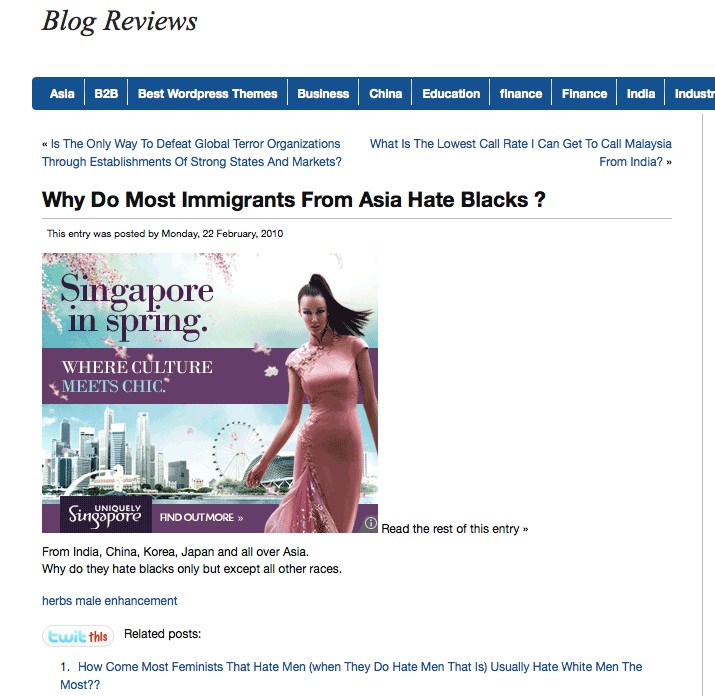
So we’ll kick of this project with a grab of a page I encountered today. I saw the question after answering another question and thought to myself that it would be interesting to see what, if any, the responses to the question might be.

As you can imagine I was shocked to see the ad right under the controversial, not to mention provocative question!

Today’s negative brand association story comes from the BBC site. This time it is a video about a drunk driver in China who is caught on film smashing into road dividers and barricades. You can see the full video here

You’ll note that the story is preceeded by a commercial for Lexus!

Here is a still image from the end of the commercial.

Actually this could also be included in brand disasters. Is it appropriate for a luxury brand such as Lexus to be associated with a drunk driver? Or does it not make a difference?

Any comments?

If a consumer cannot afford your brand, he won’t buy it


Brands are defined by the economic, emotional and experiential value they provide to a consumer. If you can’t match the attributes of your brand to those requirements for value, consumers won’t buy it. Cost is a critical element.

No matter how much you spend on expensive TV commercials that the agency says will reach the most consumers and create awareness of your product the quickest, if a consumer cannot afford your product, he won’t buy it.

It doesn’t matter how much you spend positioning your product in the mind of consumers. If those consumers can’t afford your product, they won’t buy it.

Even if you manage to completely differentiate your product from other products, if a consumer can’t afford your product, he won’t buy it.

More effective brand communications required to build the Volvo brand in Malaysia


Building a brand in any country requires more than a series of tactical initiatives to create awareness and ‘get the name out there’. It takes a meticulously planned and integrated strategy that incorporates the participation of numerous stakeholders and initiatives, both internal and external. Internally to ensure the whole organisation is on brand and externally to ensure communications and content resonates with target markets and are communicated via relevant channels. There’s more but for the purpose of this article that’s enough for now.

And what if the brand is to penetrate other markets? There was a time when all it took to do this was a continuation of the positioning tactics carried out in the home country, perhaps with a few language changes in print media and perhaps some dubbing of TV commercials (TVCs). An over simplification perhaps, but essentially correct.

But as we all know, the world is very different today.

Building western brands in Asia
To build a Western brand in Asia today, as many international brands are finding out the hard way, takes an even more robust and integrated brand strategy that has at its core organisational excellence. Only once has that strategy been developed can the brand strategy be executed. And part of the brand strategy, a small but critical part, is the communications campaign.

This is particularly true of the automotive industry that has seen a number of well known European and other Western brands find it hard to repeat the successes at home in new Asian markets. There are other issues such as high duties etc but many European brands perform below expectations, despite large marketing budgets.

One of those is Volvo. Despite an extensive presence across most media, in 2009, out of a total industry volume (TIV) of just under 537,000 units, Volvo only sold 600 cars in Malaysia, South East Asia’s largest passenger market. This gives Volvo about 0.15% of the market. Although this is a slight increase over 2008 when Volvo sold 524 cars, it is way below the 2007 total of 752 units. Interestingly, in 1999 Volvo sold 839 cars, giving it 0.3% of the market. So Volvo’s market share of the Malaysian passenger car market has halved in 10 years. I think I know why.

Last Thursday, 28th January 2010, a half page full colour ad in the New Straits Times, (NST) Malaysia’s ‘premium’ newspaper caught my eye. The ad features the Volvo V50 and a headline “There’s more to life with Volvo.” The ad goes on to sell space and luxury using images of a kayak, a windsurfer and a mountain bike. The ad lists, in really small print, a number of dealers in key cities. There is no website address.

Last Friday 29th January 2010, Volvo ran another half page ad in the same publication, this time a spot colour ad. This ad features a Volvo XC60 parked on a snow covered road with the occupants, a man and a woman in warm fur collared winter parkas sitting in a pile of snow staring out at a snow covered landscape. This time the headline is “Volvo owners get more out of life!”

If I’m not mistaken, the traditional rule of thumb has it that you have approximately 3 seconds to grab a readers attention with a print ad headline, perhaps less in today’s noisy, cluttered world. I don’t know how effective the Volvo ads have been but I did notice that the offer in the second ad has been extended, rarely a good sign. I also noticed that there is no tracking mechanism in the copy. And, in case you can’t read it, the tagline in the print ad reads “Volvo owners get more out of life!” So the ad is targetting both existing and potential customers.

Coincidentally, there is a Volvo billboard outside my office, at the busy intersection of a very busy highway. The billboard ad features the Volvo XC90 Diesel. This time the headline is “Winner of fuel efficiency award.”

Sitting in my office in the Malaysian capital of Kuala Lumpur where the recent hot spell has seen the temperature top 40 degrees centigrade on more than one occassion and the humidity is often around 90%, I tried to figure out a couple of things.

1) What was the relevance of these communications to potential and existing Volvo owners in Malaysia?
2) Why are they using images featuring snow to sell a service in the tropics?
3) Why is an ad targetted at existing Volvo owners also trying to get the attention of non Volvo owners?
4) Where is the consistency?
5) Is this part of a planned out, integrated strategy or a series of one off tactics?
6) Why would anyone get out of a nice warm car and sit on wet cold snow to admire the view?

OK, ignore the last one.

Hemorrhoids and Frost bite
Well as far as I can tell, more out of life for the couple featured in the second ad is likely to be hemorrhoids and frost bite. I don’t mean to be fecetious, but what is the relevance to the Malaysian market? There are some marketers who insist that to build a brand you need to be first in a category and perhaps Volvo wants to be first in the frost bite category but I think not.

More confusing is the content. The main copy of the ad is encouraging existing Volvo owners to bring their cars in for servicing, repairs or to buy accessories and be entered into a competition to win vouchers that can be redeemed for more accessories and parts. Shooting off on a brief tangent, the takeaways I get from that copy, as a non Volvo owner are, in roughly equal amounts:

1) you are going to be spending a lot on parts and accessories so here’s a little help or
2) these cars are built so well that you will never actually win anything because nothing needs to be repaired but the model sold is so basic you’ll be spending a lot on accessories. Interestingly Volvo also offers a 3 year warranty/100,000km for cars sold in Malaysia so if you’ve got a new car you may have to wait 3 years to receive your prize!

Seriously though, The Volvo communications are confusing. Furthermore, according to the Star newspaper, 86% of Malaysians don’t trust advertising. So that means the print ads mentioned earlier are targetted at only 14% of Malaysians. Moreover, with an entry level Volvo S40 at around RM170,000 (US$48,000) it is off the radar of the average Malaysian so a mass media approach is a waste of valuable funds.

There are a number of other things Volvo can do to halt the slide in its market share and build a profitable brand in Malaysia.

1) Separate the acquisition strategy from that of the retention strategy.
2) An indifference to retention branding is short-sighted. Michigan State University estimated that US$1 spent on acquisition generates US$5 in revenue, while every dollar spent on retention creates US$60 in revenue. Bain and Co has estimated that increasing retention by 5% can increase profits by 25%. Companies have a 5 – 15% of selling something to a new customer, but a 50% chance when selling to an existing customer. But retention branding requires a completely different strategy to acquisition branding.
3) In the mass economy the brand communications goal was to increase awareness. This evolved into persuasion but the ultimate goal today is adoption. Adoption ensures the brand is seen as the best or, better still, the only choice. But adoption of a brand is not an event it is a process built on the back of organisational excellence and reinforced by the ability to deliver relevant solutions on customer terms.
4) Volvo cannot expect adoption if messaging is inconsistent and fragmented. If print campaigns and billboards are to be part of the brand communications, keep them consistent. Announcing fuel efficiency awards is not going to drive traffic to showrooms.
5) Review communication tools and explore social media options. I believe there is no benefit at all for a luxury product like Volvo to advertise in a daily newspaper in Asia.
6) Understand social media is for communities and those communities must be relevant. The only opportunity for interaction on the Volvo website leads the viewer to an international site. Volvo owners in Malaysia will want to be part of a community here, and learn about issues and opportunities in Malaysia, not in Istanbul.

The purpose of this article is not to embarrass Volvo. So if anyone from Volvo reads this article, please view my comments as feedback, not criticism. There are a number of automotive manufacturers making similar mistakes but Volvo caught my eye!

You cannot build a brand with advertising alone


86% of Malaysians don’t trust advertising. The Star) . 78% of Malaysians trust the recommendations of other consumers. There are more than 1,500,000 Malaysians on Faceboook. 80% of affluent Malaysians (those with a household income (HHI) above RM5,000) use social networking sites. Nine of the Top 20 websites in Malaysia are social networking sites. These consumers are the new world order. They are online for many hours a day and pay little attention to traditional mass media. Despite this, Malaysian companies continue to poor billions (RM6.45 billion in 2008. Adoi) into mass market advertising in the mistaken belief that what they are doing is building a profitable brand.

Advertising was much more relevant in the past when the mass media was limited to only one or two TV stations, few radio stations, a couple of national newspapers and the occasional billboard. Limited leisure time pursuits meant consumers spent a lot of time interfacing with the mass media. Finally, there was little competition so high product or service standards were unimportant. With frequency and timing, mass media advertising generated enough ‘awareness’ to justify the budget.

With limited competition and consumers who were willing to accept low standards or didn’t know any better, such awareness could result in sales and for some, it was enough to build a brand.

Using advertising to build a brand is ineffective
Unfortunately, using advertising to build a brand will not work anymore. Mass media has disintegrated into niches or communities. Consumers have been carpet bombed by so many messages – up to 3,000 a day and for so long, that they have learned to block most of those messages. The favoured reaction of advertising agencies to declining responses and lack of effectiveness is to increase frequency but this doesn’t help because it just adds to the cacophony.

In a media saturated world, awareness is just background noise that means very little. For most companies, and there are very few exceptions, in an age when information on every product and service is widely available, and consumers have more choice, are better informed, and more powerful, creating awareness is not going to build a brand. For instance we’re all aware of Mazda, Alfa Romeo, Eon Bank, Pan Am, Airbus, Ritz Carlton and many other multi national global brands, yet most of us will go through life without ever buying something from these companies.

Indeed, many companies have realized, sadly after spending millions on advertising, that advertising can raise awareness (and even that outcome is not a given), but still fail to transform an offering into a brand. Settling for awareness, when so much more is possible and required is a total waste of valuable funds.

But this doesn’t mean that advertising is no longer important. Advertising is, and will probably always be, important to branding. But its role has changed. Advertising can no longer be a tactical initiative to ‘reach’ as many consumers as possible to ‘get the name out there’.

Advertising
Advertising must do more than try to create awareness. Advertising must work to ensure consumers adopt offerings into their lives. Adoption enables an offering to be seen as the best option. But this adoption also needs organisational excellence and the ability to match offerings to client requirements for value. Advertising cannot be expected to do this on its own. And it is wrong of advertising agencies to give the impression it can but it is also wrong of business owners to expect advertising agencies to be solely responsible because advertising is not a silver bullet.

It may seem like I am stating the obvious, but advertising must also communicate trust. This is the key element in any relationship. Prospects won’t make that critical initial connection without trust. And for trust to grow into loyalty, the key to brand building, companies must deliver on the promises made in the advertising. If you don’t deliver on the promises made, your target market is reduced by 86% and you are trying to sell to the 14% of Malaysians who trust advertising.

Some of the claims being made by property developers, automotive distributors, airlines and others in their advertising are often bordering on the ridiculous. Consumers, already pressed for time and cynical, are doubtful as soon as they see the advertising. If you foster doubt from the moment of the initial contact, you’ve wasted every dollar spent on that campaign. If you are making claims you must follow through with them across every touchpoint. And don’t expect it to happen overnight. It takes time to build loyalty.

Understand that building a brand requires not just advertising but also a significant investment in building loyalty and organisational excellence and the money you spend on advertising may be money well spent. Failure to do so and you may as well pour it down the drain.

Malaysians haven’t changed since 2003


Omnicom Media Group (OMG) announced yesterday that newspaper advertising in Malaysia is as effective as it was six years ago. The report also states that readers ‘take note’ of 57% of newspaper ads and that this figure has not changed, I repeat, has not changed since 2003.

The sample size was 1,023 readers aged between 15 – 34 in four locations. They were tested on their recall of 15 ads in different sizes and in different places in newspapers they had read. The number of ads tested was 2,452 that appeared in 15 ‘main’ newspapers.

The agency developed what they describe as ‘three indicators of effectiveness’

1) Ad Noting or ad recall
2) Ad read or readers attention
3) Brand recall

The reports states that bigger ads perform better with a full page ad yielding 21% higher ad noting than a quarter page. Furthermore 60% of colour ads are noticed compared to 53% of B/W ads.

I got my information from this article and not from the original report which I would love to see.

So I can only go on the above data, plus some other results that don’t deserve to be published.

So what is my beef with this report? Well, in no particular order, the first issue I have is with the methodology. The report doesn’t tell us if the responses were aided or unaided. Critical. My second beef is with the ‘indicators of effectiveness’. There was a time, many years ago when newspaper advertising, with its one-size-fits-all mass marketing approach was effective. But not today. Awareness, or noting, or recall is simply not enough to turn a prospect into a tryer. And even if readers are bucking the global trend and not blanking out these and other messages but are indeed noting these ads, so what!?

Another beef is with the number of ads and the channels. 2,452 ads that appeared in 15 newspapers. That’s a lot of ads in a lot of newspapers. Most of us would find it hard to think of 15 mainstream newspapers in Malaysia. I’d also like to know which ads they were shown. For instance, were 15 year olds shown Louis Vuitton ads? They might recall it but what are the chances of them buying the product?

When we have a first meeting with a prospect, one of the first questions we ask is, “Have you read the paper today and if so, which ads do you recall?” Very, very rarely does someone actually recall an ad. And many of them were reading the paper as we walked into the meeting!

The time spent by Malaysians online went up 24% from 3 hours a day in 2006 to 3 hours and 46 minutes a day in 2008. With broadband penetration forecast to be 50% in 2010, that figure is going to rise significantly. Already, 80% of affluent Malaysians (those with a household income above RM5,000) use social networking sites. The time Malaysians spend interfacing with traditional media will suffer. But perhaps the most telling statistic of all is one that appeared recently in the Star, “78% of people trust the recommendations of other consumers, while only 14% trust advertising.”

So even if consumers are noting or recalling or whatever the latest term is, it doesn’t really matter because 86% of them don’t believe what they read in the advertisements so they’ll never buy the product!

Acquisition versus retention


The image below is a rather amusing yet fairly typical example of the importance most companies place on retaining customers. FusionBrand anecdotal research suggests that companies invest 85 – 95% of their marketing resources into the acquisition process and only 5 – 15% into the retention process. Can anyone explain why?

After all, according to Bain and Co, a firm has a 15% chance of selling to a new customer and a 50% chance of selling to an existing customer. Wouldn’t it make sense therefore to invest more in retaining customers than acquiring them? Furthermore, once a prospect becomes a customer, it is a lot easier to build a relationship with that customer, using content that is relevant and interesting to them, and not via the mass economy blitzkrieg popular with most advertising agencies.

Your thoughts?

Dodge seeks survival with mass economy approach


Chrysler has, like most US auto manufacturers, with the exception perhaps of Ford, seen its market share drop further in 2009. But this time it is down below the psychological 10% barrier at 8.9%, down from 11% in 2008. Sales are down a worrying 40% over the same period. This is not good, especially as the company stated in early 2001 that it intended to have 20% of the US market by 2005.

A restructuring plan in November 2009 introduced a number of initiatives including using models from Europe to mask the fact that Chrysler has made little investment in new products.

In what has become a depressingly familiar process, executives at the restructuring also introduced a number of new positioning strategies for the Jeep, Ram and Dodge brands. According to the executives, new models are to be redesigned or improved in times quicker than ever known to the industry. Ambitious sales figures include global sales targets of 2.8 million vehicles by the year 2014, of which about 60% are projected to be in the US. The firm forecast break even in 2010 and anticipated posting a profit in 2011. Revenues are forecast to be in the region of US$70 billion.

Specific brand initiatives include the biggest marketing budget for the Jeep brand in four years. Showrooms are to be redesigned to reflect off road heritage and Jeep managers will engage more with consumers at events. Meanwhile at Dodge, another new logo has been created to reflect a ‘sporty, youthful, inexpensive’ car. New entry level cars are to be available in different ‘flavors’ or equipped ‘differently’ not ‘expensively’. Are there such words as ‘differently’ or ‘expensively’?

Ralph V. Gilles was appointed President and Chief Executive Officer of the Dodge Car Brand in October 2009, with full profit and loss responsibility for the Dodge car product portfolio. Before this he was VP of design. He is responsible for halting the Dodge slide but to do so he is going to need more than a new positioning strategy, new logos and a one-size-fits-all approach to marketing. Unfortunately the signs are not good as he has appointed Wieden & Kennedy, an advertising agency to build the Dodge brand.

Gilles is on record as saying that Dodge cars are, “Cars that make you feel good, that are niche-like in their demeanor, but have mass appeal.” Well I’m sorry, but that sounds to me like a one-size-fits-all typical mass marketing ad agency driven concept that will, in the end, appeal to nobody.

What do you think?

Does shock and awe advertising still work?


This is a brutally graphic public service announcement from Australia’s Transport Accident Commission (TAC). Viewer discretion is advised.

This is an immensely powerful piece of work beautifully executed. And it had an emotional impact on me. All the characters resonated with me as I imagined myself as many of them at various stages of my life. At the end I was breathless and close to tears.

But the question being asked by Bill Green is “Does this stuff work? Really work?” According to Bill, TAC says yes. According to TAC, “in 1989 the first TAC commercial went to air. In that year the road toll was 776; by 2008 it had fallen to 303”. That fell again to 295 in 2009. However, despite these powerful commercials, 16 people died over the Christmas period.

Topically, I have just spent 10 days in Australia over the festive period and the only TVCs I can recall were for alcohol (beer and hard liquor) and fast food. I was stunned to see so much alcohol advertised on TV. I didn’t see this TAC commercial or if I did, it didn’t register.

Using creativity to communicate
Advertising, and in particular well executed advertising, used to be a great way to reach a great many people over a relatively short period of time. With less competition, more accepting and attentive consumers, such reach could ensure the message was received and absorbed by the right people. Not anymore. Mass media has fragmented into niches and communities. Using creativity to communicate a message is no longer effective because the message is blocked out or soon forgotten because we simply don’t have the interest or bandwidth to absorb all the messages assaulting us throughout the day, every day. Increasing frequency doesn’t help, it makes it worse as it adds to the noise. Even beautifully executed work like this is lost in the fog of products and services.

I wrote an article about a similar approach used toward smoking in the UK and Malaysia. You can read the full article here,

Chilling commercials don’t work
With smoking, the research, carried out over 10 years by the Institute for Social and Economic research found that the warnings on cigarette packets that smoking kills or maims are ineffective in reducing the number of smokers. Likewise, chilling commercials or emotionally disturbing programs are also ineffective. The study also discovered that when a close family member become ill from the effects of smoking, the smoker takes no notice. In fact, according to the study, smokers only reduce the number of cigarettes or sometimes quit when their own personal health is at stake.

In Malaysia, despite nearly US$50 million spent on shock and awe campaigns to create awareness of the dangers of smoking, the number of smokers has practically doubled every 10 years. Whether or not there are parallels between campaigns for smokers and those who drink and drive, I don’t know.

Personally, I suspect that the reductions in fatal traffic accidents since 1989 are due to better safety features in cars, better roads, better lighting, highly visible enforcement measures, increased penalties for offences such as not wearing seatbelts and using mobiles, reductions of speed limits, more drug testing and better educated consumers.

The key then is not to add to carpet bombing of consumers via advertising, but to identify how those consumers become better educated? Was it the commercials or a reaction to the commercials or other initiatives?

Pubs legally obliged to breathalyse patrons
This can be done using qualitative research with consumers and then use that data to forge future strategies. It may be expensive and time consuming, but it will give us the answers we are looking for and determine future strategies. Of course it may be that it is not the commercials but in fact peer pressure at key times such as when consumers leave a pub, club etc. I think this may be the case and I see a time, not too far in the distant future when all bars and restaurants have to, by law, breathalyse all patrons as they leave the premises.

Personally, although this is a powerful TVC, I wouldn’t watch it again. If this commercial came on, I would change channels because if I am watching TV, I don’t want my leisure time to be challenged by issues I don’t want to address at that particular time.

Thanks to Andy Wright for the heads up on this story.

The organization is the brand


Japan Airlines was established as the national flag carrier of Japan in 1953. The government was the largest shareholder and for over 30 years, JAL was the only Japanese domestic airline with the rights to fly international routes. In other words, as a government entity it had a monopoly on those prized international sectors.

Rather than employing professionals in the industry, the government tried to run the airline, creating bureaucratic inefficiencies that had little inclination to deliver the value customers are looking for.

Hope came in the late 1980s when the government sold it’s stock in the company and the airline was privatized. In 2002 Japan Airlines System was incorporated to manage JAL and by 2006 the airline’s daily operations had reached 192 international routes and 387 daily flights.

A new brand identity and aircraft livery themed around ‘the arc of the sun’ was created and it was hoped that ‘the identity would help JAL build a stronger global brand and position a JAL flight as a means to acclimatizing to Japanese culture, attempting to attract more international business people flying to Japan to choose JAL over other international carriers’.

In 2010, JAL is fighting off claims of imminent bankruptcy by multiple media organizations. According to etravelblackboardasia.com, JAL has experienced financial difficulties for quite some time and currently owes more than US$5.8 billion.

JAL shares plunged to a record low in Tokyo trading last week, however the airline is still positive that it will experience a turnaround with the support of the Japanese government. The site also quotes a JAL spokesperson as saying that reports that JAL was planning to cut all of its international routes to cut costs are 100% false.

Well, only time will tell but it is crystal clear that the airline is in big trouble and is surviving on bail outs from the ETIC (Enterprise Turnaround Initiative Corporation of Japan).

What lessons can other legacy carriers learn from this?

Using creativity to build a brand.
When Japan Airlines and Japan Air Systems merged, the idea was to provide the foundations for a more efficient organisation to compete both domestically and internationally. Nothing wrong so far.

Next came the development of the brand image. This was to clearly communicate the fact that the merger had created a new and improved organization. According to Landor, the JAL agency, “the JAL brandmark needed to express a new business philosophy and strategy and at the same time be flexible enough to apply at every touchpoint where travelers, airline employees, and travel advisors have exposure to the brand.”

Landor also says on it’s website, “The JAL mark reaches dynamically to the sky. It is derived from the motif of a rising sun, one of the best-known icons of Japan. The mark is drawn in a modern way and is reflected in the red sun on the tail of the aircraft. In 2002, the integrated holding company was established and the JAL mark was introduced. It is now visible in advertising, ticketing, airport environments, and the combined fleet of aircraft. Implementation of the design will be gradually executed through prioritized applications.”

Sounds good, but the problem is that consumers aren’t buying that stuff anymore. Positioning products belongs in a mass economy that no longers exists. There are too many airlines essentially positioning themselves in the same way. This is because positioning and the 4 ‘Ps’ are imprinted on the DNA of an entire generation of marketers. But the market conditions have changed and it is time to bury the concept otherwise we’ll see more companies in the same position as JAL.

JAL should have focussed it’s brand building efforts, not on reaching for the sky with a motive derived directly from the sun but on providing value to customers based on bespoke relationships with existing customers, access, relevant content to relevant segments, userbility, technology and more. Sure a slick identity is important but it will not build the brand on its own.

Strategic relationships
JAL was late joining an airline alliance which meant it couldn’t offer the interconnectivity of competitors. This has had a profound impact on the airline. ANA, JAL’s competitor joined Star Alliance in 1999, eight years before JAL joined ONEWORLD.

Operations
Although once the airline was privatised, it did reduce costs by cutting staff levels and employing cheaper foreign staff, it still operated at high unit costs which had a negative impact on operating effectiveness.

The right technology
It is critical to invest in technology that is user friendly. JAL’s flight planning software is awkward and confusing.

Flexibility
Like many airlines, JAL focussed on attracting customers to the high yield spots at the front of the plane. There is a general theory (I don’t know how true it is) that if you fill business class on a 747, the flight is paid for and the rest is gravy. This is a common strategy but in the recent economic meltdown it’s not a very effective one.

Despite no longer being a government company, JAL was slow to adapt to the economic situation and suffered as a result. It is imperative therefore that airlines become more nimble and whilst a strategic plan is important, it has to be versatile enough to adapt quickly to challenging market situations. At the same time, it has to be adaptable to take advantage of opportunities.

I doubt very much that the Japanese government will let JAL fail. But what about other Asian legacy carrier established by governments to fly the flag globally? Many of them are already sucking funds out of already empty coffers. Will they be alowed to fail?