Google+ Brand Pages is another critical social media tool for corporate brands


Back in June 2011, Google launched Google+ to counter the increasingly powerful and influential Facebook. According to Google, 40 million people have signed up for Google+ which equates to about 8 million new users a month. Not a bad effort but a long way to go to reach the 800 million Facebook users.

The launch of Google+ saw a number of complaints from consumers, especially related to applications whose functionality was changed or users being forced to give up pseudonyms to continue sharing.

Corporations also complained because they were unable to connect and build relationships with consumers, something they have been able to do and do successfully on Facebook.

Some companies did try to create business pages on Google+ but they were rejected, with a request to wait.

Well the wait is over with the launch today of Google+ Brand Pages. Now firms can connect and engage with consumers through corporate pages. Although Google+ Brand Pages doesn’t operate that differently from Facebook, it will have to form a part of any corporation’s social media strategy.

One neat feature not available on Facebook is Google+ Direct Connect. Simply by putting “+” in front of a brand’s name before making a Google search, will ensure searchers are directed to the firms Google+ page.

Google’s open approach also means that a brand can now have a business page that is integrated with Google search, Ad words, Google places and YouTube.

Critically, I also expect Google+ profiles to have a significant impact on Search Engine Optimisation (SEO) and search results. And once Google starts to provide metrics for pages via Google analytics, we may see Facebook’s crown slip.

Malaysian SMEs must start to build brands


This article first appeared in the 28th October 2011 issue of the Malaysian Reserve.

The recent budget and the implications of the budget are still being debated but what is clear is that the government is trying to help SMEs.

As part of the budget, the prime minister announced a RM100 million SME Revitalisation Fund for entrepreneurs who have tried and failed. The goal of the fund is to give those entrepreneurs the chance to get up and have another go.

SMEs are the engine room of countless economies and crucial to the development of many countries. In Malaysia the percentage contribution of SMEs to the nation’s Gross Domestic Product is 47.3%. This compares favourably to the larger economies of China (60%), Japan (55.3%) and Korea (50%).

One of the reasons Malaysian SMEs have stayed relevant is because most of them have been nimble and adaptable, making the change from primary industries such as agriculture and mining up until 1990 to an industrialized economy that saw manufacturing becoming the leading growth sector over the last 20 years.

However, many of those SMEs that made the move from commodities to manufacturing succeeded because they were able to compete on price. And with low labour and other costs, Malaysian made products were attractive and demand was constant. This also encouraged FDI.

But talk to any Malaysian manufacturing SME and you will most likely find that over the last 20 years, with few exceptions, every new contract negotiation with the companies they have supplied clothing or equipment to has resulted in their being forced to lower their price. Margins, with a few exceptions are down to less than 4%.

Despite relationships that may span as many as 20 years, loyalty is non existent and, despite vague promises of long term relationships, business is now being lost to Cambodia, China, Indonesia and Vietnam.

Hardly surprising when average factory wages in Malaysia are 250% higher than in Cambodia, 200% higher than in Vietnam, 160% higher than in Indonesia and even 40% higher than in China. Worse of all, as a contract manufacturer for a third party, Malaysian manufacturers have no knowledge of their consumers and little chance of finding new business.

As FDI and even local investment in manufacturing has dried up as brand owners seek less expensive locations, Malaysian SMEs are now fighting for their survival and whilst the SME revitalization fund is an important step to help those who have failed, Malaysian SMEs will need to develop more strategic ways to differentiate themselves.

One obvious way for SMEs to do this is to build brands. Yet the majority of Malaysian SMEs ignore the importance of branding. But competition, accentuated by AFTA and China’s entry into the WTO means that if they do not begin to brand, they will not be able to compete. The long term reliance on cost to differentiate, driven by historical experience in commodities and the fact that Malaysia was a cheap manufacturing base, will no longer suffice.

The irony is that Many Malaysian SMEs have done the hard part. Malaysian SMEs are already capable but are yet to sell their capabilities to the world. A major investment in branding will allow Malaysian SMEs to leverage substantial advances in quality manufacturing, workforce productivity, logistics and efficiency.

Malaysian SMEs already produce garments for international brands, components for the international aerospace industry, electronics for the global computer industry and numerous personal consumer goods.

In the services sector Malaysian SMEs provide support to banks, airlines, hospitality providers, medical services, insurance companies, and so on.

But these SMEs may lose out to international competition if they do not develop brands. Now is the time for SMEs to learn the importance of branding and the strategies and skills needed to create and maintain market strength through building relationships, providing personalisation and delivering value to customers.

Compounding the problem is that Malaysia is becoming a victim of its own success. As it becomes a more mature economy, global MNCs will start to take notice, as they are already doing and flood the market with international brands using international budgets to buy market share. Unless Malaysian SMEs begin to brand they will not survive this onslaught.

It’s especially important that Malaysian SME’s allocate their (and the Governments) limited resources effectively. The brand promotion grant, launched by the government about six years ago helped some companies advertise but using advertising to build a brand requires deep pockets and leaves too much to chance because it is so hard to stand out from the clutter and be heard over the noise of other advertisers and make an impact with consumers who are permanently distracted.

The good news is that branding today does not necessarily require huge investments in logos, slogans and expensive creative driven advertising campaigns pushed out across traditional mass media, which too often result in at best, a short-term sales spike but have no real long term gains for the company.

By utilizing emerging technologies and trends that are having a major impact on brands and branding and by leveraging these technologies and trends, and by integrating such trends and technologies with the social nature of Malaysian culture, Malaysian SMEs can potentially build global powerhouse brands. And not in the twenty years it has taken traditionally taken to build a brand, but possibly in as few as five to ten years.

But to do this Malaysian SMEs must focus not on price and trying to undercut rivals, both domestic, regional and international, but by identifying prospects, building relationships and understanding customer requirements for value. This will take a significant change on organizational culture but it is one that Malaysian SMEs must make.

It is great news that the government is trying to help SMEs with the SME revitalization fund but it is also important that SMEs help themselves and understand that if they are to survive and thrive, they can no longer compete on price alone.

Repositioning won’t solve Nokia’s problems


In 2002, Nokia was Britain’s number two super brand; by 2010 it was 89th. But Nokia doesn’t have a branding problem.

Although I no longer use a Nokia, I still have some brand loyalty and track the performance of the Finnish mobile phone behemoth and although it’s global share of mobile sales dropped below 30% for the first time since 1999, it still sold 450 million handsets in 2010, outselling Apple 10 to one.

10 years ago, in 2000, Nokia sold 128 million handsets out of a total of 405 million, giving it just under 32% of the market and with margins of 20%, Nokia was well placed in the sector as Motorola and Ericsson struggled.

By the end of 2003, Nokia had increased its share of the global handset market to 34.6%. By the end of the first quarter, 2004, that share had slipped to 28.4%. This 20% drop in market share was despite a year-over-year increase of mobile shipments of 29.3%. Nokia found itself in this potentially dangerous position because it was slow to introduce clamshell style phones and colour displays.

Fast forward to 2007 and Nokia was once again humiliating competitors in the handset stakes, and in particular Motorola. In the first quarter of 2007, Nokia shipped 92 million units, a 20.6% growth compared with Motorola’s 47.5 million units shipped during the same period. 2007 also saw handset sales break through the one billion units level with a total of 1.17 units sold, a 16% increase over the 990 million phones sold in 2006.

Nokia’s global market share climbed to 38% whilst Motorola’s slumped to a dismal 13%. Analysts thought at the time that Nokia’s share of the global market could climb to an all-time high of 40% by the end of 2007.

On 2nd August of that year, Nokia announced an astonishing 57% increase in second quarter operating profits to US$3.2 billion. And when the definitive metric for measuring brands is profitability, Nokia sizzled again with operating margins for the combined mobile device business of 20.9%. The company also had US$9.5 billion in cash and no debt.

But 2007 saw the launch of the iPhone and suddenly the mobile phone became a smartphone. By the third quarter of 2007 the iPhone had 20% of the smartphone market, way behind RIM with the Blackberry at 39% but more than the smartphone sales of Motorola, Nokia and Palm combined.

By 2010 Nokia’s market share had slid from a 36.4 percent share in 2009 to 28.9%. Nokia still sells more mobile phones than any other company but consumers no longer want mobile phones, they want smartphones.

And at the heart of the smartphone is the operating system. By January 2011, Google’s Android, and its Chinese versions Tapas and OMS had become the top smartphone platform in the world with an 888% year-over-year growth.

Nokia’s Symbian system is a very close second with Research in Motion a distant third and Apple’s iOS way back in fourth. Microsoft’s mobile operating system barely warrants a mention with 4% of the market.

Under pressure in a market it once dominated and essentially still does, Nokia has panicked. Realising the key to smartphone sales is the OS, it has mucked about with Symbian, a perfectly good OS with no more flaws than the iOS.

But because of the now huge size of the organisation, issues bought up during the testing of touch screens and browsers were often ignored.

Desperate, Nokia launched the N-Gage with too few poor quality games and terrible network connectivity for multiplayers, the phone was blown away by the PSP and DS.

Next came another disaster, the Ovi. Nokia’s answer to the iTunes Store was an unmitigated disaster. In 2007, Nokia restarted its touchscreen development after deciding in 2006 that touchscreens were essentially a gimmick.

This delay meant that the N95 and N97, both good smartphones in their own right and with email, music players, the Internet and GPS as well as a slide out Querty keyboard were supposed to compete with the cool iPhone.

Next up, the beautiful N8, launched in 3Q2010. Engineering porn in my opinion with a 12 megapixel camera used by professionals. But the N8 was outsold 6 to one in Europe and did even worse in the gadget hungry, fast growing Asian markets.

Then it tried a completely new Linux based OS called MeeGo but it’s corporate heart wasn’t in it and MeeGo only got a year.

Now, in what could be seen as a last throw of the dice, Nokia has teamed up with Microsoft and is launching the partnership with a US$112m global brand repositioning campaign, which will see the launch of its first phone running on the Windows 7 operating system in October 2011.

This is a big mistake. Microsoft’s Phone 7 was launched for Q4/2010 on about twelve handsets from a number of manufacturers. During the quarter it achieved a meagre 1.5 million sales, earning it about a 2% market share and worse than Windows Mobile which had 4%.

During the same period, the latest version of Symbian (the all new user-friendly touch screen version that powers the N8) was launched on 3 Nokia smartphones and sold 5 million units. All Symbian products sold a respectable 32 million units.

Although I don’t know the objectives of the six month reposition campaign, one assumes it is an attempt by Nokia to try and regain lost market share from rivals Android, Apple and Blackberry.

But this won’t happen because some ad agency or agencies have created a position that they intend to push out, no doubt primarily across traditional mass media because that’s where most of the eyes are supposed to be and it pays the highest commissions.

And I’m sure the same message will be communicated in all countries, irrespective of local cultures, smartphone habits and so on.

And of course there will also be a nod to digital and social media. And with US$100 million to play with there will no doubt be an attempt at a clever Old Spice type viral campaign.

But the problem is, Nokia’s issues cannot be solved with a communications campaign that will no doubt generate lots of interest but will not change the fact that the Windows OS is an unpopular OS.

Nokia doesn’t have a brand problem, it has an organisational problem that cannot be solved by a repositioning campaign.

Nokia products don’t come close to delivering the experience Android, RIM and Apple smartphone products offer. And that won’t change with seven. Especially as Nokia has had very little influence over the first Windows 7 devices.

And if you can’t offer a compelling experience, you won’t solve the problems Nokia has.

Nokia would be better off taking that US$100 million and giving it to the Symbian crew to improve what is almost a very good OS capable of competing with Android and iOS.

The top 1,000 brands in Asia – so what!


Following the completion of a research project carried out in conjunction with TNS, the Asia Pacific edition of the globally respected marketing magazine, Campaign Asia has named Sony as the top brand in Asia.

According to the study the top 4 positions all went to power house North Asian brands – Sony retained its position at number one followed by Samsung, Panasonic and LG with Canon at five. In fact the top 5 were unchanged from 2010.

At six is Apple, HP at seven, Google at eight and Nestle at nine with Nike at ten.

Facebook was the top social networking site at number 17 whilst Twitter leapt from 123 to sixtieth.

HTC, whose stock has tripled in the last year and is now Asia’s second largest maker of smart phones leapt from 532 to 100.

Interestingly no Chinese brands made the top 100 and only one Indian brand (Amul) managed to do so.

Amul, the largest food products business in India and the maker of ‘the big daddy’ of butters and the number one ice cream in India, was the best performing non-Japan or Korea brand, coming in at number 89.

At 123, Louis Vuitton was the highest luxury brand and surprisingly luxury brands fared poorly. Despite listing on the Hong Kong stock exchange recently, luxury brand Prada came in at a disappointing 348th, only two places above CIMB and down from 252.

Although Maggi (22nd) place and Tesco (96th) will be familiar to Malaysians, the top Malaysian brand is Marigold at 131, down from 129. Other Malaysian brands include Malaysia Airlines at 163, Maybank at 172 and F&N at 238. Old Town coffee also deserves a mention at 245, coming in almost 40 places above Maxis at 284. Celcom, Maxis main competitor was further down at 395.

Sticking with Malaysian brands, Boh tea was down at 417, Firefly, a budget airline was at 462, up from 518.

The highest new entry was Hankook tyres of Korea at 246. The highest new entry Malaysian brand was Life, a sauces/condiment maker at 718 followed by Kimball, another sauce/condiment maker at 825. Surprisingly Proton, the Malaysian national car was also a new entry at 916.

The survey was carried out in ten Asian markets: Australia, China, Hong Kong, India, Japan, Korea, Malaysia, Singapore, Taiwan and Thailand. Ages of the respondents were from 15 to 64 and approximately 300 respondents from each country were surveyed.

Participants were asked only two questions:

“When you think of the following (product or service) category, which is the best brand that comes to your mind? By best, we mean the one that you trust the most or the one that has the best reputation in the (product or service) category.”

“Apart from the best brand you entered, which brand do you consider to be the second best brand in the (product or service) category?”

14 major product and service categories were covered in the survey:
Alcohol and tobacco
Financial services
Automotive
Retail
Restaurants
Food
Beverages
Consumer electronics
Computer hardware
Computer software
Logistics
Media
Telecommunications
Travel and leisure
Household
Personal care.

In addition to these major categories, a further 72 sub-categories were included!

The final rankings were determined based on the total number of mentions each brand received across all categories and countries.

Then the data was weighted on two levels: the first to reflect the population composition within the markets covered, and the second to reflect the competitiveness of the categories included in the study.

Now I don’t know about you guys but if there is one thing I have learnt over the years it is that markets such as Malaysia and Japan or Thailand and India have very little in common, especially when it comes to food, alcohol (60% of the Malaysian market is Muslim and therefore alcohol is forbidden) and other culture specific products.

Furthermore, I don’t know how they included all the categories and sub categories but I can only assume the answers were aided. Nevertheless, imagine a questionnaire that lists 14 potential answers and then a further 72 options to those answers! How accurate are the responses going to be?

I also think that the sample size and the demographic – only 300 participants per country and a massive demographic of 15 – 64 is simply too big to provide results that are actionable or relevant.

And we don’t know the gender of the participants yet gender will be crucial in many of the listed categories and in how we communicate with prospects, with what content and across what platforms.

And looking at the brands, someone in India is not going to name Proton as the best (another thought, define best?) automotive brand because the Malaysian national automotive brand has yet to go on sale in India.

Frankly, I don’t really understand what is the point of this survey and what it means? How is it relevant to a consumer or company in Malaysia when it lists brands not available in the country? How can a company leverage its position? What must a company do to move up the list, perhaps to the top? How relevant is the ranking?

If the survey must be done, it would be better if it were country specific and related to each category alone. Rather than asking two (aided) questions, it would make sense to develop questions based on the product needs in that country. Questions will also need to be developed based on the category.

And instead of looking at traditional approaches that rely on demographics, in the social economy, it would be better to work with social media communities. Results could then be correlated and geographic comparisons made although they still won’t offer actionable data to the brands.

What do you think?

Suggestions to improve a travel website


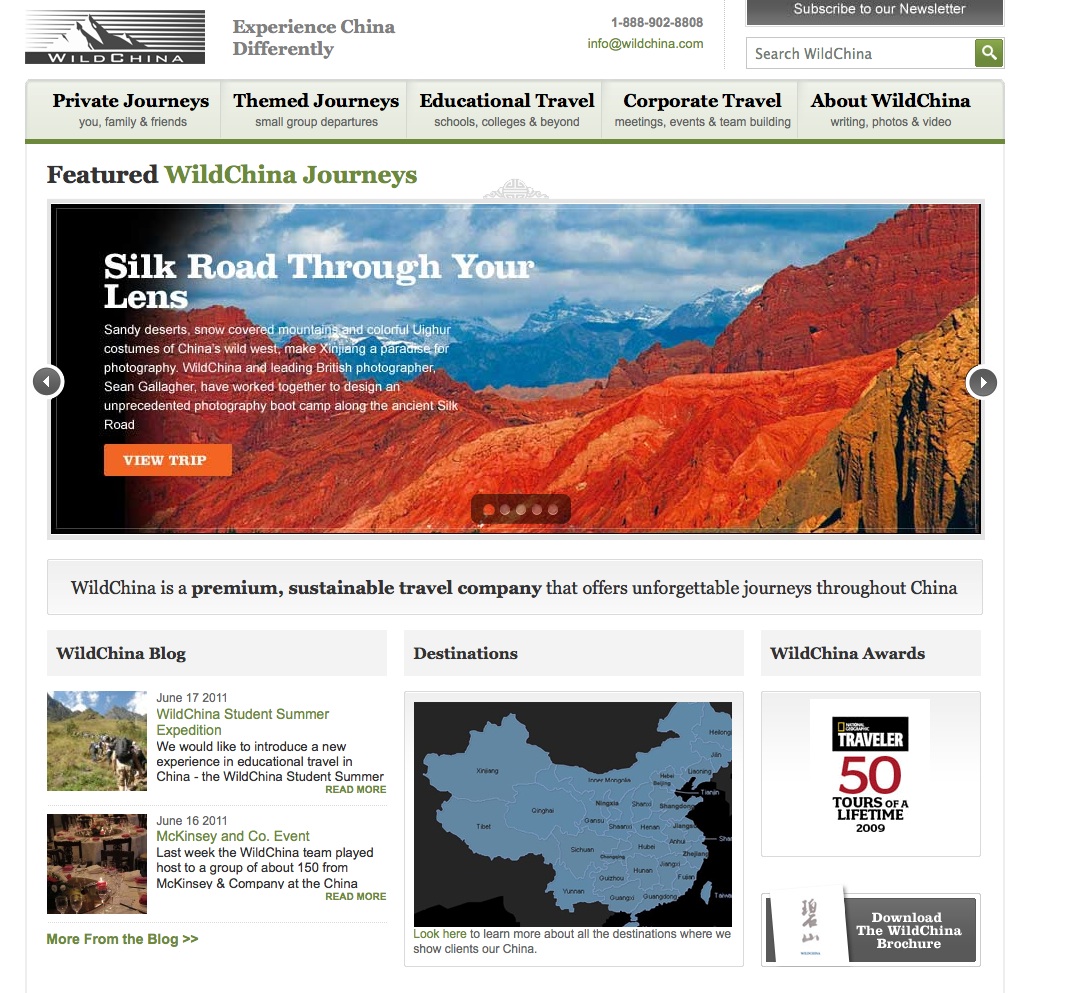
One of my favourite business sites, Bnet has an interesting case study of a site that offers bespoke or customised trips in China. The site is not doing as well as the owners expected.

The article asks the question “Why doesn’t this website draw more visitors” and there is an outline of the situation with the issues and readers are invited to comment. I tried to add my comments but as has happened before, I couldn’t add them so I am including them below.

The look and feel of the site is drab and reminds me of websites from 10 years ago. The content is too ‘traditional’ and rather predicatable.

If they are not happy with the number of visitors, then SEO is obviously an issue. So many companies spend a fortune designing a site and then sit back and wait for the orders to flow in. If only it were so easy…

So what would I do to make things happen?

They need to improve the writing. Although this won’t improve traffic to the site, it’ll keep visitors on the site once they are there.

I’d talk to existing customers and ask them what improvements they would like to see. I’d also talk to prospects that have visited the site and made enquiries but have not booked and identify why they didn’t book.

Before that, they need to invest more in driving traffic to the website, especially if as stated, 10% of the marketing budget generates 70% of enquiries. I’d also investigate and measure the number of leads generated from those 1,650 page views, source of visits, conversion rates from all channels, lost prospects and retention rates.

Other thoughts
1) The target market doesn’t have time to wait for flash to load. Furthermore, many of them are probably accessing from smartphones between appointments or via laptops whilst at airport lounges with poor internet speeds. Keep the information simple and bin the flash. Also you need a mobile version of the site.

2) So many companies think a website will make sales for them. It won’t, it is nothing more than a brochure to generate interest. Once an enquiry comes in, start building a one on one relationship with those prospects.

3) The form is too long. The target market is the wealthy but the wealthy are careful about sharing information, especially at the prospecting stage. If I buy you can have that data but not yet. Let’s stick to email communications for now. And maybe twitter.

4) Social Media initiatives aren’t engaging enough and there is too much broadcasting. Moreover there appear to be comments by readers/fans to which there hasn’t been a response.

5) Although I didn’t read the Blog articles, the headlines on the home page would suggest they are press releases not blog posts.

The key in any customer facing exercise is to put yourself in the shoes of the people you are looking to communicate with. And the best way of doing this is to talk to the people that visit your site, those that do business with you as well as those that don’t.

The Maldives is ‘rebranding’. Why?


I read here that the Maldives is starting a major rebranding initiative. The republic of the Maldives is an island nation in the Indian Ocean and consists of about 26 atolls with about 1,200 islands spread over approximately 90,000 square kilometers. Of those islands, about 200 are inhabited.

Its area and population of 300,000 make it one of the smallest Asian countries. It is also the lowest country in the world and at 2.3 metres above sea level, it is also the country with the lowest highest point.

Fortunately for the Maldives, it has some of the most stunning beaches on the planet and an ideal climate, all year round sunshine and beautiful calm seas have helped make the republic a popular destination.

You may recall the horrific images of death and destruction caused by the Tsunami in 2004. Despite the harrowing scenes and negative publicity after the Tsunami in 2004, the country has seen a steady increase in arrivals and 2009 saw arrivals surpass the pre Tsunami total of 500,000 visitors in 2003. Indeed, arrivals for 2009 were an all time high of almost 700,000. The main countries of origin for tourists to the Maldives are the UK, Italy, China, France, Germany, and Japan.

And there has been little negative reaction to the recent public relations disaster when an European couple were humiliated by hotel staff who were asked to bless their marriage. Probably because an apology to the couple was almost immediate and other fallout was handled confidently and quickly by authorities.

With limited natural resources, tourism and fishing have become the two key industries although the country does have a thriving cottage industry consisting of activities such as handicrafts and lacquer work.

Currently tourists spend most of their time in private bungalows in self-contained tourist resort islands designed specifically for tourism. Only one resort can be constructed on an island and the maximum built-up area of any resort island is limited to 20% of the land area and the building heights is not allowed to be higher than vegetation levels. Only 68% of a beach length can be utilised for guestrooms, 20% of each resort island beach is reserved for public use and 12% is classed as open space areas.

With such a fragile ecosystem, efficient waste management is vitally important and new resorts must install their own wastewater treatment plants, bottle crushers, incinerators and compactors. Sewerage disposal through soak-pits into the aquifer is no longer allowed. New resorts are also required to install desalination plants and this has substantially reduced the stress on ground water supplies.

The Maldives are seen by many to be the role model for sustainable tourism and it is such planning, strict environmental controls and policies that have ensured the Maldives retain their mystique.

When not in the resorts, most tourists spend time relaxing on private beaches, swimming, snorkeling, diving, fishing and boating. Sightseeing and visits to markets and local artisans in Male the capital are also popular.

So it would appear the Maldives, so to speak, is in a good place. It is managed efficiently, it is a role model for many countries, it has a thriving tourism business that works because of the policies and systems and processes put into place to protect the industry, it handles crises effectively and is probably in the top ten of most people’s ‘must go to destinations’ so you could be forgiven for thinking, “If it ain’t broke, why fix it?”

Thoyyib Mohamed, Minister of State for Tourism in the Maldives aims to “position the Maldives as the must-see destination of our time for all travelers.”

A recent press release goes on to state, “The (rebranding) initiative will focus on enhancing the positioning of the nation’s tourism product, strengthening its image in established key source markets while broadening its appeal to wider audiences and emerging niche markets.”

I’m not privy to just how many visitors the Maldives can take without breaking that fragile infrastructure and I don’t know what the targets are but I am fairly confident that broadening its appeal to wider audiences and niche markets may result in an increase in the number of arrivals. Even another 100,000 visitors, an increase of around 15% will put a tremendous strain on these beautiful islands and in addition to the added pressure on the environment and infrastructure these new arrivals will obviously bring, they may also cause social and cultural problems.

I would hazard a guess that the Maldives are known to most people who travel abroad for leisure. I also think it will be practically impossible to ‘enhance the image’ of what is for many an already perfectly enhanced image. And trying to position the country and creating awareness of the destination amongst those that don’t know the country will be a costly exercise that may do little more than waste valuable resources. Something no country can afford to do.

I recommend the Maldives focus on these 5 key areas

1) Retention. What does it need to do to get people to visit again?
2) Share of wallet. What does it need to do to get more out of visitors?
3) Instead of using outdated mass economy approaches like positioning, leverage the power of social media. There are numerous sites on Facebook about the Maldives but none seem to be managed.
4) If new markets are pursued, chose them carefully, only after extensive brand research. And go after them with a strategic plan that engages relevant communities in those countries and again, not via traditional media.
5) I just realised how good this point is so I have to keep it for a destination we’re working with, sorry!

Should you measure Brand Equity or Customer Equity?


Malaysian and Asian firms can save themselves a lot of effort and resources by focussing on customer equity as they attempt to build brands.

It’s almost 20 years since the launch of the landmark book “Managing Brand Equity: Capitalizing on the Value of a Brand Name” by David Aaker. David Aaker name may not be as familiar as others in his industry, but he is credited with developing the concept of “brand equity”.

The release of “Managing Brand Equity: Capitalizing on the Value of a Brand Name” came at a time when companies were desperately seeking new ways to increase the value of their brands by assigning a value to them or, measuring the intangible assets of the company such as reputation or channel relationships, that were previously ignored by traditional accounting systems. This became known as Brand equity.

On the face of it, “Brand equity” appeared to quantify intuitive recognition about the value of brands that in turn helped to rationalize marketing expenditures. It was also shorthand for a brand’s two key strengths – its relationship with purchasers and mental image among both prospects and customers. And it provided a means to rank winners and losers in branding wars – MAS vs Singapore Airlines, Maxis vs Celcom, Coca-Cola vs. Sarsi and so on.

Brand equity is now considered one of a number of factors that increase the financial value of a brand and the term is used freely to say the least. Nevertheless, despite its popularity, the concept of “brand equity” has numerous shortcomings, especially in an age when customers not organizations, are determining the success or failure of brands. Indeed, the pursuit of brand equity can even warp executive decision making and lead to lost profits and opportunities.

One shortcoming is that although the term is widely used, no common definition of brand equity exists.

In fact, in his book Building, Measuring and Managing Brand Equity, published about seven years after David Aaker’s work, K.L. Keller lists NINE definitions of Brand equity, some of which actually contradict one another. This lack of a definition means that no universally agreed upon measure exists.

Delve deeper into any methodology concerning a “brand equity” calculation, and it quickly becomes apparent that the effort has all the intellectual rigour of a fence post – a dash of corporate history, a gaggle of retail outlet numbers, a touch of stature here and some strength there, a little bit of ‘brand esteem’ topped off with an extra helping of distribution sales, a sampling of questionnaires and so on.

This lack of a common methodology means that two experts examining the same brand come up with widely divergent calculations. Furthermore, it is impossible to compare brands across different countries, industries or perspectives.

This imprecision – at a time of global economic uncertainty when shareholders are demanding more accountability and C level executives insist on both sophisticated measurement and accountability – means “brand equity” lacks validity as a benchmark for executive decision-making. After all, how can executives make effective decisions when it’s impossible to understand – and agree upon – consistent numbers?

As if C level executives didn’t have enough to think about, this imprecision causes other problems as well. If “brand equity” increases by 10%, what caused it? Was it the latest advertising campaign? Or was it a new product launch? Perhaps it was more aggressive sales? Or maybe it was the discounts at critical times to reduce inventory? Better service? “Brand equity” does not provide any insights about cause-and-effect.

Second, “brand equity” does not indicate market or financial success. Look at some companies with great “brand equity” – Pelangi Air, Perwaja steel, Port Klang Free Zone (PKFZ), Kodak, K-Mart, MV Augusta, MAS, – that have either disappeared, faced or are facing financial difficulties. Indeed, “brand equity” as a guiding star leads companies to focus on product maximization at a time when leading companies recognize that a focus on customers is critical to success.

Finally, and most important of all, “brand equity” is irrelevant to customers. Customers buy on value, service, price, convenience or other reasons, but never make a purchase decision based on the relative “brand equity” of two offerings.

Ask yourself, did you ever walk into Cold Storage, Armani or Isetan and buy something based on its brand equity? No, of course you didn’t. Hold that thought, why should you pay attention to an issue that customers ignore? Because everyone else is? Because you were told to in marketing classes that were probably developed in an era before Facebook, twitter, ecommerce and more?

So what should you focus on? The answer is “Customer equity”.

Customer equity has one universally recognized definition – the lifetime value of customers. This value results from the current and future customer profitability as well as such intangible benefits as testimonials and word-of-mouth sales.

Customer equity incorporates customer loyalty to buy again and again, the faith to recommend a brand and the willingness to forgive the inevitable mistakes that every firm makes.

While “brand equity” is impossible to calculate consistently, customer equity can be easily calculated on the back of an envelope. All that’s required are numbers that every company already is – or should be – calculating. These include revenue, customer acquisition (or marketing) costs, costs of goods/services and retention rates.

Ideally, depending on the industry, companies should also track leads and referrals, and be able to determine the profitability of specific products or services. By adding up revenue (or profits), subtracting relevant costs and incorporating retention rates, companies can determine the current – and future – profitability of every customer.

And because customer equity is easy to calculate, it will be understood by everyone from the boardroom to the warehouse, making it much easier to unify personnel behind the brand.

“Brand equity” is all about a product or an organization. But in the customer economy, brands that attempt to push products onto customers that don’t want them will fail. Even if you spend millions creating awareness of your products. Today, building a successful brand requires customers that are profitable.

Customer equity supports and measures the activities that encourage customers to buy more, more often. Increasing “brand equity” does little for a firm and decades of good will can be wiped out overnight (think BP), but increased customer equity reflects increased retention and word-of-mouth sales, key elements of a profitable brand.

Customer equity has other advantages as well. Because retention and customer profitability are tracked, it’s easy to make a direct link between marketing, service and other programs to increases (or declines) in customer equity.

Customer equity also enables the segmentation of very profitable, not so profitable and unprofitable customers. Knowing the relative profitability of customers not only helps promote retention of the best customers but also substantially improves the investment required and effectiveness of marketing as well as reducing marketing costs.

In today’s customer economy, “Brand equity” provides few if any tools for those responsible for attracting and keeping satisfied customers. In The Loyalty Effect, the author Frederick Reichheld wrote, “Customer equity effectively explains success and failure in business…. The companies with the highest retention rates also earn the best profits. Relative retention explains profits better than market share, scale, cost position or any other variables associated with competitive advantage.”

Do brands have value? Absolutely, and David Aaker has left an impressive legacy. But attempting to measure this value provides little benefit and distracts a company away from the critical task of retaining profitable customers.

Because ultimately, it’s these customers – not a fallible calculation of a dated concept – who are responsible for brand value and long-term corporate success.

How to build a brand in Asia today


Building brands has evolved from the one dimensional, top down era where the company controlled the relationship and essentially managed that relationship using broadcasts across mass media such as TV, Out of Home, print and radio with messages and content created to tell you what the company wanted you to know into the bottom up, customer economy.

In the bottom up customer economy, brands and their success or failure are defined and determined by customers. Those customers will create content and messages and disseminate that content and those messages across multiple platforms and to communities who are interested in their opinions. Now, how you interact with consumers is on their terms.

This is not revolution, simply evolution in the branding space. Brands are to blame for this loss of control because they have consistently misled consumers or over promised and under delivered. Brands can no longer be built using one-size-fits-all messages broadcast across traditional media channels to anyone who will listen. Basically because no one is listening.

Sure, there is still a place for messages, campaigns, and so on but because there are so many sources of information, so much clutter, these messages don’t have the impact or influence they had 20 or 30 years ago. In the digital age you can spend as much as you want on traditional media and reach everyone in the country but if they are not listening they won’t buy your product or service.

If a brand wants to be successful it must learn to communicate with multiple segments, and messages must be targeted and must be dynamic, using content and channels that resonate with those segments. But brands must move away from the traditional demographic approach to researching those segments. After all, how many 15 – 24 communities are there on Facebook? And content must constantly be revised and updated with new content.

And organizations must ensure that they deliver on promises and that promise must deliver economic, experiential and emotional value to each of those multiple segments. In the consumer business, this is most often done, initially anyway, in the store. Because in the customer economy, no matter how much you spend, if your staff don’t know how to build rapport with your prospects then they may buy once but rarely will they become a loyal customer. And without loyal customers, you won’t have a brand.

So if you are looking to build a brand, forget about reach, awareness, positioning and brand equity and trying to be all things to all people and start thinking about delivering value to specific segments and building customer equity.

A solid brand is built from the inside out


The chances are that you have discussed branding, what it is and whether it is important. You’ve probably agreed to ‘look into it’ and assigned someone from marketing to research brand consultants.

Marketing will probably google something like ‘brand consultants’ or ‘how to build a brand’ or ask friends or associates if they can recommend anyone. If your marketing department is staffed with ex advertising agency personnel, they may get on the phone to ex colleagues.

Unfortunately, advertising agencies is where many companies start the development of their brand. Senior management and the marketing department together with an advertising agency and often without any input from other departments such as sales, will spend a considerable amount of time developing the “marketing mix.”

A tagline will be created, colours discussed and so on. This is important but not at this stage. A good brand is built from the inside out. Before the creativity starts, carry out a brief internal brand audit. Ask yourself questions such as, “Do our employees know what we do?” “Do our employees believe in the product/service that we offer?” “Do they understand the role they have to play in the brand mission?” “Do they understand the importance of our customers?” “Do our staff ‘live the brand’?”

Here are 10 other initiatives that will help you lay the foundations for a brand.

Step 1: Review your organizational structure
Customers control relationships with businesses like never before. Manufacturing costs have fallen to record lows. Transactions are cheaper and faster than ever. The Internet has revolutionized the way we communicate and do business. Yet despite these cataclysmic changes, companies continue to integrate in the same old traditional ways.

Employees report to superiors and information is channeled up and down hierarchical chains not across departments, hampering coordination and improvement. To succeed in the future, brands must understand that the customer is king, focus on processes not functions and develop a retention based not acquisition based culture.

Step 2: Recruit talent not bodies
Too many companies leave recruitment to the last minute or try to save money by increasing the work load of already overburdened staff. Look to recruit people that will enhance your organization based on your long term vision.

Step 3: Build a credible corporate vision
In collaboration with staff, create a vision that benefits employees, shareholders and customers. And make it realistic! Brand values must be based on providing value to customers. The reasons for and the role of the organization and individual staff in providing this value and the benefits to the organization and staff must be crystal clear to all.

Step 4: Train new and existing staff immediately, consistently and regularly
The only thing that all brands have in common is that customer loyalty is a result of employee loyalty. The foundations for any internal branding initiative must therefore start with personnel understanding the importance of the role they have to play in the evolution of the brand. In addition to improving skills, training also gives staff the confidence and attitude the organizations requires.

Step 5: View staff as an investment not an expense
Too many companies see staff as an expense and as a result do not invest in them because they are frightened the staff will leave. If you create an environment that is rewarding and encourages personal growth and has clearly defined career paths, your staff will not leave.

Step 6: Give personnel room to grow
Everyone makes mistakes but few people make them deliberately. Once you’ve invested in the right people and trained them, show them you believe in them by supporting them and trusting them to get things done, even if they make mistakes along the way. And if they make mistakes, give them the responsibility to correct the mistake.

Step 7: Encourage freedom of expression at meetings
If you only want to hear people support what you say or agree with what you have done what is the point of them attending meetings? To build a great brand, individuals will contribute and good managers will need to be open and aware of those individuals and give them the freedom to benefit the brand by challenging senior management.

Step 8: Understand that in general the sales department is the frontline of your company
No matter how much you spend on advertising, the first touch point most prospects will have with your brand will be via the sales force. It may be in a shop, a showroom, at an exhibition and so on. If that first meeting with your sales force is unsatisfactory, the prospect will not return. Train your sales force to represent your brand and reward them for doing so.

Step 9: Think long term
Whilst it is possible to build a brand more quickly than perhaps twenty years ago, building a profitable brand takes time and commitment. Take a long term approach to your business rather than a short term deal making mentality.

Step 10: Measure all activities
Wherever possible, measure. But before you do, ensure measurement definitions are standardized to ensure consistency and communicate them corporate wide. And when you measure, share the results across the organization and seek feedback and recommendations for improvement from staff. And then help them implement those recommendations and measure them.