In 2012, online advertising spend breached the US$100 billion level for the first time. And forecasters are predicting double digit increases for the next couple of years.
But the types of ads are extensive, from pop-ups to banner ads, to text ads to display ads and so on. There is no consensus on what works the best and what doesn’t but studies suggest that interstitial ads (those that appear when you move from one page to another) animated ads and pop-up ads have the highest visibility, but have low click-through rates.
Whereas banner ads suffer from what the industry calls “banner blindness.” Which basically means that users have stopped seeing them.
According to one company in Australia, for every 1,000 people who see an online ad, only 1 will click on it and the average conversion rate for most sites is 2% which means that you require 50,000 people to see your online ad before you are likely to make a sale.
Another company, Digiday states that only 8% of Internet users account for 85% of clicks on banner ads and that 50% of clicks on mobile banner ads are a mistake.
But digital advertising will continue to grow especially as advertisers online can target their messages at the right segments, thanks to increasingly sophisticated technology. But with such low penetration, you need to get the content right so that when the 1 in 50,000 comes along, there is a good chance they will buy whatever it is you are selling.
I’ve had a go at Malaysia Airlines a few times and I’m probably not very popular with them which is a shame because I’m a big fan of the brand and in some areas, they are trying very hard to build a global brand. But I don’t believe the airline is demonstrating high levels of branding professionalism. Most recently I had a go at their latest advertising campaign. You can read that story here.
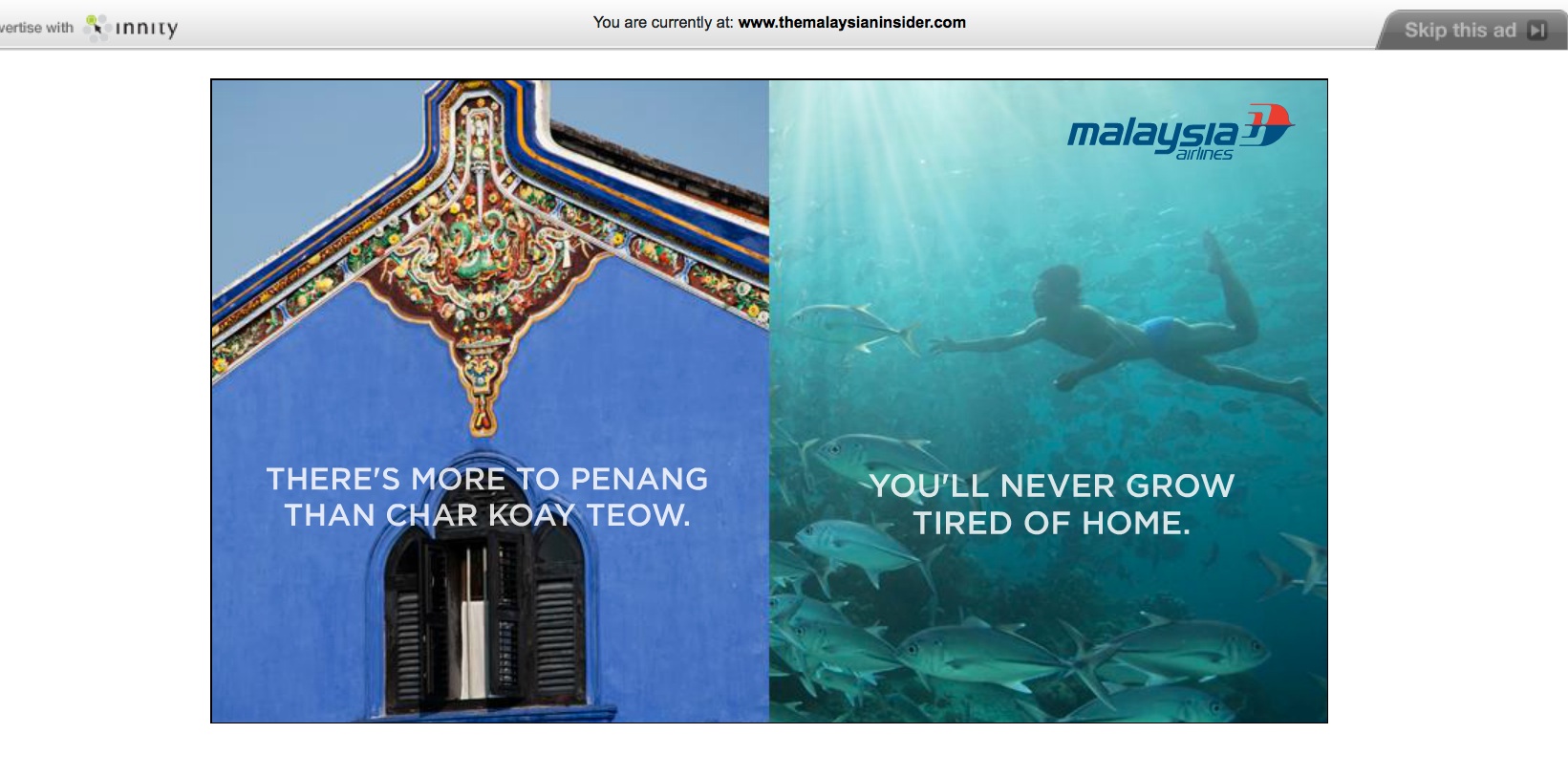
I’m sorry to say that I’m going to have another go at them. Earlier today I clicked on a link at the Malaysian Insider website and was interrupted by an interstitial ad for Malaysia Airlines. The ad (see below) featured an underwater image and an image of Penang. Obviously I was interested to see what they were doing so I clicked on the ad.
I was directed to the Malaysia Airlines site and was told it is under going system maintenance. Now I understand that sites need to be up dated all the time but not in the middle of a digital advertising campaign.
This type of schoolboy error can be fixed with a brand blueprint that is shared throughout the organisation and ensures the organisation works collaboratively, not in silos. Until they make such organisational improvements, Malaysia Airlines will continue to struggle. It really needs to up its branding game if it is serious about becoming profitable.
The development of a Malaysia nation brand has been discussed for a number of years. As part of the Industrial Master Plan (IMP3), a National Branding Task Force was established and tasked with building the Malaysia Nation Brand. In 2008, through the Malaysian External Trade Development Corporation (MATRADE) and after extensive research and a nationwide tender, the project was awarded to a brand consultancy.
After a letter of award was issued to the consultancy and the project team was mobilized, the then Prime Minister stepped down and six months later the project was cancelled. Soon after the National Branding Task Force was disbanded.
Since then there hasn’t really been any organization established to develop a Malaysia Nation Brand. Some of you will say that 1 Malaysia was a Nation Brand but it wasn’t.
At the end of 2011, some firms were invited to “submit slogans for a new Nation Branding project”. Of course a slogan isn’t a Nation Branding project but it was considered a start.
The slogan chosen was probably “Endless Possibilities” because this was used during the World Economic Forum in Davos to promote Malaysia as a South East Asia location for investment and tourism.
Without any warning, a sixty second TV commercial aired on CNN in March 2013. If you have a weak stomach, I don’t recommend you read any of the reader/viewer comments below the video.
It’s hard to identify who posted the video but there is reference to a brief with the comment, “The brief from the Prime Minister’s Office of Malaysia was to promote Malaysia as a dynamic country with well developed infrastructure and an aggressive economic growth plan for the future.”
More recently, the Prime Minister was spotted wearing a badge with a design that has been described as “a starburst in red, yellow and white against a blue background.” Malaysia, in a custom font is underneath the logo.
The new Malaysia logo (thanks to thestar.com.my)
In late August 2013, a local news portal reported that Prime Minister Najib Razak will launch a new national branding effort and that the national branding effort comes with the slogan or tagline, “Endless Possibilities”.
This is exciting news, so what should we expect from the Malaysia Nation Branding project?
It is important that Malaysia doesn’t fall into the trap many other countries fall into – jumping head first into a well produced communications campaign in a misguided attempt to build a brand.
India is famous for its ‘Incredible India’ advertising campaign launched in 2002. By 2009, India was spending US$200 million advertising the country. In November 2012 India announced that a new advertising campaign headlined, “Find what you seek” would be launched to build on the Incredible India efforts.
The new Indian minister of tourism announced that the new campaign highlighted to consumers that ‘they will find whatever they are looking for from a holiday in India.’
The goal of the new campaign was to increase international arrivals by 12% annually till 2016. Unfortunately, little more than a month later, a woman in Delhi was brutally gang raped and left for dead on a public bus. The story made headlines around the world.
Four months later, a Swiss woman was gang raped whilst on a cycling tour of Madhya Pradesh and soon after, a British woman was attacked in Delhi and only avoided potential death after jumping from a hotel window to escape.
Within a matter of weeks, instead of announcing increased interest, tour operators were reporting a 35% cancellation rate from women and a 25% drop in all arrivals with multiple cancellations from the lucrative markets of Australia, the UK, Canada and the United States.
Meanwhile, FDI dropped 29% in 2012 despite the ongoing advertising campaign. An advertising campaign, however good, isn’t going to change perceptions caused by crime or reverse FDI declines caused by the global economic situation. So years of the Incredible India campaign, if remembered at all will now be replaced with harrowing tales of the treatment of women in India and depressing economic data.
What nation brands have to understand is that today, not only are constituents in target markets more segmented and more knowledgeable, they also live their lives very differently, source their information more socially and in many countries, no longer believe corporate driven messages anyway.
But most important of all, in today’s dynamic, fluid social, Internet fuelled world the corporate driven message, created after months of brain storming by consultants and the like and communicated to all and sundry at enormous expense repeatedly can be undone in a moment and replaced with harrowing tales of criminality and economic woe.
Building a Nation Brand is a strategic initiative not a tactical one. A communications campaign is a tactical activity and it is not possible to build a Nation Brand with a communications campaign, especially one that is created to convince both internal and external stakeholders of something that is hard to prove.
Today, building a Nation Brand requires multiple elements that are critical to the success of any such project. However there are two in particular that will make or break the Malaysia Nation Branding project.
The first is that the community must be involved in the development of the Nation Brand and agreed values must be clearly defined and understood by all stakeholders and integrated into their lives and applied to every touch point.
Sure there must be a CEO with the knowledge, strength and unbiased objective viewpoint to drive the project but without this early stage buy in from stakeholders, the chance of success are very low.
And the second critical element is that promises made must be kept. It is simply not good enough anymore to say you are something or you are going to do something without delivering on that promise at every touchpoint.
I don’t know the full extent of this project and how the community was involved but in the video aired on CNN, the Prime Minister says, “Malaysia is the unique place where the best of Asia comes alive.” That’s a bold statement that will require buy in from all Malaysians and will be tough to deliver to all stakeholders.
So let’s hope the Prime Minister and his team pulls it off because in the current economic climate, a well defined brand that has the buy in of key constituents, resonates with target markets and delivers on promises made will give Malaysia a significant edge over competitors in an increasingly competitive environment.
The talented team at Brandwatch in the UK have produced a very useful report on Twitter usage by global brands. This report should be read by marketing departments and CEOs. You can read the full report here but some of the findings are listed below:
1) 253 companies, primarily from the US and UK were analysed for the report.
2) Only 2.4% of the companies surveyed did not use Twitter at all
3) 97% of major brands used Twitter in 2013, up from 62% in 2011.
4) It was noted that Apple does not use Twitter or any other social media. Interestingly, Apple’s share price has tumbled to as low as US$400 earlier this year, down from US$700 in September 2012. Of course I’m not blaming that on the fact they don’t use Twitter however it does mean there will be some distance between the brand and customers.
5) Brands use Twitter for both broadcast and engagement purposes but most of them acknowledge that Twitter is best utilized as a two-way channel.
6) 145 brands surveyed (over half) tweet a minimum of 30 times per week.
7) 25% of Brands use Twitter solely as a broadcast channel.
8) 63% of Brands have multiple accounts. Using one for company news and another for customer service was a common example of multiple accounts.
9) Dell has 44 Twitter accounts.
10) Weekends are the best time to reach customers on Twitter. (I don’t think that applies to Asia). However a little research into what your audience prefers goes a long way to successful engagement.
11) Tweets with media (a photo/video) get 3 to 4 times more engagement than those without.
12) The average size of a UK and US Twitter team is 4 people.
13) The maximum number of tweets in a week for the US was 2,500 tweets, compared with 113 tweets in the UK.
14) The Twitter web interface is the most popular platform for tweeting.
15) 20% of the top 100 global brands use HootSuite.
What can Asian firms learn from this data?
For a start, if your firm is not on Twitter, it needs to be. Twitter won’t go away! British and American firms have an average of 4 people on their Twitter team. Most Asian firms don’t even have a community manager, let alone a social team. This needs to change.
Asian firms can use Twitter to engage customers more effectively, deal with issues and retain customers. It is far more effective and less expensive than attempting to use acquisition marketing across traditional channels to retain existing, unhappy or vulnerable customers.
Twitter can be an effective and inexpensive way to drive sales. Low cost airlines in the US generally tweet special offers to their followers before making them available. The cost for the tweet is minimal and its effectiveness can be easily measured.
Asian firms can be notoriously opaque and secretive. Twitter forces firms to become more open and transparent, encouraging trust.
In Asia we tend to follow the US and Europe in many things, especially in marketing. This report gives Asian firms the data needed to support their marketing strategy going forward.
I don’t like to kick a man (or an airline) when he’s (or it’s) down, and despite a couple of good quarters, Malaysia Airlines (MAS) is certainly down.
The good quarters (following six straight quarters of losses) are a result of increased revenues thanks to better load factors and higher RASK (Revenue per available seat kilometer).
Just to recap, to avoid bankruptcy, MAS embarked on a massive restructuring plan towards the end of 2011 that included cutting unprofitable routes and reducing costs with the goal being to return to full year profitability in 2013.
Although the airline has done quite well, that’s unlikely to happen even though it is focusing on Asia and has stopped flying to costly destinations such as Buenos Aires, Johannesburg, Cape Town and oddly, Dubai. Giving up Dubai and Dammam suggests the carrier is surrendering to the aggressive carriers from the Middle East.
The most recent business strategy announced two key strategic elements – one to focus on the premium sector and the other to focus on the competitive Asian market. The announcement that the airline would go after the premium sector came at the same time as the partnership deal with AirAsia that has now been scrapped.
I’ve seen nothing to suggest the airline is courting premium customers and although it is good to see the airline understands the importance of segmentation, I doubt their ability to execute such a strategy.
Especially as the airline seems to be going the same old predictable route of using an advertising campaign featuring an irritating tagline (more on that later) to magically increase demand. And I’ve seen nothing else to suggest the airline is doing anything other than the usual advertising, print and PR tactics with a nod to social media.
And what an advertising campaign it is! I think this is the TV commercial.
I’m sorry but this has to be the worst commercial or video I’ve ever seen. It features people of various ages walking, cycling, swimming, jogging, directing traffic (I’m serious), reading newspapers, skateboarding, going to a meeting, graduating, bowling, clubbing and all with one thing in common – they are all carrying at least one suitcase! Yes, even the traffic policeman!! This really is rock bottom.
The print advertisement (which I’ve also seen on a billboard) features two men sitting on a wooden dock. They are both holding suitcases and the younger man has his arm around the older man and is looking into his eyes.
Sitting on the dock of the bay, suitcase in my hand
Does this image make anyone else uncomfortable? Here’s a close up to help you decide.
Does this make you uneasy?
MAS also has a corporate video that starts off with a series of stock scenes featuring babies taking their first steps, dad playing with son, climbers etc and then cuts to old shots of MAS in the early days. Meanwhile the voice over tells us that life is made up of countless journeys. Getit?.
Then we get shots of computer generated imagery of the various planes used by the airline from past to present (didn’t BA do something similar?) before going back to the people shots – nice, smiling, friendly air hostess with kid – cut to boys jumping into lake – then back to nice, smiling people, tender, caring hostess and then, out of the blue we’re told the strangers we meet on our journeys give us courage – cut to skydivers – then back to lovers on beach, cultural harmony, pregnant couple and so on. I stopped at this point, unable to continue. Have a look instead.
One of the videos (I can’t remember which one and I have no intention of watching them again) features the Malaysia Airlines app that I really like but isn’t integrated with the website (or if it is I can’t figure out how to find my bookings made online on the app).
So if MAS is serious about increasing market share, what should the company do? Here are 5 things they need to start doing today.
1) Forget about the big idea. Focus instead on consistent, onging, personalised engagement with each of your very diverse audiences.
2) You probably have one of the most comprehensive databases in South East Asia. Start to use it properly.
3) Focus. These ‘one-size-fits-all’ advertising campaigns are an expensive exercise in naïve futility. Put an end to them now.
4) Don’t do social, be social.
5) Integrate all your solutions to make it easier for consumers to use them. Otherwise they defeat the object of developing them in the first place!
I’ve been flying MAS for over 20 years and I think it is a great product but it needs work. A lot of work. This traditional approach to brand building is not going to help steer the airline to full year profitability. They’d be better off throwing the money down a black hole.
Singapore Airlines only recently reported its group operating profit fell 19.8% to S$229 million (RM564 million). SIA Engineering and SilkAir also reported lower profits while losses for SIA Cargo dived more than 40% from S$119 million to S$167 million.
And then a recent Singapore Airlines flight from Singapore to London made it into the global headlines for all the wrong reasons.
Air turbulence caused the flight to lose altitude just as breakfast was being served. Much of the food and drinks were left all over the cabin and passengers and a potential Public Relations nightmare could have resulted with irate passengers complaining across social media.
Milk and sugar?
However, an event that the airline has little control over turned into a PR success thanks not to the Singapore Airlines corporate PR department but due to the professionalism of the crew and the community approach of the passengers.
As soon as it was safe to do so, the cabin crew checked every passenger and then, with the help of passengers did their best to clean up the mess. When the flight arrived in London, paramedics were waiting to treat the few slightly injured passengers & crew.
As passengers disembarked, the crew handed out an apology, chocolates and of course a big Singapore Airlines smile. A potential disaster averted with good training, responsibility and a customer centric mentality.
This infographic from McKinsey offers a fantastic insight into how two key European markets are engaging with digital and how it is revolutionising the buying habits of their citizens.
Are you ready for how digital is changing the way consumers interact with brands?
The implications of these new realities are significant to say the least. As more and more of the population buys online, traditional retailers will have to reinvent themselves or risk going out of business. Because these traditional retailers tend to move slowly, more of them are going out of business than reinventing themselves.
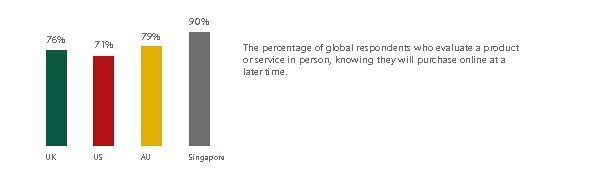
South East Asian countries tend to a year or two behind Europe in how technology is integrated into our lives however we’re already seeing digital influence how we interact with brands in Asia. For instance a recent survey by SDL in the UK found that 90% of Singaporeans evaluate a product or service in person before buying online.
Unless Asian brands wake up to the way consumers are using digital to research and choose brands – and that means more than using a traditional model of mass and invasive ads across news and other sites – they will find it hard to compete and that won’t have a happy ending.
A fascinating insight into the social media and mobile shopping habits of consumers in the United States, United Kingdom, Australia and Singapore has just been released by SDL in the UK.
The survey size is a little small – 4,000 people in four countries – but the results unearth new data on how social media and mobile are influencing how consumers interact and build relations with brands.
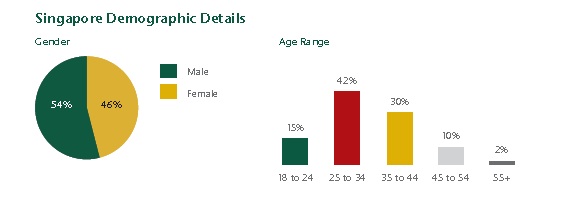
Singapore participant breakdown
Findings include:
33% of respondents from all four countries have acted on promotions seen on social media.
58% of respondents have shared positive experiences online and have sought advice from friends and family when talking about brands on social media.
U.K. respondents are more likely than respondents from the other four countries to complain about service on social.
When respondents express feedback, Facebook is the most popular platform to do this.
Showrooming (visiting a physical location to evaluate products and services even when you know you will buy online at another time) is increasingly prevalent as 77% of participants showroom.
Experiential branding key to branding success
62% of the participants use a mobile device when in stores to compare product prices.
69% of respondents from all four countries expect a brand’s online store, mobile app, and physical store to offer the same pricing, discounts and sales.
Pricing consistency is expected in all countries
What can brands learn from this thought provoking survey?
They need to understand their relationship with consumers and what resonates with those consumers.
Brands that ensure parity in pricing and products across multiple channels will have to place greater emphasis on the customer experience and experiential branding if they want to win and retain business. Those that compete on price alone will soon be out of business.
Department stores and other retail outlets that represent multiple brands will have to work harder to engage consumers and ensure a positive brand experience otherwise they face the prospect of losing customers, possibly forever.
Mobiles are changing the way consumers research and learn about brands.
Brands that take the time to build relationships with core fans or brand evangelists will see their brands promoted to thousands of fans for minimal financial investment.
Those brands with digital brand strategies that go beyond tactical campaigns online are increasing sales through loyalty and advocacy.
Brands that try to control content and manage corporate driven messages and ignore consumers are unlikely to last very long in the consumer economy of today.
Telling the brand story online should be done across Facebook and other popular platforms with the ongoing development of corporate and consumer content.
The Malaysian automotive industry consists of two low-end manufacturers. To help these manufacturers, the government protects them with massive import duties, sales and other taxes that can jack up the price of an imported car with a large engine by as much as 155%.
In addition to these taxes an Approved Permit (AP) is required to import a car. These can cost around RM30,000 (US$10,000) each.
This makes it a tough country in which to sell foreign cars, especially luxury vehicles. To give you an example, a BMW 3 series that costs approximately £30,000 (RM150,000) in the UK, will cost about RM230,000 (£46,000) in Malaysia.
Top selling luxury cars in Malaysia
The BMW 3 series and the Mercedes C class are the most popular of all luxury vehicles in Malaysia. Sales of the BMW 3 series are around 2,000 units per year and the Mercedes C class slightly higher at 2,200 units. Both these models account for about 40% of each manufacturer’s total annual sales in Malaysia.
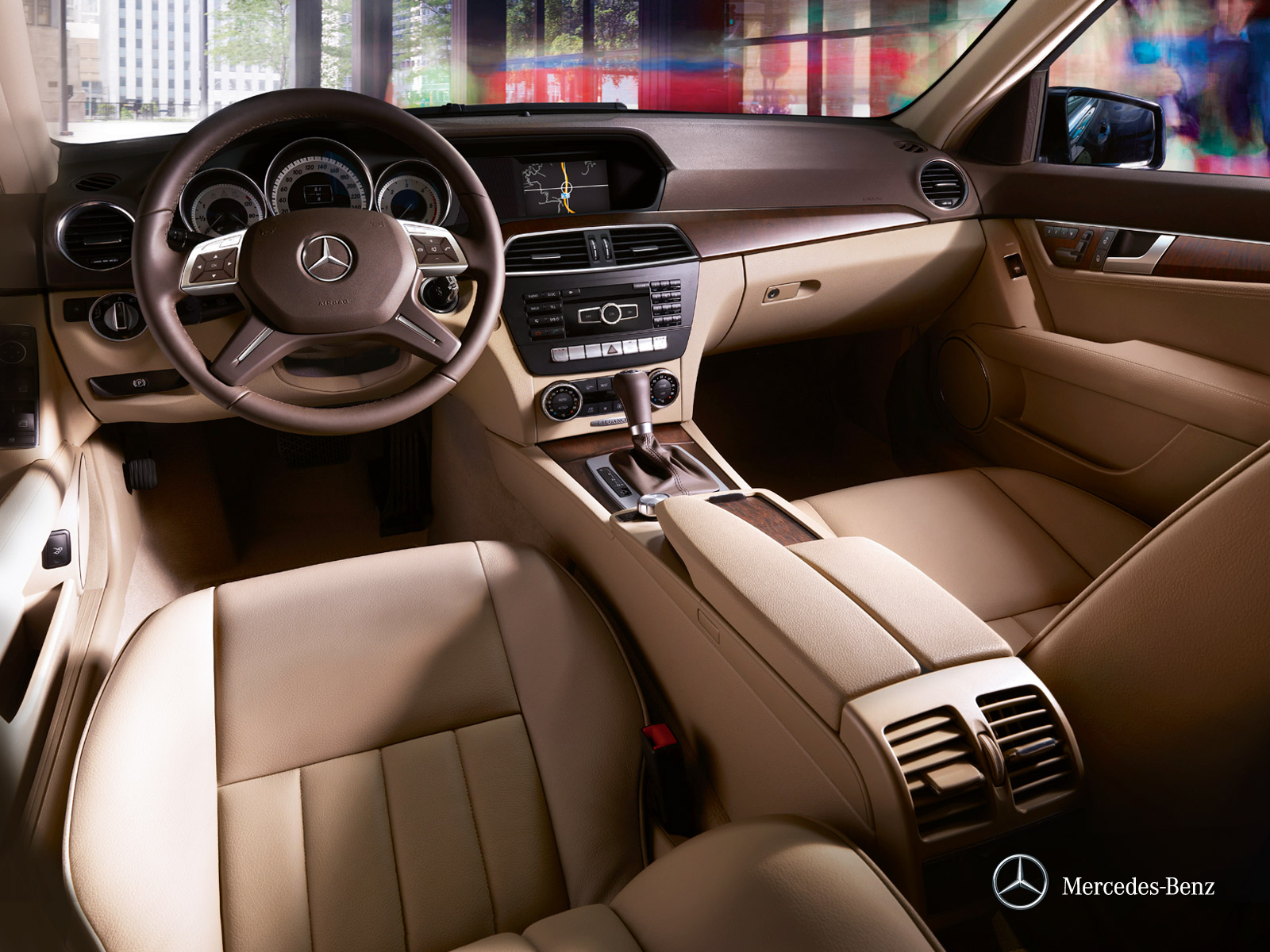
Mercedes Benz C class interior
So you would expect any dealer that makes a living selling and servicing luxury cars to be on top of their game. Right?
In November and December 2012, a prospect visited a number of luxury auto dealers and had a few test drives. During one test drive, the sales person spent the whole time texting.
On another occasion, at a different showroom he was approached by an executive who began the discussion by arguing about whether a particular vehicle in the showroom was the latest model.
Despite operating in a very competitive space, neither sales executive followed up on the prospect’s visit. However one of them does send ad hoc emails focusing on discounts.
Eventually the prospect asked a friend to refer him to someone at one of the main dealers. He was introduced to a senior Director who referred him to a manager who referred him to an assistant manager. Despite this the prospect purchased a new Mercedes Benz C250 because this dealer offered a larger discount than any of the other dealers.
Even this luxury car dealer who got a referral from a supplier and made a sale with zero marketing investment has done little to build a relationship with the customer, preferring instead to simply sell a car. More on this later.
Selling a luxury product is not like selling a bag of rice
More than any other sector, luxury brands must have people who know how to build relationships with customers. The market for these brands is 0.02% of the Malaysian population. It is not like selling rice, LCD TVs, Computers or Fax machines where volume is the key to success.
Ensuring a luxury purchase requires an investment in time and effort to build a relationship. A one-to-one relationship with a representative that offers individual specific value, exclusivity and personalisation is what customers want.
Levels of service must be exemplary because customers in this space have so much choice and have worked hard for their disposable income.
They want to be seen as special, important and part of a select club and not simply as another anonymous person in an anonymous crowd buying an anonymous product.
In the first month after purchase, our buyer received two or three calls and both times the callers were essentially going through the motions of ticking service and satisfaction boxes.
Since then he has heard nothing. Then last week he received a text message. It is enclosed here, in full.
Poorly written, too familiar and a lazy way to try and upsell a luxury product!
Pathetic I know. And the cars listed in the text are not cheaper. We’re talking about RM350,000 (£75,000) and upwards!
Now manufacturers, dealers and salesmen are going to say that all that matters is price and discounts but that is only because you cannot be bothered to build relationships with prospects and customers.
So what should this dealer of luxury automobiles do differently? Here are 10 things they need to do and do fast:
1) Recruit the right people and train them not with generic training courses that are used for automotive today and property tomorrow, but with bespoke training relevant to your brand, your industry and your customers.
2) Use technology correctly. Text messages are not a sales tool.
3) Put in place processes and systems that must be adhered to. For instance, if a member of staff has never met a customer before, the relationship must start on a formal footing, at least to begin with. Depending on how the relationship evolves, staff may be allowed to become more familiar.
4) Telling isn’t selling. Appeal to prospect emotions by identifying individual requirements for value and matching your product attributes to those preferences. You don’t sell cars, you realize dreams.
5) Service, service, service. Every interaction with a luxury brand must be of the highest level and expectations must be exceeded every time.
6) Make the experience of dealing with the brand special, unique, glorious but never, ever assume the customer will come back.
7) Too many brands spend a fortune on marketing and then practically ignore the customer. You have a 50% chance of selling to an existing customer and only a 15% chance of selling to a new customer. But sending a poorly written text is not going to retain a customer.
8) Don’t discount.
9) Carry out a sales process audit and sales skills analysis (yes, we can do that for you) and improve the skills of your customer facing staff.
10) Don’t waste time measuring satisfaction. It offers no value.
There is talk of liberalisation of the Malaysian automotive market but the reality is there won’t be any significant changes soon. Luxury brands need to know how to build relationships and realise dreams, not sell cars.
This infographic shows how spending on advertising on social networks is growing at a phenomenal pace. Whilst this is an area that any brand should be looking in to, it is important to understand that consumer behaviour in these environments is very different and the approach to content must take this into account.
A recent report on digiday stated that a consumer is more likely to die in a plane crash than click on a banner ad and that 50% of clicks on mobile banner ads are accidental! The same report also stated that 8% of Internet users account for 85% of clicks on banner ads.
So if you want to ensure a ROI from your social advertising campaigns, make sure you understand target market requirements for value before launching a social media campaign otherwise consumers will continue to avoid online advertising, and that includes yours.
Dr Jim Hamill, IBM, GARTNER, MOSTI & OTHER HIGH-PROFILE THOUGHT LEADERS TO HIGHLIGHT FIRST ASEAN SOCIAL BUSINESS SUMMIT
A premier 1-day event in Malaysia to provide business and government with insights, case studies & useful tips for high-ROI innovation and collaboration
High-profile international speakers at the premier event, whose theme is “where innovation and collaboration meet,” include IBM, Gartner, MOSTI (Ministry of Science, Technology and Innovation) and other Social Business leaders. Presentations include case studies, strategic insights and hands-on advice and tips about optimizing innovation and collaboration. ECS, an IBM Business Partner, is a Gold Sponsor of the event.
The keynote speaker, one of the foremost world experts on Social Business, is Dr Jim Hamill, Business Fellow at the University of Strathclyde Business School. Dr. Hamill will present a case study about a UK public company that leveraged both a Balanced Scorecard and Social Business to improve operations.
International business and government leaders such as GE, Australian Bureau of Statistics, CEMEX, China Telecom, Asian Paints, HP, DHL, Shell, NBCUniversal and many more have turned to Social Business to streamline organizational processes, enhance customer collaboration, speed information flow, fast-track innovation and improve access to expertise.
According to a study by McKinsey & Co., “We asked 4,200 global executives how organizations deploy [Social Business] and the benefits it confers. When adopted at scale & integrated into work processes, social technologies can boost a company’s financial performance and market share, respondents say.” As a result of these benefits, Forrester estimates that the Social Business market will increase 61% through 2016.
Major speakers and topics include:
• Dave Aron, Gartner: “Impact of Social on Business Models: Broad and Deep”
• Brian Cheng, IBM: “4 major trends shaping Social Business 2013 and beyond”
• Cuneyt Uysal, Newsgator: “Collaboration: It’s not only about future work, but also how the future works”
• Azim Pawanchik, Alpha Catalyst Consulting (ACC): “Case study: Using Open Innovation to expand the Social Business ecosystem”
A limited number of sponsorships for this high-profile, high-value event remain available. For more information, contact me marcus(at)fusionbrand.com.
The event fee is RM1,500. Early-bird and other discounts from 20-35% are available. For more details and registration, visit: www.socialbizsummit.com
Please note: Social Business refers to enterprise collaboration & innovation that use social technologies to boost corporate, customer and social value. Social Business does NOT refer to social marketing (PR) or social entrepreneurship (helping rural businesses).





 brandconsultantasia.com