Top 10 airline brands for 2012


Skytrax, the UK based research company that specialises in research for commercial airlines, has just announced the winners of the world airline award for 2012.

Skytrax parent company, Inflight Research Services work has been used by the UK government to determine the UK government policies on air transport.

The Skytrax Awards are one of the benchmarking tools for the air industry. They measure passengers’ satisfaction levels by surveying passengers in all cabin classes.

The award is announced after a 10 month telephone survey with 18 million airline customers from 100 countries. That’s right, 18 million airline customers from 100 countries. This must be one of the largest surveys ever attempted.

That’s 1.8 million participants a month or based on a 20 day working month, its 90,000 calls per day which equates to, assuming an 8 hour day, 11,250 calls an hour! Many of which are international, in different languages and probably, if they use my carrier, many of the calls cut off half way through the conversation.

I’ve managed some large brand audits that required a lot of calls but not 18 million in 10 months! So Skytrax should be commended for managing such a logistical nightmare. But I digress.

As I mentioned, the survey takes 10 months and covers 200 airlines, both domestic and large international airlines. The survey measures standards across 38 key performance indicators of airline front line product and services.

The study focuses on customer satisfaction related to experiences right across all touch points including check-in, boarding, onboard seat comfort, cabin cleanliness, food, beverages, in-flight entertainment and staff service.

According to the World Airline Awards website, product and Service factors ranked by customers
in the survey included the following elements:

GROUND/AIRPORT
Standard of Airline web site
Online Booking service
Online check-in services
Airport Ticket Counters
Waiting times at Check-in
Quality of Check-in service
Self Check-in options
Boarding Procedures
Pre-boarding for families
Friendliness of Ground staff
Efficiency of Ground Staff
Transfer services
Arrival services
Baggage Delivery
Handling Delays

ONBOARD: PRODUCT
Cabin Seat comfort
Cabin Cleanliness
Toilet Cleanliness
Cabin Lighting / Ambience
Cabin Temperatures
Cabin Comfort amenities
Reading Materials
Airline magazine
Inflight Entertainment standards
Audio/Movie programming
Audio Video on demand (AVOD) options
Quality of Meals
Quantity of Food served
Meal Choices
Selection of Drinks/Pay bar formats

ONBOARD: STAFF SERVICE
Assistance during Boarding
Friendliness of Staff
Service Attentiveness/Efficiency
Consistency of Service across different flights
Staff Language skills
Meal service efficiency
Availability thru Flight/Cabin presence
PA announcements
Assisting families with children
Problem solving Skills
General Staff Attitudes
Staff Grooming

This is an enourmously complex project and it doesn’t end there. Follow up research includes back up interviews and the data is weighted to ‘provide nomination equity when evaluating airlines of different size.’

Anyway after all that, here is the list of the top 10 airlines for 2012

The World’s Best Airlines 2012

1. Qatar Airways
2. Asiana Airlines
3. Singapore Airlines
4. Cathay Pacific Airways
5. ANA All Nippon Airways
6. Etihad Airways
7. Turkish Airlines
8. Emirates
9. Thai Airways
10. Malaysia Airlines

It is interesting to note that 6 of the top ten are Asian brands and the other 4 are Middle Eastern Brands.

Looking back over the last 10 years, the list has always been dominated by Asian and Middle Eastern brands. With the exception of 2006 When British Airways came first, no European Airline has ever appeared in the top 3.

The new Malaysia Airlines Brand identity is stunning


Malaysia Airlines has had a torrid couple of years. Bitter court cases and weak management have led to record losses and low morale which in turn have caused the reputation of the brand to diminish in the eyes of the vast majority of Malaysians and other stakeholders.

All this despite huge sums spent on global positioning strategies using one size fits all advertising and other marketing broadcast across traditional channels.

However, in a couple of weeks time the beleaguered national carrier, once considered one of the finest airlines in the world will start scheduled flights of its new Airbus A380 on the potentially lucrative Kuala Lumpur – London – Kuala Lumpur sector.

The new look Malaysia Airlines identity

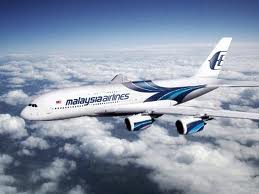
Looking at the press images, it is hard not to miss the beautiful new identity of the aircraft. Personally I think the new look is stunning – bold colours, sweeping lines, very contemporary yet true to Malaysia’s heritage.

Although there were discussions late last year about new uniforms, I haven’t seen any official announcements to confirm it but one can only assume this new identity will also be reflected in the uniforms of the A380 cabin crew and throughout the rest of the airline as well as in all the collaterals, training of the staff and across all the other brand touchpoints.

The Malaysia Airlines cabin crew uniform has hardly changed since it was introduced in 1982

After all, it wouldn’t make sense to create a new identity for a new plane without integrating it across the whole organisation, right?

5 branding tips for Malaysia Airlines to save its troubled brand


Earlier this month, troubled Malaysian carrier, Malaysia Airlines (MAS) reported a staggering RM2.52 Billion (US$850 million) loss for 2011. Despite the tough economic climate, a number of competitor airlines – British Airways, Singapore Airlines and Cathay Pacific all reported a profitable year.

Soon after, Group CEO of MAS Ahmad Jauhari announced that he will implement ‘strong and immediate measures to stem the flow of losses with staff redeployment, improved productivity and efficiency, further cost controls and more route reviews’ whilst at the same time, he also promised ‘an aggressive sales and marketing strategy’.

Marketing budget doubled
Then MAS announced that it has doubled its marketing budget for 2012. The marketing budget is reported to be as much as 2% of revenue which on 2011 revenue of RM13.90 billion (US$4.63 billion) equates to about RM278 million or nearly US$100 million.

So if the marketing budget is doubled, it means that MAS has more than RM550 million or US$190 million to rebuild it’s battered brand. That’s a tidy sum.

Details of what marketing initiatives the company has in mind are sketchy. Although the company has announced it will provide ‘better and more branded customer experience and embark on a major advertising and promotions campaign in 2H/2012’.

This morning I read that the airline has appointed Ogilvy and Mather Advertising as its master creative agency. I also read this comment on the appointment from Al Ishal Ishak the senior vice president for marketing and promotions, “2012 will be a breakthrough year for Malaysia Airlines on our path to recovery. We recognised, however, that we could not achieve financial success without clearly defining our brand positioning.”

He went on to say, “Ogilvy understood this and throughout the pitch process were best able to translate our message into a powerful campaign idea. An idea that is big enough to help us transform our business and truly engage our customers like never before.”

Before I go on, I have a confession to make, I am a loyal Malaysia Airlines passenger and fan of more than 20 years. During that time I have been on the receiving end of more positive than negative experiences with the airline. So I want the airline to succeed.

But if this is the last chance for this iconic brand, Al Ishak and his team have to get it right. Any advertising campaigns will need to reflect the culture of travel and consumers today and not try to use the traditional high gloss beautifully presented images and TVCs so favoured by the airline industry to ‘clearly define our brand positioning’.

How will MAS spend the marketing budget?
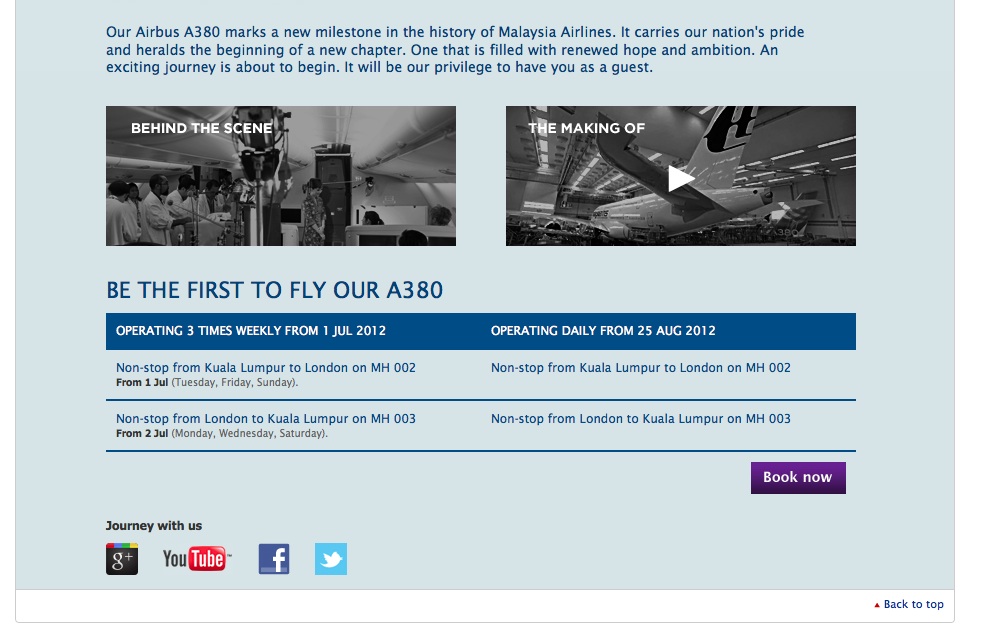
I appreciate it is early days but I have noticed a digital campaign selling the new A380. The style would suggest MAS is going the traditional route using glossy images and slick advertising with high production values to attempt to position the company in the minds of its consumers.

The ad features an image of the A380 in the very attractive new MAS livery and a tagline about the journey which I assume is related to the A380 and one about the aircraft being the pride of the nation. Let’s hope Ogilvy improves on that. Anyway, clicking on the ad, you go to the existing MAS site where you are greeted with the same, larger image of the A380 and the same taglines.

Below the fold there are two black and white images with click through options. The one on the left entitled, Behind the scene (sic) links to still images of the making of the new commercials which look very traditional and my first reaction was what a pity they haven’t changed the cabin crew uniforms. The image on the right links to a video entitled ‘The pride of our nation”, a predictable and uninspiring video of an MAS A380 being painted!

Throughout, the copy is uninspiring.

Below the images are social media options. I had a quick look at the twitter feed and it looks very collaborative with plenty of discussions although efforts to build the brand in the social context can be improved.

But I have a sneaking suspicion that the bulk of that US$190 million is going to be spent on advertising. And as Singapore Airlines learnt with it’s A380s, you can no longer rely on developing a position and using advertising to communicate that position in the hope that it will work and consumers will buy.

Positioning
The problem is that positioning is a throwback to the mass economy that no longer exists. What advertising agencies tried to do was create a position that reflected the strengths and weaknesses of the offering. Ideally, this position was based on being first in a particular category.

If someone was already first in a category, then companies attempted to redefine themselves in a new category to be first. In the airline business, this tended to be related to passenger comfort or service. The effectiveness of positioning depended on the ability of advertising to drive branding perceptions in the mind of consumers.

To do this, airlines often made promises they were unable to keep (admittedly, often due to third party issues out of their control), failed to meet traveller expectations, often because dynamic competitors moved quickly and so raised the bar, which in turn led to brand disillusionment.

Positioning was ideal for the mass economy. It was also ideal for advertising agencies and marketing departments because it gave them enormous power without the responsibility of accountability. Al Ries and Jack Trout invented the concept of positioning. The preface to one of their books states, “Positioning has nothing to do with the product,…. (it) is what you do in the mind of the prospect.” So, essentially this means that the consumer can be made to believe, through extensive advertising and PR and via the right conduits to consumers, and other vehicles, what an offering means to them.

Well I’m sorry, this might have been true in our parents day, when consumers were more predictable, more trusting and had less choice but in today’s mean spirited world, a world in which only 4% of Americans and 14% of Malaysians believe what they read in adverts it is going to be very, very difficult. And of course the problem with using positioning to build a brand is, if it doesn’t work, the money is wasted, time is lost and you have to repeat the process again, with a new position!

So how can MAS save its troubled brand?
1) Research. Your existing customers are your best source of information. But they are not all the same. I would be interested to know which, if any customers MAS talked to when they were configuring the aircraft. MAS is talking about flat beds and big TV screens in first and business. Well that is so last year and who doesn’t offer them so why should I change? What about Internet access? I hope the A380 offers it throughout the aircraft.

2) Mass market branding and the old model of developing a position and communicating that position across for mass media repetatively for as long as possible is no longer effective. Brands today are built on relationships, access, personalisation and relevance. Before MAS marketed to segments of 18 – 34 year olds, businessmen and so on. Today, MAS must deliver economic, experiential and emotional value to to everybody and on their terms.

3) MAS must focus on developing more profitable relationships, not a more profitable product. Brands evolve when companies start buying for customers instead of selling to them.

4) Branding is an organisational not a departmental responsibility. And the organisation is the responsibility of the CEO. MAS is charging about a 100% premium for an economy class ticket on its A380 in July over the price of an economy class ticket on a 747 for the same route. Throw in all the other airport fees etc and it’s going to have to be a pretty good product to charge such a premium.

5) Retention is key to brand building. Companies no longer sell a product, customers buy a product. And those customers have plenty of choice, especially in the airline business. Sadly too many companies spend lots of money on acquiring a customer but very little on retaining them. MAS is one such company. Once a consumer buys the product, companies should do everything possible to hang onto those customers, build relationships with them, learn about them and leverage them.

Bonus tip. This is the social era. As I said MAS is working hard on social media but there is room for improvement and integration. It would be interesting to know how they leverage their social media efforts to get more business.

AirAsia brand hits turbulence


A week ago, AirAsia X CEO Azran Osman-Rani announced to much fanfare, a new service between Sydney and Kuala Lumpur.

Soon after, the Australian Competition and Consumer Commission, (ACCC) an Australian consumer watchdog announced that it has launched a court action against AirAsia, alleging the company is misleading consumers in its advertisements for flights out of Australia.

This follows negative press after AirAsia X recently announced it was ceasing flights to London, Paris, Mumbai and New Delhi and criticism by Neil Warnock, the former manager of Queens Park Rangers football club, owned by AirAsia chairman Tony Fernandes after he was sacked.

Although the company acted quickly and decisively with offers of refunds or alternative travel at no extra cost for passengers who hold tickets for future flights to Europe and India, in terms of customer loyalty, these latest developments won’t do the brand any favours.

Especially as the airline is also copping plenty of flak for it’s opaque charging and poor engagement skills on social media, as seen by this image taken from a disgruntled customer on Facebook.

The former AirAsia fan says the image was taken down after 10 minutes when he posted it on the company Facebook page and he has since been barred from posting anything on the AirAsia Facebook page!

Hidden or extra fees add almost 100% to cost of Kuala Lumpur to London ticket on AirAsia

According to the ACCC, AirAsia’s website did not include all taxes, duties, fees and other mandatory charges when advertising fares on certain routes from the Gold Coast, Melbourne and Perth. In Australia if a company wishes to advertise part of a price, it must also advertise one total price for the product or service.

Brands are defined by the economic, experiential and emotional value they deliver to customers. Fail on any of these counts and your brand will struggle. The disgruntled Facebook customer and customers like those in this article have undone a lot of the work AirAsia has done to build a people friendly brand.

As Low cost carrier brands grow, charging extra for food and entertainment may be acceptable on short or medium haul routes but many consumers see it as unfair on long haul routes so strategic changes need to be made if they really do want to build brands.

Building a brand in the consumer economy is more than the CEO and Chairman tweeting all day. It requires a strategic plan with processes to deal with reputation issues and a willingness to engage with consumers who raise positive AND negative issues on and off line.

The reality is that AirAsia probably had little choice in cutting unprofitable routes to India and Europe.

But what it should have done was have a strategy in place to announce the changes and a plan to communicate with existing ticket holders to inform them and work with them to solve their personal issues in as seamless manner as possible.

A Facebook page with direct access to a community director and suggestions for alternative routes or airlines and how to go about booking flights would have been a tactical initiative to show the airline cared.

Such an effort may be a relatively time consuming and expensive initiative but in the social economy, one that is imperative and one that will pay retention dividends.

A tactical fail for a major brand on twitter


Qantas has had a bad run of luck recently and has also made some questionable corporate decisions. Especially in relation to the ongoing wage negotiations with the Transport Workers Union that is threatening further disruption to the Aussie carrier.

The most recent Public Relations disaster is related to an attempt by the newly formed social media unit to implement a social media campaign.

The Twitter campaign asked users to describe what would be their “dream luxury inflight experience” and use the hashtag #QantasLuxury to generate traction.

The airline probably thought it would generate comments related to Spas, champagne and top quality service.

However, Aussies known for their acerbic wit, jumped at the chance to lay into the beleaguered national carrier. One of the first was, luxury is “giving yourself a pay rise whilst grounding your whole airline and taking local jobs offshore”.

Another example “#QantasLuxury is feeding a family of 5 on pittance they pay their ground staff while Alan Joyce is on $94k a week”

Cherry Pizza came up with “#QantasLuxury is sitting in your first-class lounge chair, watching a failed social media campaign get out of control.” How right she was!

The misjudged campaign was an unmitigated disaster and in an effort to end the suffering, two hours after launching the project, Qantas thanked users for their tweets. Unfortunately for Qantas, social media doesn’t work that way and 36 hours later the topic is rumoured to have generated 14,000 tweets, the best of which are featured in a presentation on slideshare and the topic is still trending high on Twitter.

It didn’t help that the prizes offered were a set of Qantas pyjamas and an amenity kit!

British Airways promotion


One of the greatest branding success stories has to be British Airways, the blue riband aviation brand.

Recently the airline hired agency BBH to create a new campaign to explain the history of the company. The final work can be seen below

As part of their work, the agency chose a row of 747s at a terminal. Unfortunately not all the aircraft were BA 747s!

Never mind, the agency got the digital guys to put BA livery on the planes.

Unfortunately, they forgot to delete the serial code of the nearest aircraft which was actually a Virgin aircraft! Not clever, especially as Virgin is BA’s sworn enemy!

Fortunately, during an internal showing to staff, a hawk eyed engineer spotted the offending information and alerted the marketing department!

Ironically, the director, Frederic Planchon is renown for his attention to detail!

You can see the edited shot about 56 seconds into what is in my opinion, a beautifully crafted video.

Real time example of social media branding in action


This is happening right now!

An American teenager who enjoys knitting and the TV show Glee chose, for reasons unknown, the twitter handle @theashes. Unfortunately the ashes are the name given to one of the great sporting contests of all time, no I’m not talking about the world series that only American teams play in, I’m talking about the (sort of) bi-annual cricket series between Australia and England.

These two have been playing Test cricket since 1877 however the first match for the ashes was played in 1882. This is not the place to explain cricket!

The five match series has just begun with an enthralling 5 day match in Brisbane. Unfortunately for @theashes, fans around the world thought she was the official twitter account and bombarded her for updates from Brisbane!

Her early responses were more bemused than anything, “This is not the account of the cricket match. Check profiles before you send mentions, it’s incredibly annoying and rude.” However later tweets suggest a little frustration creeping in as this recent example shows, “I AM NOT A FREAKING CRICKET MATCH!!!”

In another tweet, she asked, “what the hell is a wicket?” and later she was unsure whether she should support Australia or England.

Enter the Brand. Qantas, sensing an opportunity began a twitter campaign – #gettheashestotheashes and offered her a free flight from New York. Other companies have also offered free tickets to matches, transport in Australia and even mobile phones.

She is considering the flight offer, but isn’t keen to travel alone. Qantas has done the right thing, seeing and responding to a great opportunity to develop a brand advocate. It is little events like this that are critical for the successful development of a brand in the social medial space.

Now they need to offer another ticket for her to travel with a friend otherwise their initial advantage could evaporate.

Valuable resources wasted on poorly executed awareness campaign


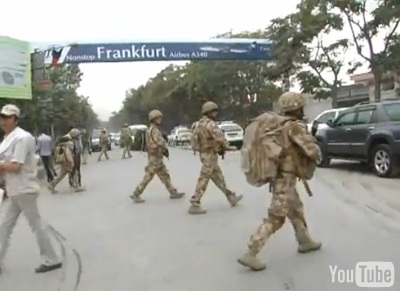
This screen grab of ISAF British Force Protection Company, Delta platoon, on a foot patrol around Kabul caught my attention because of the banner across the street advertising non stop flights to Frankfurt on an Airbus A340.

I doubt there is much demand in Kabul for flights to any destinations outside of Afghanistan. And those interested in such opportunities could surely be engaged more directly. Such poorly thought out tactics are often the result of not having a brand strategy.

These tactics may not be expensive but that is never a reason to use a marketing tool. And anyway, this is probably not the only one in the city.

Branding is more than a communications exercise


The most common definition of a brand that I hear is: “A brand is a name, sign, symbol, slogan or anything that is used to identify and distinguish a specific good (product), service, or business” This comes from the respected American Marketing Association. The problem is that this definition belongs to an era of limited competition, limited choice and limited knowledge of consumers.

In the mass economy that no longer exists, it was relatively easy to build a brand and your brand could easily become the name, in your category, on everyone’s lips. And it got to this position by mass advertising via mass media. 50 years ago, a good ad on prime time TV was enough to get someone to write a brand name down and ask for it at the department store the next day.

Quite often, even if the product was unable to deliver value, consumers would still buy it, quite often because they didn’t have a choice or because they were less demanding, and willing to put up with poor quality. In some cases consumers believed they were wrong and the product was good so they continued to buy it.

Today consumers are far more knowledgeable and much more demanding. They have more choice and there is more competition, especially for consumers attention via mass marketing channels. Moreover, a lot of those products with their flashy names, creative symbols and signs have lied to consumers in their slogans and consumers have been let down. It is no longer enough to tell a consumer your product is the best. If they are let down they won’t buy it again.

Instead, they go elsewhere. Today, to build a brand requires a comprehensive investment in organisational excellence. Building a brand is no longer a creative exercise or a communications exercise to differentiate a product. And the key metric must be profitability.

At this stage, most articles give an example of Nike, Coke, Apple or a similar brand. But these companies are exceptions and I’ll explain that in another article. But this time I am going to use Apple as an example because they have adopted their brand better than most.

Apple is a brand but 15 years ago the name, logo, etc that differentiated the good/product was not helping the company gain market share in the computer business. In fact, I wouldn’t be surprised if they were thinking of changing the name.

But instead, what happened was a massive investment in operational excellence, R&D, purchasing, supply chain, distribution and strategic alliances in manufacturing, etc plus a complete overhaul of sales processes, customer service, a huge stroke of luck and later, an investment in clever creatives.

The result, the ability to match product attributes to give consumers economic, experiential and emotional value that has built a global brand. I would say that the ads didn’t build Apple, it was the investment in R&D, organisational excellence and a lot of luck.

Another example is PAN AM. PAN AM had a great name, nice logo and spent a lot of money on mass marketing. I’m sure we all remember the tagline “PanAm. We’re flying better than ever”. Where is PAN AM today? PAN AM doesn’t exist.

So the next time someone says a brand is “A brand is a name, sign, symbol, slogan or anything that is used to identify and distinguish a specific good (product), service, or business” Ask them how many products they buy because of the name.