The top 1,000 brands in Asia – so what!


Following the completion of a research project carried out in conjunction with TNS, the Asia Pacific edition of the globally respected marketing magazine, Campaign Asia has named Sony as the top brand in Asia.

According to the study the top 4 positions all went to power house North Asian brands – Sony retained its position at number one followed by Samsung, Panasonic and LG with Canon at five. In fact the top 5 were unchanged from 2010.

At six is Apple, HP at seven, Google at eight and Nestle at nine with Nike at ten.

Facebook was the top social networking site at number 17 whilst Twitter leapt from 123 to sixtieth.

HTC, whose stock has tripled in the last year and is now Asia’s second largest maker of smart phones leapt from 532 to 100.

Interestingly no Chinese brands made the top 100 and only one Indian brand (Amul) managed to do so.

Amul, the largest food products business in India and the maker of ‘the big daddy’ of butters and the number one ice cream in India, was the best performing non-Japan or Korea brand, coming in at number 89.

At 123, Louis Vuitton was the highest luxury brand and surprisingly luxury brands fared poorly. Despite listing on the Hong Kong stock exchange recently, luxury brand Prada came in at a disappointing 348th, only two places above CIMB and down from 252.

Although Maggi (22nd) place and Tesco (96th) will be familiar to Malaysians, the top Malaysian brand is Marigold at 131, down from 129. Other Malaysian brands include Malaysia Airlines at 163, Maybank at 172 and F&N at 238. Old Town coffee also deserves a mention at 245, coming in almost 40 places above Maxis at 284. Celcom, Maxis main competitor was further down at 395.

Sticking with Malaysian brands, Boh tea was down at 417, Firefly, a budget airline was at 462, up from 518.

The highest new entry was Hankook tyres of Korea at 246. The highest new entry Malaysian brand was Life, a sauces/condiment maker at 718 followed by Kimball, another sauce/condiment maker at 825. Surprisingly Proton, the Malaysian national car was also a new entry at 916.

The survey was carried out in ten Asian markets: Australia, China, Hong Kong, India, Japan, Korea, Malaysia, Singapore, Taiwan and Thailand. Ages of the respondents were from 15 to 64 and approximately 300 respondents from each country were surveyed.

Participants were asked only two questions:

“When you think of the following (product or service) category, which is the best brand that comes to your mind? By best, we mean the one that you trust the most or the one that has the best reputation in the (product or service) category.”

“Apart from the best brand you entered, which brand do you consider to be the second best brand in the (product or service) category?”

14 major product and service categories were covered in the survey:
Alcohol and tobacco
Financial services
Automotive
Retail
Restaurants
Food
Beverages
Consumer electronics
Computer hardware
Computer software
Logistics
Media
Telecommunications
Travel and leisure
Household
Personal care.

In addition to these major categories, a further 72 sub-categories were included!

The final rankings were determined based on the total number of mentions each brand received across all categories and countries.

Then the data was weighted on two levels: the first to reflect the population composition within the markets covered, and the second to reflect the competitiveness of the categories included in the study.

Now I don’t know about you guys but if there is one thing I have learnt over the years it is that markets such as Malaysia and Japan or Thailand and India have very little in common, especially when it comes to food, alcohol (60% of the Malaysian market is Muslim and therefore alcohol is forbidden) and other culture specific products.

Furthermore, I don’t know how they included all the categories and sub categories but I can only assume the answers were aided. Nevertheless, imagine a questionnaire that lists 14 potential answers and then a further 72 options to those answers! How accurate are the responses going to be?

I also think that the sample size and the demographic – only 300 participants per country and a massive demographic of 15 – 64 is simply too big to provide results that are actionable or relevant.

And we don’t know the gender of the participants yet gender will be crucial in many of the listed categories and in how we communicate with prospects, with what content and across what platforms.

And looking at the brands, someone in India is not going to name Proton as the best (another thought, define best?) automotive brand because the Malaysian national automotive brand has yet to go on sale in India.

Frankly, I don’t really understand what is the point of this survey and what it means? How is it relevant to a consumer or company in Malaysia when it lists brands not available in the country? How can a company leverage its position? What must a company do to move up the list, perhaps to the top? How relevant is the ranking?

If the survey must be done, it would be better if it were country specific and related to each category alone. Rather than asking two (aided) questions, it would make sense to develop questions based on the product needs in that country. Questions will also need to be developed based on the category.

And instead of looking at traditional approaches that rely on demographics, in the social economy, it would be better to work with social media communities. Results could then be correlated and geographic comparisons made although they still won’t offer actionable data to the brands.

What do you think?
What Malaysia must do to build a Nation Brand


Traditionally, Tourism Malaysia has had the responsibility of raising the awareness and promotion of Malaysia. And Tourism Malaysia has worked hard to build awareness of the country as a tourist destination and on the whole, it has been reasonably successful.

But in an increasingly competitive world, Malaysia is not just in a global competition to attract tourists. It is also in a global competition to encourage talented Malaysians to return to the country, international talent to live in the country and international investment. Malaysia also needs to move away from its image as a supplier of commodities to the provider of more valued added products and services and increase its influence in Asia and on the world stage. As if there weren’t enough, it is also in a domestic battle to forge a national identity bought into by multiple races!

A strategic tool to achieve the goals of attracting talent, increased revenue through expanded tourism and more valuable exports is Nation Branding or country branding. Australia, India, Norway, Oman and Qatar are all making a concerted effort to attract the world’s attention, interest and revenue by embarking on Nation Branding initiatives.

In this competitive environment, complicated by bickering politicians and individual agendas, tactical rather than strategic initiatives, fragmented and outdated communications, a lack of integration and communication between organisations and dwindling global funds available for investment, Malaysia has a lot to offer.

It is a progressive, innovative and stimulating country in which to live, work and visit. Malaysians are enthusiastic for development and have a natural ability for entrepreneurship. Individual races have capabilities in specific areas important for the growth of the country. For such a young country, it is remarkably open and many times it has been called a model Islamic country. It has numerous natural resources that should ensure quality of life can be high. Residents and visitors can enjoy the benefits of increasingly advanced infrastructure combined with a vibrant, diverse culture and a reasonably well trained and educated work force.

But, unfortunately, Malaysia does not have a clearly defined image or the visibility internationally that it deserves. Part of the reason is that it lacks a national Brand that resonates with Malaysians and enjoys wide acceptance internally and is effectively and consistently communicated externally.

As a result, international perceptions vary widely. Some believe it is an undeveloped country rich in such natural resources as rubber and timber; others look at the Petronas twin towers and fail to see many differences between Taipei, Shanghai, Bangkok, Hong Kong and other Asian metropolises. This lack of a consistent Nation Brand persists despite the efforts of successive Prime Ministers, international events such as the Formula 1 Grand Prix and the 1998 Commonwealth Games and increased visitors to the country.

The need for successful Nation Branding is recognized at the highest levels.

Most recently, the Prime Minister, via his website and with the assistance of Tony Fernandes, CEO of Air Asia has outlined the need to shape the country moving forward and asked for help from citizens. Although technically not a citizen, I have three children growing up as Malaysians so I have a vested interest in the success of the country.

So what should Malaysia do to start building the Malaysia Nation Brand?

Five key factors are required to achieve the prime minister’s goal as an international “corporate nation.” These include:

• Widespread agreement and acceptance on what Malaysia stands for, and what makes her unique in the community of nations. The agreement and acceptance is based on communication and understanding among all levels of government and all facets of society.

• The identification of industries most likely to complement Nation Branding initiatives and a clear process for investing in and sustaining that investment and developing those industries.

• Clear, consistent and coordinated communications to domestic and international audiences by public and private sectors. A long-term plan with goals and measurements is critical. Ideally, these communications must be tailored to specific segments.

• Successful execution of brand messages. This is not just a communications exercise. The public and private sector must facilitate international and other economic involvement, while tourist-related industries and areas must perform according to expectations.

• Leadership. Current branding efforts are hampered by a variety of uncoordinated tactical efforts, each promulgating a different message. Leadership is required to ensure that Malaysia both speaks “with a single voice” and has the necessary long-term commitment.

The following are the key steps required in the development of the Malaysia Nation Brand and they are as follows:

1) Carry out a brand audit. Who do we think we are? Who do our stakeholders think we are? What do we have? What do we want to become? What do we have? Do we have the skill sets required to sell it? Are our communications communicating this effectively? Does the content of our communications resonate with target markets or are we using a one-size-fits-all strategy to communicate with everyone? Are we using the right platforms? Who are key stakeholder influencers? How do we communicate with them? What do stakeholders want from us? Can we deliver? If so how?

2) Analyse and review the data collected in step one and identification of key industries to help drive the Malaysia Nation Brand.

3) Develop the nation brand framework. This stage includes the development and articulation of the vision, mission and values of the brand as well as the development of a positive & competitive identity that offers economic, experiential and emotional value to each target audience

4) Develop a holistic and comprehensive visual and verbal brand. Sadly this is where most nation brands start. Using a creative driven approach, they look to spray advertising across as many platforms as budgets will allow and pray that it sticks in at least some of the places. This ‘spray and pray’ approach to branding is destined to fail nearly every time.

5) Develop the brand strategy. Only AFTER the above steps can the brand strategy be developed. Normally a plan to drive the brand forward, it outlines how to position Malaysia as a unique, different and attractive country for key stakeholders such as tourists, investors, strategic partners and talent and includes, branding, marketing, sales and other imperatives as well as measurement, budgets, responsibilities and more. Individual country brand strategies should also be included for key markets. The brand strategy also outlines requirements to clearly communicate relevant messages to the target constituents and stakeholders in multiple countries.

6) Make sure all initiatives systemically connect the Nation Brand to Malaysia’s core industries, corporate brands and Small and Medium Enterprise (SME) sector brands

7) Measure, improve, refresh and keep relevant.

Building a nation brand is not easy. It requires commitment and perseverance and the will to stick with something even when it may not be going according to plan. Follow the elements above and we will have a much better chance of building a Malaysia Nation Brand.

How Tourism Malaysia should have approached its social media strategy


Twitter, facebook and other social media communities have been buzzing with comments related to the RM1,800,000 (US$600,000) Tourism Malaysia (TM) is spending on Social Media (SM). Here’s a little background on the story.

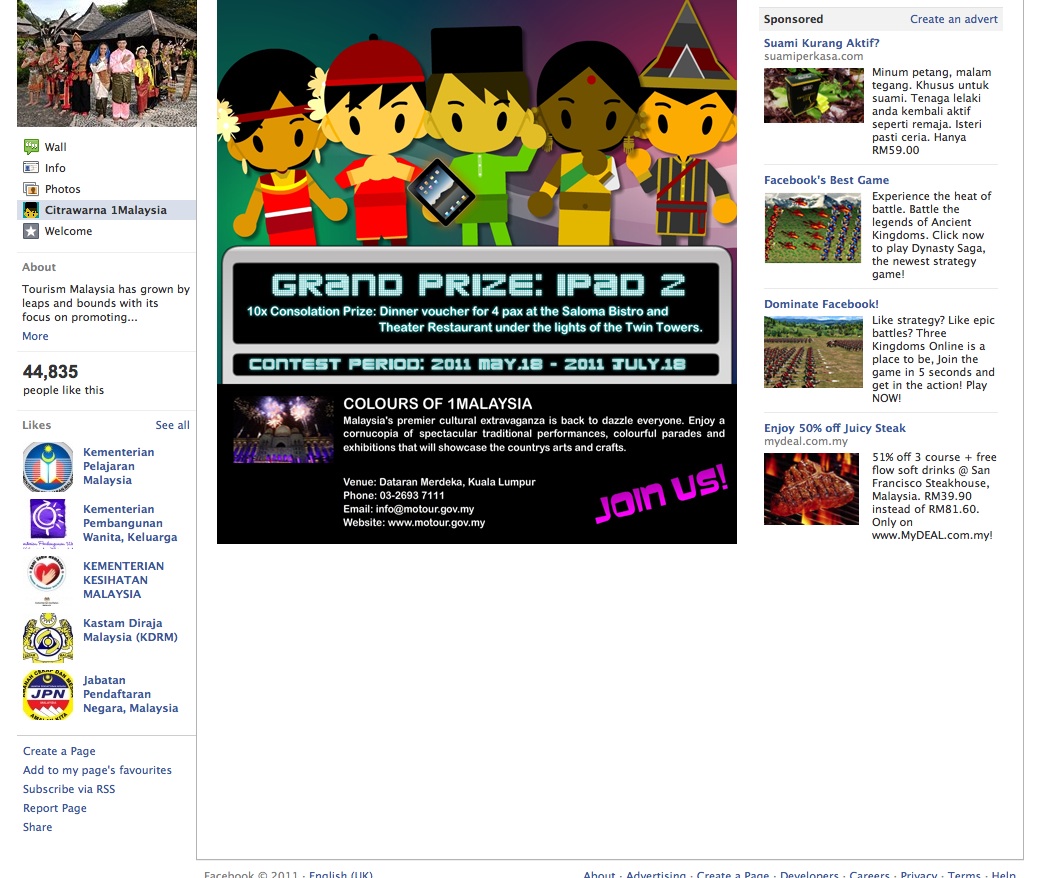
Initially, the deputy minister of tourism was quoted as saying that the RM1,800,000 “covers the cost of hosting various activities on the facebook page, including six interactive Flash applications, development and maintenance work and advertising.” He went on to say that, “the ministry spent nearly RM300,000 to develop each of the six applications on their facebook page.” I could only find one (see screenshot below).

This statement was rejected by citizens and government ministers alike with one minister suggesting it was a waste of funds as the facebook site is free and using the ‘Visit Penang’ facebook page as an example (see screenshot below), explained that it was set up for free and had attracted over 100,000 fans.

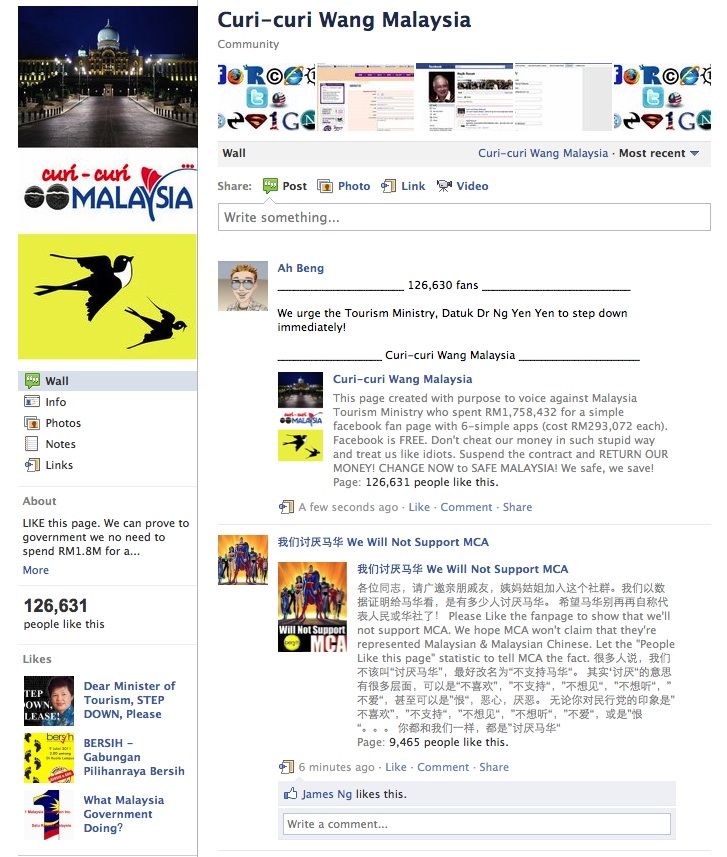
Citizens were even more incensed, with one enterprising and concerned tax payer setting up a facebook page that parodied one of the official government pages (see screen grab below). Within hours, this page had attracted 5 times as many ‘likes’ as the official page.

A couple of days later, the tourism minister announced that, “the RM1.8 million (is) for a full social media branding campaign, and not just to set up a facebook page.” She went on to say, “”(The money) is for responding, informing, interaction and monitoring (work on the facebook page), evaluation, data collecting, content development and advertising on Google, Facebook, etc…”

With her comments came an official release that stated the costs were for the following:

1. Technical

* Dedicated hardware deployment
* Software licencing
* Front end applications
* Application server engine

2. Development of six campaigns that require the following:

* Flash games engine
* Flash programming and coding
* Creative development and design
* Campaigns ideas and concept
* Front-end Flash design
* Testing and debugging

3. Campaign promotions

* Digital advertising campaigns on Google and facebook
* Contest, page wall and tourism fanpage content management
* Collection and management of database

The tourism minister then went on the offensive, asking reporters, “Do you think it’s cheap to set this up?” And as if to justify the expense, explained, “Tourism Australia is spending RM150 million (US$50 million) for the next three years on social media.”

Most recently, the minister stated that the allocation was to ‘run, manage and monitor a tourism campaign in the social media, including RM360,000 for advertising and over RM500,000 for prizes for the contests organized.’

‘Disappointed and hurt’ she is reported to have invited the Malaysian Anti-Corruption Commission (MACC) to investigate the campaign finances.

It is too early to determine the results of Tourism Malaysia’s first foray into social media but whatever the results, the Malaysian government, the tourism minister and the tourism ministry could have handled the matter more effectively and efficiently.

One would be forgiven for thinking that Tourism Malaysia has some internal communications issues. Because when the deputy minister first explained what the funds were spent on, his statement didn’t make sense. The deputy minister’s statement suggests he was provided with notes written by someone more familiar with the workings of an IT department than the requirements of a social media campaign. This has caused the deputy minister to be embarrassed in parliament and I hope someone has been reprimanded.

In terms of the social media exercise, Dave Duarte MD of South Africa based Huddlemind and a social media expert who was in Malaysia as the story broke stated in his blog that the exercise has already justified its expense.

His rationale is based on his guesstimate that the average conversion rate of a facebook fan to a customer is approximately 3% and because the average domestic tourist spends RM2,500 with 40,000 fans, the facebook page has already recouped its expenses.

This statement may be a little optimistic but it is certainly worth tracking the number of ‘likes’.

In terms of the game itself, it seems OK, leaning heavily on guitar hero. Personally I found the racial profiling of the characters unnecessary. Playing the game requires one to be more dexterous than I and as a result, the score required to qualify for the iPad 2 draw will always be beyond my means! I suspect I’m not the only decision maker in the family who will feel the same and this resulted in me leaving the page rather disappointed. But I digress.

So Tourism Malaysia’s (TM) long overdue foray into social media has not had an auspicious start. In the future, what can this key organization that contributes over RM50 billion (US$16.6 billion) to the national purse do to ensure tax payers get value money for all social media branding initiatives?

Here are 10 key recommendations for future initiatives

1) A social media strategy or any of the tactics within that strategy, is not the responsibility of the IT department. In future, the head of the department responsible for social media initiatives should represent the ministry when talking to the press and his press release should be prepared by him and his department and not by anyone else. Although the minister or his/her deputy must respond to questions in parliament, it is wrong to expect them to be knowledgeable about branding tools such as social media. Ministers do not need to talk to the media about such relatively small activities.

2) Social media requires an ongoing strategy and interactive initiatives such as the facebook pages are merely tactics within the strategy. Successful social media initiatives must be integrated with other branding initiatives.

3) I strongly suspect TM didn’t think through what they were doing when they launched the facebook pages. First of all it is important to develop a plan. Within that plan and before embarking on a social media strategy, it is important to identify what are the goals and how can facebook add value to branding efforts. Facebook is obviously an additional channel to interact with prospects and customers but why do it? To get more fans? Why? To get more participants? Why? How does TM convert those participants in the competition into leads? How does TM put a monetary value on social media activities? What metrics should be used? All of these should be outlined in the social media plan before implementation.

At the moment, registration is only required if participants want to be included in the draw for the iPad or meals. So how will TM optimize interactions with those participants and get them to become customers?

4) It’s also important to get fans to interact with other participants and to interact with participants. Critical to the success of any social media campaign are the conversations. Channels such as facebook are not platforms to broadcast messages about the company or in this case, Malaysia. The cuti cuti 1Malaysia facebook page has generated over 40,000 likes in a very short time and this is impressive. Furthermore, many of the postings on the wall have generated plenty of comments but TM is failing to enter into discussions with those who comment, preferring instead to pass that responsibility to others (See screen shot below). Interacting and engaging with people who comment is what social media is all about and will give TM more visibility, improve reputation and increase trust.

5) This first foray into social media is pretty basic and there is nothing wrong with that. But in future, Tourism Malaysia must look to be more innovative with what it does on social media. Fans will soon get bored of commenting and uploading images, especially if issues raised are ignored. Tourism Malaysia must encourage fans to be more creative. Perhaps by designing trips, submitting and voting for slideshows or setting up sub groups of specific niche related fans.

6) What makes being a fan special? At the moment nothing really which is a good and bad thing. Good because it means more people will become fans but bad because TM doesn’t know how many fans are really interested in the product or just want to win an iPad. In future, TM must look for ways to offer special content to fans or competition participants. Don’t be afraid to ask people to register.

7) This maybe a bit difficult for TM because technically, it isn’t allowed to sell Malaysia, only promote it but that doesn’t mean it can’t turn facebook into a potential profit centre. TM should make it easy for fans to book trips to destinations featured on the TM facebook the way it does on its website.

8) TM is still using mass media tactics on social media channels. This is ineffective and pointless. TM needs to stop thinking demographics and start thinking communities.

9) This applies to everyone and not just TM. Pause before creating a facebook group. Managing a group is difficult, time consuming and requires talent and patience to be able to respond to issues raised and continue a conversation till it’s natural end. TM launched four or five facebook pages at the same time! That requires a lot of talented manpower and judging by the lack of responses to issues raised, TM was ill prepared. Also important is what to do with the facebook group once the contest or event is over. It you want to delete a group, you have to manually delete every member of the group. With 40,000 members and growing, and with at least two clicks required to delete a member, the cuti cuti site will take a lot of manpower to shut down! If TM decides not to close down pages, in five years time, there will be a lot of dead pages that will confuse people.

10) The big question with facebook is what to measure and how to calculate ROI. In 2010 a study stated that fans of the top twenty brands on facebook were worth an average of US$136 each. With 40,000 fans, that would make the cuti cuti page worth over RM16 million! However the study was panned as it was actually a measure of the value of customer loyalty and not a measure of how much facebook had contributed to that loyalty. Moreover, the average of 20 brands like Nokia and Apple bears no relevance to tourism anyway!

As TM doesn’t technically have a product to sell, it is hard to know what to measure. For instance, TM can’t measure the ROI of acquiring a prospect and turning that prospect into a customer via facebook and comparing it with other customer acquisition programmes.

In reality, Measuring the ROI of facebook fans is probably impossible, especially for a national tourism agency such as TM and especially when the facebook page features a competition that allows multiple attempts from the same user and the end product is a future staycation.

As the dust settles on this rather unfortunate event, TM and its agency has a lot of work to do to sort out its social media strategy. It’s not a great start, and a lot of mistakes have been made. The key is not to make the same ones again.

Email and your brand, part three


Sticking with the use of email as a tactic within your brand strategy, I came across this interesting graphic showing when are the best times to send emails. Thanks Chuan Choong for the heads up.

But even if you get the timing right and the recipient does actually scan or even read the email, there are certain rules that must be adhered to.

You must be honest (in the US, deceptive subject lines are illegal) and transparent by revealing routing information such as the originator email address.

Make sure you offer recipients an opt out method and if they opt out, accept it and don’t add them back again three months later.

If you want to be taken seriously, I suggest you also include your physical address and website in any emails.

It is important too to make sure you track the effectiveness of your email campaigns and analyse the results. Create a source code for each campaign, track response rates, cost in terms of personnel, financial and time.

But most important of all is the content of the email and whether it is personalised and relevant to the target.

Here is another email that I received recently. From memory lane it is an absolute shocker. It isn’t personalised, it doesn’t resonate with me, the content is dull and uninspiring and the design, if I may call it that is dreadful.

When I receive a good example I will post it!

Suggestions to improve a travel website


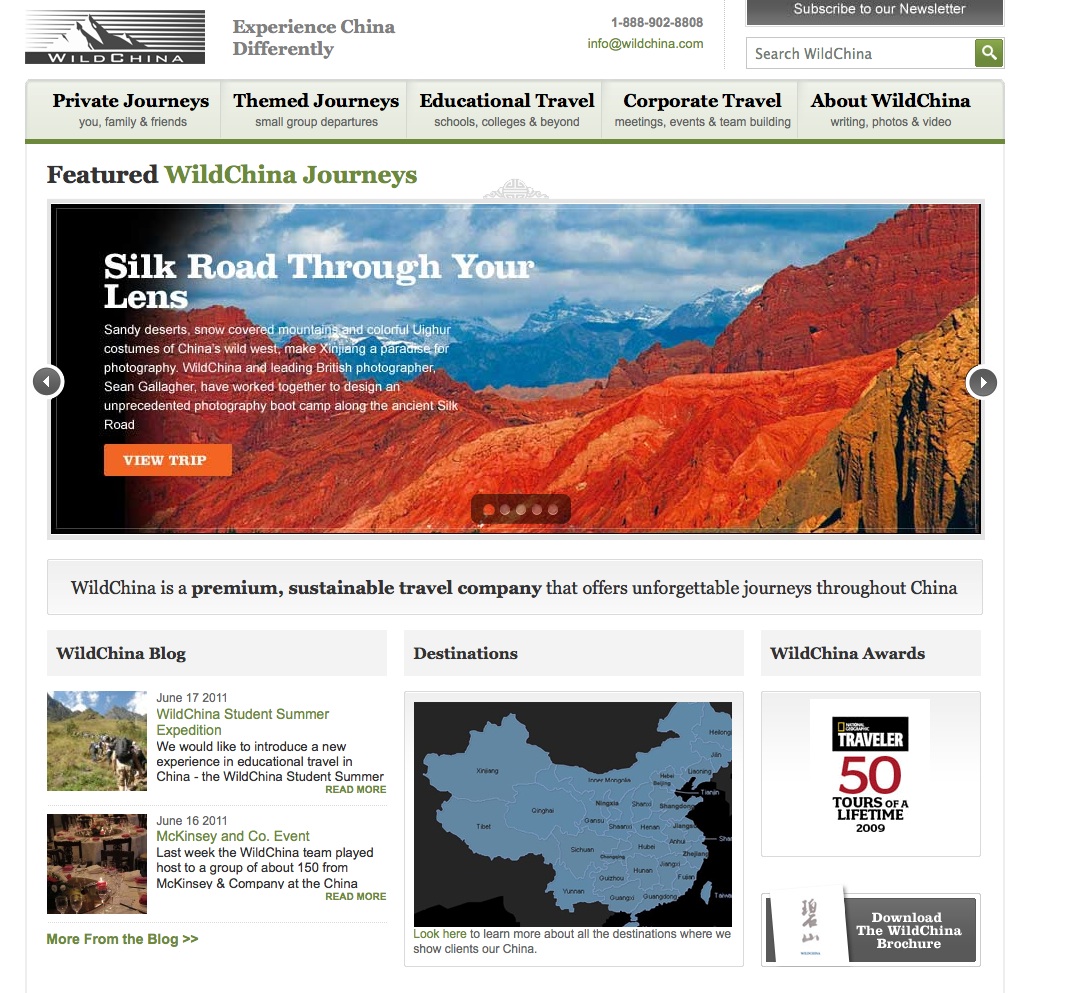
One of my favourite business sites, Bnet has an interesting case study of a site that offers bespoke or customised trips in China. The site is not doing as well as the owners expected.

The article asks the question “Why doesn’t this website draw more visitors” and there is an outline of the situation with the issues and readers are invited to comment. I tried to add my comments but as has happened before, I couldn’t add them so I am including them below.

The look and feel of the site is drab and reminds me of websites from 10 years ago. The content is too ‘traditional’ and rather predicatable.

If they are not happy with the number of visitors, then SEO is obviously an issue. So many companies spend a fortune designing a site and then sit back and wait for the orders to flow in. If only it were so easy…

So what would I do to make things happen?

They need to improve the writing. Although this won’t improve traffic to the site, it’ll keep visitors on the site once they are there.

I’d talk to existing customers and ask them what improvements they would like to see. I’d also talk to prospects that have visited the site and made enquiries but have not booked and identify why they didn’t book.

Before that, they need to invest more in driving traffic to the website, especially if as stated, 10% of the marketing budget generates 70% of enquiries. I’d also investigate and measure the number of leads generated from those 1,650 page views, source of visits, conversion rates from all channels, lost prospects and retention rates.

Other thoughts
1) The target market doesn’t have time to wait for flash to load. Furthermore, many of them are probably accessing from smartphones between appointments or via laptops whilst at airport lounges with poor internet speeds. Keep the information simple and bin the flash. Also you need a mobile version of the site.

2) So many companies think a website will make sales for them. It won’t, it is nothing more than a brochure to generate interest. Once an enquiry comes in, start building a one on one relationship with those prospects.

3) The form is too long. The target market is the wealthy but the wealthy are careful about sharing information, especially at the prospecting stage. If I buy you can have that data but not yet. Let’s stick to email communications for now. And maybe twitter.

4) Social Media initiatives aren’t engaging enough and there is too much broadcasting. Moreover there appear to be comments by readers/fans to which there hasn’t been a response.

5) Although I didn’t read the Blog articles, the headlines on the home page would suggest they are press releases not blog posts.

The key in any customer facing exercise is to put yourself in the shoes of the people you are looking to communicate with. And the best way of doing this is to talk to the people that visit your site, those that do business with you as well as those that don’t.

Direct Mail, Email and your brand


Direct Mail and Email marketing are critical components of any branding strategy for either a business to business or business to consumer brand. And it is a growing business. But the quality of Direct Mail and Email marketing in Malaysia and the mining and management of the databases used is horrendous.

If you own a company and you want to destroy any equity there may be in your brand, prepare a badly written product sheet on your desktop and when you are finished, don’t bother to spell check the document.

Print 50,000 copies and shove them in all the letterboxes of as many office or apartment complexes in the Klang Valley as you can. While you are sitting at home waiting for the phone to ring (assuming you included it on the flyer – and believe me, some don’t), your ‘DM campaign’ is being thrown in the rubbish bin by the lift, used as a place mat for lunch or simply thrown on the floor by the mail boxes. Hardly an inspiring ‘moment of truth’ first time experience for your brand and potential customer.

Another way to damage your brand is to send the wrong material to the wrong people. I have three kids, two under the age of 13. Yet this year they have both received two offers from credit card companies. These offers state that applicants must be at least 18 years of age.

A lot of firms are moving away from DM to save money on the printing of their flyers or brochures and looking at Email marketing. Although figures are unavailable for Malaysia, the Direct Marketing Association in the UK informs us that 90% of companies are now using email marketing.

There is no doubt that a well thought out and planned email campaign can be effective and profitable. But too many firms don’t do this and instead are simply adding to the seven trillion spam messages expected to be delivered to inboxes around the world in 2011.

I signed up with a local event organiser for information on forthcoming branding and marketing seminars that they organise in the region. Within a week my inbox was inundated with emails related to human resources, accounting, insurance, motivation and other topics I have nothing to do with and no interest in. These emails are trashed with the same irritation as the ones for Viagra, lottery wins and Nigerian banks.

Despite my repeated requests to be unsubscribed from their list, I continue to receive multiple emails. I cannot simply mark the email as ‘junk’ because they are using a Gmail account and this will send all mail from Gmail addresses to my trash. The name of the company is ingrained in my subconscious, but for all the wrong reasons and it is now a matter of principle that we will not sign up for any event organized by this firm.

I have received about 10 emails in the past month from an insurance company that recently spent RM13 million (US$4 million) on a rebranding exercise. The emails are not personalized, the attachment is of a flyer that is dull and states in two places that the offer is exclusively for Mastercard holders yet I don’t have a Mastercard.

I really lose faith in financial institutions and other companies when they make such mistakes. Think of the money wasted on the cost of the name, flyers, administration and so on.

The rewards for good campaigns are significant. The Direct Marketing Association reports that more than RM550 billion was spent on direct marketing advertising (including email marketing) in 2008 and sales generated from that were an astonishing RM6,450 billion! There is no question then that DM can be effective because it allows consumers to read about the products and services before deciding to explore further, or even buy.

But it has to be done properly. It is not enough simply to create a campaign and send it out. It is also important that the content resonates with the target market. And you still need to ‘sell’ the product. Just because you have got into the prospect’s inbox, doesn’t mean the prospect will buy.

The key for all direct marketing or email marketing is get the customer information right in the first place and keep it updated accurately thereafter. If you are collecting a lot of leads but don’t have the resources to input and clean the data, then outsource. There are many firms offering such services and it will be money well spent.

There is an edict within Direct Marketing industry that says, “Right offer, right person, right time.”

So it’s time for Malaysian firms, from SME up to main board, to end all this untargetted, uninspiring, untrackable, unproofed direct mail and start building brands with quality marketing collateral.

Repetition no longer solution to brand building


One of the problems with a mass marketing approach to communications is that they assume that prospects can be made to believe, through advertising repetition of the same message, what offerings can mean to them. It’s a variation of positioning and in the mass economy, when firms could control how offerings were portrayed, it may have worked.

But consumers have been misled, lied to, abused, manipulated, let down and so on. As a result, they no longer believe what most companies say, no matter how many times they say it.

Today, other customers define brands and their opinions and experiences will determine if consumers try a brand. Once they do, it is up to the company to know and understand those consumers and communicate with them with content that resonates with them to keep them.

Failure to do so will determine the success of the brand and not repeating the same message to anyone and everyone.

Why you should start building your Brand today


This article first appeared in the Friday 29th April 2011 edition of The Malaysian Reserve/International Herald Tribune

Does this statement sound familiar? “I know I need to start thinking about building my brand but I don’t know where to start so it can wait.”

I’ve heard this statement a lot recently and if it is a general feeling throughout the business community, then we’ve got a problem.

We’ve got a problem because as Malaysia becomes an increasingly wealthy country it will increasingly become a target for global brands that have seen their penetration in more traditional markets reach saturation point.

Moreover, free trade agreements and stagnant manufacturing or services based economies are also encouraging global brands to take notice of countries like Malaysia.

In the last twelve months, major global brands from the agriculture, automotive, aviation, biotechnology, education, fashion, food, hospitality, logistics, property, transportation and other sectors that in the past have barely considered Malaysia, are now establishing offices here.

Even Unilever owned brand Marmite, a quintessentially British savoury spread most often used on toast, now has sales in excess of RM20 million in Malaysia, mainly because it makes a bowl of congee a little more interesting!

And as these global brands take note of Malaysia they will invest substantial funds to establish their brands here and once those brands are established, it will be difficult for Malaysian products and services to compete with them. Unable to compete, over time, these Malaysian brands will fail.

So Malaysian firms really must begin the process of building brands now, rather than later. The good news is that beginning the process of building a brand or revamping an existing company has many benefits. Some of the most significant include the ability to charge more for products and services as well as a reduction in costs. Furthermore, changes in technology and communications mean that Malaysian firms might not have to invest significant funds into mass communications.

A word of warning though. Any branding initiative should begin with a careful analysis of the organization, its processes and systems, especially those that are customer facing and whether or not it has a customer centric culture, what it stands for and whether these elements are relevant today. Be ready for bad news but see it as feedback and an opportunity to improve not as criticism.

And once the brand is ready, communications should focus not on broadcasting how wonderful the brand is across traditional mass media channels, but on engaging prospects with content that resonates with them and delivering economic, emotional and experiential value to consumers and across all touch points.

Here are six more reasons why you shouldn’t wait to start to build a brand.

Reason No 1: Branding unifies your organization & motivates staff
Your people will want to be part of a respected and recognized brand because personnel who can identify with and support a brand’s culture, values and behaviour are better motivated, more loyal and engaged, both internally and externally.

As a result, your people will have pride and an interest in the company they work for and what they do for that company. Morale will improve, productivity will rise and resignations will be reduced. Moreover, a culture that strives to deliver value to customers and on customer terms will prevail. This in turn will lead to increased sales.

Reason No 2: Branding integrates & enhances brand touch points
This is really important. Organisations with weak or non-existent brands more often than not, make promises they cannot keep, focus on acquiring customers but pay little attention to existing customers and underestimate the importance of the customer experience. By developing a brand and building processes and systems into the brand delivery system, every single touch point between your organization and the consumer will be geared towards delivering a positive experience. Positive brand experiences will go a long way towards building customer loyalty, key to profitability.

Reason No 3: Branding reduces costs
What better incentive can there be for building a brand? Branding requires a brand strategy and a strategy will anticipate multiple scenarios and prepare the organization for outcomes, reducing the likelihood of expensive cost over runs or unexpected expenses.

Furthermore, a well recognized and well respected brand attracts talent, reducing the need for time consuming recruitment campaigns and expensive head hunters. A brand also reduces marketing costs. Less established products or services can spend up to 10% of revenue on marketing, brands often spend as little as 0.8% up to 2% on marketing.

Reason No 4: Branding justifies a price premium
Yet another major incentive for anyone still not convinced they should be building a brand. Branding allows you to charge more for your product or service because people will pay more for a name they can trust and have confidence in.

Reason No 5: Branding shortens the sales cycle
A strong, well respected and recognized brand creates trust and an emotional attachment to the product which also helps to make purchasing decisions easier. Over time, this influences the speed at which a prospect or customer makes that purchasing decision. This in turn allows a company to build customer loyalty and create brand ambassadors to sell the brand on their behalf, shortening the process further.

Reason No 6: Branding blocks competition
By focusing on building a brand rather than carrying out a series of transactions, you will ‘ring fence’ your brand and stop the competition from poaching your customers. As interactions with your brand increase, customers will automatically think of you when thinking of your category, thereby ignoring competitors.

In an increasingly competitive and noisy environment where better established global brands with deeper pockets are starting to flex their muscle, it is imperative that Malaysian firms, large and small start to build their brands now, before global brands get a foot hold in the country and it is too late.

Effective email campaigns must be part of your brand strategy


You’ve probably never heard of unsolicited bulk Email (UBE) or for that matter, unsolicited commercial email (UCE) but you have of course heard of junk mail or spam, the more common moniker.

The earliest known spam was a message sent in 1978 and the earliest known commercial spam message was sent in March 1994. This latter event coincided with the opening up of the Internet and the amount of spam has grown exponentially since then and the forecast is that seven trillion spam messages will be sent in 2011, making up about 85% of all emails sent worldwide.

This constant carpet bombing of consumer inboxes with irrelevant messages has had a detrimental effect on email marketing and now, with the advent of social media, our belief and trust in email is wavering. Nevertheless, email is still an effective tool in the communications of any brand strategy. It can be used as a marketing, sales, retention and CRM tool and response rates to personalized emails have been reported to be as high as 62% although 2-4% is the average. Still impressive.

But it is critical for marketers to ensure that their emails are relevant to the target market, well written and succinct enough to gain the attention of the reader in the roughly three seconds they have before the reader hits the delete/spam button.

It is also critically important to ensure before the campaign begins, that you know what the purpose of the campaign is and, most important of all, that your database is clean and up to date.

I am constantly stunned at the amount of shockingly written, poorly thought out and irrelevant emails that land in my inbox. I’m equally stunned at the amount of times I receive the same email from the same organization.

For instance this email, from an organization that recently spent RM15 million (US$5 million) on a ‘rebranding’ exercise, is exclusively for Mastercard owners yet I don’t have a mastercard!

Furthermore, the email is addressed to ‘undisclosed recipients’ and contains no cover message or other form of personalization. Finally, to the detriment of the brand, it has been sent to me an incredible six times in less than a month!

Takaful Malaysia which refurbished its 13 platinum branches and outdoor signs and billboards during the rebranding exercise should have also looked at its communications processes and systems, including qualification, lead and list management and other elements. As its stated aim is to ‘make the company more appealing to the younger age group, it should also review its creatives! But I digress!

What should Takaful Malaysia and other companies, who are thinking of carrying out email campaigns do to ensure those email campaigns create leads and prospects rather than brand antagonists?

Here are 10 recommendations that will help them and others get the most out of email:

1. Target your message
It’s critical that the subject line grabs the attention of the reader and encourages them to open the email. The best way to do this is to personalize the subject line. The Takaful Malaysia subject was the name of the product. Few people buy products. A better option would have been “Can I help you protect your family?”

2. Segment your target markets
Keep list sizes to a manageable amount. Don’t send gazillions of messages and then be unable to respond to them in an acceptable time frame (24 hours). Segmenting your targets will stop this happening.

3. Target messages
Keeping list sizes to a manageable level will allow you to develop multiple messages for multiple segments, critical to successful tracking. There is no one-size-fits-all solution.

4. Use a Salutation
The whole point of the exercise is to get a response, not to make a sale. If you met someone at a convention, you wouldn’t start pitching to them the moment you are introduced and it is the same with an email campaign. Be contemporary, slightly informal and inviting. Start prospecting emails with a greeting and, depending on the product or service, the contact’s first or last name, such as “Dear Mr Smith” or “Hi Fatima.”

If you don’t have the first and last name, don’t send the email until you have the correct information. The majority of emails without a name will go straight to the trash folder.

5. Keep Your Email Short
Lay the content out so that it is easy to read and keep the first email short to ensure it is skimmed. You want the prospect to read the entire email but they won’t stick around for long so make it a fast, easy read.

Keep the email to three paragraphs of no more than three or four sentences. You can also close with a one-line sentence.

6. Track each segment within each campaign
One of the great advantages of email campaigns over traditional advertising campaigns is the ability to calculate an exact CROI (campaign return on investment).

But don’t limit your calculations to response and conversion rates. Depending on the goals of the campaign, track demographics, territories, consumer data, page visits, click-throughs, time spent on pages, and other elements. Use this information to influence future email campaigns with more efficient and effective content.

7. Have a hook
Business owners and C level executives are busier than ever. They don’t have time to waste so have an instant hook. We are in difficult economic times and businesses are looking to save money, especially small businesses so an obvious hook would be related to saving money for a business. Ensure content resonates with target markets.

8. Content is still king
Mention specific issues relevant to target segments. There is so much information available that it is easy to identify issues affecting segments. It may take a little more preparation but it will be worth it in the long term.

9. Don’t go overboard on design
I’ve received emails with video clips, multiple graphics, embedded links, audio and so on. These are all distracting and time consuming when opened on a mobile device at an airport. Keep it simple.

10. Email marketing should form part of a brand strategy
Many firms conduct email campaigns on a whim, without any real thought or planning. This is a bit like driving a Ferrari in first gear, the car does everything you want it to but is it getting the best out of the car?

Incorporate your email campaigns into your brand strategy. Identify your quiet periods and implement an email campaign to boost sales in that period.

Email is still the most effective way to reach a lot of new prospects quickly and inexpensively. Email campaigns also have impressive response rates.

But email campaigns, carried out in an amateur way, can have a negative effect on your brand. However, if you follow these email best practices, prospects will take notice and respond, increasing your sales and building your brand.