Building brands requires CEOs to understand branding


95% of products fail to become brands, despite over US$1.5 trillion spent on marketing of which about US$500 billion is spent on advertising. And most of that is spent on awareness, reach and other mass market mass economy mass media tactics.

Advertising is important and always will be important to brand building but ‘getting your name out there’ or ‘creating awareness’ are too mass economy and we’re now in the customer economy.

In the customer economy, it is about engaging members of communities that have interests related to your product and entering into a communication initially and a collaboration eventually with certain members of those communities. Throw out the old mass economy mass market attitude that includes carpet bombing consumers with messages via full page ads, TVCs, billboards and one-size-fits-all communications.

But who is to blame? Is it the advertising agencies? Or is it the CEOs? I believe that until CEOs get over their own egos and realise that just because they can see their company name on a 40 foot by 10 foot billboard, or on page 3 of the national newspaper etc etc, doesn’t mean that the rest of us can see through the clutter and even if we do, most of us don’t take any notice because we don’t care.

Until CEOs instead seek accountability and ROI from their advertising, they will, in all likelihood be at the front of the long queue to be one of those products that fail to become brands.

And if advertising agencies continue to make hay, who can blame them?

Lead generation key to brand building


Many brands in Malaysia believe acquisition is key to brand building and are always trying to speed up the sales process. They focus on trying to close a deal as soon as possible. Qualification doesn’t exist, there is no attempt to build rapport and lay the foundations for a relationship. All that matters is closing a deal.

Even at road shows or other public events essentially meant to be marketing efforts to gather leads to approach later, the focus is on trying to sell something. Often, a photocopied flyer, even for luxury products will be thrust into a passing consumer’s hand with numerous features described in a robotic manner.

From suspect to customer
But a road show or trade exhibition, advertising campaign or similar is often meant not to sell something, but to lay the foundations of a relationship with a consumer who may, just may become a suspect, then prospect and finally customer. In other words, they are lead generation campaigns.

CSO insights release an annual report on Lead Generation Optimisation. Simplified, Lead Generation is marketing efforts designed to encourage targetted consumers to request more information about a product or service.

Unsurprisingly 67% of the 635 firms surveyed, reported weak sales so far this year as a result of reduced marketing budgets last year. But one positive to come out of the economic situation was that firms were spending more resources on measurement.

Measurement
Companies establish measurement systems to track strategic decisions – new enquiries, new customers won, sales and so on. But it is important not to measure the wrong stuff or measure for the sake of measuring. Metrics such as satisfaction (too broad) and awareness (too vague) are the wrong metrics and will tell you little.

In the CSO report over 50% of the firms that took part now have processes in place to track campaign ROI. And the criteria are simple, with the top 3 criteria being:

1. Total number of leads generated per campaign
2. Number of leads that convert to sales opportunities
3. Amount of revenue ultimately closed from those opportunities.

Now this isn’t nuclear science. Any company, of any size should be measuring these three elements every time they carry out a marketing campaign such as a trade exhibition. In the long run they may not speed up the sales process but they will definitely make it more profitable. And profitability not sales should be the goal of any brand.

How to sustain a family retail brand


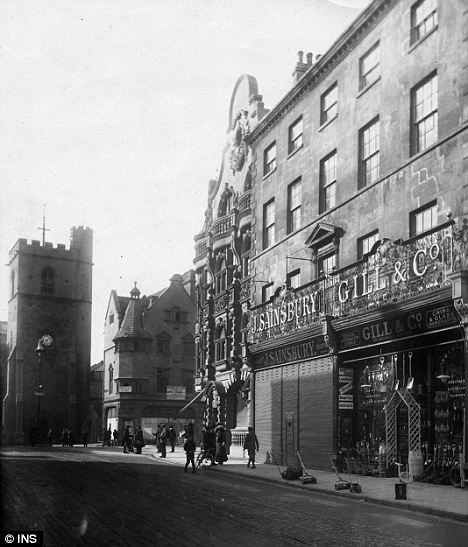
The picture below was taken in 1912 in Oxford, UK a city about 60 miles to the North West of London. It features Gill & Co, an ironmongers and a branch of J. Sainsbury, a food store.

Gill & Co was established in 1530 during Henry VIII’s reign. At the time it was the first ironmonger in the country. It has been in business ever since and has witnessed the English Civil War, two World Wars, a couple of global economic depressions, three recessions, the birth of the railway, the car, powered flight, electricity, the Internet and more.

Originally the firm supplied ironware and related products for Oxford residents however as times changed it tried to reinvent itself and also stocked equipment for chimney sweeps (think Mary Poppins), farming equipment, tools and gardening supplies. Although Gill & Co moved locations, it was always a one store operation in Oxford.

In 2010, after 480 years in business Gill & Co is closing down, beaten into submission by large DIY and home improvement suppliers like B&Q the 3rd largest DIY retailer in the world, largest in Europe and the largest in China and Homebase.

Sainsbury’s, at a mere 141 years old, a relatively new brand was established in 1869 in Drury Lane. Although now at the centre of the theatre district, this was once a very poor area of London.

Sainsbury has also witnessed much, including 2 world wars, 2 depressions, a couple of recessions, the automobile, manned flight, the moon landings and more. Sainsbury soon became an institution, offering high quality products at low prices. By 1882 Sainsbury was selling it’s own label brands.

Although lacking the heritage of Gill & Co, Sainsbury invested heavily in its staff, employing women as managers when it was unheard of in the early 20th century and developing its own training school to train managers.

Sainsbury also invested in new stores and although at times it has had a rough ride, today it employs more than 150,000 people, has 800 stores in the UK and there are on average more than 19 million customer transactions in Sainsbury’s stores every week and the company has a 16% market share.

It has diversified into non-food products and services and non-food is growing 3 times faster than food. It has a bank with operating profits of £19million and its Internet home delivery shopping service is responsible for 100,000 deliveries every week.

Asia has many small family businesses. In fact in Malaysia, Small Medium Sized Enterprises (SME’s) make up 99% of Malaysia’s total registered businesses. Hanoi in Vietnam has over 90,000 SMEs.

These organizations have a critical impact on the business of a country. In Japan, known for its heavy industry, approximately 70% of the Japanese work force is employed by small and medium-size enterprises (SMEs) and half the total value added in Japan is generated by SMEs.

Asian SMEs, many of them well established with years of heritage cannot sit by and hope that they will be safe from bigger, more aggressive retailers. They need to start planning for the future now before it’s too late.

Here are 5 recommendations for Asian SMEs to help them become a Sainsbury

1) Keep an eye on retail trends, especially in your space
2) Talk to your customers, not just about the weather/politics/sport. Ask them what their needs are, what they would like you to stock, when they would like you to open and so on
3) Build a database of customers and their preferences. If you do sell up, this will help you secure a better price for your business
4) Leverage what you have against the big retailers in your space. You can’t compete on price and probably can’t compete on choice but you can compete in other areas – convenience, personalization, customization, free alterations, returns, speed of delivery and more
5) Develop a brand strategy that includes succession planning. If you have sent your kids to university overseas, are they going to come back and work in your hardware store? If you don’t think so, look to create strategic relationships with other players in your space now before it is too late.

Social Media is not a branding silver bullet


A brand is built not on acquisition but on retention.

And retention requires a relationship. And a relationship is based primarily on ‘Trust and an ongoing, sustained engagement, on customer terms that provides economic, experiential and emotional value to the customer’.

That’s what branding is all about. It’s not a communications exercise. It won’t happen as a result of an advertising campaign. And it won’t be carried out on the pages of Facebook. That’s right, social media is not a silver bullet.

Social networks give us the tools to engage with consumers and build relationships with them. But like any tool we need to use it properly to get the most out of it. We still need marketing with links to articles, while papers, blogs and so on that appeal to target markets.

Unfortunately the majority of brands are continuing to use new tools such as social media, that allow them to lay the foundations for a relationship with consumers, in the same way as they use mass market tools that trumpet a one-size-fits-all approach to marketing.

I recently tweeted about a cool bit of kit from sonos, makers of wireless digital audio systems. I asked if there was a Sonos dealer in Malaysia. Sonos tweeted me and told me to contact someone in Singapore and obviously allerted them as I got a tweet from the Singapore guy with an email of the distributor in Malaysia. I emailed the distributor and didn’t get a reply. Sonos hasn’t contacted me to see if I purchased and nor has the Singapore distributor followed up.

There is no silver bullet with social media. It won’t solve all our branding problems but, used correctly, it will help us build relationships with customers. From there you might, just might build a brand

Louis Vuitton in a spot of bother over print ads


The Advertising Standards Authority (ASA) in the UK has received complaints that print ads for Louis Vuitton created by Ogilvy and Mather suggest that the products were made by hand.

Certainly looking at this ad that shows a woman creating the lines for the folds of a wallet

and also this ad that appears to be a woman stitching a handbag

It is easy to see why there have been complaints. Especially as the copy states, “infinite patience protects each overstitch… One could say that a Louis Vuitton bag is a collection of fine details.”

However, according to marketingweek Louis Vuitton defended the campaign by saying that “their employees were not assembling pre-packed pieces but were taking individual handcrafted and hand-sewn parts through a range of hand-made stages to reach a final item.”

Louis Vuitton added that the use of hand sewing machines and associated tasks were “part and parcel of what would amount to ’handmade’ in the 21st century”.

So handmade doesn’t actually mean handmade in the traditional sense?

If that is the case does that mean then that the iconic hand made Hermes Birkin bag that can cost anything from US$10,000 to well over US$100,000 isn’t actually hand made?

Does this mean that the animal skins used in a Birkin bag are not actually spread out on the floor of the processing room and screened by a number of artisans before being measured and cut by hand as required?

Does this mean that the bottom of the handbag is not sown by hand to the front and back with waxed linen threads?

Does this mean that the handle of the Birkin bag is not manually stitched until the shape comes to the fore?

Does this mean then that the artisans don’t use sand paper to smooth rough edges? And does it mean therefore that hot wax is not applied to the handles to protect them from moisture?

And all the effort that goes into the front flap, the metal and lock is not actually done by hand?

Does it mean that the craftsmen in France that all work out of the little lane in Paris don’t actually exist?

And advertising agencies wonder why 76% of consumers don’t believe that companies tell the truth in advertisements. In Malaysia that figure is 86%!

The number one element in any relationship is trust. If a brand wants to build a relationship with a consumer, that consumer must be able to trust the brand.

An element of doubt in communications is not a good way to build trust.

Nation Branding and Social Media


A key element of a successful nation branding initiative depends on how well your audience absorbs, understands, adopts and redistributes the message based on their requirements for value. Back in the day this was done at a coffee shop, sundry store, mosque, church, football club or where ever else consumers congregated. Today those same people are increasingly likely to hang out in communities online. Facebook is the most popular home for many communities and it and other forms of Social Media need to be part of any strategic nation branding initiative.

But the Social Media rules are very different to the traditional media rules. And although many nations, organisations and government institutions or destinations believe they understand the new rules, the output of many of them would suggest otherwise. And this is detrimental to the long term success of the nation brand. Social Media channels or tools may not survive as long as many traditional media channels, but Social Media is here to stay.

One country that seems to be doing Social Media right, is the US. The importance of Social Media, and in particular Facebook during Obama’s presidential election campaign is now the stuff of legend. Key to the successes of the campaigns was that campaign personnel asked people what was important to them and then fed that information back to the main office where local service projects were implemented as quickly as possible. Many of of those vote winning projects continue today.

At one stage, in November 2008, Obama had 2,155,244 friends on Facebook, McCain had 578,651 and George W. Bush had none! Little wonder then who won.

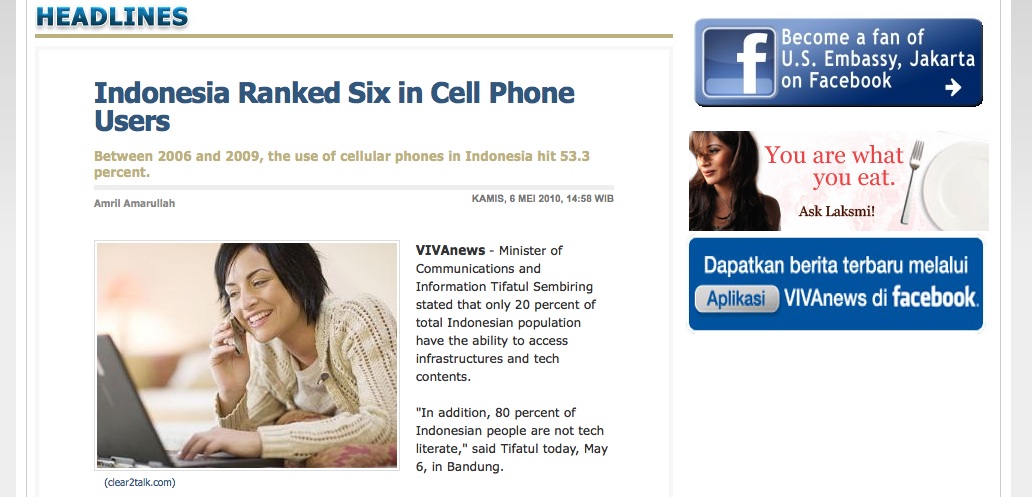
The US has since expanded its use of Social Media to the international arena and the increasing importance of Social Media channels is reflected in the Facebook efforts of the US embassy in Jakarta, Indonesia. The Embassy has invested significant resources into Social Media just as the use of Social Media in the country takes off – the number of active Facebook users in the world’s most populous Muslim country has grown from 2,325,840 in March 2009 to 20,775,320 in March 2010, an increase of 793%!

As the US Embassy in Jakarta has ramped up its presence on Facebook, its fan base has ballooned from 35,000 followers to 131,000 in little more than a month! This in a country not known for its love of the US. But the US embassy understands that this is not a soap box to try and hard sell or influence Indonesians with US policies and attitudes.

As a result, the tone of the Facebook site is light and cheerful. One recent post on the homepage related to Indonesia Batik, has received over 795 comments and more than 2,300 thumbs up. Most of the posts receive 100+ comments and significant numbers of thumbs up. Batik is err a common thread throughout the site and most of the postings are related to American life and culture, and in particular sport, music and popular green initiatives. Other initiatives include Blogger workshops.

Tourism, primarily destinations in the United States are also featured, including a rather ambitious and possibly poorly targetted attempt by Nebraska to attract Indonesians to the Great Plains state. Despite the remoteness of the destination, the video has received over 50 mainly positive comments. Other states using the site to market themselves include Tennessee and Ohio.

The US Embassy markets the site via advertising on local sites such as this one

Social Media and, in this particular case, Facebook is undoubtedly an excellent channel for nations to build their brands by engaging with consumers and offering value to those consumers based on the needs of those consumers, whilst understanding the environment. The USA, certainly in Indonesia seems to know this better than most.

Thanks to unspun for the inspiration for this story

Most Asian firms should not consider Positioning to be the right tool for Branding initiatives


Two of the most famous names in marketing – Jack Trout and Al Ries developed the concept of positioning back in the 1970s. Their business/marketing book, Positioning: The battle for your mind was written in the early 1970s and almost forty years later, is a well thumbed addition to the book shelves of respected marketing professionals around the world.

Jack Trout and Al Ries developed the concept of positioning because they believed that branding was becoming increasingly difficult as audiences were inundated with numerous and confusing communications. Positioning was promoted as a tool to “break through the clutter.”

Today, the following product description for the latest edition of the book on Amazon is: “Positioning” describes a revolutionary approach to creating a “position” in a prospective customer’s mind – one that reflects a company’s own strengths and weaknesses as well as those of its competitors. It goes on to say, “Advertising gurus Ries and Trout explain how to: make and position an industry leader so that its name and message wheedles its way into the collective subconscious of your market – and stays there.”

I disagree with this statement. Positioning may have been revolutionary in the 1970s but it can hardly be described as such today. Furthermore, where I come from, ‘to wheedle’ is not really a flattering term. In fact the free online dictionary has this definition, “To obtain through the use of flattery or guile: a swindler who wheedled my life savings out of me.”

The concept of Positioning also suggests the ‘position’ should be based on being first in a particular category. If another company is already first in the category, then the company should work to redefine itself in a new category to ensure it is first in that category. This was really important to Ries and Trout. In fact so important, that they felt it was more important to be first in the mind than first in the marketplace.

In the mass markets of the 1970s and 1980s, positioning was defined by perceptions. To influence perceptions and maintain a position within the relevant minds, it was imperative that companies dictate the information consumers received.

And, because of the power of mass media, this wasn’t an impossible task. Moreover, because most audiences were relatively passive, and they had little choice of products, well-researched messages were likely to register with targeted audiences.

Furthermore, advertising agencies and in house marketing departments also embraced the concept of positioning because it gave them total control yet there was little opportunity for accountability. After all, it was relatively easy to show progress in awareness or top of mind, but first in the category was tough to measure.

As a result, positioning was adopted by many companies and became a successful tool. In the face of this increased competition, many companies took the wheedling part at face value and started to manipulate information to control a hard fought for position that was threatened on many fronts. Soon fantastic claims were being made in advertising and other channels.

One example is the tobacco industry that tried to convince consumers that tobacco wasn’t addictive. Ford made a similar attempt to persuade prospects that the Pinto did not have design issues. More recently there were some outrageous claims around the Enron scandal and certain financial institutions last year were wheedling furiously!

Unsurprisingly, this has caused consumers to become more disillusioned and cynical and less likely to pay attention to claims made by advertisers. Here in Malaysia, 84% of those polled in a recent study by a daily newspaper said they didn’t believe what they read in advertisements. This despite the fact that many of the companies featured in those ads were attempting to position themselves in the minds of those very consumers.

Because positioning relies on mass media, it has to appeal to as many people as possible. This may be alright in a single or homogeneous market but what happens when a market is segmented?

Furthermore, firms consider a positioning campaign to be the communication of a particular message to a mass audience. But what happens if that audience doesn’t listen or accept the message? The advertising agency will tell the company to do it again, perhaps after tweaking the creatives a bit. This is also known as repositioning.

Jack Trout, this time with Steve Rivkin, released a book last year entitled REPOSITIONING: Marketing in an Era of Competition, Change and Crisis. The back cover calls this “A brilliant new book” and states, “So you’ve mastered the art of marketing. You’ve positioned your company, branded your product, and targeted your consumer. Unfortunately, in today’s economy, that’s not enough. You need REPOSITIONING.”

I haven’t read the book so I can’t comment but I have my doubts as to the effectiveness of repositioning.

Don’t get me wrong, I do think that positioning is a tool that was, in its time and for many products, a very good tool. But I don’t think it has a role to play in today’s customer driven economy. There may be some exceptions such as in the destination branding sector and some soft drinks may benefit but these are the exceptions not the rule.

I know it is hard to let go and there will be a lot of resistance to what I have written. After all, so much effort by so many people has gone into learning about positioning. But the world has changed. More importantly, consumers have changed. And marketers should acknowledge this and change with it.

Communications and the way consumers live have changed a lot over the last 40 years. Isn’t it time Branding and the way brands are built and the tools used to build those brands changed too?
Ad placement is critical to the success or failure of campaigns


Here is a screen grab of an article about the terrible earthquake in Chile. Alongside the article is an ad for Celcom, a Malaysia mobile service provider. It is one of those ads that you are encouraged to roll your mouse over to expand the ad and get more information. What I was pleased to note was that unlike many other similar ads, this one reduced when you moved your mouse away from the ad. I find it offensive and intrusive when you roll your mouse over these ads and then cannot get the ad to reduce when you move the mouse away.

Anyway, to me it is another example of the dangers of not controlling your ad placement. This could be considered even worse because it features a man standing on the top of a mountain and by default references nature. I’m not really sure what the relevance of the mountain is and it is not explained in the copy. Perhaps we are supposed to associate using the telco with being on top of the world. Or perhaps it is not relevant and is just an image chosen by the advertising agency. Or perhaps we just make up our own minds in which case, having the ad alongside a horrifying article about the Chile earthquake is not helpful.

We won’t go into the fact that he is standing on the top of a mountain that doesn’t have any snow on it even though mountains lower than his do have snow on them, or the fact that the scale is so out of whack.

But tell me, does an ad like this, alongside a negative story, encourage you to roll your mouse over the ad, read the copy and then seek further information or do you simply ignore the ad?

Take control of your ad placement


I’ve decided to make these real time observations of branding blunders/negative brand association individual posts instead of putting them all together. This latest one is a real gem.

Essentially it is an argument between the British meat industry and the World Cancer Research Fund about the the dangers (or not) of red meat. The article is littered with negative words such as confusing, cancer, nightmare, death, bitter, row and more. To the right (and above) the article is an ad selling Dell computers. You can read the full article here but of course the advertisers may change

The execution of the ad is good. Readers can quickly and easily identify the brand and there is a seamless call to action.

But I’d like to know why Dell is advertising next to such a negative article. How does Dell buy these ads? Have they considered where the ads may be placed? Do they book a specific number of spots and choose the location or does the website decide where the ad goes?

If you are a brand and considering advertising online, make sure you determine what sort of articles the ads can be placed alongside otherwise you may be associated with death, cancer, arguements and so on. Probably not what you intended.

Any thoughts?

Negative brand association, real world examples


In October of last year, I wrote a piece on my blog about negative brand association. You can read the short post here

David Ansett of Storm in Australia approached the subject from a different angle and you can read his piece here

Essentially, my attitude is that if the concept of positioning a product in a consumers mind is a serious concept then it is only logical to assume that the same process can have a negative impact on the brand. Over the next few months, I will post examples that I encounter and I hope you guys will enter into a conversation with me on the impact, either positive or negative, of this brand association.

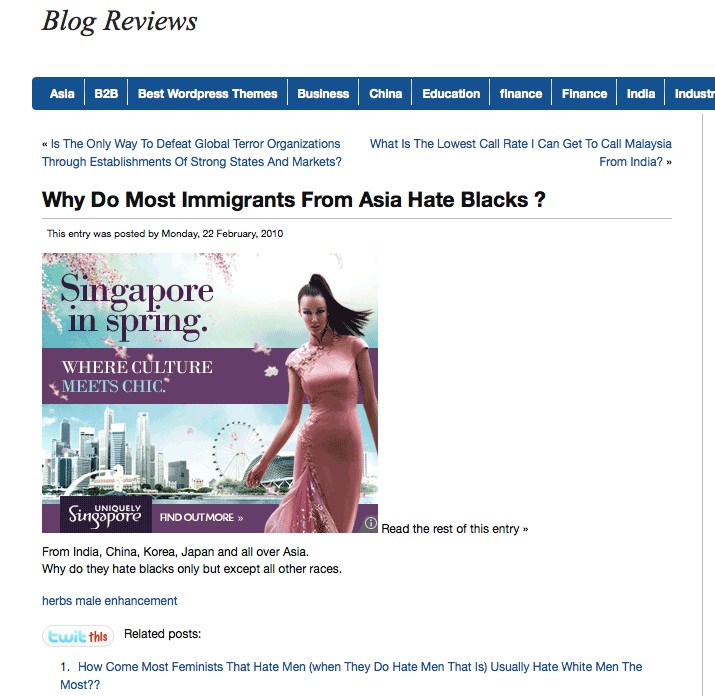
So we’ll kick of this project with a grab of a page I encountered today. I saw the question after answering another question and thought to myself that it would be interesting to see what, if any, the responses to the question might be.

As you can imagine I was shocked to see the ad right under the controversial, not to mention provocative question!

Today’s negative brand association story comes from the BBC site. This time it is a video about a drunk driver in China who is caught on film smashing into road dividers and barricades. You can see the full video here

You’ll note that the story is preceeded by a commercial for Lexus!

Here is a still image from the end of the commercial.

Actually this could also be included in brand disasters. Is it appropriate for a luxury brand such as Lexus to be associated with a drunk driver? Or does it not make a difference?

Any comments?