Integrating and engaging all activities


Back in the day, if a TV commercial was good a consumer might, just might ask a friend for his opinion on the product advertised. If the opinion was a favourable one, then the consumer may have sought the product out the next time he was at the mall. Assuming of course that he remembered it on the way to the mall or his memory was jogged by some effective point of sale promotions.

But today, the consumer has millions of friends with him as he watches the TV commercial. And all of those friends are just waiting to pass on their opinion to our consumer. To ask them, all our consumer has to do is key in a word or two into the search cell on his browser on the laptop that is probably on his lap as he watches the TV.

With this in mind, wouldn’t it make sense for advertisers to create TVCs with easy to remember links or search terms that can be keyed in at the same time as the commercial plays? Of course product sites will have to feature the same image of the same product with relevant content and information on local store opening hours and product availability. Messaging and images as well as content in traditional and digital media must be consistent too but this shouldn’t be a problem.

Surely we should move away from the mass market mass economy one message for all approach to this more instant, integrated and engaged approach. What do you think?

Building a 400 year old brand is a strategic initiative


Shepherd Neame, the oldest brewer of beer in the UK was established in 1608 or 402 years ago! An amazing heritage and the brewer likes to play on this heritage with its advertising campaigns for brands such as Spitfire, Canterbury Jack and Bishops Finger.

The brewer allocated its entire 2006 advertising budget, which was about £300,000 (US$450,000) to one of those, Spitfire a real ale, and all of the budget was spent on the London Evening Standard, an afternoon/evening newspaper in London. This was considered a radical change of strategy. As well as print ads, content and sponsored supplements, the brand also sponsored the Evening Standard’s football World Cup special feature in May of that year. The strategic agency was John Ayling & Associates and the creative agency was RPM3. Promotional support such as free pint promotions were also included.

The really well executed and edgy “Bottle of Britain” campaign ran over six months and is one of my favourite campaigns. Here are some samples of the award winning creative work that was considered controversial and was investigated by the advertising watchdog Advertising Standards Authority (ASA) in the UK after complaints about the use of SS insignia. The complaints were later rejected by the ASA. You’ll need to have some knowledge of history, colloquial English as well as WWII jargon to really appreciate the ads.

Spitfire

You can find more examples of their campaigns on the Facebook page here

But Shepherd Neame understands that advertising campaigns are not enough to build and grow a strong brand. As a result, the company continues to invest in state of the art SAP technology and bottling technology, new acquisitions of high turnover pubs and refurbishments of existing properties to create airy, spacious and clean environments.

The company also invests extensively in merchandise including a bottle of Britain book, social media and charity work (Spitfire originated as a charity brew) and will link the brand to the extensive 70th anniversary celebrations of the Battle of Britain due to be held in the UK later this year. Also look out for its campaigns related to the 2010 football world cup.

All these elements ensure the brands offer experiential, emotional and economic value to both new and existing customers.

It comes as no surprise therefore that despite the recession and clouds of uncertainty, red tape and increased taxes and shocking weather in the UK, turnover was up 8.2% to £60 million in the last six months of 2009 proving that investing in brands is not just about edgy and controversial advertising campaigns, but a long term strategic imperative to continue to build on a 400 year heritage!

Managing your media placement is critical


Here’s another example of poor control of ad placement online. If you are responsible for your own ad placement, make sure this will not happen. If the channel won’t let you dictate where your ads cannot appear, find another channel. If your agency is responsible for your ad placement tell them if this happens again, they’ll be one client short in a heart beat.

A is for Advertising


This is a good place to start a compendium of branding terms because unfortunately, it is where many companies start their brand building. And that’s a shame, no tragedy because it is an expensive exercise in futility to try and build a brand using advertising alone.

Advertising can be traced back to around the late eighteenth century when the first print ads appeared in the USA. However, they were rarely much more than extensions of the editorial copy and newspapers were reluctant to allow ads that were bigger than a single column. Even magazines preferred to print all the advertisements at the back of the publication.

Mass advertising only really began in the second half of the nineteenth century when firms began to produce greater quantities of more and more products thanks to improved production techniques. Soon after manufacturing, other businesses such as department stores and mail order firms jumped on the bandwagon and by 1880 advertising in the US was estimated to be in the region of US$200 million. This grew to almost US$3 billion by 1920.

In the mass economy of the 1930s to the 1990s that coincided with the growth of mass circulation magazines, advertising companies proliferated. At the same time, companies wanting to stand out from the competition determined, quite rightly that the quickest way to grow was to raise the profile and awareness of the company’s product or service by informing or reaching as many people as possible in the shortest time.

The most common way to do this was via advertising, especially via TV advertising. The business of advertising is based on a model of repetition across mass media. OK, creativity is important, initially anyway, but once you get over the wow factor, the idea is to repeat the same message through as many channels as possible for as long as possible.

Budget played (and still does) a significant part in what sort of advertising an agency may recommend. It is important for you to know that from the advertising company point of view, the size of the available budget will determine two main points, 1) who works on the project (in terms of seniority and talent) and 2) what channels will be utilised. A larger budget generally results in TV advertising becoming part of the recommendations.

Other platforms include print advertisements, billboards, lamp post buntings, banners, taxi, bus and tube trains, coffee shop tables, flyers, leaflets and more. The introduction of the Internet has seen a proliferation of banner ads, tower ads, unicast ads, contextual ads, takeover ads, interstitial ads, floating ads, and other options to an already noisy, crowded and complicated marketplace. It is important to note that none of these initiatives are branding, they are all advertising and advertising is a tactical initiative not a strategic initiative, like branding.

In the mass economy and unfortunately still to this day, once a campaign has launched, probably to much fanfare, the client waits with anticipation to see the promised sales spike. Meanwhile the agency submitted any well executed commercials to one of the numerous creative shows that offer awards for creativity.

As mentioned earlier, repetition is important and with enough frequency, and perhaps a little vague targeting, this repetition was expected to encourage enough consumers to walk into a store or other outlet and choose or request the advertised product.

The model worked, to some degree fifty years ago but in today’s crowded marketplace, using advertising alone to build a brand is leaving too much to chance. It is simply too difficult to stand out from the crowd. Can you remember the last ‘great’ TV commercial or print ad that you saw? And even if you can, have you bought the product?

Quite often, the promised sales spike didn’t happen, unperturbed and with a straight face, the agency would ask the client for more money, arguing that it is the client’s fault as it should have made more money available in the first place for increased frequency. If you have gone this route, I suggest you bin the advertising agency and call a brand consultant.

Should you still use advertising? Absolutely because advertising will help your company project a vision of the relationship you can deliver to the customer. The ads also help you to educate customers about the value that you can offer them. Advertising must also communicate trust. Unfortunately this is forgotten by most advertisers, especially in South East Asia where outrageous claims made in advertising are rarely backed up in reality. In Malaysia for example, after years of being let down by claims made in advertising, only 14% of Malaysians now believe what companies tell them in their advertising.

But instead of seeking to increase awareness of your product or service with as many consumers as possible, ensure your advertising seeks to communicate with those consumers that are most likely to adopt your product or service.

Make your advertising relevant to those consumers you have targeted. Core messages must be related to those consumers interests, needs and/or desires. So rather than a one-size-fits-all approach in your communications, it is essential for messages to be about offering value to those specific customers and making their life better as a result. How to identify those consumers and what is relevant to them will be explored in brand audits and targetting.

The goal is to ensure a consumer incorporates an offering into their personal or business lives.

Adoption will ensure your brand is seen as the best, hey perhaps even the only choice. This won’t happen on its own. It is a process built on operational excellence, superb sales incorporating ‘top of game’ customer service and the ability to match offerings to the consumers individual requirements for value, on an ongoing basis. To build a brand retention is key and retention requires relationships and without relationships, adoption is not achievable.

And this is good news for Asian companies because the fact is Asian companies, and especially those from South East Asia, simply don’t have deep enough pockets to compete with international brands using outdated one-size-fits-all, mass economy tactics.

Ad placement is critical to the success or failure of campaigns


Here is a screen grab of an article about the terrible earthquake in Chile. Alongside the article is an ad for Celcom, a Malaysia mobile service provider. It is one of those ads that you are encouraged to roll your mouse over to expand the ad and get more information. What I was pleased to note was that unlike many other similar ads, this one reduced when you moved your mouse away from the ad. I find it offensive and intrusive when you roll your mouse over these ads and then cannot get the ad to reduce when you move the mouse away.

Anyway, to me it is another example of the dangers of not controlling your ad placement. This could be considered even worse because it features a man standing on the top of a mountain and by default references nature. I’m not really sure what the relevance of the mountain is and it is not explained in the copy. Perhaps we are supposed to associate using the telco with being on top of the world. Or perhaps it is not relevant and is just an image chosen by the advertising agency. Or perhaps we just make up our own minds in which case, having the ad alongside a horrifying article about the Chile earthquake is not helpful.

We won’t go into the fact that he is standing on the top of a mountain that doesn’t have any snow on it even though mountains lower than his do have snow on them, or the fact that the scale is so out of whack.

But tell me, does an ad like this, alongside a negative story, encourage you to roll your mouse over the ad, read the copy and then seek further information or do you simply ignore the ad?

Take control of your ad placement


I’ve decided to make these real time observations of branding blunders/negative brand association individual posts instead of putting them all together. This latest one is a real gem.

Essentially it is an argument between the British meat industry and the World Cancer Research Fund about the the dangers (or not) of red meat. The article is littered with negative words such as confusing, cancer, nightmare, death, bitter, row and more. To the right (and above) the article is an ad selling Dell computers. You can read the full article here but of course the advertisers may change

The execution of the ad is good. Readers can quickly and easily identify the brand and there is a seamless call to action.

But I’d like to know why Dell is advertising next to such a negative article. How does Dell buy these ads? Have they considered where the ads may be placed? Do they book a specific number of spots and choose the location or does the website decide where the ad goes?

If you are a brand and considering advertising online, make sure you determine what sort of articles the ads can be placed alongside otherwise you may be associated with death, cancer, arguements and so on. Probably not what you intended.

Any thoughts?

Negative brand association, real world examples


In October of last year, I wrote a piece on my blog about negative brand association. You can read the short post here

David Ansett of Storm in Australia approached the subject from a different angle and you can read his piece here

Essentially, my attitude is that if the concept of positioning a product in a consumers mind is a serious concept then it is only logical to assume that the same process can have a negative impact on the brand. Over the next few months, I will post examples that I encounter and I hope you guys will enter into a conversation with me on the impact, either positive or negative, of this brand association.

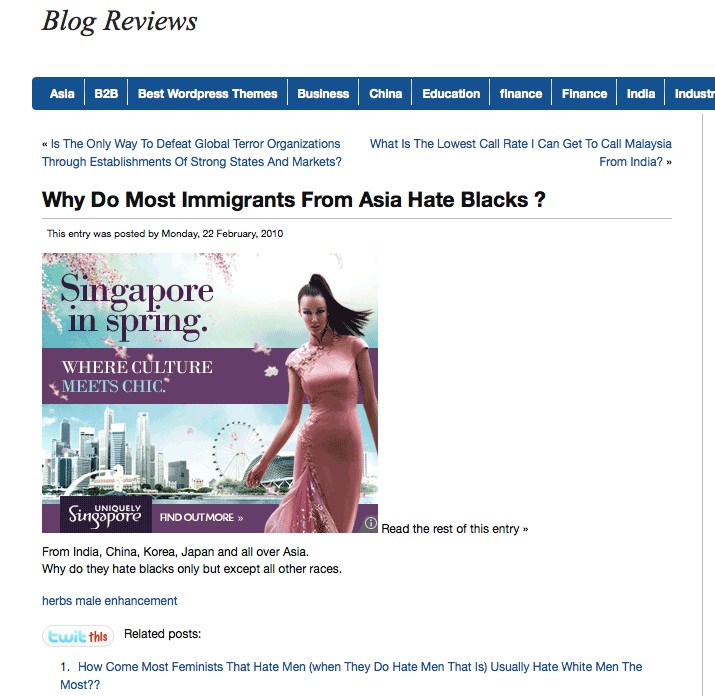
So we’ll kick of this project with a grab of a page I encountered today. I saw the question after answering another question and thought to myself that it would be interesting to see what, if any, the responses to the question might be.

As you can imagine I was shocked to see the ad right under the controversial, not to mention provocative question!

Today’s negative brand association story comes from the BBC site. This time it is a video about a drunk driver in China who is caught on film smashing into road dividers and barricades. You can see the full video here

You’ll note that the story is preceeded by a commercial for Lexus!

Here is a still image from the end of the commercial.

Actually this could also be included in brand disasters. Is it appropriate for a luxury brand such as Lexus to be associated with a drunk driver? Or does it not make a difference?

Any comments?

If a consumer cannot afford your brand, he won’t buy it


Brands are defined by the economic, emotional and experiential value they provide to a consumer. If you can’t match the attributes of your brand to those requirements for value, consumers won’t buy it. Cost is a critical element.

No matter how much you spend on expensive TV commercials that the agency says will reach the most consumers and create awareness of your product the quickest, if a consumer cannot afford your product, he won’t buy it.

It doesn’t matter how much you spend positioning your product in the mind of consumers. If those consumers can’t afford your product, they won’t buy it.

Even if you manage to completely differentiate your product from other products, if a consumer can’t afford your product, he won’t buy it.

How Asian firms and politicians can adopt social media into their strategy


When TV first started, commercials consisted of a presenter standing in front of a microphone reading from a script. Why? Because that was how it had always been done on radio. It took companies a few years to leverage the power of TV but eventually they did and now TV ad spend is estimated to be in the region of US$500 billion annually.

And in the same way as first the radio and then the television changed the way companies pass on information to consumers in the 20th century, social media is changing the way consumers source information about businesses in the 21st century. But social media will have an even bigger impact than radio and television because social media is not only changing the way we make decisions related to brands, social medial is changing the way we do business.

Consumers receive up to 5,000 messages a day
Back in the day, companies used radio and then TV to build brands by developing a one-size-fits-all message and broadcasting that message to as many consumers as possible as often as required. All communications were one way and the messages contained only the information the company wanted to share and the consumer was expected to accept this information and not dispute it. In a more trusting world, with limited competition and smaller markets, consumers were accommodating. Unfortunately, more and more companies adopted the same strategy. Soon consumers were inundated with up to 5,000 messages a day, many of them making increasingly outrageous claims.

Companies were unable to follow through on the promises made in advertising and trust, the key element of any relationship, was eroded. Repeatedly let down, consumers began to look elsewhere for independent information and the truth. They found it with other consumers. Consumers now source their information on brands from other consumers. Today, consumers have the power to make a brand succeed or fail. As consumers learn the truth about a brand, the reputation of companies and their brands is being determined, shaped, altered and increasingly discarded by consumers.

Dynamic process
And it is an ongoing, dynamic process. At any given time, consumers are searching for information on a product or service that has caught their eye. But they are not sourcing that information from TV commercials, the radio or the company website, they are looking to other consumers for the information they require.

And they are doing it, on the whole via social media. And social media is yet another tool that organizations must embrace because it is replacing marketers and the marketing department and other barriers between the organization and the consumer.

Social media cost of entry is low
Social media is not a fad. Those companies that don’t buy into social media will be left behind. But a lot of companies in Malaysia are going to be intimidated at the prospect of opening their virtual doors and giving the general public the opportunity to interface directly with them. But they are going to be talked about anyway so they might as well be part of the conversation. That way at least, they will have the chance to contribute a corporate take on all issues. And the good news is that the cost of entry is low and there are very few barriers to participation.

So what should Malaysian firms do to leverage social media?

1. The first thing they have to understand is that social media is not about you. It is not PR and it is not advertising. Social media is not for the hard sell, it is for engaging prospects and customers and for entering into two way conversations with them. Do this, and you will get opinions on issues that are important to an audience who is interested in your product. If you listen and use this information wisely, you will be able to match your product attributes to your customer requirements for value.

2. Identify which social media platforms you intend to use and develop a strategy to use them. Transparency, consistency, honesty and longevity are key so don’t just jump in and fire away for a fortnight of frantic activity and then get bored and stop communicating.

3. Do some research and find out how your customers are using social media, what platforms and so on. 350,000,000 million people read blogs. Identify which ones your prospects and customers are reading and how can you get involved by responding to articles.

4. Offer forums on your website that allow customers to express freely their experiences of using your products. You’ll be astonished at how valuable the feedback will be as you listen to what really matters to consumers and incorporate the feedback into your strategy.

5. Over time, develop a formal process to monitor and review what consumers are saying about you and where they are saying it. This monitoring will allow you to enter into dialogues that are very personal and transparent. It will also allow you to address negative issues as they arise and before they develop into crises. Casual monitoring will give you a real time view of what is being said but it is resource consuming and may not be as effective as a more formal program via a third party such as BuzzMetrics.

6. Set up blogs for key customer facing departments. Blogs are a great sounding board and instantly engage prospects and customers. Be honest, develop a personality but don’t try to sell your products. Don’t worry if your opinions differ to those of the audience. Open and transparent responses are what your audience is looking for.

7. Social media requires a fresh approach to content. Too many Malaysian firms are simply paying ‘lip service’ to social media. One government agency simply copied and pasted its website onto its Facebook page and then left it for nine months!

8. Social media is a platform for communication and collaboration, not a soapbox. Some companies simply tell followers about special offers. A number of politicians use Twitter to tell everyone what they are doing yet ignore specific issues raised by voters.

So as you embark on your social media strategy, remember that the digital environment is immense and fluid. Understand that you must change the corporate approach of one that aims to push messages onto consumers, to one that aims to listen to what they have and then responds to those issues. Take these first steps and you’ll soon learn to leverage the powers of social media and throw away the script.