Malaysia Airlines won’t return to profitability with bland, boring TV commercials


I don’t like to kick a man (or an airline) when he’s (or it’s) down, and despite a couple of good quarters, Malaysia Airlines (MAS) is certainly down.

The good quarters (following six straight quarters of losses) are a result of increased revenues thanks to better load factors and higher RASK (Revenue per available seat kilometer).

Just to recap, to avoid bankruptcy, MAS embarked on a massive restructuring plan towards the end of 2011 that included cutting unprofitable routes and reducing costs with the goal being to return to full year profitability in 2013.

Although the airline has done quite well, that’s unlikely to happen even though it is focusing on Asia and has stopped flying to costly destinations such as Buenos Aires, Johannesburg, Cape Town and oddly, Dubai. Giving up Dubai and Dammam suggests the carrier is surrendering to the aggressive carriers from the Middle East.

The most recent business strategy announced two key strategic elements – one to focus on the premium sector and the other to focus on the competitive Asian market. The announcement that the airline would go after the premium sector came at the same time as the partnership deal with AirAsia that has now been scrapped.

I’ve seen nothing to suggest the airline is courting premium customers and although it is good to see the airline understands the importance of segmentation, I doubt their ability to execute such a strategy.

Especially as the airline seems to be going the same old predictable route of using an advertising campaign featuring an irritating tagline (more on that later) to magically increase demand. And I’ve seen nothing else to suggest the airline is doing anything other than the usual advertising, print and PR tactics with a nod to social media.

And what an advertising campaign it is! I think this is the TV commercial.

I’m sorry but this has to be the worst commercial or video I’ve ever seen. It features people of various ages walking, cycling, swimming, jogging, directing traffic (I’m serious), reading newspapers, skateboarding, going to a meeting, graduating, bowling, clubbing and all with one thing in common – they are all carrying at least one suitcase! Yes, even the traffic policeman!! This really is rock bottom.

The print advertisement (which I’ve also seen on a billboard) features two men sitting on a wooden dock. They are both holding suitcases and the younger man has his arm around the older man and is looking into his eyes.

Sitting on the dock of the bay, suitcase in my hand

Does this image make anyone else uncomfortable? Here’s a close up to help you decide.

Does this make you uneasy?

MAS also has a corporate video that starts off with a series of stock scenes featuring babies taking their first steps, dad playing with son, climbers etc and then cuts to old shots of MAS in the early days. Meanwhile the voice over tells us that life is made up of countless journeys. Getit?.

Then we get shots of computer generated imagery of the various planes used by the airline from past to present (didn’t BA do something similar?) before going back to the people shots – nice, smiling, friendly air hostess with kid – cut to boys jumping into lake – then back to nice, smiling people, tender, caring hostess and then, out of the blue we’re told the strangers we meet on our journeys give us courage – cut to skydivers – then back to lovers on beach, cultural harmony, pregnant couple and so on. I stopped at this point, unable to continue. Have a look instead.

One of the videos (I can’t remember which one and I have no intention of watching them again) features the Malaysia Airlines app that I really like but isn’t integrated with the website (or if it is I can’t figure out how to find my bookings made online on the app).

So if MAS is serious about increasing market share, what should the company do? Here are 5 things they need to start doing today.

1) Forget about the big idea. Focus instead on consistent, onging, personalised engagement with each of your very diverse audiences.
2) You probably have one of the most comprehensive databases in South East Asia. Start to use it properly.
3) Focus. These ‘one-size-fits-all’ advertising campaigns are an expensive exercise in naïve futility. Put an end to them now.
4) Don’t do social, be social.
5) Integrate all your solutions to make it easier for consumers to use them. Otherwise they defeat the object of developing them in the first place!

I’ve been flying MAS for over 20 years and I think it is a great product but it needs work. A lot of work. This traditional approach to brand building is not going to help steer the airline to full year profitability. They’d be better off throwing the money down a black hole.

Digital consumption by consumers will determine the success or failure of your brand


This infographic from McKinsey offers a fantastic insight into how two key European markets are engaging with digital and how it is revolutionising the buying habits of their citizens.

Are you ready for how digital is changing the way consumers interact with brands?

The implications of these new realities are significant to say the least. As more and more of the population buys online, traditional retailers will have to reinvent themselves or risk going out of business. Because these traditional retailers tend to move slowly, more of them are going out of business than reinventing themselves.

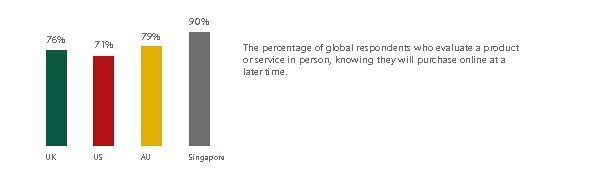
South East Asian countries tend to a year or two behind Europe in how technology is integrated into our lives however we’re already seeing digital influence how we interact with brands in Asia. For instance a recent survey by SDL in the UK found that 90% of Singaporeans evaluate a product or service in person before buying online.

Unless Asian brands wake up to the way consumers are using digital to research and choose brands – and that means more than using a traditional model of mass and invasive ads across news and other sites – they will find it hard to compete and that won’t have a happy ending.

Stop advertising and start branding part II


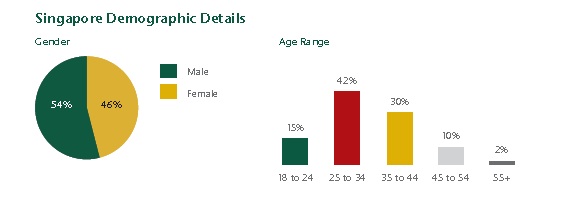
A fascinating insight into the social media and mobile shopping habits of consumers in the United States, United Kingdom, Australia and Singapore has just been released by SDL in the UK.

The survey size is a little small – 4,000 people in four countries – but the results unearth new data on how social media and mobile are influencing how consumers interact and build relations with brands.

Singapore participant breakdown

Findings include:

33% of respondents from all four countries have acted on promotions seen on social media.

58% of respondents have shared positive experiences online and have sought advice from friends and family when talking about brands on social media.

U.K. respondents are more likely than respondents from the other four countries to complain about service on social.

When respondents express feedback, Facebook is the most popular platform to do this.

Showrooming (visiting a physical location to evaluate products and services even when you know you will buy online at another time) is increasingly prevalent as 77% of participants showroom.

Experiential branding key to branding success

62% of the participants use a mobile device when in stores to compare product prices.

69% of respondents from all four countries expect a brand’s online store, mobile app, and physical store to offer the same pricing, discounts and sales.

Pricing consistency is expected in all countries

What can brands learn from this thought provoking survey?

They need to understand their relationship with consumers and what resonates with those consumers.

Brands that ensure parity in pricing and products across multiple channels will have to place greater emphasis on the customer experience and experiential branding if they want to win and retain business. Those that compete on price alone will soon be out of business.

Department stores and other retail outlets that represent multiple brands will have to work harder to engage consumers and ensure a positive brand experience otherwise they face the prospect of losing customers, possibly forever.

Mobiles are changing the way consumers research and learn about brands.

Brands that take the time to build relationships with core fans or brand evangelists will see their brands promoted to thousands of fans for minimal financial investment.

Those brands with digital brand strategies that go beyond tactical campaigns online are increasing sales through loyalty and advocacy.

Brands that try to control content and manage corporate driven messages and ignore consumers are unlikely to last very long in the consumer economy of today.

Telling the brand story online should be done across Facebook and other popular platforms with the ongoing development of corporate and consumer content.

What’s happening in social marketing in 2013


As the advertising agency driven ‘big idea’ developed to push out a corporate controlled message continues to lose steam, social media and multiple new platforms, devices and applications mean that marketers have less control over the brand. Indeed, as consumers not companies now define brands, those marketers need to learn how to engage consumers on an ongoing basis.

This will be driven by content development and engagement across social media and digital mobile marketing.

This infographic from dotcominfoway suggests the most likely tools and technologies that will most influence the digital marketing landscape in 2013.

4 Digital trends moving forward

What do you think?

Advertising on social networks should form part of your brand strategy


This infographic shows how spending on advertising on social networks is growing at a phenomenal pace. Whilst this is an area that any brand should be looking in to, it is important to understand that consumer behaviour in these environments is very different and the approach to content must take this into account.

A recent report on digiday stated that a consumer is more likely to die in a plane crash than click on a banner ad and that 50% of clicks on mobile banner ads are accidental! The same report also stated that 8% of Internet users account for 85% of clicks on banner ads.

So if you want to ensure a ROI from your social advertising campaigns, make sure you understand target market requirements for value before launching a social media campaign otherwise consumers will continue to avoid online advertising, and that includes yours.

Brands, it is no longer about you


Whilst researching a chapter for my new book (you can get an idea of how the book will go by reading this article here) I came across a fascinating company called Undercurrent.

One of the key players in the firm is a guy called Aaron Dignan. You can follow him on Twitter here.

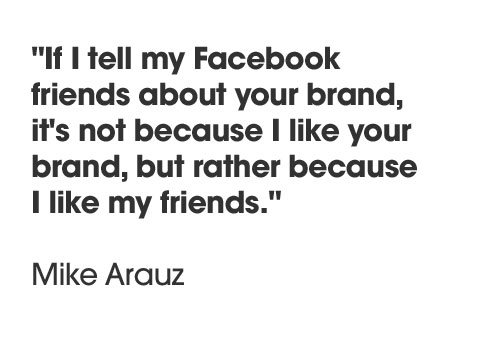
I was impressed by much of what I read on their website but whilst continuing my research, I also found this quote from Aaron:

Do you really understand Facebook?

This simple quote sums up the new world order of branding. It is not about you. Consumers really don’t care about you and your brand. There are so many brands out there that consumers are no longer buying into brands in the same way as they did before.

There are exceptions but on the whole, the world is changing and brands can no longer expect to have the loyalty they used to take for granted. Do you agree?

Stop advertising and start branding


Are you happy with your branding activities? Or do you find the money you spend does little to build your brand?

Unfortunately, most branding initiatives revolve around a creative campaign developed by an advertising agency. Depending on budget, the creative campaign will be implemented with a one-size-fits-all message communicated to all and sundry and across multiple mass media platforms for as long as budget allows.

The model essentially revolves around hope – hope that lots of people will see the campaign, hope that amongst those people will be the target markets, hope that the message will resonate with those target markets, hope that those target markets will remember and hope that if they remember they will act.

In a noisy world, is a traditional approach to building a brand going to make you stand out?

So basically, the ‘strategy’ is one of hope. Chances are if it doesn’t work, the agency will, if you haven’t already fired them, propose more of the same.

For most brands this approach is an exercise in futility. Wouldn’t it be better to first get an understanding of where your brand is – both internally and externally?

In the social economy, where consumers not companies define brands, don’t you want to know what your stakeholders want from your brand, what you are doing right (and wrong), the channels they are most likely to interface with, their influencers and more?

Internal and external brand and communications audits can both help determine how effective your branding activities have been and, more importantly, what they need to accomplish in the future.

In the social economy, a brand audit is the first step to building a brand

Brand audits have multiple advantages. They provide a benchmark to evaluate the current brand position. Carried out every 2 years they can evaluate progress toward branding goals. They also unify an organization. Too often, everyone has a different definition of branding. A brand audit will identify this and provide recommendations for improvement.

Indeed, a brand audit can provide a consistent, universally accepted brand DNA and from that a definition that ensures that everyone in the organisation is marching to the beat of the same branding drum. Finally, a brand audit can help eliminate the all-too-common disconnect between what companies believe their brand to be and what customers perceive it to be.

An internal brand audit takes the brand temperature from corporate executives and other personnel. One-on-one confidential interviews probe to determine each individual’s perceptions of the brand, branding goals, evaluation of past branding activities, knowledge of key corporate or brand messages and other key points.

An Internal brand audit is a key component of any brand strategy, when did you last carry out an Internal brand audit?

What are the current branding and customer processes, and how can they be improved? One great question to ask is: “Imagine it is five years from now, and the company is celebrating historic financial and market success. How did the company arrive at this point? What are some of the activities that brought us to such success?”

A brand audit can cover a wide cross section of departments but must have the customer and the customer’s needs at its core. What do we know about customers? Are we collecting THE RIGHT data? Is relevant customer data being added to corporate databases? Is customer information shared with other areas of the company? What initiatives are on the horizon that will affect certain customers and how will this be addressed?

A minimum of 25 minutes is required for each interview, but they can take up to an hour. Questions can be prepared beforehand, but the most valuable insights often result from free-ranging discussions on relevant topics.

A key component of a brand audit is a communications audit, which is especially useful for larger firms with multiple divisions or departments that get involved in branding activities.

A communications audit looks at all the visual material that represents a brand – the brand identity, sales documentation, press releases, ads, brochures, Web sites, social media channels, merchandise, vehicles, logos, etc.

Too many so called brand strategies are really just pointless journeys to unknown destinations

Analysis then determines the amount of consistency and integration in appearance/design, messages and their relevance to target markets (in a noisy world where consumers are time poor, content is so, so important) and adherence to corporate standards. Ideally, a brand manual is in place to provide a benchmark.

The role of social media in both internal and external corporate communications is increasingly important and a social media audit must be included in the communications audit. Communications across social media require different skill sets to traditional marketing and this is scaring some companies away but it must be addressed.

A social media audit lays the foundations for the social media strategy that has an crucial role to play in the brand strategy developed later.

Internal brand and communications audits often reveal a stunning amount of discrepancies that result in mixed messages to both prospective personnel and customers, incompatible branding efforts or even disagreement about branding goals.

An external brand audit looks at how various stakeholders (or, more accurately, constituencies) view the brand. Such constituencies include customers, prospects, media, distributors/retailers, regulatory bodies and suppliers.

Sometimes, an external brand audit is combined with a loss analysis to determine why a contract or other business went to a competitor. These constituencies are asked their perceptions and experiences with the brand and crucially, asked “What do we have to do to win back your business?”

For some companies, it should also be combined with a customer acquisition audit to see if relationships are being developed effectively.

Sample questions can include: “Why did you buy the first time?” “Why will you buy again?” “How useful and relevant are corporate communications?” “How responsive is our support?” “How do our competitors compare to us?” One revealing question we’ve used in the past is: “If you were running our company, what would you do to better meet your requirements?”

The number involved in brand audits can vary greatly according to time, cost or other constraints. Even as few as 5 – 10 qualitative interviews may produce actionable insights.

The success of a brand audit will be determined by the people involved. They must understand branding imperatives, be familiar with the relevant products and company and have superb questioning, listening and analytical skills.

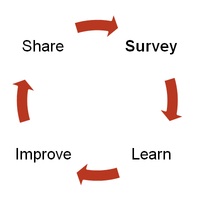
Results of brand audits (the good and the bad) must not only be shared as widely as possible but also incorporated into internal and external branding efforts, including employee communications, advertising and PR.

Share research data, not just the good stuff!

It is especially important to use the results to drive changes in sales, service, support and other customer-facing activities.

Finally, remember to use brand audits as guidelines for improvement, not as sticks for punishment.

Are brands responsible for where their ads are placed?


A couple of years ago I wrote a blog post about negative brand association. You can read the story here.

I hate to say ‘I told you so’ but I’ve always said that in the social economy, the concept of using communications to try and position a product or service in the mind of a consumer is fraught with danger because it can backfire in many ways.

When I last discussed this issue, I mentioned a video on the BBC website that featured a drunk driver in China who was caught on film smashing into road dividers and barricades.

That video story was preceded by a commercial for Lexus! Here is a still image from the end of the commercial.

Negative brand association - Lexus and drunk drivers
Negative brand association – Lexus and drunk drivers

Interestingly, the story is still online but now the video is preceded by a commercial for the Philippines with an amusing if a little tactless play on the concept of parking! Which would suggest the ad placement is left to the media owner.

India spent millions and millions of dollars positioning the country as an incredible destination only for all their hard work to be undone in a matter of months this year as report after report came out about the rape and murder of women, tourists and children.

More recently, Facebook has been criticised not only for featuring customer ads on controversial sites, but also for reacting slowly to complaints from customers.

Facebook - not just their fault

Dove, owned by Unilever the global Multinational Corporation that spends over US$1.5 billion per year on advertising, with an increasingly large percentage spent online was said to be furious when its ads on Facebook were featured on controversial group pages such as ‘Drop kicking sluts in the teeth’ and ‘Raping’.

Vodafone, another advertiser with a global marketing budget in excess of US$1.3 billion was particularly miffed when its ads appeared on the offensive Facebook page ‘This is why Indian girls are raped’.

It's the responsibility of brands to know where their ads are placed
It’s the responsibility of brands to know where their ads are placed

Another advertiser affected in a similar way announced that it would review it’s advertising if Facebook could not ensure this didn’t happen again.

Facebook’s revenue from advertising in the last quarter was an impressive US$1.33 billion, up 41% on the previous quarter.

If Facebook wants to continue to see such massive increases in advertising revenue, it needs to sort out its processes and systems.

But it’s also the responsibility of CEOs, brand owners and managers who need to understand that in the social economy, using traditional methods to try and position brands is a lazy approach and unless they start to take control of their brands, the platforms they use and the way they communicate, they may find that their brands will suffer in the long term.

They will probably blame their advertising or media agency and they have a point but the real responsibility lies with them, the brand owner.

Cross platform marketing to build a brand


It is accepted now that consumers are paying less attention to traditional media.

Although the TV or the radio may be on, it doesn’t mean they are viewed or heard. And with the proliferation of ads and trailers, more consumers are reaching for other screens during a break in programming.

But marketers still insist on using traditional media to reach as many consumers as possible in the hope that their message will stick. Even those companies that are spending on digital are using the same methods as they used in the old mass economy.

This despite the fact that last year Harvard Business Review said, “Traditional marketing is dead… in today’s increasingly social media-infused environment, traditional marketing and sales not only doesn’t work so well, it doesn’t make sense.”

However, all is not doom and gloom for traditional media channels. Or at least the TV.

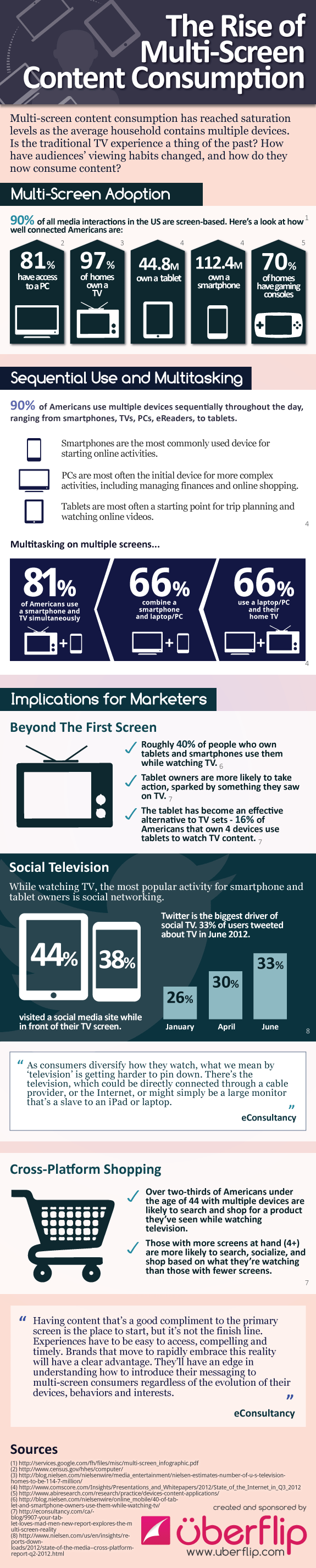
This infographic from Uberflip shows that although consumers are reaching for other devices whilst watching TV, many of them (66%) are using those devices to source information on a product and often purchase after seeing that product on TV.

Cross platform marketing requires a new mindset

So there may be a future for the TV as a communications tool after all.

However, what marketers must do is rely less on corporate driven messages and instead, identify how to introduce their products on one screen and then integrate that product and messaging across other screens taking into account changed behaviours, attitudes and cultures.

When is the best time to use Twitter?


Whether we like it or not – and despite the fact that there are 500 million Twitter users of whom 200 million are active users, far too many companies refuse to take Twitter seriously. Preferring instead to continue to use traditional channels – Twitter is an increasingly important tool for brand building.

It allows firms to distribute real time content to people that are interested in that content. It provides access to celebrities and other people of (significant) influence.

It also allows brands to lay the foundations for and build stronger business relationships, address negative issues in a transparent manner and thereby improve customer service and help retain customers that could have been lost.

But one of the drawbacks of Twitter is not knowing when and when not to use it. Not any more. Thanks to this excellent infographic from linchpinseo you can time your tweets to perfection!

Perfect tweet times
Perfect tweet times