Dove commercial raises a laugh but will it increase sales of the brand?


Every now and then a television commercial appears that brings a smile to the viewers face. And Unilever brand Dove tends to make us laugh more than many other brands. Their new commercial, created for the Brazil market is creating a bit of a stir .

It features a conversation between two men in an office, one of whom (Diego) appears to have beautiful shiny (really shiny!), curly, lively hair that bounces around like the hair in those cringeworthy women’s shampoo ads.

Diego happens to have his shampoo with him in the office and realises he has been using a woman’s shampoo. When he realises that’s why his hair is bouncing all over the place, hair guy rushes to the store and buys a man’s shampoo, goes straight home and jumps in the shower and washes his hair after which it becomes a ‘normal’ male cut.

The commercial closes with the tagline, “Women’s shampoo is not meant for you.”

It’s a fun ad but not without risk. It tells men that the brand (I’ve forgotten the name) is the right choice for masculine men who want masculine hair but it could alienate men with long hair who might feel it says they are not cool.

And it only works if it encourages men to switch from a competing brand. If it is just moving men from Unilevers range of women’s shampoo to men’s shampoo then it doesn’t really make a difference. And for those men like me who are married with kids, all they care about when they get in the shower is whether or not there is some shampoo left in the bottle!

To engage consumers, Jakarta needs to improve its communications


As the world attempts to shake loose the shackles of the economic meltdown, competition for tourists from both established and new markets is gathering pace.

But the new environment is an even more competitive one. There are almost 200 countries worldwide and over 100,000 places in Asia alone, actively seeking to attract and retain tourists.

As a result, it is increasingly important that destinations seeking domestic and international visitors have a well researched, structured, long-term strategy for increasing visibility & engaging the right segments to generate arrivals.

One relative newcomer to this tourism marketing battleground is the city of Jakarta, the capital of Indonesia, located on the island of Java and the capital of Indonesia. If you haven’t been to Jakarta I recommend you go as soon as possible because it is a fascinatiing destination.

I spotted this ad in a Malaysian daily recently.

Does this ad make you want to get more information on Jakarta?

It would appear that the people at the Jakarta tourism and culture department are looking to attract visitors to Jakarta with the promise of great shopping. However, as a consumer, without knowing anything about the rest of this campaign I can tell you that this ad needs work.

Firstly, what is the headline trying to tell us? Is it telling us that time is irrelevant? This is an existential argument and possibly true but in this situation not relevant. Perhaps it is saying, “don’t worry about time when you go shopping in Jakarta”? Or to be more specific, when you go shopping for shoes because after looking at this ad, am I wrong to assume Jakarta is a great place to buy shoes?

There is no call to action, the image of the shoe boxes looks photo shopped onto the main image and there isn’t a website address to gather more information.

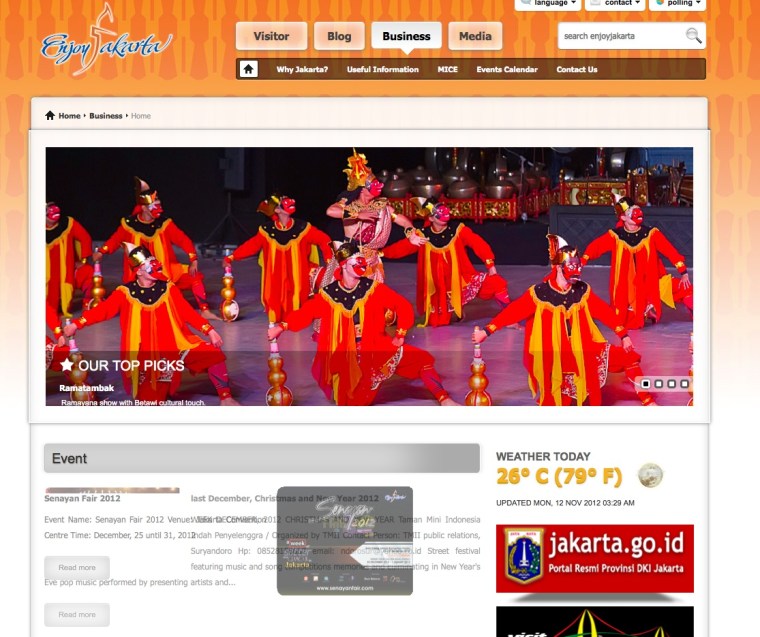
So I took it on myself to google (other search engines are available) “Enjoy Jakarta” and arrived at the official Jakarta travel website where I couldn’t find any information on enjoying Jakarta, shopping or even shoe shopping.

Not the best introduction to what Jakarta has to offer

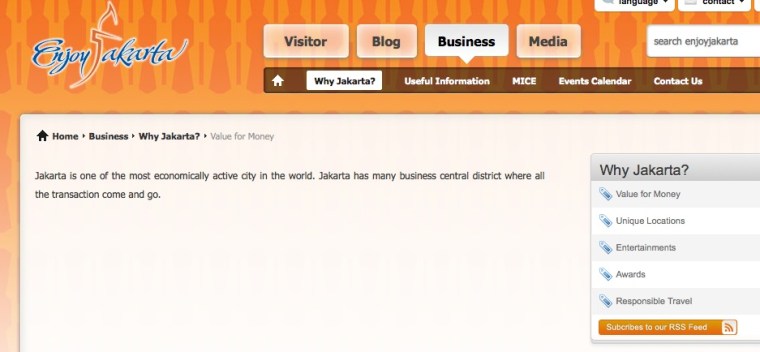
I spent some time on the site and for what it’s worth, I found the site very slow, difficult to navigate with limited information and English that needs proof reading before pubication. When I clicked on the “Why Jakarta” tab on the drop down menu, the information provided was hardly compelling and unlikely to attract investors. And talking of investors, is this a tourism site or a business site?

Not the most compelling of arguments

Moreover, I found the information above the fold didn’t match the information below the fold and when I clicked on Wine and Dine in the footer, all I got was a list of restaurants which to a first time visitor would mean nothing.

This won't mean much to anyone
This won’t mean much to anyone

Today, audiences rely less on traditional media to source information, making them increasingly hard to reach. Furthermore, consumers are less inclined to see or be interested in a corporate driven message delivered across traditional media.

But as the reliance on traditional media diminishes, opportunities arise in new and social media. Where before, companies were dependent on content from the media owners, today they can create their own content that resonates with specific consumers and their interests.

Consumers too are developing their own content and it’s important that destination brands such as Jakarta understand this and provide channels for consumers to create and share content.

It is good to see Jakarta looking to encourage visitors to this exciting city but it will take more than the print campaign and website reviewed in this article to be successful.

IS YOUR INTERNET STRATEGY WORKING FOR OR AGAINST YOUR BRAND?


I’ve heard a lot of good things about the Naumi hotel in Singapore and as I’m travelling down south, I thought it would be a good opportunity to try the place. Sadly when I attempted to book online, the hotel was full.

The next day I was reading an online newspaper and noticed an ad for the Naumi. I thought that maybe they’ve freed up some rooms and I can get to stay there after all.

Unfortunately, the hotel was still fully booked. In fact, after further research, the hotel is fully booked and in just about every room category, with one or two exceptions, for the next 12 months at least. I didn’t look past 12 months so it could even be longer.

Massive digital campaign despite being fully booked for a year

Since I saw the ad almost a week ago, I have continued to see Naumi ads across a wide variety of online sites, both local and international.

So why is the Naumi advertising? Isn’t this a total waste of an advertising budget? Is this an example of why CEOs are losing patience with CMOs? I can only assume it’s not a one off ad but in fact part of a campaign. If I am right, how much is this campaign costing and if the hotel is full for 12 months, what is the point?

Despite being fully booked, the hotel continues to advertise

When creating a digital campaign, reach and frequency are irrelevant. If those words were used in the pitch to you then you need to sack the agency. Because all they tell you is how many people saw your ad and how often they saw it.

You are probably wondering if they are perhaps using it as a lead generation exercise. Well I thought the same thing and that as I left the site they would try to grab some data from me.

It’s a logical thought because banner ads are not that effective. The general consensus of opinion is that the number of visitors who actually click on a banner ad is only 0.2%, which equates to one in 500 visitors that actually click on the ad.

And just because they click on the ad, doesn’t mean they automatically become customers. The seller, in this case the Naumi hotel still has to convert those visitors into prospects.

There are various ways of doing this, depending on your business. For the Naumi hotel, this is obviously to get the visitor to book a room. However if the hotel doesn’t have any rooms and simply tells the visitor this, the whole exercise has been a complete waste of time and money.

Of course the visitor may return, but then again they may not after all, how many visitors that have been disappointed, return to the scene of their disappointment? Or they may go on to build a relationship with another hotel.

Surely it would have made sense for the hotel to offer an apology (I don’t know about you, but when a firm apologises for being successful, I am hooked) and ask me for an email address so they can start to build a relationship with me?

And to use the campaign more effectively, I would create an offer whereby any visitors that register, will be offered a free upgrade when they book at a later date.

But no, they spent that money creating a campaign to get me to their website and then when I get there its like the place has closed down.

I bet the marketing department is reporting an increasing rate of visitors to the website but so what.

Digital advertising is not just about the campaign – the creativity, the reach, the frequency, the impressions, the clicks etc.

It is about the data, the source of the lead, the influencers and ultimately conversions that generate ROI.

If you don’t do it properly, don’t do it at all.

What is the difference between an advertising agency and a brand consultancy?


As the consumer landscape changes and consumer habits and the purchase decision making process evolves, it is imperative that brand owners understand where, when and how to spend their valuable and increasingly limited resources.

Historically advertising agencies defined and controlled a brand’s message and through which channels it was broadcast. They would then blitz consumers with intrusive advertising and messages. The goal was to reach as large and as broad a target audience as possible on those platforms with the most extensive penetration.

But in the social economy, consumers have little faith in such corporate driven messages broadcast across mass media channels to which they are paying less and less attention.

Today consumers spend their time in a variety of social networks or in niche online communities with likeminded people. And it is to these people they look to when seeking information on products and services.

So does this mean the end of advertising agencies and advertising? Definitely not, there is still a need for good advertising agencies that create good work but the process has changed and the advertising agency can no longer be given responsibility for building brands.

In the past, branding and advertising used to be elements of marketing. Today, marketing and advertising are now part of branding and it is the brand consultant you should look to if you want to build a brand.

So here is an outline of the difference between an advertising agency and a brand consultancy. Hopefully this will give you enough knowledge to make an informed decision on who should build your brand.

1) Branding is strategic and advertising is tactical. The most strategic actions you will get from an advertising agency will be a brief. The brief will define the proposition that the advertising must communicate and to which segments. But then what? And what about internally? How will you get personnel on brand? Does the delivery driver or sales assistant know what their role is in the delivery of the promise/s made?

A brand consultant will develop a brand plan or brand blueprint that will drive the brand strategy, both internally and externally. This holistic approach will address all key elements of the brand from the copy used in recruitment advertising to customer facing departments and their ability to represent the brand to point of sale and retention strategies and more.

The brand consultant will then work with you to determine the best resources to use to get the whole organisation on brand.

It is not possible to define a brand through an advertising brief but it is possible to define a brand through a brand plan or blueprint.

2) Advertising agencies do advertising. That’s what they are good at. In fact some of them are very good at it. Advertising uses creativity and a slick message (normally defined by the organisation) to get your attention.

And this is done via campaigns pushed out across TV, radio, billboards, websites and so on. The idea is that enough people will see the campaign and the message will hopefully resonate with as many people as possible. And of course the agency gets a commission for placing these ads with the channels.

If it doesn’t work you either get the agency to come up with another creative idea and go through the whole process again, get rid of the agency, hire another one and hope they can come up with a creative campaign that does resonate or you can go out of business.

And as consumers have lost faith in traditional marketing and now distrust the messages contained in such campaigns or simply miss them because of the clutter, it is increasingly difficult to build a brand using such a model.

So unless you have very, very deep pockets and can advertise consistently for long periods of time, this approach is simply going to waste valuable resources.

A brand consultant will carry out an audit of your business, industry, processes, systems, stakeholders and more and then determine the best way forward for you.

Solutions may require advertising but will also look to improve R&D, sales, production, supply chains, operations, customer relationships and retention strategies.

3) If you are looking to go with an advertising agency, your strategy is likely to be in the hands of a creative director and his team. If the agency is going through a difficult period and doesn’t have many staff when they win your business, the agency will attempt to employ talent with experience in your industry.

Unfortunately, if the talent isn’t available, perhaps because they are working for competitor agencies, you will end up with sub standard people working on your brand and your chances of success are reduced further.

Because branding is a strategic institutional initiative, not a marketing initiative and therefore must have the buy in of executive management, a brand consultant will insist on having C level involvement in the development of the brand which places your brand strategy where it should be, in the hands of executive management.

4) Advertising agencies are often deemed successful if they have won lots of awards for creativity not whether a campaign increases sales or profitability.

There aren’t many awards for brand consultants which is a good thing because this allows them to focus on increasing profitability, often through developing and strengthening relationships with stakeholders and customers.

5) Most advertising focuses on a series of tactical initiatives to acquire customers. A brand consultant will develop a strategy to acquire and retain customers.

6) Traditional marketing activities are enormously wasteful as much of the advertising targets irrelevant demographics or customers that cannot afford or are not interested in the product. A recent report in the Harvard Business Review quoted a UK study that reported 72% of CEOs are tired of being asked for money from marketing departments without an explanation of how it will increase business.

Furthermore, in the same survey, 77% of CEOs have had enough of talk about ‘brand equity’ that can’t be linked to any real equity. A brand consultant will ensure budgets are spent on the right strategies for the right segments with metrics for measurement.

7) An advertising agency uses a one size fits all series of tactical advertising campaigns that use mass marketing across mass media with only a nod to digital and below the line activities.

A brand consultant will look to collect and leverage specific data to develop targetted communications across digital channels to engage prospects, whilst carrying on conversations with existing customers.

8) An advertising agency will often look at what the competition is doing and try to position an offering based on competitor actions. This approach is flawed because successful organisations are nimble and by the time you have developed your position the competition’s strategy will have evolved.

A brand consultant will be aware of competitor activities and will use that knowledge to strengthen the firm’s competitive advantage but will not allow competitors to define strategy going forward.

9) The impact of an advertising agency’s work is difficult to measure. A brand consultant will develop metrics to measure promotions, advertising and other activities.

Marketing is dead


In June 2009 I wrote a blog post explaining that in today’s social economy where consumers not companies define brands, the concept of positioning was no longer relevant.

You can read the full article here but the crux of the article is that the concept of positioning, a key element of marketing is no longer relevant.

In September 2009 I wrote another post about how the Malaysian Ministry of health spent over US$35 million on a traditional marketing campaign that failed to reduce smoking in the country. You can read the full article here

In January 2010 I wrote an article about how 95% of products fail to become brands despite US$1.5 trillion spent on marketing annually. You can read the full article here

There are lots more similar articles all saying the same thing – that in the new world order, where customers not companies define brands – the old rules of marketing are dead. Feel free to browse my blog to find them.

Now Bill Lee over at Harvard Business Review has got on the bandwagon. He claims in this article, and rightly so that marketing is dead and provides three very good reasons.

Traditional marketing is dead

a) consumers aren’t listening to traditional messages. He provides empirical evidence that proves that in the consumer decision making process, traditional marketing has no relevance.

b) CEOs have lost patience with marketing departments. A 2011 study reports that “73% of CEOs said that CMOs lack business credibility and the ability to generate sufficient business growth, 72% are tired of being asked for money (by CMOs) without explaining how it will generate increased business, and 77% have had it with all the talk about brand equity that can’t be linked to actual firm equity. (I believe measuring brand equity is a futile exercise and you can read more about what you should measure here).

c) In a social world dominated by social media and the way we use it, traditional marketing doesn’t work and doesn’t make sense.

Bill goes on to provide some excellent advice on how to move forward with building a brand. If you have been spending too much on traditional marketing activities and can’t see the benefits, it may be time to review your strategy.

You know where to find us!

Could Yuna be the face of the Malaysia Nation Brand?


It takes multiple initiatives across multiple platforms to build a Nation Brand.

And some, no many of those initiatives will require more attention than others.

And some initiatives will take root and grow immediately whilst others may take time to thrive. Many more will require a significant investment in time, money and energy and still fail.

And many of these initiatives will be individual efforts that form no part of the Nation Brand strategy yet will play an important role in the development of the Nation Brand and therefore must be integrated into the Nation Brand plan to be leveraged effectively so that the Brand grows.

The Malaysian prime minister has set up a department tasked with building the Malaysia Nation Brand. I mapped out ten Nation Branding principles here.

As the department embarks on this daunting task they will uncover little surprises that will help them build the Malaysia Nation Brand. One such surprise is a singer called Yuna who comes from Alor Setar in the northern Malaysian state of Kedah.

Could Yuna be the contemporary cultural icon Malaysia needs?
Could this be the face of the Malaysia Nation Brand?

The diminutive Malay singer/songwriter has a wonderfully natural sound that reminds me of an early Sade. Her music is simple, her lyrics are a touch naive and she doesn’t quite feel what she sings and is still a bit self conscious but she has obvious talent. With the right songwriting collaborations, it won’t be long before her songs feature on late night Hed Kandi CDs and are forming the backdrop to romantic encounters.

Yesterday Yuna appeared on Conan in the US. Conan is the most watched chat show in the US with over 4 million viewers. Crucially most of them are in the 18 – 33 range which will no doubt be most likely to buy this music and travel to Malaysia. But it will still be hard for her to break into the US and other international markets. To do so, she’ll need a lot of marketing dollars to help her succeed.

Yuna appears on Conan

I know that the Malaysia Nation Brand team are not yet in the implementation stage but to be successful they will need to be loose, flexible and adaptive. In addition to appearing in front of 4 million viewers on Conan, Yuna has 360,000 followers on Twitter and over 1,1000,000 likes on Facebook. She is a star in the making and working with Yuna will be a great opportunity to give Malaysia a foothold on the contemporary cultural stage.

Yuna’s new album is out on 24th April.

You can listen to more of her music here.

Yuna has undoubted talent and can become an ambassador for the Malaysia Nation Brand. She won’t build it on her own but she can make a considerable contribution to its success.

5 branding tips for Malaysia Airlines to save its troubled brand


Earlier this month, troubled Malaysian carrier, Malaysia Airlines (MAS) reported a staggering RM2.52 Billion (US$850 million) loss for 2011. Despite the tough economic climate, a number of competitor airlines – British Airways, Singapore Airlines and Cathay Pacific all reported a profitable year.

Soon after, Group CEO of MAS Ahmad Jauhari announced that he will implement ‘strong and immediate measures to stem the flow of losses with staff redeployment, improved productivity and efficiency, further cost controls and more route reviews’ whilst at the same time, he also promised ‘an aggressive sales and marketing strategy’.

Marketing budget doubled
Then MAS announced that it has doubled its marketing budget for 2012. The marketing budget is reported to be as much as 2% of revenue which on 2011 revenue of RM13.90 billion (US$4.63 billion) equates to about RM278 million or nearly US$100 million.

So if the marketing budget is doubled, it means that MAS has more than RM550 million or US$190 million to rebuild it’s battered brand. That’s a tidy sum.

Details of what marketing initiatives the company has in mind are sketchy. Although the company has announced it will provide ‘better and more branded customer experience and embark on a major advertising and promotions campaign in 2H/2012’.

This morning I read that the airline has appointed Ogilvy and Mather Advertising as its master creative agency. I also read this comment on the appointment from Al Ishal Ishak the senior vice president for marketing and promotions, “2012 will be a breakthrough year for Malaysia Airlines on our path to recovery. We recognised, however, that we could not achieve financial success without clearly defining our brand positioning.”

He went on to say, “Ogilvy understood this and throughout the pitch process were best able to translate our message into a powerful campaign idea. An idea that is big enough to help us transform our business and truly engage our customers like never before.”

Before I go on, I have a confession to make, I am a loyal Malaysia Airlines passenger and fan of more than 20 years. During that time I have been on the receiving end of more positive than negative experiences with the airline. So I want the airline to succeed.

But if this is the last chance for this iconic brand, Al Ishak and his team have to get it right. Any advertising campaigns will need to reflect the culture of travel and consumers today and not try to use the traditional high gloss beautifully presented images and TVCs so favoured by the airline industry to ‘clearly define our brand positioning’.

How will MAS spend the marketing budget?
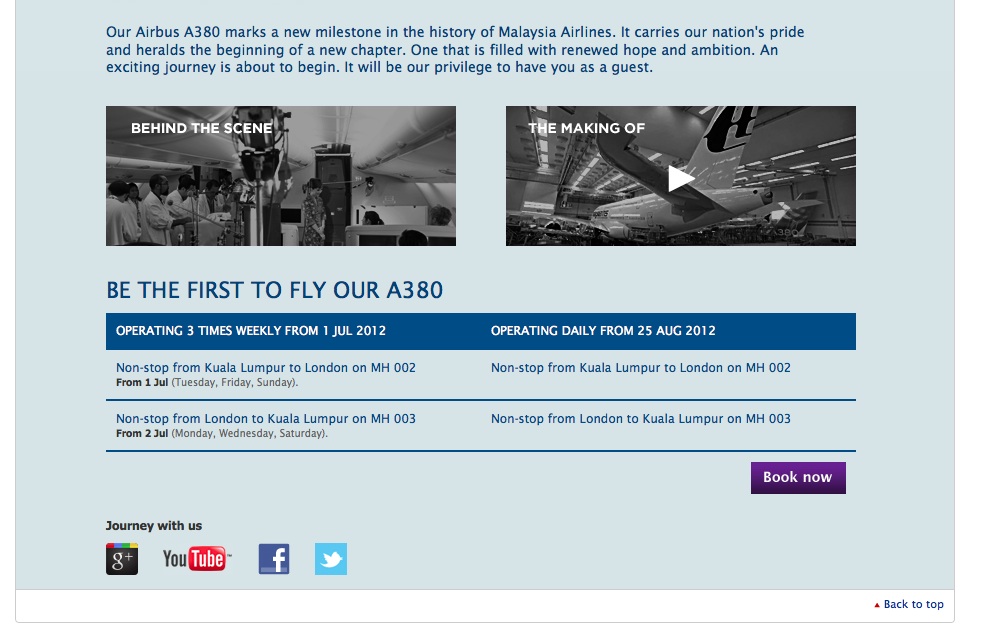
I appreciate it is early days but I have noticed a digital campaign selling the new A380. The style would suggest MAS is going the traditional route using glossy images and slick advertising with high production values to attempt to position the company in the minds of its consumers.

The ad features an image of the A380 in the very attractive new MAS livery and a tagline about the journey which I assume is related to the A380 and one about the aircraft being the pride of the nation. Let’s hope Ogilvy improves on that. Anyway, clicking on the ad, you go to the existing MAS site where you are greeted with the same, larger image of the A380 and the same taglines.

Below the fold there are two black and white images with click through options. The one on the left entitled, Behind the scene (sic) links to still images of the making of the new commercials which look very traditional and my first reaction was what a pity they haven’t changed the cabin crew uniforms. The image on the right links to a video entitled ‘The pride of our nation”, a predictable and uninspiring video of an MAS A380 being painted!

Throughout, the copy is uninspiring.

Below the images are social media options. I had a quick look at the twitter feed and it looks very collaborative with plenty of discussions although efforts to build the brand in the social context can be improved.

But I have a sneaking suspicion that the bulk of that US$190 million is going to be spent on advertising. And as Singapore Airlines learnt with it’s A380s, you can no longer rely on developing a position and using advertising to communicate that position in the hope that it will work and consumers will buy.

Positioning
The problem is that positioning is a throwback to the mass economy that no longer exists. What advertising agencies tried to do was create a position that reflected the strengths and weaknesses of the offering. Ideally, this position was based on being first in a particular category.

If someone was already first in a category, then companies attempted to redefine themselves in a new category to be first. In the airline business, this tended to be related to passenger comfort or service. The effectiveness of positioning depended on the ability of advertising to drive branding perceptions in the mind of consumers.

To do this, airlines often made promises they were unable to keep (admittedly, often due to third party issues out of their control), failed to meet traveller expectations, often because dynamic competitors moved quickly and so raised the bar, which in turn led to brand disillusionment.

Positioning was ideal for the mass economy. It was also ideal for advertising agencies and marketing departments because it gave them enormous power without the responsibility of accountability. Al Ries and Jack Trout invented the concept of positioning. The preface to one of their books states, “Positioning has nothing to do with the product,…. (it) is what you do in the mind of the prospect.” So, essentially this means that the consumer can be made to believe, through extensive advertising and PR and via the right conduits to consumers, and other vehicles, what an offering means to them.

Well I’m sorry, this might have been true in our parents day, when consumers were more predictable, more trusting and had less choice but in today’s mean spirited world, a world in which only 4% of Americans and 14% of Malaysians believe what they read in adverts it is going to be very, very difficult. And of course the problem with using positioning to build a brand is, if it doesn’t work, the money is wasted, time is lost and you have to repeat the process again, with a new position!

So how can MAS save its troubled brand?
1) Research. Your existing customers are your best source of information. But they are not all the same. I would be interested to know which, if any customers MAS talked to when they were configuring the aircraft. MAS is talking about flat beds and big TV screens in first and business. Well that is so last year and who doesn’t offer them so why should I change? What about Internet access? I hope the A380 offers it throughout the aircraft.

2) Mass market branding and the old model of developing a position and communicating that position across for mass media repetatively for as long as possible is no longer effective. Brands today are built on relationships, access, personalisation and relevance. Before MAS marketed to segments of 18 – 34 year olds, businessmen and so on. Today, MAS must deliver economic, experiential and emotional value to to everybody and on their terms.

3) MAS must focus on developing more profitable relationships, not a more profitable product. Brands evolve when companies start buying for customers instead of selling to them.

4) Branding is an organisational not a departmental responsibility. And the organisation is the responsibility of the CEO. MAS is charging about a 100% premium for an economy class ticket on its A380 in July over the price of an economy class ticket on a 747 for the same route. Throw in all the other airport fees etc and it’s going to have to be a pretty good product to charge such a premium.

5) Retention is key to brand building. Companies no longer sell a product, customers buy a product. And those customers have plenty of choice, especially in the airline business. Sadly too many companies spend lots of money on acquiring a customer but very little on retaining them. MAS is one such company. Once a consumer buys the product, companies should do everything possible to hang onto those customers, build relationships with them, learn about them and leverage them.

Bonus tip. This is the social era. As I said MAS is working hard on social media but there is room for improvement and integration. It would be interesting to know how they leverage their social media efforts to get more business.

A definition of branding that will help you to build a global brand


This article first appeared in the 30/09/2011 edition of The Malaysian Reserve

Over the years, companies have invested phenomenal amounts of money in marketing and advertising activities such as sales calls, direct mail, TV, outdoor, indoor, print and other advertising, brochures, leaflets and more. Indeed, according to Nick Wreden in his book Profit brand, How to increase the profitability, accountability and sustainability of brands, over US$1.5 trillion is spent annually on marketing (including advertising) worldwide and yet according to McKinsey, a management consultancy, up to 90% of products fail to become brands.

With little or nothing to show for these significant investments, companies looked to other disciplines and soon Branding was considered the way forward and the last 10 years has seen a major change in the resources committed to Branding.

As a result of this interest, hundreds of traditional books and ebooks have been written on the topic of Branding. Thousands of newspaper and magazine column inches have been dedicated to the discipline. Workshops and seminars have been held all over the world, all promising to teach business people how to Brand. These presentations are often uploaded to slideshare and Youtube videos have appeared, all with content related to Branding.

Many companies, including I suspect, yours have explored the concept and many have actually embarked on what they thought was a branding or rebranding exercise. Indeed, only recently, Malayan Banking Bhd (Maybank) announced it had gone through a rebranding exercise and even the Prime Minister attended the press launch of the new ‘brand’.

At the press conference, Malayan Banking Bhd President and CEO Datuk Seri Abdul Wahid Omar unveiled a new logo and explained that the bank would be spending RM13 million on the implementation exercise across the Asian region and that it would take about a year.

On the face of it and with the only evidence a new logo, this does not look like a rebranding exercise. This is more like a brand identity makeover or corporate identity reengineering, nothing more.

Another financial institution recently made a similar announcement and stated that it would spend RM15 million on a rebranding exercise. Soon after I received nine emails for a product that I didn’t understand and with a tagline that offered an exclusive deal for MasterCard holders even though I am not a MasterCard user.

Other well-known companies from the transportation, media and distribution industries have recently announced rebranding exercises that have actually been little more than a new advertising campaign.

The reality is that the new Maybank logo and identity will probably not make a difference to the brand and how consumers and organizations view the brand or the profitability of the brand. Think about it, when was the last time you signed up with or changed your bank because of a competitor’s logo?

This confusion is not Datuk Seri Abdul Wahid Omar’s fault. If we have to point fingers, we should probably point them at the marketers and advertising agencies responsible for muddying the branding waters.

It is because they have confused business owners and consumers with their contradictory interpretations that there is still a lot of confusion about Branding, the concept of Branding, what constitutes a Brand, what is Branding and how to build a Brand.

But this article is not about pointing fingers it is about identifying a definition of branding that will help Malaysian SMEs and other companies use scarce funds effectively and efficiently.

So what is a good definition that Malaysian companies can use as a foundation for their branding efforts?

We created this definition in 2004 and it still rings true today:

A brand is a long term profitable bond between an offering and a customer.

This relationship is based on offering economic, experiential and emotional value to those customers.

And it is backed up by operational excellence and consistently evaluated and improved.


We have used this as a foundation to build Malaysian brands and all of them have benefited from using this to take their brand forward. But what does it mean and how can Malaysian companies like yours use it as a foundation for their branding efforts? To do this, we need to break the definition down into three parts, as per the paragraphs above.

The first paragraph relates to two key elements, profitability and retention. One of the reasons that advertising, marketing and other traditional communications campaigns are so ineffective is that too many companies spend an absolute fortune getting a customer into their shop or showroom and then after the customer buys something, they just let them walk out the door! Isn’t it incredible that firms let customers walk out the door without attempting to at least try to build some sort of bond with them?

If you don’t why should the customer come back again? Don’t kid yourself that your product (there are some exceptions) is so unique that they will ignore other products and fight off all the attempts to lure them into competitor stores even though you have absolutely no relationship with them.

Profitability is an important branding metric, much more important than reach or awareness. It is estimated that up to 15% of a firms customers are unprofitable. You need to know who are your unprofitable customers and get rid of them.

If you have a car that won’t start and you send it to the garage and the mechanic says the engine is broken so you take the car to the paint shop and paint the body, will it help to fix the engine problem? Of course it won’t. It is the same with a brand. If you are receiving numerous complaints about the quality of your products or the time it takes to be served at a branch and you ask an advertising agency to create a new logo and you put that new logo on all your company materials, it won’t solve your quality or service issues or make your brand any better.

But if you carry out research with your customers and identify what are their requirements for economic, experiential and emotional value and then match your product attributes to those requirements for value you will make sales. And if you’ve laid the foundations for retaining those customers, as mentioned earlier, then you will be on your way to building a brand.

And by developing this emotional connection with your customers in which you deliver economic, experiential and emotional value, which incidentally will be done across multiple touch points such as when they use the counter service, through your correspondence and marketing collateral, the way you handle enquiries, your packaging, in one on one meetings with your representatives and so on, there will be no interest or need for them to take their business elsewhere.

In fact you will be surprised at the effort they will put into returning to you. And provided you keep your product or service relevant and continue to interact with those customers across platforms and channels that they engage with then you will be building a brand.

Operational excellence is a key ingredient in your quest to build a brand. It doesn’t matter how much you spend on marketing, sales, advertising etc if your organization isn’t efficient and effective it will struggle to deliver value and ergo, build a brand.

Finally, it is important to continually improve to stay relevant so you must track, evaluate and improve your brand on a continuous basis.

Instead of looking at branding as a creative exercise or short term tactical communications exercise, look at it as a holistic strategic initiative that requires internal and external research, investment in retention and not just acquisition, investment in the organization and a desire to constantly improve.

Follow these rules and you are more likely to build a global Malaysian brand.

How Tourism Malaysia should have approached its social media strategy


Twitter, facebook and other social media communities have been buzzing with comments related to the RM1,800,000 (US$600,000) Tourism Malaysia (TM) is spending on Social Media (SM). Here’s a little background on the story.

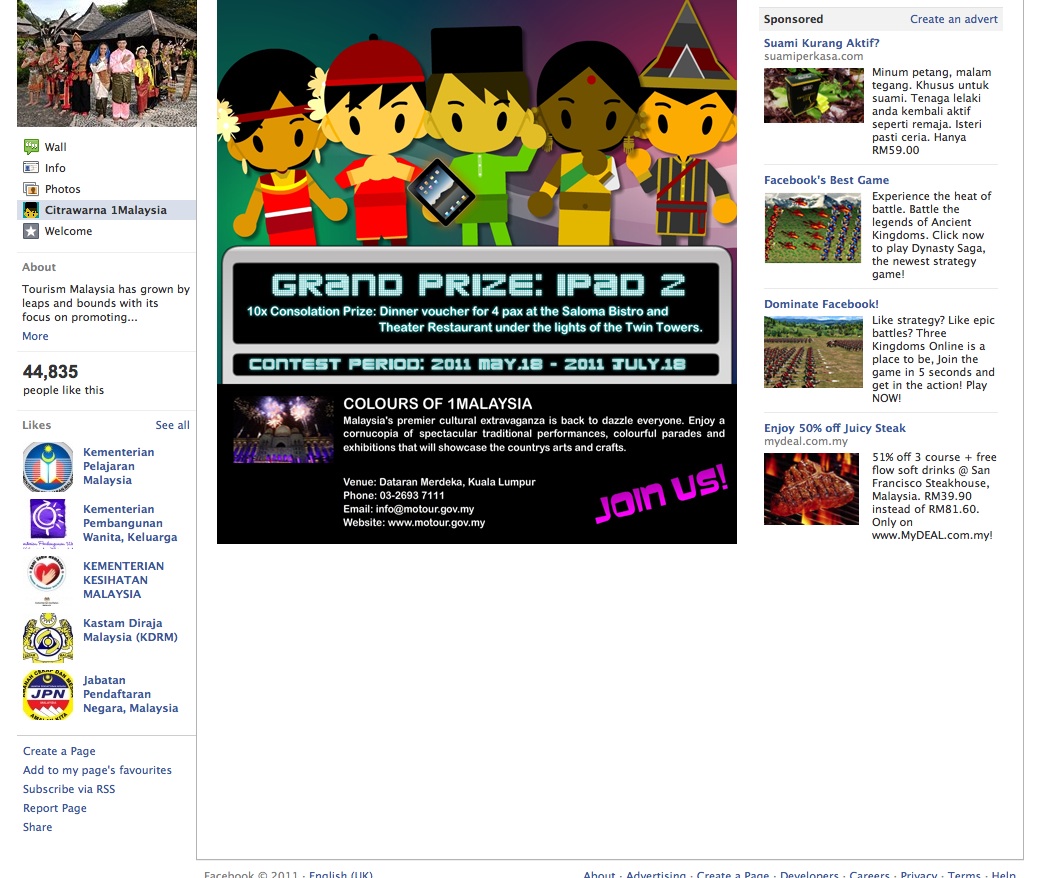
Initially, the deputy minister of tourism was quoted as saying that the RM1,800,000 “covers the cost of hosting various activities on the facebook page, including six interactive Flash applications, development and maintenance work and advertising.” He went on to say that, “the ministry spent nearly RM300,000 to develop each of the six applications on their facebook page.” I could only find one (see screenshot below).
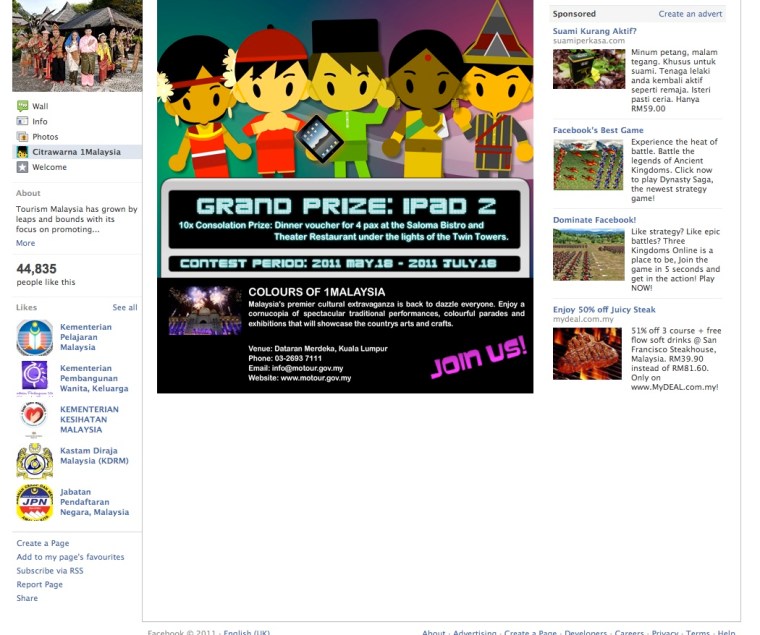
This statement was rejected by citizens and government ministers alike with one minister suggesting it was a waste of funds as the facebook site is free and using the ‘Visit Penang’ facebook page as an example (see screenshot below), explained that it was set up for free and had attracted over 100,000 fans.

Citizens were even more incensed, with one enterprising and concerned tax payer setting up a facebook page that parodied one of the official government pages (see screen grab below). Within hours, this page had attracted 5 times as many ‘likes’ as the official page.
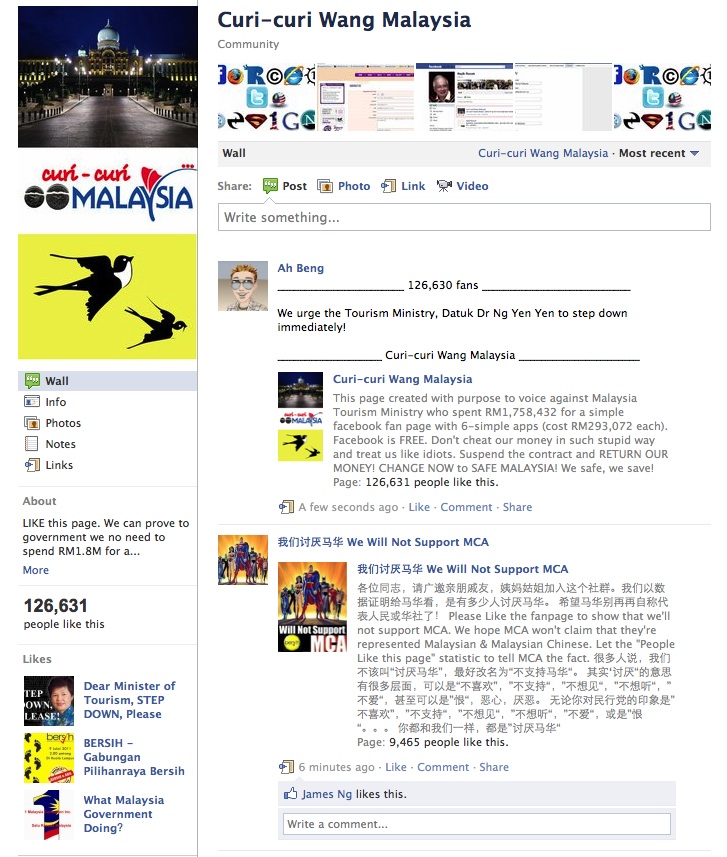
A couple of days later, the tourism minister announced that, “the RM1.8 million (is) for a full social media branding campaign, and not just to set up a facebook page.” She went on to say, “”(The money) is for responding, informing, interaction and monitoring (work on the facebook page), evaluation, data collecting, content development and advertising on Google, Facebook, etc…”

With her comments came an official release that stated the costs were for the following:

1. Technical

* Dedicated hardware deployment
* Software licencing
* Front end applications
* Application server engine

2. Development of six campaigns that require the following:

* Flash games engine
* Flash programming and coding
* Creative development and design
* Campaigns ideas and concept
* Front-end Flash design
* Testing and debugging

3. Campaign promotions

* Digital advertising campaigns on Google and facebook
* Contest, page wall and tourism fanpage content management
* Collection and management of database

The tourism minister then went on the offensive, asking reporters, “Do you think it’s cheap to set this up?” And as if to justify the expense, explained, “Tourism Australia is spending RM150 million (US$50 million) for the next three years on social media.”

Most recently, the minister stated that the allocation was to ‘run, manage and monitor a tourism campaign in the social media, including RM360,000 for advertising and over RM500,000 for prizes for the contests organized.’

‘Disappointed and hurt’ she is reported to have invited the Malaysian Anti-Corruption Commission (MACC) to investigate the campaign finances.

It is too early to determine the results of Tourism Malaysia’s first foray into social media but whatever the results, the Malaysian government, the tourism minister and the tourism ministry could have handled the matter more effectively and efficiently.

One would be forgiven for thinking that Tourism Malaysia has some internal communications issues. Because when the deputy minister first explained what the funds were spent on, his statement didn’t make sense. The deputy minister’s statement suggests he was provided with notes written by someone more familiar with the workings of an IT department than the requirements of a social media campaign. This has caused the deputy minister to be embarrassed in parliament and I hope someone has been reprimanded.

In terms of the social media exercise, Dave Duarte MD of South Africa based Huddlemind and a social media expert who was in Malaysia as the story broke stated in his blog that the exercise has already justified its expense.

His rationale is based on his guesstimate that the average conversion rate of a facebook fan to a customer is approximately 3% and because the average domestic tourist spends RM2,500 with 40,000 fans, the facebook page has already recouped its expenses.

This statement may be a little optimistic but it is certainly worth tracking the number of ‘likes’.

In terms of the game itself, it seems OK, leaning heavily on guitar hero. Personally I found the racial profiling of the characters unnecessary. Playing the game requires one to be more dexterous than I and as a result, the score required to qualify for the iPad 2 draw will always be beyond my means! I suspect I’m not the only decision maker in the family who will feel the same and this resulted in me leaving the page rather disappointed. But I digress.

So Tourism Malaysia’s (TM) long overdue foray into social media has not had an auspicious start. In the future, what can this key organization that contributes over RM50 billion (US$16.6 billion) to the national purse do to ensure tax payers get value money for all social media branding initiatives?

Here are 10 key recommendations for future initiatives

1) A social media strategy or any of the tactics within that strategy, is not the responsibility of the IT department. In future, the head of the department responsible for social media initiatives should represent the ministry when talking to the press and his press release should be prepared by him and his department and not by anyone else. Although the minister or his/her deputy must respond to questions in parliament, it is wrong to expect them to be knowledgeable about branding tools such as social media. Ministers do not need to talk to the media about such relatively small activities.

2) Social media requires an ongoing strategy and interactive initiatives such as the facebook pages are merely tactics within the strategy. Successful social media initiatives must be integrated with other branding initiatives.

3) I strongly suspect TM didn’t think through what they were doing when they launched the facebook pages. First of all it is important to develop a plan. Within that plan and before embarking on a social media strategy, it is important to identify what are the goals and how can facebook add value to branding efforts. Facebook is obviously an additional channel to interact with prospects and customers but why do it? To get more fans? Why? To get more participants? Why? How does TM convert those participants in the competition into leads? How does TM put a monetary value on social media activities? What metrics should be used? All of these should be outlined in the social media plan before implementation.

At the moment, registration is only required if participants want to be included in the draw for the iPad or meals. So how will TM optimize interactions with those participants and get them to become customers?

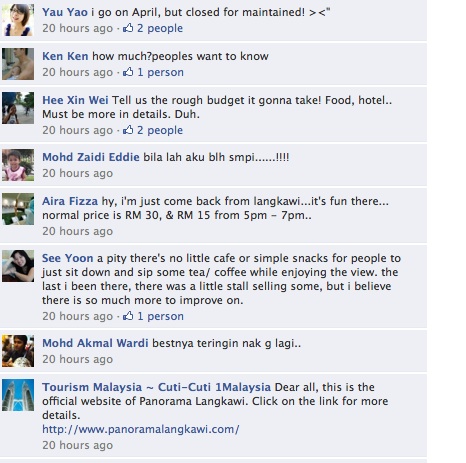
4) It’s also important to get fans to interact with other participants and to interact with participants. Critical to the success of any social media campaign are the conversations. Channels such as facebook are not platforms to broadcast messages about the company or in this case, Malaysia. The cuti cuti 1Malaysia facebook page has generated over 40,000 likes in a very short time and this is impressive. Furthermore, many of the postings on the wall have generated plenty of comments but TM is failing to enter into discussions with those who comment, preferring instead to pass that responsibility to others (See screen shot below). Interacting and engaging with people who comment is what social media is all about and will give TM more visibility, improve reputation and increase trust.
5) This first foray into social media is pretty basic and there is nothing wrong with that. But in future, Tourism Malaysia must look to be more innovative with what it does on social media. Fans will soon get bored of commenting and uploading images, especially if issues raised are ignored. Tourism Malaysia must encourage fans to be more creative. Perhaps by designing trips, submitting and voting for slideshows or setting up sub groups of specific niche related fans.

6) What makes being a fan special? At the moment nothing really which is a good and bad thing. Good because it means more people will become fans but bad because TM doesn’t know how many fans are really interested in the product or just want to win an iPad. In future, TM must look for ways to offer special content to fans or competition participants. Don’t be afraid to ask people to register.

7) This maybe a bit difficult for TM because technically, it isn’t allowed to sell Malaysia, only promote it but that doesn’t mean it can’t turn facebook into a potential profit centre. TM should make it easy for fans to book trips to destinations featured on the TM facebook the way it does on its website.

8) TM is still using mass media tactics on social media channels. This is ineffective and pointless. TM needs to stop thinking demographics and start thinking communities.

9) This applies to everyone and not just TM. Pause before creating a facebook group. Managing a group is difficult, time consuming and requires talent and patience to be able to respond to issues raised and continue a conversation till it’s natural end. TM launched four or five facebook pages at the same time! That requires a lot of talented manpower and judging by the lack of responses to issues raised, TM was ill prepared. Also important is what to do with the facebook group once the contest or event is over. It you want to delete a group, you have to manually delete every member of the group. With 40,000 members and growing, and with at least two clicks required to delete a member, the cuti cuti site will take a lot of manpower to shut down! If TM decides not to close down pages, in five years time, there will be a lot of dead pages that will confuse people.

10) The big question with facebook is what to measure and how to calculate ROI. In 2010 a study stated that fans of the top twenty brands on facebook were worth an average of US$136 each. With 40,000 fans, that would make the cuti cuti page worth over RM16 million! However the study was panned as it was actually a measure of the value of customer loyalty and not a measure of how much facebook had contributed to that loyalty. Moreover, the average of 20 brands like Nokia and Apple bears no relevance to tourism anyway!

As TM doesn’t technically have a product to sell, it is hard to know what to measure. For instance, TM can’t measure the ROI of acquiring a prospect and turning that prospect into a customer via facebook and comparing it with other customer acquisition programmes.

In reality, Measuring the ROI of facebook fans is probably impossible, especially for a national tourism agency such as TM and especially when the facebook page features a competition that allows multiple attempts from the same user and the end product is a future staycation.

As the dust settles on this rather unfortunate event, TM and its agency has a lot of work to do to sort out its social media strategy. It’s not a great start, and a lot of mistakes have been made. The key is not to make the same ones again.