Twitter users increasingly influential


Twitter estimates that there are 26 million monthly Twitter users online in 2010. This is not that significant compared with the 500 million using Facebook.

But it’s not the numbers that matter, it’s the quality of the users that count. Twitter users are far more influential than other online users. In fact, a recent study by ExactTarget considers Twitter users to be the most influential online.

Quote “While the number of active Twitter users is less than Facebook or email, the concentration of highly engaged and influential content creators is unrivaled — it’s become the gathering place for content creators whose influence spills over into every other corner of the internet.”

The study, conducted in April 2010 found that the main reason consumers follow brands they like on Twitter is to gather news and information about the company and its products and to learn about future sales and likely discounts. Interestingly the study found that brands are still not participating in conversations with followers, reducing the opportunity for the brands to build relationships with consumers that cannot be duplicated, like the sales and discounts.

Reasons for this might be because brands are seeking social media advice from advertising agencies who prefer to recommend traditional broadcasting of messages from the brand rather than engagement with consumers that gives more responsibility for the brands development to the consumer.

Lead generation key to brand building


Many brands in Malaysia believe acquisition is key to brand building and are always trying to speed up the sales process. They focus on trying to close a deal as soon as possible. Qualification doesn’t exist, there is no attempt to build rapport and lay the foundations for a relationship. All that matters is closing a deal.

Even at road shows or other public events essentially meant to be marketing efforts to gather leads to approach later, the focus is on trying to sell something. Often, a photocopied flyer, even for luxury products will be thrust into a passing consumer’s hand with numerous features described in a robotic manner.

From suspect to customer
But a road show or trade exhibition, advertising campaign or similar is often meant not to sell something, but to lay the foundations of a relationship with a consumer who may, just may become a suspect, then prospect and finally customer. In other words, they are lead generation campaigns.

CSO insights release an annual report on Lead Generation Optimisation. Simplified, Lead Generation is marketing efforts designed to encourage targetted consumers to request more information about a product or service.

Unsurprisingly 67% of the 635 firms surveyed, reported weak sales so far this year as a result of reduced marketing budgets last year. But one positive to come out of the economic situation was that firms were spending more resources on measurement.

Measurement
Companies establish measurement systems to track strategic decisions – new enquiries, new customers won, sales and so on. But it is important not to measure the wrong stuff or measure for the sake of measuring. Metrics such as satisfaction (too broad) and awareness (too vague) are the wrong metrics and will tell you little.

In the CSO report over 50% of the firms that took part now have processes in place to track campaign ROI. And the criteria are simple, with the top 3 criteria being:

1. Total number of leads generated per campaign
2. Number of leads that convert to sales opportunities
3. Amount of revenue ultimately closed from those opportunities.

Now this isn’t nuclear science. Any company, of any size should be measuring these three elements every time they carry out a marketing campaign such as a trade exhibition. In the long run they may not speed up the sales process but they will definitely make it more profitable. And profitability not sales should be the goal of any brand.

How to sustain a family retail brand


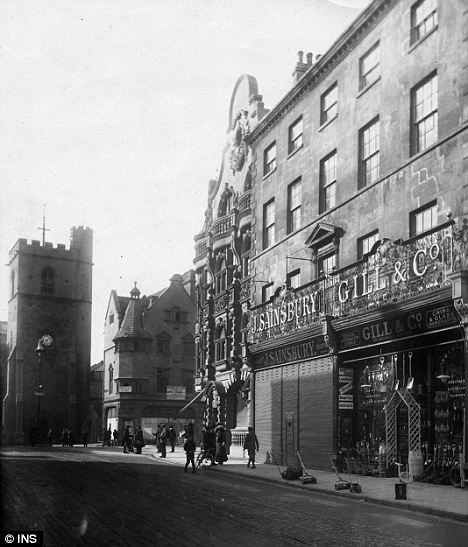
The picture below was taken in 1912 in Oxford, UK a city about 60 miles to the North West of London. It features Gill & Co, an ironmongers and a branch of J. Sainsbury, a food store.

Gill & Co was established in 1530 during Henry VIII’s reign. At the time it was the first ironmonger in the country. It has been in business ever since and has witnessed the English Civil War, two World Wars, a couple of global economic depressions, three recessions, the birth of the railway, the car, powered flight, electricity, the Internet and more.

Originally the firm supplied ironware and related products for Oxford residents however as times changed it tried to reinvent itself and also stocked equipment for chimney sweeps (think Mary Poppins), farming equipment, tools and gardening supplies. Although Gill & Co moved locations, it was always a one store operation in Oxford.

In 2010, after 480 years in business Gill & Co is closing down, beaten into submission by large DIY and home improvement suppliers like B&Q the 3rd largest DIY retailer in the world, largest in Europe and the largest in China and Homebase.

Sainsbury’s, at a mere 141 years old, a relatively new brand was established in 1869 in Drury Lane. Although now at the centre of the theatre district, this was once a very poor area of London.

Sainsbury has also witnessed much, including 2 world wars, 2 depressions, a couple of recessions, the automobile, manned flight, the moon landings and more. Sainsbury soon became an institution, offering high quality products at low prices. By 1882 Sainsbury was selling it’s own label brands.

Although lacking the heritage of Gill & Co, Sainsbury invested heavily in its staff, employing women as managers when it was unheard of in the early 20th century and developing its own training school to train managers.

Sainsbury also invested in new stores and although at times it has had a rough ride, today it employs more than 150,000 people, has 800 stores in the UK and there are on average more than 19 million customer transactions in Sainsbury’s stores every week and the company has a 16% market share.

It has diversified into non-food products and services and non-food is growing 3 times faster than food. It has a bank with operating profits of £19million and its Internet home delivery shopping service is responsible for 100,000 deliveries every week.

Asia has many small family businesses. In fact in Malaysia, Small Medium Sized Enterprises (SME’s) make up 99% of Malaysia’s total registered businesses. Hanoi in Vietnam has over 90,000 SMEs.

These organizations have a critical impact on the business of a country. In Japan, known for its heavy industry, approximately 70% of the Japanese work force is employed by small and medium-size enterprises (SMEs) and half the total value added in Japan is generated by SMEs.

Asian SMEs, many of them well established with years of heritage cannot sit by and hope that they will be safe from bigger, more aggressive retailers. They need to start planning for the future now before it’s too late.

Here are 5 recommendations for Asian SMEs to help them become a Sainsbury

1) Keep an eye on retail trends, especially in your space
2) Talk to your customers, not just about the weather/politics/sport. Ask them what their needs are, what they would like you to stock, when they would like you to open and so on
3) Build a database of customers and their preferences. If you do sell up, this will help you secure a better price for your business
4) Leverage what you have against the big retailers in your space. You can’t compete on price and probably can’t compete on choice but you can compete in other areas – convenience, personalization, customization, free alterations, returns, speed of delivery and more
5) Develop a brand strategy that includes succession planning. If you have sent your kids to university overseas, are they going to come back and work in your hardware store? If you don’t think so, look to create strategic relationships with other players in your space now before it is too late.

Even iconic brands need to do the basics


Since the first iMac came out back in the 1990’s, I have been a loyal mac user. I’m now on my third generation of iMacs, and currently have 7 macs in my office as well as 2 iPhones. At home my family uses 3 mac laptops, 1 iMac, 3 iPods and 2 iPod touch. We also have 3 airports at home and one in the office.

Last year I convinced my technologically challenged wife to buy a mac and she now has 8 top end iMacs, three laptops and two iPhones and an airport in her office. About a year ago I referred a friend to my mac representative who sold him six iMacs and a couple of iPhones.

Service not a priority in Malaysia
Service and looking after existing customers are not a priority for Malaysian firms. But my mac representative was a diamond in the service rough of Malaysia. He would come out to my house at 10pm to replace an airport fried by one of the 250 thunderstorms we get annually in this tropical paradise.

He would bring a replacement airport, install it, reconfigure all my kit and sheepishly give me an invoice. Of course the next morning I would take the invoice straight to my accounts dept and stress that it must be paid immediately.

Unfortunately he has moved on to pastures new. It’s a massive loss to me because his service was exceptional and could not be faulted or replicated. In fact he was brilliant.

So until I find a replacement and I expect that to take some time because he truly was unique, I have to suffer the ignominy of taking my computers to the Apple store.

I did this recently after dropping a laptop. Because one of the key components of building a brand is experience, I thought it would be a good opportunity to see if local resellers were on brand.

As far as I can tell, for such a small country, the mac landscape in Malaysia is a competitive one. There are a number of stores around the Klang Valley.

Machines is probably the largest premium reseller with 6 stores across the Klang Valley and one in Johor. Their flagship store is at KLCC. You can find their neat website here
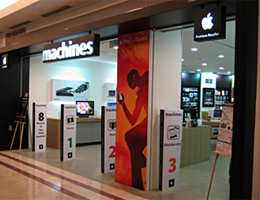
Another company is Smack. Smack is an authorised reseller. You can find their price driven site here

In fact, according to ‘where to buy’ on the mac site there are 83 resellers, in Malaysia. This includes those authorised to sell iPods. That’s a lot for a company that only has about 10% of the PC market.

So it’s a very competitive environment. One in which you would expect resellers to do what it takes to hang on to clients for as long as possible. An environment in which you would expect resellers to do what they can to take business away from other resellers.

Walkins are potential customers
I took my laptop to a mac store in a nearby mall. Now think about this, here is a relatively new store, less than a year old. In walks a foreigner with an old laptop that has a problem. He has never been to that store before. If FusionBrand were working with this retailer, he would understand that this guy represented an opportunity to gain a customer. And as he was unfamiliar and did not register when his name was entered into the database yet was a mac user, he was obviously a customer of a competitor.

I went to the counter where there were 3 or 4 guys standing around not doing much. None of them smiled so I said good morning and explained the problem. After a brief discussion the sales person asked if I could come back the next day because the technician was off that day.

I didn’t bother to ask why a technician would be off mid week. I said that as I didn’t really want to make another trip could I leave the laptop with him? Reluctantly, after discussion with his colleague he said yes but that it was company policy to charge RM100 (US$30) to carry out a diagnostic.

This isn’t much money but the salesman in me says this is the wrong way to do business. Here is a potential new customer with a long record of buying macs (they don’t know this of course because no attempt has been made to build rapport with me). Surely it would be a great idea to score some PR points by sitting down with me and getting to know me before charging an irrelevant diagnostic fee?

Anyway, long story short, I was bored by now but to put the boot in, I said I would go to the other store nearby. He shrugged and handed me the laptop.

I went to the other store in a mall nearby (next to a Starbucks with wifi, neat). Now I have been to this store before and it was where my super salesman worked but the turnover is high and I didn’t recognise the guy working there. Nevertheless, when I walked in I was greeted with a cheerful hi. I explained the problem and the guy told me to leave it with him and he would call me when he found out the problem. That was on Friday. On Monday, I got a call from him with some bad news. It’ll be interesting to see if he attempts to sell me a replacement when I go to collect the laptop.

Poor service
Now this is not a rant about poor service, I’ll leave that to others much better qualified than I. This is an attempt to show companies that branding is more than advertising, logos and so on. Building rapport, gathering data, qualifying prospects, engaging them and building towards a sale are all critical components of branding. Because many brands, especially Asian ones, won’t have the resources that Apple has.

Here are 5 things to do that will help to build your retail brand

1) Every walkin is not only a potential customer, but possibly a customer who is currently with a competitor. Be nice to them.
2) Develop 5 or 6 conversational fact finding questions that will give you the data you need to make informed decisions on how you want to proceed with the prospect.
3) The 1980s are gone and with it the concept of ‘company policy’.
4) Going the extra mile will ensure loyalty and loyalty is critical to profitable branding
5) Train sales personnel to sell because a lot of people want to buy but don’t know how to and so need a little help.

Louis Vuitton in a spot of bother over print ads


The Advertising Standards Authority (ASA) in the UK has received complaints that print ads for Louis Vuitton created by Ogilvy and Mather suggest that the products were made by hand.

Certainly looking at this ad that shows a woman creating the lines for the folds of a wallet

and also this ad that appears to be a woman stitching a handbag

It is easy to see why there have been complaints. Especially as the copy states, “infinite patience protects each overstitch… One could say that a Louis Vuitton bag is a collection of fine details.”

However, according to marketingweek Louis Vuitton defended the campaign by saying that “their employees were not assembling pre-packed pieces but were taking individual handcrafted and hand-sewn parts through a range of hand-made stages to reach a final item.”

Louis Vuitton added that the use of hand sewing machines and associated tasks were “part and parcel of what would amount to ’handmade’ in the 21st century”.

So handmade doesn’t actually mean handmade in the traditional sense?

If that is the case does that mean then that the iconic hand made Hermes Birkin bag that can cost anything from US$10,000 to well over US$100,000 isn’t actually hand made?

Does this mean that the animal skins used in a Birkin bag are not actually spread out on the floor of the processing room and screened by a number of artisans before being measured and cut by hand as required?

Does this mean that the bottom of the handbag is not sown by hand to the front and back with waxed linen threads?

Does this mean that the handle of the Birkin bag is not manually stitched until the shape comes to the fore?

Does this mean then that the artisans don’t use sand paper to smooth rough edges? And does it mean therefore that hot wax is not applied to the handles to protect them from moisture?

And all the effort that goes into the front flap, the metal and lock is not actually done by hand?

Does it mean that the craftsmen in France that all work out of the little lane in Paris don’t actually exist?

And advertising agencies wonder why 76% of consumers don’t believe that companies tell the truth in advertisements. In Malaysia that figure is 86%!

The number one element in any relationship is trust. If a brand wants to build a relationship with a consumer, that consumer must be able to trust the brand.

An element of doubt in communications is not a good way to build trust.

Self service can help brand profitability


The other day, one of our computers froze. This is a scary moment for most companies and it was even more scary for us as we use Apple computers and it was the first time this happened in 7 years. More worrying, this particular PC is running some expensive design software and auto-save was off!

We had two options call tech support and wait 24 – 36 hours for them to come in or check out the Apple support site and see of we could solve the problem ourselves. We chose the latter and 20 minutes later the PC was up and running.

Enabling prospects and customers to answer their own questions is nothing new, but few Asian brands use it effectively. Yet it can have a significant impact on profitability. Forrester found that the cost of a customer sales or support call cost as much as US$33. The same report found that even email support can cost as much as US$10 per response. Yet Web-based self help averages US$1.17 per incident. And this doesn’t take into account the impact on reputation due to lost productivity by the customer.

Customers benefit too. In our case, we work to tight deadlines, sometimes spending the whole weekend in the office. If this had happened on a Saturday night, with a Monday delivery deadline, we may have lost the account.

One word of caution though. Self-service is not an excuse for avoiding service.

3 words that can ruin your brand in Malaysia and Singapore


If you are in Malaysia or Singapore and you sell stuff to customers, there is one phrase that can ruin your brand.

“No stock Lah.” Is repeated time again by poorly trained and disinterested staff.

This seemingly innocuous phrase should be banned in your organization. While we’re at it, you should also ban the obligatory disinterested shrug of the shoulders that normally comes with the phrase.

For the uninitiated, the phrase is common in retail outlets the length and breadth of Malaysia and still, despite the alleged sophistication of the city state, in many of the malls up and down Orchard Road in Singapore.

This simple yet powerful phrase, used with annoying regularity in both discount stores and swank boutiques of luxury brands negates every penny your organization has spent on sales training, reputation development, customer service, customer relationship management and other operational excellence initiatives.

It renders worthless the massive investments you have made in licenses, real estate, interior design, stock, utilities and more.

It erases the hard work you have put into press releases, press conferences and other promotional efforts.

It undoes all the good of the advertising campaigns you have run for years in an attempt to get a consumer or two to give your brand a chance.

In a heartbeat, it ruins every single, expensive effort, financial and otherwise you have put into getting the consumer into your store.

In short, this seemingly innocuous phrase can ruin your brand.

Luxury branding in developing markets requires a different approach


Patek Philippe, the eponymous luxury Swiss watch, or should I say, timepiece brand is known for running the same advertising campaign for years. Although the images may have changed, the tagline “You never actually own a Patek Philippe. You merely look after it for the next generation.” has remained consistent, usually along with a jaw droppingly handsome and immaculately dressed and coiffured ‘father and son’ portrait.

For the target market, the aristocracy and the wealthy of the world, and those that aspire to the class, the ads say many things, including ‘buy one and you’ll be like us and ‘You have class and you know class’.

The ads are a wonderful example of luxury branding – a great product manufactured with precision engineering, immaculate heritage, an aristocratic client base and creative genius in the advertising that communicates on a level that the target market will connect with and explains, in the limited time available to garner interest, the timeless character of the brand. And I am sure the quality of service at the point of sale will be equally as impressive.

PP has recently launched a new global print advertising campaign that focusses on the values of the company established by two Polish immigrants, Frantisek Czapek and Antoni Patek in Geneva in 1839. I’m not sure if this campaign is to replace the old one. I for one hope not.

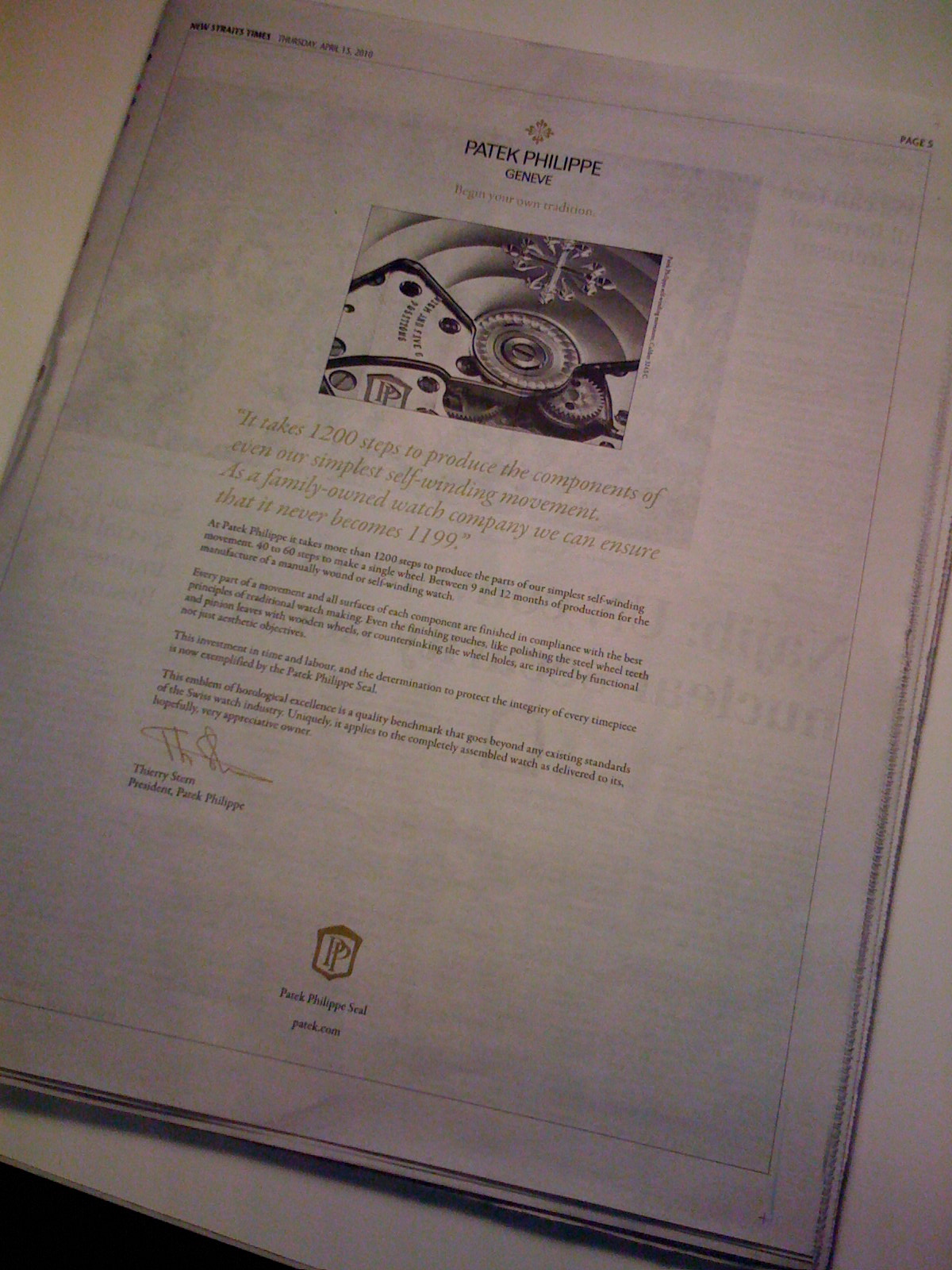
The latest campaign revolves around the personal letter concept and has the current president, Thierry Stern waxing lyrical about the steps involved, the time taken and care and attention to detail invested in the production of a PP timepiece. He talks about ‘polishing steel wheel teeth and pinion leaves with wooden leaves and countersinking wheel holes’ and the fact that these efforts are ‘inspired by functional not just aesthetic objectives’.

He goes on to mention the Patek Philippe Seal, an ’emblem of horological excellence’ that appears to be an internal ‘quality benchmark’ that claims to be ‘beyond existing standards of the Swiss watch industry’.

The ads are set to appear in ‘quality daily newspapers and influential trade publications’ around the world and will also appear at the point of sale.

The first ad (I think) appeared in Malaysia in the New Straits Times on 15th April 2010. I can understand (although I don’t agree with the tactic) the mass market approach of running an ad in the New York Times or the London Times, South China Morning Post etc or any other developed country where there is significant market potential.

But I can’t understand the purpose of running the ad in a developing country such as Malaysia. A quick search of the net finds a rather old PWC report, that states ‘the mean monthly gross income per Malaysian household increased from MYR2,472 in 1999 to MYR3,011 in 2002, denoting average growth of 6.8% per annum’. So if we use that growth rate to bring us up to 2010, the mean monthly gross income per Malaysian household is now roughly RM5,096 or US$1,358. Don’t forget that is gross and does not take into account the impact of the economic crisis.

Another search of the Internet would suggest that the cheapest PP watch is around US$4,000 and the most expensive sold some time ago for about US$11,000,000 (that’s RM36 million in real money). The majority of PP watches appear to be in the US$10,000 to US$35,000. At those rates, the potential market in a country the size of Malaysia is tiny and an ad for such a luxury product in a daily newspaper is essentially a waste of money.

Just to put things into context, the ad after the PP ad is for Honda and the ad after that is for Panasonic household appliances such as an Alkoline ionizer, hair styler and hair dryer and men’s shaver (inner Blade and outer foil).

So what should PP do in developing markets like Malaysia?

Here are 5 suggestions

1) Rethink the one-size-fits-all mass market approach to building a brand, especially in developing markets. The consumers who can afford your products can be engaged much more effectively in other ways.
2) Build a database of prospects and customers. But all markets require different strategies and data collection techniques will be different.
3) Build relationships with your existing customers. Existing customers are often ignored by companies scared of asking too many probing questions. And certainly timing is important. But well trained luxury retail staff can build relationships with wealthy customers who are likely to be successful businessmen and politicians and their opinions will carry a lot of weight with prospective customers.
4) Advertising is important, but choose your channels carefully. Mass circulation newspapers and magazines are for shavers and hypermarkets.
5) Content is important too. I’m not sure anyone really cares what is hidden away inside the shell of a product with almost 200 years of heritage. After all, if the quality was a given in the previous campaign, why must it be addressed now?
6) Integrate your digital commuications with mobile channels to engage with prospects and customers interactively when they are on the move.

Building a brand is hard enough. PP has done it successfully for 200 years. But treating every market the same and using mass marketing tactics that belong to an era that no longer exists, will make it hard to do it successfully for the next 200 years.

Are we seeing the commoditisation of the iPhone in Asia?


Here in Malaysia it took time for the mobile service providers to agree terms with Apple to offer the iPhone to subscribers. But finally, Maxis signed up and has invested heavily over past year or so in traditional aquisition focussed marketing.

Recently, another provider, the aggressive and innovative provider, Digi signed an agreement with Apple and has started to promote the iPhone.

Last night, I was watching TV and was astonished to see first a Maxis ad for the iPhone, featuring the numerous applications (there’s one for just about everything) and then, I think separated by another commercial but possibly even back to back, the same commercial for the iPhone, featuring all the applications, this time with a Digi logo!

I have a number of reactions to this. Firstly, don’t advertising agencies know how to do a deal with a TV station anymore? If you can’t get an exclusive deal at least ensure no competitor products advertise on the same program.

Secondly, what are these telcos doing slugging it out in public on TV? Do’t they have any understanding of the iPhone and what it stands for and means?

Thirdly, these telcos are commoditising a valuable brand that deserves better. A more sophisticated approach for a sophisticated product that offers value for many people in many ways targetted at existing subscribers and personalised would be far more effective than a mass economy spray and pray approach!

Creating awareness via TVCs is a complete waste of money for a product such as the iPhone. If anyone out there is unaware of the iPhone, the applications and how they can add value to a person’s life, then that person is not the type of customer Apple, or the telcos want!

Don’t expect prospects to build your brand


Yesterday I saw a video on the new sonos zone player. You can find the video on the site here but to brief you it is a cool looking internet radio and itunes player controlled by your iPhone that allows you to play music in all your rooms. Pretty cool so watch the video if you can.

The video was really well executed and I was sold by the end of it. I went to the ‘Find a store’ feature on the site and was impressed to find a dealer not far from my office in Kuala Lumpur. There was even a contact name and email address.

I sent the contact an email but also decided to post a request for information on Twitter. Probably because I have sent emails to electronics dealers in Malaysia before and never heard from them (it’s a fairly unsophisticated business here, dominated by old school Chinese traders). But I sent the email because it is slowly changing, as I found out when I had a technical issue with my Zepellin.

Anyway, I haven’t got a reply to the email but I did get 2 responses to my tweet, one directly from the manufacturer @Sonos and one from the distributor in Singapore @SeowHow.

Incredibly, the manufacturer told me to contact their distributor and the distributor told me to contact his sales office!

Here’s some free advice to ensure your brand doesn’t end up in the bulging cemetary of great brands.

1) Don’t expect an interested prospect to become a customer
2) Treat all your leads/prospects as if they are the most important person in your world
3) Don’t expect a prospect, even an excited prospect with buyer written all over his face, to do all the heavy lifting
4) Your brand may be the be all and end all of your life but it isn’t of anyone elses
5) There is a lot of competition out there