Today is a landmark day for retailing in the UK as Selfridges “The best department store in the world*” launches a “No-noise” experience at its major stores across the the country.
It’s a pretty cool concept, offering a Silence Room where customers can ‘find a moment of peace in a world where we are bombarded by a cacophony of information and stimulation’. Customers will be asked to leave their shoes, mobile phones and anything else that makes a noise at the door.
Interestingly the store also aims to reduce the visual noise and has encouraged some brands to offer ‘de-logoed’ products. Paul Smith and Heinz are already onboard with others expected to join in later.
There will also be meditation sessions, quiet music performances (that’ll be a challenge), art exhibitions and motion sensor window displays. Selfridges will also take its name off the classic yellow shopping bags.
You can see more about the Silence Room and other elements of the event on the Selfridges site.
Personally, I think this is a brilliant concept as it understands what customers are looking for and takes experiential branding to a new level. What do you think?
More and more firms are using effective email campaigns in association with their social media initiatives to build brands. This is because an email campaign allows you to know who is opening your emails, which links they’re clicking on and how many of your them are forwarding your emails to their friends. The right product also means you will only pay when a recipient clicks through to the offer.
Malaysian firms are slowly waking up to the benefits of a good email campaign. Let me put that differently, Malaysian firms are waking up to the fact that email is an effective marketing tool. Which is good timing because according to a recent report from MarketingProfs, email returns the highest return on investment (ROI).
The problem is that too many Malaysian firms are trying to do their email campaigns ‘on the cheap’. often they do it inhouse or if they do outsource, they outsource to the cheapest company.
This means they often send out poor quality emails that can damage the brand. it is important to get the email and the content of your email right. Because this is the first interaction a potential customer will have with your brand. It is a great opportunity to make a good impression and start building the foundations you need to earn their trust and eventually make a sale.
Unfortunately, it is also a great opportunity to make a bad impression. And once you’ve made a bad impression, it is very dificult to build trust with a consumer who is already forming a negative opinion of you and your brand.
Not only should your email campaign resonate with your target markets, it also needs to be well written and to the point. If it is full of poor English or grammatical errors, you will create a bad impression with the recipient.
Below are two examples of emails I received recently. Although I haven’t included the subject line, take it from me they were almost as bad as the copy.
How to create a good email campaign
When you prepare an email campaign, the subject line is the most important element of the exercise because this is the first thing the recipient will see.
If there are spelling mistakes in the subject line, the reader will not have any faith in what you say from there on in. If you make outrageous claims in the subject line, the email will go straight to the trash.
Finally, if the subject line doesn’t state its point concisely, it will be ignored. Accept that it is impossible to include content in a subject line that will appeal to everyone on your mailing list. It may take more time but it is better to break up your database and rewrite different subject lines and body copy for different segments.
Once you get to the body of the email, a good rule of thumb is that less is more. Don’t waffle on and on about how great is your product or use textbook marketing jargon that confuses the reader and drives them away from the product.
Keep the email simple. Remember, you are not trying to make a sale, only get the recipient to interact with your brand. Explain what you have to offer, where the recipient can get it or gather more information, who you are and why they should buy your product or service.
Finally and most importantly, focus more on the benefits of your product not the features.
Get the message right, and email is an effective and inexpensive way to make sales, grow your customer base and build a valuable, profitable brand. Used wrongly and it is a complete waste of your time and the recipient’s time and instead of making sales and building your brand you will actually damage your brand.
There was an interesting interview with Tony Fadell in the Daily Telegraph last week. Tony Fadell is the inventor of the iPod and although the interview is meant to focus on his patest invention – smart thermostats – the conversation keeps coming back to his time at Apple.
What I found most interesting was Apple’s approach to doing business. Tony Fadell talks about branding in a refreshing, relevant way. He says, ““If you’re a company focused on competitors,” he says, “you’ll be a follower. And you’ll talk to the media about all sorts of stuff. But if you’re a company focused on the consumer you’ll talk about the products that you’ve got and how to get the most out of them.”
This is so, so true. In the customer economy, if you spend all your time looking at what your competitors are doing and then try to replicate it, you are always going to be playing catchup.
But more importantly, this is the wrong place to look because companies don’t define brands anymore, customers do. And also, loyalty is a lot harder to earn and certainly isn’t earned by a traditional, corporate driven positioning strategy.
Apple talks about it’s products but more importantly, it lets consumers talk about its products and you need to build an environment where consumers can talk about your brand. Don’t be afraid to be talked about because it is already happening anyway.
In the social economies of Asia, giving consumers platforms or building communities for them to discuss your brand allows you to track the conversations and get involved when need be.
Critically it allows you to identify and engage with influential consumers, those people other consumers listen to. Because brands need to understand that in the customer economy, success will be determined by relationships not transactions. An automotive dealer doesn’t sell cars, they build relationships with people looking to make their lives more interesting, exciting or easier.
As that relationship evolves and solutions provided, they seek introductions to others who may also join the family by buying the product. This requires an investment in the product and also in the relationships. But the investment in the product can be determined by the needs of the customers.
Take a leaf out of the Apple book and look to your customers not your competitors to build your brand.
Luxury brands are working hard to keep up with a more dynamic environment with more discerning, knowledgeable customers who have different requirements for value. To retain these customers requires a greater understanding of the those requirements and less emphasis on the mass economy tools such as positioning, reach, awareness.
Loyalty is also less of a factor as consumers see their exclusivity watered down as luxury brands go mainstream and sell their product to anyone. Those brands that don’t understand customer requirements for value may lead to brand deflation, according to Michael Bleby in this article for BRW in Australia
And as it happens, I’ve never managed to secure any consulting projects with automotive brands. So as buying a car is probably the second largest investment most of us will make, I decided to use this opportunity to carry out a mini brand audit of those brands I visited.
So today (Sunday) I visited the Audi, Mercedes, Peugeot, Land Rover & VW showrooms in Kuala Lumpur. Excluding the luxury marques – Aston Martin, Rolls Royce and Bentley, these are considered top end cars in Malaysia.
The automotive sector here in Malaysia is really tough, especially as the middle class market, although growing is still rather small. In fact, between them these brands probably sell no more than 10,000 units per annum of which 60% are Mercedes.
Furthermore, with import duties higher than anywhere else in the world and an increasingly bleak global economy that looks like it will catch up with south east Asia in 2013, you would expect these guys to have some of the best sales people in the industry.
Well here’s my ‘mini’ report card on my experiences and the ability of these top marques to sell their products.
Firstly though, some background information.
1) Not one of the sales people that attended to me asked for my business card.
2) Only one sales person asked my name.
3) Only one of them asked me what car I currently drive.
4) One of the sales people who was very pleasant, could not pronounce the name of her brand. I’d like to add that this brand name is bloody hard to pronounce for English people so must be impossible for a native Chinese speaker. But…
5) At one of the showrooms I was told if I bought the car today I could get free Sat Nav (GPS). When I asked whether it covered Malaysia, Singapore and Thailand I was told no, it covered France – I swear to god that is the truth!
So, in reverse order, here is my report card on my experiences with these brands and a brief explanation. WARNING: It makes for distressing reading.
5=) VW.
VW comes in last, way last. Not really a result of the salesman’s ability or inability to sell because he was a very nice guy and anyway we didn’t get a chance to test his sales ability because the VW in Malaysia doesn’t come with Sat Nav (GPS) and in my opinion, at that level if you don’t have Sat Nav, you are not in the game.
5=) Land Rover
Joint last is Land Rover. Again, not a result of the ability or inability to sell because we didn’t get a chance to find out. There weren’t any sales people to attend to me because they were all out doing test drives. That’s no excuse. When your cheapest car – the Freelander 2 – is RM271,000 (US$90,000) and your most popular car – the Evogue – has a long waiting list, you need to be on top of your game. I wasn’t the only person to walk out frustrated.
3=) Peugeot
I really liked the top of the range 508 GT but the sales person seemed to want to sell me something cheaper. Maybe she was on a higher commission to sell that car or maybe she was just using price to make a quick sale.
3=) Audi
The Audi lady was nice and gave a good description of Quattro to my wife who really looked as if she was interested. But she didn’t ask me anything about what car I drive, how old is it etc, etc. Where’s the relationship building?
1) Mercedes Benz
Apparently, the sales lady here was working in the Mercedes showroom in Glasgow, Scotland for 10 years but is now back in Malaysia. In 20 years of living in Malaysia, this was the first time I have heard a Malaysian speaking with a Glaswegian accent! But crucially she was miles ahead of the rest with her product knowledge, attempts to build rapport, personality and sales ability. Not too pushy, not too technical and she asked for my name at the right time in the discussion and when I gave her my first name she asked for my surname so she could address me as Mr Osborne – top talent.
I’m not here to criticize, only to offer feedback to help people and brands. Viewed for what it is – feedback, every brand on this page can learn from my experiences. Sales is no longer about taking orders or convincing someone of something. It is now about building rapport and delivering value, on an individual basis. If you don’t have the training or the skills to do that you will lose business, lots of it.
All of these brands spend a lot on advertising to draw people into their showrooms. And they may be happy with their sales but my question is, would any of them be happier with less advertising spend and increased sales as a result of better customer engagement skills? Of course they would.
Newsweek’s announcement that it will transition to an all digital format in 2013 is hardly a surprise. Such global magazines are increasingly expensive to produce and in a niche world, less relevant.
Newsweek – almost 80 years in print
But the bigger impact will come in the way advertisers communicate with consumers.
According to research carried out by comScore, more tablet users are reading magazines and newspapers on their tablets.
comScore talked to 6,000 tablet users over a 3 month period (I’m not sure of the geographic locations of the participants) and overall, 11.5% of tablet owners read a newspaper on their tablets ‘almost every day’ or ‘at least once a week.’
Tablets are not cheap and this is reflected in the income levels of the participants as half of tablet owners who read a newspaper on their device have household incomes of US$75,000 or more.
Readers of tablets and newspapers online are also more likely to be younger, with adults aged 25-34 accounting for 27% of newspaper readers and 28% of magazine readers on tablets.
Other research from GfK MRI found impressive engagement rates for digital advertising across tablets. They surveyed 30,000 ads across 1,000 magazine issues earlier this year and found 55% noted or read a digital ad on a tablet or e-reader.
And of those, 52% interacted with the ad as a result.
So does Newsweek’s decision and the changing way in which we source our news and current affairs information mean that this mean the end of the newspaper and magazine?
Absolutely not, especially in developing countries where many of the population are still not online or prefer to source their information from traditional sources.
But it does mean that many brands, especially luxury brands aimed at more affluent users, don’t need to waste resources on pointless ads on page 3 of daily newspapers.
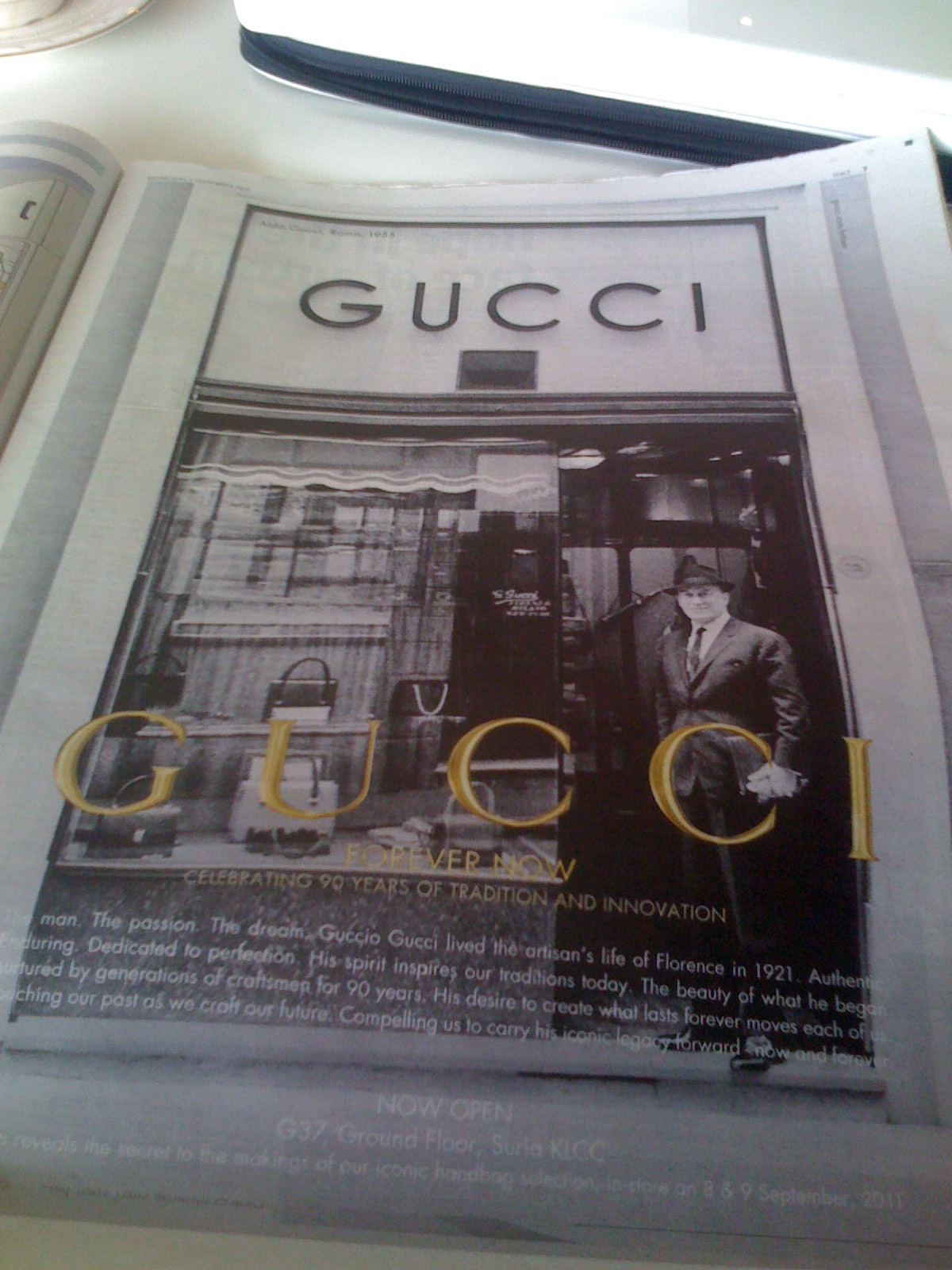
New data means Gucci can target ads more effectively
After all, if affluent readers are sourcing their news from tablets, why advertise a luxury product in a traditional newspaper or magazine, especially when the engagement rates are so high?
I’ve heard a lot of good things about the Naumi hotel in Singapore and as I’m travelling down south, I thought it would be a good opportunity to try the place. Sadly when I attempted to book online, the hotel was full.
The next day I was reading an online newspaper and noticed an ad for the Naumi. I thought that maybe they’ve freed up some rooms and I can get to stay there after all.
Unfortunately, the hotel was still fully booked. In fact, after further research, the hotel is fully booked and in just about every room category, with one or two exceptions, for the next 12 months at least. I didn’t look past 12 months so it could even be longer.
Massive digital campaign despite being fully booked for a year
Since I saw the ad almost a week ago, I have continued to see Naumi ads across a wide variety of online sites, both local and international.
So why is the Naumi advertising? Isn’t this a total waste of an advertising budget? Is this an example of why CEOs are losing patience with CMOs? I can only assume it’s not a one off ad but in fact part of a campaign. If I am right, how much is this campaign costing and if the hotel is full for 12 months, what is the point?
Despite being fully booked, the hotel continues to advertise
When creating a digital campaign, reach and frequency are irrelevant. If those words were used in the pitch to you then you need to sack the agency. Because all they tell you is how many people saw your ad and how often they saw it.
You are probably wondering if they are perhaps using it as a lead generation exercise. Well I thought the same thing and that as I left the site they would try to grab some data from me.
It’s a logical thought because banner ads are not that effective. The general consensus of opinion is that the number of visitors who actually click on a banner ad is only 0.2%, which equates to one in 500 visitors that actually click on the ad.
And just because they click on the ad, doesn’t mean they automatically become customers. The seller, in this case the Naumi hotel still has to convert those visitors into prospects.
There are various ways of doing this, depending on your business. For the Naumi hotel, this is obviously to get the visitor to book a room. However if the hotel doesn’t have any rooms and simply tells the visitor this, the whole exercise has been a complete waste of time and money.
Of course the visitor may return, but then again they may not after all, how many visitors that have been disappointed, return to the scene of their disappointment? Or they may go on to build a relationship with another hotel.
Surely it would have made sense for the hotel to offer an apology (I don’t know about you, but when a firm apologises for being successful, I am hooked) and ask me for an email address so they can start to build a relationship with me?
And to use the campaign more effectively, I would create an offer whereby any visitors that register, will be offered a free upgrade when they book at a later date.
But no, they spent that money creating a campaign to get me to their website and then when I get there its like the place has closed down.
I bet the marketing department is reporting an increasing rate of visitors to the website but so what.
Digital advertising is not just about the campaign – the creativity, the reach, the frequency, the impressions, the clicks etc.
It is about the data, the source of the lead, the influencers and ultimately conversions that generate ROI.
The burger chain, Wendy’s has given its logo a makeover. Well it’s not really a makeover, more of a touchup. They are not the first company to do this. Gap did it a couple of years ago (and turned it into a branding disaster that you can read about here), RHB and Maybank have made minor changes to their brands recently as well.
When I saw the new Wendy’s logo I checked out the old to see what it looked like. I don’t think Wendy’s promotes itself much in Malaysia so the logo isn’t really familiar to me.
Wendy’s logo – long overdue a makeover
The old logo, created in 1983 was really dated. It reminded me of old fashioned pub signs in England. It was boxy, with outdated fonts and weak colour coordination and the girl, who is the focal point of the logo had an almost Victorian look about her.
The new logo has done away with the pub sign look and feel and is much more contemporary. It retains the brand name but the name is now in a less formal red font on a plain white background but retains ‘the wave’ (when a font moves from left to right in an upward direction).
The girl is more pronounced and less stiff. Her formal, Victorian dress has some colour but is less prominent, she’s still a redhead but seems more natural which may reflect a future brand direction.
Wendy’s new logo – the roll out will take at least 6 years
Interestingly, there is no reference to what the brand does which may make business development a challenge, especially in South East Asia. Unless of course the brand is planning a change in direction. Or maybe the new look and feel won’t be applied to South East Asia.
I often wonder if these brand makeovers are really worth the trouble. After all, we have to assume every Wendy’s restaurant around the world will change all its livery. Every signboard, truck, van, car etc will have to be redesigned too.
All the menus, napkins, cups, letterheads, envelopes, business cards and uniforms – Wendy’s employs over 150,000 people worldwide – will have to be updated.
Wendy’s is projecting it will renovate half of its 1,425 locations by 2015. So we can assume the other half will take as long again so the process could take more than 6 years to be finalized.
That’s a lot of effort, not to mention money to change a logo that will probably need to be changed again when the project is finshed.
It makes me wonder if logos are still relevant. What do you think?
I read an interesting article on the Malaysia Nation Brand which can be found here.
But I was particularly taken by one of the reader’s comments.
As someone who has worked on a number of elements of the Malaysia brand and who has written numerous articles on it, I believe I can add value to this discussion.
Firstly, it is incredibly hard to write about the Malaysia Nation Brand or any other Nation Brand in an article of a thousand words or so! It’s a thankless task which is why many experts have trouble writing a relevant or coherent book on the subject!
And, because the world is so dynamic, what is a ‘cutting edge’ tool today maybe obsolete tomorrow and a tactical solution recommended yesterday may not be relevant tomorrow.
Anyway, back to the contributor. He appeared to state that maintenance in Malaysia is not a problem and insinuated that it was irrelevant anyway because it had no bearing on the Malaysia Nation Brand.
The author of the article responded saying that maintenance is very important and forms part of the confusing image of Malaysia. The author goes on to say that poor maintenance of buildings contributes to the experience and therefore the success of the brand.
Let me state here that maintenance is a major cause for concern in Malaysia, especially at Government venues but also at privately owned venues.
Last Saturday and Sunday, I was at the Bukit Jalil indoor stadium for a world class sporting event (ATP Tennis) and the place is a sad, shabby, tired mess. Walls are filthy, the place smells, doors are broken, clocks don’t work, ventilation is poor and navigation complicated. I won’t event mention the toilets. Furthermore, the TV sets are old and either not working or showing a picture that looks as if there is a snow storm going – the list of poor experiences is endless.
As I left I looked up at the beautiful main stadium and could see numerous holes in the roof, abandoned scaffolding and other signs of neglect. And we all know this scene is replicated around the country.
If we want to build a nation brand, it will require more than a tagline, a brand essence or a glossy advertising campaign. To build a Malaysia Nation Brand will require a massive change in mindset. Part of this will require an understanding that positive experiences create positive memories which lead to positive word of mouth and an improved Nation Brand.
Because it is the experiences people have when they interact with numerous touchpoints that they will remember and communicate to others.
World class sporting events are a major way of improving a brands image and the organisers should be commended for bringing in this prestigious event. But the authorities should also do their part and make sure the experience is unforgettable, for the right reasons.
If you are interested I wrote an article on the Malaysia Nation Brand and you can find it here.
David M. Ogilvy erstwhile spy, farmer, researcher, promoter and of course iconic ad man wrote in his popular book “Confessions of an Advertising Man”, that there are essentially three main points of view on what is considered to be a good advertisement.
Ogilvy, “What is a good advertisement? There are three schools of thought. The cynics hold that a good advertisement is an advertisement with a client’s OK on it.
Another school accepts Raymond Rubicam’s definition, “The best identification of a great advertisement is that its public is not only strongly sold by it, but that both the public and the advertising world remember it for a long time as an admirable piece of work.”
I have produced my share of advertisements which have been remembered by the advertising world as “admirable pieces of work”, but I belong to the third school, which holds that a good advertisement is one which sells the product without drawing attention to itself. It should rivet the reader’s attention on the product. Instead of saying, “What a clever advertisement,” the reader says, “I never knew that before. I must try this product.”
Bearing these comments in mind, I would like to draw your attention to an advertisement that appeared recently in the Malaysia Daily Star newspaper.
In any market, good copywriting is needed to sell cars
Firstly have a look at the tagline, “This Season’s Style Icon.” What does that say to you? Does it say, “Buy this car and have trouble free motoring for years to come” or does it say, “quick get one now before the end of the season (traditionally a season in the fashion industry is 3 months) otherwise it will be out of date?”
One could argue that the good news is that there will be a newer model at the start of the next season.
I haven’t test driven the ASX but I’ve seen it on the road and it looks like a nice bit of kit and certainly doesn’t deserve to be portrayed as something fashionable to own for a season, especially when it costs almost US$50,000 in Malaysia.
In case you can’t read it, the sub heading reads, “The exceptionally stylish Mitsubishi ASX Euro.”
And the copy proclaims, “They say it’s the clothes that make the man (There’s the link to the fashion industry but I doubt it encourages many women to pay attention). In our case, that means the panoramic glass roof (Malaysia is a tropical country and the last thing anyone wants is a panoramic sun roof magnifying the sun’s glare) and 8-way power leather seat (Has anyone ever bought a car because of the number of options available on the power seat?) in our latest ASX Euro.
Not only do they (that’s the sun roof and leather seats) make this Euro-spec (does that mean it comes with a heater?) urban utility vehicle look classy (the sun roof that no one can see because it is on the, well roof and the seats make it look classy?), but also anyone who’s behind the wheel (So a sun roof and leather seats will make me look classy? Have you seen me?). If that’s not alluring enough, it’s only limited to 200 units. So hurry down to your nearest showroom today (Does anyone hurry to buy a car?).
I believe the art of copywriting is really under appreciated in Malaysia and you can see why. I think that this is one of the many reasons why 86% of Malaysian consumers no longer believe what they read in advertisements.
The poor quality of copywriting has led to shortcuts and the use of increasingly ridiculous claims that are at times laughable.
A copywriter should communicate a relevant or legitimate meaning quickly, connect with needs of the target segment, influence and hopefully persuade that segment to seek more information.
I don’t see how this ad does that. But it must have the client’s OK on it… What do you think?




 brandconsultantasia.com