Malaysia Airlines achieves 1 million Likes on Facebook


Malaysia Airlines issued a press release yesterday announcing the airline has one million “Likes” on Facebook.

You don’t need me to tell you Facebook is massive. But I will. Facebook is massive. If it were a country it would be the third largest in terms of population, the largest in terms of area covered and probably the richest in terms of income.

So it is understandable that MAS wants to use Social Media and in particular Facebook, to build its business. Indeed, Khairul Syahar Khalid, Malaysia Airlines’ Head of Advertising & Promotions says, “Social Media is a new frontier for marketing, and as many brands have discovered, going on social media certainly pays.”

Encik Khairul adds, “We have positioned social media at the forefront of our marketing mix. We will be pushing the boundaries even further with our next marketing plans, all of which will see the social media platforms at the forefront. We want to continue to engage with our fans globally at a much deeper level whilst growing our footprint further. Growing our engagement with fans globally has contributed significantly to our business turnaround successes.”

Crediting Social Media with providing a significant contribution to the improvements in the airline’s performances recently is interesting and shows how important is Social Media.

Personally I think it is exciting that MAS is pushing the boundaries even further on social media, especially after the dreadful advertising campaign that is still being run. For more on that campaign please refer to this article

To thank fans for helping the airline reach one million ‘Likes’ on Facebook, MAS created a video with their social media ambassador, Malaysian singer Yuna. The video has been viewed 2,000 times since its launch a week ago.

Incidentally, I believe the Malaysian government has missed a trick here because I think Yuna should be the face of the Malaysia Nation Brand. You can read more about that here.

But how important are Facebook ‘Likes’? Are they a relevant metric for a business? What do they tell us and how can we leverage them?

The bad news is that 96% (BrandGlue goes even further, stating that only 0.02% of fans who ‘Like’ a page ever return) of ‘fans’ never return to a page after liking it. Moreover on Facebook, most posts are seen only by about 10% of fans.

Another little known fact about Facebook is that when fans create new posts on your Facebook page, other fans don’t necessarily see them. In other words, just because you go to your fan page doesn’t mean your fans are doing the same.

Consumers are increasingly sceptical about Facebook ‘Likes’ because it it is so easy and cheap to buy them. Twipquick is offering 100,000 Facebook ‘Likes’ for about US$750.

Any social media strategy must have clearly defined target markets and relevant customer data and content must be developed that will resonate with those customers. This content must resonate with those target markets. After all, there aren’t any groups for 18-35 year olds on Facebook.

MAS must avoid taking its advertising campaigns and trying to push them out across social media. Taking a video and dubbing it into the local language is not a social media strategy. This is simply mass economy marketing and there is no place for that model in the social economy where customers not companies define brands.

MAS must engage consumers and encourage them to contribute to the MAS story and then share and encourage the sharing of that content whilst enabling multiple channels for consumers to interact through.

At the same time, MAS must not forget its existing customers. MAS has millions of frequent flyer members but it currently neglects these existing customers, despite spending a lot of money to acquire them.
You need to track the reputation of your brand online: Infographic


Recently I was asked to map out a plan to develop some substance around the CEO of a major organization in Malaysia. The belief was that although he heads a hugely successful company, his personal brand lacks gravitas and this may count against the firm in the long run.

And they were right because the reputation of a CEO is inextricably linked to the reputation of a company. Just look at the fortunes of any CEO who had a good reputation then lost it.

Or the fortunes of a business whose reputation was painstakingly built over years, only to fall in a heartbeat because of C level indiscretions or dodgy practices.

Here in Malaysia errant CEOs generally leave quietly so we don’t often hear about such reputational issues but there are plenty of examples of the above. Because of the increasingly litigious nature of society, I’m not going to name names but think of the automotive, aviation, banking, steel and telecommunications industries amongst others and you should be able to work out who I am talking about.

Even in the consumer trenches, a company with a poorly respected CEO or dodgy reputation is going to struggle to find enough customers to build a brand. After all, would you buy from a company with a poor reputation? If a company with a questionable reputation submits a tender to your company, would you consider them? With so many alternatives in the market, there is no need to do so.

Even if the CEO has a solid reputation, he is often the difference between the company and a competitor. If he lacks charisma he may struggle to compete effectively. Tracking his reputation online will enable firms to identify what issues to address, in which channels and where and when. The effectiveness of solutions can be tracked and improved almost immediately.

In today’s social economy, where consumers not companies define brands it is imperative that every organization tracks its reputation online. This is even more important here in Asia where consumers are more likely to take to social media to complain and raise issues rather than connect directly with a company.

Unfortunately many companies still don’t see the benefit of tracking their reputation. Hopefully that will change with this handy infographic from Digital Firefly which shows why companies need to make reputation management a top priority – NOW!

Tracking your reputation online has never been more important

Great example of how to use video to build interest in a brand


The 1970s are considered to be the decade in which Hollywood rebranded itself after the collapse of the studio system of the 1960s. Independent filmmakers (at the time) such as Scorsese, Lucas and Spielberg all got their breaks in the 1970s creating such iconic movies as Jaws, Star Wars, Raging Bull, The Godfather, Raiders, ET and Chinatown.

It was also a period (no pun intended) when some of the scariest horror movies such as The Texas Chain Saw Massacre, The Exorcist (in my opinion the scariest film ever), The Shining and Carrie which was possibly the forerunner of the teen horror flick, were released.

But for every successful blockbuster, I think that something like 7 fail. And those failures can be really, really expensive. John Carter, released in 2012 is rumoured to have lost RM250 million (US$90 million), despite a RM330 (US$100 million) million marketing campaign.

So in an attempt to reduce failures and to squeeze more money out of a successful franchise, Hollywood likes to remake films. The latest of which is Carrie. I saw Carrie when I was 14. I wish I hadn’t. Carrie is an outsider, her mother is a religious nut and all of her classmates hate her. But Carrie has special powers. Telekinesis powers which means that she can mess with your mind, especially when you piss her off. Add in her first period, pigs blood, a prom, nasty girls etc. You can imagine the rest.

But the movie still has to be sold. And selling a movie is not easy. Especially as international audiences are often the difference between a success and failure – John Carter only took US$80 million in the States, over US$100 million came from Asia. So they decided to come up with a digital marketing campaign whereby they would lay the foundations with a video and then encourage consumers to do the rest.

So far the video has received almost 10 million views in 2 days. The cost? Maybe RM320,000 (US$100,000). Sure a viral campaign is nothing new but it shows that marketing departments need to open their eyes to the social economy and in some sectors, there actually may be one size fits all solutions.

Case studies of how two Malaysian brands used technology in a crisis


This article looks at two high profile situations in Malaysia and how these very different institutions used technology and social media to communicate with and engage stakeholders during a crisis.

Case study one: Syabas
Syabas (pronounced Sha-bas) provides water to the state of Selangor, the largest and most developed state in Malaysia. Following a diesel spillage on the Selangor river (a major source of water) at the end of August 2013, Syabas shut down four treatment plants, essentially cutting off water supply to nearly 1 million homes. I was personally affected by this issue and was without water for over 24 hours.

When my taps ran dry, the first thing I did was go to the Syabas website where I was greeted by a pop up press release telling me there was no water. I also found a 1800 number. I called the number and a recorded message told me to go back to the website. I revisited the website which told me that I was living in an area that was affected by the shut down. This wasn’t really very helpful as I new this because my taps were dry.

Not really helpful
Not really helpful

So my next stop was Twitter. I found the Syabas Twitter feed and fired off some tweets asking for more specific information that would allow me to plan for my family of seven who could not shower, flush toilets, wash clothes and make contingency plans for our open house scheduled for Sunday 1st September.

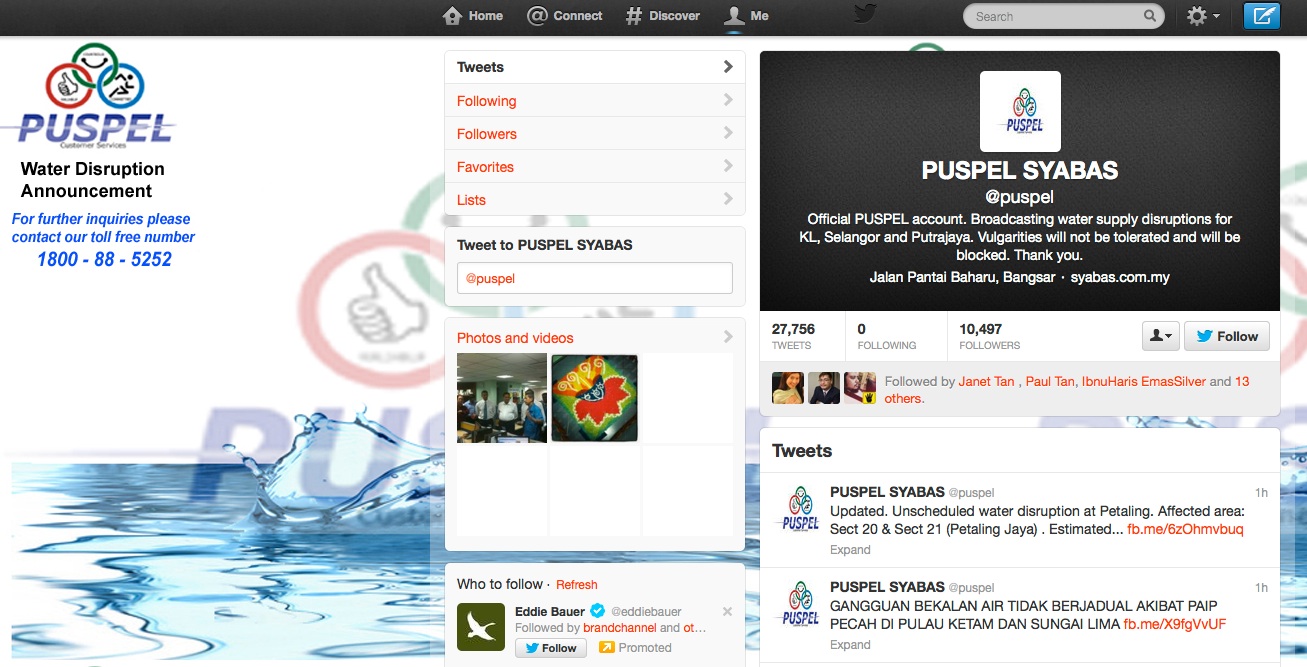
None of my tweets generated a response. I was stunned to find Syabas has over 10,000 followers on Twitter but doesn’t follow one person. I appreciate that not many companies have the resources to listen to what their customers are doing all the time however, one of the key reasons for being on Twitter is to be able to quickly identify conversations and trends about their business, their brand and their services.

No followers makes it hard to use Twitter effectively

This then allows brands to address issues in a transparent, prompt and empathetic manner and also leverage positive comments and discussions, join in with the conversation and encourage engagement.

So after trying the 1800 number, the website and the Twitter page, my last resort to try and get some actionable data to help me plan ahead was to go to the Syabas Facebook page.

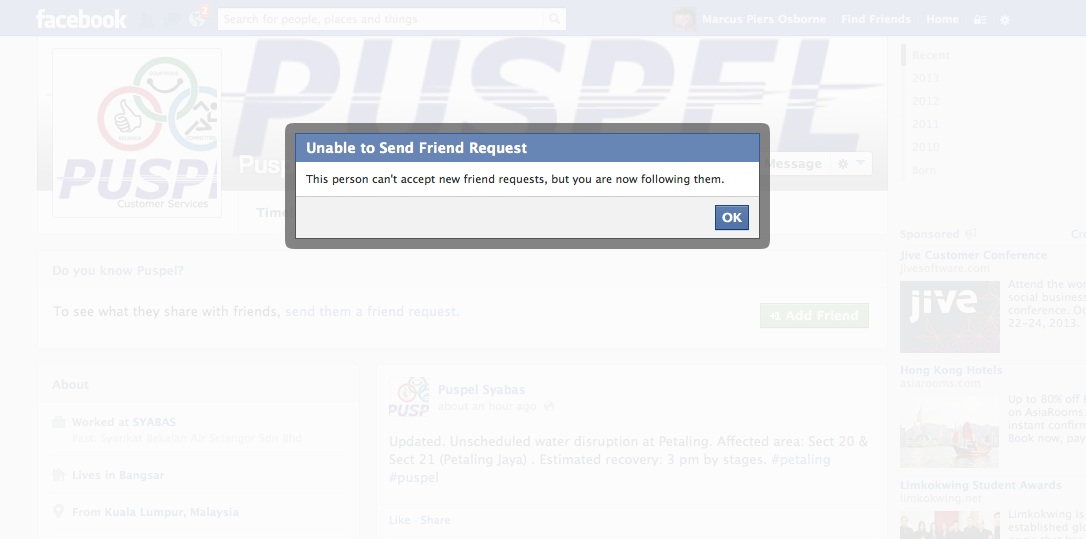
No luck on Facebook because Syabas had disabled the comments function which meant that I could follow them but couldn’t make any comments! As they were only reposting the press releases posted on the website, this was pointless. So I was unable to source any information that was relevant to me or get specific answers to specific problems.

Please listen to us but don't ask us anything
Please listen to us but don’t ask us anything

Incredibly, Syabas was on every social media platform yet was using those platforms not to engage with consumers but to broadcast only the messages it wanted consumers to hear. All Syabas seemed to want to do was push generic and pointless press releases to consumers. Yet the whole point of these platforms is to allow consumers to interact with the brand and get closure on personal issues.

And this is particularly relevant when it comes to negative issues or complaints. During a recent stay at the Marina Bay Sands, I complained on Twitter. Within 30 minutes the MBS was following me and asked me to follow them back so that they could send me a Direct message. Not only did this make me feel someone was listening, it also allowed them to take my complaint out of the public domain. The Marina Bay Sands has 8,500 followers and follows almost 1,700 people.

The irony of this situation is that Syabas actually dealt with the physical problem very efficiently and the water was back online to over 650,000 consumers within 36 hours. But by then it was too late and what could have been a PR success turned into a social media nightmare as frustrated consumers turned to forums, online newspapers and social media to vent their anger.

Case study two: Sekolah Sri Cempaka
Sekolah Sri Cempaka is a private school in Malaysia. It quickly embraced the arrival of technology in the classroom and places a great emphasis on communicating with students via its digital platform, Schoology. On Saturday 7th September 2013 a fire broke out at the school in the exclusive neighbourhood of Damansara Heights in the suburbs of Kuala Lumpur.

Within an hour Twitter was awash with chatter and soon after images of the fire were all over Twitter and Facebook. This fire could not have come at a worse time for the school with students busily preparing for critical exams.

The school quickly announced the fire simultaneously on Twitter and Facebook. The school then expanded its reach on both Social Media and the school Intranet to communicate with concerned students and parents.

Openness and transparency, success factors for social media

Throughout the next 36 hours numerous rumours developed and began to spread however, the school was quick to inform stakeholders of the real situation. By acting quickly and in a transparent, engaging manner, students and parents were reassured and potentially damaging rumours were negated, before they got out of control.

As the crisis unfolded, the school maintained contact with students and parents. Sharing with them the important developments – news of the damage, the fire department inspection, plans by the school, discussions with the education ministry and so on. This gave concerned and busy parents a regular stream of credible information which allowed them to plan ahead.

cem2

The new technological landscape is here to stay. Here are five things you must do now to prepare your company for a crisis:

1. Every company, government department and institution should have a clear, transparent, policy on social media and a clearly defined social media crisis management strategy to address comments/posts on the website or social media pages during the crisis. And this should be part of a grater social media plan.
2. Make sure you have enough properly trained staff to administer your social media pages and respond to issues raised by angry consumers.
3. Unless there is a potential threat to your organisation or your staff, transparency is key.
4. Always, always, always engage. Ignoring consumers or shutting down conversations is the worst thing you can do.
5. Have a back up solution ready for such situations.

These two institutions responded very differently to a crisis. One got it right, one didn’t. Which one best represents your brand?

MCA needs to work on how it communicates its brand


I hate to blow my own trumpet but there are times when I really don’t have a choice. I came across this promotional video for the Malaysia Chinese Association (MCA) which represents the interests of the Chinese in Malaysia’s Barisan Nasional political alliance.

I don’t know if this video is the reason but in the recently held general election in Malaysia, MCA won only seven parliamentary seats out of 37 and 11 state seats out of 90 the party contested. The song was voted the worst ever election song by an Australian TV station.

One thing is for sure, this video won’t have helped the party and I would like to offer my services to the MCA. I promise you, whatever I do for your brand will be an improvement.

How to develop a measurable content marketing plan


As the corporate driven creative message is assigned to the advertising graveyard, and content becomes the key tool to engage consumers the ability to use content to build a story around your brand is more important than ever before.

If you know and understand your customers and are able to create content that resonates with each segment (and I’m not talking traditional age related segments) you are well on your way to building a profitable brand.

That’s because so much research is carried out online. Need to find something out, what do you do? You ask Google. It is estimated that Google answers more than a billion questions from people around the world every day.

So where do you start? Well this superb infographic from BrandPoint in the US provides a robust overview of what you must do to build awareness, generate interest and create customers. These are of course key steps to building a profitable brand.

How_to_Measure_Content_Marketing_Infographic

Back to the drawing board for Brand Malaysia


Word reaches me from reliable sources that “Endless possibilities” the Nation Brand tagline chosen for Malaysia and scheduled for an official launch on 17th September will not now be used.

The tagline was panned from the outset, primarily because it was used by Mongolia and Israel. Trying to communicate a Nation brand promise in a few words or sentence, which is essentially what a tagline does, is becoming more and more complicated, not least because most of the best superlatives have already been used up but also because we live our lives very differently today and we’re not easily convinced by contrived messages anymore.

What most destinations fail to understand is that a tagline is not the first step in developing a Nation brand. Because what this creative driven approach aims to do is create a slogan, build an advertising campaign around that slogan, cross your fingers and hope that target markets will see it, buy into it and act and it will then become a brand. But this approach ignores what are the foundations for any destination brand strategy – stakeholder buy-in.

Unfortunately, because such a slogan is often created by an advertising agency there will be beautifully produced print and TV ads that woo key officials who immediately believe what they see in the slogan and of course buy into it themselves.

As we can see with “Endless Possibilities” this model does not work. So what should be Malaysia’s next move? The first thing is to establish a Branding Malaysia panel or task force. This panel should not be lead by someone with a creative background because this is not a creative exercise.

This panel will be tasked with carrying out extensive internal and external research to identify what Malaysia has to offer to what I hope are already identified target markets and sectors. Subjectivity and a grip on reality are required to make this stage work. I know it’s not sexy and requires a lot of boots on the ground but this phase is critical to the long term success of the project. Once research data is compiled and analysed, a blueprint to present the nation to the relevant audiences and not to the whole world will be created.

This blueprint will lay out the implementation process and feature clear timelines and responsibilities, communications strategies and channels, influencer relationship development, budgets, targets and possibly and only if necessary, a tagline.

This is a brief overview of how to build the Malaysia Nation Brand. A mistake has been made, never mind, let’s get it right the second time.

Digital consumption by consumers will determine the success or failure of your brand


This infographic from McKinsey offers a fantastic insight into how two key European markets are engaging with digital and how it is revolutionising the buying habits of their citizens.

Are you ready for how digital is changing the way consumers interact with brands?

The implications of these new realities are significant to say the least. As more and more of the population buys online, traditional retailers will have to reinvent themselves or risk going out of business. Because these traditional retailers tend to move slowly, more of them are going out of business than reinventing themselves.

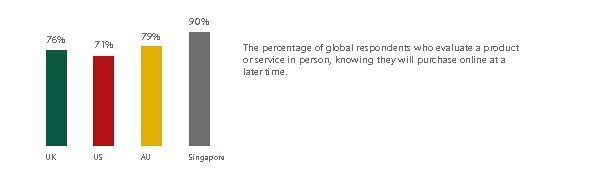
South East Asian countries tend to a year or two behind Europe in how technology is integrated into our lives however we’re already seeing digital influence how we interact with brands in Asia. For instance a recent survey by SDL in the UK found that 90% of Singaporeans evaluate a product or service in person before buying online.

Unless Asian brands wake up to the way consumers are using digital to research and choose brands – and that means more than using a traditional model of mass and invasive ads across news and other sites – they will find it hard to compete and that won’t have a happy ending.

Stop advertising and start branding part II


A fascinating insight into the social media and mobile shopping habits of consumers in the United States, United Kingdom, Australia and Singapore has just been released by SDL in the UK.

The survey size is a little small – 4,000 people in four countries – but the results unearth new data on how social media and mobile are influencing how consumers interact and build relations with brands.

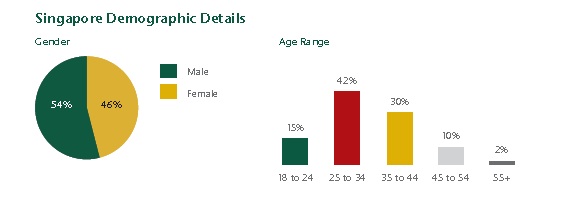
Singapore participant breakdown

Findings include:

33% of respondents from all four countries have acted on promotions seen on social media.

58% of respondents have shared positive experiences online and have sought advice from friends and family when talking about brands on social media.

U.K. respondents are more likely than respondents from the other four countries to complain about service on social.

When respondents express feedback, Facebook is the most popular platform to do this.

Showrooming (visiting a physical location to evaluate products and services even when you know you will buy online at another time) is increasingly prevalent as 77% of participants showroom.

Experiential branding key to branding success

62% of the participants use a mobile device when in stores to compare product prices.

69% of respondents from all four countries expect a brand’s online store, mobile app, and physical store to offer the same pricing, discounts and sales.

Pricing consistency is expected in all countries

What can brands learn from this thought provoking survey?

They need to understand their relationship with consumers and what resonates with those consumers.

Brands that ensure parity in pricing and products across multiple channels will have to place greater emphasis on the customer experience and experiential branding if they want to win and retain business. Those that compete on price alone will soon be out of business.

Department stores and other retail outlets that represent multiple brands will have to work harder to engage consumers and ensure a positive brand experience otherwise they face the prospect of losing customers, possibly forever.

Mobiles are changing the way consumers research and learn about brands.

Brands that take the time to build relationships with core fans or brand evangelists will see their brands promoted to thousands of fans for minimal financial investment.

Those brands with digital brand strategies that go beyond tactical campaigns online are increasing sales through loyalty and advocacy.

Brands that try to control content and manage corporate driven messages and ignore consumers are unlikely to last very long in the consumer economy of today.

Telling the brand story online should be done across Facebook and other popular platforms with the ongoing development of corporate and consumer content.