Malaysians haven’t changed since 2003


Omnicom Media Group (OMG) announced yesterday that newspaper advertising in Malaysia is as effective as it was six years ago. The report also states that readers ‘take note’ of 57% of newspaper ads and that this figure has not changed, I repeat, has not changed since 2003.

The sample size was 1,023 readers aged between 15 – 34 in four locations. They were tested on their recall of 15 ads in different sizes and in different places in newspapers they had read. The number of ads tested was 2,452 that appeared in 15 ‘main’ newspapers.

The agency developed what they describe as ‘three indicators of effectiveness’

1) Ad Noting or ad recall
2) Ad read or readers attention
3) Brand recall

The reports states that bigger ads perform better with a full page ad yielding 21% higher ad noting than a quarter page. Furthermore 60% of colour ads are noticed compared to 53% of B/W ads.

I got my information from this article and not from the original report which I would love to see.

So I can only go on the above data, plus some other results that don’t deserve to be published.

So what is my beef with this report? Well, in no particular order, the first issue I have is with the methodology. The report doesn’t tell us if the responses were aided or unaided. Critical. My second beef is with the ‘indicators of effectiveness’. There was a time, many years ago when newspaper advertising, with its one-size-fits-all mass marketing approach was effective. But not today. Awareness, or noting, or recall is simply not enough to turn a prospect into a tryer. And even if readers are bucking the global trend and not blanking out these and other messages but are indeed noting these ads, so what!?

Another beef is with the number of ads and the channels. 2,452 ads that appeared in 15 newspapers. That’s a lot of ads in a lot of newspapers. Most of us would find it hard to think of 15 mainstream newspapers in Malaysia. I’d also like to know which ads they were shown. For instance, were 15 year olds shown Louis Vuitton ads? They might recall it but what are the chances of them buying the product?

When we have a first meeting with a prospect, one of the first questions we ask is, “Have you read the paper today and if so, which ads do you recall?” Very, very rarely does someone actually recall an ad. And many of them were reading the paper as we walked into the meeting!

The time spent by Malaysians online went up 24% from 3 hours a day in 2006 to 3 hours and 46 minutes a day in 2008. With broadband penetration forecast to be 50% in 2010, that figure is going to rise significantly. Already, 80% of affluent Malaysians (those with a household income above RM5,000) use social networking sites. The time Malaysians spend interfacing with traditional media will suffer. But perhaps the most telling statistic of all is one that appeared recently in the Star, “78% of people trust the recommendations of other consumers, while only 14% trust advertising.”

So even if consumers are noting or recalling or whatever the latest term is, it doesn’t really matter because 86% of them don’t believe what they read in the advertisements so they’ll never buy the product!

Acquisition versus retention


The image below is a rather amusing yet fairly typical example of the importance most companies place on retaining customers. FusionBrand anecdotal research suggests that companies invest 85 – 95% of their marketing resources into the acquisition process and only 5 – 15% into the retention process. Can anyone explain why?

After all, according to Bain and Co, a firm has a 15% chance of selling to a new customer and a 50% chance of selling to an existing customer. Wouldn’t it make sense therefore to invest more in retaining customers than acquiring them? Furthermore, once a prospect becomes a customer, it is a lot easier to build a relationship with that customer, using content that is relevant and interesting to them, and not via the mass economy blitzkrieg popular with most advertising agencies.

Your thoughts?

Dodge seeks survival with mass economy approach


Chrysler has, like most US auto manufacturers, with the exception perhaps of Ford, seen its market share drop further in 2009. But this time it is down below the psychological 10% barrier at 8.9%, down from 11% in 2008. Sales are down a worrying 40% over the same period. This is not good, especially as the company stated in early 2001 that it intended to have 20% of the US market by 2005.

A restructuring plan in November 2009 introduced a number of initiatives including using models from Europe to mask the fact that Chrysler has made little investment in new products.

In what has become a depressingly familiar process, executives at the restructuring also introduced a number of new positioning strategies for the Jeep, Ram and Dodge brands. According to the executives, new models are to be redesigned or improved in times quicker than ever known to the industry. Ambitious sales figures include global sales targets of 2.8 million vehicles by the year 2014, of which about 60% are projected to be in the US. The firm forecast break even in 2010 and anticipated posting a profit in 2011. Revenues are forecast to be in the region of US$70 billion.

Specific brand initiatives include the biggest marketing budget for the Jeep brand in four years. Showrooms are to be redesigned to reflect off road heritage and Jeep managers will engage more with consumers at events. Meanwhile at Dodge, another new logo has been created to reflect a ‘sporty, youthful, inexpensive’ car. New entry level cars are to be available in different ‘flavors’ or equipped ‘differently’ not ‘expensively’. Are there such words as ‘differently’ or ‘expensively’?

Ralph V. Gilles was appointed President and Chief Executive Officer of the Dodge Car Brand in October 2009, with full profit and loss responsibility for the Dodge car product portfolio. Before this he was VP of design. He is responsible for halting the Dodge slide but to do so he is going to need more than a new positioning strategy, new logos and a one-size-fits-all approach to marketing. Unfortunately the signs are not good as he has appointed Wieden & Kennedy, an advertising agency to build the Dodge brand.

Gilles is on record as saying that Dodge cars are, “Cars that make you feel good, that are niche-like in their demeanor, but have mass appeal.” Well I’m sorry, but that sounds to me like a one-size-fits-all typical mass marketing ad agency driven concept that will, in the end, appeal to nobody.

What do you think?

Outstanding performance by Tourism Malaysia


Tourism Malaysia should be commended for its performance last year. A total of 23.65 million visitors in 2009, beating the target set by Putrajaya by an impressive 4 million. In fact the 2010 target of 23 million visitors was beaten by over 500,000 visitors. This generated over RM50 billion for the country despite the difficult global situation.

You may be interested to learn that FusionBrand carried out the research that addressed numerous areas and culminated in over 300 actionable recommendations, including that TM move away from a global one size fits all strategy to a geographic focussed, segment specific stategy.

To realise these recommendations, FusionBrand also wrote the 2009 Tourism Malaysia global brand plan and 12 key market brand plans that were the back bone of the Tourism Malaysia brand strategy for 2009.

FusionBrand would like to think it was responsible, at least in a small way, for part of this impressive performance by an organisation that will be, within 10 years the number one industry in Malaysia, in terms of revenue.

What is the impact of the mosques referendum on the Swiss brand?


Last month a much reported public referendum in Switzerland voted to implement a complete ban on the construction of minarets in the country.

The referendum, sponsored by the right-wing Swiss People’s Party sparked numerous national debates and 57.5% of the electorate voted in favour of the ban. This despite the protestations of the ruling pary of Switzerland, religious and business leaders who all campaigned for a no and public polls that suggested a significant majority opposed the referendum.

This is not a political blog so I won’t go into the details, but I am curious to know what people think about the consequences of this decision in respect of the impact it will have on the Swiss brand. Switzerland has an image of a country that has respect for human rights, no doubt influenced, ironically, for a tradition of religious tolerance. Although the decision is likely to be overturned in the European Court of Human Rights, the Swiss image of neutrality and tolerance may have been damaged. If it has, what are the consequences of this, from a branding perspective?

After all, the country is home to many international brands, especially from the financial services industry and luxury brands. These luxury brands and financial institutions are popular with Muslim consumers from all over the Muslim world.

Will we see these Muslim consumers withdraw their funds from Swiss banks and transfer them elsewhere? Will they shun shops selling Swiss watches and other jewellery? Does anyone have any thoughts or firm data on the impact of this decision on the Swiss brand?

Does shock and awe advertising still work?


This is a brutally graphic public service announcement from Australia’s Transport Accident Commission (TAC). Viewer discretion is advised.

This is an immensely powerful piece of work beautifully executed. And it had an emotional impact on me. All the characters resonated with me as I imagined myself as many of them at various stages of my life. At the end I was breathless and close to tears.

But the question being asked by Bill Green is “Does this stuff work? Really work?” According to Bill, TAC says yes. According to TAC, “in 1989 the first TAC commercial went to air. In that year the road toll was 776; by 2008 it had fallen to 303”. That fell again to 295 in 2009. However, despite these powerful commercials, 16 people died over the Christmas period.

Topically, I have just spent 10 days in Australia over the festive period and the only TVCs I can recall were for alcohol (beer and hard liquor) and fast food. I was stunned to see so much alcohol advertised on TV. I didn’t see this TAC commercial or if I did, it didn’t register.

Using creativity to communicate
Advertising, and in particular well executed advertising, used to be a great way to reach a great many people over a relatively short period of time. With less competition, more accepting and attentive consumers, such reach could ensure the message was received and absorbed by the right people. Not anymore. Mass media has fragmented into niches and communities. Using creativity to communicate a message is no longer effective because the message is blocked out or soon forgotten because we simply don’t have the interest or bandwidth to absorb all the messages assaulting us throughout the day, every day. Increasing frequency doesn’t help, it makes it worse as it adds to the noise. Even beautifully executed work like this is lost in the fog of products and services.

I wrote an article about a similar approach used toward smoking in the UK and Malaysia. You can read the full article here,

Chilling commercials don’t work
With smoking, the research, carried out over 10 years by the Institute for Social and Economic research found that the warnings on cigarette packets that smoking kills or maims are ineffective in reducing the number of smokers. Likewise, chilling commercials or emotionally disturbing programs are also ineffective. The study also discovered that when a close family member become ill from the effects of smoking, the smoker takes no notice. In fact, according to the study, smokers only reduce the number of cigarettes or sometimes quit when their own personal health is at stake.

In Malaysia, despite nearly US$50 million spent on shock and awe campaigns to create awareness of the dangers of smoking, the number of smokers has practically doubled every 10 years. Whether or not there are parallels between campaigns for smokers and those who drink and drive, I don’t know.

Personally, I suspect that the reductions in fatal traffic accidents since 1989 are due to better safety features in cars, better roads, better lighting, highly visible enforcement measures, increased penalties for offences such as not wearing seatbelts and using mobiles, reductions of speed limits, more drug testing and better educated consumers.

The key then is not to add to carpet bombing of consumers via advertising, but to identify how those consumers become better educated? Was it the commercials or a reaction to the commercials or other initiatives?

Pubs legally obliged to breathalyse patrons
This can be done using qualitative research with consumers and then use that data to forge future strategies. It may be expensive and time consuming, but it will give us the answers we are looking for and determine future strategies. Of course it may be that it is not the commercials but in fact peer pressure at key times such as when consumers leave a pub, club etc. I think this may be the case and I see a time, not too far in the distant future when all bars and restaurants have to, by law, breathalyse all patrons as they leave the premises.

Personally, although this is a powerful TVC, I wouldn’t watch it again. If this commercial came on, I would change channels because if I am watching TV, I don’t want my leisure time to be challenged by issues I don’t want to address at that particular time.

Thanks to Andy Wright for the heads up on this story.

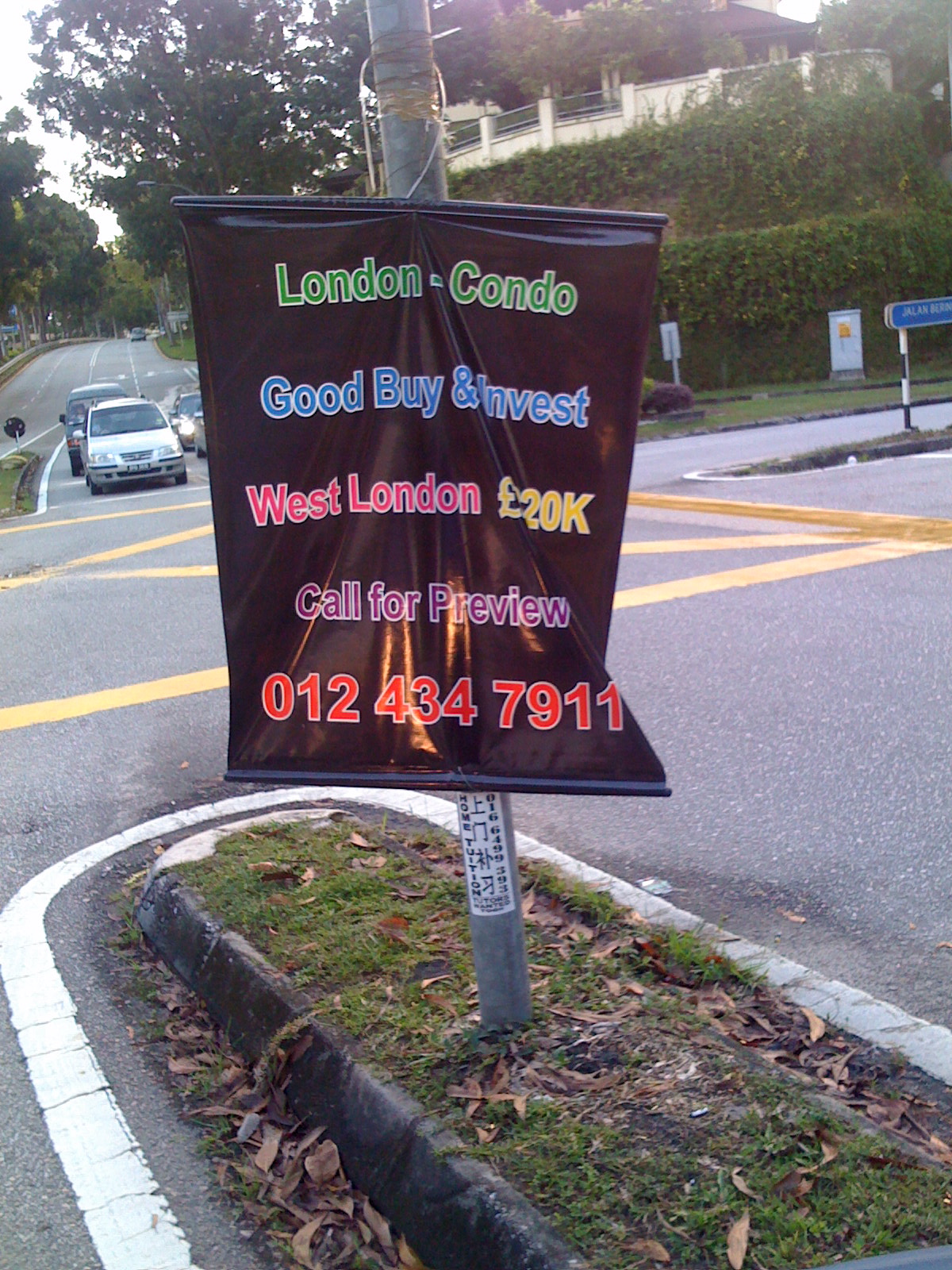
How not to sell a London property to Malaysians


I spotted the sign below on a lamp post in Damansara this morning. In case you can’t read it, the content is as follows:

London – Condo
Good Buy & Invest (sic)
West London £220k
Call for Preview
012XXXXXXX

I cannot believe that a genuine UK property developer or estate agent would encourage a company to sell million Ringgit properties with signs on lamp posts. After all the UK property market, and in particular the London market is benefitting from substantial investment and has hardly been affected by the global financial crisis.

Commercial property
Jones Lang LasSalle expects the total direct investment in commercial real estate in the UK to be around £23 billion (RM125billion) for 2009. Prime yields in the West End are 5% and in the city, around 6.25%. That’s impressive compared with a bank rate of, well about 0%.

Residential Property
Meanwhile, the residential market is also performing strongly. International buyers increased by 25% in 2009 compared to 2008. Most of the investment is coming from Europe, Russia and the Middle East. Knight Frank estimates demand from new buyers is “almost 25% higher than a year ago” and “prices have now risen 13.8% in the nine months since March.”

In fact, most of the investment is coming from the overseas market. Foreign buyers account for 80% of the investment, the highest ever. Indeed, the average over the last 10 years has been closer to 46%. The latest sources of this overseas investment include Oman, Libya, Lebanon, USA, Korea and Ireland.

UK property roadshow
Little wonder then that Malaysian firms want to get in on the act and sell UK property. I can’t find any figures on the total Malaysian investment in the UK or London property market however, the recent launch of a luxury development at Imperial Wharf, London, Malaysian buyers purchased £9.25 million (RM56 million) worth of luxury apartments and penthouses over the 2-day road show in Kuala Lumpur.

Olympic games
With more than 10,000 Malaysians studying in the UK and a number of companies keen to make the UK their European HQ, there are going to be plenty of willing buyers. Especially with the Olympics to held in London in 2012.

Wrong way to sell
But this is not the way to sell those properties. It dilutes the value of the property, negatively impacts the credibility of the local representation and makes it harder for future efforts to sell UK properties here in Malaysia. But worst of all, it portrays Malaysia as an amateur in a professional world.

Updated: 11th January 2010. I have since called the number on the bunting. I spoke to a nice guy with a pleasant attitude. I asked him where the property is. He stated the property was in South Ealing. As I know this area well I asked for the exact location and I consider it to be more Brentford than Ealing. He asked for my email address and promised to email me more information.

That was last Thursday, I have not received anything as of today.

Case study – How a Malaysian Company built its brand from the inside


Senior executives at a Malaysian technology related firm were frustrated. Sales growth was not meeting expectations, despite the firm’s 20-plus year track record, strategic partnerships with top international firms, excellent service and high profile advertising campaigns.

To boost sales, the firm had explored common alternatives – price cuts and an expensive marketing campaign. But although such actions had a short term impact in the past, there were no long term benefits and they hurt profitability. So the senior executives decided to look at another option – increase sales effectiveness by reviewing sales processes and tools, increasing the sales close rate and shortening the sales cycles.

Headquartered in Kuala Lumpur, the firm specializes in boosting supply chain and other efficiencies through both product sales and software and other integration. With offices in Singapore, Thailand and other Asian countries, the firm has a blue-chip list of customers that includes some of Malaysia’s largest companies. Sales had grown steadily over the previous decades, but the firm was now facing price-based competition from China at the same time as it was weighing opportunities to go public.

Issues
After looking at the issue, senior management determined that the sales problem was not due to a lack of leads. The firm received a steady supply of leads from word-of-mouth and customer referrals, as well as from its strategic partners. The sales staff also cold-called regularly for leads.

The main issue was converting those leads into sales. Qualified leads languished in the sales pipeline for months or even years. Too often, active senior management involvement was required to close sales, which took time away from expansion, financial and operational issues. The sales force constantly pressured management for price cuts to make sales. Even when sales were made, opportunities for sales to other divisions or branches were rarely leveraged. Too many sales were for low-margin commodities and replaceables, when the firm wanted more profitable service, maintenance and IT integration contracts.

Management had earlier tried to address these issues with automation (providing laptops to the sales force and installing a low-end CRM system), new sales compensation schemes, re-organization (creating a department just for telephone sales) and other steps. But sales still were not meeting expectations.

Traditional sales training
So the managing director decided that the best solution was to upgrade the skills of the 15-member sales force and other customer facing departments, and requested bids from multiple training companies. The most common proposal focused on sales training that emphasized lead development and closing skills. However, such training was generic to almost any industry.

Another, more expensive option, was a comprehensive approach that included revamping its sales processes and skills around the company’s offerings and requirements of its customers. After careful consideration, the company decided that an improved sales process and customized training provided the most value, and contracted with the sales development division of Malaysia’s leading customer driven brand consultancy, FusionBrand.

Sales audit
The first step was an in-depth sales audit that sought to uncover issues hampering sales as well as opportunities for improvement. FusionBrand conducted hour-long, confidential interviews with senior management, sales managers and many sales personnel. All sales material, including brochures, proposals, quotations, sales scripts, pipeline reports and other information, was reviewed and analyzed. Current as well as “lost” customers were interviewed for their critical perspective on the sales process and their reasons for buying/not buying.

The sales audit resulted in a comprehensive sales process analysis that identified strengths and weaknesses in the sales process as well as in the sales material. For example, the sales pipeline report, a key tool for sales forecasting and supplier orders, was both out of date and contained inaccurate information, making it difficult to prioritize resources and estimate future sales. The sales process analysis included numerous specific recommendations for improving sales processes, reports, collateral and proposals.

Many graduates of training courses complain that the material studied was not relevant to their industry or customer requirements. This issue did not arise because FusionBrand carried out a sales audit first. Information learned during the sales audit was then used to develop two customized sales training courses that incorporated actual customer, product and sales situations. Furthermore, the number of attendees was limited to 12 to ensure that each sales person gained maximum benefit from numerous role-plays and hands-on exercises.

The first customized, two-day course focused on sales basics, ranging from lead development, time management and closing. Special attention was paid to dealing with price-based objections. About four weeks later, the second customized course was held in 5 half-day sessions over a three-week period to minimize the impact on sales time and provide more opportunities for review and retention. This course focused on “strategic sales.”

Many training courses assume that sales can be made in a single sales call. However, only commodity, low-margin products can be sold in one call. More advanced offerings inevitably require strategic sales, characterized by longer sales cycles, multiple corporate decision-makers (ranging from finance to IT to actual users) and complex requirements. Such strategic sales require understanding differing requirements for value among various departments as well as internal political issues at the prospect. Using an existing prospect that was difficult to close, each attendee developed a focused sales strategy and delivered a PowerPoint presentation designed to win over all departmental decision-makers involved in contract approval.

Sales manual development
The final phase of the multi-month effort was a sales manual. A sales manual includes standardized information on sales processes, compensation (eg, commission schedules), reporting, requirements, resources (ranging from key telephone numbers to report and presentation templates), sales tips and more. The sales manual gives the company more consistent management by acting as teaching tool for sales managers with new staff and ensures more consistent operations and reduces training time.

Results
Results have been achieved in both sales and other departments. Ordering is based on more accurate pipeline data, which has reduced inventory, freeing up capital for expansion. Morale has improved, sales personnel are more confident and less inclined to reach for a calculator at the first objection and offer discounts. The company has made its sales and presentations more customer-centric. Most importantly, sales have accelerated and sales cycles are starting to decrease.

Other internal branding initiatives were embarked on to ensure the successes were communicated and integrated throughout the organization.

Summary
Companies invest a lot in marketing to generate leads. But even all the leads in the world mean nothing until they are converted into a sale and, ideally, a long-term customer. That is why investing in your sales organization, processes, and personnel is crucial for ensuring that customer requirements for value – whether at the MD or user level — are consistently understood and addressed by the brand. Such understanding is hard to achieve from a ‘one-size-fits-all’ sales training class.

A sales process audit, customized sales instruction and sales manual can give companies the framework and structure to close more sales more often – without having to compete just on price. This in turn will build a comprehensive, well respected and, most important of all, profitable brand.

The organization is the brand


Japan Airlines was established as the national flag carrier of Japan in 1953. The government was the largest shareholder and for over 30 years, JAL was the only Japanese domestic airline with the rights to fly international routes. In other words, as a government entity it had a monopoly on those prized international sectors.

Rather than employing professionals in the industry, the government tried to run the airline, creating bureaucratic inefficiencies that had little inclination to deliver the value customers are looking for.

Hope came in the late 1980s when the government sold it’s stock in the company and the airline was privatized. In 2002 Japan Airlines System was incorporated to manage JAL and by 2006 the airline’s daily operations had reached 192 international routes and 387 daily flights.

A new brand identity and aircraft livery themed around ‘the arc of the sun’ was created and it was hoped that ‘the identity would help JAL build a stronger global brand and position a JAL flight as a means to acclimatizing to Japanese culture, attempting to attract more international business people flying to Japan to choose JAL over other international carriers’.

In 2010, JAL is fighting off claims of imminent bankruptcy by multiple media organizations. According to etravelblackboardasia.com, JAL has experienced financial difficulties for quite some time and currently owes more than US$5.8 billion.

JAL shares plunged to a record low in Tokyo trading last week, however the airline is still positive that it will experience a turnaround with the support of the Japanese government. The site also quotes a JAL spokesperson as saying that reports that JAL was planning to cut all of its international routes to cut costs are 100% false.

Well, only time will tell but it is crystal clear that the airline is in big trouble and is surviving on bail outs from the ETIC (Enterprise Turnaround Initiative Corporation of Japan).

What lessons can other legacy carriers learn from this?

Using creativity to build a brand.
When Japan Airlines and Japan Air Systems merged, the idea was to provide the foundations for a more efficient organisation to compete both domestically and internationally. Nothing wrong so far.

Next came the development of the brand image. This was to clearly communicate the fact that the merger had created a new and improved organization. According to Landor, the JAL agency, “the JAL brandmark needed to express a new business philosophy and strategy and at the same time be flexible enough to apply at every touchpoint where travelers, airline employees, and travel advisors have exposure to the brand.”

Landor also says on it’s website, “The JAL mark reaches dynamically to the sky. It is derived from the motif of a rising sun, one of the best-known icons of Japan. The mark is drawn in a modern way and is reflected in the red sun on the tail of the aircraft. In 2002, the integrated holding company was established and the JAL mark was introduced. It is now visible in advertising, ticketing, airport environments, and the combined fleet of aircraft. Implementation of the design will be gradually executed through prioritized applications.”

Sounds good, but the problem is that consumers aren’t buying that stuff anymore. Positioning products belongs in a mass economy that no longers exists. There are too many airlines essentially positioning themselves in the same way. This is because positioning and the 4 ‘Ps’ are imprinted on the DNA of an entire generation of marketers. But the market conditions have changed and it is time to bury the concept otherwise we’ll see more companies in the same position as JAL.

JAL should have focussed it’s brand building efforts, not on reaching for the sky with a motive derived directly from the sun but on providing value to customers based on bespoke relationships with existing customers, access, relevant content to relevant segments, userbility, technology and more. Sure a slick identity is important but it will not build the brand on its own.

Strategic relationships
JAL was late joining an airline alliance which meant it couldn’t offer the interconnectivity of competitors. This has had a profound impact on the airline. ANA, JAL’s competitor joined Star Alliance in 1999, eight years before JAL joined ONEWORLD.

Operations
Although once the airline was privatised, it did reduce costs by cutting staff levels and employing cheaper foreign staff, it still operated at high unit costs which had a negative impact on operating effectiveness.

The right technology
It is critical to invest in technology that is user friendly. JAL’s flight planning software is awkward and confusing.

Flexibility
Like many airlines, JAL focussed on attracting customers to the high yield spots at the front of the plane. There is a general theory (I don’t know how true it is) that if you fill business class on a 747, the flight is paid for and the rest is gravy. This is a common strategy but in the recent economic meltdown it’s not a very effective one.

Despite no longer being a government company, JAL was slow to adapt to the economic situation and suffered as a result. It is imperative therefore that airlines become more nimble and whilst a strategic plan is important, it has to be versatile enough to adapt quickly to challenging market situations. At the same time, it has to be adaptable to take advantage of opportunities.

I doubt very much that the Japanese government will let JAL fail. But what about other Asian legacy carrier established by governments to fly the flag globally? Many of them are already sucking funds out of already empty coffers. Will they be alowed to fail?

Tips for building a retail brand


In terms of service, Christmas shopping this year has been a roller coaster ride from the highs of the interactions in the luxury stores of Pavillion to the lows of the interactions in the wannabe Malaysian fashion store in Mid Valley.

And even though approximately 85% of the interactions have left me frustrated, I want to be positive during the festive season and so am offering free advice to those retailers in Malaysia who want to build a profitable brand.

1) Teach your staff to smile when a customer walks into your shop. It costs nothing and instantly makes the customer feel welcome.

2) If you are a clothes store, get your staff to wear your clothes. If you are not a clothes store, develop a company policy on dress and stick to it. It may also help if you are responsible for laundry, that way the clothes will get washed.

3) Make it a company policy that all customer facing staff must have a shower and brush their teeth EVERY day, before coming to work. This is especially important in restaurants.

4) Teach your staff to approach the customer and say ‘good morning/afternoon’ etc with a smile on their face.

5) Teach your staff to understand how to respond if another customer interrupts a transaction. Essentially, teach them how to say no.

6) If you are a luxury or high end store, make it a company policy not to allow staff to drink from plastic bags when customers are in the store. Actually, make it a company policy not to allow staff to drink from plastic anything, ever.

7) The same goes with food. I walked into one store as a member of the staff was eating at the counter. He was on his own so came to serve me. I walked out 9 seconds later with half his samosa on my lapel.

8) The opening line, “Can I help you?” Begs a negative response. Teach your staff to try something open ended, such as “Are you looking for shirts or trousers?”

9) Sales staff are not order takers. If a customer, despite all the attempts by your staff to prevent him from making a purchase, insists on buying something, teach your staff to show something that goes well with the purchase. You never know, you might actually sell something else.

10) Listen carefully, the statement, “NO STOCK LAH!” is being used by many staff to get the prospect out of the store so the staff member can go back to sending sms messages to his friends. Teach your staff to apologise profusely for the fact that they just sold the last piece 15 minutes ago. Teach them to then explain that they will be happy to call other branches to see if they have the relevant product/size/colour. If you don’t have other branches, then teach them to ask nicely for the prospect’s number and explain that your customer service representative will call the prospect as soon as the correct product/size/colour comes in.

11) If someone buys something they have gone from being a prospect to a customer. Remember all that money you spent on launch party/PR/mailshots/leaflets/brochures/billboards/print ads etc? Well, you did all that for this moment. It wasn’t to create awareness, it was to drive this person to your store. And now he’s bought something, what are you going to do? Well, most of you let him walk out the door! Are you nuts? You have a 5% – 15% chance of selling to a prospect and a 50% chance of selling to an existing customer. So what is the point of letting a new customer walk out the door? It’s criminal! I’m serious! Be nice to this person, flatter him, spoil him, kiss him, do whatever it takes to get his contact information because he is now a customer. He is familiar with your product, your store, your staff, despite their best efforts. Your job now is to get him back into the store, preferably tomorrow!

12) Not every white person is a tourist. And not every tourist is a white person, but that’s another story. Just because a customer looks like a tourist, doesn’t mean he is one. Moreover, if he is wearing a suit, he probably has a white collar job which means, in Asia that he is probably paid well. Even if he is visiting, he may be back or he may be lonely so ensure your staff engage him.

13) The needs of a Saudi are different to those of an Englishman. And the needs of an Englishman are different to those of a Korean. You get the point. Invest in some training that teaches your staff to be able to develop rapport with different nationalities.

14) Pay your staff a commission on sales. If you don’t where is the incentive to sell your products? Without a commission, all the staff are doing is increasing your energy bill and destroying your brand.

15) While we are on the subject of remuneration, I suggest you pay your staff more. Every sales person I spoke to complained about their salary. One was earning RM550 per month, with no commission. That is slavery. Sales staff are an investment, not a cost. They represent your brand and, with the correct training, can multiply your profits enormously. And good ones are worth paying for. And before you tell me about the lack of loyalty, please don’t bother. If you create a nice environment with good pay, your staff will stick with you.

If you implement the above into your corporate strategy (if you have one, and many of the stores I visited over the last week can’t even spell it) then I guarantee you will increase your sales and move toward a more profitable brand.

I’ve got about 100 more of these but I’ve got a plane to catch. Happy Christmas!