Good consumer generated content will build destination brands better than any corporate commercials


It’s well documented how numerous companies waste huge amounts of money on ineffective advertising. Generally the advertising is ineffective because it is poorly written, isn’t tested or has been developed to appeal to as many vastly different segments as possible.

This is especially true of country brands. If I had £1 for every ‘me too’ destination advertisement that I’ve seen on TV, heard on radio or seen on a website, I’d be a rich man. Time and time again I see beautifully executed ads for destinations such as Thailand, Egypt, Malta, Malaysia, Bali and others that are all selling the same things – beautiful white sandy beaches, crystal clear waters and cloudless blue skies.

These ads are pushed out across traditional media in the hope that enough people will see them, buy into them and eventually visit the country. If the campaign doesn’t work (and no one knows whether they work or not), the agency is generally sacked, a new one appointed and the whole process starts again.

Basically this model uses Hope as a strategy – hope the timing is right, hope it will be seen, hope it will be liked, hope it will be remembered, hope it will influence viewers enough to reject previous choices, hope the destination will be researched, hope the inevitable competitors that are seen at the same time will not influence viewers, hope this and hope that.

But it doesn’t need to be like that anymore. In the social media era, when consumers not countries define brands and the Internet provides copius amounts of information from other like minded consumers to help influence the decision making process, destinations need to be reaching out across this channel and leveraging consumer produced media to market themselves.

This approach requires a massive mindset change and will revolutionise the traditional organisational hierarchy but it has to start soon or destinations will lose the increasingly brutal competition for heads in beds.

To illustrate this point, I came across one video that is an outstanding advertisement for Kuala Lumpur, the capital of Malaysia. It didn’t cost the Malaysian Tourism Board a penny and is a far better advertisement than any advertising agency produced Television Commercial.

Tourism Malaysia needs to have a community team scouring the web for such content and must then distribute such content across multiple channels to generate buzz and interest. This content will allow destinations to engage directly with influencers and other consumers in a way that traditional media does not allow them to.

This really is an impressive video. I suspect that after you watch it, Malaysia will go to the top of your list of must visit destinations.

Enjoy!

<a href="

Kuala Lumpur DAY-NIGHT from Rob Whitworth on Vimeo.

” target=”_blank”>
Sabah criticised for low growth in tourist arrivals, is it justified?


One of the less mainstream online newspapers carried a scathing attack on Sabah Tourism Board today. You can read the article here

The paper carried extensive comments from a local activist who slammed the State government for recording what he called a ‘paltry’ 1.1% growth in arrivals for 2012 and blames this growth on a lack of planning.

I’ve worked to develop the tourism brand in Malaysia at both the federal level and with some of the State tourism boards and I have to say that although I have not worked with Sabah, from a distance, I think Sabah tourism is one of the most accomplished State tourism boards in Malaysia.

I do know that the State has invested in Tourism infrasture and although it has made some mistakes (name me a country, State or region that hasn’t), the Sabah Tourism Board appears to have worked hard to develop the industry and attract visitors to the State.

However, I do agree that a well thought out short, medium and long term plan that is flexible enough to react to the dynamic world today that focusses on delivering economic, experiential and emotional value (and not ‘me too’ advertising campaigns that do nothing more than waste valuable funds) is key to delivering a destination that not only survives but thrives. And as far as I know, not one State in Malaysia has a clearly defined brand strategy going forward.

One other issue that Sabah and Malaysia in general face is the lack of new products in the state and indeed in the country. Many of the visitors to competitor destinations return year after year because there are new products, opportunities and more.

In the face of growing regional and international competition and the changing tourism demographics that will see tourists from India and China looking for more than a beach resort with a well stocked bar, States such as Sabah and countries like Malaysia will have to invest in new products otherwise any growth, however low will soon turn into a decline.

Consumers have changed, has your marketing strategy?


Doe this sound familiar?

You need to spend time creating a position that is driven by the corporation.

Once created, the position must be communicate across traditional media (with a nod toward social media, but a nod only) to as many people as possible and hope that some of it sticks.

If it doesn’t, create a new position and repeat ad nauseum. Hopefully you will get it right. If you don’t, well you can always discount. This model was developed by Jack Trout in the 1970s. I wrote a blog post about it here

Sadly, despite US$1.5 trillion spent annually on marketing, 70% of today’s manufactured goods will be obsolete in six years (Industry Week magazine). There are estimated to be more than 30,000 new product introductions in the US alone every year, and that’s just in the packaged goods market. According to AC Nielsen, up to 90% of products fail to become brands. This means that as many as 27,000 of those new products will fail.

Today’s consumer has changed the way he lives his life and moreover, markets are so fluid, spending time developing a position and watching your competitors is the fastest route to business oblivion.

The key to success is the sales force and their ability to build your business through collaborations and by matching products/services to individual customer requirements for value and then maintaining those relationships and your brand communities team who develop brand evangelists and influence influencers.

And with social media and modern technology, that is not difficult. A lot less difficult than creating a position and pinning all your hopes on, well hope.

How effective is your country brand strategy?


Bloom Consulting has just published the 2012 Bloom Consulting Country Brand Ranking which classifies countries based on the effectiveness of their country brand strategies and the impact this has on GDP.

the 2012 Country Brand ranking

In an email to me the Ranking was explained as having a different methodology to other indexes such as the Futurebrand or Simon Anholt rankings as it “conveys dozens of variables in order to position the countries by facts and mathematical algorithms instead of pure opinions, like other country branding rankings do”.

The ranking “takes into account both hard and soft data and includes ground breaking processes to show the relationship between the country’s economic performance and the projections of the country’s brand strategy.”

It doesn’t explain what those processes are, how it gets access to those projections or how it measures them but I do like the fact that someone is trying to develop branding metrics for destination branding initiatives.

“The methodology measures the coherency between the external messages of a country and its actual economic performance under a certain period of time.

The higher a country is on the list, the better they are compared to their competitors, in positioning themselves to attract either Foreign Direct Investment (FDI) or tourists”.

Bloom doesn’t believe that it is possible to develop a single promise for a country and this I agree with (and have been saying for years – please read this article on nation branding). We’re working with destinations in Asia trying to attract tourists from the region, talent from the country and heavy industries from North Asia and North America. Trying to create an umbrella promise for such diverse target markets will be an exercise in futility!

The email went on to say, “this year Bloom incorporated Online Search Demand (OSD) into the ranking. This looks at the gap between what countries are promoting (supply) and what investors and tourists are searching for (demand).

Bloom Consulting uses the OSD along with an analysis of each country’s brand strategy to assign each nation a Country Brand Strategy (CBS) Rating©. This identifies the accuracy match between supply and demand and allows Bloom Consulting to assess the best country brands”.

You can read the report and get more information on the methodology, from this page. Or you can look at an interactive version here.

What’s interesting from an Asian perspective is that Asian countries are big winners in 2012, especially in tourism. Although the USA was top for the second year running, eight Asian countries were in the top 25.

China was the top Asian country at 4th, Thailand 6th, Macao came in 8th, Hong Kong 13th, Malaysia 14th and Singapore 22nd.

Japan was down in 28th place, no doubt the Tsunami played a part although the Arab Spring didn’t seem to have too much of a negative impact on Eqypt which, all things considered did well to come in at 31st.

A great example of how to drive traffic to your retail outlet in a slow month


Today is a landmark day for retailing in the UK as Selfridges “The best department store in the world*” launches a “No-noise” experience at its major stores across the the country.

It’s a pretty cool concept, offering a Silence Room where customers can ‘find a moment of peace in a world where we are bombarded by a cacophony of information and stimulation’. Customers will be asked to leave their shoes, mobile phones and anything else that makes a noise at the door.

Interestingly the store also aims to reduce the visual noise and has encouraged some brands to offer ‘de-logoed’ products. Paul Smith and Heinz are already onboard with others expected to join in later.

There will also be meditation sessions, quiet music performances (that’ll be a challenge), art exhibitions and motion sensor window displays. Selfridges will also take its name off the classic yellow shopping bags.

You can see more about the Silence Room and other elements of the event on the Selfridges site.

Personally, I think this is a brilliant concept as it understands what customers are looking for and takes experiential branding to a new level. What do you think?

*Global Department Store Summit, Paris. 2012

To engage consumers, Jakarta needs to improve its communications


As the world attempts to shake loose the shackles of the economic meltdown, competition for tourists from both established and new markets is gathering pace.

But the new environment is an even more competitive one. There are almost 200 countries worldwide and over 100,000 places in Asia alone, actively seeking to attract and retain tourists.

As a result, it is increasingly important that destinations seeking domestic and international visitors have a well researched, structured, long-term strategy for increasing visibility & engaging the right segments to generate arrivals.

One relative newcomer to this tourism marketing battleground is the city of Jakarta, the capital of Indonesia, located on the island of Java and the capital of Indonesia. If you haven’t been to Jakarta I recommend you go as soon as possible because it is a fascinatiing destination.

I spotted this ad in a Malaysian daily recently.

Does this ad make you want to get more information on Jakarta?

It would appear that the people at the Jakarta tourism and culture department are looking to attract visitors to Jakarta with the promise of great shopping. However, as a consumer, without knowing anything about the rest of this campaign I can tell you that this ad needs work.

Firstly, what is the headline trying to tell us? Is it telling us that time is irrelevant? This is an existential argument and possibly true but in this situation not relevant. Perhaps it is saying, “don’t worry about time when you go shopping in Jakarta”? Or to be more specific, when you go shopping for shoes because after looking at this ad, am I wrong to assume Jakarta is a great place to buy shoes?

There is no call to action, the image of the shoe boxes looks photo shopped onto the main image and there isn’t a website address to gather more information.

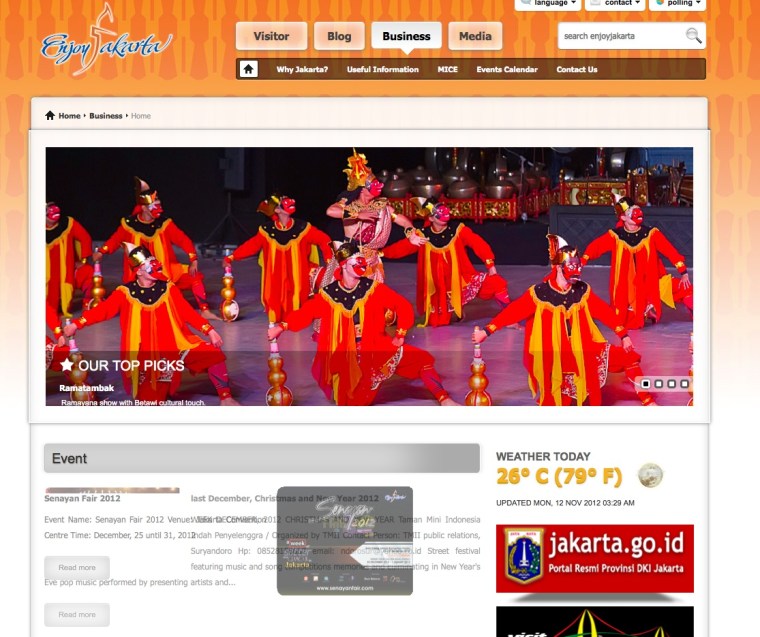
So I took it on myself to google (other search engines are available) “Enjoy Jakarta” and arrived at the official Jakarta travel website where I couldn’t find any information on enjoying Jakarta, shopping or even shoe shopping.

Not the best introduction to what Jakarta has to offer

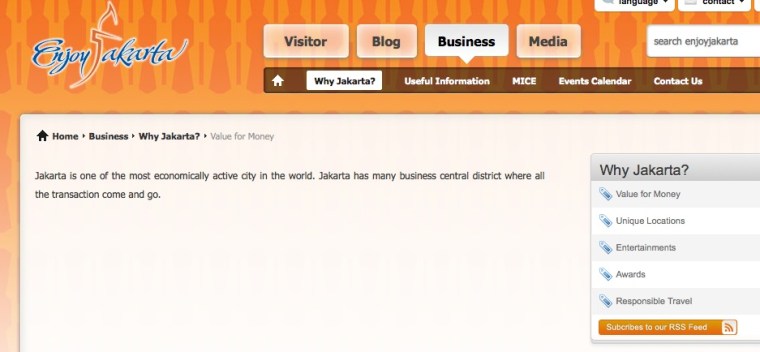
I spent some time on the site and for what it’s worth, I found the site very slow, difficult to navigate with limited information and English that needs proof reading before pubication. When I clicked on the “Why Jakarta” tab on the drop down menu, the information provided was hardly compelling and unlikely to attract investors. And talking of investors, is this a tourism site or a business site?

Not the most compelling of arguments

Moreover, I found the information above the fold didn’t match the information below the fold and when I clicked on Wine and Dine in the footer, all I got was a list of restaurants which to a first time visitor would mean nothing.

This won't mean much to anyone
This won’t mean much to anyone

Today, audiences rely less on traditional media to source information, making them increasingly hard to reach. Furthermore, consumers are less inclined to see or be interested in a corporate driven message delivered across traditional media.

But as the reliance on traditional media diminishes, opportunities arise in new and social media. Where before, companies were dependent on content from the media owners, today they can create their own content that resonates with specific consumers and their interests.

Consumers too are developing their own content and it’s important that destination brands such as Jakarta understand this and provide channels for consumers to create and share content.

It is good to see Jakarta looking to encourage visitors to this exciting city but it will take more than the print campaign and website reviewed in this article to be successful.

Great tips for using email to build your brand


More and more firms are using effective email campaigns in association with their social media initiatives to build brands. This is because an email campaign allows you to know who is opening your emails, which links they’re clicking on and how many of your them are forwarding your emails to their friends. The right product also means you will only pay when a recipient clicks through to the offer.

Malaysian firms are slowly waking up to the benefits of a good email campaign. Let me put that differently, Malaysian firms are waking up to the fact that email is an effective marketing tool. Which is good timing because according to a recent report from MarketingProfs, email returns the highest return on investment (ROI).

The problem is that too many Malaysian firms are trying to do their email campaigns ‘on the cheap’. often they do it inhouse or if they do outsource, they outsource to the cheapest company.

This means they often send out poor quality emails that can damage the brand. it is important to get the email and the content of your email right. Because this is the first interaction a potential customer will have with your brand. It is a great opportunity to make a good impression and start building the foundations you need to earn their trust and eventually make a sale.

Unfortunately, it is also a great opportunity to make a bad impression. And once you’ve made a bad impression, it is very dificult to build trust with a consumer who is already forming a negative opinion of you and your brand.

Not only should your email campaign resonate with your target markets, it also needs to be well written and to the point. If it is full of poor English or grammatical errors, you will create a bad impression with the recipient.

Below are two examples of emails I received recently. Although I haven’t included the subject line, take it from me they were almost as bad as the copy.

poor proof readingterrible email copy

How to create a good email campaign
When you prepare an email campaign, the subject line is the most important element of the exercise because this is the first thing the recipient will see.

If there are spelling mistakes in the subject line, the reader will not have any faith in what you say from there on in. If you make outrageous claims in the subject line, the email will go straight to the trash.

Finally, if the subject line doesn’t state its point concisely, it will be ignored. Accept that it is impossible to include content in a subject line that will appeal to everyone on your mailing list. It may take more time but it is better to break up your database and rewrite different subject lines and body copy for different segments.

Once you get to the body of the email, a good rule of thumb is that less is more. Don’t waffle on and on about how great is your product or use textbook marketing jargon that confuses the reader and drives them away from the product.

Keep the email simple. Remember, you are not trying to make a sale, only get the recipient to interact with your brand. Explain what you have to offer, where the recipient can get it or gather more information, who you are and why they should buy your product or service.

Finally and most importantly, focus more on the benefits of your product not the features.

Get the message right, and email is an effective and inexpensive way to make sales, grow your customer base and build a valuable, profitable brand. Used wrongly and it is a complete waste of your time and the recipient’s time and instead of making sales and building your brand you will actually damage your brand.

Look to customers not competitors to build your brand


There was an interesting interview with Tony Fadell in the Daily Telegraph last week. Tony Fadell is the inventor of the iPod and although the interview is meant to focus on his patest invention – smart thermostats – the conversation keeps coming back to his time at Apple.

You can read the full interview here

What I found most interesting was Apple’s approach to doing business. Tony Fadell talks about branding in a refreshing, relevant way. He says, ““If you’re a company focused on competitors,” he says, “you’ll be a follower. And you’ll talk to the media about all sorts of stuff. But if you’re a company focused on the consumer you’ll talk about the products that you’ve got and how to get the most out of them.”

This is so, so true. In the customer economy, if you spend all your time looking at what your competitors are doing and then try to replicate it, you are always going to be playing catchup.

But more importantly, this is the wrong place to look because companies don’t define brands anymore, customers do. And also, loyalty is a lot harder to earn and certainly isn’t earned by a traditional, corporate driven positioning strategy.

Apple talks about it’s products but more importantly, it lets consumers talk about its products and you need to build an environment where consumers can talk about your brand. Don’t be afraid to be talked about because it is already happening anyway.

In the social economies of Asia, giving consumers platforms or building communities for them to discuss your brand allows you to track the conversations and get involved when need be.

Critically it allows you to identify and engage with influential consumers, those people other consumers listen to. Because brands need to understand that in the customer economy, success will be determined by relationships not transactions. An automotive dealer doesn’t sell cars, they build relationships with people looking to make their lives more interesting, exciting or easier.

As that relationship evolves and solutions provided, they seek introductions to others who may also join the family by buying the product. This requires an investment in the product and also in the relationships. But the investment in the product can be determined by the needs of the customers.

Take a leaf out of the Apple book and look to your customers not your competitors to build your brand.