Building a country brand requires more than just a well executed advertising campaign


If you are responsible for a country or destination brand, read on.

As cheap air travel and the package tour (as well as the devaluation of the Spanish Peseta and the abolition of currency controls in the UK) helped jump start international travel in the 1960s, 1970s and 1980s, the world was still a fairly predictable place and countries were, on the whole inhabited mainly by citizens of that country and not by the multicultural citizens living in most cities today.

Moreover, due to the social and economic structure of Western countries, consumers were only just beginning to have disposable income that allowed them to experience the concept of leisure time.

At the same time, mass media was becoming increasingly influential as consumers purchased more and more TVs and radios.

So, with more disposable income, more leisure time and the establishment of commercial television, it was now possible to reach large swathes of a population reasonably quickly and relatively inexpensively.

In this environment countries put their faith in creativity to build brands, hoping that an exotic image, tagline or promotion would resonate with prospects and increase visitor arrivals.

And generally, because of the cultural and social predictability of countries, the same message could be used to communicate with everyone.

Moreover, with few conduits to increasingly wealthy consumers who had more disposable income than ever before and with limited competition in the market place, this type of creative driven branding often raised the profile of countries enough to attract visitors.

Countries and destinations such as Spain, the UK, Kenya, Florida, Greece, The Algarve, Singapore and Italy as well as many other destinations used this approach. And in this mass market economy, mass media – TV, Print, Outdoor, with its huge reach, was the logical vehicle to enhance the impact of creative-driven branding with reach and repetition.

bemuda

italy

Early tourism ads worked because markets were similar, new, eager and easy to reach

But that mass-market economy no longer exists. Today’s consumers are increasingly overwhelmed with those creative images, taglines and promotions. And many of the messages have become so similar that it is virtually impossible to differentiate one from another. And of course, consumers have also become fed up with countries failing to deliver on promises made.

Same images, sames messages = irrelevant

Despite this new world order, countries, agencies and consultants continue to try and build country brands by using ‘cool’ advertising, creative or symbolic logo’s with pretty colours, catchy taglines and so on.

But these activities are nothing more than advertising campaigns and do very little to build a nation brand. And even the one’s that have made us sit up, take notice and seek more information are more often than not soon forgotten or overtaken by a new campaign from a competitor destination or the recommendation of a friend.

But most worrying of all, these advertising campaigns lull countries into a false sense of security. ‘Visitor arrivals are up so everything is good in the world’. The problem is that an advertising campaign might draw the attention of visitors to a destination but it doesn’t build a destination brand.

An advertising campaign may be important but it is part of what should be a well researched and planned brand strategy that takes into account all brand related activities.

These include internal buy in and a thorough understanding of external stakeholder requirements for value and other elements such as content development, social media, PR and most important of all for a country, crisis management. Traditional communications pushed out across traditional and digital media, may still have a role to play, but they are not a total solution.

Sadly, too many countries and destinations have short cut the process to try and get their ads out quickly. This has resulted in the demise of the brand strategy. Yet failure to invest in such a brand strategy can be detrimental to the long term success of the brand.

A case in point. The Maldives has invested more than US$10 million in the last three years on advertising itself as a luxury destination. But in 2012, political turmoil saw arrivals from the lucrative European markets fall, with the UK registering a 12.2% drop. If it weren’t for a sharp rise in low yield arrivals from China, the Maldives would probably have registered a major drop in arrivals.

To the detriment of the country, participants or perhaps victims of the political turmoil in the Maldives called for a boycott of the tourism business and attempts by the new government to develop the tourism business are constantly thwarted by opponents.

One example was when the Twitter hashtag #sunnysideoflife (the official tagline) was hijacked and brochures entitled ‘The cloudy side of life’ threw scorn on tourism players and drew the readers attention to human rights abuses and police brutality against Maldivians.

This year has seen further negative press after a 15 year old girl raped by her stepfather and sexually abused by other men was sentenced to 100 lashes for having pre marital sex.

So far the Maldives government hasn’t responded, leading one to suspect they don’t have a brand strategy with a crisis plan to deal with such a situation. What is certainly true is that this complicated issue will not be solved with an advertising campaign.

In 2012 Jakarta initiated an advertising campaign across Asia in an attempt to attract visitors to the capital and largest city in Indonesia. The campaign was poorly planned, conceived and executed. You can read more about the Jakarta campaign here.

Based on the advertising campaign and the website, it is fairly safe to assume these two elements were not part of a brand strategy.

Does this ad make you want to get more information on Jakarta?
Lack of integration and poor content suggests little or no planning

India is famous for its ‘Incredible India’ campaign launched in 2002. By 2009, India was spending US$200 million advertising the country. This iconic advertising campaign is still going strong and in November 2012 at the World Travel Market in London and to great fanfare, India announced a new advertising campaign headlined, “Find what you seek”.

Early 'incredible India' ads - excellent execution
Early ‘incredible India’ ads – excellent execution

Officially launched by the new Indian minister of tourism at a hotel in London in front of 400 guests, the new Incredible India campaign highlighted to consumers ‘that they will find whatever they are looking for from a holiday in India.’

The Minister of Tourism India launches the new Incredible India campaign, a week later 10 years of advertising were lost due to a lack of planning for disasters

It was also announced at the launch event that the goal of the campaign is to increase international arrivals by 12% annual till 2016.

Little more than a month later, in December 2012 in Delhi a woman was brutally gang raped and left for dead on a public bus. The story made headlines around the world.

And then in March 2013, a Swiss woman was gang raped whilst on a cycling tour of Madhya Pradesh and soon after, a British woman was attacked in Delhi and only avoided further suffering after jumping from a hotel window to escape.

Within a matter of weeks, tour operators were reporting a 35% cancellation rate from women and a 25% drop in all arrivals with multiple cancellations from the lucrative markets of Australia, the UK, Canada and the United States.

Much of the outrage toward these events is related to the treatment of woman in India and numerous stories that would not normally feature on international news are now making headlines globally including the stoning, arrests and murder of Indian women. None of these events will be addressed by advertising.

If you are responsible for developing a Nation, country or destination brand, don’t allow yourself to be lulled into a false sense of security over a ‘successful’ advertising and promotions campaign telling the world how great is your country or destination.

To build a strong brand amid increasing international competition and unforeseen circumstances that are carried across social media and possibly across mass media as well, destinations must have in place a well defined brand strategy that covers all potential scenarios and doesn’t just focus on communications.

A brand strategy has other benefits. Here are five more reasons for developing a brand strategy:

1) A brand strategy clearly defines the organisation values and promises and ensures stakeholders understand what is required of them to deliver on those promises and values. For a nation brand this internal branding is critical to the success of the brand.
2) Staying with the internal brand, lots of tourism boards and CVBs attend trade shows but if I had a pound for every time I’ve been to ITB or WTM and seen poorly trained personnel representing countries or states, I’d be a very wealthy man. Trade shows cost a lot of money. A brand strategy will ensure training occurs at the best possible time.
3) A brand strategy ensures the brand is ready for every eventuality, with a crisis plan to address issues such as those that have happened in India, the Maldives and most recently, Boston.
4) A brand strategy ensures all stakeholders are pulling in the same direction. If one state is targeting visitors at the same time as another state, resources are being wasted. A brand strategy will ensure integration and engagement, not individual tactics.
5) A brand strategy ensures time isn’t wasted on stand alone tactical initiatives implemented at the whim of a government servant or other person who should know better.

Far too many countries or destinations give the responsibility of building their brand to creative advertising agencies. These agencies are called advertising agencies for a reason. They do advertising.

Good consumer generated content will build destination brands better than any corporate commercials


It’s well documented how numerous companies waste huge amounts of money on ineffective advertising. Generally the advertising is ineffective because it is poorly written, isn’t tested or has been developed to appeal to as many vastly different segments as possible.

This is especially true of country brands. If I had £1 for every ‘me too’ destination advertisement that I’ve seen on TV, heard on radio or seen on a website, I’d be a rich man. Time and time again I see beautifully executed ads for destinations such as Thailand, Egypt, Malta, Malaysia, Bali and others that are all selling the same things – beautiful white sandy beaches, crystal clear waters and cloudless blue skies.

These ads are pushed out across traditional media in the hope that enough people will see them, buy into them and eventually visit the country. If the campaign doesn’t work (and no one knows whether they work or not), the agency is generally sacked, a new one appointed and the whole process starts again.

Basically this model uses Hope as a strategy – hope the timing is right, hope it will be seen, hope it will be liked, hope it will be remembered, hope it will influence viewers enough to reject previous choices, hope the destination will be researched, hope the inevitable competitors that are seen at the same time will not influence viewers, hope this and hope that.

But it doesn’t need to be like that anymore. In the social media era, when consumers not countries define brands and the Internet provides copius amounts of information from other like minded consumers to help influence the decision making process, destinations need to be reaching out across this channel and leveraging consumer produced media to market themselves.

This approach requires a massive mindset change and will revolutionise the traditional organisational hierarchy but it has to start soon or destinations will lose the increasingly brutal competition for heads in beds.

To illustrate this point, I came across one video that is an outstanding advertisement for Kuala Lumpur, the capital of Malaysia. It didn’t cost the Malaysian Tourism Board a penny and is a far better advertisement than any advertising agency produced Television Commercial.

Tourism Malaysia needs to have a community team scouring the web for such content and must then distribute such content across multiple channels to generate buzz and interest. This content will allow destinations to engage directly with influencers and other consumers in a way that traditional media does not allow them to.

This really is an impressive video. I suspect that after you watch it, Malaysia will go to the top of your list of must visit destinations.

Enjoy!

<a href="

Kuala Lumpur DAY-NIGHT from Rob Whitworth on Vimeo.

” target=”_blank”>

Sabah criticised for low growth in tourist arrivals, is it justified?


One of the less mainstream online newspapers carried a scathing attack on Sabah Tourism Board today. You can read the article here

The paper carried extensive comments from a local activist who slammed the State government for recording what he called a ‘paltry’ 1.1% growth in arrivals for 2012 and blames this growth on a lack of planning.

I’ve worked to develop the tourism brand in Malaysia at both the federal level and with some of the State tourism boards and I have to say that although I have not worked with Sabah, from a distance, I think Sabah tourism is one of the most accomplished State tourism boards in Malaysia.

I do know that the State has invested in Tourism infrasture and although it has made some mistakes (name me a country, State or region that hasn’t), the Sabah Tourism Board appears to have worked hard to develop the industry and attract visitors to the State.

However, I do agree that a well thought out short, medium and long term plan that is flexible enough to react to the dynamic world today that focusses on delivering economic, experiential and emotional value (and not ‘me too’ advertising campaigns that do nothing more than waste valuable funds) is key to delivering a destination that not only survives but thrives. And as far as I know, not one State in Malaysia has a clearly defined brand strategy going forward.

One other issue that Sabah and Malaysia in general face is the lack of new products in the state and indeed in the country. Many of the visitors to competitor destinations return year after year because there are new products, opportunities and more.

In the face of growing regional and international competition and the changing tourism demographics that will see tourists from India and China looking for more than a beach resort with a well stocked bar, States such as Sabah and countries like Malaysia will have to invest in new products otherwise any growth, however low will soon turn into a decline.

To engage consumers, Jakarta needs to improve its communications


As the world attempts to shake loose the shackles of the economic meltdown, competition for tourists from both established and new markets is gathering pace.

But the new environment is an even more competitive one. There are almost 200 countries worldwide and over 100,000 places in Asia alone, actively seeking to attract and retain tourists.

As a result, it is increasingly important that destinations seeking domestic and international visitors have a well researched, structured, long-term strategy for increasing visibility & engaging the right segments to generate arrivals.

One relative newcomer to this tourism marketing battleground is the city of Jakarta, the capital of Indonesia, located on the island of Java and the capital of Indonesia. If you haven’t been to Jakarta I recommend you go as soon as possible because it is a fascinatiing destination.

I spotted this ad in a Malaysian daily recently.

Does this ad make you want to get more information on Jakarta?

It would appear that the people at the Jakarta tourism and culture department are looking to attract visitors to Jakarta with the promise of great shopping. However, as a consumer, without knowing anything about the rest of this campaign I can tell you that this ad needs work.

Firstly, what is the headline trying to tell us? Is it telling us that time is irrelevant? This is an existential argument and possibly true but in this situation not relevant. Perhaps it is saying, “don’t worry about time when you go shopping in Jakarta”? Or to be more specific, when you go shopping for shoes because after looking at this ad, am I wrong to assume Jakarta is a great place to buy shoes?

There is no call to action, the image of the shoe boxes looks photo shopped onto the main image and there isn’t a website address to gather more information.

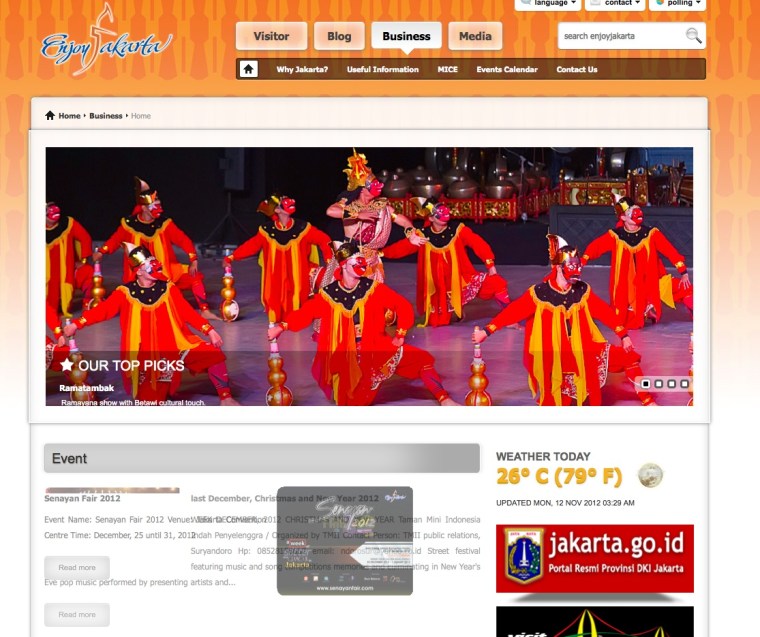
So I took it on myself to google (other search engines are available) “Enjoy Jakarta” and arrived at the official Jakarta travel website where I couldn’t find any information on enjoying Jakarta, shopping or even shoe shopping.

Not the best introduction to what Jakarta has to offer

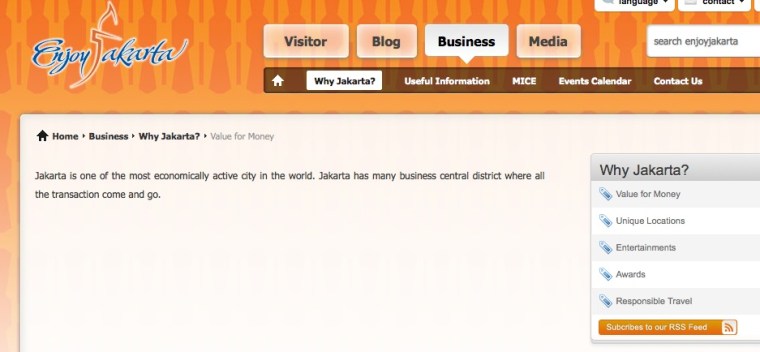
I spent some time on the site and for what it’s worth, I found the site very slow, difficult to navigate with limited information and English that needs proof reading before pubication. When I clicked on the “Why Jakarta” tab on the drop down menu, the information provided was hardly compelling and unlikely to attract investors. And talking of investors, is this a tourism site or a business site?

Not the most compelling of arguments

Moreover, I found the information above the fold didn’t match the information below the fold and when I clicked on Wine and Dine in the footer, all I got was a list of restaurants which to a first time visitor would mean nothing.

This won't mean much to anyone
This won’t mean much to anyone

Today, audiences rely less on traditional media to source information, making them increasingly hard to reach. Furthermore, consumers are less inclined to see or be interested in a corporate driven message delivered across traditional media.

But as the reliance on traditional media diminishes, opportunities arise in new and social media. Where before, companies were dependent on content from the media owners, today they can create their own content that resonates with specific consumers and their interests.

Consumers too are developing their own content and it’s important that destination brands such as Jakarta understand this and provide channels for consumers to create and share content.

It is good to see Jakarta looking to encourage visitors to this exciting city but it will take more than the print campaign and website reviewed in this article to be successful.

Brand deflation in Asia


Luxury brands are working hard to keep up with a more dynamic environment with more discerning, knowledgeable customers who have different requirements for value. To retain these customers requires a greater understanding of the those requirements and less emphasis on the mass economy tools such as positioning, reach, awareness.

Loyalty is also less of a factor as consumers see their exclusivity watered down as luxury brands go mainstream and sell their product to anyone. Those brands that don’t understand customer requirements for value may lead to brand deflation, according to Michael Bleby in this article for BRW in Australia

Art meets advertising


This is a beautiful video of what maybe the last of the billboard painters.

Hand-painted billboards first appeared in the USA in the 1950s and are still seen in some parts of the USA especially in LA where they are often used to promote a new movie.

The Red Army in China used them to err motivate citizens and they are still a common sight in parts of South East Asia and India. However the quality leaves a lot to be desired and may not compare to these American billboards.

Thanks to these guys for the heads up on this video.

The only brand worth having is a profitable brand (even if it means losing customers)


Looking through the ‘archives’ of some of our early branding blog posts, I came across a reference to an article in Fortune Small Business.

The article talked about three companies that had for years pursued a traditional sales and market growth approach that saw them investing more in acquisition than retention whilst paying little attention to profitability.

One case study was of Skelton Tomkinson (now known as Skelton Sherborne), a heavy-machinery shipper based in Brisbane, Australia. At the time the company had one office in Brisbane and one office in the U.S. where Caterpillar was a major customer.

In 2000, because he was seeing little growth using a traditional sales and market growth approach, the owner deliberately raised fees on his least profitable customers, hoping they would leave. Some of them did and revenues dropped dramatically, from US$20 million per year to $8.2 million.

But profitability increased 98% and total revenues slowly returned to $20 million. Tomkinson’s motto: “I run my company with this saying: Volume is vanity, and profit is sanity.”

And it must be working because today, the company has 11 offices, up from 2 in 2000. The new offices are in South East and North Asia, with one in the Arabian Gulf.

Far too many companies believe that they must pursue sales or market growth and this generally means ‘spraying and praying’ – basically the act of spending as much money as possible trying to reach as many people as possible.

What they should in fact focus on is profitable growth, which most often results from identifying and retaining profitable customers and not trying to sell to evey Tom, Dick and Harry.

Another mistake companies make is wasting valuable resources finding out what their customers are doing and then wasting even more valuable resources fighting or trying to block or undercut those competitors.

This is an exercise in futility because in today’s dynamic, always on, constantly evolving world, the only focus should be on identifying the right prospects, creating the right customers (and getting rid, yes getting rid of unprofitable customers) and delivering value to profitable customers through engagement and personalisation.

The great branding graveyard in the sky is full of brands that played the volume game – think Rangers FC, Viyella, Blockbuster, Silverjet, Swissair, Habitat, Mobikom, MegaTV, Pelangi Air, PanAm – they all took a traditional approach to building their businesses yet they all ended in failure.

Seeing your name on billboards or in print ads everywhere and reaching lots of people may make you feel good but focussing on profitability will keep you sane.

Top 10 airline brands for 2012


Skytrax, the UK based research company that specialises in research for commercial airlines, has just announced the winners of the world airline award for 2012.

Skytrax parent company, Inflight Research Services work has been used by the UK government to determine the UK government policies on air transport.

The Skytrax Awards are one of the benchmarking tools for the air industry. They measure passengers’ satisfaction levels by surveying passengers in all cabin classes.

The award is announced after a 10 month telephone survey with 18 million airline customers from 100 countries. That’s right, 18 million airline customers from 100 countries. This must be one of the largest surveys ever attempted.

That’s 1.8 million participants a month or based on a 20 day working month, its 90,000 calls per day which equates to, assuming an 8 hour day, 11,250 calls an hour! Many of which are international, in different languages and probably, if they use my carrier, many of the calls cut off half way through the conversation.

I’ve managed some large brand audits that required a lot of calls but not 18 million in 10 months! So Skytrax should be commended for managing such a logistical nightmare. But I digress.

As I mentioned, the survey takes 10 months and covers 200 airlines, both domestic and large international airlines. The survey measures standards across 38 key performance indicators of airline front line product and services.

The study focuses on customer satisfaction related to experiences right across all touch points including check-in, boarding, onboard seat comfort, cabin cleanliness, food, beverages, in-flight entertainment and staff service.

According to the World Airline Awards website, product and Service factors ranked by customers
in the survey included the following elements:

GROUND/AIRPORT
Standard of Airline web site
Online Booking service
Online check-in services
Airport Ticket Counters
Waiting times at Check-in
Quality of Check-in service
Self Check-in options
Boarding Procedures
Pre-boarding for families
Friendliness of Ground staff
Efficiency of Ground Staff
Transfer services
Arrival services
Baggage Delivery
Handling Delays

ONBOARD: PRODUCT
Cabin Seat comfort
Cabin Cleanliness
Toilet Cleanliness
Cabin Lighting / Ambience
Cabin Temperatures
Cabin Comfort amenities
Reading Materials
Airline magazine
Inflight Entertainment standards
Audio/Movie programming
Audio Video on demand (AVOD) options
Quality of Meals
Quantity of Food served
Meal Choices
Selection of Drinks/Pay bar formats

ONBOARD: STAFF SERVICE
Assistance during Boarding
Friendliness of Staff
Service Attentiveness/Efficiency
Consistency of Service across different flights
Staff Language skills
Meal service efficiency
Availability thru Flight/Cabin presence
PA announcements
Assisting families with children
Problem solving Skills
General Staff Attitudes
Staff Grooming

This is an enourmously complex project and it doesn’t end there. Follow up research includes back up interviews and the data is weighted to ‘provide nomination equity when evaluating airlines of different size.’

Anyway after all that, here is the list of the top 10 airlines for 2012

The World’s Best Airlines 2012

1. Qatar Airways
2. Asiana Airlines
3. Singapore Airlines
4. Cathay Pacific Airways
5. ANA All Nippon Airways
6. Etihad Airways
7. Turkish Airlines
8. Emirates
9. Thai Airways
10. Malaysia Airlines

It is interesting to note that 6 of the top ten are Asian brands and the other 4 are Middle Eastern Brands.

Looking back over the last 10 years, the list has always been dominated by Asian and Middle Eastern brands. With the exception of 2006 When British Airways came first, no European Airline has ever appeared in the top 3.