ASTRO makes a small but significant branding blunder


Rugby is an increasingly popular sport just about everywhere. According to a recent Mastercard report, the overall global growth in the sport is estimated at 15% per year.

The main rugby event is the rugby world cup which is held every four years. The first rugby world cup was held in 1987 and attracted a global TV audience of 300 million. Twenty years later, the 2007 Rugby world cup attracted a global audience of 4.2 BILLION TV viewers, and the Rugby world cup is now the most watched sport after the Football world cup and the Olympics.

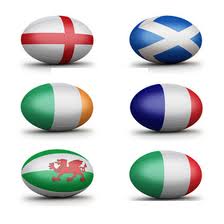
The six nations rugby tournament is the second most important international rugby tournament after the rugby world cup. It is held annually between England, Ireland, Scotland, Italy, France and Wales and was watched by over 69 million TV viewers in Europe in 2011.

The six nations, only a few games live on TV in Malaysia

According to Wikipedia, in Malaysia there are sixteen rugby unions, associations and councils affiliated to the Malaysian Rugby Union and more than 300 clubs and 600 schools and universities nationwide that teach the game.

There are 41,050 registered rugby players in Malaysia (I don’t know who they are registered with), and the country is currently ranked 57th in the world.

There are also countless other rugby players and fans who are not registered but have an interest in the game, such as expatriates from rugby playing countries.

When the commonwealth games were held in Malaysia in 1998, it was estimated that over 50,000 people watched the Rugby Sevens part of the tournament live and 20,000 were at the ground to watch the final, won by New Zealand.

It wouldn’t be too far fetched to say there are probably 250,000 to 500,000 people connected to or involved in some way with rugby in Malaysia.

So it has caused somewhat of a storm within the rugby fraternity in Malaysia to discover that ASTRO, the only satellite TV provider in the country has decided to show only a small percentage of this top class global event live on TV.

One corporate subscriber that spends almost RM100,000 per annum subscribing to Astro was stunned to learn of Astro’s poorly thought out decision not to show the games live and said, “I am shock (sic) to learn of this decision. I don’t get it, why would you not show this popular competition live? We know Astro can do it so why don’t they?”

Another domestic subscriber summed the situation up thus, “I’m sick and tired of the crap they show on Astro and then when something I really want to watch isn’t on live, it really makes me angry and I wish I could change provider.”

An audience of 500,000 is relatively small (although it does equate to about 25% of total Astro subscribers) but this is a lucrative segment with influence and with related content, advertisers would have a captive audience. Such an event should be on the radar of destinations, financial institutions, hotels, automotive companies, schools and universities, real estate agents and more.

One potential local advertiser would be Mastercard which supports rugby on a global scale. Credit cards are sold in many ways in Malaysia, including a sort of hijacking of prospects at petrol stations.

Personally, I would be more likely to be influenced by a Mastercard advertisement linked to rugby than I am by the current tactics.

Astro spends a lot of money acquiring customers but spends little on retaining customers. It may be that because Astro is a monopoly, it doesn’t think it has to listen to its subscribers and it may have a point.

But with a new provider due to launch in 2Q2012, the growing penetration of IPTV providers such as Telekom Malaysia and the growing trend for downloading programmes from the Internet, now may not be the best time to alienate a small but wealthy segment.

What do you guys think?

Despite falling sales, Volvo still trying to use advertising to build its brand


Sadly, too many firms believe, or are led to believe that the way to build a brand is through advertising or, more specifically a series of advertising campaigns that are ever more creative, cutting edge, out of the box, off the wall or any other cool catch phrase your agency cares to throw at you.

If the budget is large enough, and it seems too many companies have too much money to play with and no accountability as to how it is spent, then the best thing the agency can do is buy lots of expensive TV air time, ‘wraparounds’ for publications, preferably daily newspapers because lots of people read them so the eyeballs will be high, above the fold pop ups on websites and lots of other expensive high profile spots.

Of course no advertising campaign would be complete without a couple of high profile billboards in high traffic areas to create awareness of the product with as many people as possible, irrespective of who they are and whether they are interested in or can afford the product.

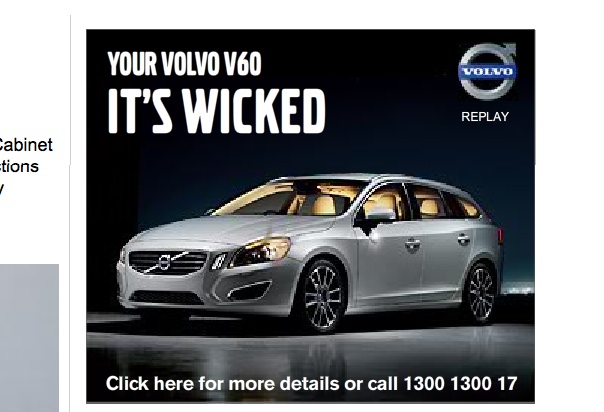
Volvo is the latest automotive brand to launch yet another new car with a creative campaign across at least print and digital media. This latest campaign expects us to believe that a Volvo is hiding a beast inside.

Are we really going to believe there is a beast inside a Volvo?
This is no longer safe, now it is wicked. Or maybe it is safe and wicked!

The above the fold digital campaign is being used to launch the new V60, T4 and T5 range and features intrusive hover or pop out ads on The Malaysian Insider and possibly other news sites. Interestingly, once the Volvo ad on The Malaysian Insider closes, there is an expandable ad for BMW beneath it!

Back in early 2010, Volvo ran a new creative campaign for the new Volvo V50 with the tagline, “There’s more to life with Volvo.” Later that same month Volvo ran another campaign featuring a man and a woman wearing parkas sitting in a pile of snow and staring at a snow covered landscape (don’t forget we’re in Malaysia which sits pretty much on the equator!) with the headline, “Volvo owners get more out of life.”

Even more confusingly, at the time there was a Volvo billboard outside my office with the tagline, “Winner of fuel efficiency award.”

In 2011, Volvo launched a new version of the S60. This time they encouraged us to “get naughty with it.” The ad claimed there are ‘naughty cars everywhere’ and that ‘naughty cars go everywhere’. The box ad features the price of the car and two links to either get naughty with the car or test drive it.

You can read more about this campaign in my post of last year which is here.

The fact of the matter is that these campaigns are not working. In 1999 Volvo sold 642 cars in Malaysia. In 2009 Volvo sold 550 cars. In the same year, Peugeot sold 1,258, VW 885, Mazda 1,444, BMW 3,564 and just to put things into perspective, Toyota sold 81,784 in the same period.

In 2010 Volvo sales increased to 839 but this was below the target of 1,100 set by the CEO. And in the same period, VW sold almost 4 times as many cars (2,810) as the year before. Mazda increased sales from 1,444 in 2009 to an impressive 4,325 in 2010. Even Peugeot increased sales from 1,258 in 2009 to 2,562 in 2010. Mazda and Peugeot do very little advertising in Malaysia.

So these creative new campaigns are obviously not working. So what should Volvo do?

1) Develop a plan to identify and target the right consumers
2) Create content that will resonate with your consumers. Better still, get consumers to generate the content.
3) Separare the acquisition strategy from the retention strategy
4) Integrate all activities across all platforms don’t just launch ad hoc tactical campaigns and hope they work. They aren’t.
5) Invest more in sales and post sales communications
6) Volvos are safe, they can’t be safe and wicked. We like the fact they are safe but we appreciate you want to attract new segments but please, keep it real or you will lose existing segments and not attract new ones.

Implementation of any creative campaign should take into account the fact that consumers are no longer impressed with well executed, high quality, brand driven commercials. Because they don’t believe what they read anymore. In Malaysia 86% of participants in a survey said they no longer believe what they read in advertisements.

A brand can no longer rely simply on ads to sell products. An integrated brand strategy is crucial to successful branding. With a recession coming, Volvo needs to get it right and get it right soon.

By the way, whilst Volvo is trying to tell us the Volvo is actually a beast and that a Volvo is wicked, Volkswagen is pushing it’s park assist in Europe. Have a look at this enjoyable <a href="

Volkswagen – Tiguan – Park Assist II (ENG) from AlmapBBDO Internet on Vimeo.

” target=”_blank”>video made for iPad.

2012 must be the year you develop a social media brand strategy


Saudi Arabian Prince Alwaleed bin Talal has twice been named as one of the smartest and most creative investors in the world by Forbes magazine. He’s also been called the “Saudi Warren Buffet” because of his impressive track record with his investments.

He first came to the fore with a signficant investment in Citibank in 1991 and now has interests in a diverse portfolio that features stellar brands such as Apple Inc, Four Seasons Hotels and Resorts, George V Hotel in Paris, Songbird Estates (Canary Wharf), Time Warner, News Corp., Walt Disney, Euro Disney, PepsiCo, Procter & Gamble, Motorola, Hewlett Packard and Kodak.

So when someone of his calibre announces, as he did just before Christmas 2011 that he was taking a US$300 million stake in Twitter, the world pays attention.

Ahmed Reda Halawani, Executive Director of the Prince’s Kingdom Holdings company said in a statement, “We believe that social media will fundamentally change the media industry landscape in the coming years. Twitter will capture and monetize this positive trend.”

“Fundamentally change the media industry landscape in the coming years.” I’m prepared to go one step further, I believe that social media is the media equivalent of the printing press, the radio and the Television – all arriving at once!

So if you are CEO of a Malaysian SME and you still haven’t invested resources into social media, I suggest you do so and do so quickly.

But before you do what many do which is to copy all the content on your website and paste it onto your Facebook page and think that is a social media strategy, I suggest you also invest some time in learning about how to use these channels.

Because social media is about relationships. And Malaysian SMEs have, on the whole over the last two decades or so, focussed not on relationships, but on selling their products at the cheapest price.

That’s fine when there is significant demand for a product and you can always produce it cheaper than someone else. But unfortunately today, someone somewhere is producing just about everything cheaper than Malaysian firms.

And this places Malaysian SMEs at a disadvantage, especially when multi national corporations are taking notice of Malaysia and beginning to invest significant marketing dollars in the country.

The good news is that social media, used correctly can actually save SMEs a lot of money because firms can create awareness, gain customers and, most critically retain them across social media platforms for a fraction of the cost of investing in traditional media such as TV, radio, Outdoor and others.

But it is important to develop a social media strategy before embarking on the exercise otherwise resources will be wasted, reputations may be affected and you could be worse off than before you started.

Here are 11 elements that must be included in any SME social media strategy

1) Determine your goals and your target market.
Obvious I know, but too many companies are trying to use the same tactics online as they did offline, ie trying to use the same ‘one-size-fits-all’ communications campaign to create awareness via a series of tactical campaigns. This will not work on social media.

2) Raise brand awareness by creating an online game or contest and hosting it on Facebook.
Tourism Malaysia has spent a significant amount of money on Facebook competitions that have generated many online column inches of comment. Despite limited investment in the content, the activities were executed well. However despite hundreds of thousands of new Facebook fans, tens of thousands of engaged users, significant traction in the social-media space, it is unclear what the actual campaign goals were.

3) Give free stuff away!

I don’t know how Tourism Malaysia will use the data it generated from the Facebook campaign, but to build a database that can be turned into brand evangalists in the future, it might be worth offering prizes for content shared with other users across platforms such as Youtube, Twitter and so on. This can be then be leveraged to gain more brand traction.

4) Use crowdsourcing to determine strategy
Back in 2009, Vitamin water wanted to launch a new brand. In an exercise that Gap management should have emulated, they binned the traditional qualitative and quantitative research via focus groups and intercept surveys. Instead the company turned to social networks and sought the opinion of consumers in a real world, real time environment to decide on the name of the new product. Over 1 million people participated in the project and they got close to celebrities employed to spike interest in the project.

5) Don’t delay your decision, you are already being talked about!
Conversations about your brand are already happening on social media. Embrace the conversation and get engaged but a word of warning, don’t try to use the platform as an opportunity to push your products onto consumers.

6) Don’t be afraid to revise your marketing message
Perhaps once, twice, three times and even more to make sure you engage the right consumers with the right content and don’t generate negative feedback from your audience. But if you do generate negative feedback, address it in an honest and transparent manner and see the conversation all the way to the end, no matter how distasteful.

7) Comments are good
One website we were asked to audit recently didn’t allow comments from other users yet increasingly, consumers are looking to comments rather than actual articles for the data that will influence and determine their decision making.

8) Remember your core message and don’t go too far away from it
Being genuine and transparent and sticking to your overall image is very important.

9) Tell the truth
Target Rounders is a subsidiary of the US retail giant. It is an online group that you sign up for & you get points for marketing a product. They come up with new products & then everyone on their list finds fun ways to promote it for “points.” The company launched a Facebook campaign that utilized a lie created to gain more fans and a larger community! Unfortunately consumers spotted the lie and the project died.

10) Creativity is effective in social media
Prior to launching the much anticipated Shark Week, the Discovery Channel sent a jar that appeared to include a death notice to new media types.

The jar included a note that read, “This jar holds a story – the story of a single tragic incident that needs to be unlocked. Dive in, investigate the evidence and discover what lies beneath the surface of frenziedwaters.com.”

The jar also included a large warning sign, shredded swimming trunks (no doubt belonging to someone who was eaten by a shark), and a detailed obituary dated for a future date at the time of the campaign.

Participants were intrigued and as a result spent a lot of time researching online before realising that the Discovery Channel was behind the whole thing. Nevertheless, the right people were soon talking about the show and building interest.

11) Write a social media policy
For most firms, their social media policy consists of restricting access to social media. But this isn’t the way forward. Used properly and by the right people, social media can be a very effective and inexpensive marketing tool for brands. But there are always going to be risks associated with a new tool so the best defense against abuse is to create a policy for usage.

Social media is making companies be more sharing, collaborative and transparent, not just externally but internally as well. Including employees in the policy development process will create internal advocates for the policy and improve morale.

The social media policy should be more about what employees can do and best practices for social media use versus all the things employees can’t or shouldn’t do on social media.

When shrewd investors such as Prince Alwaleed bin Talal are taking stakes in social media you know it is here to stay.

To stay competitive, Malaysian SMEs are going to have to invest more in developing brands. Social media, used correctly will save them large sums of money communicating those brands to consumers and other customers.
Print advertising done right


Because of the massive increase in advertising noise and clutter, it’s getting increasingly difficult for advertisers to capture the attention of consumers with traditional print ads.

You’d expect therefore that Malaysian advertising agencies would increasingly push the creative envelope, to develop material that makes consumers stop, read, mark, learn and inwardly digest.

Sadly, and for whatever reason, the work produced by Malaysian advertising agencies rarely pushes the creative envelope. Furthermore, much of the local agency output focuses way too much on the product and not on the benefits.

Other ads contain far too much copy and weak headings or taglines. Worse still are those ads that make outrageous claims that are ridiculed in coffee shops up and down the country.

The golden rule of any advertising should be, “Sell the sizzle, not the sausage.” In other words don’t focus on the product and how great it is, focus on what it can do for the reader.

Have a strong call to action and include a prominent URL and telephone number. And make sure that there is an answering service. We recently spotted an ad for a German automotive manufacturer and called the number. The phone wasn’t answered and there was no way to leave a message to arrange for a sales person to call back.

A picture really does paint a thousand words so make sure you have an clear, simple image that grabs attention.

Here are some great examples of print advertising from around the world that deliver effective messages.

This slideshow requires JavaScript.

Malays drinking Guinness


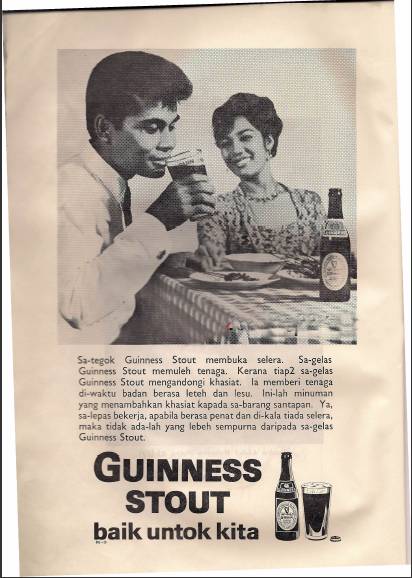
Here’s a lovely old print advertisement from 1968.

The ad features a young Malay professional enjoying a pint of Guinness and some satay whilst his admiring and approving wife looks on.

The copy tells the reader that Guinness gives you energy when you are tired after work and that there are nutritional benefits to drinking Guinness. And the tagline reminds you that Guinness is good for you.

It’s a fairly innocent ad, typical of the period but what is most surprising is that it features Malays! How times have changed!

British Airways promotion


One of the greatest branding success stories has to be British Airways, the blue riband aviation brand.

Recently the airline hired agency BBH to create a new campaign to explain the history of the company. The final work can be seen below

As part of their work, the agency chose a row of 747s at a terminal. Unfortunately not all the aircraft were BA 747s!

Never mind, the agency got the digital guys to put BA livery on the planes.

Unfortunately, they forgot to delete the serial code of the nearest aircraft which was actually a Virgin aircraft! Not clever, especially as Virgin is BA’s sworn enemy!

Fortunately, during an internal showing to staff, a hawk eyed engineer spotted the offending information and alerted the marketing department!

Ironically, the director, Frederic Planchon is renown for his attention to detail!

You can see the edited shot about 56 seconds into what is in my opinion, a beautifully crafted video.

First rule of auto advertising – keep it real!


We are carpet bombed with messages from the moment we wake up till the moment we go to sleep. Little wonder then that studies show we are increasingly oblivious to these messages.

As a result advertising agencies are increasingly hard pressed to cut through all the clutter and make us look, listen and absorb. To try and sell cars, those advertising agencies have for years used CGI (Computer Generated Imagery), think Honda and the ‘greatest ever car’ commercial, sex, think the Renault Megane ‘shake it’ campaign and humour, think Proton and ‘the Pontianak’ in their TV commercials.

Print advertising hasn’t escaped either. I don’t know exactly when automotive manufacturers started to make ridiculous claims in print advertising but I certainly remember when Toyota, in the late 1970s used “Oh what a feeling” to describe driving a Toyota!

I also remember Peugeot talking about the ‘lion leaping from strength to strength’ in the 1990s and the launch campaign for the first Proton MPV the Exora that claimed “You’ll be amazed” in 2009. I’m sorry but if I’m going to be amazed by the Exora then how will I feel about the Aston Martin V12 Zagato? Or, perhaps more relevant, how will I feel about the third version of the Exora due out in 2012?

Most recently I came across an online ad for the Volvo S60. The ad claims there are ‘naughty cars everywhere’ and that ‘naughty cars go everywhere’. The box ad features the price of the car and two links to either get naughty with the car or test drive it.

I decided to click on the get naughty link and was diverted to a landing page where I was encouraged to enter a website address. Naturally I entered my address and was confronted with this cringeworthy statement, “When we said naughty cars go everywhere…. we meant everywhere!”

You are then encouraged to ‘start your engines’ and the gimmick is that you can drive an S60 around your website very own website.

Once you get bored, and for most of you that will be after about 3 seconds, you can then request a test drive, invite a fried to have a go or close the tab, which I did. My memory of this exercise is the smoke coming out of the exhaust and the tyre tracks, not very environmentally considerate.

I don’t know about you but I think this campaign is flawed on numerous levels. To start with it really is a stretch to use the word naughty in the same sentence as Volvo. Secondly, what is naughty about the car? thirdly, what is naughty about maneuvering a car around a website? Finally, after all that effort, the campaign doesn’t collect any information on visitors!

You can see some good but hardly naughty volvo videos here

Sri Lanka: A Big Miracle


After the domestic travel trade complained repeatedly that it doesn’t spend enough money promoting the country internationally, The Sri Lanka tourism development Authority (SLTDA) announced that it will launch a new tourism campaign in the next few months to increase visibility in key source markets. The campaign is expected to be in addition to existing marketing efforts.

This is going on at the same time as a new tourism policy is being drafted that should include a new tagline that is rumoured to be “Refreshingly Sri Lanka – Wonder of Asia”. This will be the first tagline since “Sri Lanka: Small Miracle” was binned in 2009.

Sri Lanka’s annual marketing budget is about 500 million Sri Lankan rupees (RM1 = 35 Sri Lankan rupees) which is about RM14 million.

SLTDA spends about RM5.5 million on international trade fairs and about RM1 million on sponsoring international travel writers to visit the country. The balance of about RM7 million is spent on advertising and other through the line activities. It is not clear if funding for the new campaign will come from this RM7 million or additional funds will be made available.

I find it hard to understand what the domestic travel trade is complaining about and why the SLTDA is giving in. I get the feeling this is just an exercise to shut up the domestic travel trade. In my opinion, SLTDA is doing very little wrong.

Arrivals to Sri Lanka in 2010 were up an impressive 46% over 2009. Indeed arrivals reached 654,476 in 2010, the highest since the 566,202 arrivals in 2004. Revenue from tourism in 2010 was over RM1.5 billion (US$500 million).

The government is targeting 750,000 arrivals in 2011 and early indications are that that target will be achieved. In the first six months of 2011, about 381,000 visitors arrived in the country.

The record of 2004 was set after the government and the Tamil Tigers agreed a peace treaty. In May 2009 the government defeated the Tamil separatists to end the 30 year civil war and tourism arrivals have risen every month thereafter.

Furthermore, the country’s tourism business has secured US$1.2 billion in FDI already this year and has another US$3 billion of deals in the pipeline.

Surely the travel trade should be very happy with what the SLTDA has done so far on a relatively small budget?

And surely spending money on egocentric ‘look at me’ awareness campaigns that will be lost in the clutter are not the way forward?

And even if they do work, can Sri lanka manage the influx of visitors? And if it can’t what are the potential ramifications? And what does Sri Lanka do after the campaign?

It would make more sense to invest what funds it has into a well researched brand strategy and implement that brand strategy rather than spending money for the sake of it on a tactical campaign that seems to be driven by misguided travel industry workers.

The top 1,000 brands in Asia – so what!


Following the completion of a research project carried out in conjunction with TNS, the Asia Pacific edition of the globally respected marketing magazine, Campaign Asia has named Sony as the top brand in Asia.

According to the study the top 4 positions all went to power house North Asian brands – Sony retained its position at number one followed by Samsung, Panasonic and LG with Canon at five. In fact the top 5 were unchanged from 2010.

At six is Apple, HP at seven, Google at eight and Nestle at nine with Nike at ten.

Facebook was the top social networking site at number 17 whilst Twitter leapt from 123 to sixtieth.

HTC, whose stock has tripled in the last year and is now Asia’s second largest maker of smart phones leapt from 532 to 100.

Interestingly no Chinese brands made the top 100 and only one Indian brand (Amul) managed to do so.

Amul, the largest food products business in India and the maker of ‘the big daddy’ of butters and the number one ice cream in India, was the best performing non-Japan or Korea brand, coming in at number 89.

At 123, Louis Vuitton was the highest luxury brand and surprisingly luxury brands fared poorly. Despite listing on the Hong Kong stock exchange recently, luxury brand Prada came in at a disappointing 348th, only two places above CIMB and down from 252.

Although Maggi (22nd) place and Tesco (96th) will be familiar to Malaysians, the top Malaysian brand is Marigold at 131, down from 129. Other Malaysian brands include Malaysia Airlines at 163, Maybank at 172 and F&N at 238. Old Town coffee also deserves a mention at 245, coming in almost 40 places above Maxis at 284. Celcom, Maxis main competitor was further down at 395.

Sticking with Malaysian brands, Boh tea was down at 417, Firefly, a budget airline was at 462, up from 518.

The highest new entry was Hankook tyres of Korea at 246. The highest new entry Malaysian brand was Life, a sauces/condiment maker at 718 followed by Kimball, another sauce/condiment maker at 825. Surprisingly Proton, the Malaysian national car was also a new entry at 916.

The survey was carried out in ten Asian markets: Australia, China, Hong Kong, India, Japan, Korea, Malaysia, Singapore, Taiwan and Thailand. Ages of the respondents were from 15 to 64 and approximately 300 respondents from each country were surveyed.

Participants were asked only two questions:

“When you think of the following (product or service) category, which is the best brand that comes to your mind? By best, we mean the one that you trust the most or the one that has the best reputation in the (product or service) category.”

“Apart from the best brand you entered, which brand do you consider to be the second best brand in the (product or service) category?”

14 major product and service categories were covered in the survey:
Alcohol and tobacco
Financial services
Automotive
Retail
Restaurants
Food
Beverages
Consumer electronics
Computer hardware
Computer software
Logistics
Media
Telecommunications
Travel and leisure
Household
Personal care.

In addition to these major categories, a further 72 sub-categories were included!

The final rankings were determined based on the total number of mentions each brand received across all categories and countries.

Then the data was weighted on two levels: the first to reflect the population composition within the markets covered, and the second to reflect the competitiveness of the categories included in the study.

Now I don’t know about you guys but if there is one thing I have learnt over the years it is that markets such as Malaysia and Japan or Thailand and India have very little in common, especially when it comes to food, alcohol (60% of the Malaysian market is Muslim and therefore alcohol is forbidden) and other culture specific products.

Furthermore, I don’t know how they included all the categories and sub categories but I can only assume the answers were aided. Nevertheless, imagine a questionnaire that lists 14 potential answers and then a further 72 options to those answers! How accurate are the responses going to be?

I also think that the sample size and the demographic – only 300 participants per country and a massive demographic of 15 – 64 is simply too big to provide results that are actionable or relevant.

And we don’t know the gender of the participants yet gender will be crucial in many of the listed categories and in how we communicate with prospects, with what content and across what platforms.

And looking at the brands, someone in India is not going to name Proton as the best (another thought, define best?) automotive brand because the Malaysian national automotive brand has yet to go on sale in India.

Frankly, I don’t really understand what is the point of this survey and what it means? How is it relevant to a consumer or company in Malaysia when it lists brands not available in the country? How can a company leverage its position? What must a company do to move up the list, perhaps to the top? How relevant is the ranking?

If the survey must be done, it would be better if it were country specific and related to each category alone. Rather than asking two (aided) questions, it would make sense to develop questions based on the product needs in that country. Questions will also need to be developed based on the category.

And instead of looking at traditional approaches that rely on demographics, in the social economy, it would be better to work with social media communities. Results could then be correlated and geographic comparisons made although they still won’t offer actionable data to the brands.

What do you think?

Email and your brand, part three


Sticking with the use of email as a tactic within your brand strategy, I came across this interesting graphic showing when are the best times to send emails. Thanks Chuan Choong for the heads up.

But even if you get the timing right and the recipient does actually scan or even read the email, there are certain rules that must be adhered to.

You must be honest (in the US, deceptive subject lines are illegal) and transparent by revealing routing information such as the originator email address.

Make sure you offer recipients an opt out method and if they opt out, accept it and don’t add them back again three months later.

If you want to be taken seriously, I suggest you also include your physical address and website in any emails.

It is important too to make sure you track the effectiveness of your email campaigns and analyse the results. Create a source code for each campaign, track response rates, cost in terms of personnel, financial and time.

But most important of all is the content of the email and whether it is personalised and relevant to the target.

Here is another email that I received recently. From memory lane it is an absolute shocker. It isn’t personalised, it doesn’t resonate with me, the content is dull and uninspiring and the design, if I may call it that is dreadful.

When I receive a good example I will post it!