Branding is relational, not transactional. It's about retention, not acquisition. I work with companies and governments to identify and develop the strategies required to build the relationships that ensure ongoing branding success.
I call it data driven branding & it should not be confused with creative driven branding.
I'm also a rugby nut & devoted family man, probably in that order, but don't tell my wife!
Numerous papers have been written on the influence of advertising in developing countries. Most of the papers suggest that historically advertising influences consumers more in the developing world than it does in developed countries.
This probably stems from a ‘traditional suspicion towards the ‘middleman’ as opposed to a belief that manufacturing or production is more ‘honourable’ or ‘respectable’’. Malcolm Harper “Advertising in a developing economy”. The assumption being that the manufacturer’s message has an air of respectability about it whilst the sales pitch of a salesman or middleman should be viewed with suspicion.
Firms, especially Western firms spend a lot of money on advertising in Asia to convince consumers to buy their products. The problem is of course that far too many consumers have been let down by products that fail to live up to the promises made in the advertising. This is one of the reasons quoted for the advertising fatigue across Asia.
In fact many experts suggest this is also why Asian consumers are so obsessed with discount and, perversely Western luxury brands with a clear evidence of a quality heritage. Clearly, if brands want to continue to have an influence on consumers, they must be honest with those consumers.
One firm that always spends big on advertising is Proctor & Gamble (P&G). According to Ad Age P&G spends an incredible US10 billion per year globally on advertising. In the first 9 months of 2014 P&G spent US$48 million on traditional media in Thailand and often its ads are dubbed to be shown across national borders.
The ad above was shown in Malaysia but looks as if it was produced in a different language. The ad shows a family all working together to get the son through his exams. However, the dad appears to have a cold and although the mum stops his sneeze with a pillow, the voiceover tells us that germs can spread through fabrics which the wife complains are hard to wash.
Cue voice over claims that Fabreze Ambi Pur eliminates flu viruses and odours, 99.9% of germs and freshens fabric, leaving a light scent behind”. The ad closes with the son getting an A+ and the line “Odours and flu virus go, freshness stays.”
I think that based on the ad, a lot of possibly gullible consumers are going to think that by using this product they won’t have to wash big items like blankets, carpets and cushion covers.
Air fresheners and in particular Fabreze Ambi Pur are very popular in South East Asia. Get into a car in Malaysia, Singapore, Indonesia or Thailand and the chances are you’ll see a Fabreze Ambi Pur product placed in front of the air conditioning vent.
Many government offices have machines on the wall that squirt out similar products at regular intervals. And the Malaysia Ambi Pur Facebook page has 90,000 Likes and the Thailand Facebook page has nearly 160,000 Likes.
That’s an impressive following. But can Ambi Pur really eliminate flu viruses? Can it really eliminate 99.9% of germs? And what are the effects on humans of the chemicals contained in these products?
According to the sustainable baby steps website, Fabreze is a dangerous product. The site claims it contains a total of 87 chemicals, many of which are supposedly dangerous to humans. It suggests that Fabreze doesn’t clean the air but instead masks the odours with chemicals. The site goes on to provide a number of natural, inexpensive ways to keep a home smelling fresh and healthy.
Another site that claims to ‘set the standards for safe self care’ says that Fabreze contains phthalates which are ‘hormone-disrupting chemicals that have been linked with childhood asthma.’
P&G doesn’t share any of the apparently harmful ingredients in Fabreze. Oddly, the Ambi Pur ad is filed under education on Youtube.
P&G is a global brand and an influential advertiser in South East Asia. It maybe that spraying chemicals on a cushion is not harmful. Whatever it is, P&G has a responsibility to educate consumers properly, truthfully and in a transparent manner. Otherwise, it will lose its respectable tag.
Since the twin disasters of MH370 and MH17, Malaysia Airlines has slashed prices on just about all its fares, offered travel agents in Australia Rolex watches and free flights to promote the carrier and attempted to discount its way out of trouble. And it has tried to do this with a series of ill conceived and poorly executed ads and PR campaigns that I wrote about here.
At the same time, it continues to ignore those passengers who have supported the airline during this difficult period.
MAS has also sent out the same poorly thought out post flight survey to passengers that asks questions that can offer little actionable data to be used to save the iconic brand. An example of the survey is this question below:
Good to know but how useful is the data?
As an example, question A is about value for money. If a passenger has paid RM50 for a RM400 ticket then he will probably consider the flight to be good value for money. But if he has paid RM400 for the ticket and the person next to him has paid RM50, he probably won’t consider it good value for money. So how can MAS use the results?
I also wrote here that MAS should not be slashing prices because it was not going to work and once you’ve slashed prices, it is very hard to increase them.
Many people disagreed with me. Commenting on the article, Bob said, “At this time, the last thing they need is branding. They need to fill up seats for revenue so I don’t see any issues with the ads to be honest.”
I disagreed and said instead that MAS should focus on rebuilding its brand and offer more value rather than slash prices. Well if rumours from Reuters are to be believed, MAS is about to announce that the 3rd quarter 2014 was its worst quarter since it began operations 70 odd years ago. Reuters reports that despite the promotions and cheap flights, passenger numbers and yields were the loweest ever.
I’ll say it again, slashing prices does not work. This is what MAS needs to do NOW to save the brand. It’s time to stop reacting and start planning.
Luxury brands are beginning to feel the effects of slowing economic growth in Asia, political protests in Thailand and Hong Kong, political confrontation in Russia and Ukraine, political instability in the Middle East and the threat of Ebola.
Demand from Asia for luxury goods, especially expensive bags and other leather products appears to be on the wane. Struggling more than many others is Mulberry, one of the finest British luxury brands and manufacturers of exquisite leather goods that are actually made in England. In fact, as many brands look to increase profits by outsourcing their manufacturing to China, Mulberry is increasing production in the UK.
60% of Revenues from the UK
Mulberry generates more than 60% of its revenue from the UK but has been trying hard to grow sales outside of the UK, particularly in the US and Asia. In its quest to become a global luxury brand it has made some disastrous strategic decisions including raising its already high prices to differentiate itself from more affordable luxury brands.
For the British Mulberry was always an aspirational brand that offered affordable luxury but by going after the rich in Asia and America, it may have priced itself out of the segment it once dominated in the market it makes the most money.
At the beginning of 2014, the Chief Executive Bruno Guillon announced that he intends to bring ‘more excitement’ to the brand. From the outside this seemed to be nothing more than trying to create ever more expensive handbags that competed head on with Chanel, Hermes and Louis Vuitton. Bags that had once cost £500 got a makeover and were back on the shelves at £900.
The core customers were upset and drifted to other brands. By March 2014 Guillon was on his bike and Chairman Godfrey Davis returned to take the reins. In the summer of 2012, Mulberry’s share price topped £25 (RM140). By the time Guillon left it was around £6.40. Today it has regained some value at £7.30 (RM40) but is still off its peak.
Deserting middle England
Guillon was accused of deserting ‘middle England’ the middle classes that made the brand. Judging by the Mulberry 2014 Christmas ad it looks like the brand is trying to regain its relationship with that loyal segment.
Christmas in England is commonly associated with Santa Claus and reindeer, over eating, cottages covered with snow, a tree with lots of presents in front of an open fire, carols and goodwill to all men.
But in some families there is a darker side to Christmas that is rarely spoken about. The competition to give the best possible present, often to the most annoying and spoilt family member, can be intense. With this in mind, Mulberry has created a cynical but lovely parody in what I think is their first ever Christmas commercial.
33% of annual sales generated in November and December
In the west, retailers generate over 30% of annual sales during November and December and Mulberry will be hoping this ad will kick start the recovery of the business. Longer term they need to work on rebuilding their core values and create a Mulberry narrative that resonates with their target markets and once again become a successful aspirational brand.
But in the meantime, it’s Christmas morning, somewhere in middle England…
If you intend to create a social media strategy in house then this infographic is a useful tool that will help you determine how to use the most popular social media tools and where to focus resources. It’s not perfect and it is US centric but local research has shown consumers in South East Asia are not that different in the way they engage with social media.
Thanks to Buffer social for the excellent infographic
I am sad, confused and bewildered. I mean what is this ad about? What is it for? What is the relevance of a coughing durian or a cat with big eyes and cat emoticons? Wait a minute, there’s a dinosaur in the background wearing a face mask. Is it about respiratory conditions?
The answer is no, it’s for a telco offering free social chat all day or at least I think it is because the closing tagline is ‘Keep the Ohhsome Internet always on’ which suggests to me that the Internet isn’t always on which in fact it is unless perhaps you are a Hotlink subscriber or used to be but now you are not because you don’t want to be associated with such a brand or perhaps Hotlink subscribers couldn’t use Viber, What’s app and all the other free tools for, well free.
Oh I don’t know but the 90 seconds I spent watching it three times to see if I had missed something (I hadn’t) are gone forever.
Last night I watched an episode of Mad Men where Harry Crane, the new head of the new television department at Sterling Cooper (It’s season 2) almost got fired because he allowed a Maytag commercial to appear in a TV programme related to communism.
He nearly lost his job because the brand didn’t want to be associated with a contentious or negative issue. This has been a standard approach of brands over the years which is why you won’t see a commercial for an airline aired on a programme about aviation disasters or a commercial for an automotive company in a programme that features a car crash.
Well that used to be the case. Recently Volkswagen in Hong Kong and O&M created an this campaign solely for cinema audiences. It’s interactive and gets the viewers attention.
I like the ad but I’d like to know more about it. What is it for, is it to sell cars? Or is it a public service exercise? If the former, does it send the right message and will consumers remember the brand for the right reason? If the latter, does it make a difference? Such ads don’t stop people smoking, taking drugs or drink driving so why will this one work?
Like I say it’s a great bit of creativity. VW had a record year in 2013, selling 2.51 million cars in China and Hong Kong. This will certainly help VW stay top of consumer’s minds. But I think Harry Crane is turning in his grave. That’s not a plot spoiler. Well I don’t think so as I’m only on season 2!
Few people know that just about everything we buy is owned by 10 jumbo companies such as Kraft, P&G, Nestle and Unilever. Last year Unilever spent more than US$10 billion (that’s about the same as the GDP of Iceland) on advertising and still managed to see a drop in sales of around 3%.
Unilever is the global market leader in ice cream and the business is worth about US$5 billion in revenue with about 40% of that coming from Cornetto and Ben & Jerry’s.
Cornetto sales in the US were down 2.5% last year and Europe isn’t much better. Sales there are affected by the inclement Northern Hemisphere weather and so the firm is looking to Asia for future growth.
Early results are good and we could see more of this sort of cheeky, unexpected humanised type of product building out here. Sells the product and shows a human side of the police force. Long overdue IMHO.
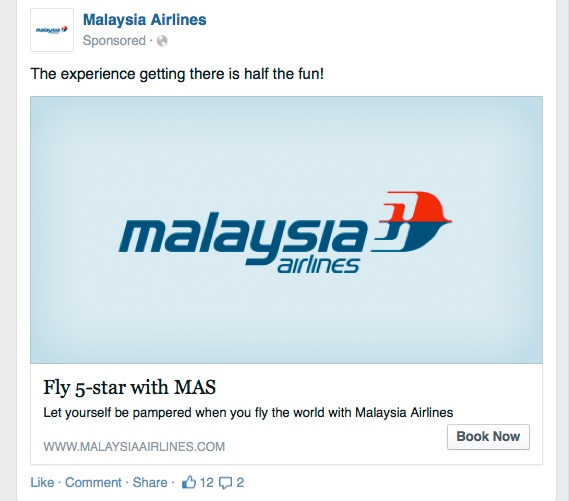
I was shocked to see this ad appear on my Facebook page this morning.
Poorly conceived ads like this are terribly insensitive
Is anyone in control of marketing at Malaysia Airlines at the moment or has the transition to the new company already started? At the same time as the world’s media is showing terribly sad but dignified video and images of the crew of MH17 returning to Malaysia in flag draped coffins, the airline’s marketing department launches an advertising campaign with a grammatically incorrect tagline telling us flying with Malaysia Airlines is fun.
Are they mad? Does the marketing team really think they can convince us that the experience of flying MAS is going to be fun? Should they be trying to do that? Do they think they can change global perceptions of MAS with a grammatically incorrect tagline? Actually they are not trying to change perceptions, they are trying to change reality, with ads! Not only is it offensive, it is ignorant and they really should know better.
This is the second poorly conceived tactical ad MAS has released online in the last month and it smacks of desperation. There is enormous pressure on the management at MAS but they need to get their act together and start rebuilding the brand and not simply throw out poorly thought out tactical ads or what I can only assume are seen as quick fix solutions. The rebuilding of the brand will start by rebuilding trust and faith in the brand but not with this rubbish.
Hardly a compelling tagline or call to action
Last year, when JWT India created an offensive ad featuring Silvio Berlusconi in a Ford Figo with girls bound, gagged and crying in the boot of his car JWT fired the executives responsible and Ford apologized.
Tasteless Ford ad forces agency to sack executive
MAS doesn’t need to apologise but the management must reevaluate their marketing team and their ad agency needs to fire the clowns who created this nonsense.
Then the managment needs to understand that rebuilding the reputation of the brand is a strategic initiative and not a tacticial one. And the CEO needs to have his finger on the brand pulse otherwise this sort of incompetence will continue and there will be a further erosion in the brand’s reputation.
The recent announcement by the Malaysian government that it will invest RM6 billion of public funds to revive Malaysia Airlines (MAS) is a good idea and one that should be welcome by every Malaysian.
MAS a national icon worth saving
The national carrier is a source of immense pride for Malaysians and so it should be. In the broader perspective, MAS has an exemplary safety record, provides direct and indirect employment for thousands of Malaysians and was profitable for many years.
Furthermore, when managed effectively and innovatively and when the importance of morale was understood, the national airline played a major role in defining the Malaysia Nation Brand as it was the first touch point for many of the more than 10 million passengers carried annually.
Moreover, through MAS, Malaysia got the opportunity to reach out to consumers with a physical product, develop a relationship with them and build a profitable business at the same time. Many of the millions of Europeans who flew the ‘kangaroo route’ from Europe to Australia and New Zealand became brand ambassadors for the carrier.
Much of that goodwill has been eroded but the brand is still intact but there is a lot of work to be done to rebuild global trust in the brand. The recovery plan that will require sweetheart deals to be renegotiated, staff numbers to be reduced and other major restructuring initiatives are just the beginning. Rebuilding internal branding and developing a strong, innovative, customer focused external brand strategy will be just as important.
While the airline restructures, it needs to continue to operate. In June 2014, when MAS CEO Ahmad Jauhari Yahya told shareholders that the MH370 incident had “sadly now added an entirely unexpected dimension, damaging our brand and our business reputation, and accelerating the urgency for radical change”, I was expecting, well radical change.
Externally, it looks like that radical change consists of nothing more than slashing prices!
Slashing prices won’t build confidence in the MAS brand
MAS is reported to be offering cut price ticket prices from the UK, Australia and New Zealand to Kuala Lumpur in an attempt to do what regional senior vice president Lee Poh Kait termed as, “inspire and encourage customers to dream, plan and book their next holiday, and help rebuild trust in Malaysia Airlines.”
Mr Lee also told Australian news site news.com.au that, “With unbelievable savings, these deals are a very competitive offering as we build a stronger Malaysia Airlines.”
He also went on to say, “We are committed to regaining the confidence of our customers and sending them on memorable holiday experiences as a trusted five-star carrier.”
In addition to slashing prices, MAS also launched ‘My Ultimate Bucket List’ competition with 12 return flights to Kuala Lumpur and 4 iPads as prizes.
Its not uncommon for bricks and mortar retailers to slash prices in the face of poor sales and it’s a familiar tactic of low cost carriers looking to sell excess seats. The idea is you attract new customers who might not have bought from you and you get a spike in sales that will get you through the lean times. But we’re not selling soap powder, software or biscuits.
An international airline that competes in the same space as Singapore Airlines, Cathay Pacific and the increasingly aggressive Middle Eastern carriers and is reeling from two tragic events is not going to build a stronger airline or rebuild trust by slashing prices.
Slashing prices gives the impression the project is cheap, something MAS cannot afford to do. It also smacks of desperation and lowers the value of the product to that of a low cost carrier and may well cause customers to lose not rebuild confidence in the airline.
THe lastest MAS online ads are easily forgotten
Furthermore, by slashing prices, MAS is throwing away all of the pricing power it has built up over the past few years, power that will take years to win it back.
The regional senior vice president also said “We would like to thank all our travel agency partners and passengers for their relentless support during what has been a difficult period.” I understand that MAS has also doubled the travel agent commission rate to 11% till mid September.
At the same time as this seat sale and travel agent incentive is launched, the MAS frequent flyer programme (FFP) Enrich is sending emails out to 14 year olds offering them the opportunity to earn extra air miles if they book a hotel with the MAS hotel booking partner. Not many 14 year olds book hotels.
Enrich marketing is sending out up to 8 emails a month asking members to play golf at the Mines, get double miles when they fly with Firefly, take advantage of a sale at shoe shop Lewre and various other offers.
Used properly, the MAS FFP database is a potential revenue gold mine
After flights, the airline is also sending an email to travellers asking them to complete a survey that asks questions such as “At which airport did you board/leave this flight?” and “Class of travel” as well as questions that the answers might be good to know but don’t identify causes of dissatisfaction or provide any real actionable data.
Meanwhile, while MAS offers travel agents double commission on bookings, MAS loyalists who have flown more than 20 times since MH370 went missing in April 2014 haven’t received personalized communications from the airline thanking them for their support or an offer of free air miles, upgrades or other shows of appreciation.
Based on this evidence, it would appear MAS has essentially ignored its existing customers and frequent flyer members and instead gone out and offered special deals to all and sundry in the hope that enough of them will take the bait and fly the airline.
This discounting approach will do little to regain trust or repair the battered brand. Here are 6 tactical initiatives MAS should be doing to rebuild trust before slashing price:
1. Existing customers are more likely to buy than those who haven’t bought before
Right now a focus on gaining new customers or market share is a misguided approach. Yet MAS, like so many firms is attempting to do just that whilst ignoring its existing customers. The MAS FFP Enrich is rumoured to have more than 1,000,000 members. The database of Enrich members is a potential gold mine of revenue that needs to be cleaned and leveraged properly and quickly with a well planned and implemented programme.
2. All data is important
OK, MAS probably doesn’t need to know the name of every FFP member’s pet but it does need to know enough data to know what products should be sold and to whom and how to increase share of wallet.
Consumers are willing to share more information than ever before and MAS needs to start collecting data and sending the right offers to the right people. Sending invitations to book hotels to 14 year olds is sloppy and shows a lack of professionalism and that will do nothing to rebuild the brand’s reputation.
Good to know but how can the answers help rebuild the MAS brand?
3. Leverage the power of social media
Each customer’s experience is defined by the economic, experiential and emotional value of each ‘moment of truth’ when interacting with the brand so mass advertising campaigns either online or offline and slashing costs are not going to rebuild the MAS brand.
There is a great deal of sympathy out there for MAS and a bright, real, transparent, honest and consumer driven campaign on social media about real people travelling on MAS will inspire more people to develop a relationship with the airline (and relationships are the goal, not selling seats) than any seat sale with a weak call to action.
4. Branding is about experiences and relationships, not one off sales
Few consumers are going to develop a relationship with a brand based on a one off sale. And besides, legacy carriers can’t compete with LCCs and the moment MAS tries to increase prices, those customers won on price will go elsewhere. MAS must start building relationships with its customers and leverage those relationships to increase sales.
The success of those relationships will be determined at every touch point which means the website booking engine, check in staff, customer service representatives, ground and airport staff, cabin crew, in flight entertainment, comfort and service, baggage operators, communications, helplines and more must be all be ‘on brand’ and on top of their game at all times.
5. Stop being lazy and start re building the MAS brand
There is no short cut to rebuilding the MAS brand. It is going to take a lot of effort strategically and tactically. Slashing prices and flooding the Internet with forgettable, price driven ads won’t turn the company around. The MAS website has been a mess for too long. No matter what the cost, funds must be made available to fix the booking machine and fix it quickly.
It’s also time to retrain front line staff as they currently do not have the skillsets required to deliver a premium brand that can compete with the aggressive ME carriers.
6. Think customer not customers
The customer is only interested in one thing, what’s in it for me (WIIFM). Yes many of them care about the airline but they aren’t about to risk their lives or those of their families.
Every single customer flying MAS in these difficult times has to be made to feel special (this should be part of the brand strategy but is particularly important now).
Those customers flying MAS now are the saviours of the brand and must be nurtured to become brand ambassadors and brand advocates who will be talking loudly about the fact that they are flying the airline now.
Make the experience a memorable one and they will talk loudly and for longer and do more to rebuild trust that any corporate driven advertising or PR campaign.
None of this is rocket science but these 6 top tactical tips will lay the foundations for the rebuilding of the Malaysia Airlines reputation quicker and more effectively than slashing prices.
This is the biggest weekend of the year in Malaysia as families across the country go home for the end of Ramadhan Eid holidays. As Monday and Tuesday are public holidays, many people will have a nine day break.
For me personally I’m looking forward to some quality time with my family in Sarawak, one of the best kept secrets in Asia. I’m flying business class to Kuching about an hour and forty minutes flying time from Kuala Lumpur.
When I get to the airport they tell me my flight is delayed. Now I’m a little bit annoyed by this because I’ve been a member of their FFP since it began and they have my email address and mobile number so they could have let me know the flight was delayed. But hey, that’s a minor issue and besides, if it’s a technical problem I’d prefer them to discover it on the ground and not in the air. Incidentally when I checked in, there was no apology from the girl at the desk.
MAS is carrying out renovations to its lounge at KLIA so I am directed to a temporary lounge. When I get to the lounge I show my boarding card to the person at the counter who looks at it and hands it back. There is no mention of flight announcements. The greeting isn’t rude but it’s hardly enthusiastic.
I sit down and get online. The lounge is quiet, I’m in a good mood, and considering I’m at an airport and about to get on an MAS flight I’m relaxed and excited at the prospect of spending some quality time with my family in a beautiful place.
30 minutes later I get to that point in an airport where you feel like you need reassurance that everything is alright. So I go to the counter and ask about my flight. I’m told it is delayed (like I didn’t know that) and the staff member points to a time on the boarding card and mumbles something incoherent.
I don’t know about you but when I’m at an airport there are so many distractions, so many unusual assaults on the senses that I rarely pay attention to announcements however, a little later, I suddenly look up and realize I haven’t heard an announcement about my flight or for that matter any others. I ask one of the MAS staff in the lounge what is happening with my flight. She goes to the desk and comes back and tells me my flight has left!
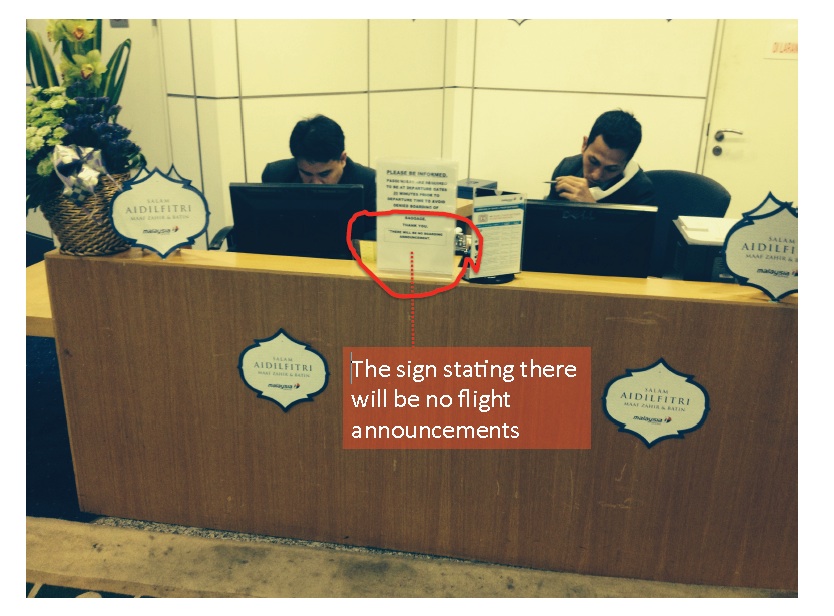
I’m stunned and ask someone to explain what just happened. The explanation revolves around the fact that it is a temporary lounge and they don’t make announcements and anyway, there is a sign on the desk stating that there won’t be any announcements.
Now bearing in mind getting passengers to the plane is a fairly important part of an airline’s responsibility, the sign below can hardly be described as adequate, especially with all the other messages on the desk.
The pathetic sign stating there will be no flight announcements
Understandably I’m not impressed. This is business class, there aren’t many people waiting and it wouldn’t take much effort on the part of the staff to inform the few passengers in the lounge that their flight was boarding. Furthermore, if one business class passenger is late arriving at the departure gate, how much effort does it take for the staff at the gate to call the business class lounge and ask if the passenger is there? Aren’t these the little things that help passengers justify paying more for a ticket?
For some reason I’m then sent to the flight transfer counter where I listen to a staff member explain my situation to other staff members who all look like the last thing they want to be doing right now is deal with this issue. No one tells me anything. Eventually after interrupting the conversation I learn that my luggage has been sent to lost and found and I have to go and get it and not to worry, I will be put on the next flight.
I then go back to the lounge and 10 minutes later another member of staff tells me that I have to go and get my luggage because he doesn’t have the authority put it on the next flight which is odd because someone had the authority to take it off the previous aircraft and send it to lost and found but most galling of all, he tries to nickel and dime me for RM150 penalty to change to the 5.55pm flight!
He’s not very happy with the fact that I’m not very happy but obviously is just following a procedure and not interpreting the situation as it is. I realise he doesn’t have any authority so ask him to send a supervisor to talk to me. He walks off to the desk and sits down. 30 minutes later he is still there and making no effort to update me so I have to go and find out what is happening. He tells me the supervisor will be here in 10 minutes.
25 minutes later I get up again and go and ask him what is going on. He says the supervisor will be there soon. As we’re talking the supervisor arrives. She manages to talk to another supervisor who agrees not to charge me the RM150 penalty. It has taken me a lot of effort to get to this stage.
But it doesn’t get better just yet. It transpires that I wasn’t put on the 5.55pm flight, I was put on the waiting list because the flight was full. No one told me this. I asked what time is the next flight, answer 6.30pm but it is also full. The next flight after that with seats is 7.30pm. By the time I board that flight I will have been at the airport for six hours.
So how is related to the problems at MAS?
Throughout this horrendous experience I felt that on the whole, with the exception of a couple of members the staff were sympathetic to my predicament and wanted to help. But the problem is they just didn’t have the knowledge or the skills to deal with the situation effectively.
Being told repeatedly that the lounge is temporary and therefore there won’t be any announcements is not good enough but it isn’t the fault of the staff. It suggests the company doesn’t understand the importance of the customer. Especially highly profitable business class passengers.
It’s great that you are renovating the lounge but it doesn’t mean you lower your standards in a temporary lounge. It might be temporary to you but to every passenger, it is still the lounge. It’s not like I’m paying less for my ticket because I am using a temporary lounge. Does it mean that when you lease an aircraft from another airline you lower your engineering or safety standards?
And besides we’re talking about the worst time in the airlines history. Shouldn’t every customer willing to spend money with the airline at this difficult stage be appreciated more?
The attitude of the lounge staff was at best adequate. I got the feeling they were doing the job but nothing more. And having flown Malaysian Airlines for over 20 years I have to say I’ve felt this way for the last 12 – 15 years.
If the MAS brand is to survive, those that make the decisions on training have got to understand that the airline is not doing passengers a favour. Numerous reports released over the last 5 years point to service as being the main factor influencing consumer brand choices.
In every report I have read recently, the averages percentage of people who switch brands because of poor service is around 70% and goes as as high as 80%. It is universally accepted that customer service is critical to the success of a brand. That service comes from effective and timely training based on the changing needs of customers.
The issue is that what may have been considered acceptable customer service yesterday is no longer acceptable today. Moreover, as more and more companies raise the bar in terms of the quality of service they deliver, consumers expect more. Training needs to be updated and reinforced.
Nowadays, for an Asian carrier to thrive let alone survive, it has to have a culture not of customer service but of exceptional customer service. The ability to deliver exceptional customer service is the only way brands can build the loyalty that will differentiate themselves from other competitor brands.
Armed with the skills and tools needed to deliver exceptional customer service, staff will have the ability, confidence and enthusiasm to go the ‘extra mile’ when dealing with their customers.
Malaysia Airlines is a service product in a very competitive space. Despite the two very tragic incidents in the last 5 months numerous customers such as my family and I have stuck by them.
Right now it is tough being loyal to MAS and it isn’t made easier when they can’t even get the basics right. I, like many loyal customers don’t want any special treatment but I do expect a decent level of service.
As I write this, there is talk in the UK newspapers of a strategic review of MAS that may include renaming and rebranding the airline. I don’t know what they define as a rebrand but it’ll take more than a change of name to save MAS.






 brandconsultantasia.com