Google+ Brand Pages is another critical social media tool for corporate brands


Back in June 2011, Google launched Google+ to counter the increasingly powerful and influential Facebook. According to Google, 40 million people have signed up for Google+ which equates to about 8 million new users a month. Not a bad effort but a long way to go to reach the 800 million Facebook users.

The launch of Google+ saw a number of complaints from consumers, especially related to applications whose functionality was changed or users being forced to give up pseudonyms to continue sharing.

Corporations also complained because they were unable to connect and build relationships with consumers, something they have been able to do and do successfully on Facebook.

Some companies did try to create business pages on Google+ but they were rejected, with a request to wait.

Well the wait is over with the launch today of Google+ Brand Pages. Now firms can connect and engage with consumers through corporate pages. Although Google+ Brand Pages doesn’t operate that differently from Facebook, it will have to form a part of any corporation’s social media strategy.

One neat feature not available on Facebook is Google+ Direct Connect. Simply by putting “+” in front of a brand’s name before making a Google search, will ensure searchers are directed to the firms Google+ page.

Google’s open approach also means that a brand can now have a business page that is integrated with Google search, Ad words, Google places and YouTube.

Critically, I also expect Google+ profiles to have a significant impact on Search Engine Optimisation (SEO) and search results. And once Google starts to provide metrics for pages via Google analytics, we may see Facebook’s crown slip.

5 Essential Rules for Social Media and your small business brand


The original version of this article first appeared in the August 26th 2011 print edition of The Malaysian Reserve.

It is not a question of if you will stick your corporate toes in the social media waters, but when. Whether you like it or not, social media is taking the world of business by storm.

In a recent survey by Nielsen, a research company 73% of connected consumers in Indonesia, Malaysia, the Philippines, Singapore, Thailand and Vietnam agreed they had been influenced by advertisements on social media.

Firms that continue to believe that social media is a fad or fun or not for business are only doing one thing, giving their competitors an advantage.

Research from Hubspot and MSN shows that companies with a social media brand strategy are seeing a significant increase in awareness, traffic to websites, search engine rankings, and social-media-generated qualified leads, perhaps the most important element of all. Moreover, statistics increasingly show that more and more people like to do business with businesses that have a strong social media presence.

But social media is much more than setting up a Twitter account or starting a Facebook page. Social media activities must be elements of your brand strategy in the same way as advertising, direct mail, email, PR are. The problem with these traditional activities is that they are reactive, you put it out there and wait for something to happen. If nothing happens you spend more money on another idea. If that doesn’t work you try something else.

A social media strategy, if done properly is proactive and can actually offer you all the things your traditional campaign can’t offer you – accountability, retention, a measureable return on investment, effectiveness tracking and more. Data from a 2010 report by Nielsen, a research company showed that social media had better results than traditional marketing activities.

So how should a small business enter the world of social media? The following five rules are relevant to any firm that seeks to develop a contemporary platform to raise awareness and be heard over the noise, acquire customers, increase sales and better serve customers which will in turn ensure customers are retained and not released to the competition.

1. Social media is not a technology issue it is relational and requires cultural changes within organizations.

The social media space is not the place for people with a traditional marketing mindset. Social media is exactly that, SOCIAL and requires you to use social skills to build rapport with consumers so that they may eventually become prospects, customers and possible evangelists. Trying to use a traditional marketing approach in social media and using a hard sell and trying to push a product or service in social media will damage your reputation.

2. Identify who in your organization will be responsible for your social media strategy.
You will need to have a social media strategy and it will have to be integrated with your brand strategy. If you don’t already have someone, you must be looking to hire a social media manager who reports directly to the CEO and not to a marketing or sales director. And because social media is incredibly dynamic and changes are happening 24/7, you are going to have to be prepared to give this person a lot of autonomy to interact with consumers and make decisions, some of which will be financial, that directly impact the relationship with prospects and customers.

In the old days of mass advertising across mass media you had control of the messages related to your brand. Social media is fluid, consumer driven and places the control of your brand in the hands of consumers. Accept that you have to relinquish control.

3. Social media is not a technical initiative, it is a relational initiative
Relationships don’t stop for an hour at lunchtime, at 5pm or over the weekend and nor does social media. Success in social media takes time as firms seek to build the credibility needed for consumers to trust them. Make sure posts are made daily and questions or requests attended to immediately even if raised over the weekend.

Although your social media strategy is not a technical initiative, social media personel need to have at least an understanding of related technology such as Google Analytics, Content Management Systems (like WordPress), and third party social media software like Tweetdeck and HootSuite – so as to assign metrics by which to assess and respond quickly.

4. Define your core audience and messages for those audiences.
Traditional marketing attempts to be all things to all people. This model won’t work on social media. If you intend to educate, identify who you want to educate and do so but don’t try to sell to them. If you have targeted them effectively, they will take the initiative and seek out more information about your organization and how you can provide value to them.

5. Social media is not a volume business
Someone once said that volume is vanity, value is sanity. What this means is that firms should look to increase profitability not sales. Used properly, social media can help you reduce your cost of acquisition and increase profitability. Don’t set out trying to have lots of followers who never buy your product or service. A single follower or friend who is engaged and interacts with you is worth more than a thousand followers or friends who only drop by once a year.

Social media is participatory and is an efficient tool for your organization to learn, exchange and build professional networks so take time to build individual relationships. Once you have a follower or friend or contact, you have their permission to interact with them in a consultative manner. It is not about broadcasting messages but holding conversations.

When a consumer gives an organization permission to speak to them, it is because they like what the organization is saying and want to hear more of it. An organization must engage, gain trust and then solve the problem. But be warned, this means that the organization’s messaging must be relevant just about 100% of the time.

This may take time and you may find it difficult to open up, especially if you and your marketing department, educated on a diet of broadcasting corporate driven messages to as many people as possible, are not used to sharing information, especially with prospects.

However, get it right and you will find that you build relationships and followers quickly, and inexpensively and this will lead to increased sales and more loyal customers who will not only spend more with you, they will share their experiences with your brand with their friends.

For brands, now more than ever, content is king but who generates that content?


I think it was Bill Gates who coined the phrase “Content is King” back in the mid 1990s. He was right then and he is right today, possibly even more so today.

In today’s economic climate, traditional media owners, desperate for content but unable to afford to produce it themselves, are increasingly looking to independent production companies to generate that content.

But ever more cynical consumers are skeptical of content distributed via traditional media channels, especially in Malaysia where the mainstream media is acknowledged as being controlled by the government. Even content on respected platforms such as the BBC, CNN and CNBC has come under scrutiny recently after questions were asked about content produced by UK company FBC media

At the same time, or perhaps as a result of this, consumers are now changing the way they interact with brands, both during the evaluation stage, purchase stage and, critically after the purchase.

In the past, despite the major investment required to attract a new customer, the brand owner would be happy to sell them something and let them go. If they didn’t come back, it didn’t really matter as there were an increasing number of consumers to replace the initial customer and competition was limited. Moreover consumers expected little from the brands they bought.

Now after a purchase, consumers want to be involved with brands and mindful of the lack of genuine information available, want to influence others. Thanks to social media, they can do this and will share information, thoughts and opinions about their acquisition, long after the actual purchase.

Those consumers also believe they have a right to a role in the development of the brand going forward. This means that increasingly we are seeing consumers create content that defines brands and not the brand owner.

So content is still king, but it is now created by consumers. The key is to influence that content in the same way as traditional media once did.

Do you agree?

Malaysian brands not spending enough online


Yahoo’s latest Net Index study reveals something most of us with kids know already – Malaysians are spending record amounts of time on social networks. The report states that the time spent by Malaysians on social networks increased 29% in 2010.

As well as social media, file sharing, online searches, email and chatting all saw an increased activity. The number of purchases online also grew so you would expect Malaysian CEOs to be spending more money online right?

Well yes, and no. Advertising spend in 2010 grew to RM7.7 billion (US$2.6 billion) a YOY growth of 16%, but of that only RM52 million was spent online. Up a respectable 29% over the previous year but still not enough.

The rest was spent on traditional media with newspapers capturing 51% or RM3.9 billion of total ad spend. This is an increase of 14% despite the fact that readership of all newspapers is declining.

With consumer confidence falling it is going to be hard to sustain such gains and traditionally, when the economy falters, advertisers will seek accountability.

My hunch is that we’ll see a huge jump in online advertising with traditional media – newspapers, TV, radio, Out of Home and magazines all taking the biggest hit.

Data from the Nielsen company

Media

2009 spend (RM ‘000)

Percentage Share

2010 spend (RM ‘000)

Percentage Share

Percentage change

Newspapers 3,407,826

51.5

3,890,824

50.8

14.2

TV 2,446,536

37.0

2,892,472

37.7

18.2

Radio 361,818

5.5

408,871

5.3

13.0

Magazines 139,545

2.1

151,735

2.0

8.7

Outdoor 112,250

1.7

119,745

1.6

6.7

In-store 86,300

1.3

123,620

1.6

43.2

Internet 40,446

0.6

52,149

0.7

28.9

Cinema 22,496

0.3

23,811

0.3

5.8

Total 6,617,217

100

7,663,227

100

15.8

How Tourism Malaysia should have approached its social media strategy


Twitter, facebook and other social media communities have been buzzing with comments related to the RM1,800,000 (US$600,000) Tourism Malaysia (TM) is spending on Social Media (SM). Here’s a little background on the story.

Initially, the deputy minister of tourism was quoted as saying that the RM1,800,000 “covers the cost of hosting various activities on the facebook page, including six interactive Flash applications, development and maintenance work and advertising.” He went on to say that, “the ministry spent nearly RM300,000 to develop each of the six applications on their facebook page.” I could only find one (see screenshot below).
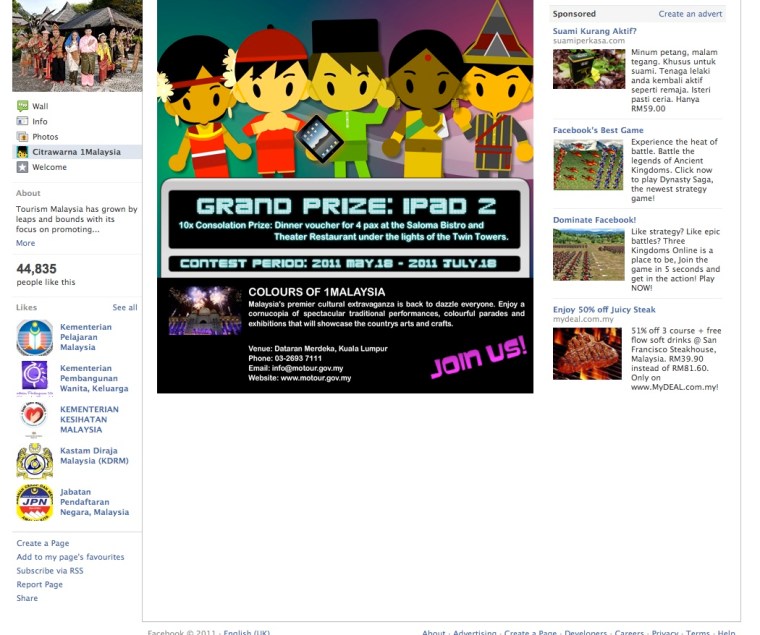
This statement was rejected by citizens and government ministers alike with one minister suggesting it was a waste of funds as the facebook site is free and using the ‘Visit Penang’ facebook page as an example (see screenshot below), explained that it was set up for free and had attracted over 100,000 fans.

Citizens were even more incensed, with one enterprising and concerned tax payer setting up a facebook page that parodied one of the official government pages (see screen grab below). Within hours, this page had attracted 5 times as many ‘likes’ as the official page.
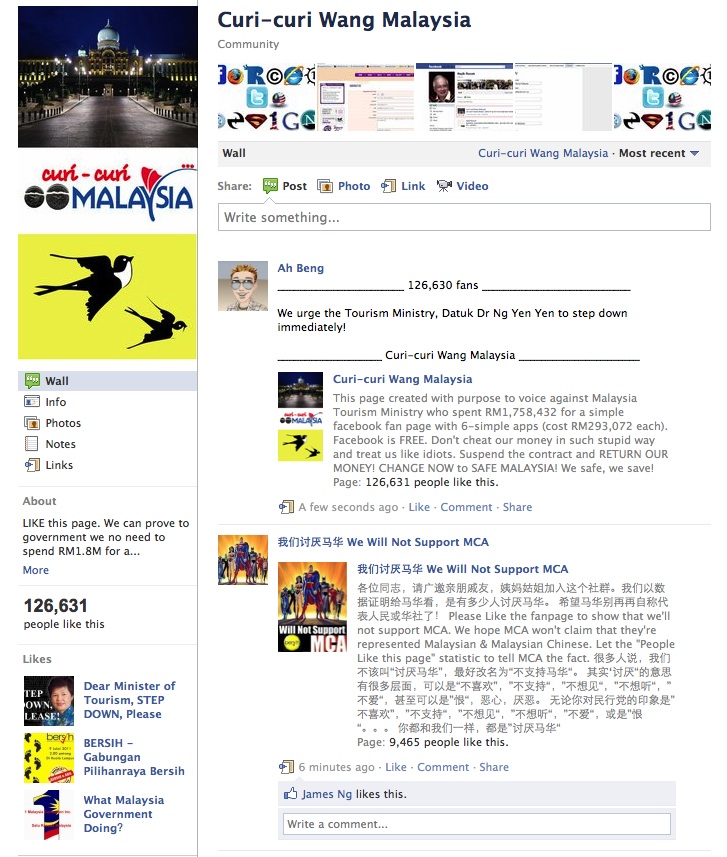
A couple of days later, the tourism minister announced that, “the RM1.8 million (is) for a full social media branding campaign, and not just to set up a facebook page.” She went on to say, “”(The money) is for responding, informing, interaction and monitoring (work on the facebook page), evaluation, data collecting, content development and advertising on Google, Facebook, etc…”

With her comments came an official release that stated the costs were for the following:

1. Technical

* Dedicated hardware deployment
* Software licencing
* Front end applications
* Application server engine

2. Development of six campaigns that require the following:

* Flash games engine
* Flash programming and coding
* Creative development and design
* Campaigns ideas and concept
* Front-end Flash design
* Testing and debugging

3. Campaign promotions

* Digital advertising campaigns on Google and facebook
* Contest, page wall and tourism fanpage content management
* Collection and management of database

The tourism minister then went on the offensive, asking reporters, “Do you think it’s cheap to set this up?” And as if to justify the expense, explained, “Tourism Australia is spending RM150 million (US$50 million) for the next three years on social media.”

Most recently, the minister stated that the allocation was to ‘run, manage and monitor a tourism campaign in the social media, including RM360,000 for advertising and over RM500,000 for prizes for the contests organized.’

‘Disappointed and hurt’ she is reported to have invited the Malaysian Anti-Corruption Commission (MACC) to investigate the campaign finances.

It is too early to determine the results of Tourism Malaysia’s first foray into social media but whatever the results, the Malaysian government, the tourism minister and the tourism ministry could have handled the matter more effectively and efficiently.

One would be forgiven for thinking that Tourism Malaysia has some internal communications issues. Because when the deputy minister first explained what the funds were spent on, his statement didn’t make sense. The deputy minister’s statement suggests he was provided with notes written by someone more familiar with the workings of an IT department than the requirements of a social media campaign. This has caused the deputy minister to be embarrassed in parliament and I hope someone has been reprimanded.

In terms of the social media exercise, Dave Duarte MD of South Africa based Huddlemind and a social media expert who was in Malaysia as the story broke stated in his blog that the exercise has already justified its expense.

His rationale is based on his guesstimate that the average conversion rate of a facebook fan to a customer is approximately 3% and because the average domestic tourist spends RM2,500 with 40,000 fans, the facebook page has already recouped its expenses.

This statement may be a little optimistic but it is certainly worth tracking the number of ‘likes’.

In terms of the game itself, it seems OK, leaning heavily on guitar hero. Personally I found the racial profiling of the characters unnecessary. Playing the game requires one to be more dexterous than I and as a result, the score required to qualify for the iPad 2 draw will always be beyond my means! I suspect I’m not the only decision maker in the family who will feel the same and this resulted in me leaving the page rather disappointed. But I digress.

So Tourism Malaysia’s (TM) long overdue foray into social media has not had an auspicious start. In the future, what can this key organization that contributes over RM50 billion (US$16.6 billion) to the national purse do to ensure tax payers get value money for all social media branding initiatives?

Here are 10 key recommendations for future initiatives

1) A social media strategy or any of the tactics within that strategy, is not the responsibility of the IT department. In future, the head of the department responsible for social media initiatives should represent the ministry when talking to the press and his press release should be prepared by him and his department and not by anyone else. Although the minister or his/her deputy must respond to questions in parliament, it is wrong to expect them to be knowledgeable about branding tools such as social media. Ministers do not need to talk to the media about such relatively small activities.

2) Social media requires an ongoing strategy and interactive initiatives such as the facebook pages are merely tactics within the strategy. Successful social media initiatives must be integrated with other branding initiatives.

3) I strongly suspect TM didn’t think through what they were doing when they launched the facebook pages. First of all it is important to develop a plan. Within that plan and before embarking on a social media strategy, it is important to identify what are the goals and how can facebook add value to branding efforts. Facebook is obviously an additional channel to interact with prospects and customers but why do it? To get more fans? Why? To get more participants? Why? How does TM convert those participants in the competition into leads? How does TM put a monetary value on social media activities? What metrics should be used? All of these should be outlined in the social media plan before implementation.

At the moment, registration is only required if participants want to be included in the draw for the iPad or meals. So how will TM optimize interactions with those participants and get them to become customers?

4) It’s also important to get fans to interact with other participants and to interact with participants. Critical to the success of any social media campaign are the conversations. Channels such as facebook are not platforms to broadcast messages about the company or in this case, Malaysia. The cuti cuti 1Malaysia facebook page has generated over 40,000 likes in a very short time and this is impressive. Furthermore, many of the postings on the wall have generated plenty of comments but TM is failing to enter into discussions with those who comment, preferring instead to pass that responsibility to others (See screen shot below). Interacting and engaging with people who comment is what social media is all about and will give TM more visibility, improve reputation and increase trust.
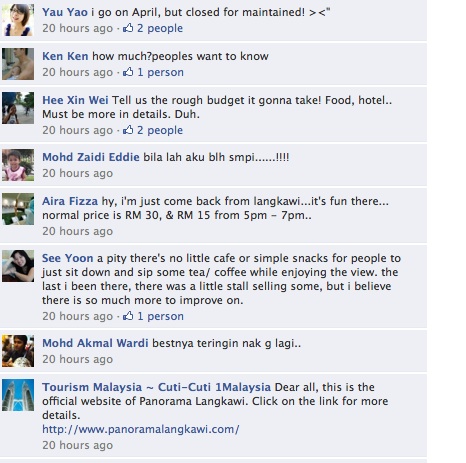
5) This first foray into social media is pretty basic and there is nothing wrong with that. But in future, Tourism Malaysia must look to be more innovative with what it does on social media. Fans will soon get bored of commenting and uploading images, especially if issues raised are ignored. Tourism Malaysia must encourage fans to be more creative. Perhaps by designing trips, submitting and voting for slideshows or setting up sub groups of specific niche related fans.

6) What makes being a fan special? At the moment nothing really which is a good and bad thing. Good because it means more people will become fans but bad because TM doesn’t know how many fans are really interested in the product or just want to win an iPad. In future, TM must look for ways to offer special content to fans or competition participants. Don’t be afraid to ask people to register.

7) This maybe a bit difficult for TM because technically, it isn’t allowed to sell Malaysia, only promote it but that doesn’t mean it can’t turn facebook into a potential profit centre. TM should make it easy for fans to book trips to destinations featured on the TM facebook the way it does on its website.

8) TM is still using mass media tactics on social media channels. This is ineffective and pointless. TM needs to stop thinking demographics and start thinking communities.

9) This applies to everyone and not just TM. Pause before creating a facebook group. Managing a group is difficult, time consuming and requires talent and patience to be able to respond to issues raised and continue a conversation till it’s natural end. TM launched four or five facebook pages at the same time! That requires a lot of talented manpower and judging by the lack of responses to issues raised, TM was ill prepared. Also important is what to do with the facebook group once the contest or event is over. It you want to delete a group, you have to manually delete every member of the group. With 40,000 members and growing, and with at least two clicks required to delete a member, the cuti cuti site will take a lot of manpower to shut down! If TM decides not to close down pages, in five years time, there will be a lot of dead pages that will confuse people.

10) The big question with facebook is what to measure and how to calculate ROI. In 2010 a study stated that fans of the top twenty brands on facebook were worth an average of US$136 each. With 40,000 fans, that would make the cuti cuti page worth over RM16 million! However the study was panned as it was actually a measure of the value of customer loyalty and not a measure of how much facebook had contributed to that loyalty. Moreover, the average of 20 brands like Nokia and Apple bears no relevance to tourism anyway!

As TM doesn’t technically have a product to sell, it is hard to know what to measure. For instance, TM can’t measure the ROI of acquiring a prospect and turning that prospect into a customer via facebook and comparing it with other customer acquisition programmes.

In reality, Measuring the ROI of facebook fans is probably impossible, especially for a national tourism agency such as TM and especially when the facebook page features a competition that allows multiple attempts from the same user and the end product is a future staycation.

As the dust settles on this rather unfortunate event, TM and its agency has a lot of work to do to sort out its social media strategy. It’s not a great start, and a lot of mistakes have been made. The key is not to make the same ones again.

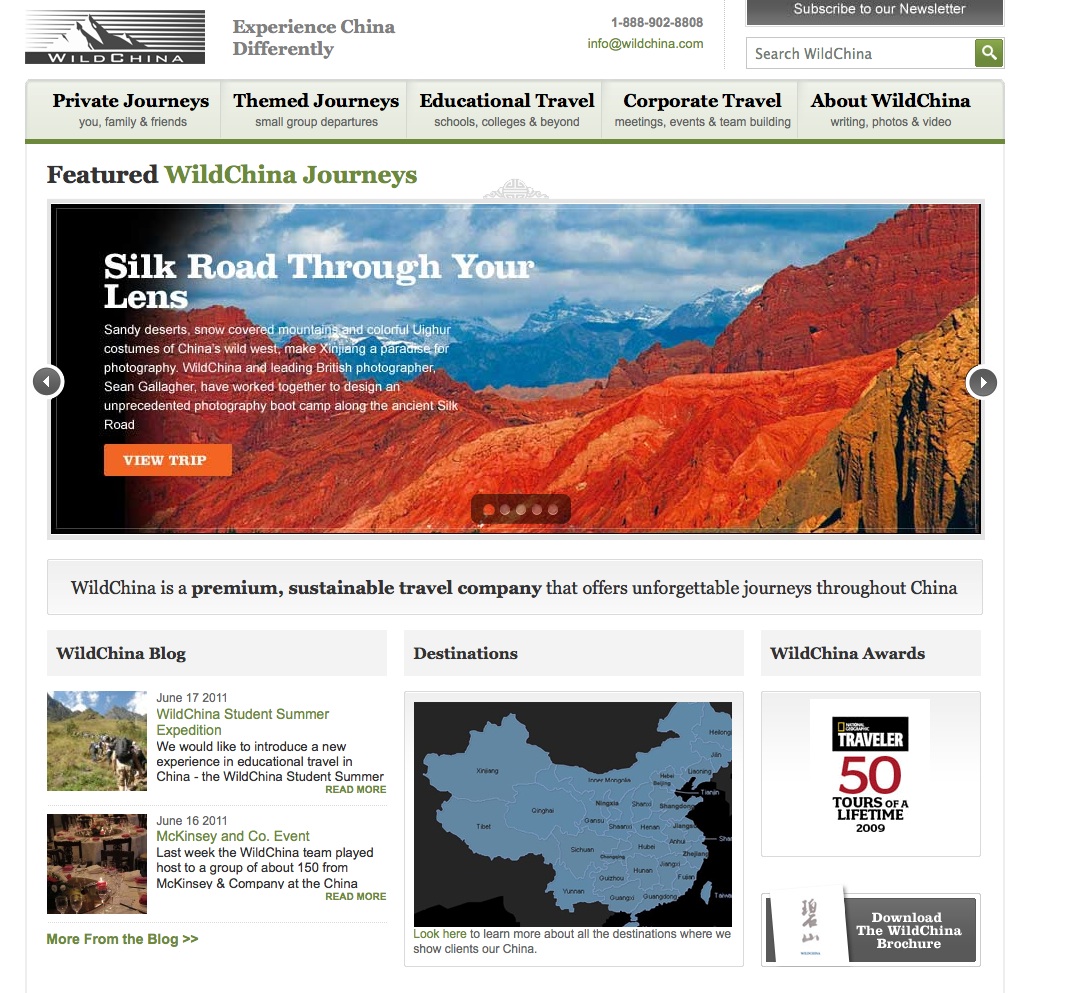
Suggestions to improve a travel website


One of my favourite business sites, Bnet has an interesting case study of a site that offers bespoke or customised trips in China. The site is not doing as well as the owners expected.

The article asks the question “Why doesn’t this website draw more visitors” and there is an outline of the situation with the issues and readers are invited to comment. I tried to add my comments but as has happened before, I couldn’t add them so I am including them below.

The look and feel of the site is drab and reminds me of websites from 10 years ago. The content is too ‘traditional’ and rather predicatable.

If they are not happy with the number of visitors, then SEO is obviously an issue. So many companies spend a fortune designing a site and then sit back and wait for the orders to flow in. If only it were so easy…

So what would I do to make things happen?

They need to improve the writing. Although this won’t improve traffic to the site, it’ll keep visitors on the site once they are there.

I’d talk to existing customers and ask them what improvements they would like to see. I’d also talk to prospects that have visited the site and made enquiries but have not booked and identify why they didn’t book.

Before that, they need to invest more in driving traffic to the website, especially if as stated, 10% of the marketing budget generates 70% of enquiries. I’d also investigate and measure the number of leads generated from those 1,650 page views, source of visits, conversion rates from all channels, lost prospects and retention rates.

Other thoughts
1) The target market doesn’t have time to wait for flash to load. Furthermore, many of them are probably accessing from smartphones between appointments or via laptops whilst at airport lounges with poor internet speeds. Keep the information simple and bin the flash. Also you need a mobile version of the site.

2) So many companies think a website will make sales for them. It won’t, it is nothing more than a brochure to generate interest. Once an enquiry comes in, start building a one on one relationship with those prospects.

3) The form is too long. The target market is the wealthy but the wealthy are careful about sharing information, especially at the prospecting stage. If I buy you can have that data but not yet. Let’s stick to email communications for now. And maybe twitter.

4) Social Media initiatives aren’t engaging enough and there is too much broadcasting. Moreover there appear to be comments by readers/fans to which there hasn’t been a response.

5) Although I didn’t read the Blog articles, the headlines on the home page would suggest they are press releases not blog posts.

The key in any customer facing exercise is to put yourself in the shoes of the people you are looking to communicate with. And the best way of doing this is to talk to the people that visit your site, those that do business with you as well as those that don’t.

Why you should start building your Brand today


This article first appeared in the Friday 29th April 2011 edition of The Malaysian Reserve/International Herald Tribune

Does this statement sound familiar? “I know I need to start thinking about building my brand but I don’t know where to start so it can wait.”

I’ve heard this statement a lot recently and if it is a general feeling throughout the business community, then we’ve got a problem.

We’ve got a problem because as Malaysia becomes an increasingly wealthy country it will increasingly become a target for global brands that have seen their penetration in more traditional markets reach saturation point.

Moreover, free trade agreements and stagnant manufacturing or services based economies are also encouraging global brands to take notice of countries like Malaysia.

In the last twelve months, major global brands from the agriculture, automotive, aviation, biotechnology, education, fashion, food, hospitality, logistics, property, transportation and other sectors that in the past have barely considered Malaysia, are now establishing offices here.

Even Unilever owned brand Marmite, a quintessentially British savoury spread most often used on toast, now has sales in excess of RM20 million in Malaysia, mainly because it makes a bowl of congee a little more interesting!

And as these global brands take note of Malaysia they will invest substantial funds to establish their brands here and once those brands are established, it will be difficult for Malaysian products and services to compete with them. Unable to compete, over time, these Malaysian brands will fail.

So Malaysian firms really must begin the process of building brands now, rather than later. The good news is that beginning the process of building a brand or revamping an existing company has many benefits. Some of the most significant include the ability to charge more for products and services as well as a reduction in costs. Furthermore, changes in technology and communications mean that Malaysian firms might not have to invest significant funds into mass communications.

A word of warning though. Any branding initiative should begin with a careful analysis of the organization, its processes and systems, especially those that are customer facing and whether or not it has a customer centric culture, what it stands for and whether these elements are relevant today. Be ready for bad news but see it as feedback and an opportunity to improve not as criticism.

And once the brand is ready, communications should focus not on broadcasting how wonderful the brand is across traditional mass media channels, but on engaging prospects with content that resonates with them and delivering economic, emotional and experiential value to consumers and across all touch points.

Here are six more reasons why you shouldn’t wait to start to build a brand.

Reason No 1: Branding unifies your organization & motivates staff
Your people will want to be part of a respected and recognized brand because personnel who can identify with and support a brand’s culture, values and behaviour are better motivated, more loyal and engaged, both internally and externally.

As a result, your people will have pride and an interest in the company they work for and what they do for that company. Morale will improve, productivity will rise and resignations will be reduced. Moreover, a culture that strives to deliver value to customers and on customer terms will prevail. This in turn will lead to increased sales.

Reason No 2: Branding integrates & enhances brand touch points
This is really important. Organisations with weak or non-existent brands more often than not, make promises they cannot keep, focus on acquiring customers but pay little attention to existing customers and underestimate the importance of the customer experience. By developing a brand and building processes and systems into the brand delivery system, every single touch point between your organization and the consumer will be geared towards delivering a positive experience. Positive brand experiences will go a long way towards building customer loyalty, key to profitability.

Reason No 3: Branding reduces costs
What better incentive can there be for building a brand? Branding requires a brand strategy and a strategy will anticipate multiple scenarios and prepare the organization for outcomes, reducing the likelihood of expensive cost over runs or unexpected expenses.

Furthermore, a well recognized and well respected brand attracts talent, reducing the need for time consuming recruitment campaigns and expensive head hunters. A brand also reduces marketing costs. Less established products or services can spend up to 10% of revenue on marketing, brands often spend as little as 0.8% up to 2% on marketing.

Reason No 4: Branding justifies a price premium
Yet another major incentive for anyone still not convinced they should be building a brand. Branding allows you to charge more for your product or service because people will pay more for a name they can trust and have confidence in.

Reason No 5: Branding shortens the sales cycle
A strong, well respected and recognized brand creates trust and an emotional attachment to the product which also helps to make purchasing decisions easier. Over time, this influences the speed at which a prospect or customer makes that purchasing decision. This in turn allows a company to build customer loyalty and create brand ambassadors to sell the brand on their behalf, shortening the process further.

Reason No 6: Branding blocks competition
By focusing on building a brand rather than carrying out a series of transactions, you will ‘ring fence’ your brand and stop the competition from poaching your customers. As interactions with your brand increase, customers will automatically think of you when thinking of your category, thereby ignoring competitors.

In an increasingly competitive and noisy environment where better established global brands with deeper pockets are starting to flex their muscle, it is imperative that Malaysian firms, large and small start to build their brands now, before global brands get a foot hold in the country and it is too late.

What will be the impact of social TV on your brand?


A fascinating survey by Digital Clarity in the UK of 1,300 under 25 mobile Internet users reports that a large number of them are talking to friends about the show they are watching.

80% of the survey participants said that they used Facebook, Twitter or other mobile applications to actually comment on the programme and talk about the programme to friends as they watch it.

Twitter (72%) is the most popular platform, followed by Facebook (56%) and other mobile applications (34%). Of those surveyed, 62% use a combination of all three.

Social TV as it is being called is popular because it means young people can communicate with friends, in real time whilst watching their favourite programmes.

But this is really going to put the cat amongst the advertising pidgeons. Here are half a dozen questions that I’d really like to get you input on:

What are the implications for advertisers, already struggling to keep viewers focused on the TV during commercial breaks?

Will advertisers accept that reaching lots of consumers is no longer a relevant metric and demand more from media owners?

Will advertisers push the creative envelope more to try and position products?

Will product placement increase, perhaps with cross platform repetition?

How will they integrate technology with traditional marketing initiatives?

How will this integration of consumer habit impact overall branding strategies?

I look forward to hearing from you.

In a social media world, should an advertising agency be responsible for your brand?


CEOs need to accept that in a crowded, dynamic, mobile market place, their brand is too important for a traditional approach to marketing. It is time to stop wasting funds on one off campaigns that are not even noticed, let alone remembered.

If you advertise in a daily newspaper or on TV, ask yourself which ads you remember from yesterday’s paper or on TV last night. Be honest. I doubt it is many. Personally I remember the ads from the Sunday paper (today is Tuesday morning) because I was stunned at how many pages were purchased on behalf of supermarkets and hypermarkets having a ‘cheap off’ on baked beans, grapes and cases of beer. And even if you remember the ads, how many of them have you interacted with? And of those how many have you purchased?

Sample ads of Malaysian hypermarkets. Take a look at the Cold Storage and Giant ads and see if you can spot how they put down their competitors. Let me know in the comments section and I’ll buy you a drink in KL if you get it right!

There is nothing wrong with these ads and I am sure they are effective, although I would be interested to know what metrics are used to measure effectiveness. I hope it isn’t CPM.

But in the 21st century, an era of smart phones, social media, increased leisure time activities and abundant choice, firms must understand that a traditional mass economy, mass media approach to communications with its one-size-fits-all campaign driven focus on tactical initiatives such as billboards, print ads, TVCs and so on is not the answer to brand building which is a strategic initiative driven by consumers and based on delivering economic, experiential and emotional value to those consumers and on their terms.

Despite extensive global research by firms such as McKinsey that proves the decision making process is now more about providing economic, experiential and emotional value, advertising agencies and some brand consultants who should know better, continue to talk about positioning products in the consumer’s mind. It’s like nothing has changed since the 1970s when Al Ries first developed the term!

But if you ask an advertising agency to build a brand you’d be a fool to think you will get anything other than a creative campaign. it might be packaged as something else but that is all it will be. Why? Because advertising agencies make money out of creating advertisements. That’s the business they are in.

It is up to CEOs to understand that they have to take an interest, indeed responsibility for the brand and ensure CMOs and brand departments take social media and more engaged communications in a social media world seriously. And this will have to be done in a much more dynamic and fluid manner.

In the past a series of full page ads in daily newspapers or a number of prime time TVCs was generally sufficient to build brand awareness. Many consumers would actually watch a commercial and take a note of the brand and where they could purchase it. Those consumers would then go to the store, look for it and buy it. If it was unavailable they would take time out to come back again and again until they could make a purchase.

Today those same consumers don’t bother taking note of the brand names because they’re carpet bombed with messages throughout the day, every day. Many of those messages are making outrageous claims or are totally irrelevant to them. They’ve been let down so many times by those claims that they now ignore them completely. And because consumers have so much choice and so many information channels, they don’t need to pay attention to messages broadcast via mass media any more.

Now consumers just block out those messages and instead use social media and other tools where they inhabit communities that they relate to and trust, to seek information.

I’ve mentioned this before, the first TVCs consisted of a man standing in front of a microphone reading from a script. Why? Because that was how it was done on radio. Right now firms are at the digital equivalent of standing in front of that microphone.