Despite falling sales, Volvo still trying to use advertising to build its brand


Sadly, too many firms believe, or are led to believe that the way to build a brand is through advertising or, more specifically a series of advertising campaigns that are ever more creative, cutting edge, out of the box, off the wall or any other cool catch phrase your agency cares to throw at you.

If the budget is large enough, and it seems too many companies have too much money to play with and no accountability as to how it is spent, then the best thing the agency can do is buy lots of expensive TV air time, ‘wraparounds’ for publications, preferably daily newspapers because lots of people read them so the eyeballs will be high, above the fold pop ups on websites and lots of other expensive high profile spots.

Of course no advertising campaign would be complete without a couple of high profile billboards in high traffic areas to create awareness of the product with as many people as possible, irrespective of who they are and whether they are interested in or can afford the product.

Volvo is the latest automotive brand to launch yet another new car with a creative campaign across at least print and digital media. This latest campaign expects us to believe that a Volvo is hiding a beast inside.

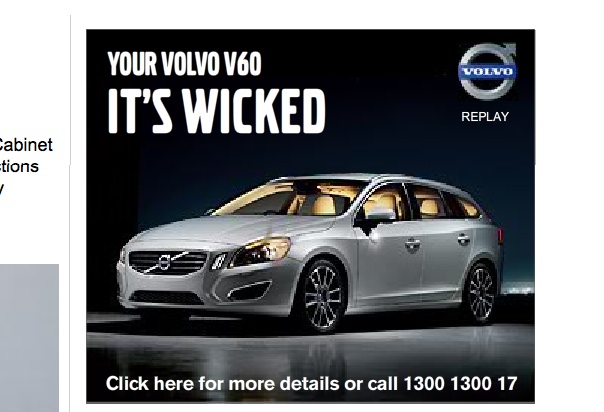
Are we really going to believe there is a beast inside a Volvo?
This is no longer safe, now it is wicked. Or maybe it is safe and wicked!

The above the fold digital campaign is being used to launch the new V60, T4 and T5 range and features intrusive hover or pop out ads on The Malaysian Insider and possibly other news sites. Interestingly, once the Volvo ad on The Malaysian Insider closes, there is an expandable ad for BMW beneath it!

Back in early 2010, Volvo ran a new creative campaign for the new Volvo V50 with the tagline, “There’s more to life with Volvo.” Later that same month Volvo ran another campaign featuring a man and a woman wearing parkas sitting in a pile of snow and staring at a snow covered landscape (don’t forget we’re in Malaysia which sits pretty much on the equator!) with the headline, “Volvo owners get more out of life.”

Even more confusingly, at the time there was a Volvo billboard outside my office with the tagline, “Winner of fuel efficiency award.”

In 2011, Volvo launched a new version of the S60. This time they encouraged us to “get naughty with it.” The ad claimed there are ‘naughty cars everywhere’ and that ‘naughty cars go everywhere’. The box ad features the price of the car and two links to either get naughty with the car or test drive it.

You can read more about this campaign in my post of last year which is here.

The fact of the matter is that these campaigns are not working. In 1999 Volvo sold 642 cars in Malaysia. In 2009 Volvo sold 550 cars. In the same year, Peugeot sold 1,258, VW 885, Mazda 1,444, BMW 3,564 and just to put things into perspective, Toyota sold 81,784 in the same period.

In 2010 Volvo sales increased to 839 but this was below the target of 1,100 set by the CEO. And in the same period, VW sold almost 4 times as many cars (2,810) as the year before. Mazda increased sales from 1,444 in 2009 to an impressive 4,325 in 2010. Even Peugeot increased sales from 1,258 in 2009 to 2,562 in 2010. Mazda and Peugeot do very little advertising in Malaysia.

So these creative new campaigns are obviously not working. So what should Volvo do?

1) Develop a plan to identify and target the right consumers
2) Create content that will resonate with your consumers. Better still, get consumers to generate the content.
3) Separare the acquisition strategy from the retention strategy
4) Integrate all activities across all platforms don’t just launch ad hoc tactical campaigns and hope they work. They aren’t.
5) Invest more in sales and post sales communications
6) Volvos are safe, they can’t be safe and wicked. We like the fact they are safe but we appreciate you want to attract new segments but please, keep it real or you will lose existing segments and not attract new ones.

Implementation of any creative campaign should take into account the fact that consumers are no longer impressed with well executed, high quality, brand driven commercials. Because they don’t believe what they read anymore. In Malaysia 86% of participants in a survey said they no longer believe what they read in advertisements.

A brand can no longer rely simply on ads to sell products. An integrated brand strategy is crucial to successful branding. With a recession coming, Volvo needs to get it right and get it right soon.

By the way, whilst Volvo is trying to tell us the Volvo is actually a beast and that a Volvo is wicked, Volkswagen is pushing it’s park assist in Europe. Have a look at this enjoyable <a href="

Volkswagen – Tiguan – Park Assist II (ENG) from AlmapBBDO Internet on Vimeo.

” target=”_blank”>video made for iPad.

2012 must be the year you develop a social media brand strategy


Saudi Arabian Prince Alwaleed bin Talal has twice been named as one of the smartest and most creative investors in the world by Forbes magazine. He’s also been called the “Saudi Warren Buffet” because of his impressive track record with his investments.

He first came to the fore with a signficant investment in Citibank in 1991 and now has interests in a diverse portfolio that features stellar brands such as Apple Inc, Four Seasons Hotels and Resorts, George V Hotel in Paris, Songbird Estates (Canary Wharf), Time Warner, News Corp., Walt Disney, Euro Disney, PepsiCo, Procter & Gamble, Motorola, Hewlett Packard and Kodak.

So when someone of his calibre announces, as he did just before Christmas 2011 that he was taking a US$300 million stake in Twitter, the world pays attention.

Ahmed Reda Halawani, Executive Director of the Prince’s Kingdom Holdings company said in a statement, “We believe that social media will fundamentally change the media industry landscape in the coming years. Twitter will capture and monetize this positive trend.”

“Fundamentally change the media industry landscape in the coming years.” I’m prepared to go one step further, I believe that social media is the media equivalent of the printing press, the radio and the Television – all arriving at once!

So if you are CEO of a Malaysian SME and you still haven’t invested resources into social media, I suggest you do so and do so quickly.

But before you do what many do which is to copy all the content on your website and paste it onto your Facebook page and think that is a social media strategy, I suggest you also invest some time in learning about how to use these channels.

Because social media is about relationships. And Malaysian SMEs have, on the whole over the last two decades or so, focussed not on relationships, but on selling their products at the cheapest price.

That’s fine when there is significant demand for a product and you can always produce it cheaper than someone else. But unfortunately today, someone somewhere is producing just about everything cheaper than Malaysian firms.

And this places Malaysian SMEs at a disadvantage, especially when multi national corporations are taking notice of Malaysia and beginning to invest significant marketing dollars in the country.

The good news is that social media, used correctly can actually save SMEs a lot of money because firms can create awareness, gain customers and, most critically retain them across social media platforms for a fraction of the cost of investing in traditional media such as TV, radio, Outdoor and others.

But it is important to develop a social media strategy before embarking on the exercise otherwise resources will be wasted, reputations may be affected and you could be worse off than before you started.

Here are 11 elements that must be included in any SME social media strategy

1) Determine your goals and your target market.
Obvious I know, but too many companies are trying to use the same tactics online as they did offline, ie trying to use the same ‘one-size-fits-all’ communications campaign to create awareness via a series of tactical campaigns. This will not work on social media.

2) Raise brand awareness by creating an online game or contest and hosting it on Facebook.
Tourism Malaysia has spent a significant amount of money on Facebook competitions that have generated many online column inches of comment. Despite limited investment in the content, the activities were executed well. However despite hundreds of thousands of new Facebook fans, tens of thousands of engaged users, significant traction in the social-media space, it is unclear what the actual campaign goals were.

3) Give free stuff away!

I don’t know how Tourism Malaysia will use the data it generated from the Facebook campaign, but to build a database that can be turned into brand evangalists in the future, it might be worth offering prizes for content shared with other users across platforms such as Youtube, Twitter and so on. This can be then be leveraged to gain more brand traction.

4) Use crowdsourcing to determine strategy
Back in 2009, Vitamin water wanted to launch a new brand. In an exercise that Gap management should have emulated, they binned the traditional qualitative and quantitative research via focus groups and intercept surveys. Instead the company turned to social networks and sought the opinion of consumers in a real world, real time environment to decide on the name of the new product. Over 1 million people participated in the project and they got close to celebrities employed to spike interest in the project.

5) Don’t delay your decision, you are already being talked about!
Conversations about your brand are already happening on social media. Embrace the conversation and get engaged but a word of warning, don’t try to use the platform as an opportunity to push your products onto consumers.

6) Don’t be afraid to revise your marketing message
Perhaps once, twice, three times and even more to make sure you engage the right consumers with the right content and don’t generate negative feedback from your audience. But if you do generate negative feedback, address it in an honest and transparent manner and see the conversation all the way to the end, no matter how distasteful.

7) Comments are good
One website we were asked to audit recently didn’t allow comments from other users yet increasingly, consumers are looking to comments rather than actual articles for the data that will influence and determine their decision making.

8) Remember your core message and don’t go too far away from it
Being genuine and transparent and sticking to your overall image is very important.

9) Tell the truth
Target Rounders is a subsidiary of the US retail giant. It is an online group that you sign up for & you get points for marketing a product. They come up with new products & then everyone on their list finds fun ways to promote it for “points.” The company launched a Facebook campaign that utilized a lie created to gain more fans and a larger community! Unfortunately consumers spotted the lie and the project died.

10) Creativity is effective in social media
Prior to launching the much anticipated Shark Week, the Discovery Channel sent a jar that appeared to include a death notice to new media types.

The jar included a note that read, “This jar holds a story – the story of a single tragic incident that needs to be unlocked. Dive in, investigate the evidence and discover what lies beneath the surface of frenziedwaters.com.”

The jar also included a large warning sign, shredded swimming trunks (no doubt belonging to someone who was eaten by a shark), and a detailed obituary dated for a future date at the time of the campaign.

Participants were intrigued and as a result spent a lot of time researching online before realising that the Discovery Channel was behind the whole thing. Nevertheless, the right people were soon talking about the show and building interest.

11) Write a social media policy
For most firms, their social media policy consists of restricting access to social media. But this isn’t the way forward. Used properly and by the right people, social media can be a very effective and inexpensive marketing tool for brands. But there are always going to be risks associated with a new tool so the best defense against abuse is to create a policy for usage.

Social media is making companies be more sharing, collaborative and transparent, not just externally but internally as well. Including employees in the policy development process will create internal advocates for the policy and improve morale.

The social media policy should be more about what employees can do and best practices for social media use versus all the things employees can’t or shouldn’t do on social media.

When shrewd investors such as Prince Alwaleed bin Talal are taking stakes in social media you know it is here to stay.

To stay competitive, Malaysian SMEs are going to have to invest more in developing brands. Social media, used correctly will save them large sums of money communicating those brands to consumers and other customers.

Effective use of Twitter to build your brand


This article first appeared in the 29th November print edition of The Malaysian Reserve

Earlier this week at the launch of the 1Malaysia Social Media Convention, the Prime Minister of Malaysia Datuk Seri Najib Abdul Razak announced that the Barisan Nasional (BN) was developing an army of BN friendly cyber practitioners to engage consumers online.

The PM said at the launch, “As a party that wants to be relevant, we have to change according to the change in time”. The Malaysian Prime Minister should be applauded for his grasp of the importance of Social Media because there are over 12 million Internet users in Malaysia and Social Media is responsible for one third of the web traffic in the country.

The Prime Minister understands that social media has transformed people’s behaviour, their expectations and how they like to express themselves. Unfortunately, although the Prime Minister is aware of the importance of Social Media, most corporations appear oblivious to the impact of Social Media on consumers and the way they learn about and share information on products.

This may be because up until recently companies have been able to manage their communications but this is changing and today, consumers no longer respect or trust slow, opaque, bureaucratic, dictatorial corporations and the structured PR and advertising they like to push out across traditional broadcast media. In fact a recent study noted that a staggering 86% of Malaysians don’t believe what advertisers tell them in traditional ads!

Consumers are fed up with the automated voicemail that greets them when they call with a product or service issue. Especially as many corporations use the inevitable waiting time to try and sell something else to a customer who is often seething at the company and is not in the right frame of mind to be sold to.

Today, consumers expect, no demand to be able to talk to the right person at the right time.

Today, successful organizations are the result of being human, responsive and transparent. And consumers will communicate with these companies across open and transparent social media communities such as Twitter, Facebook and others.

So over the next few months we’ll talk about some of the most likely social media tools you can use to communicate information about your brand and how those tools can be used for businesses such as yours.

This month we look at Twitter, what it is and how you can use it to build your brand.

Worldwide, there are now 100 million active Twitter users and daily Tweets are over 250 million. Most top actors, athletes, politicians, businessmen and artists are active on Twitter.

Every news, current affairs and sports programme proudly displays its Twitter account name. Global events anywhere in the world break first and spread faster on Twitter. While CNN is showing 2 day old sports’ scores on its ticker tape, Twitter is providing those who are interested with ball by ball updates live from the next days play.

Barack Obama has 11.2 million followers, Datuk Seri Najib Razak has 295,000, AirAsia has 245,000, Amazon has 149,000, Firefly has 47,000 and the numbers are growing fast. In Asia, Indonesia has the most subscribers to Twitter whilst there are about 1 million in Malaysia.

It is important to understand that Twitter is not another Facebook. Facebook is best described as a few to a few social network created with a goal of sharing personal information and life related stuff with friends. Only once two people ‘friend’ each other can information begin to flow. Twitter on the other hand, is a one to many social network that allows me to say follow Firefly to keep abreast of their offerings yet they don’t have to follow me back to make the relationship work.

Twitter allows prospects and customers to instantly connect with you. Brands are no longer defined by the campaigns created by marketing and PR departments within companies. In the social economy of today, brands are defined by consumers or more specifically the experiences those consumers have with brands.

Get it right and you’ll build a brand. Get it wrong, and consumers will ensure your brand fails.

One of the reasons for Twitter’s success is because consumers got fed up with the automated responses they were faced with every time they contact a company.

Twitter is a popular platform to disseminate news about your company. If you have set up your Twitter account properly, Twitter is a dynamic and inexpensive platform for you to post information relating to your brand. A well planned Twitter strategy can help keep prospects and existing customers abreast of new developments and engaged. Beware however that it is not a broadcast medium and you must know when to stop. Constantly sending out the same message will have a negative impact on the brand. It’s also important to respond to comments from consumers related to your announcements.

Twitter is an excellent platform for sourcing actionable data. Twitter lets you find out priceless information about your customers – their opinions of your brand, what they like and/or dislike about your brand, what they think of your competitors, recommendations for improvement and much more. Twitter gives you an opportunity to improving your business, often without the need for costly investments.

Twitter helps you to humanize your brand. Twitter allows you to reach, communicate and engage with consumers and match your product attributes to their requirements for value whilst other companies are publishing generic ads in newspapers or attempting to convince consumers with PR.

Twitter lets you send the right message to the right people immediately. By using groups, lists, communities and other Twitter features effectively, Twitter lets you distribute news, make announcements, inform or create awareness of special offers to the right people in real time. No more waiting a month for the magazine to come out or 24 hours for the newspaper (assuming they have the space).

Being active and effective on Twitter communicates a company at ease with technology. Being a part of the Twitter community shows that you are moving with the times, that you embrace technology and are an open and transparent organization.

Twitter case study
A frequent business traveler between Malaysia and the UK was a loyal user of Budget Rent a car. But after a 13 hour flight, the business traveller was forced to wait two hours for a pre booked car. He stayed with Budget until on another occassion he received a bill for £86 because he forgot to pay the £10 congestion charge. So he decided to look for another car hire company for his next trip to the UK.

Using a price comparison site he came across Sixt, a company he had never heard of. The company offered an attractive pick up and drop off within a 5 mile radius of the nearest showroom. But when the businessman was booking the car hire on line he couldn’t find out any information on the pick up service.

So he turned to Twitter and asked for help. Within 5 hours the MD and CEO of Sixt had both contacted him with a request for his email address so that the @Sixt customer service team could get in touch.

Arrangements were made with customer service for the pick up and as a nice touch the car hire company upgraded him to a premium car. The experience was seamless, quick and pleasant. The businessman then shared, across multiple social media platforms details of his experiences and I am now sharing his experience with readers of this Blog and across Twitter, Facebook, Stumbleupon and more.

What was the cost of the positive buzz and acquiring this new, influential customer from a competitor? In terms of time perhaps an hour at most. Financially, next to nothing.

Why it pays to build a brand


As they enter the season of contract negotiations, many Asian and Malaysian firms are finding their margins squeezed by the Western brands for which they manufacture products.

As they go through this painful process, the question of whether they should explore the possibility of developing their own brands will come to the fore once again.

It is well known of course that the cost of building a brand can be substantial but failure rates are high too – as high as 90% according to Ernst & Young.

But the rewards of developing a brand successfully are difficult to ignore and Apple is considered by many to be the poster boy of successful branding.

Almost bankrupt 15 years ago Apple’s stock reached US$369.89 in August 2011 when its market capitalisation hit US$342.8 billion. This put the tech superpower ahead of the previous richest company Exxon, whose stock fell to US$68.78 with a market cap of US$334.41 billion.

Although Apple only held the position of richest company in the world for a short time, it was some achievement.

The demand for Apple products continues and the company sold four million of the iPhone 4S in the first four days after the launch in November 2011.

Such demand allows the company to charge a premium for its products. But how much profit does Apple make on iPhones and is it really beneficial to build a brand?

A recent report from technology research firm iSuppli would suggest the answer is a definate yes.

iSuppli has carried out extensive research and recently announced that a 16GB iPhone 4S costs US$196 (RM616) to make whilst the 64GB costs US$245 RM770).

In the UK the iPhone 4S costs UK pounds 499 or RM2,520 out of contract. The iPhone 4S is not on sale in Malaysia yet but in Singapore an out of contract 16GB iPhone 4S will cost S$948 (RM2,526) and the 64GB will cost S$1,088 (RM2,669).

Nice margins indeed!

Individual component costs of an iPhone

Google+ Brand Pages is another critical social media tool for corporate brands


Back in June 2011, Google launched Google+ to counter the increasingly powerful and influential Facebook. According to Google, 40 million people have signed up for Google+ which equates to about 8 million new users a month. Not a bad effort but a long way to go to reach the 800 million Facebook users.

The launch of Google+ saw a number of complaints from consumers, especially related to applications whose functionality was changed or users being forced to give up pseudonyms to continue sharing.

Corporations also complained because they were unable to connect and build relationships with consumers, something they have been able to do and do successfully on Facebook.

Some companies did try to create business pages on Google+ but they were rejected, with a request to wait.

Well the wait is over with the launch today of Google+ Brand Pages. Now firms can connect and engage with consumers through corporate pages. Although Google+ Brand Pages doesn’t operate that differently from Facebook, it will have to form a part of any corporation’s social media strategy.

One neat feature not available on Facebook is Google+ Direct Connect. Simply by putting “+” in front of a brand’s name before making a Google search, will ensure searchers are directed to the firms Google+ page.

Google’s open approach also means that a brand can now have a business page that is integrated with Google search, Ad words, Google places and YouTube.

Critically, I also expect Google+ profiles to have a significant impact on Search Engine Optimisation (SEO) and search results. And once Google starts to provide metrics for pages via Google analytics, we may see Facebook’s crown slip.

Isn’t it time you valued – not measured — customer satisfaction?


Recently I’ve met a couple of companies who couldn’t explain why they implemented a customer satisfaction survey and how they used the results! I hope this is the exception, not the rule.

If you’ve carried out a customer satisfaction survey, you probably did it because you want to deliver great customer service and believe the satisfaction survey will give you something to benchmark future results against. If this is the case, you are not alone.

Many companies regularly measure customer satisfaction. They send out surveys or call asking questions about satisfaction with service, product usage and more. Most people will have encountered the satisfaction survey at the bank counter that encourages immediate responses, the results of which can impact the manager’s bonus.

Others may have received a call from a car workshop after a service or an email from an online service provider.

But, unfortunately, the results of such measurement are unactionable. That means customer satisfaction surveys do a poor job of linking cause and effect.

As an example, a traditional survey might ask, “How satisfied were you with the product/service?” And then give 5 options from “Very satisfied” to “Very dissatisfied” but where’s the cause and effect?

If customers are dissatisfied with the product, what caused it? Was it a poor sales or other service experience? Or was it because the teller gave the wrong information? An unfair ‘returns policy’? Complexity? A lack of add-ons?

Part of a typical satisfaction survey, how measureable are the results?

Many customer satisfaction surveys measure the wrong activity at the wrong time, often with the wrong customers. If a walk in customer to a branch of a bank is a frequent visitor who takes up a lot of time making withdrawals or engaging expensive, trained personnel with minor transactions, should the bank care if they are satisfied or not?

Another failing of customer satisfaction surveys is that they are divorced from the costs of satisfaction. Yes, customers can be satisfied, but do you really want to satisfy every customer no matter what it costs?

Many organizations apparently do and some think good satisfaction scores are considered more important than profits. At least one Malaysian firm boasts of “exceeding expectations.” Not unexpectedly, setting the satisfaction bar so high inevitably leads to excessive expenses, hurting profitability.

And it is also misleading. According to Frederick Reichheld, writing in the influential Harvard Business School publication, 90% of industry customers report that they are satisfied or very satisfied. Impressive figures but why is it then that repeat purchases remain in the 30% – 40% range? Surely if so many customers are satisfied, shouldn’t they be making repeat purchases?

But most telling of all, in numerous surveys, 60% – 80% of customers have reported they are happy with service, before moving to a competitor!

Harvard Business Review - even completely satisfied customers can leave

Another issue with satisfaction is that as consumers become more empowered, the less likely they are to be satisfied. According to a survey by Accenture and the Marketing Society, the percentage of people whose ‘expectations of service quality are frequently or always met’ declined from 53% in 2007 to 40% in 2009. If this trend continues, it is unlikely that expectations will ever be met and therefore, what is the relevance of a satisfaction survey?

Companies can also influence or manipulate satisfaction scores with the timing of the questions. For instance, if an airline upgrades a traveler from economy to business class on a long haul flight and then calls the next day to ask if the passenger was satisfied will produce a predictable answer.

What you really want to do is to value satisfaction, not measure it. Valuing satisfaction means putting an actual cost figure on the satisfaction that is required to keep a customer as a customer.

After all, you spend large amounts of money on advertising, sales and other branding tactics to acquire a customer and then when you do acquire him, you ask if he is satisfied with the service. Wouldn’t it make sense to know why he became a customer and what it will take to keep him as a customer?

The importance of keeping a customer as a customer is ignored in almost all satisfaction surveys. Yet why would you want to satisfy a customer if 60% – 80% are likely to defect to a competitor with the next purchase?

Companies committed to growing profitability instead of expenses are already making the move to valuing satisfaction.

One of the first companies was Starbucks. Starbucks prides itself in providing a unique customer experience. In many ways, its brand is based on this customer experience. But Starbucks success meant longer queues that created unhappy customers. So, to ensure continued growth, Starbucks sought to measure satisfaction with the customer experience.

Starbucks strives to deliver value

Starbucks decided to talk to customers. Its customer research discovered that the average “unsatisfied” customer stuck with the company for a little more than one year, made 47 visits to its stores during that period and spent a total of approximately US$200. Not bad, really, for an “unsatisfied” customer.

But look at the value of a “satisfied” customer. The average “highly satisfied” Starbucks customer patronized the chain for more than eight years, made almost double the amount of visits (86) per year and spent over US$3,000 over that average eight-year time frame.

What was the primary difference between “unsatisfied” and “highly satisfied” customers? The amount of time the customer had to wait in line. Now that Starbucks knew the value of satisfaction, it could make the appropriate financial decisions.

Indeed, once the connection was made between marketing metric and financial outcome, calculating the investment and its potential payoff became easier. Based on Starbucks’ estimate, marketing would have to invest US$40 million annually worldwide to sufficiently reduce wait times and help convert those unsatisfied customers into highly satisfied ones. That’s no small amount, even for Starbucks.

If you were the CEO of Starbucks, what would you have done?

Actually, the data made the decision quite easy. Since the research had shown that each highly satisfied customer was worth US$3,000 over eight years and each unsatisfied customer was worth US$200 for one year, all Starbucks had to do was calculate the discounted cash flow and determine how many customers must be converted from unsatisfied to satisfied customers to generate the US$40 million in incremental revenue needed to cover the investment. The calculation revealed that Starbucks would rapidly recover its investment in satisfaction.

So take a close look at your own customer satisfaction surveys. Are they just telling you how “happy” customers are at a particular time and place and based on a specific transaction? Or do they provide actionable data about customer value?

Do they let you know their standards for product and service performance? Do they let you know how customers hold you accountable? Do they provide data that lets you make financial investments in customers that will bring the greatest financial return?

What’s needed today – and unfortunately is missing among companies that depend on creativity to build their brand – is a correlation between marketing metrics and financial outcomes.

Don’t limit your bottom line with feel-good customer satisfaction surveys that just look at customer good will. Instead, measure the value of their satisfaction. The result will not only tell you the causes of their satisfaction or dissatisfaction, but, much more importantly, provide the hard financial data to determine what to do about it.

Malaysian SMEs must start to build brands


This article first appeared in the 28th October 2011 issue of the Malaysian Reserve.

The recent budget and the implications of the budget are still being debated but what is clear is that the government is trying to help SMEs.

As part of the budget, the prime minister announced a RM100 million SME Revitalisation Fund for entrepreneurs who have tried and failed. The goal of the fund is to give those entrepreneurs the chance to get up and have another go.

SMEs are the engine room of countless economies and crucial to the development of many countries. In Malaysia the percentage contribution of SMEs to the nation’s Gross Domestic Product is 47.3%. This compares favourably to the larger economies of China (60%), Japan (55.3%) and Korea (50%).

One of the reasons Malaysian SMEs have stayed relevant is because most of them have been nimble and adaptable, making the change from primary industries such as agriculture and mining up until 1990 to an industrialized economy that saw manufacturing becoming the leading growth sector over the last 20 years.

However, many of those SMEs that made the move from commodities to manufacturing succeeded because they were able to compete on price. And with low labour and other costs, Malaysian made products were attractive and demand was constant. This also encouraged FDI.

But talk to any Malaysian manufacturing SME and you will most likely find that over the last 20 years, with few exceptions, every new contract negotiation with the companies they have supplied clothing or equipment to has resulted in their being forced to lower their price. Margins, with a few exceptions are down to less than 4%.

Despite relationships that may span as many as 20 years, loyalty is non existent and, despite vague promises of long term relationships, business is now being lost to Cambodia, China, Indonesia and Vietnam.

Hardly surprising when average factory wages in Malaysia are 250% higher than in Cambodia, 200% higher than in Vietnam, 160% higher than in Indonesia and even 40% higher than in China. Worse of all, as a contract manufacturer for a third party, Malaysian manufacturers have no knowledge of their consumers and little chance of finding new business.

As FDI and even local investment in manufacturing has dried up as brand owners seek less expensive locations, Malaysian SMEs are now fighting for their survival and whilst the SME revitalization fund is an important step to help those who have failed, Malaysian SMEs will need to develop more strategic ways to differentiate themselves.

One obvious way for SMEs to do this is to build brands. Yet the majority of Malaysian SMEs ignore the importance of branding. But competition, accentuated by AFTA and China’s entry into the WTO means that if they do not begin to brand, they will not be able to compete. The long term reliance on cost to differentiate, driven by historical experience in commodities and the fact that Malaysia was a cheap manufacturing base, will no longer suffice.

The irony is that Many Malaysian SMEs have done the hard part. Malaysian SMEs are already capable but are yet to sell their capabilities to the world. A major investment in branding will allow Malaysian SMEs to leverage substantial advances in quality manufacturing, workforce productivity, logistics and efficiency.

Malaysian SMEs already produce garments for international brands, components for the international aerospace industry, electronics for the global computer industry and numerous personal consumer goods.

In the services sector Malaysian SMEs provide support to banks, airlines, hospitality providers, medical services, insurance companies, and so on.

But these SMEs may lose out to international competition if they do not develop brands. Now is the time for SMEs to learn the importance of branding and the strategies and skills needed to create and maintain market strength through building relationships, providing personalisation and delivering value to customers.

Compounding the problem is that Malaysia is becoming a victim of its own success. As it becomes a more mature economy, global MNCs will start to take notice, as they are already doing and flood the market with international brands using international budgets to buy market share. Unless Malaysian SMEs begin to brand they will not survive this onslaught.

It’s especially important that Malaysian SME’s allocate their (and the Governments) limited resources effectively. The brand promotion grant, launched by the government about six years ago helped some companies advertise but using advertising to build a brand requires deep pockets and leaves too much to chance because it is so hard to stand out from the clutter and be heard over the noise of other advertisers and make an impact with consumers who are permanently distracted.

The good news is that branding today does not necessarily require huge investments in logos, slogans and expensive creative driven advertising campaigns pushed out across traditional mass media, which too often result in at best, a short-term sales spike but have no real long term gains for the company.

By utilizing emerging technologies and trends that are having a major impact on brands and branding and by leveraging these technologies and trends, and by integrating such trends and technologies with the social nature of Malaysian culture, Malaysian SMEs can potentially build global powerhouse brands. And not in the twenty years it has taken traditionally taken to build a brand, but possibly in as few as five to ten years.

But to do this Malaysian SMEs must focus not on price and trying to undercut rivals, both domestic, regional and international, but by identifying prospects, building relationships and understanding customer requirements for value. This will take a significant change on organizational culture but it is one that Malaysian SMEs must make.

It is great news that the government is trying to help SMEs with the SME revitalization fund but it is also important that SMEs help themselves and understand that if they are to survive and thrive, they can no longer compete on price alone.

Should you use celebrities to promote your brand?


There are lots of differing views on the use of celebrities to sell brands but if you have the money, it makes sense to explore this option.

But tread carefully because celebrities after all are human and humans get injured or worse, make mistakes – think Tiger Woods, who was unceremoniously dumped by Tag Heur, Gatorade, Gillette, ATandT and Accenture, soon after the details of his infidelities emerged in late 2009.

Firms the world over spend hundred of millions of dollars getting endorsements from celebrities. And studies would suggest the returns are worth the investment – and the risk. Which is probably why Rolex has announced that Tiger Woods will now endorse its watches.

Indeed, a report last year by Anita Elberse for CNN found that sales of brands in consumer product categories jumped an average of 4% in the six months after an endorsement deal was announced.

Interestingly the report also noted that stock prices went up about 0.25% on the announcement and would generally react favourably each time the athlete won an event in his field.

As an aside, although Tiger Woods lost those endorsements, he is still the most endorsed athlete in the history of sport. And justifiably so if a report from Kevin YC Chung is anything to go by. According to the report, from 2000 – 2010, just the golf ball division of Nike earned an additional profit of US$60 million after acquiring 4.5 million customers after Tiger Woods began endorsing Nike products.

Of course Celebrity endorsements are not cheap. In 2000, Nike paid Woods US$100 million for a 5 year endorsement deal. Tennis player Anna Kournikova has multiple deals with Omega, Berlie Lingerie, Prince racquets and Canon. Kournikova also signed a US$50 million six year deal with Adidas. Fortuitously for Adidas they wrote a line into the contract that insisted on Kournikova winning something. This she rarely did but she still earned US$3 million from the deal.

Probably the biggest endorsement deal ever done was between Adidas and David Beckham. The lifetime deal cost Adidas US$161 million back in 2003. But at least it stops Nike from getting their hands on the globally popular football star.

Sometimes however all it takes is a little bit of good fortune related to a celebrity to generate massive sales. Victoria Beckham let it slip in an interview recently that despite the healthy state of her and husband David’s bank account, David was more than happy buying his socks from Marks & Spencer.

Since she made the statement, Marks & Spencer claim they have seen a more than 30% increase in the sale of men’s socks! And the cost of this celebrity endorsement? US$0.

A definition of branding that will help you to build a global brand


This article first appeared in the 30/09/2011 edition of The Malaysian Reserve

Over the years, companies have invested phenomenal amounts of money in marketing and advertising activities such as sales calls, direct mail, TV, outdoor, indoor, print and other advertising, brochures, leaflets and more. Indeed, according to Nick Wreden in his book Profit brand, How to increase the profitability, accountability and sustainability of brands, over US$1.5 trillion is spent annually on marketing (including advertising) worldwide and yet according to McKinsey, a management consultancy, up to 90% of products fail to become brands.

With little or nothing to show for these significant investments, companies looked to other disciplines and soon Branding was considered the way forward and the last 10 years has seen a major change in the resources committed to Branding.

As a result of this interest, hundreds of traditional books and ebooks have been written on the topic of Branding. Thousands of newspaper and magazine column inches have been dedicated to the discipline. Workshops and seminars have been held all over the world, all promising to teach business people how to Brand. These presentations are often uploaded to slideshare and Youtube videos have appeared, all with content related to Branding.

Many companies, including I suspect, yours have explored the concept and many have actually embarked on what they thought was a branding or rebranding exercise. Indeed, only recently, Malayan Banking Bhd (Maybank) announced it had gone through a rebranding exercise and even the Prime Minister attended the press launch of the new ‘brand’.

At the press conference, Malayan Banking Bhd President and CEO Datuk Seri Abdul Wahid Omar unveiled a new logo and explained that the bank would be spending RM13 million on the implementation exercise across the Asian region and that it would take about a year.

On the face of it and with the only evidence a new logo, this does not look like a rebranding exercise. This is more like a brand identity makeover or corporate identity reengineering, nothing more.

Another financial institution recently made a similar announcement and stated that it would spend RM15 million on a rebranding exercise. Soon after I received nine emails for a product that I didn’t understand and with a tagline that offered an exclusive deal for MasterCard holders even though I am not a MasterCard user.

Other well-known companies from the transportation, media and distribution industries have recently announced rebranding exercises that have actually been little more than a new advertising campaign.

The reality is that the new Maybank logo and identity will probably not make a difference to the brand and how consumers and organizations view the brand or the profitability of the brand. Think about it, when was the last time you signed up with or changed your bank because of a competitor’s logo?

This confusion is not Datuk Seri Abdul Wahid Omar’s fault. If we have to point fingers, we should probably point them at the marketers and advertising agencies responsible for muddying the branding waters.

It is because they have confused business owners and consumers with their contradictory interpretations that there is still a lot of confusion about Branding, the concept of Branding, what constitutes a Brand, what is Branding and how to build a Brand.

But this article is not about pointing fingers it is about identifying a definition of branding that will help Malaysian SMEs and other companies use scarce funds effectively and efficiently.

So what is a good definition that Malaysian companies can use as a foundation for their branding efforts?

We created this definition in 2004 and it still rings true today:

A brand is a long term profitable bond between an offering and a customer.

This relationship is based on offering economic, experiential and emotional value to those customers.

And it is backed up by operational excellence and consistently evaluated and improved.


We have used this as a foundation to build Malaysian brands and all of them have benefited from using this to take their brand forward. But what does it mean and how can Malaysian companies like yours use it as a foundation for their branding efforts? To do this, we need to break the definition down into three parts, as per the paragraphs above.

The first paragraph relates to two key elements, profitability and retention. One of the reasons that advertising, marketing and other traditional communications campaigns are so ineffective is that too many companies spend an absolute fortune getting a customer into their shop or showroom and then after the customer buys something, they just let them walk out the door! Isn’t it incredible that firms let customers walk out the door without attempting to at least try to build some sort of bond with them?

If you don’t why should the customer come back again? Don’t kid yourself that your product (there are some exceptions) is so unique that they will ignore other products and fight off all the attempts to lure them into competitor stores even though you have absolutely no relationship with them.

Profitability is an important branding metric, much more important than reach or awareness. It is estimated that up to 15% of a firms customers are unprofitable. You need to know who are your unprofitable customers and get rid of them.

If you have a car that won’t start and you send it to the garage and the mechanic says the engine is broken so you take the car to the paint shop and paint the body, will it help to fix the engine problem? Of course it won’t. It is the same with a brand. If you are receiving numerous complaints about the quality of your products or the time it takes to be served at a branch and you ask an advertising agency to create a new logo and you put that new logo on all your company materials, it won’t solve your quality or service issues or make your brand any better.

But if you carry out research with your customers and identify what are their requirements for economic, experiential and emotional value and then match your product attributes to those requirements for value you will make sales. And if you’ve laid the foundations for retaining those customers, as mentioned earlier, then you will be on your way to building a brand.

And by developing this emotional connection with your customers in which you deliver economic, experiential and emotional value, which incidentally will be done across multiple touch points such as when they use the counter service, through your correspondence and marketing collateral, the way you handle enquiries, your packaging, in one on one meetings with your representatives and so on, there will be no interest or need for them to take their business elsewhere.

In fact you will be surprised at the effort they will put into returning to you. And provided you keep your product or service relevant and continue to interact with those customers across platforms and channels that they engage with then you will be building a brand.

Operational excellence is a key ingredient in your quest to build a brand. It doesn’t matter how much you spend on marketing, sales, advertising etc if your organization isn’t efficient and effective it will struggle to deliver value and ergo, build a brand.

Finally, it is important to continually improve to stay relevant so you must track, evaluate and improve your brand on a continuous basis.

Instead of looking at branding as a creative exercise or short term tactical communications exercise, look at it as a holistic strategic initiative that requires internal and external research, investment in retention and not just acquisition, investment in the organization and a desire to constantly improve.

Follow these rules and you are more likely to build a global Malaysian brand.

Why the iPad will fail – part four


Apple’s shares took a hit of as much as 3% yesterday after a JP Morgan Chase analyst announced that Apple was reducing orders of parts for its iPad by as much as 25%.

This is an interesting move, especially as we’re about to begin the traditionally busy lead up to Christmas.

I don’t want to say “I told you so”, but I did write here, here and here that the iPad will fail.