It’s not easy creating an original ad these days. Especially when you are trying to sell a car or pick up truck. Some of the best ads tell a story. Some of the really, really good ads tell a story and then take that story even further whilst creating little vignettes within the original story.
The very best do all of that whilst creating humour that resonates with everyone and not just the target market. This commercial, released a couple of years back for Toyota in Australia is one of the latter and probably goes some way to explaining why the Toyota Hilux is the most popular vehicle in the country.
Unfortunately, despite such brilliant commercials, Toyota pick up sales are down 21% year-on-year.
I don’t like to kick a man (or an airline) when he’s (or it’s) down, and despite a couple of good quarters, Malaysia Airlines (MAS) is certainly down.
The good quarters (following six straight quarters of losses) are a result of increased revenues thanks to better load factors and higher RASK (Revenue per available seat kilometer).
Just to recap, to avoid bankruptcy, MAS embarked on a massive restructuring plan towards the end of 2011 that included cutting unprofitable routes and reducing costs with the goal being to return to full year profitability in 2013.
Although the airline has done quite well, that’s unlikely to happen even though it is focusing on Asia and has stopped flying to costly destinations such as Buenos Aires, Johannesburg, Cape Town and oddly, Dubai. Giving up Dubai and Dammam suggests the carrier is surrendering to the aggressive carriers from the Middle East.
The most recent business strategy announced two key strategic elements – one to focus on the premium sector and the other to focus on the competitive Asian market. The announcement that the airline would go after the premium sector came at the same time as the partnership deal with AirAsia that has now been scrapped.
I’ve seen nothing to suggest the airline is courting premium customers and although it is good to see the airline understands the importance of segmentation, I doubt their ability to execute such a strategy.
Especially as the airline seems to be going the same old predictable route of using an advertising campaign featuring an irritating tagline (more on that later) to magically increase demand. And I’ve seen nothing else to suggest the airline is doing anything other than the usual advertising, print and PR tactics with a nod to social media.
And what an advertising campaign it is! I think this is the TV commercial.
I’m sorry but this has to be the worst commercial or video I’ve ever seen. It features people of various ages walking, cycling, swimming, jogging, directing traffic (I’m serious), reading newspapers, skateboarding, going to a meeting, graduating, bowling, clubbing and all with one thing in common – they are all carrying at least one suitcase! Yes, even the traffic policeman!! This really is rock bottom.
The print advertisement (which I’ve also seen on a billboard) features two men sitting on a wooden dock. They are both holding suitcases and the younger man has his arm around the older man and is looking into his eyes.
Sitting on the dock of the bay, suitcase in my hand
Does this image make anyone else uncomfortable? Here’s a close up to help you decide.
Does this make you uneasy?
MAS also has a corporate video that starts off with a series of stock scenes featuring babies taking their first steps, dad playing with son, climbers etc and then cuts to old shots of MAS in the early days. Meanwhile the voice over tells us that life is made up of countless journeys. Getit?.
Then we get shots of computer generated imagery of the various planes used by the airline from past to present (didn’t BA do something similar?) before going back to the people shots – nice, smiling, friendly air hostess with kid – cut to boys jumping into lake – then back to nice, smiling people, tender, caring hostess and then, out of the blue we’re told the strangers we meet on our journeys give us courage – cut to skydivers – then back to lovers on beach, cultural harmony, pregnant couple and so on. I stopped at this point, unable to continue. Have a look instead.
One of the videos (I can’t remember which one and I have no intention of watching them again) features the Malaysia Airlines app that I really like but isn’t integrated with the website (or if it is I can’t figure out how to find my bookings made online on the app).
So if MAS is serious about increasing market share, what should the company do? Here are 5 things they need to start doing today.
1) Forget about the big idea. Focus instead on consistent, onging, personalised engagement with each of your very diverse audiences.
2) You probably have one of the most comprehensive databases in South East Asia. Start to use it properly.
3) Focus. These ‘one-size-fits-all’ advertising campaigns are an expensive exercise in naïve futility. Put an end to them now.
4) Don’t do social, be social.
5) Integrate all your solutions to make it easier for consumers to use them. Otherwise they defeat the object of developing them in the first place!
I’ve been flying MAS for over 20 years and I think it is a great product but it needs work. A lot of work. This traditional approach to brand building is not going to help steer the airline to full year profitability. They’d be better off throwing the money down a black hole.
According to medical anthropologist Dr. Michael L. Tan, “Smoking will kill more people in the next twenty years than HIV/AIDS, accidents, homicides, and suicides combined.”
One report estimates that national health care costs for tobacco-related diseases for a population with a smoking prevalence rate of 50% could add up to almost 2% of GDP, or nearly 20% of the country’s total healthcare budget of just under RM20billion (US$6.5billion).
Little wonder then that countries such as Singapore are doing everything they can to encourage smokers to quit. Unfortunately, most of these efforts revolve around advertising campaigns.
And with advertising becoming increasingly ineffective, it is little wonder that the number of smokers shows no sign of a significant reduction.
This despite the fact that Singapore has one of the highest tax rates on cigarettes, the strictest rules on smoking in public places and those under 18 can even be fined just for carrying cigarettes.
In 2010 the Health Promotion Board appointed Ogilvy & Mather Singapore to develop a creative campaign to encourage young people to ‘reject cigarettes and live a tobacco free life that will improve their appearance, fitness, spending power and contribute positively to the environment’.
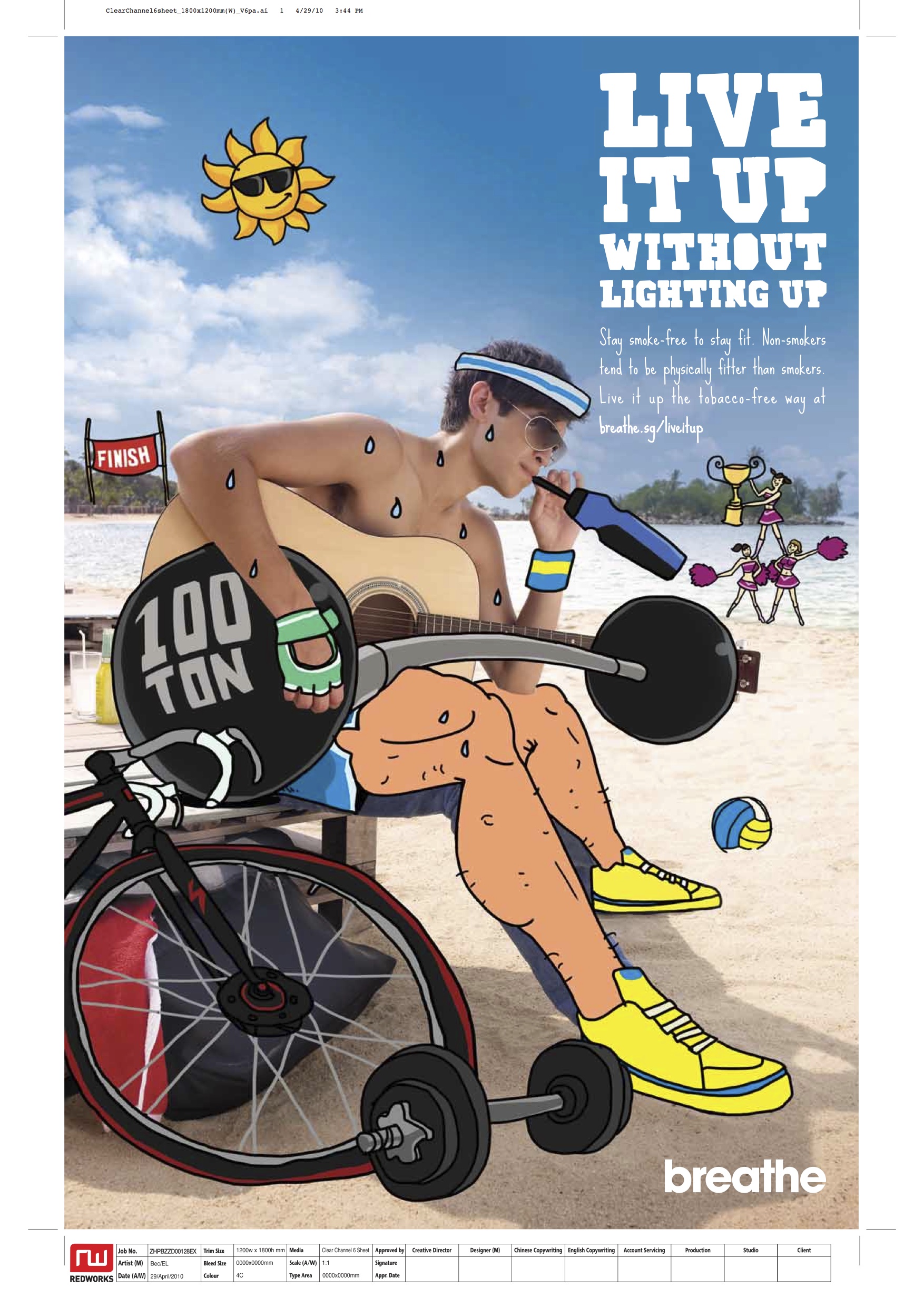
The results were ‘Live it up without lighting up’ and examples of the print ads can be seen and . The campaign featured above the line (ATL), out of home (OOH), digital, radio and events such as the Great Audio Experience, held on 29th May 2010 as part of World No Tobacco Day celebrations.
The creatives feature gorgeous, young, happy, confident people with unblemished skin in semi cartoon like environments. Copy tells readers that “Non smokers tend to look younger than smokers of the same age” and “Non smokers tend to be physically fitter than smokers.”
Goals were to communicate a better more beautiful and green world populated by gorgeous young things who are fitter, healthier and generally in a better place as a result of not smoking.
According to Jon Loke, the then Head of Art, Ogilvy & Mather Singapore, the agency was careful to ensure that “the campaign would not talk down to them”.
“We needed to turn the traditional way anti-smoking campaigns are carried out on their heads to create a message that would appeal to youths. Hence, the campaign encourages, empowers and ultimately celebrates a smoke-free life.”
Now I really liked the creatives for this campaign. I think they were really well executed and I wanted the campaign to work. But at the time I sincerely doubted this was the right way forward.
That’s because a creative driven campaign, no matter how much it turns things upside down, is unlikely to have an impact on the number of smokers in Singapore. Data shows that traditional marketing tools are even less effective today than they were as recently as 10 years ago. Consumers simply don’t listen to corporate driven mass marketing the way they used to, especially when copy uses vague terms such as ‘tend’.
Malaysia spent RM100 million (US$30 million) over 5 years on such a campaign that was ineffective in bringing down the number of smokers in Malaysia and the smoking rate of men in Malaysia is still over 50%.
In the UK, after extensive research of more than 8,500 smokers over a ten-year period, the Institute for Social and Economic research found that the warnings on cigarette packets that smoking kills or maims are ineffective in reducing the number of smokers.
Likewise, chilling commercials or emotionally disturbing programs are also ineffective. The study also discovered that even when a close family member becomes ill from the effects of smoking, the smoker takes no notice.
In fact, according to the study, smokers only reduce the number of cigarettes or sometimes quit when their own personal health is at stake. And even failing health may not persuade a smoker to reduce or even stop smoking because smoking is linked to a lack of psychological wellbeing and quite often failing health results in psychological decline.
Now I don’t know if these campaigns are working but if the goal is to reduce smoking then the answer is no they are not. Because according to The Wall Street Journal, more Singaporeans, especially young adults are smoking than ever before.
According to a Singapore National Health Survey in 2010, the proportion of smokers among young Singaporeans aged 18 to 29 was 16.3% in 2010, up 33% from 12.3% in 2004.
Even though previous ad campaigns did not work, the Government of Singapore commissioned Ogilvy & Mather Singapore to develop another campaign. This time the message moved from anti-smoking to pro-quitting. The campaign highlighted citizens who had quit smoking and made them “quitter champions.” ‘‘.
This campaign also featured across traditional and digital media. From 1st June 2013 a quit smoking movement will try to encourage smokers to quit for 28 days in the hope those that commit to the programme will not go back to smoking at the end of the 28 days. We shall see.
So what should Singapore do to reduce smoking in the country?
Countries that really want to reduce the number of smokers (and every country should want to because the burden on the health services will not get better) must understand that advertising is not going to solve their problems. There is no silver bullet to reducing the number of smokers.
What is required is a data driven approach to the issue. Specific and comprehensive qualitative research with relevant targeted questions related to each segment (and each segment will be specific and targetted) that are designed to deliver actionable data. For instance if Singaporeans are becoming smokers when they do their national service, is an advertising campaign going to change that? Of course not. The issue needs to be addressed inside the National Service camps.
It is imperative that audiences are identified and then engaged individually, on a one to one basis. It will be an expensive and long term effort (but not as expensive as wasting money on advertising campaigns and health costs). That doesn’t mean repeating the same one size fits all commercials or messages, this means developing a relationship with these partners through engagement.
Also critical to the development of the strategy will be the buy in from stakeholders such as doctors, educators, retailers and others. Discussions must be held with these key elements to determine strategies. One such strategy will involve retailers where most cigarettes are sold. But before banning sales at retailers, alternative sources of income for retailers must be identified. Once implemented, policing of retailers must be ramped up.
Once research is completed and analysed, a comprehensive strategy must be developed featuring a fully integrated program to communicate with all stakeholders with specific emphasis on education at residential level and dynamic, preventative and educational programmes for schools. Existing smokers will be targetted individually through interviews with doctors, rather than one-size-fits all government driven creative campaigns.
Singapore has done many things right in the past to reduce the numbers of smokers. Investing valuable resources on creative driven campaigns that are proven to have been ineffective in the past is not the way forward.
This infographic from McKinsey offers a fantastic insight into how two key European markets are engaging with digital and how it is revolutionising the buying habits of their citizens.
Are you ready for how digital is changing the way consumers interact with brands?
The implications of these new realities are significant to say the least. As more and more of the population buys online, traditional retailers will have to reinvent themselves or risk going out of business. Because these traditional retailers tend to move slowly, more of them are going out of business than reinventing themselves.
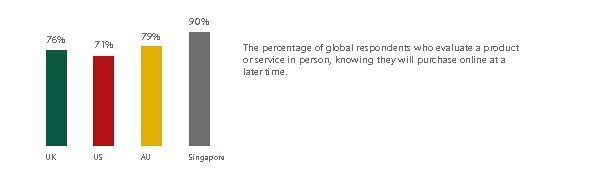
South East Asian countries tend to a year or two behind Europe in how technology is integrated into our lives however we’re already seeing digital influence how we interact with brands in Asia. For instance a recent survey by SDL in the UK found that 90% of Singaporeans evaluate a product or service in person before buying online.
Unless Asian brands wake up to the way consumers are using digital to research and choose brands – and that means more than using a traditional model of mass and invasive ads across news and other sites – they will find it hard to compete and that won’t have a happy ending.
A fascinating insight into the social media and mobile shopping habits of consumers in the United States, United Kingdom, Australia and Singapore has just been released by SDL in the UK.
The survey size is a little small – 4,000 people in four countries – but the results unearth new data on how social media and mobile are influencing how consumers interact and build relations with brands.
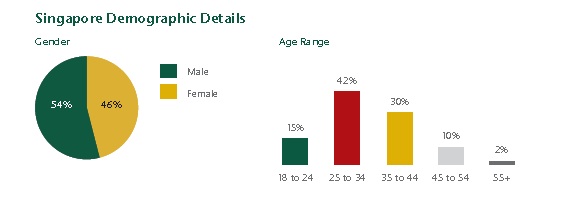
Singapore participant breakdown
Findings include:
33% of respondents from all four countries have acted on promotions seen on social media.
58% of respondents have shared positive experiences online and have sought advice from friends and family when talking about brands on social media.
U.K. respondents are more likely than respondents from the other four countries to complain about service on social.
When respondents express feedback, Facebook is the most popular platform to do this.
Showrooming (visiting a physical location to evaluate products and services even when you know you will buy online at another time) is increasingly prevalent as 77% of participants showroom.
Experiential branding key to branding success
62% of the participants use a mobile device when in stores to compare product prices.
69% of respondents from all four countries expect a brand’s online store, mobile app, and physical store to offer the same pricing, discounts and sales.
Pricing consistency is expected in all countries
What can brands learn from this thought provoking survey?
They need to understand their relationship with consumers and what resonates with those consumers.
Brands that ensure parity in pricing and products across multiple channels will have to place greater emphasis on the customer experience and experiential branding if they want to win and retain business. Those that compete on price alone will soon be out of business.
Department stores and other retail outlets that represent multiple brands will have to work harder to engage consumers and ensure a positive brand experience otherwise they face the prospect of losing customers, possibly forever.
Mobiles are changing the way consumers research and learn about brands.
Brands that take the time to build relationships with core fans or brand evangelists will see their brands promoted to thousands of fans for minimal financial investment.
Those brands with digital brand strategies that go beyond tactical campaigns online are increasing sales through loyalty and advocacy.
Brands that try to control content and manage corporate driven messages and ignore consumers are unlikely to last very long in the consumer economy of today.
Telling the brand story online should be done across Facebook and other popular platforms with the ongoing development of corporate and consumer content.
This infographic shows how spending on advertising on social networks is growing at a phenomenal pace. Whilst this is an area that any brand should be looking in to, it is important to understand that consumer behaviour in these environments is very different and the approach to content must take this into account.
A recent report on digiday stated that a consumer is more likely to die in a plane crash than click on a banner ad and that 50% of clicks on mobile banner ads are accidental! The same report also stated that 8% of Internet users account for 85% of clicks on banner ads.
So if you want to ensure a ROI from your social advertising campaigns, make sure you understand target market requirements for value before launching a social media campaign otherwise consumers will continue to avoid online advertising, and that includes yours.
Are you happy with your branding activities? Or do you find the money you spend does little to build your brand?
Unfortunately, most branding initiatives revolve around a creative campaign developed by an advertising agency. Depending on budget, the creative campaign will be implemented with a one-size-fits-all message communicated to all and sundry and across multiple mass media platforms for as long as budget allows.
The model essentially revolves around hope – hope that lots of people will see the campaign, hope that amongst those people will be the target markets, hope that the message will resonate with those target markets, hope that those target markets will remember and hope that if they remember they will act.
In a noisy world, is a traditional approach to building a brand going to make you stand out?
So basically, the ‘strategy’ is one of hope. Chances are if it doesn’t work, the agency will, if you haven’t already fired them, propose more of the same.
For most brands this approach is an exercise in futility. Wouldn’t it be better to first get an understanding of where your brand is – both internally and externally?
In the social economy, where consumers not companies define brands, don’t you want to know what your stakeholders want from your brand, what you are doing right (and wrong), the channels they are most likely to interface with, their influencers and more?
Internal and external brand and communications audits can both help determine how effective your branding activities have been and, more importantly, what they need to accomplish in the future.
In the social economy, a brand audit is the first step to building a brand
Brand audits have multiple advantages. They provide a benchmark to evaluate the current brand position. Carried out every 2 years they can evaluate progress toward branding goals. They also unify an organization. Too often, everyone has a different definition of branding. A brand audit will identify this and provide recommendations for improvement.
Indeed, a brand audit can provide a consistent, universally accepted brand DNA and from that a definition that ensures that everyone in the organisation is marching to the beat of the same branding drum. Finally, a brand audit can help eliminate the all-too-common disconnect between what companies believe their brand to be and what customers perceive it to be.
An internal brand audit takes the brand temperature from corporate executives and other personnel. One-on-one confidential interviews probe to determine each individual’s perceptions of the brand, branding goals, evaluation of past branding activities, knowledge of key corporate or brand messages and other key points.
An Internal brand audit is a key component of any brand strategy, when did you last carry out an Internal brand audit?
What are the current branding and customer processes, and how can they be improved? One great question to ask is: “Imagine it is five years from now, and the company is celebrating historic financial and market success. How did the company arrive at this point? What are some of the activities that brought us to such success?”
A brand audit can cover a wide cross section of departments but must have the customer and the customer’s needs at its core. What do we know about customers? Are we collecting THE RIGHT data? Is relevant customer data being added to corporate databases? Is customer information shared with other areas of the company? What initiatives are on the horizon that will affect certain customers and how will this be addressed?
A minimum of 25 minutes is required for each interview, but they can take up to an hour. Questions can be prepared beforehand, but the most valuable insights often result from free-ranging discussions on relevant topics.
A key component of a brand audit is a communications audit, which is especially useful for larger firms with multiple divisions or departments that get involved in branding activities.
A communications audit looks at all the visual material that represents a brand – the brand identity, sales documentation, press releases, ads, brochures, Web sites, social media channels, merchandise, vehicles, logos, etc.
Too many so called brand strategies are really just pointless journeys to unknown destinations
Analysis then determines the amount of consistency and integration in appearance/design, messages and their relevance to target markets (in a noisy world where consumers are time poor, content is so, so important) and adherence to corporate standards. Ideally, a brand manual is in place to provide a benchmark.
The role of social media in both internal and external corporate communications is increasingly important and a social media audit must be included in the communications audit. Communications across social media require different skill sets to traditional marketing and this is scaring some companies away but it must be addressed.
A social media audit lays the foundations for the social media strategy that has an crucial role to play in the brand strategy developed later.
Internal brand and communications audits often reveal a stunning amount of discrepancies that result in mixed messages to both prospective personnel and customers, incompatible branding efforts or even disagreement about branding goals.
An external brand audit looks at how various stakeholders (or, more accurately, constituencies) view the brand. Such constituencies include customers, prospects, media, distributors/retailers, regulatory bodies and suppliers.
Sometimes, an external brand audit is combined with a loss analysis to determine why a contract or other business went to a competitor. These constituencies are asked their perceptions and experiences with the brand and crucially, asked “What do we have to do to win back your business?”
For some companies, it should also be combined with a customer acquisition audit to see if relationships are being developed effectively.
Sample questions can include: “Why did you buy the first time?” “Why will you buy again?” “How useful and relevant are corporate communications?” “How responsive is our support?” “How do our competitors compare to us?” One revealing question we’ve used in the past is: “If you were running our company, what would you do to better meet your requirements?”
The number involved in brand audits can vary greatly according to time, cost or other constraints. Even as few as 5 – 10 qualitative interviews may produce actionable insights.
The success of a brand audit will be determined by the people involved. They must understand branding imperatives, be familiar with the relevant products and company and have superb questioning, listening and analytical skills.
Results of brand audits (the good and the bad) must not only be shared as widely as possible but also incorporated into internal and external branding efforts, including employee communications, advertising and PR.
Share research data, not just the good stuff!
It is especially important to use the results to drive changes in sales, service, support and other customer-facing activities.
Finally, remember to use brand audits as guidelines for improvement, not as sticks for punishment.
“You’ll find many ‘marketers’ pushing their social and interactive expertise with little true marketing experience in their backgrounds. This results in tactically driven campaigns that do not support a company brand promise or any kind of overarching strategy. It’s talking for the sake of having a mouth – but ultimately saying nothing.”
CEOs and or CMOs, already under pressure time wise, are giving too much responsibility to creative advertising agencies to manage their brands. This is a sweeping generalisation but the fact is creative advertising agencies do creative advertising because that’s all they do. Good luck to them but creativity design alone cannot build a brand.
Brand strategy is being sacrificed for speed, creativity, originality and one off tactics that have no longevity. Shareholders and consumers are the losers.
If you are responsible for a country or destination brand, read on.
As cheap air travel and the package tour (as well as the devaluation of the Spanish Peseta and the abolition of currency controls in the UK) helped jump start international travel in the 1960s, 1970s and 1980s, the world was still a fairly predictable place and countries were, on the whole inhabited mainly by citizens of that country and not by the multicultural citizens living in most cities today.
Moreover, due to the social and economic structure of Western countries, consumers were only just beginning to have disposable income that allowed them to experience the concept of leisure time.
At the same time, mass media was becoming increasingly influential as consumers purchased more and more TVs and radios.
So, with more disposable income, more leisure time and the establishment of commercial television, it was now possible to reach large swathes of a population reasonably quickly and relatively inexpensively.
In this environment countries put their faith in creativity to build brands, hoping that an exotic image, tagline or promotion would resonate with prospects and increase visitor arrivals.
And generally, because of the cultural and social predictability of countries, the same message could be used to communicate with everyone.
Moreover, with few conduits to increasingly wealthy consumers who had more disposable income than ever before and with limited competition in the market place, this type of creative driven branding often raised the profile of countries enough to attract visitors.
Countries and destinations such as Spain, the UK, Kenya, Florida, Greece, The Algarve, Singapore and Italy as well as many other destinations used this approach. And in this mass market economy, mass media – TV, Print, Outdoor, with its huge reach, was the logical vehicle to enhance the impact of creative-driven branding with reach and repetition.
Early tourism ads worked because markets were similar, new, eager and easy to reach
But that mass-market economy no longer exists. Today’s consumers are increasingly overwhelmed with those creative images, taglines and promotions. And many of the messages have become so similar that it is virtually impossible to differentiate one from another. And of course, consumers have also become fed up with countries failing to deliver on promises made.
Despite this new world order, countries, agencies and consultants continue to try and build country brands by using ‘cool’ advertising, creative or symbolic logo’s with pretty colours, catchy taglines and so on.
But these activities are nothing more than advertising campaigns and do very little to build a nation brand. And even the one’s that have made us sit up, take notice and seek more information are more often than not soon forgotten or overtaken by a new campaign from a competitor destination or the recommendation of a friend.
But most worrying of all, these advertising campaigns lull countries into a false sense of security. ‘Visitor arrivals are up so everything is good in the world’. The problem is that an advertising campaign might draw the attention of visitors to a destination but it doesn’t build a destination brand.
An advertising campaign may be important but it is part of what should be a well researched and planned brand strategy that takes into account all brand related activities.
These include internal buy in and a thorough understanding of external stakeholder requirements for value and other elements such as content development, social media, PR and most important of all for a country, crisis management. Traditional communications pushed out across traditional and digital media, may still have a role to play, but they are not a total solution.
Sadly, too many countries and destinations have short cut the process to try and get their ads out quickly. This has resulted in the demise of the brand strategy. Yet failure to invest in such a brand strategy can be detrimental to the long term success of the brand.
A case in point. The Maldives has invested more than US$10 million in the last three years on advertising itself as a luxury destination. But in 2012, political turmoil saw arrivals from the lucrative European markets fall, with the UK registering a 12.2% drop. If it weren’t for a sharp rise in low yield arrivals from China, the Maldives would probably have registered a major drop in arrivals.
To the detriment of the country, participants or perhaps victims of the political turmoil in the Maldives called for a boycott of the tourism business and attempts by the new government to develop the tourism business are constantly thwarted by opponents.
One example was when the Twitter hashtag #sunnysideoflife (the official tagline) was hijacked and brochures entitled ‘The cloudy side of life’ threw scorn on tourism players and drew the readers attention to human rights abuses and police brutality against Maldivians.
This year has seen further negative press after a 15 year old girl raped by her stepfather and sexually abused by other men was sentenced to 100 lashes for having pre marital sex.
So far the Maldives government hasn’t responded, leading one to suspect they don’t have a brand strategy with a crisis plan to deal with such a situation. What is certainly true is that this complicated issue will not be solved with an advertising campaign.
In 2012 Jakarta initiated an advertising campaign across Asia in an attempt to attract visitors to the capital and largest city in Indonesia. The campaign was poorly planned, conceived and executed. You can read more about the Jakarta campaign here.
Based on the advertising campaign and the website, it is fairly safe to assume these two elements were not part of a brand strategy.
Does this ad make you want to get more information on Jakarta?Lack of integration and poor content suggests little or no planning
India is famous for its ‘Incredible India’ campaign launched in 2002. By 2009, India was spending US$200 million advertising the country. This iconic advertising campaign is still going strong and in November 2012 at the World Travel Market in London and to great fanfare, India announced a new advertising campaign headlined, “Find what you seek”.
Early ‘incredible India’ ads – excellent execution
Officially launched by the new Indian minister of tourism at a hotel in London in front of 400 guests, the new Incredible India campaign highlighted to consumers ‘that they will find whatever they are looking for from a holiday in India.’
It was also announced at the launch event that the goal of the campaign is to increase international arrivals by 12% annual till 2016.
Little more than a month later, in December 2012 in Delhi a woman was brutally gang raped and left for dead on a public bus. The story made headlines around the world.
And then in March 2013, a Swiss woman was gang raped whilst on a cycling tour of Madhya Pradesh and soon after, a British woman was attacked in Delhi and only avoided further suffering after jumping from a hotel window to escape.
Within a matter of weeks, tour operators were reporting a 35% cancellation rate from women and a 25% drop in all arrivals with multiple cancellations from the lucrative markets of Australia, the UK, Canada and the United States.
Much of the outrage toward these events is related to the treatment of woman in India and numerous stories that would not normally feature on international news are now making headlines globally including the stoning, arrests and murder of Indian women. None of these events will be addressed by advertising.
If you are responsible for developing a Nation, country or destination brand, don’t allow yourself to be lulled into a false sense of security over a ‘successful’ advertising and promotions campaign telling the world how great is your country or destination.
To build a strong brand amid increasing international competition and unforeseen circumstances that are carried across social media and possibly across mass media as well, destinations must have in place a well defined brand strategy that covers all potential scenarios and doesn’t just focus on communications.
A brand strategy has other benefits. Here are five more reasons for developing a brand strategy:
1) A brand strategy clearly defines the organisation values and promises and ensures stakeholders understand what is required of them to deliver on those promises and values. For a nation brand this internal branding is critical to the success of the brand.
2) Staying with the internal brand, lots of tourism boards and CVBs attend trade shows but if I had a pound for every time I’ve been to ITB or WTM and seen poorly trained personnel representing countries or states, I’d be a very wealthy man. Trade shows cost a lot of money. A brand strategy will ensure training occurs at the best possible time.
3) A brand strategy ensures the brand is ready for every eventuality, with a crisis plan to address issues such as those that have happened in India, the Maldives and most recently, Boston.
4) A brand strategy ensures all stakeholders are pulling in the same direction. If one state is targeting visitors at the same time as another state, resources are being wasted. A brand strategy will ensure integration and engagement, not individual tactics.
5) A brand strategy ensures time isn’t wasted on stand alone tactical initiatives implemented at the whim of a government servant or other person who should know better.
Far too many countries or destinations give the responsibility of building their brand to creative advertising agencies. These agencies are called advertising agencies for a reason. They do advertising.
Every now and then a television commercial appears that brings a smile to the viewers face. And Unilever brand Dove tends to make us laugh more than many other brands. Their new commercial, created for the Brazil market is creating a bit of a stir .
It features a conversation between two men in an office, one of whom (Diego) appears to have beautiful shiny (really shiny!), curly, lively hair that bounces around like the hair in those cringeworthy women’s shampoo ads.
Diego happens to have his shampoo with him in the office and realises he has been using a woman’s shampoo. When he realises that’s why his hair is bouncing all over the place, hair guy rushes to the store and buys a man’s shampoo, goes straight home and jumps in the shower and washes his hair after which it becomes a ‘normal’ male cut.
The commercial closes with the tagline, “Women’s shampoo is not meant for you.”
It’s a fun ad but not without risk. It tells men that the brand (I’ve forgotten the name) is the right choice for masculine men who want masculine hair but it could alienate men with long hair who might feel it says they are not cool.
And it only works if it encourages men to switch from a competing brand. If it is just moving men from Unilevers range of women’s shampoo to men’s shampoo then it doesn’t really make a difference. And for those men like me who are married with kids, all they care about when they get in the shower is whether or not there is some shampoo left in the bottle!














 brandconsultantasia.com