What is the difference between an advertising agency and a brand consultancy?


As the consumer landscape changes and consumer habits and the purchase decision making process evolves, it is imperative that brand owners understand where, when and how to spend their valuable and increasingly limited resources.

Historically advertising agencies defined and controlled a brand’s message and through which channels it was broadcast. They would then blitz consumers with intrusive advertising and messages. The goal was to reach as large and as broad a target audience as possible on those platforms with the most extensive penetration.

But in the social economy, consumers have little faith in such corporate driven messages broadcast across mass media channels to which they are paying less and less attention.

Today consumers spend their time in a variety of social networks or in niche online communities with likeminded people. And it is to these people they look to when seeking information on products and services.

So does this mean the end of advertising agencies and advertising? Definitely not, there is still a need for good advertising agencies that create good work but the process has changed and the advertising agency can no longer be given responsibility for building brands.

In the past, branding and advertising used to be elements of marketing. Today, marketing and advertising are now part of branding and it is the brand consultant you should look to if you want to build a brand.

So here is an outline of the difference between an advertising agency and a brand consultancy. Hopefully this will give you enough knowledge to make an informed decision on who should build your brand.

1) Branding is strategic and advertising is tactical. The most strategic actions you will get from an advertising agency will be a brief. The brief will define the proposition that the advertising must communicate and to which segments. But then what? And what about internally? How will you get personnel on brand? Does the delivery driver or sales assistant know what their role is in the delivery of the promise/s made?

A brand consultant will develop a brand plan or brand blueprint that will drive the brand strategy, both internally and externally. This holistic approach will address all key elements of the brand from the copy used in recruitment advertising to customer facing departments and their ability to represent the brand to point of sale and retention strategies and more.

The brand consultant will then work with you to determine the best resources to use to get the whole organisation on brand.

It is not possible to define a brand through an advertising brief but it is possible to define a brand through a brand plan or blueprint.

2) Advertising agencies do advertising. That’s what they are good at. In fact some of them are very good at it. Advertising uses creativity and a slick message (normally defined by the organisation) to get your attention.

And this is done via campaigns pushed out across TV, radio, billboards, websites and so on. The idea is that enough people will see the campaign and the message will hopefully resonate with as many people as possible. And of course the agency gets a commission for placing these ads with the channels.

If it doesn’t work you either get the agency to come up with another creative idea and go through the whole process again, get rid of the agency, hire another one and hope they can come up with a creative campaign that does resonate or you can go out of business.

And as consumers have lost faith in traditional marketing and now distrust the messages contained in such campaigns or simply miss them because of the clutter, it is increasingly difficult to build a brand using such a model.

So unless you have very, very deep pockets and can advertise consistently for long periods of time, this approach is simply going to waste valuable resources.

A brand consultant will carry out an audit of your business, industry, processes, systems, stakeholders and more and then determine the best way forward for you.

Solutions may require advertising but will also look to improve R&D, sales, production, supply chains, operations, customer relationships and retention strategies.

3) If you are looking to go with an advertising agency, your strategy is likely to be in the hands of a creative director and his team. If the agency is going through a difficult period and doesn’t have many staff when they win your business, the agency will attempt to employ talent with experience in your industry.

Unfortunately, if the talent isn’t available, perhaps because they are working for competitor agencies, you will end up with sub standard people working on your brand and your chances of success are reduced further.

Because branding is a strategic institutional initiative, not a marketing initiative and therefore must have the buy in of executive management, a brand consultant will insist on having C level involvement in the development of the brand which places your brand strategy where it should be, in the hands of executive management.

4) Advertising agencies are often deemed successful if they have won lots of awards for creativity not whether a campaign increases sales or profitability.

There aren’t many awards for brand consultants which is a good thing because this allows them to focus on increasing profitability, often through developing and strengthening relationships with stakeholders and customers.

5) Most advertising focuses on a series of tactical initiatives to acquire customers. A brand consultant will develop a strategy to acquire and retain customers.

6) Traditional marketing activities are enormously wasteful as much of the advertising targets irrelevant demographics or customers that cannot afford or are not interested in the product. A recent report in the Harvard Business Review quoted a UK study that reported 72% of CEOs are tired of being asked for money from marketing departments without an explanation of how it will increase business.

Furthermore, in the same survey, 77% of CEOs have had enough of talk about ‘brand equity’ that can’t be linked to any real equity. A brand consultant will ensure budgets are spent on the right strategies for the right segments with metrics for measurement.

7) An advertising agency uses a one size fits all series of tactical advertising campaigns that use mass marketing across mass media with only a nod to digital and below the line activities.

A brand consultant will look to collect and leverage specific data to develop targetted communications across digital channels to engage prospects, whilst carrying on conversations with existing customers.

8) An advertising agency will often look at what the competition is doing and try to position an offering based on competitor actions. This approach is flawed because successful organisations are nimble and by the time you have developed your position the competition’s strategy will have evolved.

A brand consultant will be aware of competitor activities and will use that knowledge to strengthen the firm’s competitive advantage but will not allow competitors to define strategy going forward.

9) The impact of an advertising agency’s work is difficult to measure. A brand consultant will develop metrics to measure promotions, advertising and other activities.

Street art goes to war against outdoor advertising


Here’s something interesting from the UK.

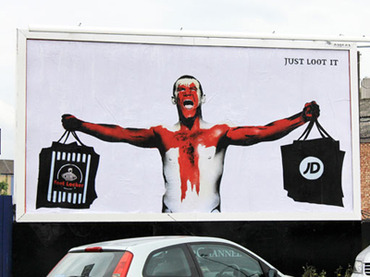
A group of artists from the UK, Italy and France have embarked on a project around the UK that is called “Brandalism” which aims to “challenge the destructive impacts of the advertising industry.”

Brandalism is essentially a campaign to hijack a number of billboards around London and ‘refresh’ them with new work by 26 street artists.

These guys are not happy with the advertising industry, claiming the industry takes no responsibility for the messages they force-feed consumers and don’t give those consumers a chance to opt out from these intrusions into public and personal spaces.

Nike is just one of the brands targetted by the group

The project has so far targetted outdoor campaigns by Nike, Footlocker, JD Sports and McDonald’s and Locog have been “refreshed” by the artists among others. The group has also posted anti advertising campaigns in Leeds, Manchester, Birmingham and Bristol.

This is being portrayed as street art against branding when in fact it should be street art against outdoor advertising.

Outdoor advertising is an element of advertising which is an element of communications which is an element of branding.

I don’t quite understand how taking a billboard with one message and painting over with another message is going to stop the intrusive attempts by advertisers (and their clients) to get our attention.

There’s also a danger that they will become guilty of the ‘crime’ they are so against, don’t you think?

You can read more about the project here

The only brand worth having is a profitable brand (even if it means losing customers)


Looking through the ‘archives’ of some of our early branding blog posts, I came across a reference to an article in Fortune Small Business.

The article talked about three companies that had for years pursued a traditional sales and market growth approach that saw them investing more in acquisition than retention whilst paying little attention to profitability.

One case study was of Skelton Tomkinson (now known as Skelton Sherborne), a heavy-machinery shipper based in Brisbane, Australia. At the time the company had one office in Brisbane and one office in the U.S. where Caterpillar was a major customer.

In 2000, because he was seeing little growth using a traditional sales and market growth approach, the owner deliberately raised fees on his least profitable customers, hoping they would leave. Some of them did and revenues dropped dramatically, from US$20 million per year to $8.2 million.

But profitability increased 98% and total revenues slowly returned to $20 million. Tomkinson’s motto: “I run my company with this saying: Volume is vanity, and profit is sanity.”

And it must be working because today, the company has 11 offices, up from 2 in 2000. The new offices are in South East and North Asia, with one in the Arabian Gulf.

Far too many companies believe that they must pursue sales or market growth and this generally means ‘spraying and praying’ – basically the act of spending as much money as possible trying to reach as many people as possible.

What they should in fact focus on is profitable growth, which most often results from identifying and retaining profitable customers and not trying to sell to evey Tom, Dick and Harry.

Another mistake companies make is wasting valuable resources finding out what their customers are doing and then wasting even more valuable resources fighting or trying to block or undercut those competitors.

This is an exercise in futility because in today’s dynamic, always on, constantly evolving world, the only focus should be on identifying the right prospects, creating the right customers (and getting rid, yes getting rid of unprofitable customers) and delivering value to profitable customers through engagement and personalisation.

The great branding graveyard in the sky is full of brands that played the volume game – think Rangers FC, Viyella, Blockbuster, Silverjet, Swissair, Habitat, Mobikom, MegaTV, Pelangi Air, PanAm – they all took a traditional approach to building their businesses yet they all ended in failure.

Seeing your name on billboards or in print ads everywhere and reaching lots of people may make you feel good but focussing on profitability will keep you sane.

Top 10 airline brands for 2012


Skytrax, the UK based research company that specialises in research for commercial airlines, has just announced the winners of the world airline award for 2012.

Skytrax parent company, Inflight Research Services work has been used by the UK government to determine the UK government policies on air transport.

The Skytrax Awards are one of the benchmarking tools for the air industry. They measure passengers’ satisfaction levels by surveying passengers in all cabin classes.

The award is announced after a 10 month telephone survey with 18 million airline customers from 100 countries. That’s right, 18 million airline customers from 100 countries. This must be one of the largest surveys ever attempted.

That’s 1.8 million participants a month or based on a 20 day working month, its 90,000 calls per day which equates to, assuming an 8 hour day, 11,250 calls an hour! Many of which are international, in different languages and probably, if they use my carrier, many of the calls cut off half way through the conversation.

I’ve managed some large brand audits that required a lot of calls but not 18 million in 10 months! So Skytrax should be commended for managing such a logistical nightmare. But I digress.

As I mentioned, the survey takes 10 months and covers 200 airlines, both domestic and large international airlines. The survey measures standards across 38 key performance indicators of airline front line product and services.

The study focuses on customer satisfaction related to experiences right across all touch points including check-in, boarding, onboard seat comfort, cabin cleanliness, food, beverages, in-flight entertainment and staff service.

According to the World Airline Awards website, product and Service factors ranked by customers
in the survey included the following elements:

GROUND/AIRPORT
Standard of Airline web site
Online Booking service
Online check-in services
Airport Ticket Counters
Waiting times at Check-in
Quality of Check-in service
Self Check-in options
Boarding Procedures
Pre-boarding for families
Friendliness of Ground staff
Efficiency of Ground Staff
Transfer services
Arrival services
Baggage Delivery
Handling Delays

ONBOARD: PRODUCT
Cabin Seat comfort
Cabin Cleanliness
Toilet Cleanliness
Cabin Lighting / Ambience
Cabin Temperatures
Cabin Comfort amenities
Reading Materials
Airline magazine
Inflight Entertainment standards
Audio/Movie programming
Audio Video on demand (AVOD) options
Quality of Meals
Quantity of Food served
Meal Choices
Selection of Drinks/Pay bar formats

ONBOARD: STAFF SERVICE
Assistance during Boarding
Friendliness of Staff
Service Attentiveness/Efficiency
Consistency of Service across different flights
Staff Language skills
Meal service efficiency
Availability thru Flight/Cabin presence
PA announcements
Assisting families with children
Problem solving Skills
General Staff Attitudes
Staff Grooming

This is an enourmously complex project and it doesn’t end there. Follow up research includes back up interviews and the data is weighted to ‘provide nomination equity when evaluating airlines of different size.’

Anyway after all that, here is the list of the top 10 airlines for 2012

The World’s Best Airlines 2012

1. Qatar Airways
2. Asiana Airlines
3. Singapore Airlines
4. Cathay Pacific Airways
5. ANA All Nippon Airways
6. Etihad Airways
7. Turkish Airlines
8. Emirates
9. Thai Airways
10. Malaysia Airlines

It is interesting to note that 6 of the top ten are Asian brands and the other 4 are Middle Eastern Brands.

Looking back over the last 10 years, the list has always been dominated by Asian and Middle Eastern brands. With the exception of 2006 When British Airways came first, no European Airline has ever appeared in the top 3.

New BMW 6 series


The Malaysian Automotive Association has forecast total vehicle sales in Malaysia will be 615,000 units in 2012, up 2.5% over 2011. If this figure is reached it will be a record for Asia’s largest passenger car market.

This bullish forecast for 2012 is despite the fact that vehicle sales in Q1/2012 dipped 12.6% to 138,544 units from 158,432 units in Q1/2011.

Various reasons have been put forward to explain the drop in Q1 including the Lunar New Year and new credit policies. I was under the impression the Lunar New Year was an annual event and always in the first quarter so I don’t know how that would be a problem this year.

Personally, I think the main reason for the Q1 drop is that the global economic situation is having an impact on the number of loans approved by local banks wary of a repeat of the Asian financial crisis of 1998.

Whatever the reasons, it is good to see that BMW is doing what it can to sell its new six series with an extensive digital campaign.

I clicked on the link and was pleased to learn that the Bavarian giant will be offering wheels with the new 4 door coupe.

The BMW 6 series coupe, now sold with wheels

This should help increase sales for 2012.

British luxury Brands need to take notice of Malaysia


Despite, or because of tough global economic conditions, the retail sector in Malaysia appears in rude health. Development of new malls continues at a phenomenal pace with at least 3,500,000 square foot of additional retail space becoming ready this year in the Klang Valley alone. This will bring the total amount of retail space in the Klang Valley up to about 55 million square feet.

Passing almost unnoticed is the proliferation of international luxury brands in many of those malls. Familiar international names such as Giorgio Armani, Prada, TOD’s, Van Cleef and Arpels to name but a few, have all entered the local market in recent years, encouraged by the success of exclusive names such as Bulgari, Cartier, Hermes, Louis Vuitton, Rolex and other famous names long familiar to Kuala Lumpur shoppers.

Established luxury brands in Malaysia

Unusually for a Malaysian mall, The Pavilion has clustered its luxury boutiques into a high profile area facing Bukit Bintang. Globally, this clustering of stores is nothing new.

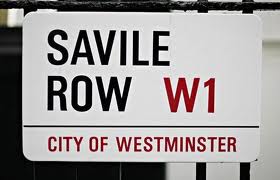
For centuries stores have organized themselves into districts based on what they sell – think Saville Row in London (tailors), Faubourg Saint-Honore in Paris (designer boutiques) and Deira in Dubai (jewelry).

Clustering similar stores in the same location is not a new concept

The cluster approach allows the rich and famous to be surreptitiously dropped off in front of a mall, rush in and make a purchase that would make a small African country drool and then rush out into the safety of the limousine without having to rub shoulders with us mere mortals.

With its double story street facing façade the luxury section or ‘couture precinct’ of the Pavilion was an exciting development in the evolution of the retail sector in Malaysia.

A section of the luxury couture precinct at Pavilion Kuala Lumpur

Just across the road, Star Hill Gallery has battled gamely to become a luxury mall with an eclectic mix of exclusive boutiques and lifestyle outlets. Meanwhile, over at Sentral, the Gardens, after a slow start has attracted one or two luxury brands.

The KLCC mall, at the base of the Petronas Twin Towers on the site of the former Selangor turf club had a rough start but has since attracted a number of luxury brands including Jimmy Choo and Chanel but has traditionally preferred them to be scattered throughout the mall.

However this has changed with the new extension that features a new Giorgio Armani store that also has an Armani Cafe as well as new Chanel and Cartier stores.

One thing all these malls have in common is a distinct lack of luxury British Brands. Sure there are some – most recently Anya Hindmarch and Thomas Pink, Burberry and Aquascutum made the move a few years ago but considering the long association with Britain and the importance of the luxury segment, there aren’t too many.

Thomas Pink opened in Kuala Lumpur in 2008 and now has one store at Pavilion

According to the ten best, the ten best British brands are:

1. Rigby & Peller: A family-run lingerie and corsetry firm awarded a Royal Warrant in 1960. It has a sterling reputation for expert bra fittings and beautiful designer swimwear and lingerie and a made-to-measure service.
2. Burberry: Famous for the iconic trenchcoat, this classic British company revels in its distinctly British attitude. Founded in 1856, the company’s core values are luxury, quality and timeless style, expressed in a modern way.
3. Mulberry: Luxury English fashion, “inspired by the cool of the city and the craft of the countryside”, is Mulberry’s speciality.
4. Barbour: Boasting three Royal warrants, Barbour is that rare entity, a family-owned, women run company. Since 1894, when it was established to provide waterproof oilskin jackets to sailors and dockyard workers in South Shields, this quintessentially British brand has created durable country-style clothes with impeccable attention to detail. Its wax jackets are known to last a lifetime.
5. Aspinal of London : This 10 year old company, or should I say upstart is dedicated to producing impeccably high quality and beautifully designed handmade leather products that draw much from traditional craftsmanship.
6. Asprey: Asprey has employed the best craftsmen to design and the best materials to produce exceptional jewellery, leather goods, silverware, homewares and timepieces since 1871.
7. Smythson: Frank Smythson opened his first shop in 1887, selling exquisite stationery and leather goods. In the digital age, the shop’s collection of beautiful diaries, handbags, purses, wallets and stationery continue to be in demand.
8. Aquascutum: Wonderfully understated British elegance at its best. Famous for inventing waterproof cloth and the raincoat, the company makes clothes that combine fine craftsmanship with luxurious tailoring.
9. Dunhill: Alfred Dunhill’s legacy continues to cater for the discerning man who wants to wear elegant clothing and fine fragrances and match it with luxury kit such as pens, lighters and timepieces.
10. Loake: Family-owned since it was established in 1880 and with a Royal warrant from the Queen, this quintessentially English boot maker employs traditional craftsmanship to produce fine, handmade footwear for men.

Of these distinctly British retail brands, only Burberry, Aquascutum and Dunhill are here. Of course there are some pretenders to this list who have set up in KL, notably Thomas Pink and Anya Hindmarch but we’re still a little light on British luxury brands.

Anya Hindmarch is a relative newcomer to the Malaysia luxury scene

Which is surprising really because although the United States remains the world’s largest consumer of luxury products (by a country mile), burgeoning middle classes in developing countries are creating new opportunities for luxury goods providers.

According to the MasterCard Worldwide Insight report, the value of the market for luxury products and services in the Asia Pacific region will be US$258.7 billion in 2016, up from US$83.3 billion in 2007. Not a bad category.

What’s more, there’s already a ready made market because the largest number of tourist arrivals to Malaysia is from ASEAN countries, followed by Japan and China with India and the Middle East not far behind. And the burgeoning middle classes from these countries are notoriously brand conscious.

And this interest almost obsession with brands is likely to continue according to Radha Chadha, author of “The cult of the luxury brand”. She believes that the Asian interest in luxury products is because of the massive changes – social, cultural, economic and political – that have been affected by the traditional attitudes to who you are and where you are in the societal food chain.

She believes that over the past 50 or so years, many of the traditional cultural indicators of social standing in Asia – profession, family, clan, caste have been eroded by the onset of globalization, migration and education.

Free of rigid social hierarchies, mass migration and the development of urban areas, more people are making money and making it faster. The way to differentiate oneself is by purchasing a luxury product that shouted, “I’ve got money, respect me.”

Displaying one’s status through outward appearances of rank and wealth is nothing new but Asians seem to have taken to it like the proverbial duck to water.

And those LV bags, Chanel suits, Jimmy Choo shoes aren’t simple female indulgences, they are part of a new world order that identifies the wearers position in society. Indeed, these luxury brands are a modern set of symbols that Asian consumers are using to redefine their identity and social position.

Jimmy Choo, technically a British brand

The Japanese have been devouring brands for years. 94% of Japanese women in their twenties own a Louis Vuitton bag. Visit the Louis Vuitton shop on Bukit Bintang and the chances are you will see a group of Japanese shoppers being fussed over by staff.

Asia now accounts for a third of Louis Vuitton sales worldwide whilst Cartier depends on the region for half of its worldwide sales.

Louis Vuitton achieved organic revenue growth of 12% in 2012, mainly due to demand from Asia

And what of China? According to the China Brand Strategy Association, 250 million Chinese people can now afford to buy luxury products, up from 175 million 3 years ago.

Already, Chinese consumers are responsible for about US$10 billion of global luxury sales. According to McKinsey, that figure is expected to grow to US$27 billion in 2015, accounting for about 20% of global luxury sales.

And although a lot of those Chinese are travelling to Europe, only 147,000 Chinese visited the UK in 2011, compared with 1,250,000 who visited Malaysia in the same year.

But it is not only the Chinese who are buying luxury products. Indians and consumers from the Middle East, are prepared to splash out on high-end goods and will often save for months to buy an expensive handbag. And Malaysia is on the radar of more visitors from these countries.

So as traditional European and US markets stumble through the economic quagmire, the time is ripe for luxury British brands to establish themselves not in the UK, but in Malaysia and use it as a gateway to developing markets.

The new Malaysia Airlines Brand identity is stunning


Malaysia Airlines has had a torrid couple of years. Bitter court cases and weak management have led to record losses and low morale which in turn have caused the reputation of the brand to diminish in the eyes of the vast majority of Malaysians and other stakeholders.

All this despite huge sums spent on global positioning strategies using one size fits all advertising and other marketing broadcast across traditional channels.

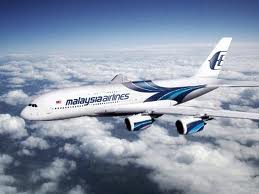
However, in a couple of weeks time the beleaguered national carrier, once considered one of the finest airlines in the world will start scheduled flights of its new Airbus A380 on the potentially lucrative Kuala Lumpur – London – Kuala Lumpur sector.

The new look Malaysia Airlines identity

Looking at the press images, it is hard not to miss the beautiful new identity of the aircraft. Personally I think the new look is stunning – bold colours, sweeping lines, very contemporary yet true to Malaysia’s heritage.

Although there were discussions late last year about new uniforms, I haven’t seen any official announcements to confirm it but one can only assume this new identity will also be reflected in the uniforms of the A380 cabin crew and throughout the rest of the airline as well as in all the collaterals, training of the staff and across all the other brand touchpoints.

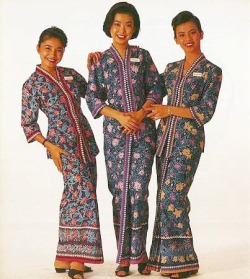
The Malaysia Airlines cabin crew uniform has hardly changed since it was introduced in 1982

After all, it wouldn’t make sense to create a new identity for a new plane without integrating it across the whole organisation, right?

Bentley looks to extend its brand


At the Geneva Auto show in March 2012, the ultra luxury automotive brand Bentley admitted it was considering adding a luxury SUV to its range of vehicles.

A month later at the Beijing Auto show the CEO announced that the firm expects to sell 3,000 of the SUV annually once production starts in 2015.

You have to admire the speed at which they make decisions at Bentley, especially as they also showcased a blue concept car and introduced a range of models, from a 4.0 liter V8 twin turbo to a 6.0 liter W-12 monster at the Beijing event.

Bentley is on a roll at the moment and has just reported 37% increase in sales in 2011 with China driving demand. Crucially, this upsurge in sales helped the brand become profitable for the first time since 2008.

At the Beijing event the CEO also announced that the target market for the SUV was the developed SUV markets of the US, UK and China. Bearing in mind the first two are reining in spending and will be doing so for about the next 20 years, one would imagine that with the exception of a couple of US based rap artists, China alone will drive demand for this new SUV.

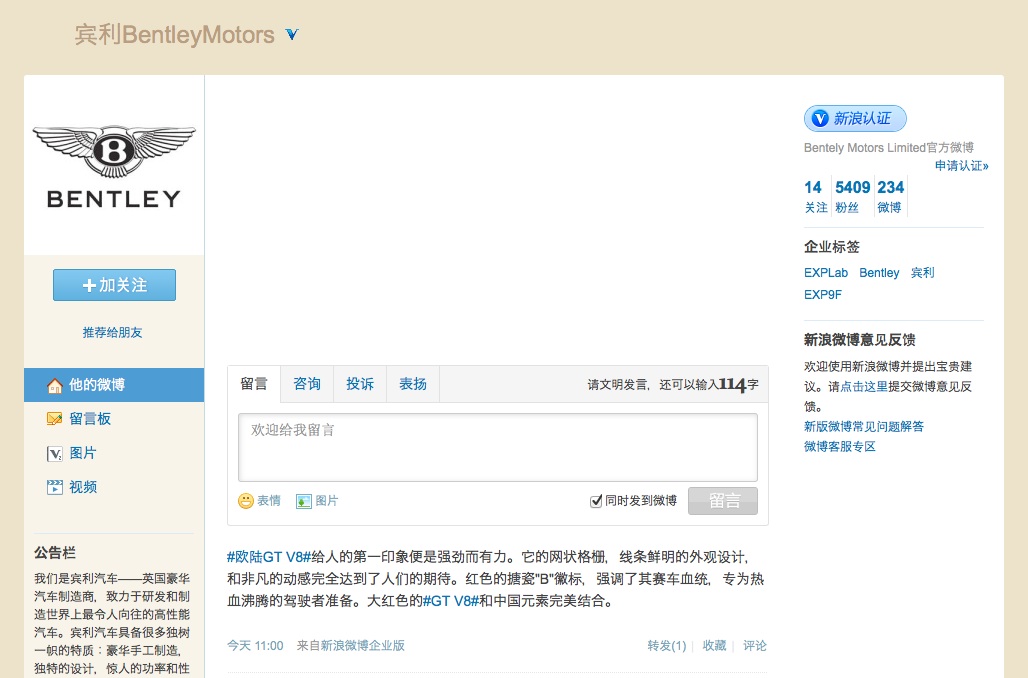
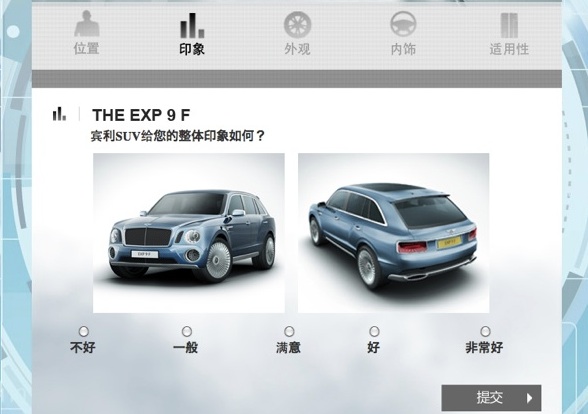
Which is probably why the company took the unprecedented step of asking Chinese users of Facebook and China’s most popular Twitter like platform Sina Weibo what they thought of the SUV concept.

The Bentley Weibo page (Is that a typo at the top right?)

Questions asked were related to the design and the interior and opinions on what sort of engine should be used and whether or not Bentley should actually launch the SUV.

Other general questions are asked about driving and vehicles. Incentives for completing the survey are wallpaper for a mobile device or computer.

The Bentley SUV seeks data

Crowdsourcing is nothing new but bearing in mind that the firm has already announced the launch of the car and the models and the nature of the questions, it is questionable how this particular data will be used to drive the brand forward.

Nevertheless, despite the unusual research methodology, it makes sense for Bentley to go down this path. After all, the luxury SUV segment revived the fortunes of other automotive companies such as Porsche.

Porsche, previously known as a manufacturer of high performance sports cars, made the SUV move in the mid 1990s after years of stagnant sales following the stock market crash of 1987.

Since then, the Porsche Cayenne has become their best selling automobile ever and despite the global economic uncertainty, global sales are expected to rise 40% to over 52,000 vehicles by 2017.

Back in 2003 Porsche sold a meagre 138 cars in the whole of China. By 2011, Porsche was selling 8,629 units of the Cayenne alone, making it the Stuttgart company’s largest market for the SUV.

In 2009, Cayenne sales represented 83% of Porsche sales in China. With each Cayenne costing up to US$300,000, that’s not a bad business to be in.

The Porsche Cayanne responsible for 87% of Porsche sales in China

Purists argue that the core brand – that of the two seater, meaty, macho sports car – is being diluted but with luxury and performance still core attributes, this is a weak argument, especially as Porsche continues to build the SUVs in Germany.

Range Rover is another luxury SUV manufacturer that is seeing record sales in China. Last year the company sold 50,994 vehicles in China, a remarkable 76% increase over the previous year. However Range Rover is also seeing significant growth in Europe where sales are up in Russia, France and Germany and even Spain has seen an 18% increase in sales despite the recession.

The recent success of the Range Rover Evoque has encouraged Porsche to launch a smaller SUV called the Macan in 2013.

The Lamborghini Urus, coming your way soon

So with Range Rover and Porsche already entrenched in the China market and with Lamborghini due to launch a luxury SUV (the Urus) by 2017, it makes sense for Bentley to extend the brand.

Branding, corporate or political, is an organisational issue


One of the problems faced by brands and branding are the attempts to simplify it. Fortuitously this approach has yet to gain traction with the aviation industry!

The business of building brands takes time. And as the business of brands and branding has evolved and the waters have become increasingly muddied, the only constant has been the influence consumers now have over the success or failure of brands.

As a result, the role of the brand manager is increasingly irrelevant because her attempts to control everything related to the brand are obsolete and pointless because consumers are crafting the messages that are heard not the marketing department or the advertising agency.

These are lessons that need to be learned in the political space as well. In Malaysia, the Prime Minister DS Najib Razak has a powerful personal brand but he cannot be expected to single handedly win an election. The key is to get all the other elements on brand. And anyway, as Tun Abdullah Badawi knows too well, a high approval rating is no guarantee of a big election win.

Historically, creating clearly defined messages and broadcasting them across traditional media was enough to build a brand or political party but today, this model alone, can no longer be relied on to educate, inform and convince.

Today, the first thing a consumer will do, assuming they hear the message through all the clutter, will be to determine if the message fits in with their own experiences. If it doesn’t, they will discard the message immediately. Secondly, consumers will discuss the message with others who they know and respect and explore their experiences and perceptions. Thirdly, consumers will seek the opinions of those they may not know. This is normally done across social media.

Only once consumers have absorbed all the information will they make a decision. If the promises defined by the organisation, whether it be a political or corporate one do not match the consumers own experiences or those of her friends or acquaintences, the message will be discarded. No matter how much money is spent.

If the response is favourable, the consumer may seek to experience a physical interaction with the brand, perhaps through a retail outlet, website or political rally. If any of these experiences are negative, the consumer will walk away from the brand, and it will take a superhuman effort to get them back.

A brand, whether political or business, requires every division, department, individual – from the tea lady to the CEO, or from the branch leader to the state leader to the divisional leader etc – to know and understand what they have to do to achieve clear strategic goals.

Only then will the brand survive and thrive.