Destination branding for small cities


Back in 2007, Destination Branding consultant Bill Baker released one of the best ‘how to’ books for city branding practitioners, mayors, planners, governors and anyone else tasked with or interested in the branding of cities.

‘Destination Branding for Small Cities: The Essentials for Successful Place Branding’ was so successful that he has updated it and you can find the updated version on amazon here

Bill Baker, defining the city branding process from the trenches

Bill understands better than most that city branding is much more than a logo, tag line or a communications exercise. With more than 30 years experience branding destinations, Bill outlines and explains the complexities of developing a place brand, the research needed, the stakeholders involved and the importance of developing a well defined strategy.

With plenty of case studies and comments from other practitioners (My contribution is below), this book should be required reading not only of practioners and government servants but also of students of marketing and branding.

Here’s my contribution to the book:
Singapore and Hong Kong have built internationally respected brands. This was achieved not by using creative taglines or cool advertising campaigns, but through their holistic approach to the process of branding.

Other Asian cities can benefit by emulating their practices through a better understanding of the elements required to build a destination brand and by having a more customer-centered approach.

Unfortunately, when it comes to destination branding, too many Asian cities have a top-down focus with a fixation on taglines or a brand essence or a one size fits all communications campaign that develops what it thinks is an interesting message that tries to speak to everyone, but really speak to no one.

As an example, in an attempt to boost tourism, the State government of Perak in Malaysia announced that the state capital, Ipoh would be known as the ‘City of White Coffee’.

Ipoh – city of white coffee. Would this tempt you to visit Ipoh?

A State executive said at the time, “Ipoh should have its own identity and branding just like Shenzhen (China) that is known as the “Shoe City” and Paris which has long been known as the “City of Fashion”. This shows a lack of understanding of what is destination branding and is an unrealistic expectation and hardly a concept to drive significant tourism growth.

I wrote an article about how to brand Ipoh, a beautiful city with massive potential and only a couple of hours north of Kuala Lumpur at the end of 2010. You can read the article here.

Similarly, the large Indonesian city of Surabaya has developed the tagline, ‘Sparkling Surabaya’ in an attempt to communicate the sparkling of the city as a centre for jewelry.

Surubaya tagline

In addition to being rather naive, the idea was controversial because citizens felt that the concept did not fully represent their city. A more thorough branding process might have helped avoid this situation.

On the other hand, the branding of the city of Zamboanga in the Philippines as ‘Asia’s Latin City’ has gained wide endorsement because it speaks well to the city’s culture and strong Latin influence, and appeals to external audiences as well.

The globally accepted principles of place branding are certainly valid in Asia however, the level of their application is very patchy at best.

Few demonstrate what can be considered ‘best practice’, and too many are influenced by basic misunderstandings concerning the practice and processes required, and how a city brand should be communicated and perform.

In general, too many see city branding as simply a tourism driven creative advertising campaign or a new slogan pushed out across traditional media.

The new Malaysia Airlines Brand identity is stunning


Malaysia Airlines has had a torrid couple of years. Bitter court cases and weak management have led to record losses and low morale which in turn have caused the reputation of the brand to diminish in the eyes of the vast majority of Malaysians and other stakeholders.

All this despite huge sums spent on global positioning strategies using one size fits all advertising and other marketing broadcast across traditional channels.

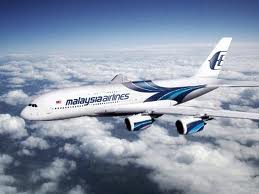
However, in a couple of weeks time the beleaguered national carrier, once considered one of the finest airlines in the world will start scheduled flights of its new Airbus A380 on the potentially lucrative Kuala Lumpur – London – Kuala Lumpur sector.

The new look Malaysia Airlines identity

Looking at the press images, it is hard not to miss the beautiful new identity of the aircraft. Personally I think the new look is stunning – bold colours, sweeping lines, very contemporary yet true to Malaysia’s heritage.

Although there were discussions late last year about new uniforms, I haven’t seen any official announcements to confirm it but one can only assume this new identity will also be reflected in the uniforms of the A380 cabin crew and throughout the rest of the airline as well as in all the collaterals, training of the staff and across all the other brand touchpoints.

The Malaysia Airlines cabin crew uniform has hardly changed since it was introduced in 1982

After all, it wouldn’t make sense to create a new identity for a new plane without integrating it across the whole organisation, right?

10 Principles to build the Malaysia Nation Brand


Minister in the Prime Minister’s department, Datuk Seri Idris Jala announced yesterday that the Prime Minister, Datuk Sri Najib Razak has a team in place and they are working full time to create a national brand for Malaysia.

Datuk Seri Idris said that the brand would involve Malaysian perspectives on national policy as well as the pattern of behaviour of Malaysians. He was quoted as saying, “If we can align these, then we can have a national brand”.

It is good to note that Datuk Seri Idris isn’t suggesting PR and advertising will drive the process. However, I don’t quite know what he means by “the brand would involve Malaysian perspectives on national policy…”, but I am sure he knows what he is doing.

One concern I have is that his statement might give some people the impression that building a Nation Brand is a relatively simple process and that it can be managed and controlled by internal forces.

Whilst the behaviour of Malaysians will have a distinct bearing on the success of a Malaysian Nation Brand, the process will also require significant investment in many other areas, many of which cannot be controlled by internal forces.

And as mentioned above and repeated later, Nation Branding is not a communications process. We cannot convince potential investors or tourists that Malaysia is the place to invest in, move to or visit.

We can influence the reputation of the country by building relationships and delivering on promises – multiple promises to multiple sectors – but we will never convince anyone of anything.

To help the PM and his team develop the Nation Brand, I’ve come up with ten key principles for a strategic Nation branding initiative. Although there isn’t a standard formula for building a Nation Brand because of course they all start from a different place, these principles will help form the foundations of any Nation brand strategy.

The same model should also be applied to government ministries, departments and agencies. And of course, these stakeholders should also form part of the internal element of any Nation Brand initiative.

• Nation Branding is a collaborative process
The best news to come out of Malaysia is that the Prime Minister is driving this initiative because without the CEOs buy in, any branding initiative is doomed. His involvement makes a statement to all those who will be involved that this is very important.

But the PM will need assistance from government representatives in each of the states and from other stakeholders. Most successful destination branding initiatives come from situations where key constituents move beyond turf protection/building, put aside their political affiliations and step out of their comfort zone and show some originality and courage.

Nation branding is difficult, requiring planning, support and coordination from a wide array of public and private entities. But even the best plan in the world will not succeed without buy-in from Nation brand stakeholders.

The most important step to ensuring buy-in is involvement in the research and planning process. As much as possible, brand stakeholders that are involved in implementation must have the opportunity to add their input to the plan.

Such buy-in has two advantages. First, it allows valuable perspectives and experiences to be incorporated into the plan, making the brand plan stronger and more effective.

Next, it facilitates better, more effective execution. If all the parties involved have a complete understanding of the entire plan and their role in it and what its success means to them, then redundant efforts can be avoided and resources maximized.

(I didn’t say this was going to be easy!)

• Research and data are fundamental
Sadly too many Nations (and companies) see Branding as a creative driven process of repetitively pushing government defined tourism and other messages out across traditional media, ad infinitum. The hope is that the message will resonate with someone or enough ‘someones’ to make it worthwhile.

Historically, this process has been the responsibility of the tourism board with support from other departments/agencies such as the agency responsible for inward investment and the Foreign Affairs Ministry.

Often the tourist board drives the Nation Brand

The tourism board delivers its message with a combination of slick, well-produced communications across mainly traditional media, PR and familiarization trips, trade shows and other trade related initiatives.

But just because the concept of carpet-bombing consumers with slickly produced commercials and PR messages worked (although this is contentious) for athletic shoes, automobiles, breakfast cereals and toothpaste in the mass economy (which incidentally no longer exists) of the post war years, doesn’t mean it is the way forward for the Malaysia Nation Brand.

Now, more than ever, step two in the Nation Branding process must include extensive qualitative and quantitative research with multiple stakeholders, both internal and external and from previously identified sectors.

Without research and data, branding decisions are no more than guesswork and the Malaysia Nation Brand is too important to base strategic decisions (or, any decisions) on guesswork.

The right research is vital for uncovering perceptions, attitudes and requirements for emotional, experiential and economic value, the three key elements of a successful Nation brand. Research also provides benchmarks for measurement and accountability.

Most perceptions about countries have been formed long ago but they can be changed, despite what Simon Anholt says! But the way they are changed in America will require a very different approach to the way they are changed in France, UK or Germany.

And of course the requirements for value of an automotive manufacturer from Detroit looking for an Asian country to set up a manufacturing base, will be very different to the value requirements of a financial institution from the city of London.

You’ll also need to know what target industries/segments think of you and also what they want from you, who/where they get their information from and what are their hot buttons.

It will be tempting to develop a common approach for these and other targetted yet diverse industries, but the reality is that each one will require information that is different and therefore more emphasis will have to be placed on relationship building than any communications.

The research will also allow you to identify what firms or institutions you should be going after and which ones you should not. And this is where the balance between the Nation Brand and the immediate success factors critical to political survival become entwined.

Because some industries are more attractive than others but if a firm from a controversial industry waves a couple of billion dollars in your face, the short term political benefits maybe significant but the long term branding benefits may be few, if any.

Of course it will require a very brave CEO to eschew those short-term political benefits for the long term benefit of the Nation. But such decisions will have to be made and to make them more palatable, they must be leveraged effectively for the benefit of the official and the government of the day.

• It is impossible for a Nation Brand to reach its greatest potential using creativity alone
Too much is at stake – both in terms of a country’s brand and resources invested – to depend on a creative-driven branding campaign (and that’s all it is because it is impossible to sustain) to form the foundations of your brand.

Furthermore, a creative campaign is best suited for mass markets and mass media – we’re back to running shoes, shampoo and so on.

Consumers are being inundated with so many messages they've stopped listening

Think of a TV commercial for a country or enterprise zone (you probably won’t be able to remember any, even if you are looking for one). They all say pretty much the same thing – how good the accessibility is, how great the country is, how special/unique their incentives are, how well educated their talent pool is, how extensive is their public transport system and so on.

But the reality is that if you are looking for somewhere to relocate to, the first thing you will do is get on the Internet and use a search engine to explore options.

Increasingly, the information you review will come from consumer generated media across social media platforms. It doesn’t matter how much a country spends on a cool logo or pushing a creative driven message out across traditional media, prospects will still go to the Internet and look for real world experiences.

Another issue I have with the creative driven approach is that it is essentially an acquisition driven model and doesn’t take into account existing prospects and investors.

But most damning of all, this approach leaves the strategy for the Nation in the hands of the advertising agency not in the hands of the CEO and executive management.

• Plan your work and work your plan
Once you have carried out your research and aligned your stakeholders, you can start to map out a Nation Brand plan that will not only form the foundations of attempts to drive the brand forward but also be the glue that keeps stakeholders together.

The world is loose, more fluid and more collaborative than ever before. And you have less control over the Nation Brand than ever before but that doesn’t mean you should forgo a well-researched brand plan and let consumers define your brand. In fact the plan is more important than ever as it serves as a blueprint for all stakeholders to adhere to.

Specifically, the Malaysia Nation Brand plan must communicate a positive and dynamic personality with economic, experiential and emotional values that reflect target audience requirements.

The brand plan must be holistic and comprehensive to enhance export promotion, economic development, tourism, foreign direct investment and other key national initiatives.

It must also communicate the intended message to the target constituents and stakeholders in multiple countries and at the same time, it must lay guidelines to strengthen the strategic, communications and visual impact of the Nation Brand.

The blueprint must also systemically connect the Nation Brand to the country’s core industries, corporate brands and Small and Medium Enterprise (SME) sector brands (more on SMEs later).

This must be established via a systematic, holistic process that accommodates the requirements of both national and international stakeholders. This process must not only be effective to optimize the Malaysia Nation Brand, but also maximize limited national resources.

But be flexible and open to the implementation of the plan. Let events influence the plan and be ready to adapt to events and opportunities.

• The essence of the Malaysia Nation Brand is more important than the brand guidelines so beloved of advertising agencies
It is common practice for companies to spend a great deal of money and time producing, communicating and training personnel about brand guidelines and how to police those brand guidelines.

What they really should be doing is spending those resources on building and nurturing a national appreciation and understanding of the brand and what it stands for, and developing a culture that will deliver a consistent brand across all touch points.

A great example is the South West of England that spent more offering free customer engagement and relationship training to key visitor facing companies than it did on advertising.

• Segmentation enables differentiation
Despite, or because of the power and sweep of globalization, which has Malaysians wearing the same fashions as Italians and Aston Martins in hot demand from Brazil to India and China, each country has its own requirements and world-views.

Once research has revealed the differing characteristics of various audiences, branding must be devoted to tailoring messages, media, channels and activities to the specific values and requirements of target markets.

Such segmentation not only ensures more receptive targets but also easily ensures differentiation from competitive countries trying to be all things to all people.

Social media and the voice of the consumer will drive online discussion and it is imperative that a social media strategy is initiated and integrated with the brand plan.

But communications are not enough. Relationships will be the key to successful development of a Malaysia Nation Brand. The successful implementation of these relationships will require unique and diverse talents that will be able to go out and sell the country. And it is important to match the right level of personnel with the prospects.

• Nation branding is a marathon, not a sprint
There is no quick win or quick fixes in any branding and this applies especially to Nation branding. Even in these technology driven times, establishing a Nation brand may take as long as a generation to develop.

For example, the current view of Japan as a nation famed for its precision and electronics is not based on its weak economic performance over the last decade. Rather, the seeds of Japan’s current nation brand were planted more than thirty years ago, when it began exporting transistor radios and two-cycle engines overseas.

But because it invested heavily in the development of the Japan Nation Brand, it has withstood the effects of the ‘lost decade’ and in fact, many argue that the Japan brand has improved, despite the economic impact of that lost decade and the terrible Tsunami of 2011.

Just as Malaysia launched its Vision 2020 program in 1991 to become a developed nation by 2020, the country must adopt a similar long-term view for Nation branding. Malaysia must look at establishing a Nation brand not for us – but for our children.

The good news is that signs of improvement and the benefits of investing in the Nation Brand development process can be enjoyed more quickly as witnessed by countries such as Croatia, Slovenia and to a lesser extent, Bosnia. These countries have invested heavily in research, product development, training and communications and as a result are building promising Nation Brands.

• The private sector, and in particular SMEs must carry its weight
The Government of Malaysia has tried to develop policies and funding and other resource allocation for SMEs to build brands. The Brand Promotion Grant was one such initiative.

However what would work better for the SMEs would be Brand development grants because Malaysian SMEs, supposedly responsible for as much as 97% of the economy, need to build brands before they can promote them.

The Malaysian government has tried to do a lot for the Nation brand – but it cannot do it alone. The private sector and SMEs need to start pulling their weight.

One way of doing this that would also generate a lot of positive publicity for the government would be to commission a reality TV programme that looks to find 25, 50 or 100 companies with the potential to make it globally.

Every season viewers vote for the SME they think has the most potential and the winner is given the opportunity and significant resources to become a global brand.

This would give SMEs a clear roadmap to success and fast track ‘country of origin’ development for Malaysian products.

Global sporting events will also help to build the Malaysia Nation Brand. It is probably not the right time to suggest Malaysia host the Olympics (although personally, I think Malaysia should be exploring the possibility of co-hosting the event with Indonesia. This would also do wonders for relationships with its neighbour).

Other private sector initiatives can range from promoting country of origin on foods and industrial goods, as Australia has done, to helping to fund trade missions to even good business ethics.

Tourism shouldn’t be neglected but if there is a strategy, it needs to be reviewed because current communications are very tactical and fall into the ‘me too’ category with little differentiation from competitors.

1Malaysia is a good concept but it needs more structure and strategy, not least to protect it otherwise it’s strength and potential will be diluted. It also needs to be better sold to Malaysians.

• Measurement and evaluation
Why should money or resources ever be spent without knowing the return? Wherever possible, perceptions, activities and processes must be measured, ideally with quantitative benchmarks.

Such measurement and evaluation must be used to establish accountability and to ensure continuous improvement.

But don’t rely on polls such as the Nation Brand Index. Such a tool, whilst perhaps relevant to Western countries offers little value to developing countries. People are too worried about their own situations to worry about Malaysia.

The western world is looking to Asia to drag it out of the economic quagmire. We may never get such an opportunity again. The timing of this initiative by the Prime Minister is perfect but we need to move fast.

Destination Branding – Take advantage of opportunities when they come your way


A luxury cruise ship, the Azamara Quest caught fire a couple of days ago whilst sailing in the South China Seas. The ship was travelling from Manila on its way to Sulawesi, Bali and Komodo before heading off to its final destination of Singapore.

By all accounts, the Azamara Quest is a beautifully designed and well built ship and the crew extinguished the fire quickly and professionally and with little if any danger to the passengers.

But the ship is now running on limited power from its generator and the passengers are probably suffering, especially if there isn’t any air conditioning.

It is not clear if the ship was scheduled to stop at Sandakan on the eastern side of north Borneo because it is not listed as a destination on the company website. But anyway that doesn’t matter because it will be stopping there now!

Sandakan has a chance to leverage this opportunity to great effect. I don’t want to take anything away from the misfortune of the company and the passengers but up to 1,000 wealthy and influential, mainly European and American visitors are about to make an unscheduled stop at what is one of the best kept secrets in South East Asia.

Furthermore, because cruise ships have had a rotten press lately, the industry is reeling and as a result, this story is getting more coverage than is typical so many journalists from around the world are covering the story and may make their way there to talk to passengers when they dock.

It is a wonderful opportunity for Sandakan and Sabah, the Malaysian state in which Sandakan is the second largest city, to gain valuable exposure.

So what should Sabah tourism do?

Find a way of communicating with the passengers before they arrive and identify what they want when they get to port and make sure you give it to them. Depending on how long it will take to repair the ship, will determine how long the passengers are staying in Sandakan. Offer the cruise ship owner accommodation to all the passengers at hotels and make sure the rate is very attractive.

Being wealthy and influential passengers, many of them will be on tight schedules and this may mean the end of their holiday. If they leave Sandakan feeling unhappy, Sandakan may be guilty by association. Make sure those passengers that need to leave quickly are assisted in anyway possible and work with partners in Kuala Lumpur and other transit points to ensure their departure is a positive experience.

Assign well trained representatives to welcome the passengers and make sure they are easily contactable, given decision making responsibilities and budgets to help passengers in any way.

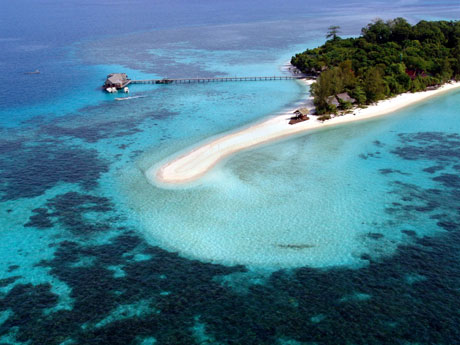
Use this opportunity to show off places like Lankayan island by providing free transfers to the island and subsidised rates for those passengers that would like to go diving.

Offer free trips to visit other attractions such as Gomantong caves, the Turtle island park, the Proboscis monkey sanctuary and of course, for anyone who has their clubs, a round of golf at the golf and country club.

All these efforts should be underwritten by the Sabah Tourism Board. There will be a temptation to see this an an opportunity to make some extra money and even charge more to the cruise ship passengers. This would be a mistake.

Wherever possible, get contact information, email addresses, twitter profiles, tumblr information and track them once they’ve left and stay in touch with those with influence.

Such gestures will also form the foundations for future negotiations with this and other cruise lines who will certainly learn of the generous and proactive approach of Sabah Tourism.

This is a marketing/PR/reputation opportunity and should be seen in such a way. These efforts won’t cost much, will leave an indelible impression on the visitors who will discuss the welcome they received in Sabah for years to come.

5 branding tips for Malaysia Airlines to save its troubled brand


Earlier this month, troubled Malaysian carrier, Malaysia Airlines (MAS) reported a staggering RM2.52 Billion (US$850 million) loss for 2011. Despite the tough economic climate, a number of competitor airlines – British Airways, Singapore Airlines and Cathay Pacific all reported a profitable year.

Soon after, Group CEO of MAS Ahmad Jauhari announced that he will implement ‘strong and immediate measures to stem the flow of losses with staff redeployment, improved productivity and efficiency, further cost controls and more route reviews’ whilst at the same time, he also promised ‘an aggressive sales and marketing strategy’.

Marketing budget doubled
Then MAS announced that it has doubled its marketing budget for 2012. The marketing budget is reported to be as much as 2% of revenue which on 2011 revenue of RM13.90 billion (US$4.63 billion) equates to about RM278 million or nearly US$100 million.

So if the marketing budget is doubled, it means that MAS has more than RM550 million or US$190 million to rebuild it’s battered brand. That’s a tidy sum.

Details of what marketing initiatives the company has in mind are sketchy. Although the company has announced it will provide ‘better and more branded customer experience and embark on a major advertising and promotions campaign in 2H/2012’.

This morning I read that the airline has appointed Ogilvy and Mather Advertising as its master creative agency. I also read this comment on the appointment from Al Ishal Ishak the senior vice president for marketing and promotions, “2012 will be a breakthrough year for Malaysia Airlines on our path to recovery. We recognised, however, that we could not achieve financial success without clearly defining our brand positioning.”

He went on to say, “Ogilvy understood this and throughout the pitch process were best able to translate our message into a powerful campaign idea. An idea that is big enough to help us transform our business and truly engage our customers like never before.”

Before I go on, I have a confession to make, I am a loyal Malaysia Airlines passenger and fan of more than 20 years. During that time I have been on the receiving end of more positive than negative experiences with the airline. So I want the airline to succeed.

But if this is the last chance for this iconic brand, Al Ishak and his team have to get it right. Any advertising campaigns will need to reflect the culture of travel and consumers today and not try to use the traditional high gloss beautifully presented images and TVCs so favoured by the airline industry to ‘clearly define our brand positioning’.

How will MAS spend the marketing budget?
I appreciate it is early days but I have noticed a digital campaign selling the new A380. The style would suggest MAS is going the traditional route using glossy images and slick advertising with high production values to attempt to position the company in the minds of its consumers.

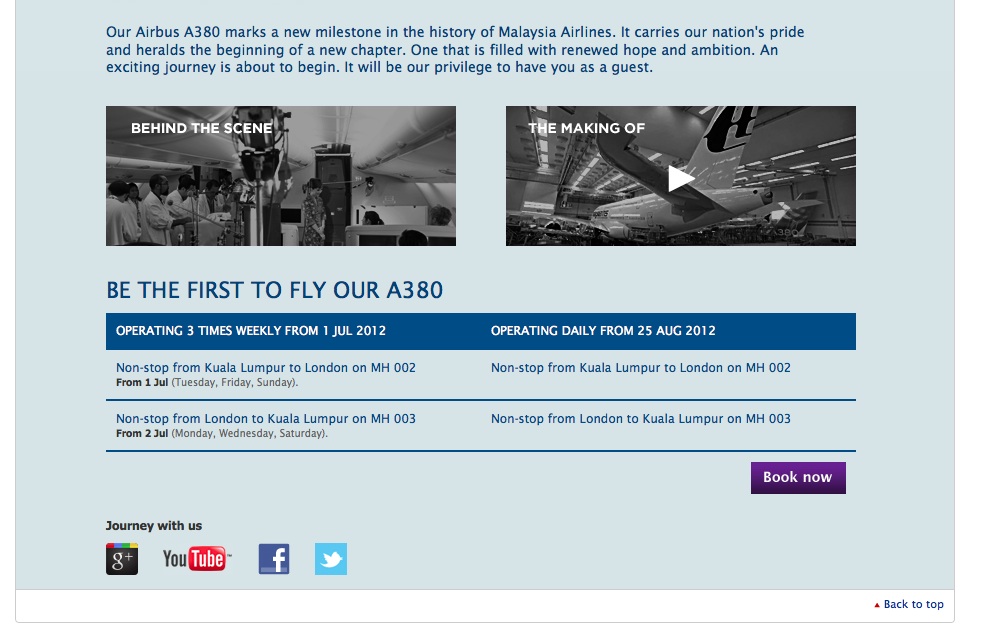
The ad features an image of the A380 in the very attractive new MAS livery and a tagline about the journey which I assume is related to the A380 and one about the aircraft being the pride of the nation. Let’s hope Ogilvy improves on that. Anyway, clicking on the ad, you go to the existing MAS site where you are greeted with the same, larger image of the A380 and the same taglines.

Below the fold there are two black and white images with click through options. The one on the left entitled, Behind the scene (sic) links to still images of the making of the new commercials which look very traditional and my first reaction was what a pity they haven’t changed the cabin crew uniforms. The image on the right links to a video entitled ‘The pride of our nation”, a predictable and uninspiring video of an MAS A380 being painted!

Throughout, the copy is uninspiring.

Below the images are social media options. I had a quick look at the twitter feed and it looks very collaborative with plenty of discussions although efforts to build the brand in the social context can be improved.

But I have a sneaking suspicion that the bulk of that US$190 million is going to be spent on advertising. And as Singapore Airlines learnt with it’s A380s, you can no longer rely on developing a position and using advertising to communicate that position in the hope that it will work and consumers will buy.

Positioning
The problem is that positioning is a throwback to the mass economy that no longer exists. What advertising agencies tried to do was create a position that reflected the strengths and weaknesses of the offering. Ideally, this position was based on being first in a particular category.

If someone was already first in a category, then companies attempted to redefine themselves in a new category to be first. In the airline business, this tended to be related to passenger comfort or service. The effectiveness of positioning depended on the ability of advertising to drive branding perceptions in the mind of consumers.

To do this, airlines often made promises they were unable to keep (admittedly, often due to third party issues out of their control), failed to meet traveller expectations, often because dynamic competitors moved quickly and so raised the bar, which in turn led to brand disillusionment.

Positioning was ideal for the mass economy. It was also ideal for advertising agencies and marketing departments because it gave them enormous power without the responsibility of accountability. Al Ries and Jack Trout invented the concept of positioning. The preface to one of their books states, “Positioning has nothing to do with the product,…. (it) is what you do in the mind of the prospect.” So, essentially this means that the consumer can be made to believe, through extensive advertising and PR and via the right conduits to consumers, and other vehicles, what an offering means to them.

Well I’m sorry, this might have been true in our parents day, when consumers were more predictable, more trusting and had less choice but in today’s mean spirited world, a world in which only 4% of Americans and 14% of Malaysians believe what they read in adverts it is going to be very, very difficult. And of course the problem with using positioning to build a brand is, if it doesn’t work, the money is wasted, time is lost and you have to repeat the process again, with a new position!

So how can MAS save its troubled brand?
1) Research. Your existing customers are your best source of information. But they are not all the same. I would be interested to know which, if any customers MAS talked to when they were configuring the aircraft. MAS is talking about flat beds and big TV screens in first and business. Well that is so last year and who doesn’t offer them so why should I change? What about Internet access? I hope the A380 offers it throughout the aircraft.

2) Mass market branding and the old model of developing a position and communicating that position across for mass media repetatively for as long as possible is no longer effective. Brands today are built on relationships, access, personalisation and relevance. Before MAS marketed to segments of 18 – 34 year olds, businessmen and so on. Today, MAS must deliver economic, experiential and emotional value to to everybody and on their terms.

3) MAS must focus on developing more profitable relationships, not a more profitable product. Brands evolve when companies start buying for customers instead of selling to them.

4) Branding is an organisational not a departmental responsibility. And the organisation is the responsibility of the CEO. MAS is charging about a 100% premium for an economy class ticket on its A380 in July over the price of an economy class ticket on a 747 for the same route. Throw in all the other airport fees etc and it’s going to have to be a pretty good product to charge such a premium.

5) Retention is key to brand building. Companies no longer sell a product, customers buy a product. And those customers have plenty of choice, especially in the airline business. Sadly too many companies spend lots of money on acquiring a customer but very little on retaining them. MAS is one such company. Once a consumer buys the product, companies should do everything possible to hang onto those customers, build relationships with them, learn about them and leverage them.

Bonus tip. This is the social era. As I said MAS is working hard on social media but there is room for improvement and integration. It would be interesting to know how they leverage their social media efforts to get more business.

Successful brand building is determined more by customer experiences than by slick advertising campaigns


Far too many companies, whether Multi National Corporation (MNC) or Small, Medium sized Enterprise (SME) think or are led to believe that the fast track way to branding acceptance is to spend large amounts of money on high quality TV commercials, billboards or print advertising campaigns that showcase their products or services and communicate corporate driven messages to consumers.

But just because telecommunications companies, banks, oil companies, soft drinks firms and others spend considerable amounts of money on advertising doesn’t mean that the advertising is the reason for their success or that it is right for you.

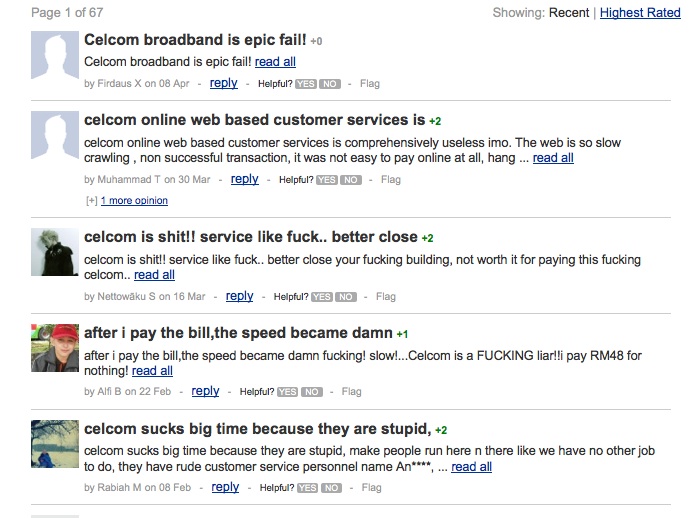
In fact quite often, there seems to be no rhyme or reason to the advertising campaigns initiated by these companies. A case in point is the current Celcom campaign “Ini Wilayah Celcom” prominent on billboards across Kuala Lumpur. With current mobile penetration in Malaysia around 125% of the population, it doesn’t make sense for Celcom to be creating awareness with expensive outdoor campaigns.

Unsurprisingly, at end of many such campaigns, there is often very little change in the fortunes of the brand. Which is why many of these advertising campaigns, do little to build brands and should not be emulated by other companies.

Because a key element of whether or not your brand building is successful will depend not on what you tell consumers through paid media but on the experiences consumers have with your personnel, your business and your products.

Put simply, if you manufacture furniture and spend a lot of money advertising a new furniture range but the furniture breaks all the time, you may make some sales but your brand will suffer as consumers avoid making a return visit and worse, discuss their issues with other consumers on and off line.

Likewise if your staff are slow, rude, inattentive, badly groomed, lack product knowledge, unhelpful and poorly trained, you may make a sale but the customer is unlikely to return and you can be sure they will share their negative experiences with others.

Furthermore, these negative experiences will be spread across the Internet using social media tools and in coffee shops, bars and so on will have a negative impact on your brand. Even sales of previously successful products may be affected negatively.

However, treat customers well and they will remain loyal. In a recent survey by Spherion, 97% of those questioned said a great experience makes them more likely to buy more of a product or repeat a service. However, once they have a bad experience or their trust is lost, it’s very hard to win back. To have a chance of winning back their business, 22% want a simple apology, 10% want a complete refund, and 8% would want incentives or coupons and even then there is no guarantee.

But 46% said that it would take an apology, a complete refund AND coupons or further incentives to have a chance of winning back their business. The implications therefore on your brand, of delivering a bad experience is costly and time consuming.

For the record, 15% said absolutely nothing would atone for their bad experience.

So you can try to shape the perceptions of your products or services with advertising, PR, advertorials, nice brochures and with content across social media and elsewhere but the reality is that the success or failure of your brand will be determined by experiences and how customers discuss your brand after the experiences.

Apple for example charges a premium for its products. It sells the sort of stuff – computers, smart phones, MP3 players – that lots of other people sell yet sells them at a premium. Margins for Apple iPhones are in the region of 50% compared to a meagre 6.2% for Nokia smartphones.

Furthermore, Apple ‘only’ spends US$250 million (2009) on advertising compared with Microsoft US$1.4 billion and Dell US811 million. In terms of a percentage of sales, this equates to 2.4% for Microsoft, 1.3% for Dell and 0.5% for Apple. RIM, manufacturer of the Blackberry spends 3.6% of revenue on advertising.

New technology companies that have sophisticated digital strategies and use email to market themselves spend even less on traditional advertising. Google spends only US$11 million on advertising or 0.05% of revenue. Amazon is a little higher at US$43 million or 0.17% of revenue.

As a general rule of thumb, spending less than 2% of revenue on advertising is considered low. For the automotive industry average advertising spend is nearer 3.5% of revenue. For alcohol it is more like 7% and for packaged goods and most other industries, as high as 10%.

Firms such as Apple, Google, Amazon and others are not successful because they spend huge amounts on short term advertising campaigns to create awareness but on innovative design, quality products and excellent service that is uniformly outstanding across all customer touch points such as in stores, whether bricks and mortar or online.

Consumers will pay more for Apple products because they are guaranteed a quality product (as well as inclusion into a not so unique club of Apple users) that will not fail them. And if it does, customers know they can go back to the store and seek a replacement or have repairs carried out under warranty.

Unfortunately most MNCs and SMEs don’t appreciate just how important the customer experience is. And the increasing popularity of social media means that consumers are voicing their dissent, not just to a few friends over teh tarik at a local Kopi Tiam but now to thousands and thousands of friends and followers and to their friends and followers across communities on Twitter, Facebook and more.

So as you try to build a successful brand, a core component of your strategy must be to build relationships with prospects and customers. You must learn how to manage relationships with customers, not just offline and during office hours but also online and at weekends.

Because unless you have a unique product or service (and few companies have unique products or offer unique services today), customers may buy from you if they have a bad experience but they are unlikely to come back again. And because of increased competition, it is impossible to build a brand on a business model that relies on new customers all the time.

Make sure that at every touch point where consumers interact with your brand, the experience for those customers is a positive one. This becomes a greater challenge as a company grows and if you get it wrong, what was once a nice little niche business with a manageable group of customers who all spoke positively about the company can become, almost overnight a loss making enterprise with fewer customers and a bad reputation for over promising and under delivering.

Ensure that every sales contact, service delivery and customer service interaction that the customer comes into contact with is positive as this will have a positive impact on your brand. Even suppliers need to be treated with respect.

But even if you invest heavily in customer relationships, and even if you keep 99% of your customers happy, there will always be some who are not happy and are dissatisfied with your service. What do you do with them?

The first thing is not to ignore these important customers. Try to get them to explain to you what is the problem. Be prepared to listen and hear stuff that may sound unreasonable. Some customers will be rude, personal and even physical. But you have to make sure your people are trained to listen and empathise. Think KFC!

And where possible solve their problem in a way that is satisfactory for them, not you. I know this might be a problem for you and will certainly cost you money on that particular transaction but in the long run it will offer far greater returns.

If you try to take care of every single customer, both those that are not a problem and those that are you’ll create a positive reputation. Even if customers are frustrated with their experiences with your brand, if you show empathy and provide a solution that makes them happy, there is a good chance they will tell others that they were impressed with you and how hard you worked to solve the problem for them. And with a little incentive, you can probably convince them to come back.

Despite what you may have been told, mass advertising across mass media is not the holy grail to building a brand. Which is fortunate because it means SMEs won’t waste hard earned money on campaigns to compete with large conglomerates. But if you look after the customer and try to make every experience a positive one, you will speed up the process of building a brand.

Thanks to zendesk for the graphic above.

AirAsia brand hits turbulence


A week ago, AirAsia X CEO Azran Osman-Rani announced to much fanfare, a new service between Sydney and Kuala Lumpur.

Soon after, the Australian Competition and Consumer Commission, (ACCC) an Australian consumer watchdog announced that it has launched a court action against AirAsia, alleging the company is misleading consumers in its advertisements for flights out of Australia.

This follows negative press after AirAsia X recently announced it was ceasing flights to London, Paris, Mumbai and New Delhi and criticism by Neil Warnock, the former manager of Queens Park Rangers football club, owned by AirAsia chairman Tony Fernandes after he was sacked.

Although the company acted quickly and decisively with offers of refunds or alternative travel at no extra cost for passengers who hold tickets for future flights to Europe and India, in terms of customer loyalty, these latest developments won’t do the brand any favours.

Especially as the airline is also copping plenty of flak for it’s opaque charging and poor engagement skills on social media, as seen by this image taken from a disgruntled customer on Facebook.

The former AirAsia fan says the image was taken down after 10 minutes when he posted it on the company Facebook page and he has since been barred from posting anything on the AirAsia Facebook page!

Hidden or extra fees add almost 100% to cost of Kuala Lumpur to London ticket on AirAsia

According to the ACCC, AirAsia’s website did not include all taxes, duties, fees and other mandatory charges when advertising fares on certain routes from the Gold Coast, Melbourne and Perth. In Australia if a company wishes to advertise part of a price, it must also advertise one total price for the product or service.

Brands are defined by the economic, experiential and emotional value they deliver to customers. Fail on any of these counts and your brand will struggle. The disgruntled Facebook customer and customers like those in this article have undone a lot of the work AirAsia has done to build a people friendly brand.

As Low cost carrier brands grow, charging extra for food and entertainment may be acceptable on short or medium haul routes but many consumers see it as unfair on long haul routes so strategic changes need to be made if they really do want to build brands.

Building a brand in the consumer economy is more than the CEO and Chairman tweeting all day. It requires a strategic plan with processes to deal with reputation issues and a willingness to engage with consumers who raise positive AND negative issues on and off line.

The reality is that AirAsia probably had little choice in cutting unprofitable routes to India and Europe.

But what it should have done was have a strategy in place to announce the changes and a plan to communicate with existing ticket holders to inform them and work with them to solve their personal issues in as seamless manner as possible.

A Facebook page with direct access to a community director and suggestions for alternative routes or airlines and how to go about booking flights would have been a tactical initiative to show the airline cared.

Such an effort may be a relatively time consuming and expensive initiative but in the social economy, one that is imperative and one that will pay retention dividends.

2012 must be the year you develop a social media brand strategy


Saudi Arabian Prince Alwaleed bin Talal has twice been named as one of the smartest and most creative investors in the world by Forbes magazine. He’s also been called the “Saudi Warren Buffet” because of his impressive track record with his investments.

He first came to the fore with a signficant investment in Citibank in 1991 and now has interests in a diverse portfolio that features stellar brands such as Apple Inc, Four Seasons Hotels and Resorts, George V Hotel in Paris, Songbird Estates (Canary Wharf), Time Warner, News Corp., Walt Disney, Euro Disney, PepsiCo, Procter & Gamble, Motorola, Hewlett Packard and Kodak.

So when someone of his calibre announces, as he did just before Christmas 2011 that he was taking a US$300 million stake in Twitter, the world pays attention.

Ahmed Reda Halawani, Executive Director of the Prince’s Kingdom Holdings company said in a statement, “We believe that social media will fundamentally change the media industry landscape in the coming years. Twitter will capture and monetize this positive trend.”

“Fundamentally change the media industry landscape in the coming years.” I’m prepared to go one step further, I believe that social media is the media equivalent of the printing press, the radio and the Television – all arriving at once!

So if you are CEO of a Malaysian SME and you still haven’t invested resources into social media, I suggest you do so and do so quickly.

But before you do what many do which is to copy all the content on your website and paste it onto your Facebook page and think that is a social media strategy, I suggest you also invest some time in learning about how to use these channels.

Because social media is about relationships. And Malaysian SMEs have, on the whole over the last two decades or so, focussed not on relationships, but on selling their products at the cheapest price.

That’s fine when there is significant demand for a product and you can always produce it cheaper than someone else. But unfortunately today, someone somewhere is producing just about everything cheaper than Malaysian firms.

And this places Malaysian SMEs at a disadvantage, especially when multi national corporations are taking notice of Malaysia and beginning to invest significant marketing dollars in the country.

The good news is that social media, used correctly can actually save SMEs a lot of money because firms can create awareness, gain customers and, most critically retain them across social media platforms for a fraction of the cost of investing in traditional media such as TV, radio, Outdoor and others.

But it is important to develop a social media strategy before embarking on the exercise otherwise resources will be wasted, reputations may be affected and you could be worse off than before you started.

Here are 11 elements that must be included in any SME social media strategy

1) Determine your goals and your target market.
Obvious I know, but too many companies are trying to use the same tactics online as they did offline, ie trying to use the same ‘one-size-fits-all’ communications campaign to create awareness via a series of tactical campaigns. This will not work on social media.

2) Raise brand awareness by creating an online game or contest and hosting it on Facebook.
Tourism Malaysia has spent a significant amount of money on Facebook competitions that have generated many online column inches of comment. Despite limited investment in the content, the activities were executed well. However despite hundreds of thousands of new Facebook fans, tens of thousands of engaged users, significant traction in the social-media space, it is unclear what the actual campaign goals were.

3) Give free stuff away!

I don’t know how Tourism Malaysia will use the data it generated from the Facebook campaign, but to build a database that can be turned into brand evangalists in the future, it might be worth offering prizes for content shared with other users across platforms such as Youtube, Twitter and so on. This can be then be leveraged to gain more brand traction.

4) Use crowdsourcing to determine strategy
Back in 2009, Vitamin water wanted to launch a new brand. In an exercise that Gap management should have emulated, they binned the traditional qualitative and quantitative research via focus groups and intercept surveys. Instead the company turned to social networks and sought the opinion of consumers in a real world, real time environment to decide on the name of the new product. Over 1 million people participated in the project and they got close to celebrities employed to spike interest in the project.

5) Don’t delay your decision, you are already being talked about!
Conversations about your brand are already happening on social media. Embrace the conversation and get engaged but a word of warning, don’t try to use the platform as an opportunity to push your products onto consumers.

6) Don’t be afraid to revise your marketing message
Perhaps once, twice, three times and even more to make sure you engage the right consumers with the right content and don’t generate negative feedback from your audience. But if you do generate negative feedback, address it in an honest and transparent manner and see the conversation all the way to the end, no matter how distasteful.

7) Comments are good
One website we were asked to audit recently didn’t allow comments from other users yet increasingly, consumers are looking to comments rather than actual articles for the data that will influence and determine their decision making.

8) Remember your core message and don’t go too far away from it
Being genuine and transparent and sticking to your overall image is very important.

9) Tell the truth
Target Rounders is a subsidiary of the US retail giant. It is an online group that you sign up for & you get points for marketing a product. They come up with new products & then everyone on their list finds fun ways to promote it for “points.” The company launched a Facebook campaign that utilized a lie created to gain more fans and a larger community! Unfortunately consumers spotted the lie and the project died.

10) Creativity is effective in social media
Prior to launching the much anticipated Shark Week, the Discovery Channel sent a jar that appeared to include a death notice to new media types.

The jar included a note that read, “This jar holds a story – the story of a single tragic incident that needs to be unlocked. Dive in, investigate the evidence and discover what lies beneath the surface of frenziedwaters.com.”

The jar also included a large warning sign, shredded swimming trunks (no doubt belonging to someone who was eaten by a shark), and a detailed obituary dated for a future date at the time of the campaign.

Participants were intrigued and as a result spent a lot of time researching online before realising that the Discovery Channel was behind the whole thing. Nevertheless, the right people were soon talking about the show and building interest.

11) Write a social media policy
For most firms, their social media policy consists of restricting access to social media. But this isn’t the way forward. Used properly and by the right people, social media can be a very effective and inexpensive marketing tool for brands. But there are always going to be risks associated with a new tool so the best defense against abuse is to create a policy for usage.

Social media is making companies be more sharing, collaborative and transparent, not just externally but internally as well. Including employees in the policy development process will create internal advocates for the policy and improve morale.

The social media policy should be more about what employees can do and best practices for social media use versus all the things employees can’t or shouldn’t do on social media.

When shrewd investors such as Prince Alwaleed bin Talal are taking stakes in social media you know it is here to stay.

To stay competitive, Malaysian SMEs are going to have to invest more in developing brands. Social media, used correctly will save them large sums of money communicating those brands to consumers and other customers.

Effective use of Twitter to build your brand


This article first appeared in the 29th November print edition of The Malaysian Reserve

Earlier this week at the launch of the 1Malaysia Social Media Convention, the Prime Minister of Malaysia Datuk Seri Najib Abdul Razak announced that the Barisan Nasional (BN) was developing an army of BN friendly cyber practitioners to engage consumers online.

The PM said at the launch, “As a party that wants to be relevant, we have to change according to the change in time”. The Malaysian Prime Minister should be applauded for his grasp of the importance of Social Media because there are over 12 million Internet users in Malaysia and Social Media is responsible for one third of the web traffic in the country.

The Prime Minister understands that social media has transformed people’s behaviour, their expectations and how they like to express themselves. Unfortunately, although the Prime Minister is aware of the importance of Social Media, most corporations appear oblivious to the impact of Social Media on consumers and the way they learn about and share information on products.

This may be because up until recently companies have been able to manage their communications but this is changing and today, consumers no longer respect or trust slow, opaque, bureaucratic, dictatorial corporations and the structured PR and advertising they like to push out across traditional broadcast media. In fact a recent study noted that a staggering 86% of Malaysians don’t believe what advertisers tell them in traditional ads!

Consumers are fed up with the automated voicemail that greets them when they call with a product or service issue. Especially as many corporations use the inevitable waiting time to try and sell something else to a customer who is often seething at the company and is not in the right frame of mind to be sold to.

Today, consumers expect, no demand to be able to talk to the right person at the right time.

Today, successful organizations are the result of being human, responsive and transparent. And consumers will communicate with these companies across open and transparent social media communities such as Twitter, Facebook and others.

So over the next few months we’ll talk about some of the most likely social media tools you can use to communicate information about your brand and how those tools can be used for businesses such as yours.

This month we look at Twitter, what it is and how you can use it to build your brand.

Worldwide, there are now 100 million active Twitter users and daily Tweets are over 250 million. Most top actors, athletes, politicians, businessmen and artists are active on Twitter.

Every news, current affairs and sports programme proudly displays its Twitter account name. Global events anywhere in the world break first and spread faster on Twitter. While CNN is showing 2 day old sports’ scores on its ticker tape, Twitter is providing those who are interested with ball by ball updates live from the next days play.

Barack Obama has 11.2 million followers, Datuk Seri Najib Razak has 295,000, AirAsia has 245,000, Amazon has 149,000, Firefly has 47,000 and the numbers are growing fast. In Asia, Indonesia has the most subscribers to Twitter whilst there are about 1 million in Malaysia.

It is important to understand that Twitter is not another Facebook. Facebook is best described as a few to a few social network created with a goal of sharing personal information and life related stuff with friends. Only once two people ‘friend’ each other can information begin to flow. Twitter on the other hand, is a one to many social network that allows me to say follow Firefly to keep abreast of their offerings yet they don’t have to follow me back to make the relationship work.

Twitter allows prospects and customers to instantly connect with you. Brands are no longer defined by the campaigns created by marketing and PR departments within companies. In the social economy of today, brands are defined by consumers or more specifically the experiences those consumers have with brands.

Get it right and you’ll build a brand. Get it wrong, and consumers will ensure your brand fails.

One of the reasons for Twitter’s success is because consumers got fed up with the automated responses they were faced with every time they contact a company.

Twitter is a popular platform to disseminate news about your company. If you have set up your Twitter account properly, Twitter is a dynamic and inexpensive platform for you to post information relating to your brand. A well planned Twitter strategy can help keep prospects and existing customers abreast of new developments and engaged. Beware however that it is not a broadcast medium and you must know when to stop. Constantly sending out the same message will have a negative impact on the brand. It’s also important to respond to comments from consumers related to your announcements.

Twitter is an excellent platform for sourcing actionable data. Twitter lets you find out priceless information about your customers – their opinions of your brand, what they like and/or dislike about your brand, what they think of your competitors, recommendations for improvement and much more. Twitter gives you an opportunity to improving your business, often without the need for costly investments.

Twitter helps you to humanize your brand. Twitter allows you to reach, communicate and engage with consumers and match your product attributes to their requirements for value whilst other companies are publishing generic ads in newspapers or attempting to convince consumers with PR.

Twitter lets you send the right message to the right people immediately. By using groups, lists, communities and other Twitter features effectively, Twitter lets you distribute news, make announcements, inform or create awareness of special offers to the right people in real time. No more waiting a month for the magazine to come out or 24 hours for the newspaper (assuming they have the space).

Being active and effective on Twitter communicates a company at ease with technology. Being a part of the Twitter community shows that you are moving with the times, that you embrace technology and are an open and transparent organization.

Twitter case study
A frequent business traveler between Malaysia and the UK was a loyal user of Budget Rent a car. But after a 13 hour flight, the business traveller was forced to wait two hours for a pre booked car. He stayed with Budget until on another occassion he received a bill for £86 because he forgot to pay the £10 congestion charge. So he decided to look for another car hire company for his next trip to the UK.

Using a price comparison site he came across Sixt, a company he had never heard of. The company offered an attractive pick up and drop off within a 5 mile radius of the nearest showroom. But when the businessman was booking the car hire on line he couldn’t find out any information on the pick up service.

So he turned to Twitter and asked for help. Within 5 hours the MD and CEO of Sixt had both contacted him with a request for his email address so that the @Sixt customer service team could get in touch.

Arrangements were made with customer service for the pick up and as a nice touch the car hire company upgraded him to a premium car. The experience was seamless, quick and pleasant. The businessman then shared, across multiple social media platforms details of his experiences and I am now sharing his experience with readers of this Blog and across Twitter, Facebook, Stumbleupon and more.

What was the cost of the positive buzz and acquiring this new, influential customer from a competitor? In terms of time perhaps an hour at most. Financially, next to nothing.