Branding is relational, not transactional. It's about retention, not acquisition. I work with companies and governments to identify and develop the strategies required to build the relationships that ensure ongoing branding success.
I call it data driven branding & it should not be confused with creative driven branding.
I'm also a rugby nut & devoted family man, probably in that order, but don't tell my wife!
Plenty of marketing people will tell you they are expected to perform miracles to keep ahead of the competition.
WestJet, a Canadian based carrier proved it can be done!
The airline set up ‘Santa chat boxes’ that looked like gifts at Hamilton and Toronto airports in Canada. The boxes featured a chatty Santa who asked kids and parents what they wanted for Christmas. Little did they know that the information was relayed to the WestJet office at their destination where a team of 150 WestJetters went out and bought the actual gift.
They were then sent back to the office where they were wrapped and put on the carousel as the passengers waited for their luggage. Just as the presents arrived Santa walked out and started interacting with the stunned but very happy passengers. Have a look at this wonderful video:
The video has got over 11 million views in 3 days. Hundreds of column inches and been featured in numerous news programs around the world. Total cost? Maybe US$100,000.
This Japanese commercial for tyre manufacturer Autoway comes with a health warning that recommends those with a heart condition, physical or mental problems or those who visit their doctor on a regular basis should not watch it.
It’s a clever if rather radical attempt to sell tyres. I’ve written about ‘shock and awe’ advertising here. Traditionally, it hasn’t been very effective, in markets like Malaysia, Singapore, the UK and Australia.
As an example, in Malaysia, despite nearly US$50 million spent on shock and awe campaigns to create awareness of the dangers of smoking, the number of smokers has practically doubled every 10 years.
Of course the success of this campaign will depend on what other initiatives are carried out and on which channels.
Whether or not there are parallels between campaigns for smokers and those who buy tyres, I don’t know. Perhaps this will be different, what do you think?
In 2011 Volvo posted its largest year-on-year increase in truck sales for the North American market. The market saw an impressive sales volume increase of 75%.
Since then the company has struggled to compete in a tough economic environment and even though 2012 saw the overall truck market in North America rise 52%, Volvo, owned by Geely, China saw sales drop by 6%. The company recorded double digit drops in China and Sweden and predicted a tough 2013.
At the same time, there is a boardroom fight going on between Chief Executive Stefan Jacoby and Vice Chairman Hans-Olov Olsson that often gets bitterly personal.
In Malaysia the company has faired better with 2012 sales up an impressive 42% from 2011. I haven’t seen any advertising campaigns for Volvo trucks in Malaysia but the latest commercial has gone viral and will no doubt get some coverage here.
The commercial features Jean Claude Van Damme doing the splits between two Volvo trucks driving backwards into the sunset to an Enya tune. It’s an impressive stunt and JC is in excellent shape but will the commercial make a difference to Volvo truck sales?
Will this impressively produced commercial get potential customers to review their purchasing options? Will it get logistics companies to revise their transportation tenders to include the line, “All vehicles must come with the equivalent of Volvo’s Dynamic Steering System”?
Surely such a unique and impressive bit of technology needs to be experienced by a potential driver/buyer first hand?
Of course I don’t know the full extent of the Volvo truck brand strategy going forward but to me, whilst the exploits of JC are impressive I find them a distraction, damaging the attempts by Volvo to draw my attention to a cool bit of kit. Do you agree or am I just an old cynic?
In my previous post I gave 10 reasons why you should use video to build your brand. You can read that post here
But there needs to be a creative element to those videos. Looking at the airline business, far too many carriers believe the bulk of their marketing dollars should be spent on well produced but hugely irritating glossy videos featuring pretty stewardesses, cute kids and seats that look further apart than they are on any plane I’ve ever flown.
A case in point is Thai Airways. In 2010, to celebrate its 50th anniversary, the carrier released a well produced video that gnaws at the heartstrings but does little new to differentiate it from competitors.
The video has generated a respectable 150,000 views since its launch in 2010 but only 400 likes which would suggest it has made very little impact.
There are some though that are doing their best to move away from this predictable and instantly forgetable approach. Most recently, Virgin America and Air New Zealand have approached the safety video from a new direction.
Instead of the oft ignored stewardess standing self consciously in the aisle and demonstrating how to use a seat belt, where are the exits, how to put on a life jacket and what to do when the oxygen mask drops, these airlines have gone to great expense with a refreshing approach to the tried and tested.
Earlier this week, on the 29th October 2013, Virgin America launched an airline safety video that it claims is the first safety video set entirely to music. They are probably right and the result is impressive.
Obviously I’m not the only one to think so as the video has already been viewed by more than 700,000 people in just two days. What I like about the Virgin video is that they are keeping the story live by inviting dancers to audition for future versions.
Potential participants must send an Instagram video to a specially set up safety dance battle website. Some of those Instagram videos, that can only be up to 15 seconds long will then no doubt take on a life of their own, thereby continuing the Virgin America narrative. So far, the video has over 13,500 Likes on YouTube.
Earlier this year Air New Zealand teamed up with Eton educated ex SAS officer Bear Grylls to create a unique and captivating safety video. The pretty stewardess and cute kids are still there but I’m sure you’ll agree the rest of the cast is unusual!
To date, the Air New Zealand video has garnered more than 277,000 views on Youtube. Not bad for an inflight safety video!
I did a quick search of Youtube to see what Asian airlines are doing on Youtube. Cathay Pacific has created a lot of content some of which has generated a lot of views. Last year they did a ‘Day in the Life’ feature with flight attendants, pilots and ground crew.
This video of a day in the life of Grace, a flight attendant has a respectable 200,000 views but not too many likes.
Malaysia Airlines YouTube page suggests the carrier is creating a lot of video content but judging by the numbers of views it isn’t compelling enough for consumers to engage with, Like and share. However, when they do get creative, or rather innovative interest in the brand goes through the roof, as shown by this flashmob video that has generated over 1,100,000 views in just under 2 years.
Unfortunately this project appears to be tactical rather than part of a strategic initiative because it doesn’t seem to go anywhere or be integrated with any other activities.
According to Cisco, 90% of all Internet traffic will be video by 2017. These Asian carriers need to start producing content that is interesting and relevant. And that content needs to be part of a planned, strategic story that resonates with target markets in order for those markets to engage with and share across the ecosystem. Otherwise it becomes just another piece of expensive content that is out there, rarely viewed and therefore ineffective.
Video is no longer a ‘nice to have’ it is now a ‘must have’. Here’s why:
1) According to Google, YouTube uploads have increased from 40 hours per 60 seconds in 2011 to 100 hours per 60 seconds in 2013.
2) As attention spans decrease, video is twice as effective at getting a viewers attention.
3) Video flot states that 20% of visitors to a site will read content in the form of text but 80% of visitors to the same site will watch the same content in video.
4) Visitors to a site who view a video stay 2 minutes longer on the site and are 64% more likely to make a purchase than other visitors.
5) 78% of people watch a video online at least once a week and 55% watch one everyday. threemotion
6) 80% of Internet users recall watching a video ad on a website they visited in the past month. 46% took some action after viewing the ad. Online Publishers Association
7) 90% of information transmitted to the brain is visual, and visuals are processed 60,000 times faster in the brain than text
8) 500 years of YouTube video are watched every day on Facebook, and over 700 YouTube videos are shared on Twitter each minute. YouTube
9) Video results have appeared in almost 70% of the top 100 search listing on Google in 2012. Marketing week
10) Cisco reports that 90% of all Internet traffic will be video by 2017.
And if you are still not convinced, have a look at this impressive video from visually
In 2002, Nokia was number two in the list of super brands in Britain. by 2010 it was 89th.
In 2010 Nokia, sold 450 million handsets, outselling Apple 10 to one. In 2012 the firm sold 16 million of its flagship Lumia handsets. In the same period, Samsung sold 384 mobile phones while Apple sold 125 million iPhones.
By 2010 Nokia’s mobile phone market share had slid from 36.4 percent share in 2009 to 28.9%. Nokia still sells more mobile phones than any other company but consumers no longer want mobile phones, they want smartphones.
And at the heart of the smartphone is the operating system. By January 2011, Google’s Android, and its Chinese versions Tapas and OMS had become the top smartphone platform in the world with an 888% year-over-year growth.
Nokia’s Symbian system was a very close second with Research in Motion a distant third and Apple’s iOS way back in fourth. Microsoft’s mobile operating system barely warranted a mention with 4% of the market.
Under pressure in a market it once dominated Nokia panicked. Realising the key to smartphone sales is the OS, it began to muck about with Symbian, a perfectly good OS with no more flaws than the iOS.
But because of the now huge size of the organisation, issues bought up during the testing of touch screens and browsers were often ignored.
Desperate, Nokia launched the N-Gage with too few poor quality games and terrible network connectivity for multiplayers, the phone was blown away by the PSP and DS.
Next came another disaster, the Ovi. Nokia’s answer to the iTunes Store was an unmitigated disaster. In 2007, Nokia restarted its touchscreen development after deciding in 2006 that touchscreens were essentially a gimmick!
This delay meant that the N95 and N97, both good smartphones in their own right and with email, music players, the Internet and GPS as well as a slide out Querty keyboard were supposed to compete with the increasingly dominant and cool iPhone. Sadly they didn’t get anywhere near it.
Next up, the beautiful N8, launched in 3Q2010. Someone described the N8 as engineering porn with a 12 megapixel camera good enough for professional photographers. But the N8 was outsold 6 to one in Europe and did even worse in the tech savvy, gadget hungry and fast growing Asian markets.
By now frantic, no hysterical Nokia tried a completely new Linux based OS called MeeGo but it’s corporate heart wasn’t in it and MeeGo only got a year.
In October 2011, in what was seen by many to be a last throw of the dice, Nokia teamed up with Microsoft and launched the partnership with a US$112m global brand repositioning campaign launch of its first phone running on the Windows 7 operating system.
This was a big mistake. Microsoft’s Phone 7 had already launched in Q4/2010 on about twelve handsets from a number of manufacturers. During the quarter it achieved a meagre 1.5 million sales, earning it about a 2% market share and worse than Windows Mobile which had 4%.
During the same period, the latest version of Symbian (the all new user-friendly touch screen version that powers the N8) was launched on 3 Nokia smartphones and sold 5 million units. All Symbian products sold a respectable 32 million units.
The six month repositioning campaign, that was meant to regain lost market share from rivals Android, Apple and Blackberry failed and was soon consigned to the overflowing but ever popular positioning graveyard in the sky.
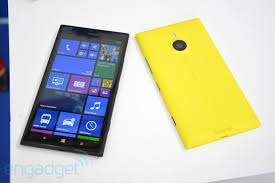
Yesterday on 21st October 2013, in a valiant but misguided attempt to steal some of Apple’s thunder, Nokia unveiled 2 new 6 inch window smartphones. These new smartphones are well designed and as always, have great hardware including a sensational camera, an app that displays the contents of the phone on a PC and more than one microphone.
Right phone, wrong OS
These new phones, developed before the decision to sell the handset business to Microsoft for US$7.4 billion was made, could give Android and iOS phones a serious run for their money. Except there is a problem. The problem is that these great products run on Windows mobile. And Windows is a dying brand. Widows mobile owns only 4% of the global market. And that is unlikely to change.
Windows is a dying brand
Today, Windows mobile products don’t come close to delivering the experience Android and Apple smartphone products offer. And that won’t change. And if Nokia can’t offer a compelling experience, Nokia (or Microsoft) can’t save the Nokia brand.
Malaysia Airlines issued a press release yesterday announcing the airline has one million “Likes” on Facebook.
You don’t need me to tell you Facebook is massive. But I will. Facebook is massive. If it were a country it would be the third largest in terms of population, the largest in terms of area covered and probably the richest in terms of income.
So it is understandable that MAS wants to use Social Media and in particular Facebook, to build its business. Indeed, Khairul Syahar Khalid, Malaysia Airlines’ Head of Advertising & Promotions says, “Social Media is a new frontier for marketing, and as many brands have discovered, going on social media certainly pays.”
Encik Khairul adds, “We have positioned social media at the forefront of our marketing mix. We will be pushing the boundaries even further with our next marketing plans, all of which will see the social media platforms at the forefront. We want to continue to engage with our fans globally at a much deeper level whilst growing our footprint further. Growing our engagement with fans globally has contributed significantly to our business turnaround successes.”
Crediting Social Media with providing a significant contribution to the improvements in the airline’s performances recently is interesting and shows how important is Social Media.
Personally I think it is exciting that MAS is pushing the boundaries even further on social media, especially after the dreadful advertising campaign that is still being run. For more on that campaign please refer to this article
To thank fans for helping the airline reach one million ‘Likes’ on Facebook, MAS created a video with their social media ambassador, Malaysian singer Yuna. The video has been viewed 2,000 times since its launch a week ago.
Incidentally, I believe the Malaysian government has missed a trick here because I think Yuna should be the face of the Malaysia Nation Brand. You can read more about that here.
But how important are Facebook ‘Likes’? Are they a relevant metric for a business? What do they tell us and how can we leverage them?
The bad news is that 96% (BrandGlue goes even further, stating that only 0.02% of fans who ‘Like’ a page ever return) of ‘fans’ never return to a page after liking it. Moreover on Facebook, most posts are seen only by about 10% of fans.
Another little known fact about Facebook is that when fans create new posts on your Facebook page, other fans don’t necessarily see them. In other words, just because you go to your fan page doesn’t mean your fans are doing the same.
Consumers are increasingly sceptical about Facebook ‘Likes’ because it it is so easy and cheap to buy them. Twipquick is offering 100,000 Facebook ‘Likes’ for about US$750.
Any social media strategy must have clearly defined target markets and relevant customer data and content must be developed that will resonate with those customers. This content must resonate with those target markets. After all, there aren’t any groups for 18-35 year olds on Facebook.
MAS must avoid taking its advertising campaigns and trying to push them out across social media. Taking a video and dubbing it into the local language is not a social media strategy. This is simply mass economy marketing and there is no place for that model in the social economy where customers not companies define brands.
MAS must engage consumers and encourage them to contribute to the MAS story and then share and encourage the sharing of that content whilst enabling multiple channels for consumers to interact through.
At the same time, MAS must not forget its existing customers. MAS has millions of frequent flyer members but it currently neglects these existing customers, despite spending a lot of money to acquire them.
I get the impression a lot of people have completely missed the fact that Yahoo has changed its logo. Either missed it or don’t care.
Yahoo put a lot of effort into creating some theatre around the launch of the new logo by releasing 1 of the submitted designs every day for 29 days in the lead up to the launch of the chosen logo. Many of the designs shortlisted were a lot more radical than the final choice.
And the final choice, according to Yahoo CEO Marissa Mayer, “reflects Yahoo – whimsical, yet sophisticated. Modern and fresh, with a nod to our history. Having a human touch, personal. Proud.”
Mayer also said, “We didn’t want to have any straight lines in the logo. Straight lines don’t exist in the human form and are extremely rare in nature, so the human touch in the logo is that all the lines and forms all have at least a slight curve.”
You can read a comprehensive justification for the logo on Marissa Meyer’s Blog.
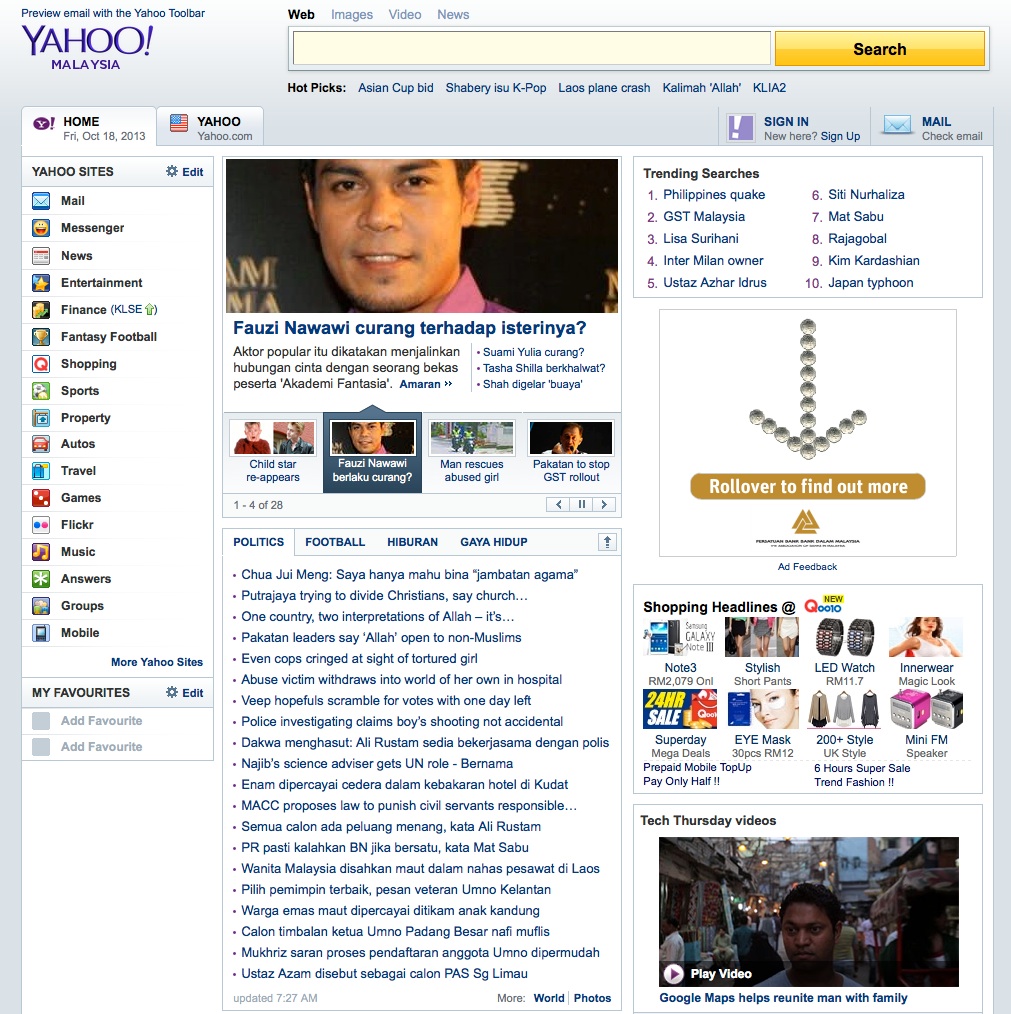
Personally I find the logo underwhelming, especially on the Yahoo homepage where it appears weak, squeezed out by all the content and rather self conscious. What do you think?
The new Yahoo logo at work. Whimsical yet sophisticated or barely noticable?
Recently I was asked to map out a plan to develop some substance around the CEO of a major organization in Malaysia. The belief was that although he heads a hugely successful company, his personal brand lacks gravitas and this may count against the firm in the long run.
And they were right because the reputation of a CEO is inextricably linked to the reputation of a company. Just look at the fortunes of any CEO who had a good reputation then lost it.
Or the fortunes of a business whose reputation was painstakingly built over years, only to fall in a heartbeat because of C level indiscretions or dodgy practices.
Here in Malaysia errant CEOs generally leave quietly so we don’t often hear about such reputational issues but there are plenty of examples of the above. Because of the increasingly litigious nature of society, I’m not going to name names but think of the automotive, aviation, banking, steel and telecommunications industries amongst others and you should be able to work out who I am talking about.
Even in the consumer trenches, a company with a poorly respected CEO or dodgy reputation is going to struggle to find enough customers to build a brand. After all, would you buy from a company with a poor reputation? If a company with a questionable reputation submits a tender to your company, would you consider them? With so many alternatives in the market, there is no need to do so.
Even if the CEO has a solid reputation, he is often the difference between the company and a competitor. If he lacks charisma he may struggle to compete effectively. Tracking his reputation online will enable firms to identify what issues to address, in which channels and where and when. The effectiveness of solutions can be tracked and improved almost immediately.
In today’s social economy, where consumers not companies define brands it is imperative that every organization tracks its reputation online. This is even more important here in Asia where consumers are more likely to take to social media to complain and raise issues rather than connect directly with a company.
Unfortunately many companies still don’t see the benefit of tracking their reputation. Hopefully that will change with this handy infographic from Digital Firefly which shows why companies need to make reputation management a top priority – NOW!
Tracking your reputation online has never been more important
The 1970s are considered to be the decade in which Hollywood rebranded itself after the collapse of the studio system of the 1960s. Independent filmmakers (at the time) such as Scorsese, Lucas and Spielberg all got their breaks in the 1970s creating such iconic movies as Jaws, Star Wars, Raging Bull, The Godfather, Raiders, ET and Chinatown.
It was also a period (no pun intended) when some of the scariest horror movies such as The Texas Chain Saw Massacre, The Exorcist (in my opinion the scariest film ever), The Shining and Carrie which was possibly the forerunner of the teen horror flick, were released.
But for every successful blockbuster, I think that something like 7 fail. And those failures can be really, really expensive. John Carter, released in 2012 is rumoured to have lost RM250 million (US$90 million), despite a RM330 (US$100 million) million marketing campaign.
So in an attempt to reduce failures and to squeeze more money out of a successful franchise, Hollywood likes to remake films. The latest of which is Carrie. I saw Carrie when I was 14. I wish I hadn’t. Carrie is an outsider, her mother is a religious nut and all of her classmates hate her. But Carrie has special powers. Telekinesis powers which means that she can mess with your mind, especially when you piss her off. Add in her first period, pigs blood, a prom, nasty girls etc. You can imagine the rest.
But the movie still has to be sold. And selling a movie is not easy. Especially as international audiences are often the difference between a success and failure – John Carter only took US$80 million in the States, over US$100 million came from Asia. So they decided to come up with a digital marketing campaign whereby they would lay the foundations with a video and then encourage consumers to do the rest.
So far the video has received almost 10 million views in 2 days. The cost? Maybe RM320,000 (US$100,000). Sure a viral campaign is nothing new but it shows that marketing departments need to open their eyes to the social economy and in some sectors, there actually may be one size fits all solutions.





 brandconsultantasia.com