How to spot a shit brand consultant


A friend sent me a great link to a Mark Ritson rant in marketingweek yesterday. Mark Ritson is something of a God for many in the marketing business and sells himself really well. And so he should as he’s won more medals than Michael Phelps.

In the rant which you can read here, he recalled a recent evening in London where a friend told him how he had been ripped off by a brand consultant. Ritson doesn’t share how the friend was ripped off but goes on to outline a seven point system for identifying ‘shit’ brand consultants so you can avoid them like the plague.

Mark Ritson - more gongs than just about everyone
Mark Ritson – more gongs than just about everyone

The list goes something like this:

1) If the consultant mentions millennials, run a mile.
2) If the consultant offers advice without qualitative or quantitative research to back up his recommendations, run a mile.
3) The more concepts the brand consultant tries to sell you, the more ‘crapper’ he is.
4) If the brand consultant uses trigger words, he is unworthy. An example of a trigger word is Innovation. According to Ritson innovation ‘is a product orientated word and worthless as a result.’
5) Any brand consultant that mentions Maslow’s Hierarchy of Needs should be shown the door – after you’ve thrown something heavy at him.
6) Likewise, if the brand consultant shows you a picture of a cow being branded.
7) And again, if they tell you reputations take decades to build.
8) If the brand consultant has a trademark attached to their special branding methodology or they use an acronym like ‘RESULTZ’ or ‘PERFORM’ then walk out of the room, but before you do write WANK on the nearest whiteboard.
9) If your brand consultant waxes lyrical about Steve Jobs and Apple and insists that what he did is relevant to your business, head for the door.

OK that’s a 9 point list but I’m only the messenger. So what do people think of his rant and list? Judging by the comments section, most of his fans agree with him. However, John Robbins of newzpoint blames ‘shit’ brand managers rather than shit brand consultants, “Although I can’t help but think the main reason there are so many shit brand consultants is because there are so many shit brand managers and the fact that you have to prepare a guide for brand managers because they generally can’t tell the difference between good and bad consultants is recognition of this.”

Robbins continues, “Try talking in realistic terms to a shit client (there are tons of them, easy to find) and most of the time their eyes glaze over because they find common sense rather tedious and prefer to listen to inflated bullshit as it excites them more. The emperors cloths continue to be sold and resold every day and no doubt will for sometime. As the old adage goes – brand managers get the brand consultants they deserve.” Powerful stuff from Mr Robbins.

Another comment from Claire who focused on the reference to the millennial segment, “I am apparently a millennial and I’m married with a kid. My brother and sister in law are technically also millennials and living it up with no mortgage in London. The idea that we are both basically the same segment for targeting is ludicrous.”

So what do I think of it? Well I think Mr Ritson is spot on really. I mean the concept of doing anything and making any recommendations without doing research is borderline criminal in my book. But the research must be focused on identifying value requirements of target markets and not be determined by age or decade of birth.

Who needs logic when you can pay for for inflated bullshit?
Who needs logic when you can pay for inflated bullshit?

I mean, in an era when social media allows you to find like minded souls in groups on Facebook and other platforms, the concept of a ‘segment’ like 18 – 24 year olds or people born in a certain year or decade is rather naive.

Every customer is a segment now and they must be engaged with content that resonates with them. And that doesn’t have to be done through marketing. Indeed, it’s hard to do so, but it can be done when the prospect is researching the product or at the point of sale, after a connection or after a sale. If any segmentation is required, it should be separating prospects from existing customers.

Or as John Robbins said, the problem is often the client. If a client wants a brand consultant to go straight to implementation without doing any research, what is he supposed to do?

Should he walk away? Undoubtedly and many brand consultants probably do but if the economy were tanking and the pipeline was bare, who can blame them for taking the plunge? After all, the client will spend their money somewhere.

And besides, once on board the brand consultant can always try to convince the client to do the proper research.

Lexus fails with its website


There is a lot going on in the world of website design and development and it can be hard to keep up. As a result, some CEOs believe the only way to stand out is to give creative people free rein over the design of their website.

Now I’ve written about Lexus before and I mention them in my book (which incidentally you can buy from the Fusionbrand website) because they are spending a lot on marketing but don’t seem to appreciate the importance of the experience in the consideration process. Plus, every time I see a new billboard or print ad it seems to be telling me something different. There isn’t any consistency in their communications.

And then I saw a digital ad this morning and clicked on the link and came to this Lexus Asia website. In my opinion (and don’t forget all comments on this site are my opinion) this website is a serious contender for the worst website of 2016.

At least TRY to make your content real and believable

People today are time poor and impatient. They don’t want to sit around and wait for your complicated video to load (unless they are given an option to look at the video). And once they’ve watched the video they don’t want to have to burn up a lot of grey matter listening to a lot of nonsense and figuring out how to navigate around the site.

The Lexus Asia site looks good but is terribly complicated. It also looks different to the Malaysia site and uses a completely different approach to the Lexus Malaysia site which also has it’s own tagline.

Now following my terrible experiences with BMW, I’m actually in the market for a new SUV and I went to the site to arrange a test drive for the weekend but left angry and frustrated and without a test drive.

So if you designed the Lexus Asia website, here are 5 free tips that you might want to cut out and put on your wall.

1. Your website must be consistent and responsive. This means it must look the same on any screen and adapt to a users screen size to ensure a seamless experience. Your site isn’t the same on a smart phone, losing the consistency that is key to successful brand building.
2. Your website must be easy to navigate and have a clear, easy to follow layout. Get anywhere in three clicks or less is the general rule of thumb.
3. Flash is very last year and search engines don’t like them and some older browsers even block flash.
4. Your site should be free of clutter.
5. Make sure your video scripts make sense – “Luxury is stiff. It’s very lobster.” Seriously?

The Lexus site was overwhelming. Beautiful and creative perhaps, but it’s only there to get visitors in for a test drive, not to win an award. Oh wait, maybe that’s it!

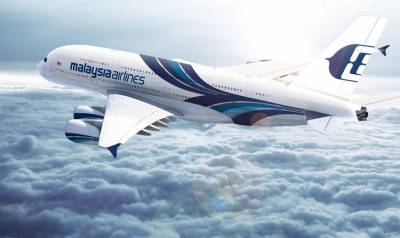
Is Malaysia Airlines serious about rebuilding its brand?


I’ve been looking forward to the new Malaysia Airlines (MAB) brand from both a professional and a personal perspective. Professionally, I’m eager to see what direction a global company with a huge reputation proposes for the carrier. Personally, I’m a big fan of Malaysia Airlines and have been for over 20 years. I also believe a national carrier is a critical component of any nation brand and building a nation brand is harder without a national carrier.

Right now, despite a new CEO and one presumes new management, the brand seems to be directionless. I think 3 launch dates for the new brand have come and gone and each time the date passes, there is a deafening silence from management.

Meanwhile corporate driven messages tell us the new brand focus will be on ‘making the customer experience change.’ In mid 2015 we were told that in December 2015 the airline “will begin installing new cabin seating and improving inflight entertainment, customer service and on time performance. New technology, lounge concepts and catering would be introduced and the uniforms may change.”

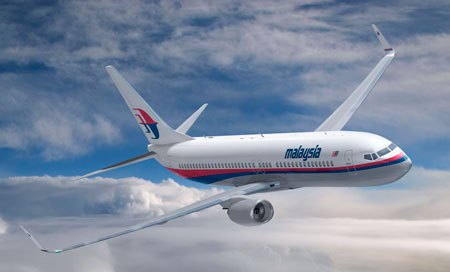
This is not the new cabin seating I was expecting

But I can’t find anyone who has witnessed the ‘new cabin seating and improved inflight entertainment.’ I hear complaints about the poor state of aircraft and have witnessed it myself. Delays are inevitable when launching a new brand but in a social world, these delays must be explained. There is nothing wrong with being normal.

Poorly thought out announcements are made regarding long haul flights that result in global condemnation and humiliating U turns but management remains silent. Days later, as if nothing happened, a press release is sent out about the new beginning at MAB and how the CEO will ‘boost product offerings and rebuild confidence in the carrier.’

What does ‘boost offerings’ mean? Does it mean make it cheaper? The lines between Low Cost Carrier (LCC) and Legacy Carrier have become blurred. The low cost carrier (LCC) model is familiar to just about everyone who travels. Basically you purchase the use of a seat on a (very cramped) plane and then pay through the nose for anything else such as luggage, food, drinks and even the location of the seat.

The alternative is Legacy carriers but I’m not really sure what they are. The term came out of the USA but today, seems to apply to any national airline not making money. With a legacy carrier or national airline, you pay one fee that covers everything including what should be a postive, even memorable experience.

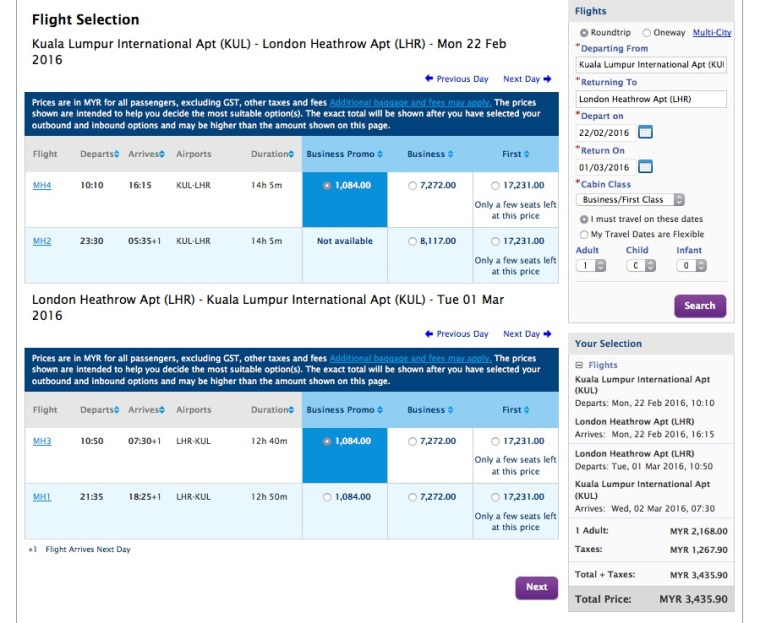
Nowadays, a lot of so called legacy carriers mimic the low cost carrier model. Many of them do it quite well, others not so well. Malaysia Airlines seems to bounce between the two. It recently offered business class seats to London at the ridiculously low return fare of RM3,400. However, just like LCCs the rate excluded GST (6%), taxes and fees and added a caveat that additional baggage and fees may apply. I didn’t check but I suspect this would have bought the figure to the same level as competitors.

MAB needs to focus on delivering on the promises it is making not slashing prices

This is a dangerous game because if Malaysia Airlines cannot compete on price with the Middle East carriers, it won’t be able to compete with LCCs like Air Asia. According to the Economist newspaper reporting on a KPMG study, “a legacy airline operating an Airbus A320 between London and Rome spends US$12,000 more on each round-trip than a low-cost airline.” Whilst the amounts may be different, the additional perceptage is no doubt the same in SE Asia.

Malaysia Airlines should focus more on improving its product than trying to discount its way through low seasons. Instead of trying to match the LCCs with their basic services and expensive add ons, Malaysia Airlines should seek to improve its relationships with its customers and offer a premium service rather than discounts, especially to its passengers at the front of the aircraft.

And it needs to start communicating with the public. Successful brands today are built on accessibility, transparency, collaboration, retention, personalisation and integrity. And consumers not companies determine the success of brands. Corporate driven press releases are not as effective as positive comments shared across social media. Malaysia Airlines needs to get its head around this.

And it must do it now because Air Asia, once the poster boy of LCCs is struggling to stay relevant and is looking to innovate. If it looks to Europe or Australia for inspiration, it will see the likes of Easy Jet and Virgin Australia morphing into legacy carriers. According to the Economist, this may leave legacy airlines “in a perilous state, regardless of their location and size.”

And before anyone says Malaysia Airlines is a private entity and doesn’t need to explain anything to anyone. Just remember that this is the 21st century not the 20th century. Consumers are smarter and acquire knowledge not from brands but from those who use them. And besides, Malaysians have invested billions in the carrier and they have a right to know what is happening and why deadlines are not being met.

If Malaysia Airlines is serious about its brand, someone needs to take charge of the communications and take charge now because I for one, don’t want to see this once great airline continue to make these elementary mistakes. Otherwise the only thing serious about the rebrand will be its inneffectiveness.

100 brilliant ads but are they relevant?


The print industry is changing rapidly. Publications are increasingly niche or evolving around new industries such as airbnb. The hospitality company with the largest inventory of beds but doesn’t own a single hotel launched Pineapple last year. It doesn’t aim to market the brand but instead inspire people to travel and of course hopefully use the company.

not selling airbnb but travel

Another new ‘investment and Lifestyle journal’ from Singapore called Cache was created not by a publishing house as a way to generate revenue but by a conglomerate with multiple interests in the luxury and related sectors.

Cache Singapore aims to grow the parent company's database of contacts.
Cache Singapore aims to grow the parent company’s database of contacts.

Although advertising revenue will help to fund the project, the main aim is to generate contacts for much more lucrative deals. These and other new publications have a different take on the publishing industry.

They are not so much worried about readership, rate cards and revenue, but more interested in reinforcing their brand values, enhancing their reputation, generating organic leads, building strategic relationships and adapting the online media platform model of being content sharers not creators.

So when I came across this interesting post called “100 brilliant print adverts” on the influential creativebloq site, I was intrigued because I thought it would be fascinating to see if the ads had a place in the new world order of publishing. Sadly, for me anyway they didn’t. Well certainly not the first 13 or so ads because after the VW ad I got bored.

Sure there was some creative genius in there as well as some comedy gold but there was also a lot of nonsense that just made me think I’d seen it all before. Traditionally, a good print ad must do six things

1) Be memorable and easy to recall

2) Connect with its audience

3) deliver useful information quickly

4) Make absorbtion of information simple

5) Don’t confuse the viewer or force them to have to do any hard work

6) Have an simple call to action

Is this a good ad?
Is this a good ad?

And historically a good print ad should include these elements

1) A strong headline

2) A unique or provocative image

3) No more than 3 paragraphs of well written copy

4) A logo and/or contact information

Is this a brilliant ad?

Advertising companies are ignoring these rules in an attempt to get our attention. But it is very hard to be creative after 150 years of advertising. And even if the creativity, the sexuality, the humour or the horror of an ad gets our attention, it doesn’t mean we’re going to interact with the brand.

Furthermore, consumers don’t engage with new brands the way they used to and besides, we are now carpet bombed by so many messages every minute of every day that most of us simply block out the noise.

Add the proliferation and fragmentation of media, the sheer number of ads, the ridiculous claims made in ads and the changing nature of how we absorb information and news means we don’t really need ads anymore.

Moreover, the concept of the ad that has to be conceptualised, created, approved, produced and distributed means it can take 6 – 12 months before a campaign sees the light of day and in that time, an idea can become obsolete.

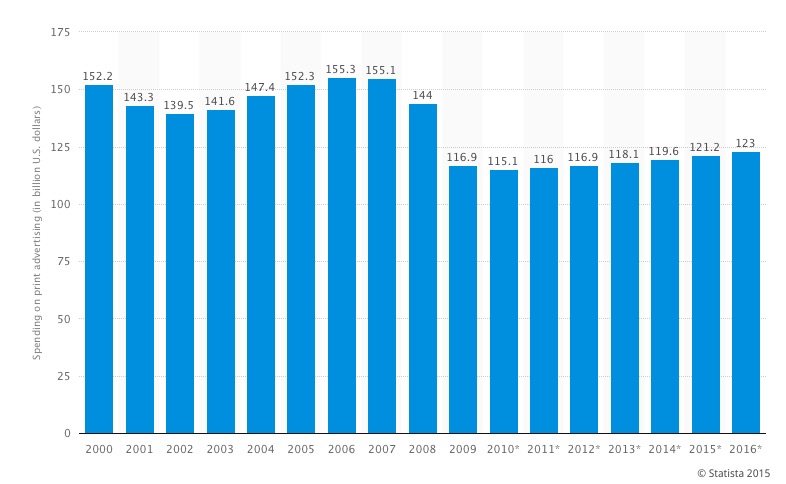
However, according to the graph from statista below, worldwide spend on print advertising has dropped from a high in 2000 of US$152.2 billion to US$119.6 billion in 2014. The same report suggests spend on print advertising will grow to US$123 billion in 2016. ad spend Admittedly that growth is maginally positive but I can’t help but think that turning up the noise isn’t going to change the fact that we’re not really paying attention to advertising anymore. I can’t help but think that in the new publishing world, we’re not interested in ads, we’re interested in what others like us have to say.

And in this environment, firms would be better off saving the money they spend on advertising and use the money saved to generate content about their business, build relationships with their customers and encourage those customers to share that content. The debate rages about whether print advertising is dying or already dead.

Personally I don’t think it’s dead but it is wounded and unless it reinvents itself, it may soon be irrelevant.

Can Christoph Mueller rebuild the MAS brand?


The May 2015 edition of Going Places, Malaysia Airlines in flight magazine features an introduction from Mr Christoph Mueller, the airline’s new CEO. In the short message Mr Mueller talks about the “overwhelming hospitality” he has received since arriving in Malaysia two months earlier. He explains that he would like all Malaysia Airlines’ passengers to experience the same overwhelming hospitality on board MAS flights.

MAS is not a bad airline

He goes on to talk about the “formidable culture” of Malaysia and expresses hope that MAS will leave visitors with a “wonderful experience from the heart of Asia”. He tells us he is ‘excited’ for Malaysia Airlines despite the difficult and challenging task he and his staff face in turning the carrier around and making it profitable again.

He explains that the turnaround begins with people like ‘me’ (the reader) who he calls guests. The airline will be listening carefully to the feedback from guests. Mr Mueller goes on to say that the “the key is to design products and services to create a guest experience that you will find truly valuable.” I’m not sure what the key refers to to but I presume it is to rebuilding the airline.

'Truly valuable products and services'
‘Truly valuable products and services’

Mr Mueller is certainly right that the turnaround of MAS begins with the airline’s guests and in particular the frequent flyers who have supported the airline over the last 20 years. No doubt retention of guests will be at the heart of the rebranding brief sent out a few weeks ago and the RFPs for which are due at the end of this week. But he needs to steer away from a ‘one-size-fits-all’ approach to his guests because they all have very different needs and requirements for value.

As for ‘designing products and services’ that guests will find ‘truly valuable’, Mr Mueller is making the right noises although I would have liked to have seen a more specific set of ideas delivered confidently and dynamically in his first public communication to the country and those many supporters of Malaysia Airlines. For instance, an overview of what he has in mind would have given people something to start talking about and sharing on social media, generating a wave of interest, enthusiasm, anticipation and positivity. And what exactly does ‘truly valuable’ mean?

MAS is not a bad product and it’s certainly not broken. Far from it, the product and services are OK. But the trouble is, to be competitive in today’s aviation business, or for that matter any other business being OK simply isn’t enough. To be successful in the aviation business, you need to be exceptional.

On a business trip to London earlier this month, I met up with a group of Malaysians who were all long-term MAS passengers, all with Silver or Gold Enrich (The MAS frequent flyer programme) cards. But this time they had flown in on Emirates and were raving about the quality of the business class experience, the outstanding service from the crew of 13 different nationalities and their professionalism, the efficiency of the airline, the seamless integration between the business class lounge in Dubai and the A380.

But what surprised me most of all was how they waxed lyrical about the communication between the crew and the passengers. Each crew member seemed to know each passenger’s name and used it in every communication, no matter how trivial. And the crew seemed genuinely interested in each passenger. Not in an irritating, intrusive way but in a professional client/customer way.

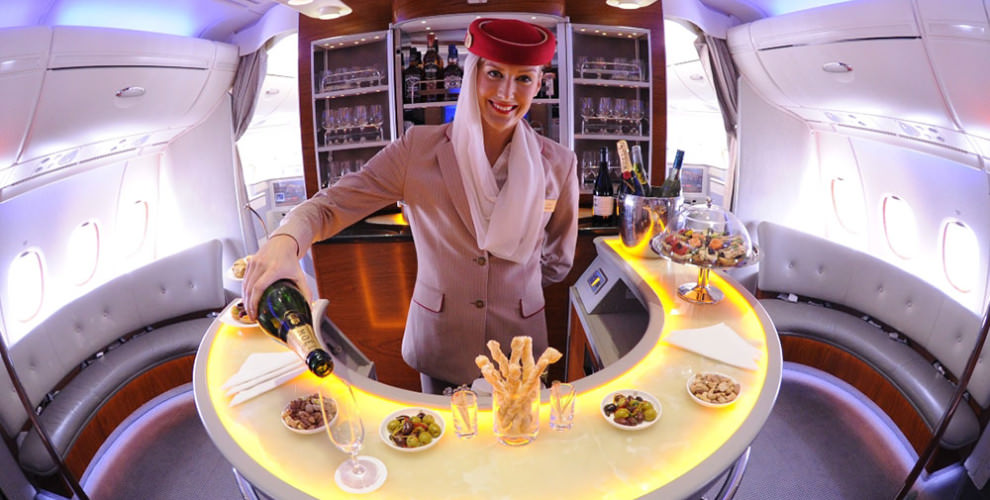
Emirates, the benchmark for MAS

The meal service was akin to something normally reserved for a 5 star restaurant and was designed around the individual passengers needs on that flight. Meals were served individually, by hand and not from a trolley. Two of the travellers sat next to each other. Both were asked if they would like to sleep first and have their meal later or eat first and then sleep. They felt the crew were doing everything possible to make their trip truly memorable.

The service wasn’t rushed and they all thought the announcements over the PA were delivered in a confident, calming and professional way. And when the Captain (not the chief steward) announced clearly and confidently that seat belts needed to be put on while the aircraft experienced some ‘choppy’ weather, they all felt instantly at ease. MAS does many of the things Emirates does (I believe having flown Emirates, MAS and Etihad business class to the UK in the last 5 months that Emirates is the benchmark) and many of the things it doesn’t do can be done.

The question is, will MAS be able to do them exceptionally? Will Mr Mueller be able to find enough good middle managers with the skills and commitment to motivate MAS staff to deliver an outstanding experience time and time again? Will branding investments focus on getting the organisation ‘on brand’ before launching very expensive and imminently forgettable advertising campaigns that over promise and force the airline to under deliver?

Making experiences outstanding will be key to winning back lost customers and attracting new business and not glossy advertising campaigns, a new logo or new uniforms. We all want Mr Mueller to turn the airline around and with the support of the government giving him the authority to let go of 6,000 staff and low oil prices driving down the price of aviation fuel his chances are good. But judging by where MAS is at the moment and the ability of competitors to keep raising the bar, Mr Mueller is really up against it.

Is it right for Malaysia Airlines to be selling insurance?


I’ve written a lot on this blog about the Malaysia Airlines (MAS) brand and much of what I have written has been negative and I’ve come in for a fair amount of criticism as a result of those posts.

But my intentions are honourable and I do know that a lot of people in MAS read my blog and take my comments in the way that they are written, as feedback not criticism.

They don’t seem to take any notice of the feedback but at least they are reading my comments. I’m publishing this post to see if I can get an explanation for the email I received from the airline recently.

There’s no need for a recap on the MAS situation except to say that earlier this week a story broke in Australia suggesting the Malaysian government lied about MH370 and later today there will be a high level meeting between Malaysia, Australia and China the three countries leading the search for MH370. Speculation is rife that the search will be called off. If this is the case, the media will be full of stories about MH370 and the downing of MH17. Probably not the ideal time for Malaysia Airlines to be trying to sell insurance.

Does MAS send the right message by selling insurance?

Yet earlier this week I received an email from MAS encouraging me to buy insurance for my upcoming flight to Tokyo. My reaction was one of surprise. My initial thoughts were that it didn’t make sense for the carrier to be trying to sell insurance so soon after the tragic events of last year and just before a major announcement that could see acres of negative newsprint around the world. It also made me even more nervous about flying MAS.

Professionally, I couldn’t help but think that this was an ad hoc tactical effort that wasn’t part of a well thought out and planned out strategy. If I’m right it would suggest the marketing and communications departments at MAS continue to churn out poorly conceived tactical initiatives and are yet to develop a sustainable brand strategy.

I think the airline would be better off trying to rebuild it’s reputation with me and all the other people that have continuously supported the airline through the dark days of 2014 and 2015. But I could be wrong, maybe this is the right time for the airline to be selling insurance, what do you think?

Customer loyalty builds brands


One of my favourite branding blogs is truly deeply from Australia and I recommend it to anyone even if you are not based in Australia.

This morning the author David Ansett Tweeted a link to a post from last year called customer loyalty, the holy grail for brands. It’s a short, thought provoking post.

We want to be part of all the brands we live with

It never ceases to amaze me that despite all the stats pointing to investment in retention and loyalty are key to building a profitable brand, most brand owners invest the majority of their marketing dollars in acquisition tactics that belong to a world that no longer exists.

The belief that advertising can build a brand in the social economy is laughable yet where do brand owners go when they want to build a brand? The nearest advertising agency. it’s ludicrous because if all you have is a hammer, everything looks like a nail. Advertising agencies only have advertising so all roads lead back to advertising and the problem with advertising is that NO ONE IS PAYING ATTENTION.

And this is where I disagree with David’s comment that “It is increasingly difficult to build long term relationships with hard won clients and customers”. I disagree because it has never been easier!

We know where everyone is, physically and digitally, we have their names, their addresses, both digital and physical, we know what they like, what they dislike, we know who their friends are, who they like, who they don’t like, who influences them, we know what winds them up and most important of all, we know that they want us to be part of their lives.

Yet most brands ignore building loyalty or give it a cursory nod in the form of generic, meaningless loyalty programmes that often provide ‘deals’ that are worse than what the customer can get himself.

Good customer service builds brands
Good customer service builds loyalty

Firms prefer instead to focus on acquisition and then, when there is a problem and brands fail to address the issue or worse, ignore the customer completely or address it in an amateurish, arrogant manner, brands wonder why those customers leave and angrily share their frustration across social media.

It has never been easier to build long term relationships with our clients and customers to improve loyalty, it’s just that most brands are going about it the wrong way.

The Interview. Is this the best marketing campaign of the year?


For industries that have an ever changing portfolio of ‘new products’ that have to be packaged from scratch and sold to as many people as possible and as quickly as possible, a mass media approach is still relevant. The music industry is one such industry and the film business is another.

But it’s not a cheap way to build a brand, whether that brand is a boy band or a movie.

Sony Pictures recently announced that it would not be releasing The Interview (the home page for the movie has been deleted) following potential threats of violence to theatres showing the movie. I’m not going to go into that story but you can read about it here.

Strangely the movie was due to be released on Christmas Day in the USA but not till February in the UK (It was not going to be released in Malaysia or anywhere else in Asia). This sort of release schedule is not unusual but rarely happens these days because studios prefer global same day release patterns in an attempt to combat piracy.

I have a nagging suspicion that Sony was struggling to generate interest in the movie and were looking to gain some traction with the hacking issue. The film is rumoured to have cost US$44 million (RM141 million), not a lot by today’s standards but throw in another US$50 million to gain some marketing traction and you’ve suddenly got a lot of money to recoup.

Early reviews of the film are lukewarm at best. Screenrant.com said it “played more like a sketch show or sitcom rather than a theatrical film.” And with a US$44 million production budget, plus marketing and other costs, I reckon the movie would need to generate over US$100 million just to break even.

Sony is reported to have been reluctant to make the film in the first place and so could be using the hacking scandal to do what it has wanted to do all along, bin the film. But that could end up costing the studio as much as US$200 million according to Bloomberg news.

I think Sony had a problem generating interest in the film and decided to use the hacking controversy as an opportunity to gain some awareness traction. I’m sure Sony understands the importance of generating an integrated buzz about movies across social media and traditional media and then nurturing that buzz.

If Sony understands better than most that the best thing they could do was to lay the foundations for a narrative by cancelling the release of the film and then let it grow organically across all media and let the traditional media, many of them competitors or linked to competitors do the story telling then my theory could be right.

Sure it’s a dangerous game and the interest in the story has been extraordinary but if they thought the movie was going to tank anyway, and they wanted to deflect attention away from the incompetence and ignorance of personnel as well as the remarkable security gaps then it may actually be a stroke of genius.

I have a nagging suspicion Sony will ‘relent’ and show the movie after all. If they do, it could become the marketing success of 2014.

I hate Thailand


Tourism accounts for about 10% of the Thai economy, employs hundreds of thousands of people and generates as much as US$65 billion in foreign currency.

But the ongoing political crisis that saw the military junta’s National Council for Peace and Order (NCPO) take power and the brutal murder of two British tourists in Phuket has seen arrival figures plummet.

According to Reuters tourist arrivals dropped 10.3% in the first 9 months of this year and 2014 will see negative arrival growth for the first time in years. The authorities have moved fast to stem the hemorrhaging with a crackdown on widespread crime, corruption and inflated costs encountered buy all but the most savvy visitors to the country.

In Phuket many of the illegal buildings, sunbed conmen, intimidating food and drink vendors, dubious boat operators and unscrupulous taxi operators have been yanked off the beach and a certain calm has returned.

Initial attempts to get tourists to come back included ramping up mass advertising and a travel insurance scheme that provided visitors who couldn’t get insurance because the country was under martial law, with insurance.

Unsurprisingly these didn’t have much of an impact. The Tourism Authority of Thailand (TAT) changed tack and came up with what it calls “A romantic comedy short film.” TAT initially released the video as consumer generated media but soon found itself having to explain the film was actually an advertisement for Thailand even though TAT wanted to create an ‘unbranded’ advertisement because ‘they receive more interest than conventional commercials.’

The spot is a counter intuitive attempt to show a more hospitable Thailand by featuring a young British tourist who has had his bag stolen and does the British thing of ranting at everyone as a result and finally declaring “I hate this place. I hate Thailand.”

Then he meets a beautiful Thai girl and a bunch of other people who rally round and help him. Sure enough, after some beautiful sunsets, scenes with kids and wonderful encounters his bag is returned with his passport and money still inside.

Counter intuitive differentiation is a brave model to use to sell a destination. But it’s also a model from a different era. An era when brands controlled the message and pushed it out across billboards, full page ads with tear offs in the corner and press releases. An era when consumers took those ads at face value and believed what brands told them. An era without the Internet.

The video is a fun piece that has received 1,500,000 views in 10 days with 21,000 Likes on YouTube. But here’s the rub. TAT should have been upfront about the video. As it is, they have given the impression it is consumer generated and that is wrong.

The video has also received more than 1,625 comments and the majority of them are not very complimentary. In fact some of them are downright hostile, talking about robberies, threats of violence, policemen that don’t speak English whilst others say the video is a scam and wrong.

One Thai commented, “Its too good to be true. No one would come by and give you a drink like that and Thai people wouldn’t give you sleepover at their house, especially in the tourist area.”

Another focused more on the deception, “How you will discover the truth by watching a fake video where the first words are already a lie. His name is not James. His name is Oliver Smith and he got paid by TAT to make this video. Look around yourself and consider how many real friends are left if you are out of money. This is not a Thai related issue it is everywhere around the world the same story. No money no honey. Same same but different. I love Thailand but I definately hate liars. And using lies to portrait (sic) a countries (sic) image is a mistake and an insult to all the honest Thai citizens. If they just made a short statement at the end of this clip that this is a TAT promotional video I would give my congratulations for that nice pink tinted heart moving clip.”

TAT is going to have to work harder than creating a video and passing it off as genuine consumer generated media to restore faith in the country.

It’ll need to work out a strategy and communicate that strategy effectively with multiple proof points. And if it wants to use social media and create influencers it needs to do it properly. There are no shortcuts in branding.

10 things to do to save the Malaysia Airlines brand


If Malaysia Airlines (MAS) makes it to 2015 and beyond, 2014 will probably be remembered as an annus horribilis for the beleaguered brand. In fact it may go down as an annus horibilis for the Malaysia Nation brand but we’ll discuss that another day.


MAS weren't ready for the ferocity of the global media
MAS weren’t ready for the ferocity of the global media

Certainly the first half of 2014 has been desperate for MAS with missed revenue targets, ineffecitve advertising campaigns universally mocked by the industry, reports of alleged sabotage, police investigations, negative press about the customer experience and of course the tragic circumstances surrounding MH370 and the subsequent weak handling of the global media by the airline.

The once mighty airline, an early poster boy for national carriers is struggling on a number of fronts with two big questions 1) Can MAS survive and 2) should it be allowed to fail? being asked in coffee shops, boardrooms and even in schools.

Mass media advertising does not build brands. THe sooner MAS understands this, the better

The answer to 1) is yes, and to 2) is no.

But to survive, someone is going to have to get very, very tough because MAS is in a mess. Since 2007, MAS has made 3 cash calls to the tune of RM7 billion (US$2.1 billion) and over the last 3 years has accumulated losses of RM4.1 billion (US$1.2 billion). Whatever they are doing isn’t working.

Morale is low, bookings are down especially from normally busy and profitable routes to and from China, the unions are throwing their weight around even though the airline is terribly over staffed – you only need to go to KLIA to see so many staff sitting around doing nothing and I heard one story recently of a new person who arrived to find someone asleep (with a pillow) at his desk.

Just to get an idea of the situation, Singapore airlines (SIA) has a fleet of 104 aircraft (MAS 107), flies to 62 destinations (MAS 61), has revenue of RM36 billion (MAS RM58 billion) and is staffed by 14,000 people (MAS 20,000) and yet in 2012 made RM1.150 billion ( during the same period MAS lost RM400 million).

SIA is flying to the same amount of destinations, operating the same amount of aircraft and using at least 6,000 less employees to do it. It turns over only about 60% of what MAS turns over yet makes an impressive profit.

Or is it this?
What is the MAS brand identity? Is it this?
Os is this the MAS brand identity?

MAS needs a new strategy but cutting costs is not the way forward. In the interests of nation building and to ensure morale and belief in Malaysia doesn’t plummet further and to turn MAS around quickly, the firm needs to carry out a number of key initiatives immediately starting with

1) All suppliers have to accept that their existing agreements must be cancelled and be given the opportunity to submit new proposals that are acceptable to the airline. If they cannot agree terms, new tenders must be issued.
2) Moving forward, all procurement activities must be done transparently.
3) The unions have to understand that 5,000 staff must go. The government must underwrite any redundancy packages for 12 months to encourage staff to leave and reskill these staff to ensure they find work immediately.
4) Training of staff, especially front line staff has to be ramped up because these people are key to the success of the brand and at the moment their customer engagement skills are simply not good enough. But training providers must be recruited transparently.
5) MAS must review it’s sales policies, processes and systems. Right now they are not leveraging effectively on key opportunities such as the Enrich database.
6) MAS marketing and advertising is stuck in a time warp of mass media mediocrity. It needs to stop wasting huge amounts of money (I was told RM400 million in 2013) on irrelevant advertising campaigns and review it’s marketing approach now.

You can't build a brand using mass media so stop trying to do so
You can’t build a brand using mass media so stop trying to do so

7) MAS must understand that customers build brands not advertising departments. The new strategy must focus on the customer and delivering economic, experiential and emotional value to its customer segments and on their terms.
8) MAS appears to have 3 brand identities at the moment. It’s a mess and needs to be revamped quickly and there has never been a better time to do it as the MAS brand identity is tired and old and associated with MH370.
9) Successful airline brands today are innovative, creative, nimble and move fast. I remember being in discussions about updating the uniform in 2003. 11 years later it is essentially the same.
10) Years ago MAS aggressively marketed it’s Enrich programme and encouraged anyone to sign up. But the programme is antiquated and a mess. Children get offers to sign up for credit cards, there is limited segmentation and personalisation and opportunities to reward and leverage brand loyalists and identify and nurture influencers are missed.

Used properly, the MAS FFP is a potential revenue gold mine

There is an obsession at the moment that cutting costs is the way to make MAS profitable. It is the wrong approach. However by understanding the importance of branding and spending money on the right brand strategy and integrating that brand strategy with the corporate restructuring plan, significant savings can be made and crucially, those savings (obviously) save the company money but will also generate more income by negating the competition, increasing share of wallet and allowing MAS to increase not decrease ticket prices.