I love this ad. It reminds me of my two girls and my boy when they were growing up. The only thing missing is the wife who seems to disappear once the child is born. Fortunately that doesn’t happen in real life. Well hopefully not too often.
It’s got a great soundtrack too but you know what, it’ll be gone in a few months. Lost in the noise of traditional, mass media, one size fits all (what about the vegetarian dads), corporate driven messages that go on in the background when the commercials come on and consumers start texting/swiping/chatting etc
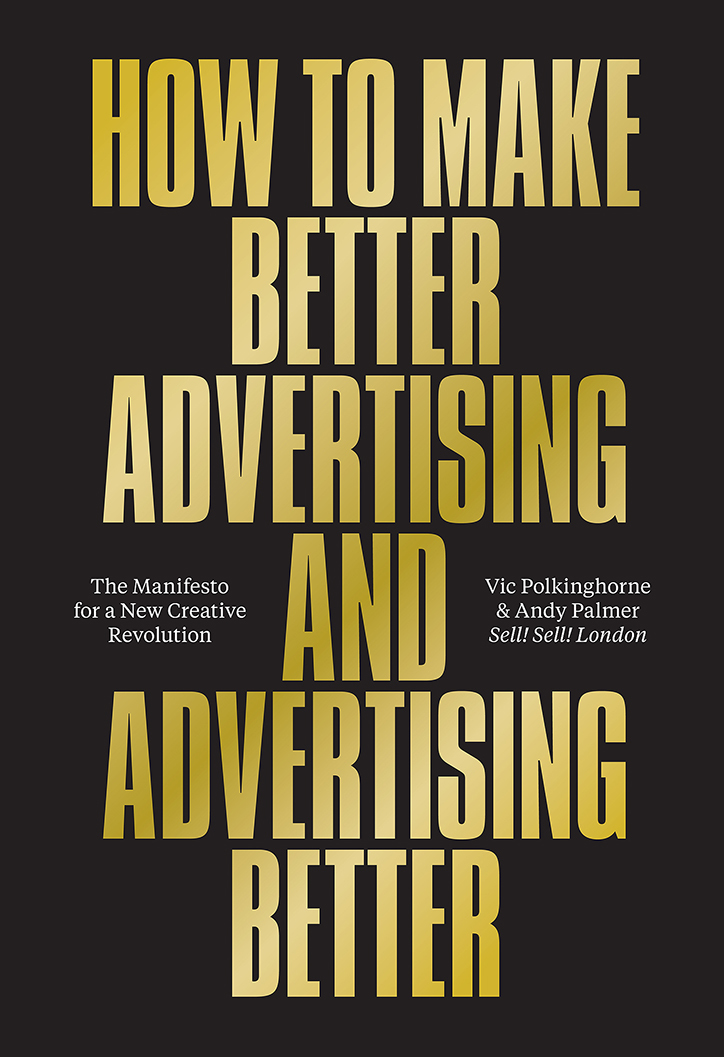
There’s a small creative agency in London called Sell! Sell! The agency is run by Vic Polkinghorne and Andy Palmer and they’ve co-written a potentially interesting new book called ‘How to make better advertising and advertising better‘. This new book shouldn’t be confused with the equally new book ‘Stop Advertising, Start Branding‘ which was written by me.
But I think there will be some similarities between both books because neither of us are happy with the state of advertising today. Here’s a quote from the Sell! Sell! website. “And the poor old punter is left faced with advertising that is at best forgettable, and at worst insulting to the intelligence. Surely there’s a better way?”
Now what we think that better way is may be different. So I’ve ordered a copy and will let you know whether it is and what I think of the book. In the meantime, I have read some interesting reviews online and you can read one of them at the creative review website that is already generating some fascinating comments.
Make it better or bin it
The book has also garnered some interesting testimonials including “This book is full of common sense. Which is rare, so it’s actually full of uncommon sense.” Dave Trott.
And this one from Bob Hoffman “The ad industry is in an unprecedented state of confusion. While the assertions and pomposity grow majestically, the advertising itself diminishes rapidly. Sadly there is no button we can push that will erase all the arrogance and self-delusion. Fortunately we have this book. It might be just the reset button we all need.”
Attached is a press release for Stop Advertising, Start Branding. This is a book about change. Yep, another one. The difference is, this one is about changing back to what you and everyone else used to do. It’s about laying the foundations before building the house. It’s about researching the destination before getting on the plane.
Stop Advertising, Start Branding on sale now
That’s right, it’s about getting the fundamentals in place before coming up with the creative, the quirky, the clever, the funny, the whatever. Far too many brands try to compete in their markets today without doing the right research. Without even communicating to their staff what they are trying to say. At other times they don’t even know if they can deliver on the promises made. That’s mad and why so much advertising doesn’t work.
Stop Advertising, Start Branding is a book that doesn’t have a title with an animal name in it. It won’t win a creative award for the cover even though it looks great. It’s normal, it’s a bit thicker than many branding or marketing books today but that’s because the information you need to build a brand takes up this much space. Sorry.
But if you read it I’m confident it will make you stop advertising and start branding. Which means it’ll save you a lot of money because let’s face it, most advertising doesn’t make much of an impression on anyone.
And you can use the money you save to build a brand your people buy into and want to work for. And once they do that they’ll be able to deliver on the promises you make. And when they do that, your customers will come back to you time and time again and they’ll tell others how great you and your product are. And when that happens you’ll make a lot of money.
OK, it’s not that easy but that’s why the book is 300 pages and that’s why I wrote it. If you want to find out how to build a brand without wasting massive amounts of money on advertising, I suggest you get a copy from your local Kinokuniya, MPH or Times bookstore in Malaysia and Singapore or from Amazon in the UK. And if they don’t have it, make sure you complain and order it or call us at +603 7054 2075 and we’ll sort something out right away.
Place branding is a generic term for all the elements of a nation or country brand, cities, states and regions and even destinations within those areas. In South East Asia alone there are more than 600,000 destinations competing for investment, talent and tourists. In an effort to match their destinations to stakeholder requirements for value, smart places are developing brands that investors, talent and tourists embrace.
Our company Fusionbrand is working on a brand for one state government in Malaysia and in the past have worked with other state governments, tourism boards, enterprise zones and the Malaysia Tourism Board. It’s always a privilege when we win a destination or place branding project because such projects have a major impact on society.
Many nation brands are victims of the politician’s need for quick wins
The Place Brand Observer heard about our work and got in touch with me in February and suggested an interview. The Place Brand Observer is a fantastic resource for anyone responsible for branding nations, cities, states and regions, public diplomacy and reputation management.
The site features insights into the industry, interviews with experts in destination branding from around the world as well as tutorials and case studies of successful branding of countries, regions, cities and destinations. It’s a meeting place for the brains and the brawn of the place branding industry. If you are involved in place branding or simply want to know more about the industry, I strongly recommend you sign up for their excellent news feeds.
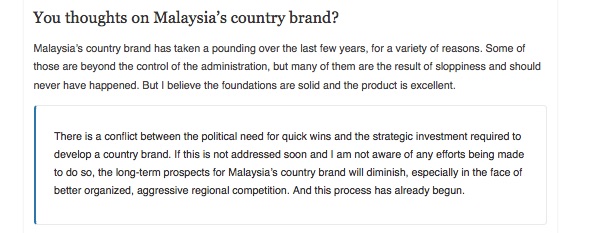
You can read the full interview here . I thought it was a really good interview and we discussed data driven branding, country brands, Malaysia airlines and the link between the legacy carrier and the country. I hope you find the time to comment, good or bad!
Malaysia’s January automotive sales nose dived 12% to 44,591 units although this was expected after the record highs of December 2015. Japanese firms were hardest hit with Toyota sales down 27%, followed by Nissan 22% and Honda down 12%.
It’ll take more than a new logo and a dubious tagline to stop Proton’s slide
Proton continued its slide with sales down 13%. And even though Perodua sold less cars this Janaury than it did in 2015, the relative newcomer to the industry saw its market share increase to 35% giving it more than double Proton’s market share. In an effort to stem the bleeding, Proton has created a new logo and tagline but Perodua is undeniably Malaysia’s number one automotive company.
Mercedes Benz sales went through the roof with a year on year increase of 139%. Mercedez Benz sold 1,027 units in January 2016, up from 430 in January 2015. Mercedes Benz was the only top 15 brand to sell more cars in January 2015 than it did in December 2015.
BMW and Audi probably spend more on traditional advertising than any of the other luxury brands and have been particularly active recently but neither brand was able to match the performance of Mercedes Benz. Audi sales were down over 40% in January over the previous month although they did manage a modest 9% gain over January 2015.
BMW fared better with a gain of 23% over January 2015 but compared to December 2015, sales were down 25%. This fall in sales would probably explain why BMW is now offering a longer warranty although anecdotal evidence suggests the BMW brand is losing its lustre in the local market.
But of most interest to me was the performance of Mazda. Mazda has come from nowhere to take 3% of the market share in Malaysia, up from 1% five years ago. This is an extraordinary feat because Mazda spends very little on advertising. Which is probably just as well because the advertising they do revolves around the words ‘ZOOM ZOOM’ and poorly written copy.
Seriously, what is this ad saying?
For instance ‘A new era of driving experience’ doesn’t make sense. The copy begins, ‘New levels of freedom, new levels of versatility. New levels of pure enjoyment on the road.’ Obviously the person who wrote that doesn’t drive on the roads of KL. Certainly not during the daily commute or on a wet Friday afternoon.
The copy also breaks the cardinal rule of not providing any solutions to problems but instead rambles on about nothing. I mean seriously, how can the CX-3 really be ‘designed and engineered to evoke emotions by closely matching human sensibilities?’ Get real. The copy is cold and doesn’t talk to anyone and ends with Zoom-Zoom is unique. It certainly is. I could go on but I’ll spare you the pain.
This is what I meant when I wrote my book Stop Advertising, Start Branding. It’s not that you should stop advertising, it’s that you should stop poor or weak advertising. Mazda is doing really well at the moment in Malaysia and globally. It has tripled its market share and could be on to something spectacular. But it needs to do more than churn out this sort of advertising because it is wasting money and it may have a negative effect on the brand. It needs to Stop Advertising, Start Branding.
I am yet to visit a Mazda showroom so can’t tell you about the experience. I will endeavour to do so and we’ll do some research and report back to you.
Back in July 2013 I wrote a post about how Proton must fast track its branding activities. You can read the full article here. Two years before that in 2011 I wrote about that the first rule of auto advertising was ‘to keep it real’. You can read that post here. More on this in my next post.
The first post quotes then Proton Edar CEO Hisham Othman as saying that the company, “Would pay greater attention to product quality and customer service.”
Fast forward to March 2016 and Proton Chief Executive Officer Datuk Abdul Harith Abdullah is promising, “new product introduction, network rationalisation, the introduction of new dealers and upgrading of services at our centres.”
Proton is in big trouble. Its market share has dropped from close to 80% to 17% in little more than 20 years. Proton service centres rarely deliver on promises made and many consider the cars to be inferior to the competition and over priced.
In other words, the brand and its reputation is in tatters. Abdul Harith has acknowledged the problem and has vowed to “reform and rebrand.”
What we don’t know at this stage is what Abdul Harith and his team consider to be a rebrand. Certainly some of the noises coming out of the firm are good.
For instance he stated at the weekend, “We have an audit team going out there to make sure that key performance indicators are met.” That’s a good start. The service centres and their ability to look after customers are key to this rescue mission. On this matter he said, “To address the poor quality of our customer services at after-sales operations, key improvement initiatives will include network rationalisation, the introduction of new dealers and upgrading of service at our centres.” Owning up to the faulty hose deception is another good start. As is getting rid of crap dealers, as long as they aren’t replaced with more crap dealers.
Meanwhile, Hong Leong Investment Bank wrote in a report that, “negative consumer perception on Proton’s quality has been a major blow to the national carmaker for many years.” The report adds, “various programs have also been introduced to improve (the) customer experience and provide more value-add services, such as courtesy car service, pick-up and delivery service, quick service money-back guarantee, mobile assist service and one-stop customer care line.” I know what you are thinking – this isn’t the first time Proton has gone through this process.
So can Proton survive? Provided the new Proton cars really are exceptional and meet target market requirements for value. If they are still poor and the team tasked with implementing the rebrand don’t know what constitutes the level of service consumers are looking for and they are able to train the service centre owners and staff to deliver meet those requirements for value at every touch point and every time, it has a fighting chance.
In other words, a rebrand is not the CEO standing up and repeating what his predecessor said 3 years ago. It’s not a change of logo or an advertising campaign. It’s a ‘fit for purpose’ product that is able to deliver on promises made. It’s a comprehensive overhaul of all the processess and systems involved in delivering the value the customer needs.
It’s the collection of data and having the knowledge to interpret and use that data. It’s the ability to deal with issues and crises in an open and transparent manner. It’s the ability to work with potential customers, assuage their fears with solutions that matter to them, and often only them. It’s about going the extra mile, time and time again and often in different ways.
It’s about communications that resonate. Not about a ‘big idea’ created by an advertising agency or the CEO. It’s about talking to customers in a language that they understand and will address their concerns.
It’s an ongoing relationship with the customer that turns them into fans and advocates. If all these are in place then Proton could achieve it’s target of 150,000 vehicle sales this year and start to reverse the decline in its market share.
This is the first in a series of articles where we will track Proton and see how it is doing.
There is a lot going on in the world of website design and development and it can be hard to keep up. As a result, some CEOs believe the only way to stand out is to give creative people free rein over the design of their website.
Now I’ve written about Lexus before and I mention them in my book (which incidentally you can buy from the Fusionbrand website) because they are spending a lot on marketing but don’t seem to appreciate the importance of the experience in the consideration process. Plus, every time I see a new billboard or print ad it seems to be telling me something different. There isn’t any consistency in their communications.
And then I saw a digital ad this morning and clicked on the link and came to this Lexus Asia website. In my opinion (and don’t forget all comments on this site are my opinion) this website is a serious contender for the worst website of 2016.
At least TRY to make your content real and believable
People today are time poor and impatient. They don’t want to sit around and wait for your complicated video to load (unless they are given an option to look at the video). And once they’ve watched the video they don’t want to have to burn up a lot of grey matter listening to a lot of nonsense and figuring out how to navigate around the site.
The Lexus Asia site looks good but is terribly complicated. It also looks different to the Malaysia site and uses a completely different approach to the Lexus Malaysia site which also has it’s own tagline.
Now following my terrible experiences with BMW, I’m actually in the market for a new SUV and I went to the site to arrange a test drive for the weekend but left angry and frustrated and without a test drive.
So if you designed the Lexus Asia website, here are 5 free tips that you might want to cut out and put on your wall.
1. Your website must be consistent and responsive. This means it must look the same on any screen and adapt to a users screen size to ensure a seamless experience. Your site isn’t the same on a smart phone, losing the consistency that is key to successful brand building.
2. Your website must be easy to navigate and have a clear, easy to follow layout. Get anywhere in three clicks or less is the general rule of thumb.
3. Flash is very last year and search engines don’t like them and some older browsers even block flash.
4. Your site should be free of clutter.
5. Make sure your video scripts make sense – “Luxury is stiff. It’s very lobster.” Seriously?
The Lexus site was overwhelming. Beautiful and creative perhaps, but it’s only there to get visitors in for a test drive, not to win an award. Oh wait, maybe that’s it!
Malaysia has joined Australia, Ireland, France and the UK by anouncing the introduction of plain packaging for tobacco products, however unlike the other countries who have announced a deadline of May 2016 for the new law to come into effect, Malaysia has not given an implementation date, saying only it will happen in stages.
Price increases and plain packaging have seen a big reduction in smoking in Australia, especially amongst teenagers so it is a logical step for Malaysia. Malaysia and other countries like Singapore have tried more traditional campaigns including shock and awe advertising but these have failed to have any long term impact on the number of smokers in the country.
Smoking statistics in Malaysia
In Malaysia, 25% of smokers are reported to start smoking before they are 10 years old. It’s not known how much smoking costs Malaysia but in Canada, a country with a lower average number of smokers but a similar sized population, smoking costs the Canadian government around RM10.5 billion in direct health care and another RM38 billion in lost productivity. Meanwhile revenue from taxes on cigarettes totaled around RM9 billion. Canada is a good benchmark for Malaysia because approximately 5.7 million Canadians smoke, about the same as Malaysia.
According to the Star Newspaper, Malaysia’s treasury generates RM3.28 billion from duty on cigarettes yet could be losing 3 times that in health care costs and 10 times that in lost productivity.
Since 1991, Malaysia has spent over RM100 million on advertising to try and reduce the number of smokers in the country and in 2003 introduced the ‘tak nak’ campaign which you can read about here which seemed to do little more than raise awareness of the dangers of smoking but did little to reduce the numbers of smokers in the country, 20,000 of whom die from related diseases every year.
According to the Guardian newspaper, global tobacco sales are more than RM2.2 trillion and generate more than RM140 billion in profits for the top six tobacco firms. That equates to a profit of RM4,000 PER SECOND of every day!
The implications for the tobacco brands are huge and they are likely to fight such steps. It’s a complicated issue but with 25% of Malaysian smokers – that’s over 1 million Malaysians – starting under the age of 10, plain packaging is a good start but it is a tactical initiative and it won’t solve the problem on its own so needs to be part of a strategic branding initiative from a strategic brand consultancy such as Fusionbrand.
This post from the poke on how to start a creative agency is actually very funny yet at the same time a sad reflection of the confusion around building brands.
Unfortunately, too many firms are under the impression you hire a creative agency to build a brand using creative driven tactics and in particular advertising, that are pushed out across media that few consumers pay any attention to. And even if the advertising is on digital platforms, it rarely understands how consumers live their lives, the environment they are advertising in and the needs of those consumers.
Too many CEOs are seduced by the creative industry
The ‘suits’ as they are called of the agency seem to have an almost hypnotic power over clients. And when they tell potential clients that the way to build a brand is with creative driven advertising that costs a lot of money they nod and write the cheque.
Then, when you ask the suits (if they haven’t moved on to another company) why the advertising didn’t work, they often blame the client and tell him that he shouldn’t have approved the initial campaign or the campaign was right but he didn’t spend enough money the first time around.
And the only way to solve the problem is do it all again and despite failing the first time, they are the team for the job. Sadly, most clients will agree and waste yet more money on a creative campaign that rarely helps build the brand.
Some advertising is very good but that doesn’t mean it works. The reality is that most advertising doesn’t work, especially with millennials who have seen their parents let down by so many products that failed to deliver on promises made through creative driven advertising. Instead they trust the opinions of their friends or others like them who share their space and their interests and have no ulterior motive but to help a friend or like minded soul.
Authentic Brand consultants understand this better than any creative agency. They know that to lay the foundations for your brand you must develop a customer centric organisation that looks at delivering economic, experiential and emotional value to customers at every touch point and every time.
Sometimes this involves advertising but more often than not, it requires nothing more than improvements to the delivery system. It’s not as cool as advertising but it is much more effective. And more often than not, it’s a lot cheaper and improvements are immediate.
For more information on the difference between a brand consultant and an advertising agency, please read this.
I’ve been looking forward to the new Malaysia Airlines (MAB) brand from both a professional and a personal perspective. Professionally, I’m eager to see what direction a global company with a huge reputation proposes for the carrier. Personally, I’m a big fan of Malaysia Airlines and have been for over 20 years. I also believe a national carrier is a critical component of any nation brand and building a nation brand is harder without a national carrier.
Right now, despite a new CEO and one presumes new management, the brand seems to be directionless. I think 3 launch dates for the new brand have come and gone and each time the date passes, there is a deafening silence from management.
Meanwhile corporate driven messages tell us the new brand focus will be on ‘making the customer experience change.’ In mid 2015 we were told that in December 2015 the airline “will begin installing new cabin seating and improving inflight entertainment, customer service and on time performance. New technology, lounge concepts and catering would be introduced and the uniforms may change.”
This is not the new cabin seating I was expecting
But I can’t find anyone who has witnessed the ‘new cabin seating and improved inflight entertainment.’ I hear complaints about the poor state of aircraft and have witnessed it myself. Delays are inevitable when launching a new brand but in a social world, these delays must be explained. There is nothing wrong with being normal.
Poorly thought out announcements are made regarding long haul flights that result in global condemnation and humiliating U turns but management remains silent. Days later, as if nothing happened, a press release is sent out about the new beginning at MAB and how the CEO will ‘boost product offerings and rebuild confidence in the carrier.’
What does ‘boost offerings’ mean? Does it mean make it cheaper? The lines between Low Cost Carrier (LCC) and Legacy Carrier have become blurred. The low cost carrier (LCC) model is familiar to just about everyone who travels. Basically you purchase the use of a seat on a (very cramped) plane and then pay through the nose for anything else such as luggage, food, drinks and even the location of the seat.
The alternative is Legacy carriers but I’m not really sure what they are. The term came out of the USA but today, seems to apply to any national airline not making money. With a legacy carrier or national airline, you pay one fee that covers everything including what should be a postive, even memorable experience.
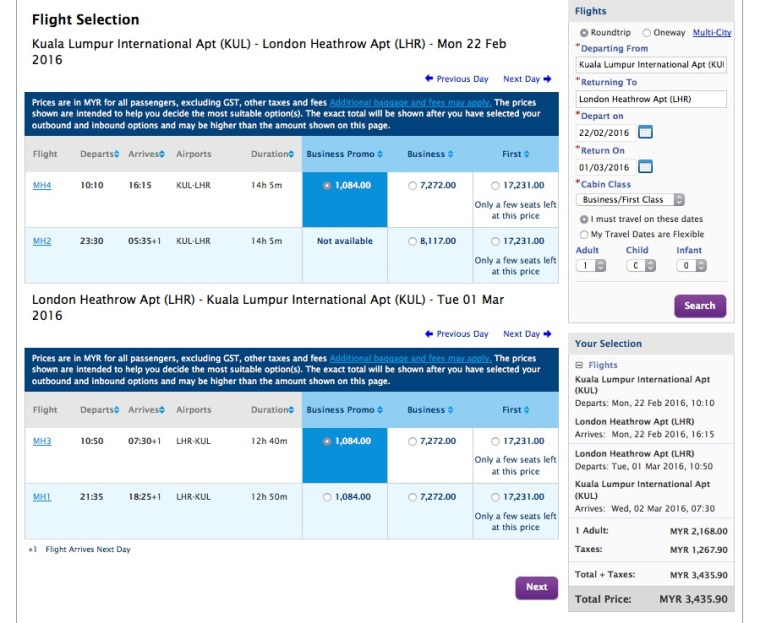
Nowadays, a lot of so called legacy carriers mimic the low cost carrier model. Many of them do it quite well, others not so well. Malaysia Airlines seems to bounce between the two. It recently offered business class seats to London at the ridiculously low return fare of RM3,400. However, just like LCCs the rate excluded GST (6%), taxes and fees and added a caveat that additional baggage and fees may apply. I didn’t check but I suspect this would have bought the figure to the same level as competitors.
MAB needs to focus on delivering on the promises it is making not slashing prices
This is a dangerous game because if Malaysia Airlines cannot compete on price with the Middle East carriers, it won’t be able to compete with LCCs like Air Asia. According to the Economist newspaper reporting on a KPMG study, “a legacy airline operating an Airbus A320 between London and Rome spends US$12,000 more on each round-trip than a low-cost airline.” Whilst the amounts may be different, the additional perceptage is no doubt the same in SE Asia.
Malaysia Airlines should focus more on improving its product than trying to discount its way through low seasons. Instead of trying to match the LCCs with their basic services and expensive add ons, Malaysia Airlines should seek to improve its relationships with its customers and offer a premium service rather than discounts, especially to its passengers at the front of the aircraft.
And it needs to start communicating with the public. Successful brands today are built on accessibility, transparency, collaboration, retention, personalisation and integrity. And consumers not companies determine the success of brands. Corporate driven press releases are not as effective as positive comments shared across social media. Malaysia Airlines needs to get its head around this.
And it must do it now because Air Asia, once the poster boy of LCCs is struggling to stay relevant and is looking to innovate. If it looks to Europe or Australia for inspiration, it will see the likes of Easy Jet and Virgin Australia morphing into legacy carriers. According to the Economist, this may leave legacy airlines “in a perilous state, regardless of their location and size.”
And before anyone says Malaysia Airlines is a private entity and doesn’t need to explain anything to anyone. Just remember that this is the 21st century not the 20th century. Consumers are smarter and acquire knowledge not from brands but from those who use them. And besides, Malaysians have invested billions in the carrier and they have a right to know what is happening and why deadlines are not being met.
If Malaysia Airlines is serious about its brand, someone needs to take charge of the communications and take charge now because I for one, don’t want to see this once great airline continue to make these elementary mistakes. Otherwise the only thing serious about the rebrand will be its inneffectiveness.



 brandconsultantasia.com